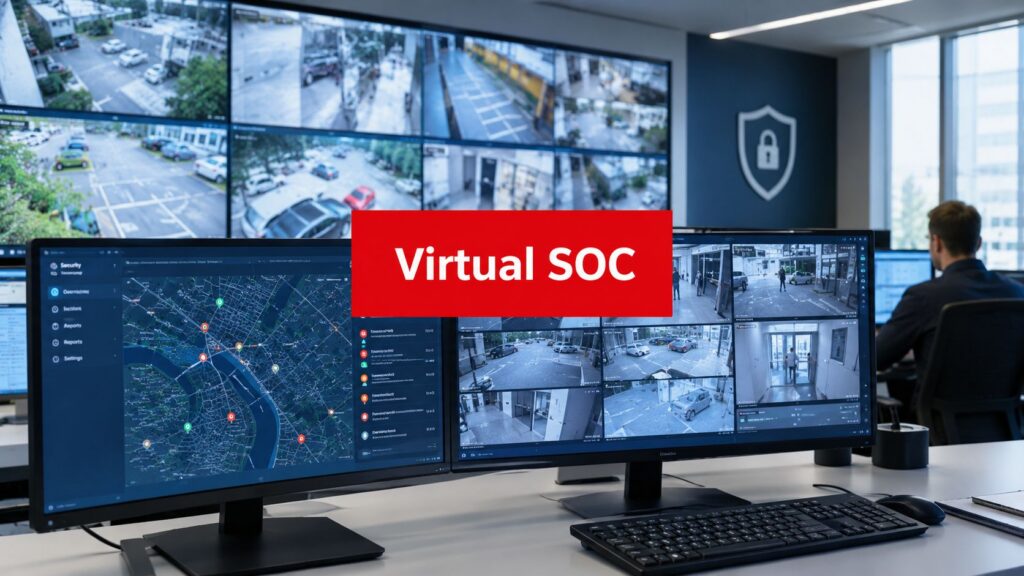
A camera records movement at a residential community after midnight. The onsite officer is patrolling the opposite side of the property, and no one is actively watching the feed. By the time a property manager reviews the footage, the opportunity to verify what happened and coordinate a response may have passed.
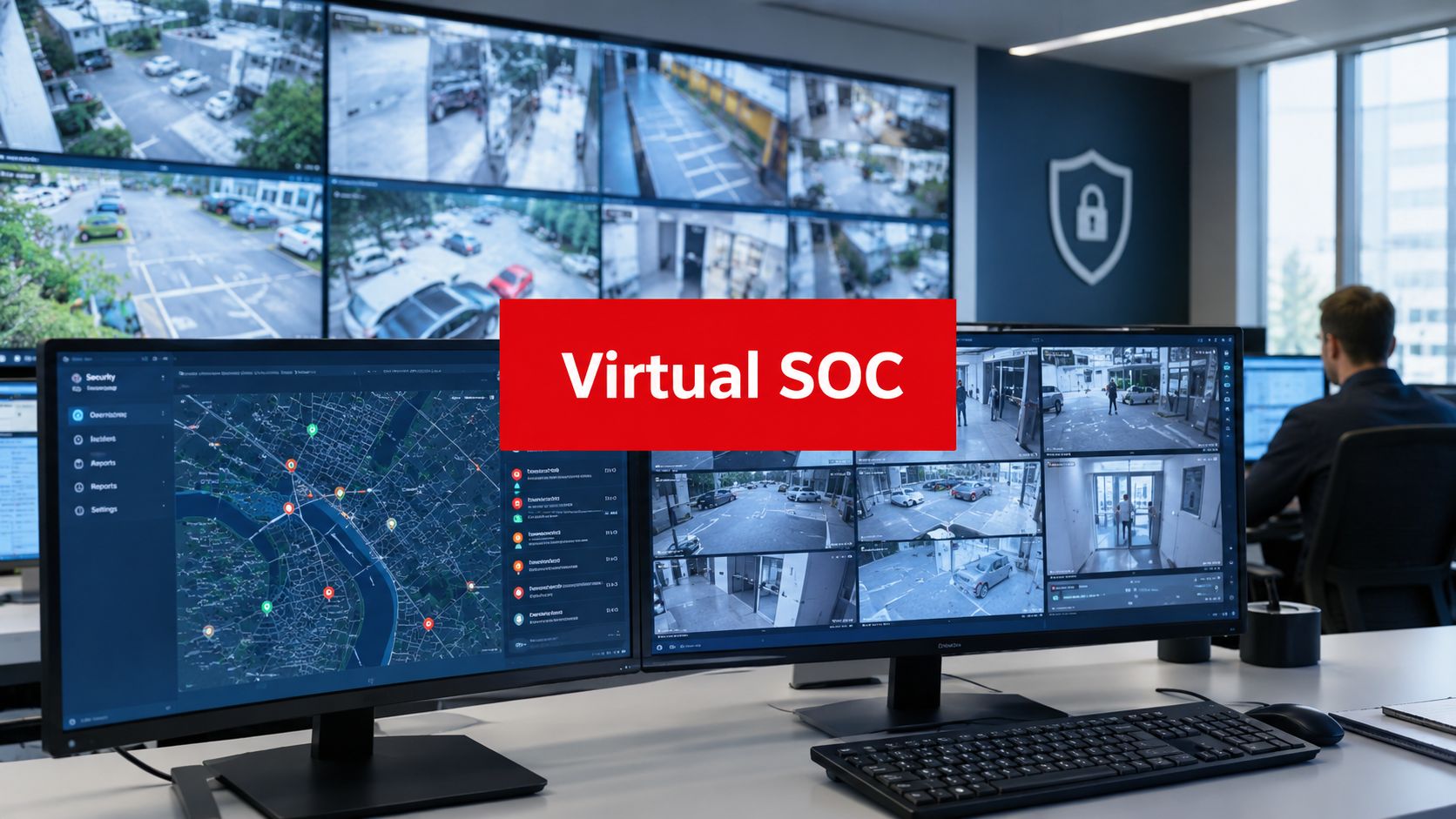
That gap between physical presence and active oversight is where a virtual security operations center, or vSOC, becomes useful. A vSOC combines remote monitoring, technology, trained operators, and defined escalation procedures so security events can be detected, assessed, documented, and sent to the right responder.
For property managers, the value isn't a room full of screens. It's a coordinated operating layer that connects cameras, access systems, mobile patrols, guard reports, and human judgment. The result is a more complete view of what is happening across a building, community, retail center, construction site, or multi-property portfolio.
The Evolution of Property Protection
Security operations centers began as centralized, round-the-clock monitoring functions in government and defense environments. After 2000, the model expanded into large enterprises and banks, and between 2007 and 2013, SOC responsibilities broadened beyond virus alerts and intrusions to include cloud monitoring and more advanced threats, establishing the operating model that virtual SOCs later delivered remotely (Security Operations Center evolution research).
Property protection followed a similar path. A guard at a gate, a patrol officer in a parking structure, and a camera system each perform a useful job, but they don't automatically create a connected response. A camera may capture an event without anyone seeing it live. A patrol officer may identify damage without knowing whether a related alarm occurred elsewhere on the property. A manager may receive separate reports that never become one incident record.
A vSOC closes those communication gaps. Remote operators can review incoming alerts, assess available video, contact onsite personnel, follow escalation instructions, and document the outcome. The onsite team remains important, but it gains a remote support function that can see beyond the officer's immediate location.
From passive recording to active oversight
Consider a mixed-use property with a retail area, residential entrances, a parking structure, and a service corridor. A motion alert near the loading area might come from a delivery worker, an animal, or someone entering outside approved hours. A passive system records the scene. An active vSOC begins verification.
The operator can compare the event with camera context, access activity, scheduled operations, and the property's response plan. If the event appears legitimate, the operator can notify a designated contact or dispatch a patrol according to the agreed procedure. If it doesn't require action, the event can be documented without sending an officer on an unnecessary trip.
This approach also helps managers evaluate related technology choices. For example, a property team comparing wireless access and guest-management platforms may find a practical resource in Purple WiFi vs Foxpass, especially when deciding how access data should fit into a broader monitoring workflow.
Practical rule: A camera network becomes more useful when someone has responsibility for reviewing meaningful events and following a documented response path.
The vSOC concept now applies well beyond cybersecurity departments. Commercial property managers, HOA boards, construction superintendents, and facilities directors can use the model to coordinate video verification, access awareness, mobile patrols, and incident communication. It doesn't eliminate the need for people onsite. It gives those people better information and stronger support when conditions change quickly.
Physical Command Centers vs Virtual Operations
A traditional security command center normally requires dedicated space, display systems, communications equipment, workstations, power, connectivity, and staff assigned to the facility. That arrangement can make sense for a large campus or specialized operation, but it can be difficult to justify for a mid-sized property, a construction site, or a portfolio of separate retail locations.
A virtual security operations center moves the monitoring function away from the property while keeping the response process connected to the site. The provider can deliver 24/7 monitoring, incident handling, and remediation recommendations without requiring a physical SOC on the premises, as described by Lumen's virtual SOC overview.
A practical comparison
| Operating model | Strength | Management consideration |
|---|---|---|
| Onsite command center | Immediate physical proximity and direct local control | Requires dedicated infrastructure, staffing, and ongoing facility support |
| Virtual operations | Centralized oversight across multiple locations | Depends on reliable integrations, connectivity, and clear escalation procedures |
| Hybrid model | Combines local officers with remote monitoring and coordination | Requires precise handoffs between the property team and remote operators |
The distinction isn't physical versus remote. It concerns where the organization places its monitoring capability and how it distributes responsibility. An onsite center may provide local context, while a virtual team can watch multiple properties and coordinate activity across a larger footprint.
For a construction company, a virtual model can connect cameras at several active sites to a remote team while mobile officers perform scheduled or random visits. For a multifamily operator, one monitoring function can support separate communities with consistent procedures. For a retail portfolio, remote oversight can provide a common escalation structure while local managers handle business-specific decisions.
A remote model also needs practical dispatch capability. Property managers evaluating providers should ask how operators communicate with officers, emergency contacts, law enforcement, maintenance personnel, and leadership. Resources describing rapid emergency dispatch can help clarify what coordinated response should look like, although the final procedure must be adapted to the property's contracts and local requirements.
Virtualization is valuable because it makes security oversight more adaptable. It doesn't make response automatic. The provider still needs trained operators, current contact lists, tested procedures, and a clear understanding of what requires verification, notification, dispatch, or documentation.
How AI Verification Reduces False Alarms
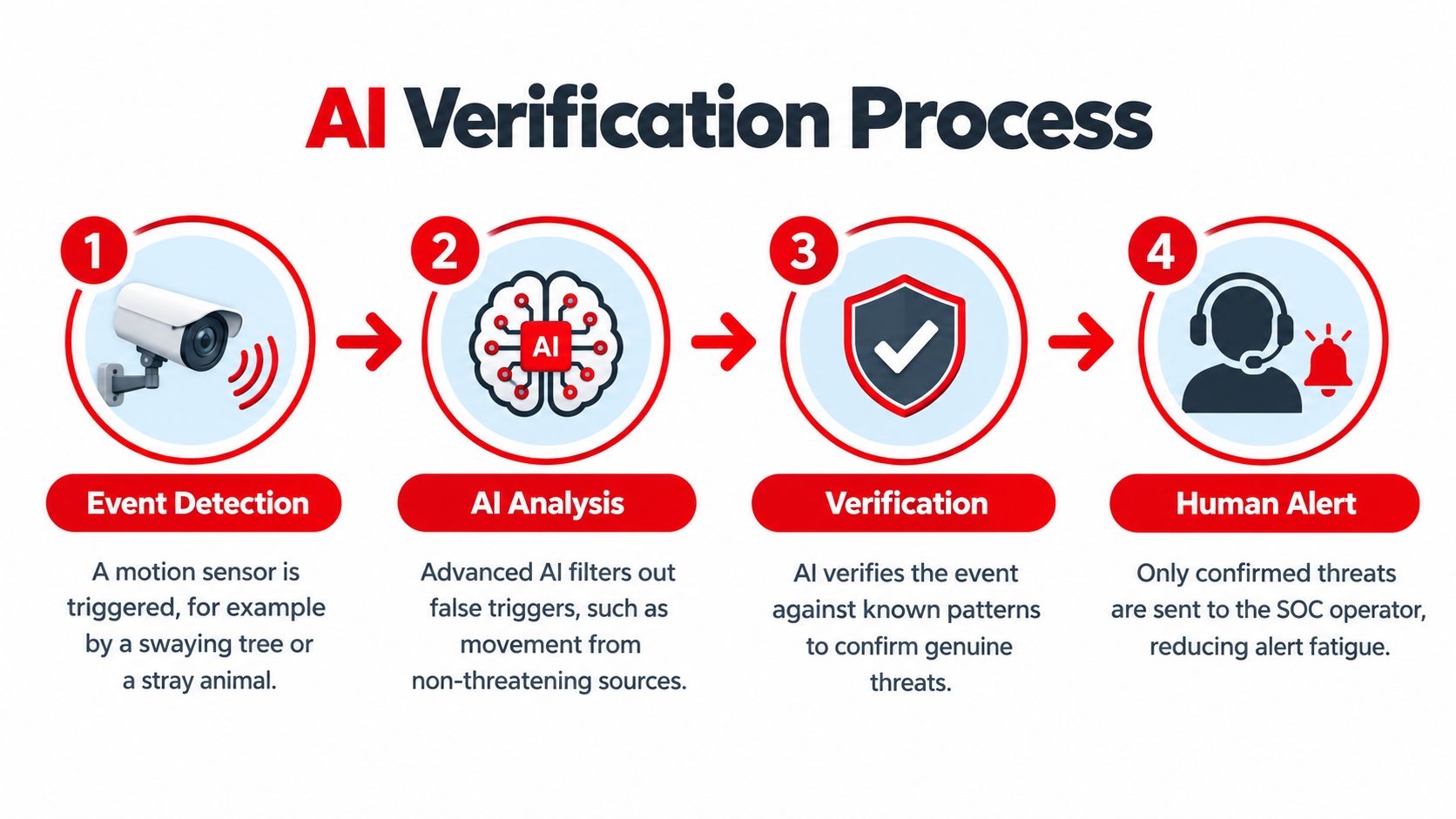
A camera may flag a swaying tree, stray animal, changing light, or passing vehicle as motion. If every trigger reaches an operator with the same urgency, attention gets diverted from events that may require action. This alert fatigue can weaken a monitoring program even when the cameras are working as configured.
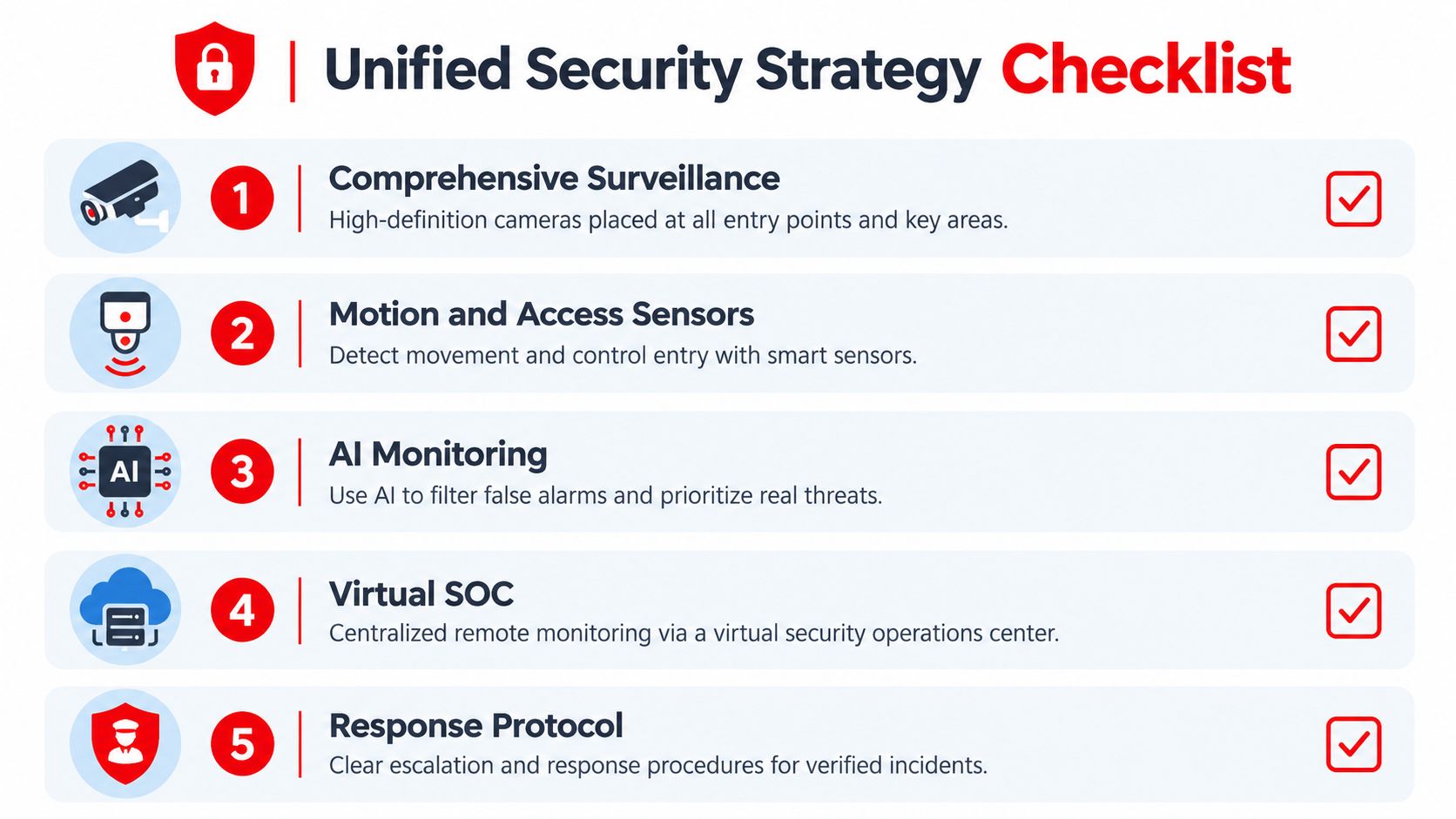
AI verification adds an analysis step before human escalation. The system examines characteristics such as whether movement resembles a person or vehicle and whether it occurs inside a monitored zone. Operators receive a more focused event rather than an undifferentiated stream of raw motion alerts.
Published video-security deployments report false-alarm reductions of about 80% to 95%, including one case study with an average 89.8% alarm reduction. Another deployment filtered 20,167 low-value events out of 20,210 raw triggers over four weeks (AI-powered alert filtering examples). Those results belong to the cited deployments and should not be treated as a guarantee for every property or camera system.
What the workflow looks like
- Detection: A camera or sensor identifies movement in a defined area.
- Analysis: AI evaluates the event against configured classifications and site rules.
- Verification: The system separates likely nuisance activity from events that deserve human attention.
- Human review: A trained operator assesses the verified event and applies the response plan.
- Escalation: The operator contacts the appropriate person, dispatches support, or records the event for follow-up.
The human review remains the decision point. AI prioritizes events, while an operator adds context, judgment, communication, and accountability. That person may know that a delivery window is active, a contractor is authorized, or an area is under maintenance.
Why this matters to property managers
Fewer nuisance alerts let operators concentrate on likely human or vehicle activity, investigate with greater focus, and avoid sending patrol officers to every low-value trigger. The benefit is practical across large perimeters, distribution yards, parking structures, and construction sites where cameras monitor broad areas.
Results depend on configuration. Camera placement, lighting, detection zones, classification settings, escalation thresholds, and post orders all affect whether the feed is useful or noisy. Property managers should ask how a provider tests and tunes those settings instead of accepting “AI monitoring” as a complete explanation.
A practical review can include the organization's security analytics platform. It should help managers examine event patterns, recurring nuisance conditions, response activity, and unresolved gaps. The technology should support decisions and coordination between AI camera monitoring, remote operators, and onsite teams, rather than create more dashboards.
Integrating Remote Oversight with Onsite Patrols
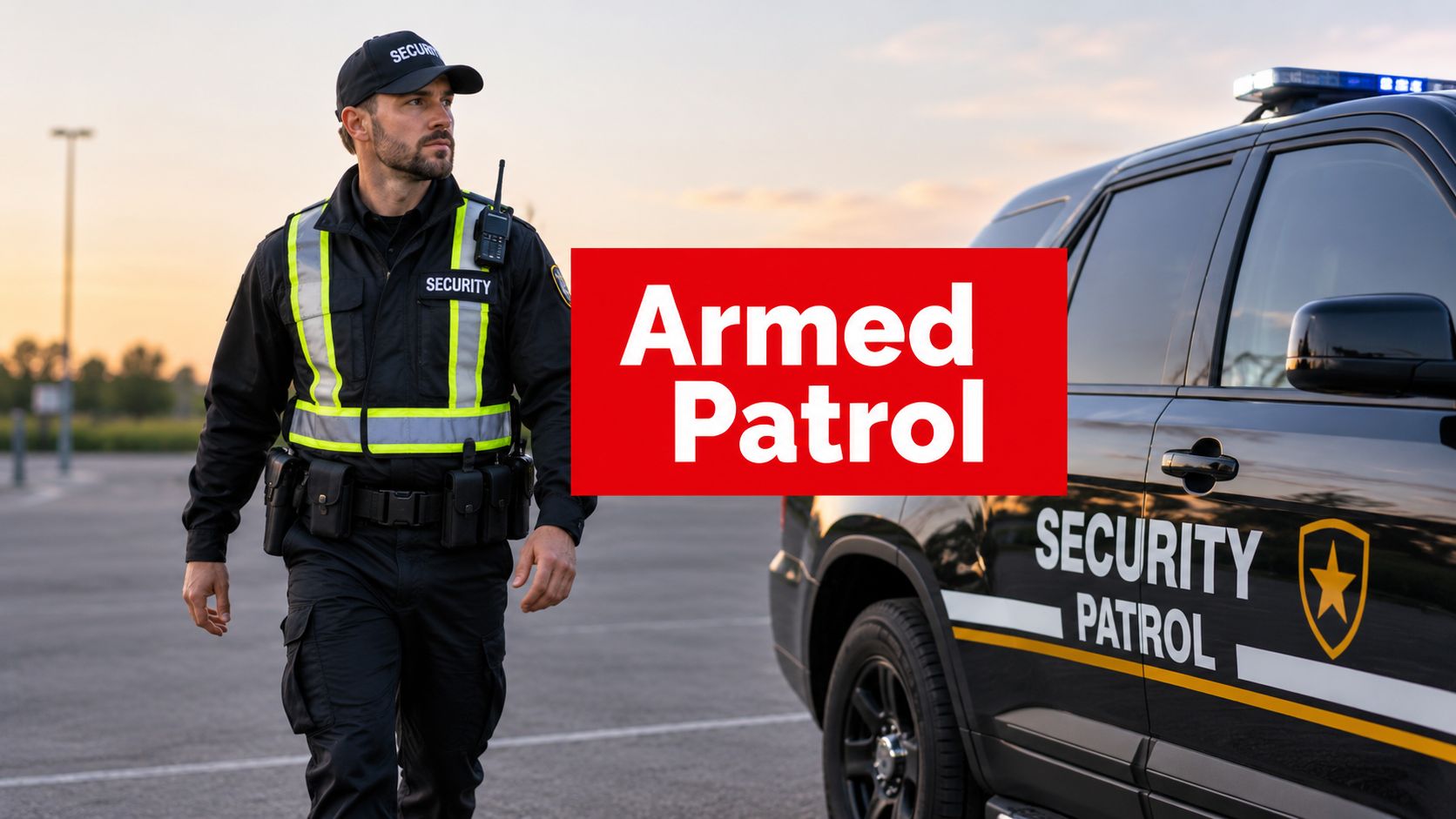
A vSOC should strengthen an officer's work, not treat remote monitoring as a substitute for every physical response. Cameras can identify a concern, but an officer may still need to inspect a gate, speak with a person, check a mechanical area, document damage, or secure a location.
The strongest arrangement connects those functions in both directions. Remote operators can identify events and request a patrol check. Officers can report what they find, upload evidence, and receive support if the situation escalates.
Turning patrols into verifiable activity
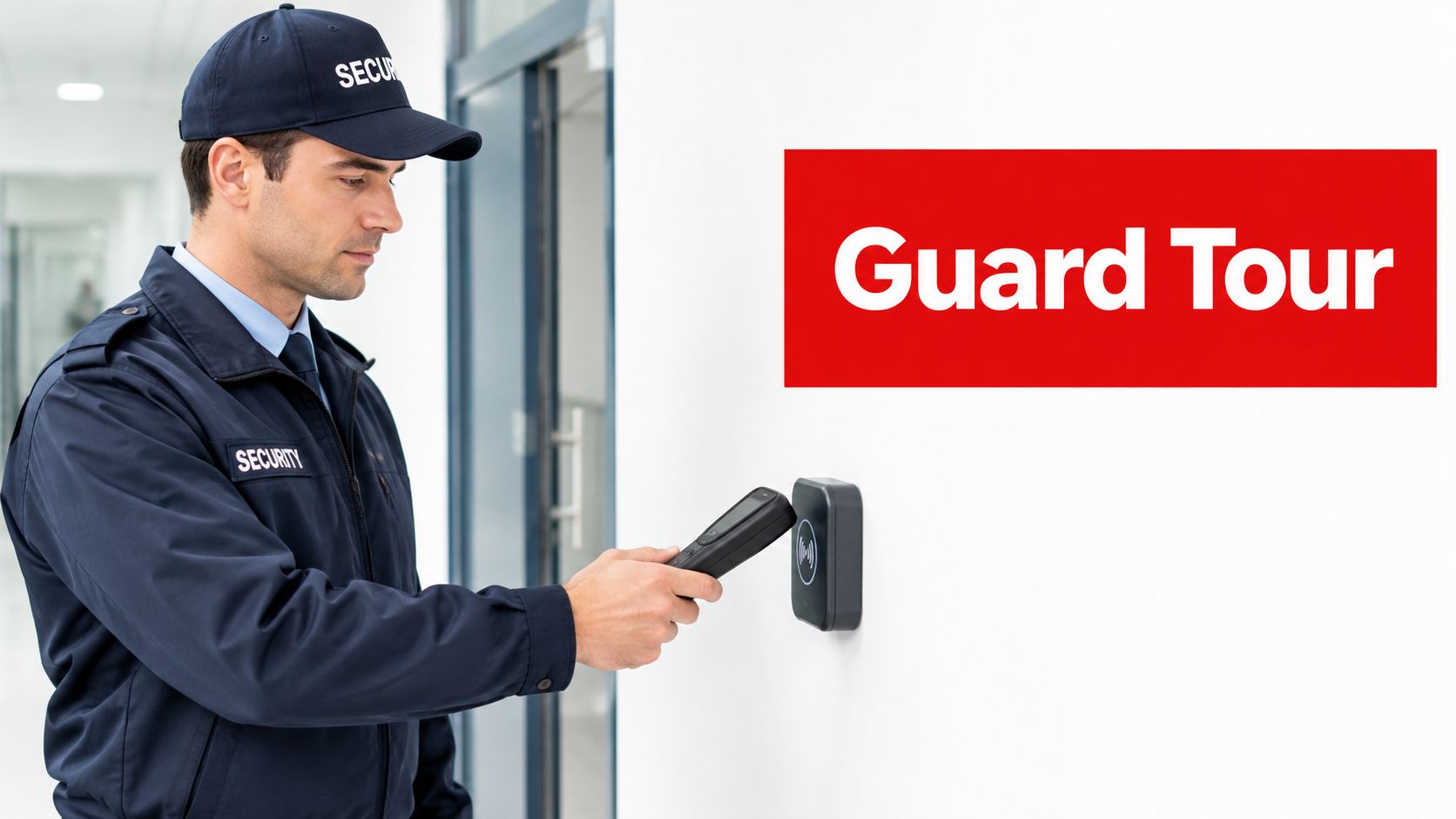
Guard Tour Management Systems use NFC checkpoints to record patrol activity. When an officer scans a checkpoint, the system can send checkpoint number, name, address, GPS coordinate, and timestamp to the security center, creating a precise audit trail for patrol verification and accountability (NFC guard-tour system details).
That record answers practical questions for a property manager:
- Was the route completed? Review checkpoint scans against the assigned patrol plan.
- Where did the officer encounter an issue? Match the report to the recorded location.
- When did the inspection occur? Use the timestamp and activity record.
- What evidence exists? Review digital reports and uploaded photographs when available.
- Was follow-up needed? Track the incident from initial observation through escalation or closure.
More detail about this operating model is available through Overton's guard tour management resource.
Supporting the officer in the field
Remote oversight also improves officer safety and continuity. A command team can monitor expected patrol activity, conduct wellness checks when required by procedure, coordinate backup, and notify client contacts when an incident needs management attention.
For a construction superintendent, this could mean a remote operator verifies an after-hours camera event and asks a patrol officer to inspect the equipment yard. For a residential community, the officer may respond to a parking-area concern while the SOC maintains awareness of related cameras and access points. For a hospital or medical campus, the remote team can help route information while onsite personnel manage the physical environment.
A professional officer performs better when the assignment includes clear post orders, reliable communication, and visible management support.
Property managers should also review the quality of reporting. A useful report identifies what happened, where it happened, what the officer observed, what action was taken, and what remains open. GPS records and NFC scans add accountability, but they don't replace training or judgment.
The human side of security matters. Stable, supported officers tend to understand site procedures more than constantly changing personnel. A provider that invests in officer retention, supervision, and communication gives the virtual SOC better field information and gives the client a more consistent experience.
Evaluating Hidden Costs and Service Limits
A vSOC can appear straightforward during a sales presentation. The provider monitors cameras, the client receives alerts, and a response follows when necessary. The contract often becomes more complicated once the property asks for integrations, special workflows, advanced investigations, incident-response support, or custom reporting.
Subscription fees may cover baseline monitoring but exclude certain response services. Incident-response add-ons, advanced investigations, equipment requirements, and customization can increase the total cost. Neutral guidance on choosing a vSOC provider highlights these issues, along with the possibility that customization may remain more limited than with an in-house SOC.
Questions that expose the real operating model
Ask the provider to explain:
- What the base service includes: Identify the cameras, sites, hours, operator duties, reports, and escalation actions included in the standard fee.
- What triggers an extra charge: Clarify incident response, special investigations, emergency dispatch, system changes, and after-hours requests.
- How integrations work: Confirm compatibility with cameras, access control, alarm systems, visitor platforms, patrol software, and communication tools.
- What happens during an outage: Review backup communication methods, local operating procedures, and responsibilities when a third-party system or network becomes unavailable.
- Who owns the data: Establish how video, reports, event histories, and incident records are accessed, retained, exported, and protected.
Integration friction deserves particular attention. A provider may claim broad compatibility, but the operational result depends on the specific camera firmware, access platform, network design, permissions, and alert logic used at the property. A weak integration can force operators to switch between disconnected systems, slowing verification and creating avoidable handoff errors.
Buy for resilience, not just headcount
The central procurement question shouldn't be, “Will this reduce our staffing?” It should be, “Can this provider deliver the response depth, integration speed, and resilience our property requires?”
A small office building may need notification and video verification. A high-rise community may need access coordination, resident-sensitive procedures, and patrol support. A construction site may require after-hours detection, equipment checks, and rapid escalation. These are different operating requirements, even if all three use cameras.
The right provider will explain its limits plainly. It will identify which actions operators can take, which actions require client approval, what happens when technology fails, and how the team will communicate during a disruptive event.
Designing a Unified Security Strategy for Your Property
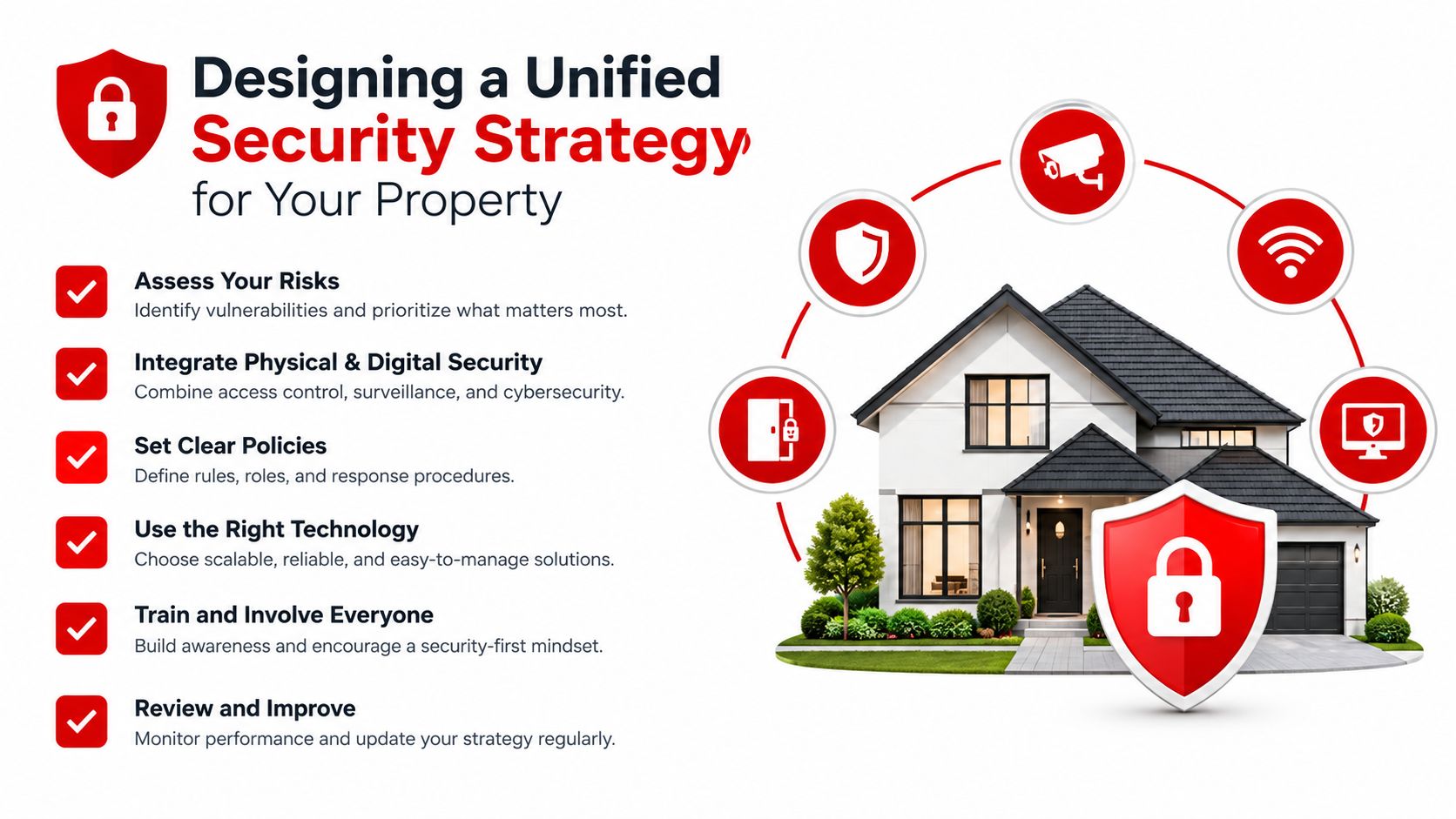
A unified security strategy starts with the property, not with a software label. Begin by mapping entrances, parking areas, loading zones, blind spots, rooftops, mechanical rooms, tenant spaces, construction materials, and other areas where activity requires attention.
Then define what each layer must accomplish:
- Cameras should provide useful visibility. Place them around entry points, key activity areas, and vulnerable approaches, while considering lighting, privacy, retention, and maintenance.
- Sensors should add context. Access events, motion detection, gates, doors, and other signals can help operators understand whether activity matches expected operations.
- AI should prioritize attention. Configure verification to reduce nuisance events and route meaningful activity to a human operator.
- The vSOC should coordinate decisions. Operators need current contacts, site maps, escalation thresholds, and authority limits.
- Officers should address physical conditions. Patrols verify locations, interact with people when appropriate, document findings, and take action under their post orders.
- Managers should review performance. Use reports, event histories, patrol records, and incident follow-up to identify recurring problems and adjust the program.
Match the model to the property
A multifamily community may prioritize resident safety, garage activity, access control, and professional interaction. A retail center may focus on parking areas, closing procedures, loitering concerns, and customer safety. A construction superintendent may need perimeter checks, material protection, gate control, and documented after-hours activity.
The response plan should describe what happens after verification. Specify who receives the first call, when an officer is dispatched, when a client representative is notified, and how emergency services are contacted when appropriate. Keep those instructions current as tenants, vendors, site layouts, and contact responsibilities change.
Physical-cyber convergence matters because properties increasingly depend on connected systems. Cameras, access control, visitor management, dispatch communications, patrol records, and digital reports should support one another rather than create separate islands of information. Guidance on the integration of security systems can help property teams evaluate that connection before implementation.
Overton Security offers a practical example of this blended model. The California-based company combines 24/7 SOC oversight, remote monitoring, GPS-enabled patrols, NFC checkpoint records, digital activity reports, and human officer support for properties across sectors including residential communities, retail centers, construction sites, healthcare facilities, and commercial buildings. Its operating approach emphasizes quality over quantity, hands-on leadership, a low manager-to-client ratio, and officer retention, rather than relying on technology alone.
Start with a site assessment, document the response requirements, and test the workflow before expanding it across a portfolio. A virtual security operations center works best when its people, systems, patrols, and property contacts operate as one coordinated program.
Overton Security provides onsite security officers, vehicle patrols, remote monitoring, SOC-supported response coordination, guard-tour tracking, and customized post orders for California properties. Visit Overton Security to discuss a unified protection plan for your building, community, retail center, healthcare facility, or construction site.