A property manager usually notices the problem before seeing the solution. Overnight incidents keep appearing in reports, residents want faster answers, guard hours are difficult to justify, and nobody on the management team can be physically present after midnight. Cameras may already cover the property, but recording an event is not the same as recognizing it, verifying it, and directing a response while it's happening.
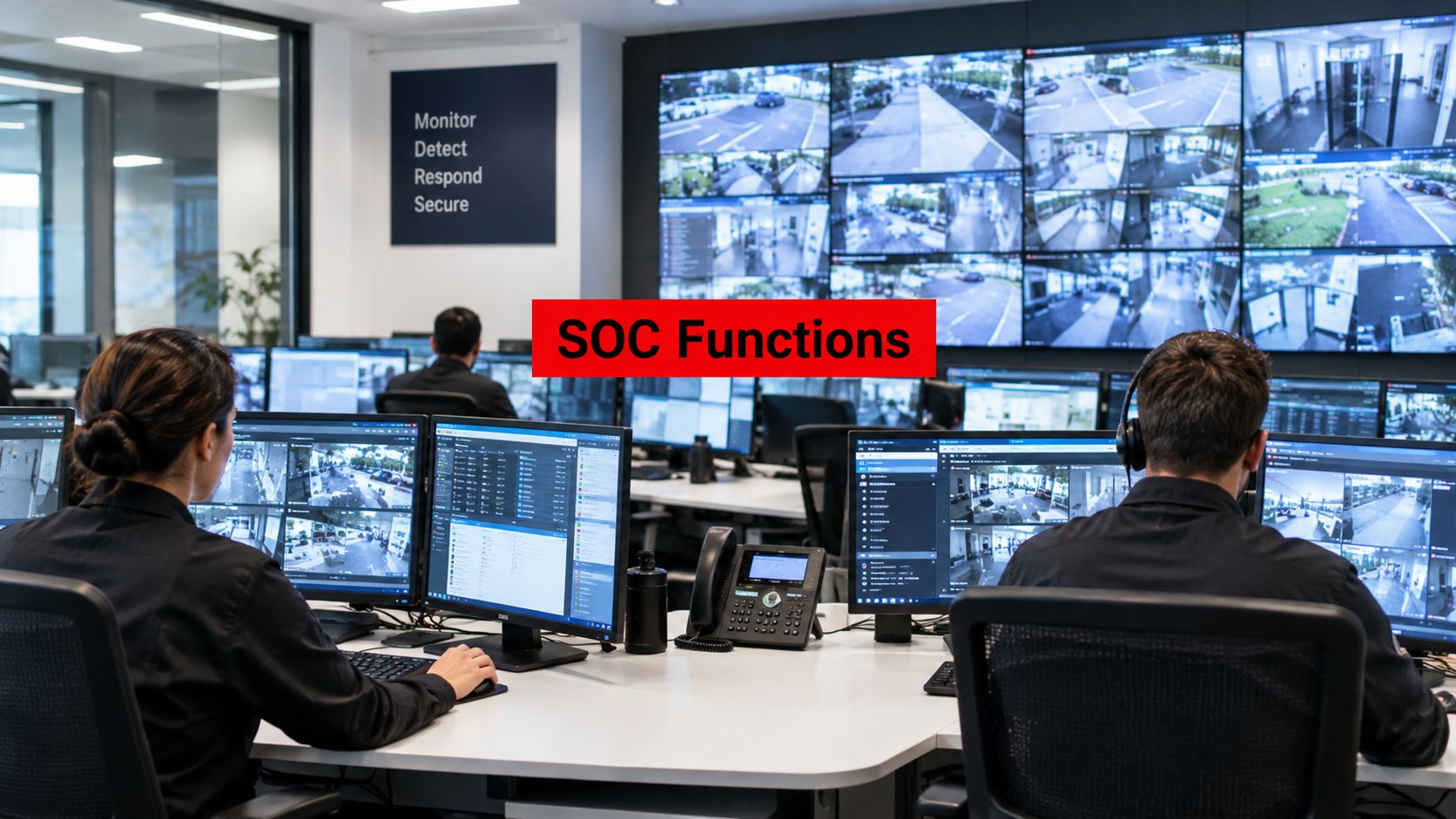
Remote monitoring technologies work when they're treated as an operating model, not a gadget. Cameras, sensors, analytics, networks, trained security operators, and field officers must work as one response chain. The property edge detects activity, a Security Operations Center, or SOC, evaluates the signal, and a designated person or team takes the next action.
When Remote Monitoring Becomes the Smart Choice
A mid-size multifamily community may have cameras at entrances, parking areas, and amenity spaces, yet still discover trespassing or package theft hours after it happens. Adding more cameras won't solve the coverage gap if nobody is watching the feeds and no procedure connects an alert to a response.
Remote monitoring becomes practical when the property has a recurring exposure that physical staffing alone can't address efficiently. A live SOC can extend oversight during unstaffed hours, verify whether an alarm represents a genuine event, and coordinate with an on-site officer, mobile patrol, property contact, or emergency service.
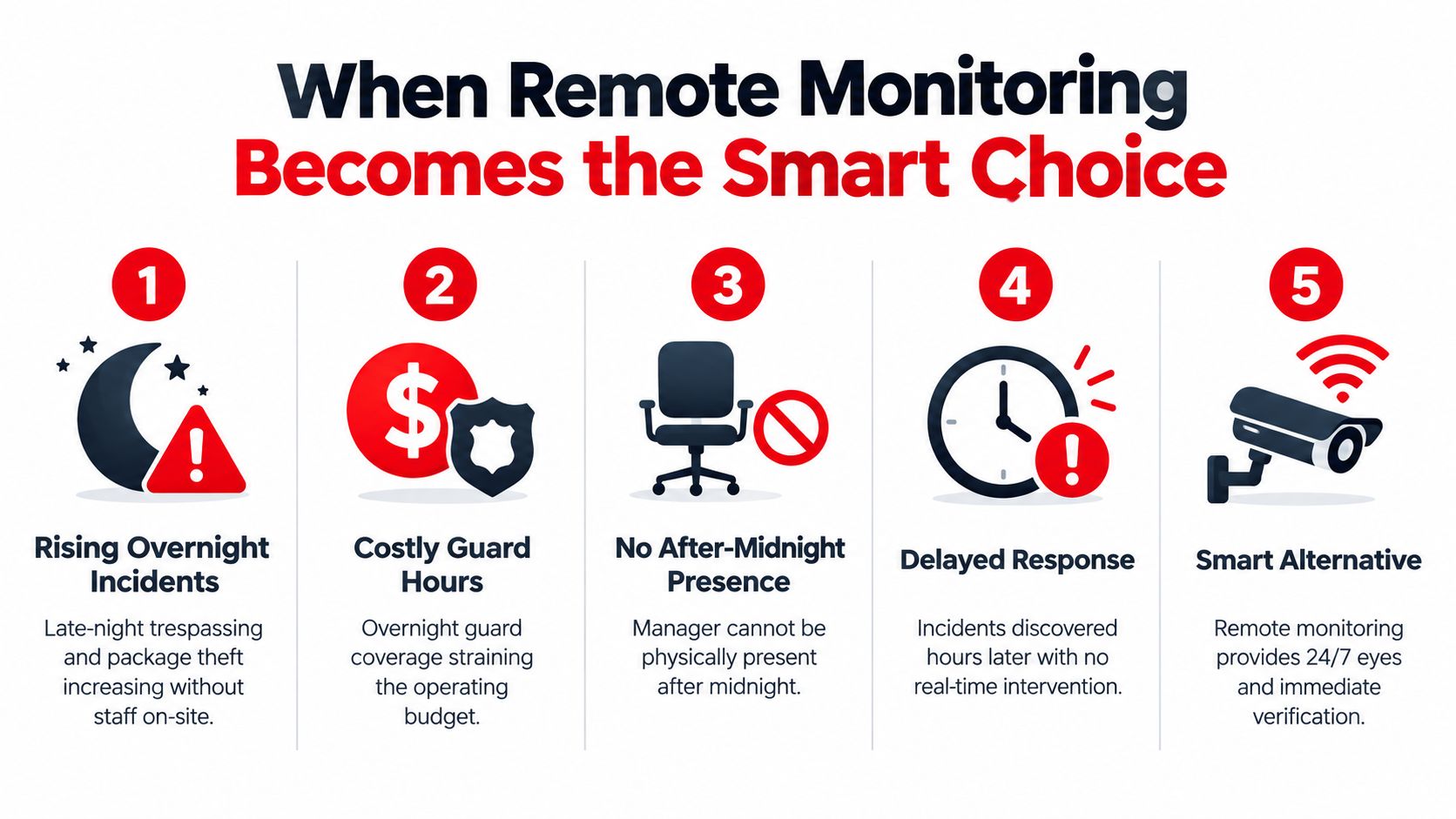
Start with the operational trigger
The strongest business case usually comes from a specific failure in coverage:
- Rising overnight incidents: Trespassing, vehicle break-ins, vandalism, and unauthorized access occur when the property team isn't present.
- Costly guard hours: Continuous overnight staffing may not be the right answer for every location, particularly when incidents are concentrated in particular zones or time periods.
- No after-midnight presence: A manager can't personally inspect a parking structure or respond to every resident call.
- Delayed response: Management learns about an event from a morning report, a resident complaint, or footage reviewed after the fact.
- Need for verified action: An operator can assess live video before directing a voice-down warning, dispatching an officer, or escalating to authorities.
Remote monitoring doesn't automatically replace on-site security officers. It often complements them by giving officers better information before they arrive and by covering the intervals when a patrol or post isn't physically present. A construction site may use active cameras for perimeter alerts while a mobile patrol checks gates and equipment. A retail center may combine a SOC with visible vehicle patrols and targeted loss-prevention coverage.
The scale of the market reflects how established this model has become. One 2026 estimate placed the global remote monitoring segment at USD 16,673.4 million in 2024, with a projection of USD 23,998.6 million by 2030 and a 6.4% CAGR over that period, as reported by Ohz Security's remote monitoring market overview. That growth doesn't prove every deployment will work, but it does show that centralized oversight, video verification, and connected alarm response now support substantial security operations.
Practical rule: Buy remote monitoring to close a defined coverage or response gap. Don't buy it simply because a camera vendor added an analytics feature.
The Core Building Blocks of Remote Monitoring
A property manager doesn't need to design every technical layer, but they do need to understand what each layer is responsible for. A reliable system has four connected building blocks: devices at the property edge, event sources, network transport, and the SOC or analytics platform that turns signals into decisions.
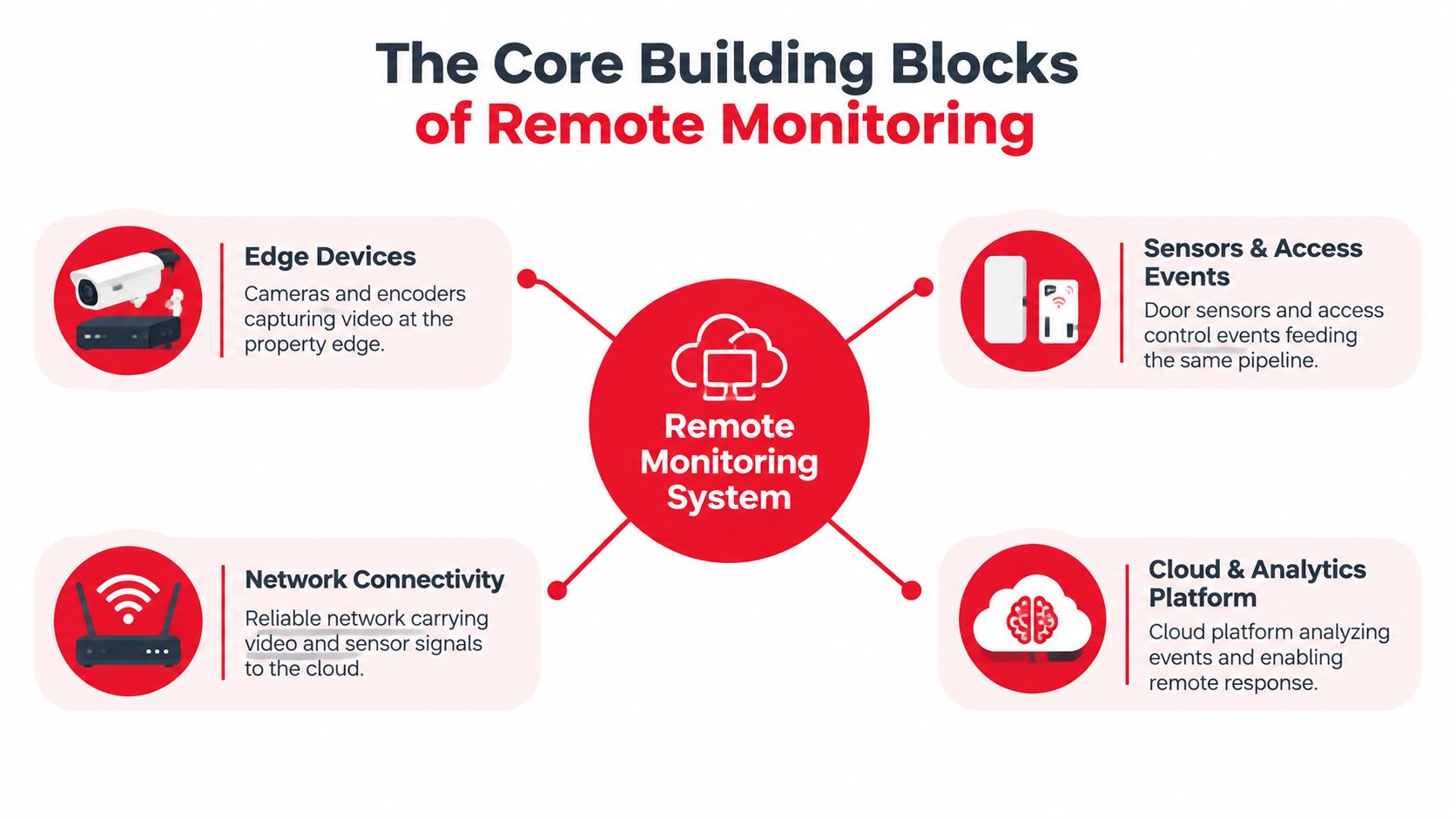
What sits at the property edge
Cameras and encoders capture video at gates, doors, parking areas, loading zones, corridors, and perimeter lines. Fixed cameras provide consistent views. Pan-tilt-zoom, or PTZ, cameras can be directed toward an unfolding event. An encoder may convert an older camera signal into a format that can enter a modern video management system, or VMS.
Sensors and access events provide context that video may miss. Door contacts, motion sensors, glass-break detection, intercom calls, access-control transactions, and environmental devices can all create events. A door forced open after an invalid credential is more meaningful than a motion alert in isolation.
How signals reach the SOC
The network carries video, metadata, alarm events, and operator instructions. Some systems send continuous streams, while others transmit event clips, thumbnails, or metadata after analytics identify activity. The design choice affects bandwidth, resilience, and what remains available when connectivity fails.
The SOC acts as a dispatcher and decision point. An operator receives an alert, reviews the associated camera view, checks nearby feeds and access records, follows the site's response protocol, and documents the outcome. The useful result is a shared incident timeline rather than separate dashboards that require someone to reconstruct what happened manually.
For a broader facilities perspective, monitoring systems for facility teams offers useful context on how connected monitoring can support property operations beyond security alone. The same principle applies here: technology matters only when it fits the people, procedures, and maintenance responsibilities around it.
Terms such as verified alarm, edge analytics, cloud analytics, PTZ, and VMS describe different parts of this chain. They shouldn't be treated as interchangeable product labels. A proposal is stronger when it explains which device detects the event, where analysis occurs, who verifies it, and what action follows.
Cameras, Sensors, and the Deployment Models Behind Them
Camera selection should follow the property's geometry and response plan. A fixed multi-sensor camera can cover a broad courtyard or parking approach from one mounting position. A PTZ camera can track activity across a large yard, but it may be looking in one direction when an event begins elsewhere. Thermal cameras can help identify heat signatures in darkness or challenging perimeter conditions, although they may need visible-light video for operator confirmation.
Door and intercom cameras become more valuable when tied to access events. A credential denial, door-held-open event, or intercom request can direct the operator to the relevant video rather than forcing a search through many feeds. Other inputs may include motion, glass-break, gunshot detection, water, temperature, or equipment sensors, depending on the site's risk profile.
Three deployment models
| Deployment Model | Video & Storage Location | Analytics Location | Best Fit Property Scenario |
|---|---|---|---|
| Fully cloud-managed | Provider cloud | Cloud platform | A single building or portfolio that wants centralized administration and limited on-site infrastructure |
| On-prem VMS | Local server or appliance | Local server or device | A campus with poor connectivity, strict local-storage requirements, or an established server room |
| Hybrid | Recording remains local, selected data moves upstream | Edge and cloud | A distributed portfolio that needs local continuity with centralized alerting and SOC oversight |
A fully cloud-managed model simplifies centralized administration, but its performance depends heavily on the property's uplink and the provider's continuity design. An on-prem VMS can preserve local recording during an internet interruption, but it creates responsibility for server maintenance, storage, updates, backup power, and remote access. Hybrid architecture often gives a portfolio the most practical balance. Cameras or local appliances can retain footage and filter events, while the cloud handles selected analytics, alert routing, reporting, and cross-site visibility.
The choice also depends on what the SOC must do. If operators need immediate access to live video and two-way audio, the design should prioritize dependable transport and clear failover behavior. If the primary need is investigation after an incident, local recording and searchable retention may matter more than constant upstream streaming.
Properties comparing analog and networked equipment can review Overton's guide to digital and analog cameras before selecting a replacement path. The important question isn't whether one camera category is universally superior. It's whether the selected equipment produces usable evidence and actionable alerts under the property's actual lighting, network, and response conditions.
Edge, Cloud, and Hybrid Analytics Compared
Where analytics run determines how quickly the system reacts and how much video the property must transport. Edge analytics process video on the camera or a local appliance. Cloud analytics send video to remote compute. Hybrid analytics use the edge to filter activity and the cloud for deeper review, reporting, or correlation across locations.
An independent benchmark reported approximate end-to-end response times of 25 to 100 milliseconds for on-camera edge processing, 30 to 120 milliseconds on an on-premises edge server, and 300 to 800 milliseconds for cloud compute, as described in Forasoft's edge AI and cloud AI comparison. The difference comes largely from network round-trip and transport overhead. Edge processing is therefore better suited to immediate deterrence, while cloud processing can serve non-urgent analytics and retrospective search.
| Factor | Edge Analytics | Cloud Analytics | Hybrid Analytics |
|---|---|---|---|
| Response latency | Lowest, because processing stays near the camera | Higher, because video travels to remote compute | Low for initial filtering, with cloud support for deeper analysis |
| Uplink demand | Lower when only events or metadata leave the site | Higher when continuous video is uploaded | Moderate, because selected clips and metadata move upstream |
| Connectivity failure | Local detection may continue, depending on equipment | Analysis may stop if the connection is unavailable | Local detection and recording can continue while cloud features pause |
| Portfolio visibility | More local management | Strong centralized management | Centralized oversight with local resilience |
| Best operational use | Immediate alerts and deterrence | Search, reporting, and complex analysis | Distributed properties needing both speed and continuity |
The cloud is attractive because providers can update models and manage analytics across many locations. It also introduces dependence on connectivity, service availability, and data transport. Edge processing reduces that dependence, but the property must manage device capability, firmware, local storage, and configuration.
A hybrid design is usually most practical when the SOC needs fast event awareness without receiving every frame from every camera. For a closer look at how analytics can connect detection, triage, and reporting, review Overton's security analytics platform. The deployment should state what happens during an outage, not just what happens when every component is online.
How a SOC Brings Remote Monitoring to Life
A remote monitoring system becomes useful when an operator can move from detection to a documented response without waiting for a manager to interpret raw data. The workflow should be predictable enough that a new operator can follow it and specific enough that a property manager can audit the result.
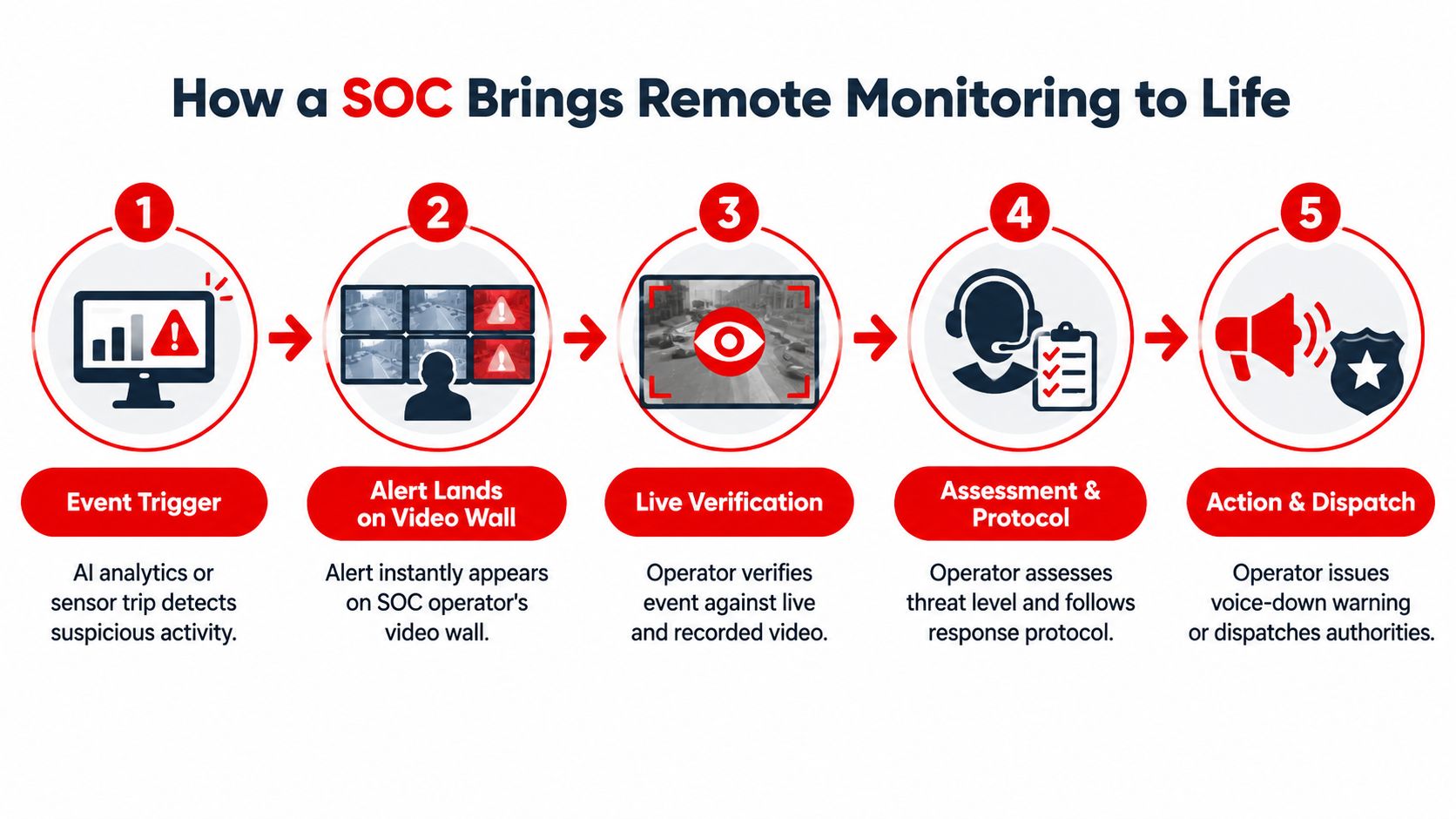
The response chain
- An event is triggered. Analytics identify activity, or a sensor reports a door, motion, access, or environmental event.
- The alert reaches the operator. The SOC platform presents the relevant camera, location, event type, and available history.
- The operator verifies the situation. Live video, recorded footage, nearby cameras, and access records help separate a genuine intrusion from an animal, reflection, weather event, or authorized activity.
- The operator applies the protocol. The response may include two-way audio, a notification to a site contact, officer dispatch, or escalation to emergency services.
- The outcome is documented. The incident record should identify the time, location, evidence reviewed, action taken, and final disposition.
Video verification has been associated with arrest rates of 20% to 50% for video alarms, compared with less than 0.1% for traditional alarm systems, according to the Partnership for Priority Video Alarm Response information. The operational lesson is straightforward. A verified event gives responders more useful information than an alarm signal that says only that something may have happened.
Guard-tour integration adds a physical accountability layer. An NFC scan can capture the checkpoint number, checkpoint name, address, and device GPS coordinate at the moment of the scan, then send the information to a security center in real time, as documented in the NFC guard tour system listing. A client portal can also display the guard identity, timestamp, and GPS location immediately, while missed checkpoints can generate alerts, according to real-time guard tour verification documentation.
A SOC should also maintain clear escalation rules for lost video, failed sensors, officer welfare concerns, and conflicting information. Operational compliance may involve specialized requirements outside ordinary property security. For example, teams reviewing aviation-related operations can consult the guide to CASA ReOC compliance requirements when that regulatory context applies.
For property managers evaluating a staffed SOC model, Overton's remote security monitoring services describes an approach that connects monitored technology with field response and documented accountability.
Pitfalls Most Buyers Never See Until It's Too Late
A vendor demonstration usually takes place under ideal conditions. Every camera has power, the network is uncongested, the analytics threshold is carefully tuned, and an experienced presenter handles the alert. Daily operations are less forgiving.
Test the failure modes before signing
Bandwidth collapse happens when several cameras stream at once, especially during an incident or during scheduled uploads. Ask whether the system can prioritize alarm video, retain local footage, and continue sending essential metadata when the uplink is constrained.
Cloud dependence creates a single point of failure if the internet connection or cloud service becomes unavailable. Ask what remains operational locally, how operators learn that a site has gone offline, and who owns the recovery process.
Alert fatigue develops when analytics classify routine movement as suspicious. A published surveillance study reported false alarms falling from about 8.5% to 4.3%, latency dropping from roughly 220 milliseconds to 120 milliseconds, and bandwidth use declining from about 280 MB per hour to 150 MB per hour in an optimized pipeline using techniques such as frame skipping and motion gating, as reported in the IRJIET surveillance study. The exact result will vary by property, but the operating principle is consistent. Filtering must protect the operator's attention.
Staffing gaps can make a technically strong platform ineffective. An independent review found that 80% of publications on remote monitoring technologies reported barriers, with recurring themes involving access, implementation guidance, and the resources needed to deploy and maintain systems, according to the remote monitoring implementation review. The same review identified system instability at 29.2%, concern about decision-making errors at 26.4%, lack of technical expertise at 24%, legal insecurity at 21%, and limited product knowledge at 17.5%. These figures describe publication themes, not a prediction for any particular property.
Questions for the vendor
- Connectivity: What are the primary and backup paths, and what does the SOC see when either one fails?
- Power: Which cameras, switches, servers, and network devices have backup power?
- Triage: Who reviews alerts, during which hours, and how are thresholds adjusted?
- Training: How are operators trained to distinguish authorized activity from intrusion?
- Privacy: Are audio, facial recognition, or other sensitive features enabled, and what policy governs their use?
- Retention: Where is footage stored, who can access it, and how are deletion requests handled?
- Costs: Are storage, licenses, cellular service, maintenance, dispatch, and replacement equipment included?
Privacy also requires a deliberate sensor choice. Infrared and non-visual sensing can be difficult to interpret and may produce more false alarms, while sound and vibration sensing can reduce privacy concerns compared with conventional video, according to literature on smart-home and assisted-living monitoring reviewed in this study. The correct question isn't whether a camera can detect an event. It's whether that sensor provides an acceptable balance of detection quality, nuisance alerts, and governance risk for the site.
Measuring ROI and Operational Impact
A defensible return-on-investment review starts with the property's existing baseline. Record how many officer hours cover the site, how often patrols are dispatched, how long it takes to verify an alarm, how many alerts prove non-actionable, and how consistently incident documentation is completed.
Remote monitoring can reduce unnecessary responses when operators verify an event before directing a field officer. It can also reallocate officer time toward physical inspections, resident service, access control, or high-risk periods rather than asking a guard to watch screens continuously. Those outcomes should be measured against the actual post orders, not against a vague promise of “24/7 protection.”
| Cost or Metric | Traditional Guard Coverage | SOC-Led Remote Monitoring | Typical Impact |
|---|---|---|---|
| Overnight observation | Officer remains physically assigned to the post | SOC operator watches prioritized events and live feeds | Coverage can be extended without placing an officer at every location |
| Field response | Officer may investigate every alarm or routine call | Operator verifies and dispatches based on evidence | Fewer unnecessary responses and clearer prioritization |
| Incident timing | Discovery may occur during a patrol or later report review | Alert, verification, and action are time-stamped | Faster awareness and more defensible records |
| Documentation | Paper logs or manually assembled reports | Event clips, operator notes, access events, and patrol records can be linked | Better claim support and management visibility |
| Multi-site oversight | Separate staffing and reporting at each property | Centralized monitoring with site-specific protocols | More consistent supervision across a portfolio |
Consider a residential portfolio with overnight guards at some properties and mobile patrols at others. A practical comparison would price the current guard and patrol schedule, then model a hybrid alternative with monitored cameras, a defined SOC response, and on-demand officer dispatch. The model should include equipment, installation, connectivity, storage, operator coverage, maintenance, patrol changes, and the labor required to manage exceptions.
The value may appear in several places:
- Response efficiency: Compare verified incidents with dispatched incidents, not raw alert counts.
- Loss prevention: Track documented trespassing, theft, vandalism, and unauthorized access over comparable operating periods.
- Liability control: Review whether footage and time-stamped reports establish what was observed, who acted, and when.
- Staff allocation: Identify officer hours that can move from passive observation to visible patrol, access control, or resident-facing duties.
- Service reliability: Measure camera uptime, sensor health, connectivity interruptions, and unresolved exceptions.
Remote monitoring should earn its place through measurable operating improvement. If the property cannot identify who responds, what gets documented, and which baseline changes will be reviewed, the financial case isn't ready.
Choosing a Remote Monitoring Partner That Actually Delivers
A reseller can install cameras. A security partner must operate the response around them. The distinction appears in staffing depth, escalation discipline, failure handling, reporting, and the willingness to discuss what happens when the system produces too many alerts or loses connectivity.
Start with the SOC. Ask whether the provider directly operates a 24/7 Security Operations Center, where it is located, how many operators support the account, and what happens when demand increases. Request the response tiers in writing. “Immediate response” should translate into a defined process for verification, voice-down intervention, property notification, officer dispatch, and emergency escalation.
Evaluate the operating model
A credible partner should be able to demonstrate:
- Redundancy: Separate monitoring capability, backup connectivity, generator-backed power, and documented failover procedures.
- Operator readiness: Training, supervision, quality review, and a clear method for handling uncertain events.
- Integration: Compatibility with the property's VMS, access control, intercom, alarm, and reporting systems.
- Transparent reporting: Incident records, video references, patrol activity, system exceptions, and unresolved maintenance items.
- Clear service levels: Expectations for alert handling, dispatch coordination, equipment repair, uptime, and false-alarm tuning.
- Field support: Officers or mobile patrols who can act on verified information rather than receiving vague requests to “check the area.”
The provider should also explain how it supports the people who carry out the physical response. Technology doesn't remove the need for dependable officers. Stable staffing, professional training, customized post orders, and manager involvement determine whether a camera alert becomes a useful intervention or an abandoned ticket.
Overton Security Services is one example of a California-based provider that combines a SOC with GPS-enabled patrols, digital daily activity reports, NFC guard-tour verification, and onsite security officers. Its operating model emphasizes quality over quantity, a low manager-to-client ratio, hands-on leadership, and support for officer retention across properties in Los Angeles, San Diego, San Jose, Sacramento, San Francisco, and other California markets.
Ask every finalist to walk through one real failure scenario. The network drops at a multifamily property during an active trespass event. A camera generates repeated alerts at a retail center. A guard misses a checkpoint at a construction site. The strongest answer will identify the person responsible, the fallback technology, the escalation deadline, and the report you receive afterward.
The right partner won't present remote monitoring as a substitute for judgment. It will show how cameras, sensors, operators, officers, managers, and documented procedures work together to protect the property when conditions are less than perfect.
Overton Security combines 24/7 SOC oversight with remote video monitoring, GPS-enabled patrols, NFC guard-tour verification, digital reports, and onsite security officers. Visit Overton Security to discuss a monitoring and response program built around your property's coverage gaps, connectivity risks, and operational priorities.