
At 2 a.m., a retail center is mostly empty. A delivery driver waits near a rear door, a camera records the movement, and an alarm sends an alert to a phone that nobody is watching. By morning, the property manager may have footage, but the opportunity to verify the event and act on it has already passed.
Remote security monitoring services are designed to close that gap. They combine cameras, sensors, communications networks, trained operators, response procedures, and reporting into a working security process. For property managers, the important question isn't whether a camera can see an event. It's whether the right person can verify it, respond appropriately, and document what happened.
What Remote Security Monitoring Services Actually Do
A remote monitoring program adds an offsite security team between a property's detection equipment and its response plan. At a multifamily community, for example, a perimeter sensor may activate after hours. The monitoring operator reviews the relevant camera feed, checks the surrounding area, uses two-way audio if appropriate, and follows the property's escalation instructions.
That makes the service different from a recording system. A recorder stores footage for later review, while a monitoring center turns live signals into decisions. It's also different from a guard company by itself, because the remote team may verify an event and direct an onsite officer, mobile patrol, police agency, or property contact rather than physically handling every incident.
A typical program includes:
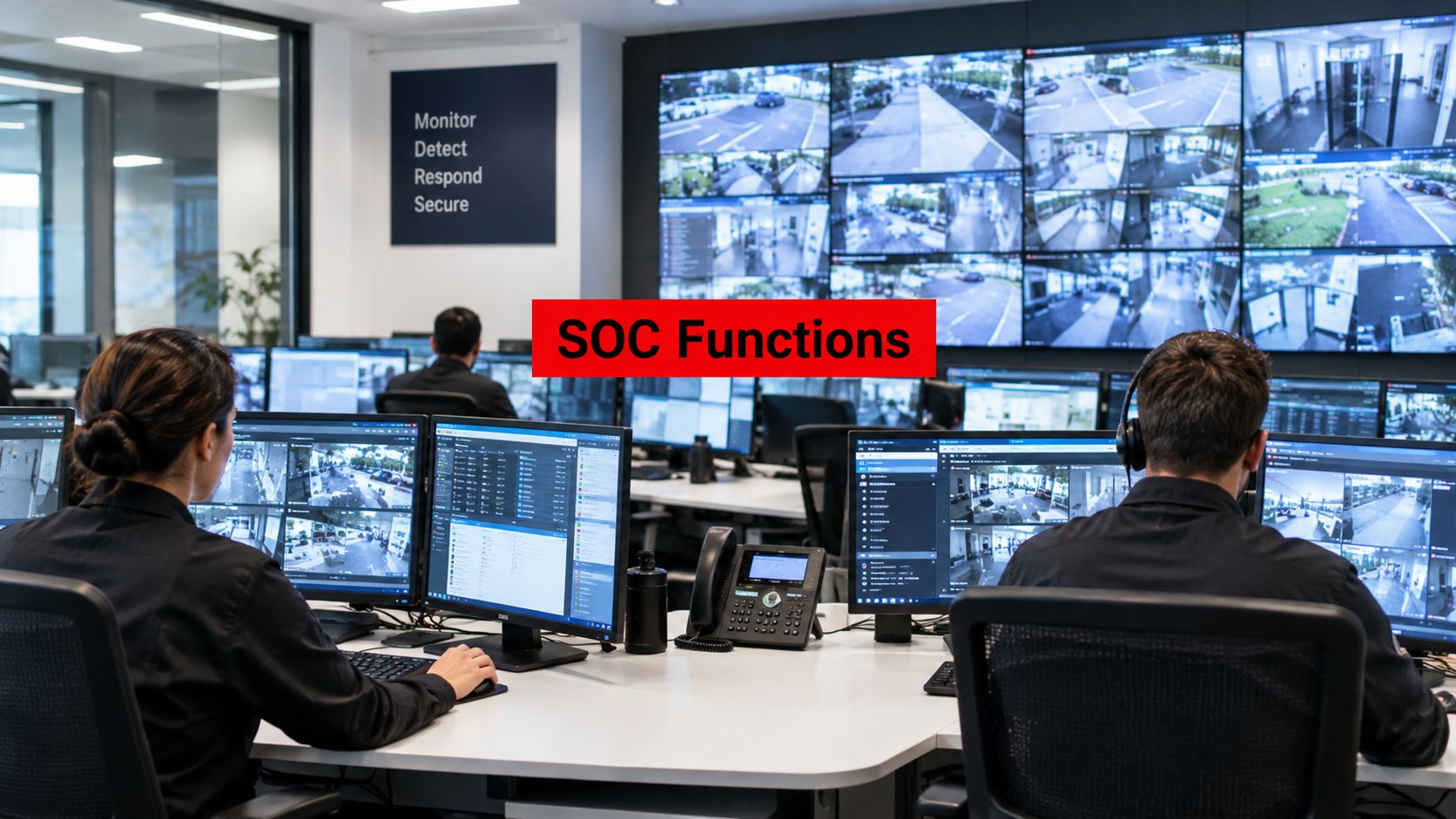
- Continuous observation: Camera feeds, alarms, and sensors are reviewed through a security operations center, often called a SOC.
- Event verification: Operators examine live video and surrounding context before treating a signal as a confirmed threat.
- Intervention: Depending on the post orders, an operator may use two-way audio, contact a responsible person, dispatch patrol, or request law enforcement response.
- Documentation: The provider records the event, actions taken, timestamps, video clips, and final disposition.
The SOC-based remote video monitoring model describes a continuous process involving monitoring, detection, analysis, response, and reporting, with AI and human specialists reviewing feeds for potential threats. That workflow matters because a property's camera network produces signals, not conclusions.
Practical rule: A remote monitoring contract should explain who makes the decision, what evidence they use, and which response they're authorized to initiate.
The value also depends on the property. A retail center with several rear doors, a construction site with exposed equipment, and a residential community with controlled gates all produce different risks. Remote monitoring is most useful when the provider understands those conditions and builds site-specific instructions around them.
The Technology Stack Behind a Modern Monitoring Program
Think of the system as an air traffic control operation. Air traffic controllers don't rely on a single radar screen. They receive signals from multiple sources, confirm what those signals mean, communicate with people in the field, and follow procedures for different situations. A modern monitoring program works in much the same way.
Field devices capture the situation
The field layer includes IP cameras, thermal imagers, motion and glass-break sensors, access control readers, and panic buttons. Each device answers a different question. A camera shows what is happening. A thermal imager can help identify heat signatures in difficult lighting. A reader records an access attempt, while a panic button communicates an urgent request for help.
Camera placement is the first property-manager decision. A high-resolution camera aimed at a wall won't help an operator verify a person at a gate. Sightlines, lighting, elevation, weather, vegetation, and privacy all affect the usefulness of the image.
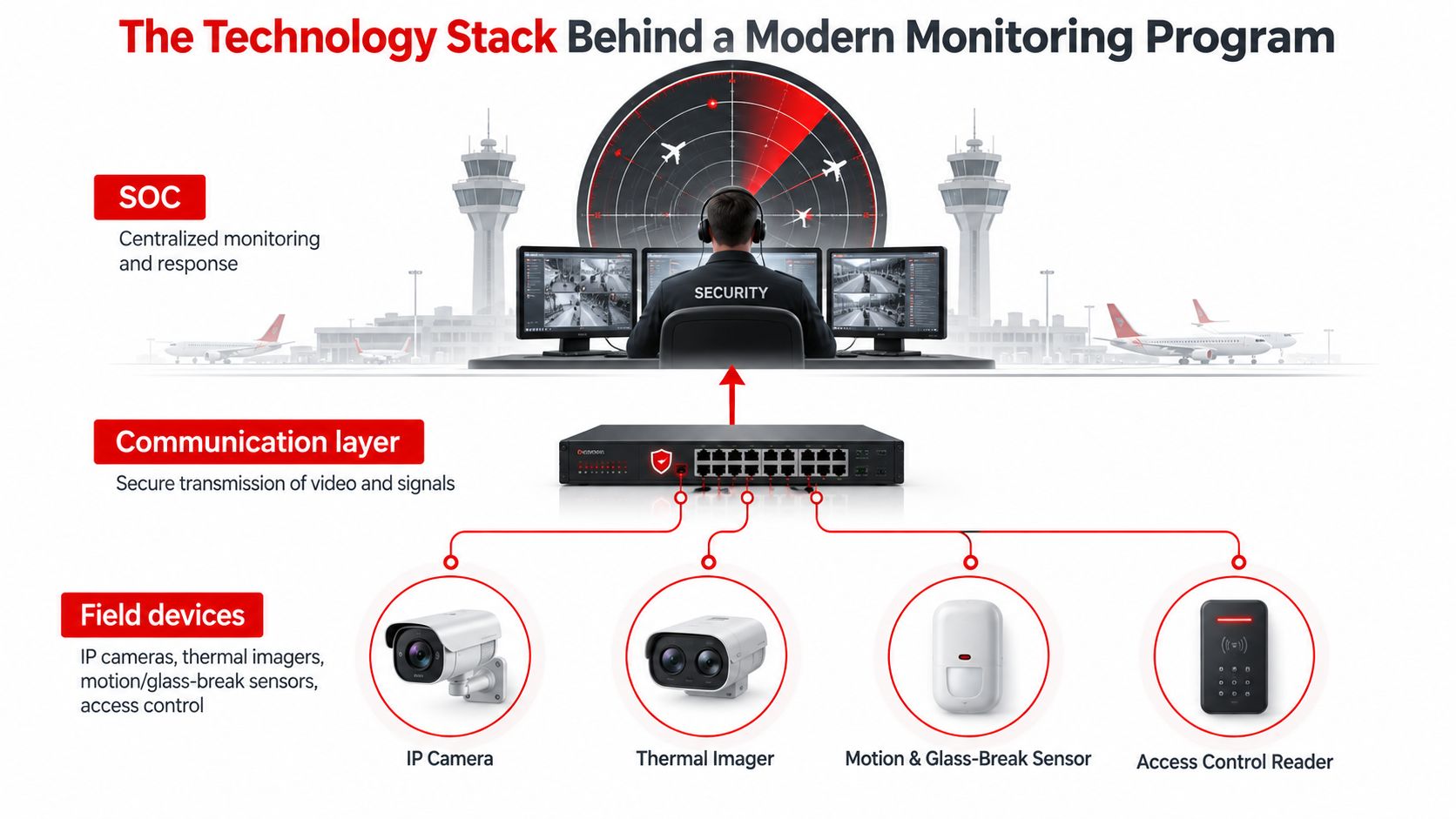
The communication layer carries the evidence
The transport layer moves video and alarm data from the property to the SOC. It may include dedicated network circuits, cellular failover, and encrypted VPN connections. The decision here isn't how much bandwidth to purchase. It's how the system will continue communicating when a primary connection fails or a local device loses power.
Property managers should ask who owns the network, who monitors its health, and how outages are escalated. A camera that works during a routine test but disappears during a connection failure creates a false sense of coverage.
Software organizes the signals
The integration layer brings together video management software, physical security information management tools, access systems, and analytics engines. Analytics may flag loitering, line crossing, vehicle dwell time, or object movement, allowing operators to focus attention where the site's rules indicate concern.
A property manager evaluating an analytics platform for security operations should ask whether the software fits the existing camera and alarm environment. Compatibility matters more than a long feature list.
Finally, the human layer includes operators, supervisors, and quality reviewers. Software can identify a pattern, but trained personnel interpret context and decide what happens next. That human review is what turns a collection of devices into an operating model.
How a Security Operations Center Turns Video Into Action
A SOC response is easiest to understand through one event. Suppose a person crosses a virtual fence line behind a commercial property after the site has closed. The system generates a signal, but the signal alone doesn't establish intent or require dispatch.
The operator follows a defined sequence:
- Monitor: The SOC receives continuous surveillance feeds and watches the relevant camera view.
- Detect: An analytics rule identifies the virtual fence breach.
- Analyze: The operator checks the person's direction, clothing, behavior, nearby vehicles, access points, and related camera views.
- Respond: The operator follows the escalation tree. That may involve a two-way audio challenge, a call to an onsite contact, mobile patrol dispatch, or law enforcement notification.
- Report: The operator creates an incident record with the timeline, actions, clips, and outcome.
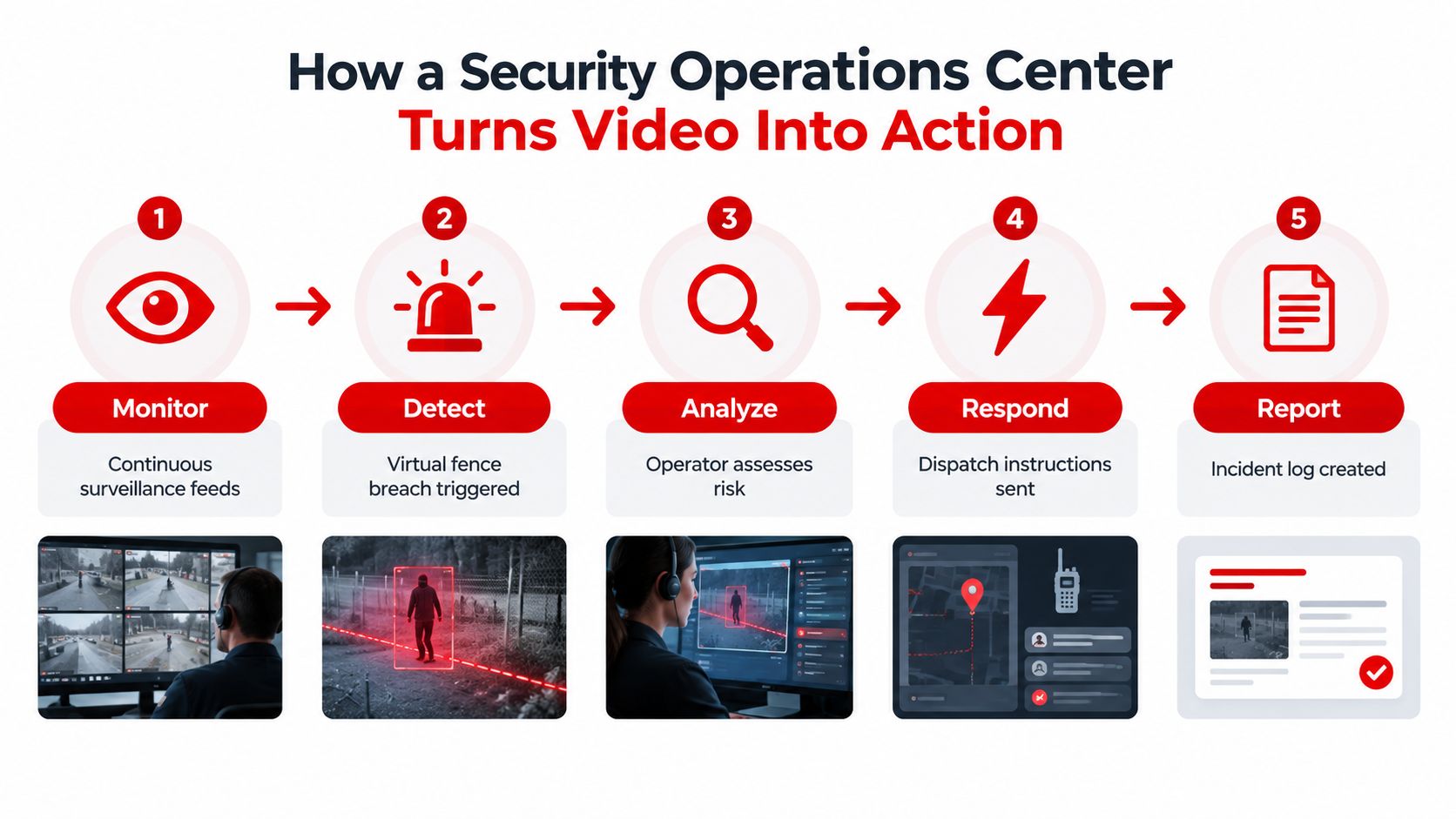
Alarm verification is the cost lever in this process. A live view may show a person who is authorized to be onsite, a delivery vehicle leaving the property, or a genuine intrusion. Without verification, every trigger can create an unnecessary dispatch, while repeated nuisance alerts can produce operator fatigue and weaken confidence in the system.
AI-powered analytics can reduce false alarms by up to 90% by classifying objects and filtering nuisance motion such as wind and foliage, according to Lumana's explanation of AI video analytics. Some advanced deployments report 95% to 99% or greater reductions when systems detect people or vehicles instead of raw motion, although results depend heavily on camera placement, exclusion zones, vegetation, animals, vibration, and site-specific thresholds, as described in this perimeter security false-alarm guide.
The reporting stage gives ownership something operationally useful. Time-stamped reports, clips, and audit logs help managers review performance, support insurance conversations, and identify recurring weaknesses such as a poorly protected gate or a lighting problem. More detail about automated SOC workflows is available through security operations center automation.
Common Service Models and How to Choose Between Them
Remote monitoring isn't one product with one level of responsibility. Property managers usually choose among three broad service models, and the right choice depends on the site's exposure, staffing, hours, and tolerance for handling alerts.
| Model | Typical Cost (per camera/month) | Average Response Time | Best Fit Property | Liability Owner |
|---|---|---|---|---|
| Self-monitoring | Varies by system and service agreement | Depends on who receives and reviews the alert | Small, low-activity sites with an available responsible contact | Primarily the property owner or manager |
| Hybrid SOC | Varies by system and service agreement | Defined by the provider and alarm-review workflow | Sites that need professional verification without continuous live intervention | Shared among owner, integrator, and monitoring provider according to contract |
| Fully managed remote guarding | Varies by camera coverage, hours, and response scope | Defined by the provider and live-guarding agreement | Retail, construction, parking, and active properties needing intervention | Must be allocated clearly among the owner and service providers |
Self-monitoring sends alerts to a property manager, owner, or designated contact. It can work when someone is consistently available, understands the site, and can act without relying on a provider to interpret the event. Its weakness is practical, not theoretical. A phone alert has little value if the recipient is asleep, driving, or unsure what the signal means.
A hybrid SOC reviews confirmed alarms or selected events. This model can suit a smaller self-storage property or a low-traffic commercial site where full live observation would add more coverage than the risk profile requires.
Fully managed remote guarding adds trained operators who watch selected feeds and may use two-way audio or dispatch resources. A Class A office tower with after-hours foot traffic, a retail center with vulnerable rear access points, or a construction site with valuable staged equipment may benefit from that active intervention.
Don't choose solely by the lowest camera line item. Ask how many hours are covered, what counts as a verified alarm, who pays for dispatch, how responsibility is divided, and whether the provider's service level matches the property's actual risk.
Integrating Remote Monitoring With Onsite Guards and Patrols
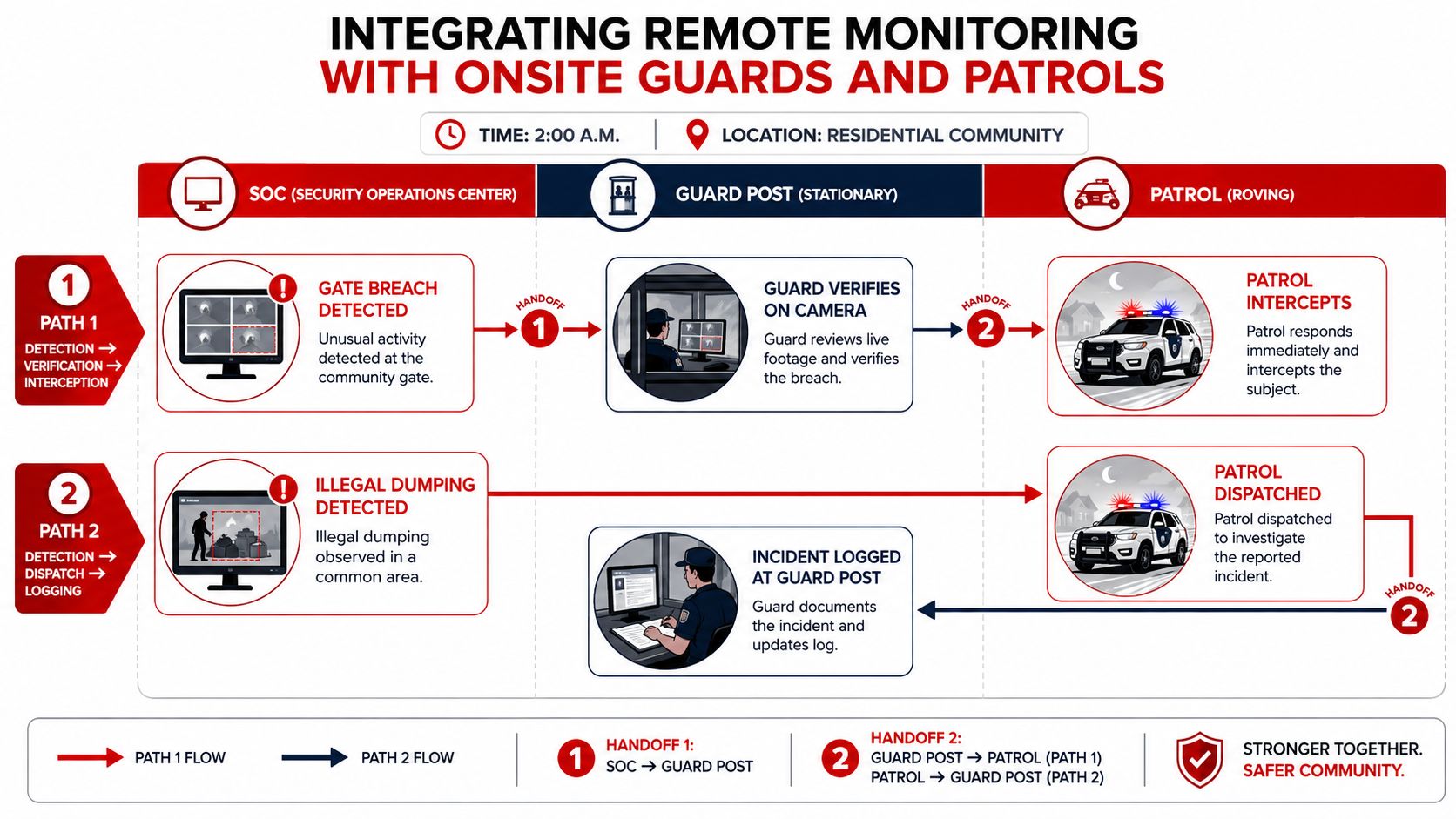
Remote monitoring works best as a layered operating model, not as a promise to remove every person from the property. The SOC sees and verifies events. Stationary officers manage access, residents, visitors, and immediate site conditions. Mobile patrol officers provide physical coverage across larger areas and investigate locations that need boots on the ground.
Consider a residential community at 2 a.m. The SOC detects a gate breach through analytics and checks the live feed. The operator uses two-way audio to challenge the person, sends the event to the mobile patrol unit, and contacts the onsite concierge so the elevator lobby can be secured while the patrol officer approaches.
That handoff only works when each role is defined in advance. The SOC shouldn't assume the concierge can lock a lobby, and the patrol officer shouldn't arrive without knowing which gate, camera, or access point generated the event.
A construction site creates a different sequence. The SOC verifies motion near a staged-equipment zone, follows the agreed police-dispatch protocol, and notifies the mobile patrol officer. The patrol officer's arrival and findings are then recorded against the service agreement, giving the site manager a clear account of what happened.
Define the handoffs before an incident
A practical site plan should identify:
- SOC authority: Which events can operators handle through audio, and which require a call or dispatch?
- Guard responsibilities: What must the stationary officer verify, secure, or communicate?
- Patrol instructions: Which locations receive priority, and what evidence must the officer collect?
- Manager notification: Which incidents require immediate contact, and which belong in a daily report?
- Closure standards: What makes an incident complete, such as a contact made, area checked, gate secured, or report submitted?
Independent patrol systems commonly use NFC, QR, or RFID checkpoints, GPS validation, and time-stamped records to confirm that an officer reached the correct location. That kind of patrol trail supports accountability for residential communities, retail centers, construction sites, and multi-site portfolios, as shown in this NFC checkpoint scanning case study.
The key distinction between onsite officers and mobile patrols is explained in this guide to onsite security officers and security patrol services. Remote monitoring filters the signal so physical teams can spend less time chasing nuisance alarms and more time resolving verified events.
An Evaluation Checklist for Remote Monitoring Providers
A provider's camera count and dashboard demonstration won't tell you whether the service will work at your property. Procurement should test the operating details, especially the parts that determine accountability after an alarm.
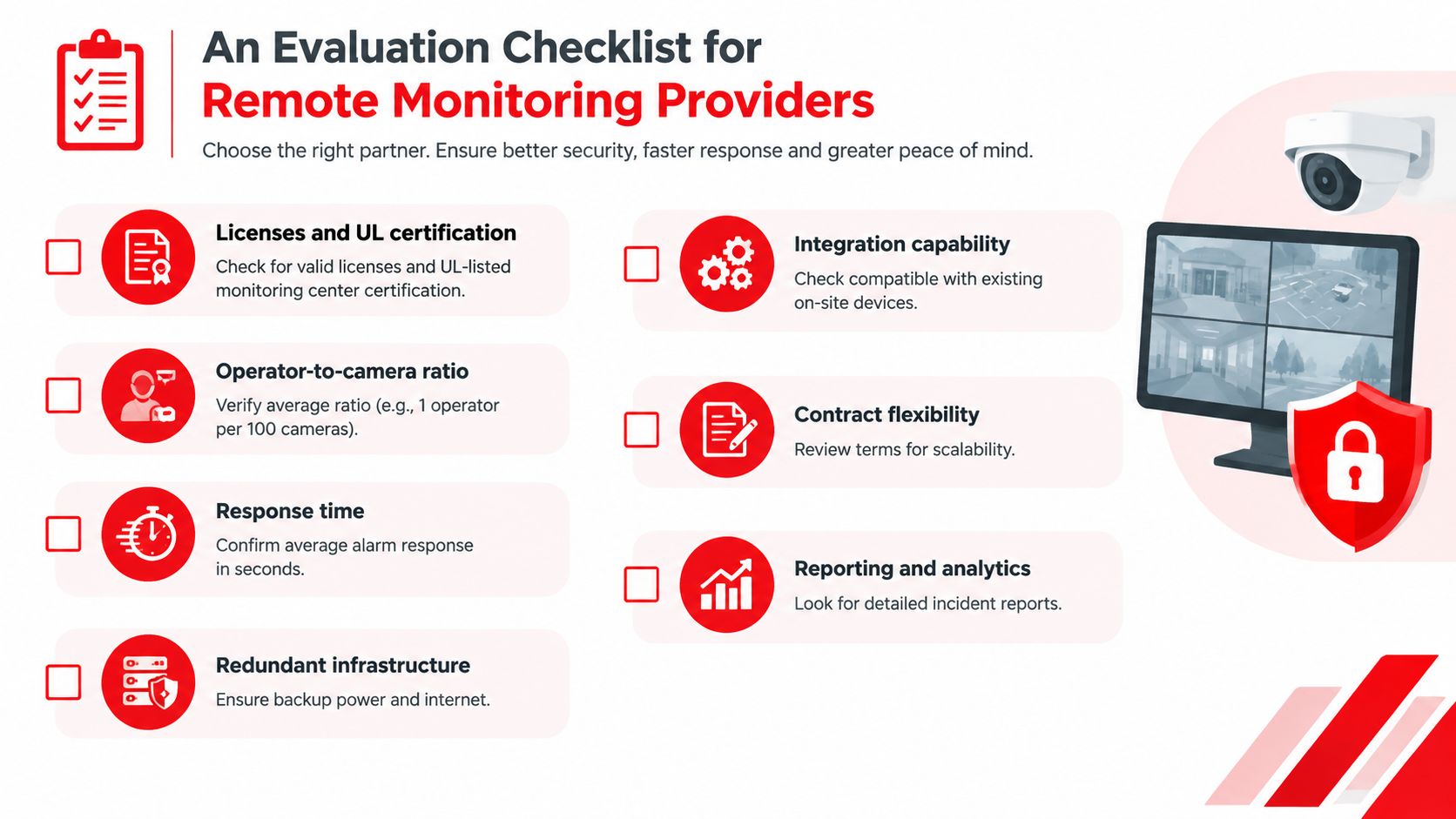
Use this checklist during vendor conversations:
- Licenses and certification: Confirm applicable licenses and ask whether the monitoring center holds relevant UL-listed certification.
- Operator coverage: Request the average operator-to-camera ratio and ask how supervisors handle spikes in activity. A ratio above one operator to 60 cameras should prompt detailed questions about the service design.
- Response commitments: Require written response-time service levels, escalation rules, and contract remedies when the provider misses an obligation.
- Alarm verification: Ask how operators verify alarms and whether the procedure supports local requirements for police dispatch.
- Reporting access: Review a sample incident report. It should show timestamps, operator actions, clips or references to evidence, notifications, and final disposition.
- Cybersecurity controls: Ask about encryption, role-based access, audit logs, retention, incident ownership, and SOC 2 or equivalent attestations.
- Integration: Confirm compatibility with existing cameras, access control, sensors, communication systems, and SOC workflows.
- Pilot terms: Ask whether the provider will run a no-cost pilot using a small group of cameras, ideally selected from different risk areas.
A vendor that only demonstrates cameras is demonstrating hardware. A monitoring provider should demonstrate decisions, escalation, and documentation.
Two signals reveal whether the provider will manage the account or merely pass coverage through a platform. The first is a low manager-to-client ratio, which gives the account team enough capacity to learn the property, update post orders, and respond to recurring issues. The second is real-time digital reporting that managers can audit from a phone rather than waiting for a vague monthly summary.
Overton Security Services presents one example of this operating approach. The California-based company combines a 24/7 SOC, GPS-enabled guard tours, digital daily activity reports, photo uploads, and a low manager-to-client ratio, while supporting onsite security officers, vehicle patrol services, construction security, and remote monitoring across markets including Los Angeles, San Jose, San Diego, and Sacramento.
ROI Compliance and Cybersecurity Considerations
A mature remote monitoring program connects operational return with risk control. Reduced unnecessary dispatches, more focused guard hours, faster incident resolution, and reliable documentation can all support the business case, but only when the provider measures the right outcomes.
The global remote monitoring service market reached an estimated US$16,673.4 million in 2024 and is projected to reach US$23,998.6 million by 2030, with about 6.1% CAGR from 2025 through 2030, according to Grand View Research's remote monitoring market data. That expansion indicates sustained demand, but market growth doesn't prove that every property receives equal value. Site conditions, camera design, alert quality, response rules, and management discipline determine the result.
Cybersecurity and governance deserve equal attention. Cloud-based systems require clear answers about who controls video, how long footage is retained, who can access it, how access is audited, and what happens if a connected camera or platform is compromised. For hospitals, mixed-use properties, and multi-state retail portfolios, the purchase is partly a data infrastructure decision.
| Dimension | What to Look For | Decision-Maker Question |
|---|---|---|
| Operational return | Verified alarms, response records, and reduced nuisance activity | Which recurring costs should this program change? |
| Compliance | Applicable licenses, monitoring-center certification, and documented procedures | Will the service satisfy our insurer, ordinance, and internal requirements? |
| Data governance | Retention rules, access controls, audit logs, and incident ownership | Who can view, export, or delete footage? |
| Cyber posture | Independent attestations, testing summaries, encryption, and recovery planning | What happens if the platform or camera network is breached? |
| Contract accountability | Written SLAs, escalation trees, reporting standards, and remedies | What does the provider owe us when service falls short? |
Ask for sample incident reports, the provider's latest penetration-test summary, and written SLA penalties before signing. For teams that need an outside view of security testing, compliance-ready pentest reports can help organize the documentation conversation with technology vendors and internal stakeholders.
Remote security monitoring services should make responsibility clearer, not blur it. Before approving a program, match the monitoring hours and response model to the property's actual exposure, then verify that the technology, people, process, and contract all support the same plan.
Overton Security combines 24/7 SOC oversight with professional onsite officers, GPS-enabled patrols, digital reporting, and customized response procedures for properties across California. Visit Overton Security to discuss your cameras, patrol needs, and site risks with a security partner that can build a practical layered monitoring program.