
Hiring a security guard is about much more than just placing a uniform on your property; it’s an investment in peace of mind, asset protection, and the well-being of your people. This decision is critical, whether you’re a property manager, a business owner, or an HOA board member. To get it right, you need to move past simple cost comparisons and understand the whole process. This guide is your roadmap to making a confident and informed choice.
Your First Step in Hiring Security Guards
The decision to hire security guards directly impacts the safety and perception of your property. For property managers balancing tenant satisfaction, construction superintendents protecting valuable assets, or retail owners focused on loss prevention, the stakes are high.
Making the right choice involves more than a quick search for “security guards for hire.” It demands a deliberate approach to find a genuine security partner, not just another vendor.
This guide breaks down the core pillars of a successful security partnership:
- Thorough Assessment: It all starts with understanding your specific vulnerabilities and goals before you even start looking.
- Diligent Vetting: You need to know the right questions to ask to tell the professional firms apart from the unreliable operators.
- Clear Contracting: This ensures the services you were promised are the services you actually get, with no grey areas.
- Proactive Management: This turns a simple security presence into an effective, integrated security program that truly works.
Key Insight: A successful security program is built on partnership. It’s a team effort between you and your provider, focused on shared goals like safety, deterrence, and protecting your assets.

To help you get started, we’ve broken down the hiring journey into four essential stages. Think of these as the foundation for building a robust security plan.
Core Pillars of Hiring Effective Security
| Pillar | Key Objective | Why It Matters |
|---|---|---|
| Assessment | Clearly define your security needs, risks, and goals. | A vague plan leads to ineffective security. Knowing what you need to protect is the first step to protecting it well. |
| Vetting | Evaluate potential providers for professionalism, licensing, and experience. | The quality of the company directly determines the quality of the guards. This step separates the pros from the pretenders. |
| Contracting | Create a clear, detailed agreement outlining duties, costs, and expectations. | A solid contract prevents misunderstandings and ensures accountability. It’s your blueprint for the partnership. |
| Management | Onboard, manage, and continuously evaluate your security program. | Good security isn’t “set it and forget it.” Ongoing management ensures your program remains effective and adapts to new threats. |
Treating each of these pillars with the attention it deserves is the surest way to build a security program that delivers real value and peace of mind.
Why This Process Matters More Than Ever
The demand for qualified, professional security is on the rise. As cities grow and properties expand, more decision-makers are turning to dedicated security services to manage risk. This isn’t just a feeling; the numbers back it up. In 2023, the global security guard market was valued at around $220 billion. It’s projected to hit an incredible $350 billion by 2032, all driven by the growing need for reliable protection. You can discover more insights about security market growth and its drivers.
But this growth creates a crowded, and often confusing, marketplace. It’s filled with everyone from highly experienced firms to new, unproven operators. Knowing how to navigate this landscape is the key to securing your property effectively.
At Overton Security, we believe an informed client is the best partner. With over 26 years of experience, we’ve seen firsthand what separates a successful security plan from a failed one. It always starts with a clear, methodical hiring process. This guide gives you the same framework we use to build lasting, effective security programs for our clients across California, from Los Angeles to San Jose. We focus on quality over quantity—a principle that begins by helping you define what quality means for your specific needs.
Defining Your Specific Security Needs
Before you pick up the phone to call a security provider, it’s essential to get a crystal-clear picture of what you’re trying to achieve. This isn’t just about saving money—though it certainly helps prevent overspending. It’s about avoiding the far more costly mistake of leaving a critical vulnerability exposed. A solid self-assessment is the foundation for any security plan that actually works.
The idea is to get specific. “We need better security” is a starting point, not a plan. For a construction superintendent in San Jose, the real goal might be to deter theft of copper wiring and expensive equipment after hours. For a property manager in Los Angeles, the priority could be creating a visible presence that prevents loitering and helps shoppers feel safe in the parking garage.
Going through this process helps you build a detailed “scope of work.” When you share this with potential security partners, everyone is on the same page from day one.
From Vague Concerns to Actionable Goals
To define what you really need, look at your property through three lenses: your assets, your people, and your environment. Answering a few key questions will bring your requirements into sharp focus.
- What are you protecting? Is it physical inventory in a warehouse? High-value tools on a construction site? Or the peace and quiet of a residential community?
- Who needs protection? Are you concerned for employees working late shifts? The safety of customers during business hours? Or ensuring residents in an HOA feel secure in their homes?
- What are the primary risks? Is your main challenge vandalism? Organized retail crime? Unauthorized access after hours? Or are you preparing for potential conflicts at a large public event?
Thinking this through makes it clear whether you need a stationary guard watching a single entrance or a mobile patrol covering a large property.
This simple flow chart shows how those answers translate directly into clear job requirements for your security team.
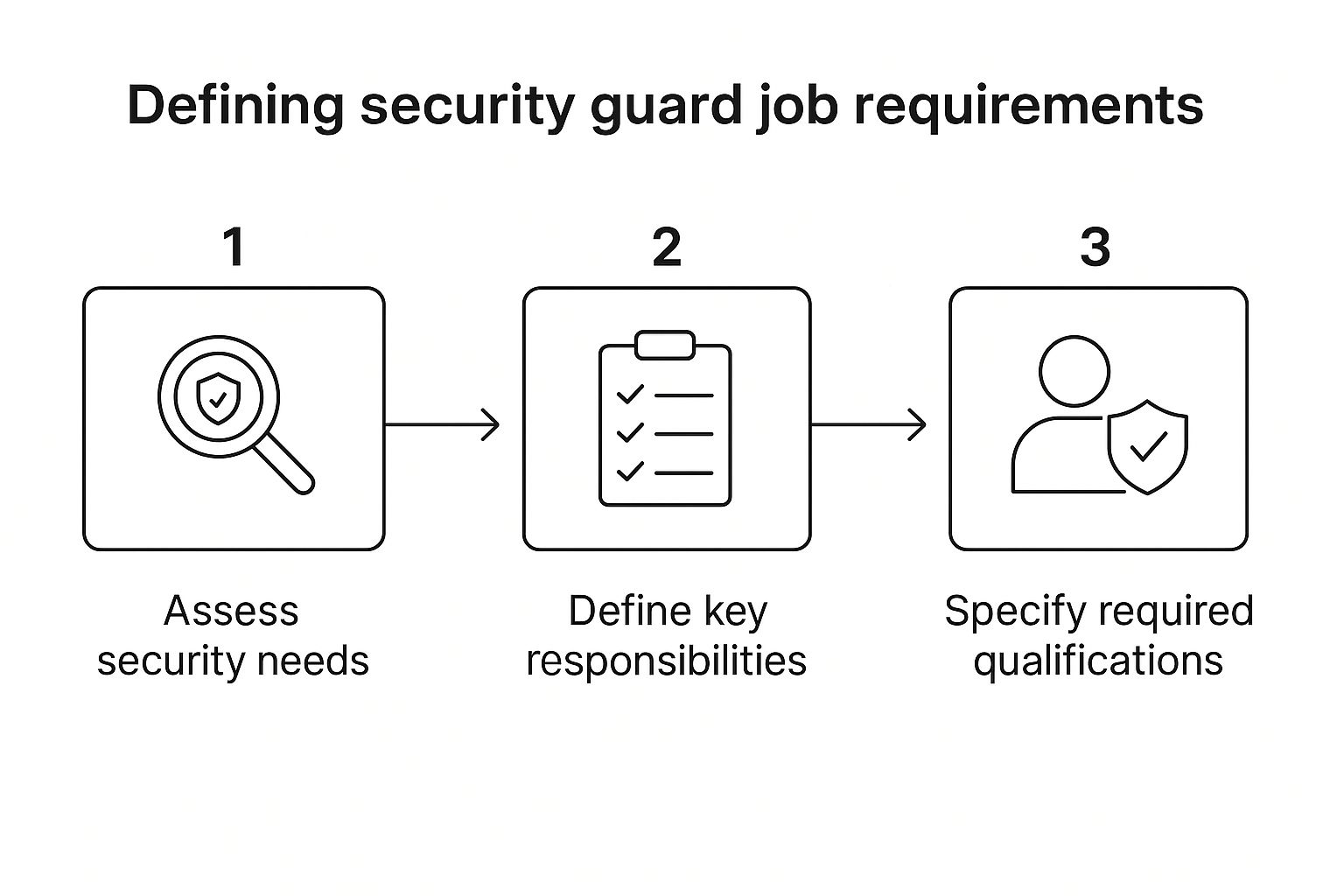
As you can see, a successful security plan always starts with a thorough assessment. That assessment then logically defines the officer’s duties and the skills they’ll need to succeed.
Static vs. Mobile: Deciding on the Right Presence
Once you’ve identified your core risks, you can determine what kind of security presence will best address them. Your needs will point you toward either a static (or standing) guard or a mobile vehicle patrol.
A static guard is ideal for controlling a specific, fixed location. Think about:
- The front desk of a Class A office building, managing visitors and maintaining a professional atmosphere.
- A gatehouse at a residential community, verifying every person who enters.
- A single point of entry at a special event, where guards check tickets and provide a reassuring presence.
On the other hand, mobile patrols are the solution for covering large areas where a constant physical presence isn’t practical, but regular, visible checks are essential. A patrol officer can efficiently cover multiple spots across a sprawling apartment complex, a massive industrial park, or a multi-building commercial campus. For a closer look at what each type of officer does, you can read our article on the differences between courtesy patrol and security guards.
Key Takeaway: The choice isn’t just about coverage; it’s about function. Static guards excel at access control and immediate response at a fixed point, while mobile patrols provide a powerful deterrent and inspection capability over a wide area.
Often, the most effective security programs we build for our clients use a hybrid approach. A large retail center, for example, might have a static officer at its main entrance during the day and supplement that with vehicle patrols to monitor the entire parking lot and perimeter overnight.
This kind of customized plan, built from a careful needs assessment, is the hallmark of a true security partnership.
Vetting Security Companies to Find a True Partner
Choosing a security company is one of the most important decisions you’ll make for your property. Get it right, and you gain a powerful layer of protection and genuine peace of mind. Get it wrong, and your “security” provider can quickly become your biggest liability.
This vetting process is where you separate true security partners—those invested in your success—from vendors simply looking to fill a shift. It goes far beyond comparing hourly rates. You need to dig into the company’s operational integrity, its people, and the systems it uses to ensure the job gets done right. This is how you find a firm that truly understands your goals, whether you’re a facilities director at a corporate campus or an HOA board member for a residential community.
The Non-Negotiable Foundations
Before you consider a sales pitch, you must verify the absolute basics. Any hesitation from a company to share this information is a massive red flag. There’s no room for compromise here.
Your initial checklist must include:
- State Licensing: The company must hold a valid Private Patrol Operator (PPO) license from the relevant state authority, like California’s Bureau of Security and Investigative Services (BSIS). This isn’t optional; it’s the law.
- Adequate Insurance: Ask to see their certificates of insurance. A reputable firm will carry substantial General Liability coverage, often $1 million or more per occurrence. Just as important is a valid Workers’ Compensation policy for all its officers. If a guard gets hurt on your property and the company isn’t properly insured, that financial responsibility could fall on you.
- Transparent Operational History: A company with a solid history, like Overton’s 26 years in business, will be proud of it. Ask about their experience with properties like yours, whether it’s a busy retail center in Los Angeles or a quiet commercial building in San Jose.
Key Insight: These credentials aren’t just paperwork. They are proof of a company’s commitment to operating legally, protecting its clients from liability, and demonstrating a stable business foundation. Don’t just take their word for it—ask for copies of the documents.
Digging Deeper: The Indicators of Quality
Once the fundamentals are confirmed, it’s time to find out what kind of service you’ll actually receive. This is where you uncover the difference between a company that just places bodies and one that deploys professional, reliable security officers. The questions you ask here reveal everything.
A critical area to probe is employee retention. The security industry is known for high turnover, which directly leads to inconsistent service, inexperienced guards, and a frustrating cycle of retraining. A company that invests in its people is investing in your security.
Ask them directly: “What is your annual employee turnover rate?” A low number is a powerful indicator of a healthy company culture and professional officers who take pride in their work. At Overton Security, we are committed to supporting and retaining our officers, a stark contrast to the “burn and churn” model common in the industry.
This focus on people is more important than ever. The demand for security guards is on the rise, with projections showing a 3% increase in employment between 2020 and 2030. What’s more, contract services dominate the field, making up nearly 70% of the North American security market in 2020. With so many options, picking a provider that retains its best people is essential. You can read more about security guard employment statistics to see just how competitive the market is.
Accountability and Hands-On Management
Finally, how do you know the promises made in the sales meeting will actually happen on-site at 3 a.m.? The answer is found in their management structure and accountability systems. This is where human expertise and smart technology must work together seamlessly.
A great metric to ask about is the manager-to-client ratio. Many large national providers overload their account managers with dozens of clients, making proactive site visits and personal attention nearly impossible. At Overton Security, we maintain a low manager-to-client ratio so our leadership has the bandwidth to conduct frequent inspections, build real relationships with officers and clients, and solve problems before they grow.
This hands-on leadership needs to be backed by modern tech. Ask potential partners about their accountability tools:
- Do they use a GPS-enabled guard tour system to verify patrols are being completed correctly and on time?
- Will you get detailed digital reports with photos and time-stamped notes sent directly from the officer on duty?
- Is there a 24/7 Security Operations Center (SOC) providing real-time oversight and support for officers in the field?
These systems create a framework of transparency that proves the work is being done right. For property managers overseeing sites in places like San Jose, having this kind of verifiable data is a game-changer. We even put together a detailed guide on how to choose a security company in San Jose that covers more of these local considerations.
By vetting a company on these three levels—foundations, people, and accountability—you can confidently move beyond just price and find a partner who will truly protect your assets.
Decoding Security Contracts and Pricing Models

Once you’ve narrowed your list of potential security partners, the service contract becomes the single most important document you’ll handle. Think of it as the official blueprint for your entire security program. Getting the details right is vital. A contract that’s vague or poorly written is a recipe for confusion, unmet expectations, and serious gaps in your protection.
You need to sign that document with complete confidence, knowing exactly what you’re paying for. This goes way beyond just the hourly rate. As a property manager or facilities director, your job is to ensure the service you receive is the same one you were promised.
Key Clauses Every Security Contract Must Have
A professional security agreement is clear, detailed, and transparent. It’s designed to protect both you and the provider by making sure everyone is on the same page. Before you sign, comb through the document and find these essential parts:
- Detailed Scope of Services: This section must spell out exactly what the security provider will do. It can’t be generic fluff. Look for specific duties tied directly to the “post orders”—the day-to-day instructions for the officers on your site.
- Term Length and Termination Conditions: Check the contract’s start and end dates. More importantly, understand how you can exit the agreement if the service isn’t meeting expectations. A fair contract will almost always include a 30-day or 60-day termination clause for either party, giving you flexibility without penalty.
- Liability and Insurance: The contract must clearly outline the provider’s insurance coverage, especially general liability and workers’ compensation. This protects you from being financially responsible for any incidents or injuries involving security staff on your property.
- Invoicing and Payment Terms: This part defines the billing cycle, when payments are due, and what happens if a payment is late. Ensure it aligns with your own accounting processes to avoid any future headaches.
A solid contract doesn’t leave things open to interpretation. It builds a foundation of accountability so that everyone, from the company’s owner to the guard on duty, knows precisely what’s expected.
Why the Cheapest Bid Is Rarely the Best Value
When you’re comparing proposals on how to hire security guards, it’s tempting to be drawn to the lowest price. But in the security industry, a rock-bottom bid should be a significant concern. An unusually low price is a sure sign that the company is cutting corners somewhere, and those cuts almost always impact the quality and reliability of your protection.
At Overton Security, we’ve built our reputation over 26 years by investing in quality, not by being the cheapest option. We know that true security value comes from reliability, professionalism, and proactive service—not from an unsustainable hourly rate.
The final cost of your security program is a direct reflection of the value you receive. Simply put, higher-quality service costs more because it’s backed by real investment in people and technology.
Here’s what goes into a fair and effective pricing model:
- Officer Experience and Pay: Quality security companies pay their officers a competitive wage. This helps them attract and retain experienced, motivated professionals. Low-bid companies often pay minimum wage, leading to high turnover and disengaged guards.
- Specialized Training: Are officers trained in de-escalation, first aid/CPR, or specific protocols for your site? That advanced training costs money, but it results in officers who are far more capable when it matters most.
- Integrated Technology: Modern tools like GPS-enabled patrol tracking, real-time digital reporting software, and 24/7 SOC oversight add tremendous value and transparency. They have associated costs, but they provide undeniable proof of service.
- Active Supervision: A dedicated manager who regularly visits your site, checks on the officers, and serves as your direct point of contact is a hallmark of quality service. This hands-on leadership is a crucial part of the price and is often the first thing cut by low-cost providers.
When you look at a proposal, remember you aren’t just buying an officer’s time. You’re investing in the entire operational infrastructure that supports them.
Managing Your Security Team for Long-Term Success

Signing the contract isn’t the finish line—it’s the starting line. This is where the real work and true partnership begin. Onboarding and proactive, ongoing management are what separate a simple security presence from a robust, fully integrated security program. This is where clear communication and solid accountability systems come together to deliver the results you expect.
For property managers and facilities directors, this transition is absolutely critical. A smooth launch sets the tone for the entire relationship. It ensures your security team hits the ground running, fully prepared to protect your assets from day one.
The Power of Crystal-Clear Post Orders
If there’s one tool that dictates the success of your on-site security, it’s the post orders. These are the detailed, site-specific instructions guiding your officers through their daily duties, patrol routes, and emergency responses. Vague or incomplete post orders are a direct path to inconsistent service and glaring security gaps.
A quality provider will work directly with you to create and refine these instructions before the first officer ever sets foot on your property. Think of them as the operational playbook for your site.
Effective post orders must include:
- Daily Duties and Patrol Routes: Specific instructions on what to check, when to check it, and the exact path for every patrol. No ambiguity.
- Access Control Procedures: Clear rules for handling employees, visitors, vendors, and deliveries.
- Emergency Protocols: Step-by-step actions for fire, medical emergencies, security incidents, and any other scenario relevant to your site.
- Communication Chain of Command: Who to contact, when, and for what reason—both within the security company and your own organization.
At Overton Security, we treat post orders as a living document. We don’t just write them and forget them. We regularly review and update them with our clients to adapt to changing needs, ensuring our officers always have the most current instructions.
Using Technology to Drive Accountability
In modern security, trust should always be verified. Technology now provides a level of transparency that was unimaginable years ago, allowing you to see that the services you’re paying for are being delivered correctly and consistently. This is a game-changer for anyone managing a property portfolio or a large construction site.
The fusion of technology with manned services is reshaping the industry. Real-time communication, surveillance, and incident management software aren’t just add-ons; they’re core components that make security operations more effective. As security firms invest more in these tools, the hiring process will naturally favor candidates skilled in both traditional security and technology. For a deeper dive, you can read the full research on manned security and technology to see where the industry is heading.
Ultimately, these systems provide the proof of performance that every client deserves.
Key Takeaway: Modern security management isn’t about hoping the job gets done; it’s about having the data to prove it. Technology like GPS tracking and digital reporting removes guesswork and builds a foundation of trust through verifiable performance.
This tech-driven approach gives you a clear window into your security program’s daily operations. It offers peace of mind and concrete data for performance reviews.
Onboarding Your New Security Provider
A smooth transition is everything. A well-planned onboarding process ensures your new security team understands your specific needs, site layout, and company culture from the very beginning. This checklist breaks down the essential steps to integrate your new provider seamlessly.
Onboarding Checklist for Your New Security Provider
| Onboarding Step | Key Action | Desired Outcome |
|---|---|---|
| 1. Initial Kick-Off Meeting | Introduce key personnel from both teams. Review the contract and service level agreement (SLA). | Everyone knows who to contact. Expectations are aligned from day one. |
| 2. Site Walk-Through | Your provider’s management team walks the entire property with you. | Identify critical areas, potential vulnerabilities, and confirm patrol routes. |
| 3. Post Order Development | Collaboratively draft and finalize site-specific post orders. | Clear, actionable instructions are ready before the first shift begins. |
| 4. Technology Integration | Set up and test all security technology (e.g., patrol tracking, reporting software). | All systems are operational and providing data. Your team has access and training. |
| 5. Officer Introduction | Introduce the assigned security officers to your key staff members. | Build rapport and establish a professional working relationship. |
| 6. First-Week Review | Hold a brief meeting at the end of the first week to discuss performance. | Address any initial issues immediately and make necessary adjustments. |
Following a structured plan like this prevents misunderstandings and sets the stage for a successful, long-term partnership. It transforms a simple vendor hand-off into a true operational integration.
The Provider’s Role in Performance Management
Finally, your security provider must be an active partner in managing performance. A “set it and forget it” approach is unacceptable in this field. A firm committed to quality will have its own internal processes to ensure consistent, high-level service delivery.
It all starts with a dedicated point of contact. You should never have to navigate a call center just to get a simple question answered. Our clients at Overton have a direct line to their account manager—a leader who knows their property and specific security needs inside and out.
This hands-on leadership is backed by:
- Regular Site Inspections: Managers should conduct frequent, unannounced visits to the property. They’re there to observe officers, ensure post orders are being followed, and check that uniforms and equipment meet professional standards.
- Continuous Officer Training: The best firms invest in their people. Ongoing training keeps skills sharp, covering everything from de-escalation techniques to updates on client-specific procedures.
- 24/7 SOC Oversight: A Security Operations Center (SOC) provides a critical layer of support and accountability. They monitor officer status, track patrols in real-time, and help manage incidents as they unfold.
By combining clear instructions, transparent technology, and active management, you transform your security guards from a contracted service into a truly integrated and effective part of your operations.
Common Questions About Hiring Security Guards
After 26 years of guiding clients through the process of hiring security, we’ve heard just about every question imaginable. Making this decision, especially if it’s your first time, can feel overwhelming.
We’ve put together some straightforward answers to the questions we get most often from property managers, HOA boards, and business owners across California. Our goal is to give you the clear, practical advice you need to build your security plan with confidence.
Should I Hire Armed or Unarmed Guards?
This is one of the first, and most important, decisions you’ll make. The right choice hinges entirely on your specific situation and risk level—there’s no one-size-fits-all answer here. A firearm introduces a serious level of responsibility and will significantly increase both liability and cost.
- Unarmed Guards are the right fit for the vast majority of properties. They are an excellent visual deterrent, manage access points, observe and report incidents, and maintain overall safety. For most commercial buildings, residential communities, and lower-risk sites, a professional unarmed officer is the most effective and appropriate choice.
- Armed Guards should only be considered for high-risk environments where there’s a credible, specific threat of serious violence. Think high-value assets like jewelry stores or cash-handling businesses, or locations with a documented history of violent crime. Hiring an armed guard demands a much higher level of vetting, and you must verify their specialized training, certifications, and experience.
Key Takeaway: The decision to bring in armed guards should always be a direct response to an identifiable threat. For nearly every other security need, a well-trained, professional unarmed officer delivers the right level of protection.
What Factors Influence the Cost of Security Services?
It’s easy to focus only on the hourly bill rate. But to compare quotes fairly, you have to understand what’s behind that number. A rock-bottom price is often a red flag that a company is cutting corners on the very things that ensure quality and reliability.
Several key factors drive the final price you pay:
- Officer Wages and Benefits: Quality security companies pay their officers a competitive wage. This is the single biggest factor in attracting and keeping experienced, professional talent. Low pay leads directly to high turnover and unmotivated guards on your property.
- Supervision and Management: You want a security partner with a low manager-to-client ratio, which means your site gets more attention. The cost of a dedicated supervisor who performs regular, unannounced inspections is a critical part of any quality service package.
- Technology and Equipment: Modern security runs on tools like GPS-enabled guard tour systems, digital reporting software, and oversight from a 24/7 Security Operations Center (SOC). These systems create accountability and transparency, but they are a real cost for the provider.
- Insurance and Compliance: Proper liability and workers’ compensation insurance is non-negotiable—it protects you. A company operating with skimpy coverage is a huge risk, and their lower price reflects that gamble.
What Are the Biggest Red Flags to Watch For?
As you vet potential security partners, certain warning signs should give you pause. Spotting these red flags early can save you from a partnership that is destined to fail.
Be wary of any company that:
- Offers a Significantly Lower Price: If one bid is drastically cheaper than the others, it’s a giant red flag. They are almost certainly paying minimum wage, skimping on training, or carrying dangerously inadequate insurance.
- Cannot Provide Documentation: A professional firm will have its state license, insurance certificates, and a list of references ready to go. Any hesitation or excuse-making is a deal-breaker.
- Has a Vague Contract: Your service agreement should be clear and detailed. Look out for ambiguous language about an officer’s duties, unclear termination clauses, or fuzzy liability terms. It’s a sign of an amateur operation.
- Lacks a Local Management Presence: If the company’s managers are based hours away from your site, you simply can’t expect responsive service or proper supervision for your guards.
Asking the right questions is the most powerful tool you have. For a more detailed guide, check out our list of essential questions to ask your security company in Sacramento, which provides a solid framework no matter where your property is located.
Article created using Outrank