
Putting up a chain-link fence and a few "No Trespassing" signs is no longer enough to secure a construction site in San Diego. To genuinely protect your project from groundbreaking to ribbon-cutting, you need a smart, layered security plan. It’s about understanding the specific risks we face locally and deploying a strategy that actively prevents theft and vandalism before they happen.
Why San Diego Construction Sites Need a Specialized Security Plan
Let's be direct: a construction site is like an open-air buffet for thieves. You have high-value equipment, stacks of expensive materials like copper and lumber, and a constant rotation of subcontractors. For any construction superintendent or project manager in San Diego, these aren't just hypotheticals—they are daily risks that can derail your timeline and budget.
The real cost of a security breach goes far beyond the price tag of a stolen generator. A single incident can set off a chain reaction of problems that puts the entire project in jeopardy.
The True Cost of Weak Security
Imagine arriving one morning to find a critical piece of heavy machinery has been vandalized or has vanished. The dollar amount to replace it is just the beginning of the problem.
Now, you're dealing with:
- Significant Project Delays: Everything grinds to a halt until that equipment is repaired or replaced. This pushes back every subsequent phase, potentially leading to costly late-completion penalties.
- Rising Insurance Premiums: Once you file a claim, you can expect your insurance costs to go up—not just for this project, but likely for future builds as well.
- Administrative Burdens: Your team is now bogged down filing police reports, dealing with insurance adjusters, and reordering materials instead of managing the build.
These challenges are amplified by the local crime landscape. Construction sites here are a prime target, with San Diego experiencing property crimes at a rate of 18.9 per 1,000 residents. In this environment, an unsecured jobsite is an open invitation. The average resident has a 1 in 53 chance of being a victim of property crime, illustrating how vulnerable an open, asset-rich site truly is. You can get a better sense of how San Diego crime trends impact construction security from official sources.
The threats facing a San Diego construction site range from petty theft to organized crime, each with its own disruptive potential.
Top Security Risks for San Diego Construction Sites
Here is a rundown of the most common threats that project managers in San Diego should have on their radar.
| Risk Type | Primary Threat | Impact on Project |
|---|---|---|
| Material Theft | Copper wire, lumber, plumbing fixtures, and appliances are prime targets. | Causes immediate replacement costs, project delays, and potential rework if installed components are stripped out. |
| Equipment Theft | Small tools, generators, and even heavy machinery like skid steers are stolen. | Leads to significant financial loss, work stoppage, and increased insurance premiums. |
| Vandalism & Sabotage | Graffiti, property damage, or intentional damage to machinery by trespassers or disgruntled individuals. | Results in costly cleanup and repairs, schedule setbacks, and can create safety hazards on site. |
| Trespassing | Unauthorized individuals entering the site after hours, posing liability and safety risks. | Can lead to accidents, injuries, and potential lawsuits, increasing project liability and insurance costs. |
| Internal Theft | Theft of tools or materials by dishonest employees or subcontractors. | Erodes trust, creates a negative work environment, and contributes to inventory shrinkage and financial losses. |
Each of these risks requires a specific countermeasure, highlighting the need for a comprehensive and proactive security strategy.
A security plan of just fences and floodlights is outdated. Determined thieves can easily bypass passive deterrents. A professional security presence is no longer a luxury—it's essential for protecting your investment.
Investing in robust construction site security san diego isn't just an expense. It's a critical component of your risk management strategy, protecting your assets, keeping your timeline intact, and safeguarding your project’s profitability.
How to Conduct an On-Site Security Risk Assessment
Before you can build a solid defense, you need to know where you're vulnerable. A proper on-site risk assessment is more than a quick walkthrough; it's a detailed analysis of your project's specific weak spots. This is the single most important step in creating a construction site security san diego plan that works.
The key is to start thinking like a potential intruder.
Your first move should be to walk the perimeter. Is the chain-link fence truly secure, or are there loose sections, gaps, or overgrown areas that offer a hidden entry point? Look at your site from the street. Can you spot any blind spots where someone could work unnoticed, especially after dark?
Next, turn your attention to access points. This includes every way people and materials get onto your site, not just the main gate. Observe these spots during the morning rush or when deliveries arrive. How are subcontractors and visitors actually being checked in? A chaotic gate is an open invitation for an unauthorized person to walk right in.
This isn't just theory—a weak point can directly lead to theft, which then causes a ripple effect of project delays.
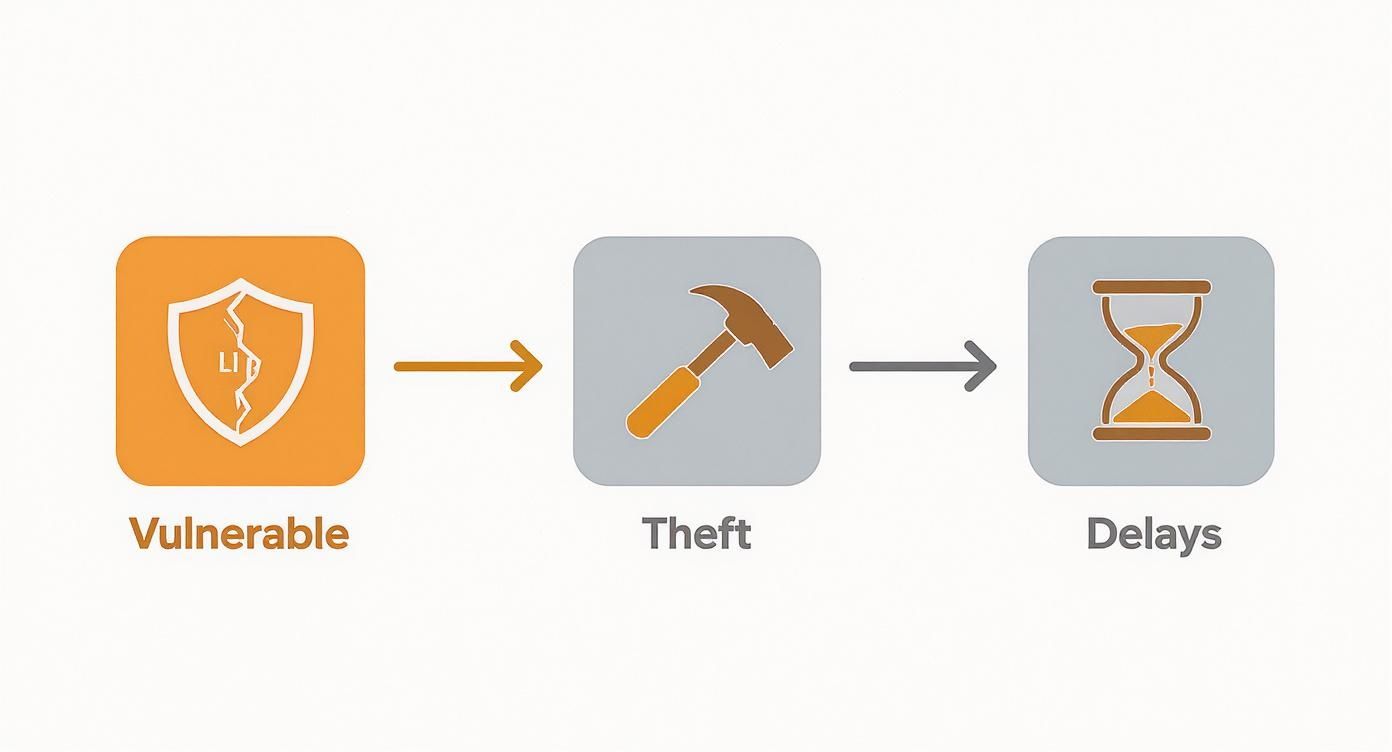
As you can see, one lapse in security isn't a minor issue. It can trigger a domino effect that impacts your schedule and your budget.
Identifying High-Risk Zones and Assets
Every job site has hot spots—areas that are tempting for thieves. Your job is to pinpoint these zones and consider what could realistically happen.
Do another walkthrough at the end of the day, after everyone has gone home. Ask yourself these questions:
- Where is our most expensive equipment stored overnight? Think about generators, heavy machinery, and pallets of copper wire or lumber.
- How secure is our tool container? A cheap padlock on a storage container isn't a deterrent.
- Which parts of the site are poorly lit? Shadows provide cover for criminals.
- Are vehicle keys actually secured? Leaving keys in the ignition of heavy machinery is a surprisingly common and costly mistake.
An honest assessment means putting yourself in an intruder's shoes. What's the path of least resistance? Where would you hide? Answering these questions helps you allocate security resources for the biggest impact.
The best security plans are built on foresight, not hindsight. When you identify vulnerabilities before an incident, you can spend your budget wisely to prevent a loss instead of just filing a report after one.
This detailed evaluation takes you from using generic security measures to deploying a strategy built for your specific site, ensuring every dollar is tackling the real risks your San Diego project faces.
Building a Multi-Layered Security Strategy That Works

Relying on a single security measure for your construction site is a recipe for failure. A determined thief can cut a fence, disable a camera, or wait for a lone guard to be on the other side of the property. True construction site security in San Diego isn’t about one solution; it’s about creating layers.
The most effective defense combines human expertise, a visible mobile presence, and smart technology. It’s about building a complete security ecosystem where each element supports the others, creating a formidable barrier against theft and vandalism.
Integrating On-Site Officers and Mobile Patrols
The foundation of a solid strategy is often the smart combination of stationed officers and mobile patrols. Each plays a different yet complementary role, creating a presence that’s both a steady deterrent and unpredictable to anyone scouting your site.
-
On-Site Security Officers: A professional officer at the main entrance manages access control, verifies subcontractor credentials, and maintains a meticulous log of all entries and exits. Their constant visibility alone is a powerful deterrent when the site is active.
-
Mobile Vehicle Patrols: After hours, the situation changes. Random, high-visibility vehicle patrols are invaluable. Intruders thrive on predictability, and random patrols disrupt their planning. These patrols can check the entire perimeter, secure lockboxes, and inspect high-value equipment storage areas.
This combined approach ensures you don't have gaps in your security as your site’s needs shift from the busy workday to the quiet of night.
Enhancing Security with Modern Technology
Technology is the ultimate force multiplier, extending the eyes and ears of your security team. When you pair smart systems with your on-the-ground personnel, you create a security program that’s truly responsive and accountable.
Construction sites are always seen as soft targets. For example, in 2025, the city saw 137 incidents of armed and strong-arm robbery, and such crimes often happen where valuable assets are left exposed.
By blending a visible officer during the day with random patrols and remote surveillance after hours, you create a holistic security presence that is both proactive and reactive. It sends a clear message that your site is a hard target.
This is where systems like remote video monitoring truly add value. Strategically placed cameras, monitored by a 2_4/7 Security Operations Center, can spot unauthorized activity the moment it happens. This allows for immediate verification and dispatch of a mobile unit or law enforcement.
Your camera system transforms from a simple recording device into an active response tool. You can learn more about how remote video monitoring can protect your site and see how it adds a critical technological layer to your defense.
How to Choose the Right Security Partner in San Diego
Picking the right security partner for your construction site security in San Diego is one of the most important decisions for your project's success. This isn't just about hiring guards; it's about bringing on a team that will protect your investment.
The right partner becomes a seamless extension of your own crew, while the wrong one can open the door to theft, vandalism, and costly delays. It's tempting to focus on the lowest bidder, but experience shows that cutting corners on security almost always costs more in the long run.
Vetting Potential Security Providers
When you meet with a potential security company, you need to cut through the sales pitch and get to the core of their operations. The answers they provide will tell you everything.
Here’s what you need to ask about:
- Officer Training and Retention: Ask them directly about their hiring process, training programs, and turnover rate. High turnover is a significant red flag in this industry, often pointing to poor management and disengaged officers. A company that invests in its people provides officers who are professional, engaged, and reliable.
- Supervisory Oversight: What is their manager-to-client ratio? You're looking for a low number here. At Overton Security, our low ratio ensures our leadership is hands-on and actively involved on-site, not just a voice on the phone managing dozens of locations.
- Technology and Accountability: How do they prove their officers are performing their duties? Ask for a demo of their reporting software. A professional firm will use a GPS-enabled system that provides real-time, time-stamped reports complete with photos and notes for total transparency.
A security provider's willingness to show you their training manuals, introduce you to supervisors, and demo their reporting technology speaks volumes. If they become defensive or vague, it's a sign to look elsewhere.
To help standardize this process, we've put together a checklist. Use this table when comparing companies to ensure you're evaluating them on the same critical criteria.
Security Provider Vetting Checklist
| Evaluation Criteria | Questions to Ask | What to Look For in the Answer |
|---|---|---|
| Experience & Licensing | How long have you been in business? Are you fully licensed and insured in California? | Look for established companies with a proven track record. They should readily provide their BSIS license number and proof of insurance. |
| Officer Training | What does your officer training program involve? Is it ongoing? | A strong answer includes initial classroom training, on-site training specific to your project, and continuous education. |
| Supervision Structure | What is your field supervisor-to-officer ratio? How often do supervisors visit the site? | A low ratio and a commitment to frequent, unannounced site visits show active management of their team. |
| Technology & Reporting | Can you show me a demo of your reporting system? What kind of data will I receive? | They should offer a real-time, GPS-verified system with photo and video capabilities. Vague promises of "daily reports" are not enough. |
| Client References | Can you provide references from other construction projects similar to mine? | A confident provider will have a list of satisfied clients ready. Be cautious if they hesitate. |
| Employee Retention | What is your average employee turnover rate? | A low turnover rate indicates a well-managed company and more experienced, reliable officers. |
This checklist is about finding the right partner for your specific needs—one built on transparency and reliability.
Key Questions to Guide Your Decision
Making an informed choice means looking past the glossy brochures. By understanding the real operational differences between providers, you can quickly spot the ones truly equipped to handle the dynamic environment of a construction site.
This process ensures you find a partner committed to quality, not just filling a shift. For a deeper dive into what separates the best from the rest, our guide on how to identify trustworthy security guard companies in San Diego is a great resource.
Ultimately, choosing a provider with a proven history, like Overton Security's 26 years of experience, means your assets are protected by a team that understands what it takes to secure a San Diego job site.
Putting Your Security Plan Into Action for Maximum Impact
A well-designed security strategy is only as strong as its execution. Once you’ve selected your partner for construction site security in San Diego, the next step is weaving them seamlessly into your daily operations. This is about transforming a plan on paper into a dynamic part of your project’s culture.
This process begins and ends with clear, consistent communication. Your security officers are an essential part of your site's ecosystem and should be a visible, approachable presence from day one.
Building On-Site Collaboration and Communication
Success hinges on the collaboration between your construction crew and the security team. When everyone feels like they're on the same team, you create a unified front where each person understands their role in keeping the jobsite secure.
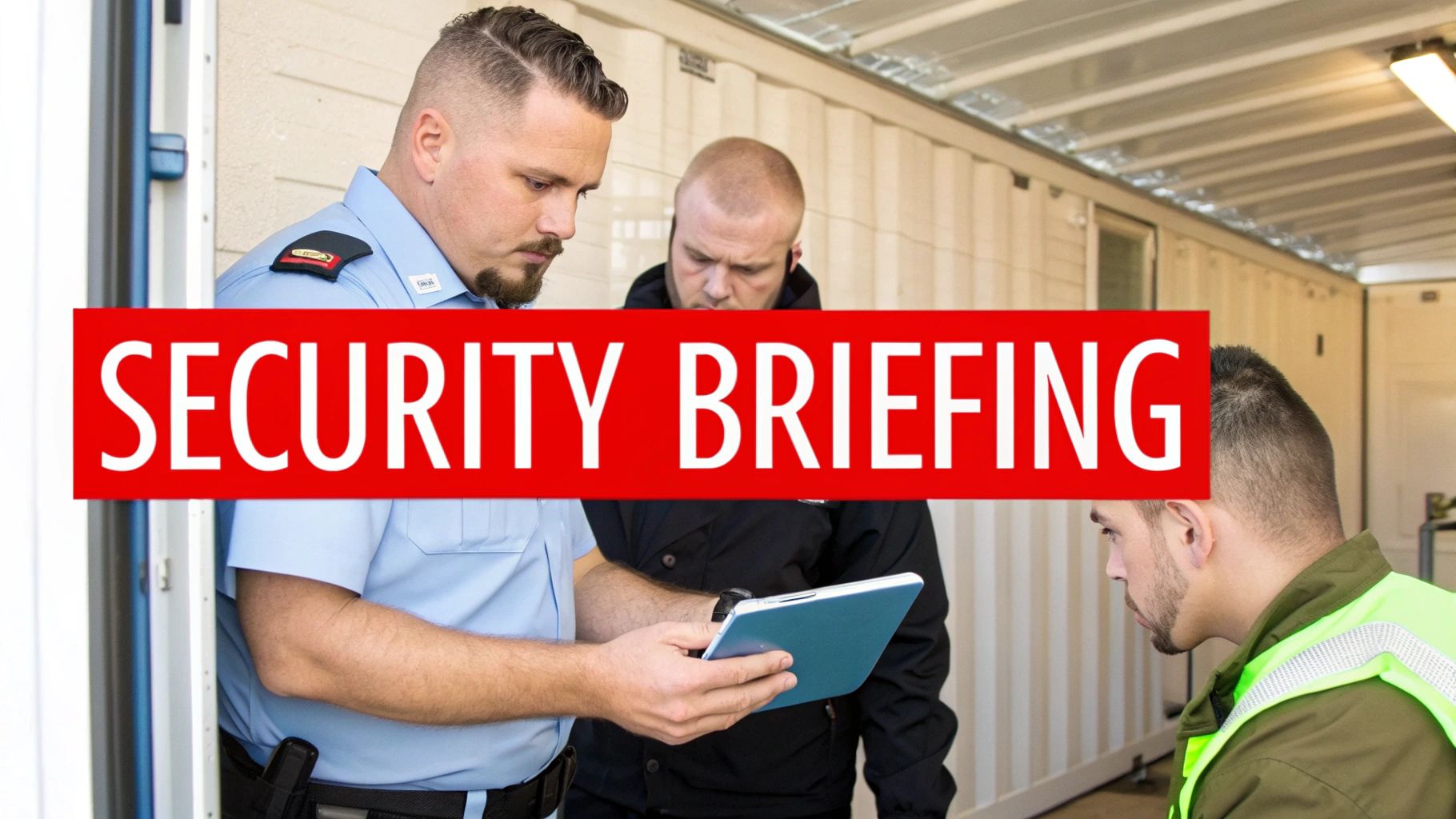
One of the most effective tools for this is the pre-shift briefing. A quick huddle with the site superintendent, key foremen, and the on-duty security officer gets everyone aligned for the day ahead.
Key topics for these briefings should include:
- Daily Deliveries: Give security a heads-up about incoming high-value materials.
- New Subcontractors: Share a list of new teams or personnel expected on-site.
- Site Changes: Point out any new access points or temporarily vulnerable areas.
- Recent Concerns: Discuss any minor incidents or suspicious activity from the previous day.
This open communication prevents misunderstandings and gives your security team the information they need to be proactive.
Using Technology for Real-Time Accountability
Years ago, a paper logbook was the only way to track a security patrol, offering little real insight. Today, technology provides a level of transparency that is essential for accountability. Any professional security partner will use a GPS-enabled guard tour system that gives you undeniable proof of presence and performance.
These systems allow officers to file detailed digital reports in real time, often with photos and timestamped notes. This means you can see exactly when a specific gate was checked or when a high-value equipment area was inspected. It replaces guesswork with reliable data.
This modern approach is crucial in a high-activity region like San Diego. For instance, some established security providers have managed over 65,000 calls for service at local construction sites since 2016, protecting hundreds of properties. Their ability to respond so effectively comes from blending human expertise with this kind of real-time data.
Proactive security does more than just stop theft. It streamlines site logistics, improves overall safety, and contributes to operational efficiency, adding tangible value far beyond a line item on your budget.
Ultimately, a well-implemented plan is about true partnership. Knowing and following specific construction site signage requirements is just as critical as running a patrol. When your crew and your security provider work together, you build a secure environment where your project can stay on schedule and on budget.
For help structuring these daily checks, our security patrol checklist template can be a great starting point.
Your Construction Site Security Questions Answered
When you're managing a multi-million dollar project, you can't afford uncertainty. We get many questions from construction superintendents and project managers across San Diego, and a few common themes always emerge. Here are some straightforward answers to help you make confident decisions.
Is a Dedicated On-Site Guard Better Than Mobile Patrols?
This is the most common question we get, and the honest answer is: it depends on your site, risks, and budget. There's no single right answer for construction site security in San Diego.
A dedicated on-site officer is a powerful, constant deterrent, ideal for high-value projects or sites with one critical entry point. Having that consistent presence is excellent for managing access during the day and providing an instant response overnight.
Mobile patrols, on the other hand, are an effective and budget-friendly way to create a security presence at unpredictable intervals. This randomness keeps potential intruders off-balance. Often, a hybrid approach provides the best of both worlds, blending smart technology with strategically scheduled patrols to maximize coverage without the expense of a 24/7 guard.
How Much Does Professional Construction Site Security Cost?
The cost can vary depending on your needs—unarmed vs. armed officers, the number of patrol visits per night, and other factors. While it is an investment, you have to weigh it against the significant cost of just one major incident.
Consider the price tag of stolen heavy equipment or the cost of project delays from missing materials. These figures almost always dwarf the investment in proactive security. A reputable partner will provide a transparent, detailed quote only after walking the site with you to conduct a proper risk assessment. The goal should always be value and reliability, not just the lowest hourly rate.
Your security budget isn't just an expense; it's insurance against catastrophic delays and losses. The right security partner provides a return on investment by keeping your project on time and your assets on-site.
What Technology Is Most Effective for Jobsite Security?
Today, the most impactful technology integrates live monitoring with a proactive response. It’s no longer just about recording a crime; it’s about stopping it before it happens.
For instance, surveillance systems with two-way audio are very effective. When an agent in a Security Operations Center sees an intruder on camera, they can use a loudspeaker to verbally warn them off the site. This simple action often sends trespassers running before they can cause damage.
GPS-enabled patrol tracking and digital reporting software are also must-haves. This technology provides the real-time proof you need to know your site is being monitored effectively. You get documented confirmation of every patrol and checkpoint inspection. The real power comes from blending smart technology with experienced human oversight.
How Quickly Can You Set Up Security for a New Project?
For an experienced security partner, deployment can be very fast. After an initial consultation and a thorough site assessment, a custom security plan can be drafted and implemented within a few days.
An agile provider understands that construction timelines are urgent. We can get professional officers on-site and establish patrol routes quickly, ensuring your San Diego jobsite is protected from the moment you break ground. As the project evolves, the security plan can adapt right along with it.
Ready to secure your project with a reliable, experienced partner? Overton Security has provided trusted construction site security solutions in San Diego for over 26 years. Contact us today for a complimentary on-site assessment.