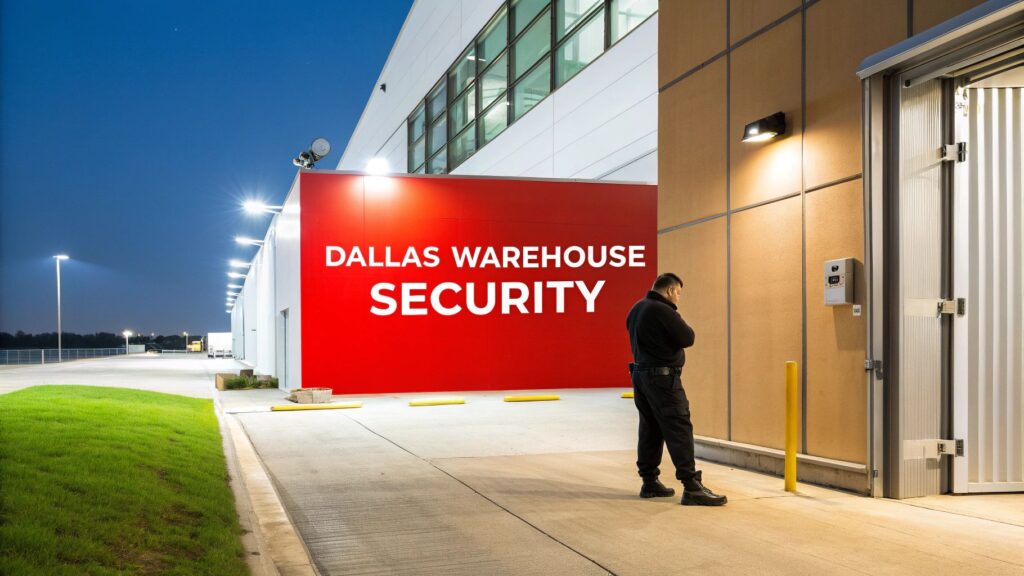
Is your Dallas warehouse truly secure, or just locked? In a massive logistics hub like DFW, a simple lock-and-key policy isn't enough. Real security requires a layered strategy that brings together experienced officers, smart technology, and solid procedures to protect your high-value assets. It's about getting ahead of threats, not just reacting to them.
Why Dallas Warehouses Require Specialized Security
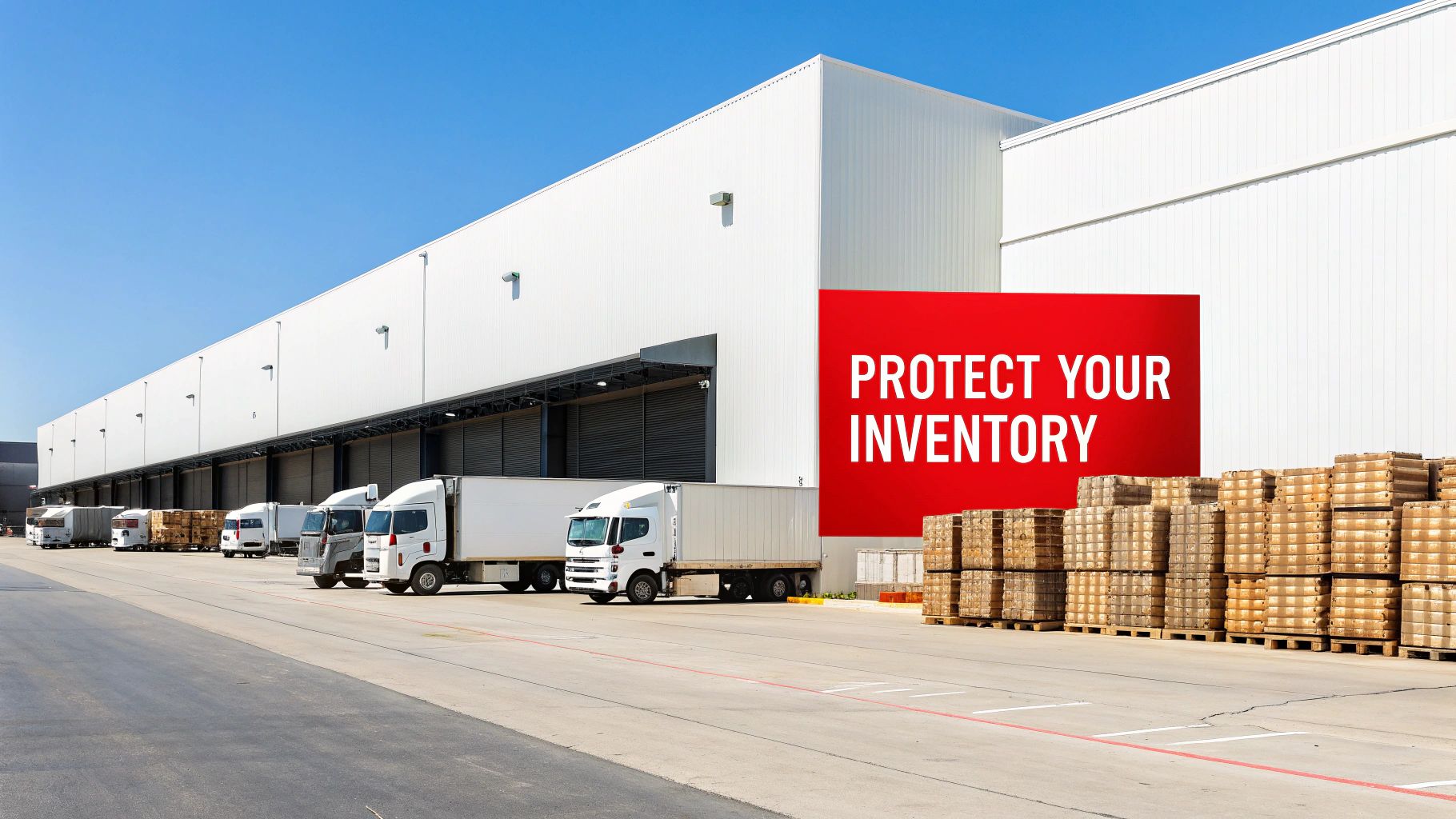
As one of the largest logistics and distribution centers in the country, the Dallas-Fort Worth area presents a high-stakes environment for warehouse and industrial facility managers. The sheer volume of goods moving through the DFW metroplex makes these properties a magnet for crime, from opportunistic theft to highly organized operations. A one-size-fits-all security plan simply won't work here.
The constant flow of trucks, personnel, and inventory creates countless opportunities for security gaps. Without a strategy designed specifically for this dynamic environment, you expose your business to financial and operational risks that extend far beyond a single missing pallet.
The True Cost of a Security Breach
When a security incident occurs, the impact is never limited to the value of the stolen goods. The real damage ripples through your entire operation, leading to costly disruptions, strained client relationships, and a loss of trust that can take years to rebuild.
Consider the domino effect:
- Direct Financial Loss: This includes the cost of stolen inventory, damaged equipment, and repairs to fences, gates, or doors.
- Operational Downtime: A theft can halt your operations. You may face investigations and inventory audits that delay shipments and reduce productivity.
- Rising Insurance Premiums: A history of security issues is a red flag for insurers. You can expect your premiums to climb, impacting your bottom line for years to come.
- Reputational Damage: Word travels fast. Failing to protect your clients' assets can damage your reputation, making it difficult to win new business or retain current partners.
To give you a clearer picture, here's a rundown of the vulnerabilities we frequently see in the Dallas area.
Common Security Gaps in Dallas Warehouses
This table offers a quick look at the most frequent vulnerabilities warehouse managers face and the potential consequences.
| Vulnerability Area | Common Threats | Potential Business Impact |
|---|---|---|
| Perimeter & Access Control | Unmonitored gates, weak fencing, unauthorized vehicle/personnel entry | Cargo theft, vandalism, trespassing |
| Shipping & Receiving Docks | Lax driver check-in, poor inventory tracking, internal collusion | Stolen pallets, inventory shrinkage, fraudulent claims |
| Employee & Visitor Management | Lack of background checks, poor credentialing, no visitor logs | Internal theft, corporate espionage, workplace violence |
| Surveillance & Monitoring | Camera blind spots, unmonitored alarms, lack of after-hours patrols | Undetected break-ins, delayed incident response, liability issues |
As you can see, a small gap can quickly become a major business problem. That's why a proactive, reassuring approach is so critical.
Viewing security as a core business investment—not just another expense—is the first step toward protecting your facility. It's a fundamental part of risk management that directly supports your stability and profitability.
Building a Defense for the DFW Environment
An effective security plan for a Dallas warehouse must be built on a deep understanding of the local threat landscape. It needs to account for the unique risks of managing vast properties and deploy multiple layers of protection to deter, detect, and respond. This requires a partner with proven experience in industrial security and a commitment to quality service.
At Overton Security, we’ve spent over 26 years developing security programs that blend human expertise with reliable technology. We know real protection comes from well-supported officers and transparent systems. Our low manager-to-client ratio ensures your facility gets the hands-on attention needed to create a security posture that delivers peace of mind.
Understanding the Dallas Threat Landscape
To properly secure a Dallas warehouse, you first need a clear-eyed view of the challenges. This isn't about fear; it’s about making smart, informed decisions based on the reality of operating in a major logistics hub. The risks in DFW are unique, driven by the sheer volume of valuable goods moving through the area daily.
These risks fall into two main categories: external threats originating outside your property, and internal threats that begin within your own operation. Both can be damaging, so it's critical to understand how they work—and how they sometimes overlap. Once you see the patterns, you can build a layered defense that shores up your true vulnerabilities.
External Threats Breaking Through the Perimeter
When facilities directors think "security," external threats are often top of mind. These incidents are caused by individuals who have no business on your property, ranging from crimes of opportunity to highly coordinated attacks.
Common external threats include:
- Organized Cargo Theft: As a critical junction in the supply chain, Dallas attracts professional rings specializing in stealing entire truckloads of high-value goods. They are skilled at exploiting lax driver check-in processes or targeting unsecured yards after hours.
- After-Hours Break-Ins: A large, quiet warehouse is a tempting target for burglars seeking electronics, tools, or specific inventory. They actively probe your perimeter for weaknesses like poorly lit corners, camera blind spots, or unsecured fencing.
- Vandalism and Trespassing: While seemingly minor, these issues can lead to significant costs. More importantly, they signal to more sophisticated criminals that your property isn't closely monitored, increasing the risk of property damage and liability issues.
Local data brings these challenges into focus. For instance, commercial break-ins in Dallas are reported at a rate of about 585 per 100,000 residents, which is nearly double the Texas state average. You can review the Dallas crime rate insights to see how these statistics compare. This elevated rate makes it clear that warehouses and commercial properties face a distinct level of risk in the DFW metroplex.
Internal Risks Undermining from Within
While outside dangers are significant, internal threats can be far more subtle and destructive. These risks come from individuals you trust with access to your facility—employees, contractors, or vendors—who exploit that trust for personal gain.
The danger here is that these individuals already know your layout, procedures, and security blind spots. That inside knowledge makes their actions difficult to detect until losses have accumulated.
Internal theft is often a slow bleed, occurring over weeks or months through small, seemingly insignificant actions. Without strict controls and oversight, these minor incidents can accumulate into a major financial drain.
Key internal risks to watch for:
- Employee Theft: This is the most common internal risk, ranging from an employee pocketing products for personal use to a coordinated scheme involving multiple staff members.
- Procedural Gaps: Weak inventory management, inconsistent access control, and a lack of accountability create opportunities for theft. If procedures for logging inventory or verifying shipments are not followed meticulously, goods can easily vanish.
- Vendor or Contractor Fraud: Third parties with access to your facility, such as cleaning crews or maintenance technicians, can also pose a risk if they aren't properly vetted and monitored while on-site.
Understanding this dual threat landscape—from both the outside and inside—is the foundation of a solid security plan. It clarifies that effective Dallas warehouse security is about more than just a better fence. It's about building a complete system where people, technology, and procedures work together to protect your assets from every angle.
Your First Line of Defense: On-Site Security Officers
Technology is a valuable tool, but for securing a sprawling Dallas warehouse, nothing replaces the presence, judgment, and responsiveness of a trained security officer. A camera can record a crime, and an alarm can signal a breach. A professional officer on the ground, however, provides your best opportunity to prevent it from happening in the first place.
Their presence sends a powerful message to potential criminals: this is a hard target, so move on. This human element is the active, thinking layer of your security strategy. An officer can investigate an unusual sound, challenge an unauthorized individual, or spot a damaged fence on a routine patrol—tasks that technology alone cannot perform.
Standing Guards vs. Mobile Patrols
Effective Dallas warehouse security often involves a smart mix of both standing guards and mobile patrols. Determining the right blend for your facility's layout and vulnerabilities is key to building a defense that is both robust and cost-effective.
A standing guard is ideal for controlling critical entry and exit points. They act as gatekeepers for your operation, stationed at locations like:
- Main gates for vehicle and personnel access
- Busy shipping and receiving docks
- Employee and visitor entrances
Their role is to verify credentials, maintain detailed access logs, and inspect outbound vehicles to ensure inventory is secure.
Mobile patrols, on the other hand, are designed to cover large areas. For facilities with extensive perimeters, sprawling parking lots, or remote storage areas, a single guard cannot see everything. These officers use marked vehicles to conduct random, visible patrols, creating an unpredictable presence that serves as a powerful deterrent to after-hours break-ins and vandalism.
The Overton Difference: Officer Retention and Hands-On Leadership
High turnover is a persistent issue in the security industry, and it directly undermines your safety. When a provider constantly cycles through staff, your property is often protected by new people unfamiliar with its layout, routines, or specific vulnerabilities. Those gaps are where incidents occur.
At Overton Security, we have built our 26-year reputation on a different philosophy. We believe in quality over quantity, starting with how we support our team. We invest in our officers with competitive pay, professional growth opportunities, and a culture that values their expertise. As a result, we have one of the best retention rates in the business. The officers watching over your site are consistent, experienced, and know your operation inside and out.
A security officer who knows your facility—from the camera blind spots to the normal rhythm of after-hours activity—is your greatest asset. Consistency in personnel translates directly to stronger, more intuitive protection.
Our hands-on leadership holds this all together. Unlike large national firms where one manager is stretched across dozens of clients, our leaders are actively involved. They conduct frequent site visits, maintain open communication, and resolve small problems before they escalate. It’s how we ensure our unarmed security guard services live up to the promise we make to every client.
Imagine an Overton patrol officer conducting a late-night check at your Dallas facility. They don't just drive by. They exit the vehicle and walk the fence line, spotting a cut section—a clear sign of a potential breach. Because they are well-trained and empowered, they immediately report it and secure the area, turning a potential disaster into a minor issue. That is the proactive judgment only a professional, well-supported officer can provide.
Integrating Smart Technology for 24/7 Oversight
While a skilled officer provides an indispensable human presence, the best Dallas warehouse security strategies pair that expertise with reliable technology. This combination creates a seamless, 24/7 defense, giving you complete oversight of your facility even when you aren't there. This isn't about chasing trends; it's about using proven tools to gain actionable intelligence and peace of mind.
Think of modern technology as a powerful force multiplier. It extends the reach and effectiveness of your on-site team, ensuring every corner is monitored, every door is controlled, and every incident is documented with clarity. This integration elevates a standard security plan into a robust, layered defense system.
The Core Components of a Tech-Enabled Defense
For a busy warehouse, a few key technologies form the backbone of a strong security posture. Each plays a specific role in deterring threats, detecting breaches, and providing the evidence needed for a swift response.
- High-Definition Surveillance: Modern cameras offer crystal-clear video, night vision, and even thermal imaging. When paired with video analytics, they can automatically flag unusual movement, identify unauthorized vehicles, and alert monitors to problems as they happen.
- Modern Access Control Systems: The days of simple lock and key are over. Keycards, fobs, and biometric scanners create a complete digital record of everyone who enters and exits. This allows you to secure sensitive areas and instantly revoke access if a security issue arises.
- Professionally Monitored Alarms: Door contacts, motion sensors, and glass-break detectors are essential after-hours guardians. When connected to a professional monitoring service, a triggered alarm guarantees an immediate response.
These tools are effective on their own, but their true power is realized when they work together as a cohesive system.
Bringing It All Together with 24/7 SOC Oversight
The brain of this integrated system is a 24/7 Security Operations Center (SOC). This command hub is where trained professionals monitor your alarms and live camera feeds, and dispatch officers to investigate potential issues. It’s the human oversight that ensures the technology is always working for you.
At Overton Security, our SOC is the nerve center for your facility's protection. If an alarm is triggered at your Dallas warehouse at 2 a.m., our team responds instantly. They can access your cameras to verify the threat, dispatch the nearest GPS-tracked mobile patrol unit, and coordinate with local law enforcement—all within minutes. You can learn more about how our team provides this crucial oversight through our remote video monitoring services.
This integrated approach has never been more critical. Globally, warehouse theft has risen over the past two years. In fact, more than 40% of surveyed facilities reported an increase in these incidents, a stark reminder of the growing threat in logistics hubs like Dallas. This trend underscores the need to combine physical security measures, from video analytics to access control, to protect your valuable inventory.
The diagram below illustrates how different on-site security roles, supported by technology, create a true hierarchy of protection.
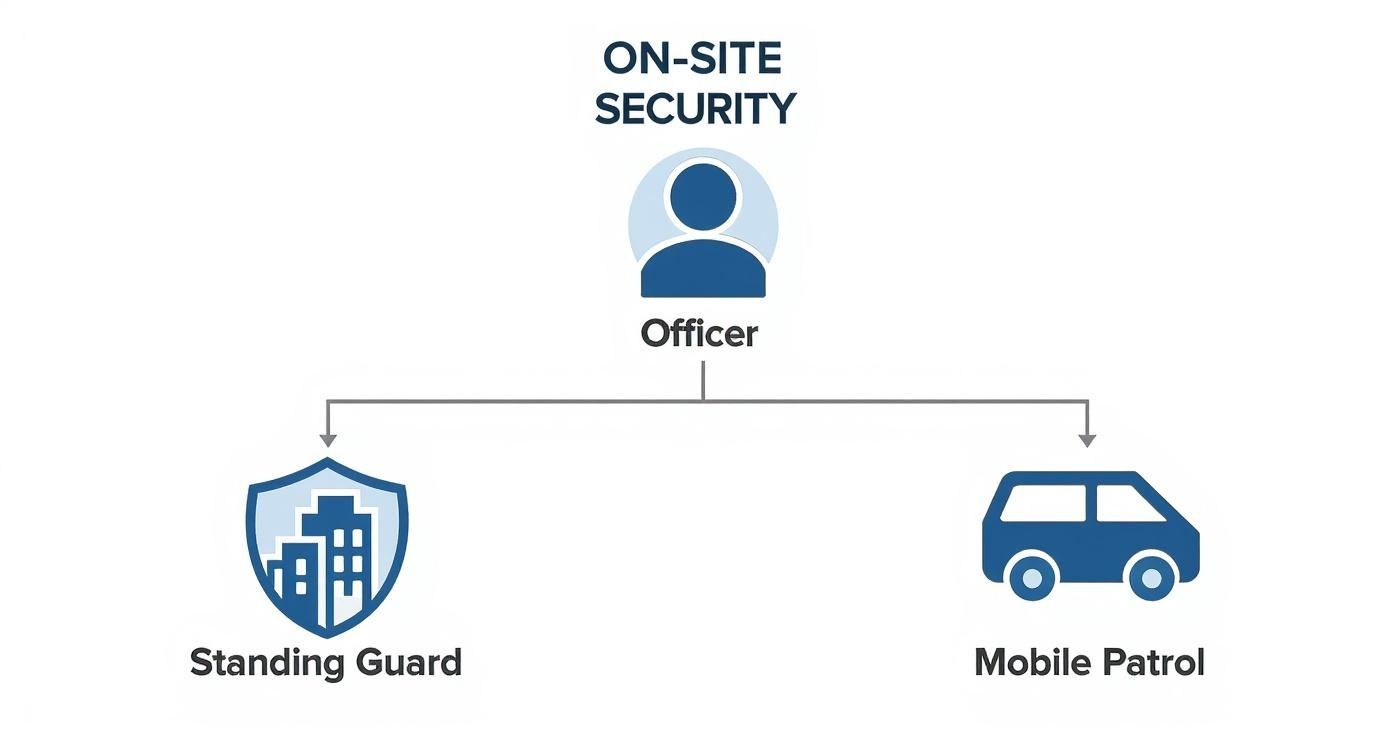
This visual breaks down how both standing guards and mobile patrols serve as distinct but essential parts of a complete security strategy.
Technology gives you data; a trusted security partner turns that data into protection. The goal is to create a system where every alert is verified, every patrol is documented, and you have complete visibility into your property's safety.
This combination of human experience and smart tech delivers more than just security—it delivers accountability. With GPS-enabled patrols and detailed digital reports sent straight to your inbox, you always have confidence that your security protocols are being followed. It’s that transparency that builds trust and ensures your Dallas warehouse is secure around the clock.
Protecting People, Operations, and Your Bottom Line
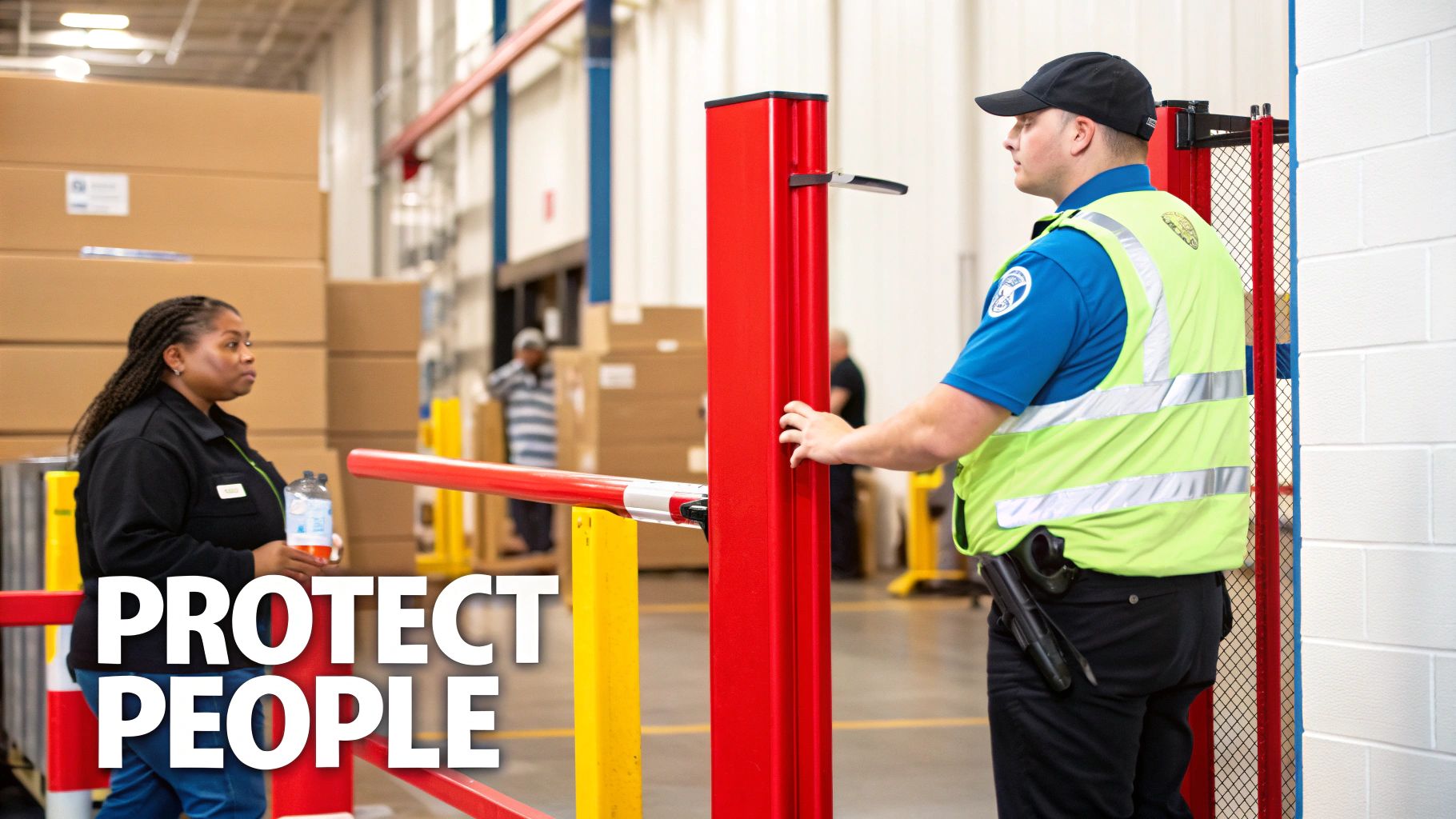
A solid Dallas warehouse security strategy is about much more than protecting inventory. It’s about safeguarding your two most valuable assets: your people and your operational continuity. A secure facility is a safe facility. When you have controlled access and a visible security presence, you naturally reduce accidents, workplace conflicts, and potential liability claims.
When everyone from employees to vendors knows that security protocols are taken seriously and enforced consistently, it builds a powerful culture of safety and accountability. This isn't just about deterring crime; it's about creating a smoother, more efficient operation by minimizing disruptions from the inside out.
Enhancing Workplace Safety and Compliance
Warehouses can be inherently hazardous environments, with heavy machinery, constant truck traffic, and complex moving parts. National data tells the story: in 2021, the warehousing sector saw an injury and illness rate of 5.5 cases per 100 full-time employees—more than double the average for all private industries.
That is why a good security plan must also function as a safety plan. A properly trained security officer is not just a guard watching for theft; they become a key part of your risk management team.
A security partner who understands operational safety is a direct asset to your OSHA compliance efforts. Their job is to observe, report, and help you enforce the protocols that protect your people and your business from preventable incidents.
This fusion of security and safety offers tangible benefits:
- Access Control: By managing who comes and goes, security officers keep unauthorized individuals out of active operational zones, dramatically reducing the odds of an accident.
- Policy Enforcement: Officers serve as a professional reminder for staff and visitors to follow safety rules, whether it’s wearing proper PPE or adhering to speed limits in the yard.
- Incident Documentation: If an accident or safety breach occurs, security provides immediate, unbiased documentation. Such reports are invaluable for investigations and insurance claims.
Beyond Crime Prevention: Critical Support Services
A true security partner brings value that extends beyond deterring crime. Their role should expand to become a core part of your emergency response plan, ensuring your facility can recover from unexpected events.
This is where the depth of a provider's capabilities becomes clear. Specialized services are designed to maintain operations and protect your assets, no matter the circumstances.
- Fire Watch Services: If your fire suppression or alarm systems are down for maintenance or a malfunction, regulations often require a dedicated fire watch. Trained officers can patrol the premises specifically to spot fire hazards and ensure a rapid response, keeping you compliant and safe.
- Emergency Response Coordination: During a medical emergency, power outage, or severe weather event, security officers act as on-the-ground coordinators. They guide first responders, manage evacuations, and maintain clear communication until the situation is resolved.
Finally, strong cargo theft prevention strategies are a critical piece of this holistic view of safety. When you see security as an extension of your operations team, you’re not just buying protection—you’re building a more resilient and profitable business.
How to Choose Your Dallas Security Partner
Selecting the right security provider is one of the most important decisions you'll make for your warehouse. This isn't just about hiring a vendor; it's about finding a true partner. You need a team that brings deep, real-world experience in industrial security and acts as a trusted advisor to protect your assets.
Look beyond the cheapest hourly rate. The goal is to build a long-term relationship based on quality, accountability, and a true understanding of the Dallas-Fort Worth operational landscape. To do that, you must ask the right questions—the kind that cut through the sales pitch and reveal a company's true capabilities.
Vetting Potential Security Providers
Before signing a contract, it's essential to do your homework. Investigate a provider's background, their people, and their processes. Their answers will tell you everything you need to know about their suitability for serious Dallas warehouse security.
Here are a few questions to start with:
- Experience with Industrial Sites: Have they secured facilities similar to yours in DFW? Ask for specific examples or case studies involving warehouses or distribution centers.
- Officer Training and Retention: What is their process for hiring, training, and retaining quality officers? High turnover is a significant red flag, often leading to inconsistent service and security gaps.
- Leadership and Supervision: What is their manager-to-client ratio? A low ratio is a positive sign. At Overton Security, we maintain a low ratio to ensure every site receives hands-on attention from our leadership.
Evaluating Technology and Accountability
A modern security operation must be more than just people in uniforms. It should be a seamless blend of human expertise and practical technology. Their systems should provide total transparency into the services you’re paying for.
The right security partner uses technology not just for surveillance, but for accountability. Tools like GPS tracking and digital reporting should be standard, offering you complete, verifiable proof of service and peace of mind.
Get specific about their tech stack:
- Reporting Platform: Do they use a GPS-enabled guard tour system? Can you receive detailed digital reports with photos and real-time incident alerts sent directly to your inbox?
- 24/7 Support: Do they operate their own Security Operations Center (SOC)? Knowing a dedicated team is monitoring your property around the clock is a critical layer of protection.
Ultimately, this is a significant decision. For a deeper look into the vetting process, our guide on hiring the right security agency offers a complete checklist to walk you through it.
Finding a company that understands your operational goals and prioritizes quality service is the final, crucial piece of the puzzle. A partner committed to experience, consistency, and accountability will deliver value that goes far beyond just having a guard on-site.
Common Questions About Warehouse Security
When it comes to securing a warehouse, many questions arise. Let's address some of the most common ones we hear from managers across Dallas.
What's Better: Security Guards or Cameras?
This classic question presents a false choice. The most effective security strategy doesn't involve choosing one over the other—it involves using them together.
Think of it this way: a camera is excellent for recording a break-in and gathering evidence after the fact. However, a professional security officer on-site can deter that break-in from ever happening simply through their visible presence. When you combine the watchful eye of technology with the quick judgment and active response of a human guard, you achieve a much stronger defense. For real Dallas warehouse security, the combination is always more powerful.
How Much Does Professional Warehouse Security Cost?
There is no single price for warehouse security, as the cost depends entirely on your specific needs. Every facility has its own unique risks and operational demands.
A few key factors will shape the price:
- Type of Coverage: Are you looking for a full-time officer stationed at a gate, or would periodic mobile patrols suffice? You may need a combination of both.
- Officer Licensing: Armed officers require more extensive training and licensing, so their rates are typically higher than those of unarmed officers.
- Scope of Duties: The cost for an officer monitoring an entrance will differ from one responsible for detailed inventory checks or operating complex access control systems.
- Contract Length: As with many services, a longer-term partnership often comes with more favorable rates compared to short-term or temporary agreements.
The only way to get an accurate cost is through a professional security assessment. A reputable provider will walk your property, identify your vulnerabilities, and build a proposal that aligns with your budget and security goals.
Can Security Officers Help with Safety and Compliance?
Absolutely. A well-trained security officer does more than watch for intruders; they become a key part of your safety and compliance team.
They can enforce critical safety rules, such as ensuring everyone wears the correct PPE, or manage the flow of traffic in a busy yard. They also control access to hazardous material storage areas. By keeping detailed daily activity logs, they provide the documentation needed for liability management and OSHA compliance. They are your eyes and ears on the ground, spotting potential safety hazards before they become problems.
Ready to build a security plan that protects your people, property, and bottom line? The team at Overton Security has over 26 years of experience creating customized security solutions for industrial facilities across the region. Contact us today for a complimentary security consultation.