
Is your current security provider a true partner, or just a line item on your budget? A truly effective private security company is a property's first line of defense, offering everything from on-site officers and vehicle patrols to sophisticated remote monitoring. Their goal is to protect your people, property, and assets from every angle.
Ultimately, a high-quality firm becomes a proactive extension of your own team. They help you manage risk, keep operations running smoothly, and create a genuinely safe environment for employees, tenants, and customers.
Why Smart Businesses Invest in Private Security

It's easy to view a security budget as just another expense. The real question isn't "What does security cost?" but "What's the cost of a single, preventable incident?" For property managers, HOA board members, and business owners, the answer to that question can be staggering, from direct financial loss to a tarnished reputation.
This is why savvy leaders treat security as a strategic investment. Think of it like a proactive insurance policy. While a traditional policy pays out after a disaster, a dedicated security program works around the clock to prevent that disaster from happening in the first place.
The Core Mission of a Security Partner
A modern private security company does far more than just station a guard at a gate. Their mission is built on three key pillars that work in tandem to keep your property secure.
- Deter: The visible presence of professional officers and clearly marked patrol vehicles is a powerful deterrent. It discourages opportunistic threats like vandalism, loitering, and theft before they even start.
- Detect: Trained officers are actively observing and looking for vulnerabilities. They spot everything from unsecured access points on a construction site to suspicious activity in a retail parking lot.
- Respond: When an incident does occur, these officers are your immediate on-site responders. They are trained to de-escalate situations, coordinate with law enforcement, and document everything meticulously for liability purposes.
This integrated approach is becoming more critical every year. The global private security market is on track to hit USD 365.0 billion by 2035, with the commercial sector driving nearly half of that demand. This trend reflects a clear shift as businesses turn to expert firms to manage the risks that threaten their day-to-day stability. You can explore more data on this industry shift in this report from Future Market Insights.
At Overton Security, we've built our 26-year reputation on a simple philosophy: quality over quantity. We believe our clients deserve a real security partner invested in their success. By keeping our leadership hands-on and focusing on consistency, we ensure you get the reliable protection your property deserves.
What Does a Modern Security Firm Actually Do?
It’s easy to think all security services are the same, but that’s a fast track to getting the wrong kind of protection. A modern security company offers a menu of solutions, each designed to tackle specific risks. Matching the right service to your property ensures you’re getting real value for your investment.
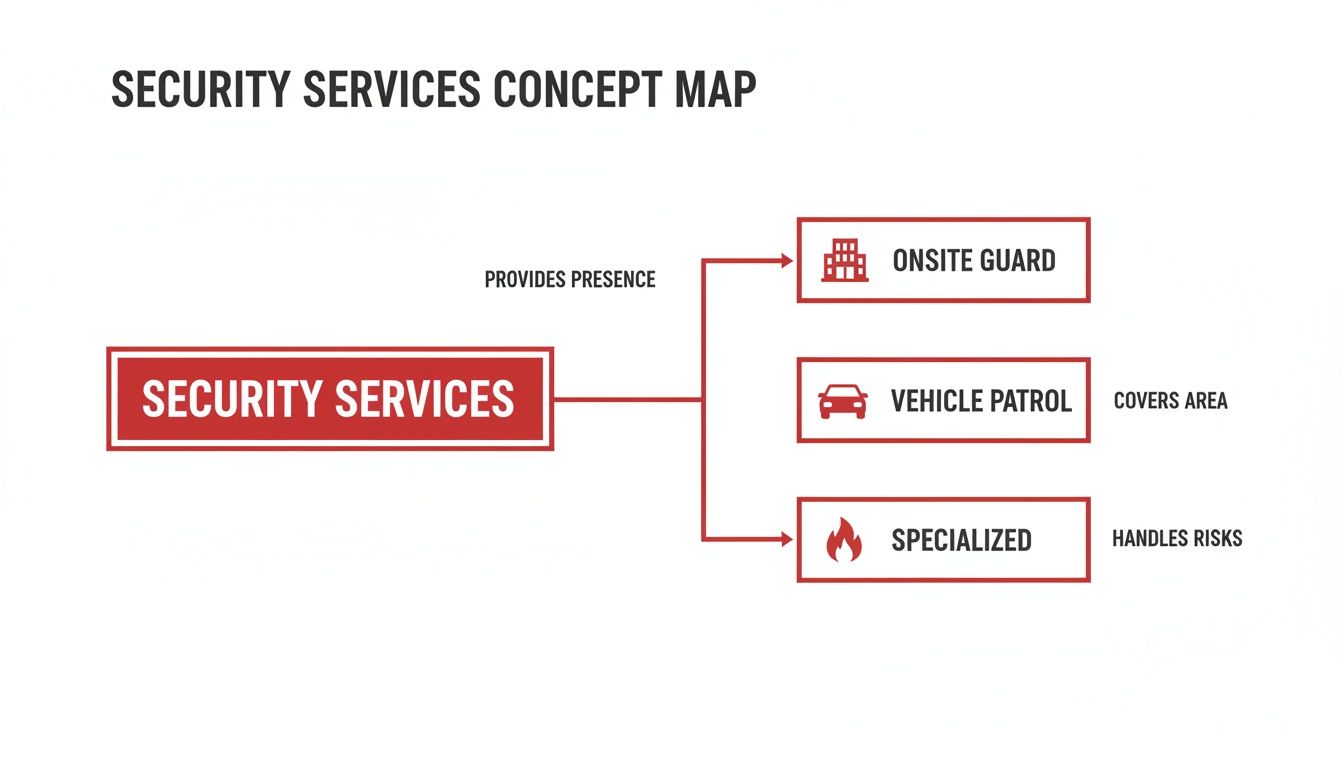
The foundation of most security plans is the Onsite Security Guard. These are the highly visible officers you see in lobbies, at gatehouses, or walking the floor in a retail store. They are the ideal solution when you need a consistent presence and immediate response capability.
Think of them as the dedicated guardians for your space. They might be managing access control in a busy office building, observing for theft in a shopping center, or simply providing a calm, professional presence for residents in a high-rise condo.
Expanding Your Reach with Vehicle Patrols
But what about bigger properties? For sprawling HOA communities, large industrial parks, or a portfolio of commercial buildings, stationing a guard on every corner isn't practical or affordable. This is where Vehicle Patrol Services come in as a smart, cost-effective way to cover significant ground.
A mobile officer in a clearly marked security vehicle acts as a powerful deterrent, conducting visible but random patrols that keep potential troublemakers guessing.
They can handle many essential tasks, including:
- Lock-ups and Alarm Response: Securing common areas like pool gates and laundry facilities for the night and being the first to respond if an alarm is triggered.
- Property Checks: Conducting physical checks on doors, windows, and fence lines to look for any signs of tampering or a breach.
- Parking Enforcement: Addressing unauthorized vehicles or other parking issues in private lots—a constant challenge for many property managers.
This approach creates an unpredictable security blanket over your entire property without the expense of a full-time, stationary officer at every location.
Specialized Services for Unique Problems
Beyond guards and patrols, a top-tier security firm has a roster of specialized services designed for specific situations. These solutions solve the unique challenges that property managers and business owners face every day.
A great example is Concierge Security, a perfect blend of high-end hospitality and professional protection. You’ll often find these officers in Class A office buildings or luxury condos, where they manage guest check-ins and elevate the tenant experience while keeping the lobby secure. On the other end of the spectrum, Fire Watch Services are critical when a building’s fire systems are down for maintenance, as officers patrol for fire hazards to protect both lives and property.
For any construction superintendent, Construction Site Security is non-negotiable. It’s all about protecting expensive materials and equipment from theft, which can derail project timelines and inflate budgets. Each of these roles demonstrates how adaptable a true security partner can be to your specific needs.
The demand for these tailored services is growing. North America is currently the largest market for private security, driven by both businesses and residential communities. For many homeowners and HOA boards, services like concierge security and dedicated vehicle patrols have become a necessity.
Here at Overton, we know that no two properties are alike. We don’t offer "one-size-fits-all" solutions because they simply don't work. We work with you to build custom post orders and patrol plans that are a perfect match for your property’s unique challenges. By taking the time to understand your needs, we make sure our security services for businesses deliver measurable results.
The Technology That Delivers Real Accountability
How do you know your security provider is doing what they promised? For too long, the industry ran on handwritten logs and blind trust, leaving a massive gap for missed patrols and a lack of transparency.
Today, a professional security company uses technology as the foundation of its accountability. This tech stack creates a verifiable, transparent record of every security activity, taking the guesswork out of the equation. It transforms security from something you hope is being done to something you can see and measure, building trust through hard data.
The Security Operations Center (SOC)
Think of a 24/7 Security Operations Center (SOC) as the central nervous system for every officer on every property. It's a command hub, staffed around the clock by experienced dispatchers and supervisors who provide constant support and oversight. This isn't a passive answering service—it's an active layer of management that ensures protocols are followed.
A professional SOC is responsible for:
- Real-Time Officer Support: When an officer in the field needs guidance or backup, they get it instantly.
- Incident Escalation: The SOC ensures critical events are escalated to property management and law enforcement exactly as planned.
- Remote Oversight: Using GPS and other tools, the SOC monitors officer status and activity, adding a powerful layer of accountability.
This central hub connects every service, from guards to patrols, into a single, coordinated system.
Whether it’s a dedicated onsite guard or a mobile patrol unit, all field activities are routed through and monitored by this central system, turning individual actions into a cohesive security strategy.
Guard Tour Management and Digital Reporting
The days of scribbled notes on a clipboard are long gone. Modern accountability is built on Guard Tour Management Systems (GTMS). These systems use GPS and scannable checkpoints (like NFC tags) to create an undeniable digital footprint of every patrol.
When an officer scans a checkpoint at the far corner of your property at 3 a.m., you get a time-stamped, geo-located record that proves they were there. No more wondering.
This data feeds directly into digital Daily Activity Reports (DARs). These are comprehensive, easy-to-read summaries of each shift, often including:
- Timestamped patrol logs showing every checkpoint hit.
- Detailed incident reports for anything out of the ordinary.
- Embedded photos of observations, like a broken fence or an unsecured door.
- Notes on potential maintenance issues or safety hazards.
For companies managing security across multiple sites, this kind of system is essential. Modern field service management software integrates scheduling, tracking, and reporting into a single platform. This level of verifiable reporting gives you a clear window into what's happening on your property, building confidence and providing invaluable documentation. To see how technology can further enhance site security, you can learn more about our approach to remote video monitoring.
At Overton Security, we built our reputation on this exact kind of transparency. For over 26 years, our blend of a 24/7 SOC, a robust GTMS, and detailed digital reporting has provided our clients with unwavering proof of service. We believe you should never have to wonder if your security team is doing its job.
Your Framework for Choosing the Right Security Partner
Choosing a private security company is a decision that can make or break your property's success. The right partner becomes a seamless extension of your team; the wrong one can quickly become your biggest liability. To get it right, you need to look past the sales pitch and dig into what makes a security firm effective.
This isn't about chasing the lowest hourly rate. It's about finding a reliable partner whose operational philosophy is built around keeping your property safe and stable. A great security partner is built on verifiable credentials, a strong internal culture, and transparent, accountable systems.
Verifying the Essentials: Licensing and Insurance
Before discussing patrol schedules, you have to confirm the basics. Any legitimate private security company in California must hold a valid Private Patrol Operator (PPO) license from the Bureau of Security and Investigative Services (BSIS). This is a non-negotiable first step.
Equally critical is their insurance. A security firm is your partner in managing risk, and they need to have the coverage to back it up.
Ask to see their Certificate of Insurance (COI). It should clearly outline their coverage, including:
- General Liability Insurance: Protects against claims of bodily injury or property damage. Ensure the limits are sufficient for your property's value.
- Workers' Compensation: Covers their officers if they are injured on your property, protecting you from liability.
- Automobile Liability: An absolute must for any company providing vehicle patrol services.
Any hesitation to provide these documents is a major red flag. A professional, trustworthy partner will have them ready and will expect you to ask.
“The true measure of a security provider isn’t just their presence, but their preparedness. Proper licensing and comprehensive insurance are the bedrock of that preparedness, demonstrating a commitment to professionalism and accountability from day one.”
Evaluating the Human Element: Training and Retention
A security company is nothing without its people. The most advanced technology can't make up for a poorly trained, unmotivated officer. The quality of the guards on your property will ultimately define the success of your security program, which is why you must ask how a potential vendor recruits, trains, and—most importantly—retains its team.
High officer turnover is a persistent issue in the security industry, often caused by low pay, minimal benefits, and poor management. For you, this turnover means inconsistent service, a constant stream of new faces who don't know your property, and an endless cycle of retraining.
Don't be shy about asking direct questions:
- What is your average officer retention rate?
- Can you describe your initial and ongoing training programs?
- Do you offer your officers a real career path with opportunities for advancement?
A company with deep roots, like Overton with over 26 years of experience, knows that investing in people is the only way to deliver consistent quality. By offering competitive pay, benefits, and a clear path for growth, we build a stable, professional team. That low turnover means the officers protecting your property are experienced, knowledgeable, and genuinely invested in doing a good job.
The Litmus Test: Manager-to-Client Ratio
Here's an inside tip: one of the most revealing questions you can ask is about their manager-to-client ratio. This simple number tells you everything you need to know about the level of attention you will actually receive. Many large national firms overload a single account manager with dozens, or even hundreds, of clients. The result is unreturned calls and a manager who only appears when something has gone wrong.
A low manager-to-client ratio is a deliberate strategy that prioritizes quality service. It means your point of contact has the bandwidth to visit your site, get to know your team, and proactively solve problems. It's a clear sign that a company is more focused on building strong client relationships than just accumulating contracts.
Vendor Evaluation Checklist for Private Security
This checklist is designed to help you look beyond the sales pitch and compare potential security partners on the key indicators of quality, reliability, and genuine service excellence.
| Evaluation Criteria | What to Look For | Why It Matters |
|---|---|---|
| Licensing & Insurance | Valid BSIS PPO License, Certificate of Insurance (COI) with adequate General Liability, Workers' Comp, and Auto Liability. | This is the non-negotiable foundation. It ensures they are operating legally and protects you from significant financial and legal liability. |
| Experience & Reputation | At least 10-15 years in business, positive online reviews, and verifiable client references in your industry. | Longevity indicates stability and adaptability. References prove they can deliver on their promises in a real-world setting similar to yours. |
| Officer Training & Retention | Low turnover rates, detailed initial and ongoing training programs, clear career paths for officers. | High retention means experienced, consistent guards who know your property. Strong training ensures they are prepared for any situation. |
| Management Structure | Low manager-to-client ratio, a dedicated point of contact, clear escalation procedures for issues. | A low ratio guarantees you'll get the attention you deserve. You won't be just another number in a massive portfolio. |
| Technology & Systems | Use of a Guard Tour Management System (GTMS) for tracking and reporting, a 24/7 Security Operations Center (SOC), GPS-tracked vehicles. | Modern tools provide transparency, accountability, and real-time oversight, ensuring the service you pay for is the service you get. |
| Customization & Flexibility | Willingness to develop site-specific post orders and adapt the security program to your unique needs, rather than a one-size-fits-all approach. | Your property is unique. Your security plan should be, too. A true partner works with you to build a program that solves your specific challenges. |
| Contract Terms | Clear scope of work, transparent pricing with no hidden fees, reasonable termination clauses. | The contract should be a clear, fair agreement that protects both parties and sets clear expectations from the start. |
Using a structured framework like this ensures you’re making a decision based on substance, not just a flashy proposal. It helps you find a partner who is truly invested in your security and equipped to deliver it consistently.
Breaking Down Security Costs and Contract Terms
Understanding the cost of private security can feel complex, but it boils down to a few core components. When a security company provides a proposal, you’re not just paying for an officer's time. You're investing in everything that makes that officer reliable: their training, the technology behind them, and the entire operational support system.
The single biggest cost driver is the officer's pay rate. To attract and retain professional security officers, a company must offer competitive wages and benefits. It’s the only way to combat the high turnover that plagues much of the industry. If a bid seems too good to be true, it probably is. That low price is almost always built on minimum-wage pay, which inevitably leads to unreliable service.
Key Factors That Influence Your Security Budget
Beyond the base pay rate, a few other key variables will shape the final price for your security program. A professional provider will walk you through these to build a budget that fits your needs.
- Service Hours: The total number of coverage hours you need per week or month directly scales your cost.
- Armed vs. Unarmed Officers: An armed officer requires more extensive training, stricter licensing, and higher insurance costs, all of which are reflected in the bill rate.
- Site Complexity: Securing a sprawling, multi-building campus is a different challenge than monitoring a single small storefront.
- Scope of Duties: An officer doing basic observation patrols will have a different rate than a front-desk concierge officer who also needs specialized customer service skills.
These factors help determine whether a simple hourly rate for an on-site guard or a flat monthly fee for vehicle patrols makes the most sense for your property.
Hourly Rates Versus Flat-Fee Contracts
Understanding the two most common pricing models makes it much easier to compare proposals. Each model is designed for different types of security services, and a good partner will recommend the one that provides the best value.
Onsite Guard Services are almost always billed using a straight hourly rate. This rate includes the officer’s wages, benefits, supervision, insurance, and the company’s overhead. It’s a straightforward pricing model for predictable, fixed-post coverage.
Vehicle Patrol Services, on the other hand, are typically priced with a flat-fee monthly contract. This fee is based on factors like the number of patrols per night and whether the service includes tasks like locking up facilities or responding to alarms. It's an excellent model for providing a consistent, visible deterrent at a fraction of the cost of a full-time onsite guard. You can explore a variety of flexible contract security services that can be customized to fit either of these pricing models.
The lowest bid often becomes the most expensive choice in the long run. When companies cut corners on pay to offer a low price, clients experience high officer turnover and missed patrols. These risks create problems that far outweigh any initial savings. A quality-focused private security company invests in its people, which translates directly into more reliable protection for you.
Reading the Fine Print in Your Service Agreement
Once you’ve settled on a price, the service agreement is the final piece of the puzzle. This contract is your operational blueprint and legal protection, so it’s critical to review it carefully. A trustworthy provider will always offer a clear, easy-to-understand agreement.
Make sure you see these key elements:
- Clearly Defined Post Orders: This is the heart of the contract. It should spell out exactly what the officers are supposed to do on your specific site.
- Term Length and Termination Clause: Understand how long the agreement lasts and how much notice is required to cancel. Be cautious of contracts with harsh penalties or tricky automatic renewal clauses.
- Insurance and Liability: The contract should clearly state the provider's insurance coverage and define the limits of liability for all parties.
- Transparent Invoicing: The price you were quoted should be the price on your invoice. Ensure there are no hidden fees for fuel surcharges or vague "administrative costs."
The People First Approach to Superior Security

In the security world, GPS tracking, digital reports, and 24/7 monitoring are all crucial tools for accountability. But they are only half the story. After more than 26 years in this business, we know the real difference between a security provider and a true security partner comes down to a relentless focus on people.
This isn't just a slogan; it’s the philosophy that drives our entire operation. While many national firms are caught in a race for rapid growth—often at the expense of service quality—we have always maintained a “Quality Over Quantity” mindset. This commitment creates tangible benefits for our clients—the property managers, HOA boards, and business owners who depend on consistent, reliable protection.
The Impact of Hands-On Leadership
A genuine people-first security program starts at the top, with leadership that’s actively involved. When executives are accessible and engaged, it fosters a culture of accountability that you can feel at every level, right down to the officer patrolling your site. This hands-on approach means your needs are understood and addressed by decision-makers, not lost in a corporate hierarchy.
Another key part of this is our low manager-to-client ratio. In an industry where account managers are often drowning in massive portfolios, we deliberately keep ours small.
This structure ensures you have a dedicated point of contact who:
- Knows your property inside and out, allowing them to offer proactive advice and solutions.
- Is highly responsive when you have a concern or need to adjust your security plan.
- Builds a genuine partnership with your team, becoming a trusted advisor instead of just another vendor.
This level of personal attention is often the first sign that you're working with a company that puts service integrity first.
Investing in Officer Retention Delivers Consistency
The most direct link between our philosophy and your on-site results is officer retention. The security industry has a reputation for high turnover. This "burn and churn" cycle creates constant disruption and inconsistent service. When a new officer shows up every few weeks, they don't know your property’s weak spots, your tenants, or your rules.
We combat this by investing heavily in our team. By offering competitive pay, solid benefits, and a clear career path, we attract and retain professional officers who see security as a long-term profession, not just another job.
That investment pays off directly for you. A stable, experienced team means the officers protecting your property are knowledgeable, engaged, and committed to your safety. They’re the ones who notice the small details that prevent big problems. This is the ultimate benefit of choosing a private security company with a people-first culture: you get consistent, dependable service from a team that is respected, supported, and motivated to do their best work.
Got Questions About Hiring Security? We’ve Got Answers.
Choosing to bring in a private security company is a significant decision. To help you navigate the process, we've answered the questions we hear most often from property managers, HOA boards, and business owners.
What’s the Real Difference Between Armed and Unarmed Guards?
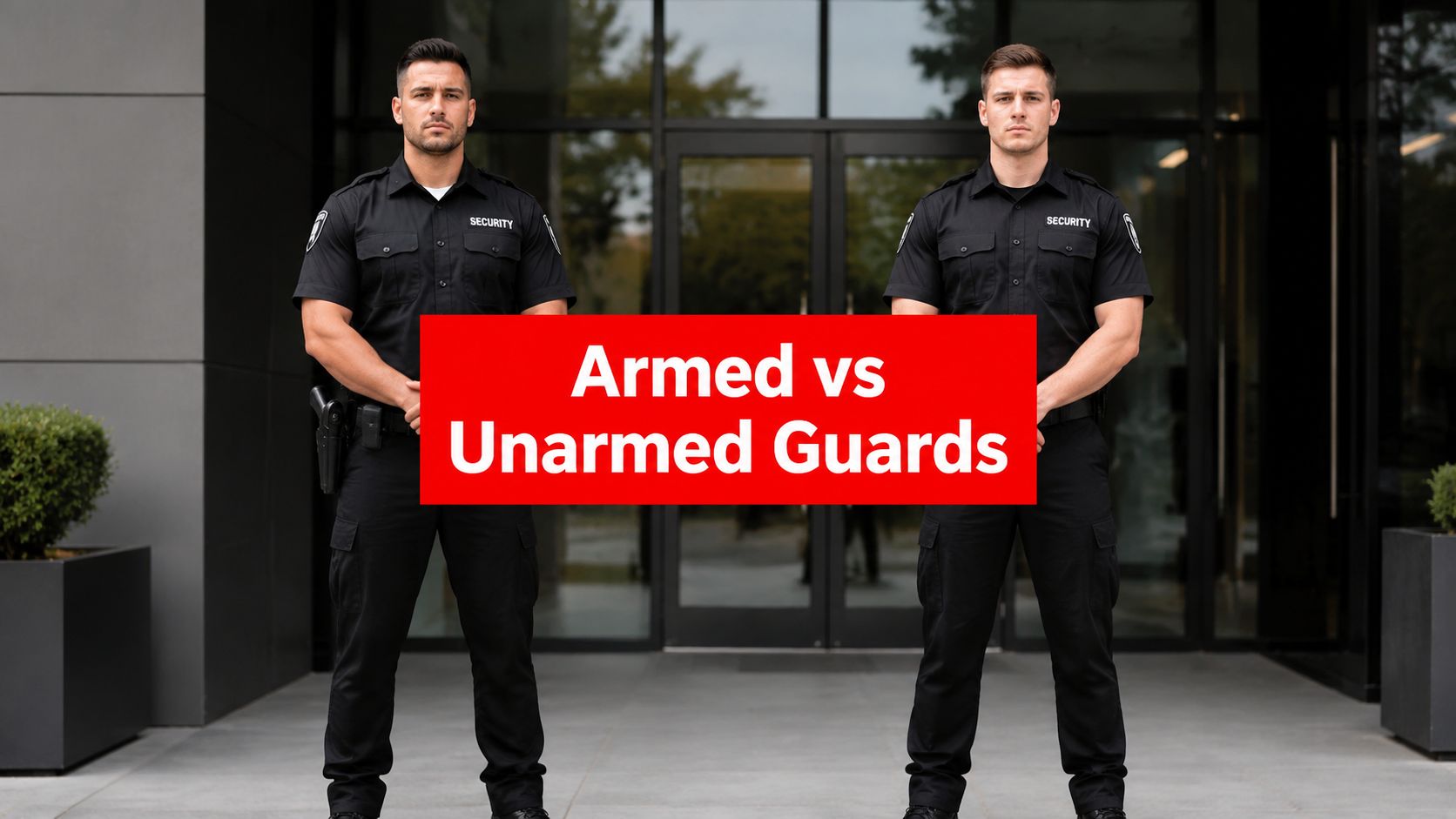
The goal dictates the tool. For most properties, unarmed officers are the perfect fit. Their role is to be a visible deterrent, provide keen observation, and manage access control and reporting. They are ideal for maintaining a safe and orderly environment at commercial buildings, residential communities, and retail centers.
Armed security guards, on the other hand, are for situations with a known or higher risk. These officers are licensed to carry firearms and are typically used to protect high-value assets or respond to specific, credible threats. The right choice always comes down to a thorough risk assessment of your property.
How Much Is Private Security Going to Cost?
There's no single price tag for security. The cost depends on the type of service (e.g., onsite guard vs. vehicle patrol), whether officers are armed, the total hours of coverage, and the complexity of your property.
Typically, onsite guards are billed at an hourly rate, while mobile patrols often have a flat monthly fee. A true security partner will walk your site with you to build a transparent quote based on your actual operational needs.
A key sign of a reliable security partner is how they prove their work. Top-tier firms use Guard Tour Management Systems (GTMS) with GPS tracking and provide detailed digital reports from a 24/7 Security Operations Center (SOC). This isn't just technology; it's verifiable proof that you're getting what you pay for.
What Should I Look for in a Security Contract?
A solid contract is all about clarity. It must include detailed "post orders" that spell out the specific duties for your site. Don't sign anything without them.
Also, look closely at the contract term, insurance coverage (always ask for a certificate of insurance), and the cancellation policy. Be cautious of long-term contracts with automatic renewals, and ensure any verbal promises are documented in the final agreement.
Ready to work with a security partner that has built its 26-year reputation on trust, transparency, and putting people first? Contact Overton Security today to discuss your property's unique needs and receive a comprehensive, no-obligation assessment.