
Contract security services provide businesses with professional security personnel and solutions without the complexities of managing an in-house team. This model allows property managers and business owners to delegate security responsibilities—like hiring, training, and liability—to a dedicated partner. It's about gaining access to specialized expertise and ensuring consistent, reliable protection for your people and property.
What Are Contract Security Services?

As a property manager, HOA board member, or facilities director, you are ultimately responsible for site safety. When you see an unfamiliar officer on-site, you might wonder about their training, reliability, and how they will respond during an incident. That uncertainty is a significant concern for any decision-maker.
Contract security services are designed to replace that uncertainty with a strategic partnership. This isn't just about placing a guard on your property; it's about outsourcing your entire security function to a company that specializes in risk management, personnel training, and operational consistency.
The core idea is simple yet powerful: You're not just hiring guards; you're transferring risk, gaining access to specialized expertise, and implementing a proven system for consistent protection.
Think of it like partnering with an established accounting firm instead of hiring a freelance bookkeeper. The freelancer might handle daily tasks, but the firm brings a comprehensive strategy, assumes liability, and has years of institutional knowledge to protect your financial health. A professional security partner does the exact same for your physical assets and people.
The In-House vs. Outsourced Security Dilemma
Many organizations weigh the pros and cons of building their own in-house security team. While direct control may seem appealing, the hidden complexities often create more problems than they solve. When you manage an internal team, you're responsible for everything:
- Recruiting and Vetting: The entire process of finding, screening, and running background checks on qualified candidates.
- Training and Certification: Ensuring every officer meets state licensing requirements and receives ongoing, site-specific training.
- Scheduling and Staffing: Juggling sick days, vacation time, and last-minute call-offs without leaving dangerous security gaps.
- Liability and Insurance: Assuming all the legal and financial risk for security incidents and employee actions.
To fully appreciate the value of contract security, it helps to understand the bigger picture of contractor management. When you outsource, you are handing off these operational challenges to a partner whose sole focus is security. A reliable firm with a deep legacy, like Overton's 26 years of experience, has already built the infrastructure to handle these challenges. This ensures your property is protected by well-supported, professional officers, day in and day out.
A one-size-fits-all approach to security doesn't work. The risks facing a busy retail center in downtown San Jose are worlds apart from those of a quiet residential community in Los Angeles. To be effective, contract security services must match the right solution to the specific risks, layout, and goals of your property.
This is where a true security partner shines. They don’t just supply a guard; they help you build a complete security program based on what you actually need—a highly visible deterrent, a discreet mobile presence, or a smart blend of both. The goal is to shift your security program from a simple line-item expense into a tangible asset that protects your property and enhances its value.
A well-designed security plan isn't about spending more money; it's about applying resources where they will make the biggest impact. The right strategy prevents incidents, reduces liability, and delivers peace of mind for you, your tenants, and your visitors.
By analyzing your property's unique profile, a security expert can recommend a service model that gives you the most effective coverage and the best return on your investment.
To help you get started, here's a quick reference table matching common property types with the services that typically work best for them.
Matching Security Services to Your Property Type
This quick-reference guide is designed to help property managers and business owners identify the most effective security solutions for their specific environment and operational needs.
| Property Type | Primary Security Need | Recommended Contract Service | Key Benefit |
|---|---|---|---|
| Commercial Office Tower | Access control, tenant safety | Onsite Guards / Concierge | Professional presence, immediate response |
| Gated HOA Community | Access control, rule enforcement | Onsite Guards or Vehicle Patrol | Resident peace of mind, deterrent |
| Large Industrial Park | Perimeter security, asset protection | Vehicle Patrol / Remote Monitoring | Cost-effective coverage for large areas |
| Retail Shopping Center | Theft deterrence, public safety | Onsite Guards / Vehicle Patrol | Visible deterrent, shopper confidence |
| Active Construction Site | Theft/vandalism prevention (overnight) | Onsite Guards / Remote Monitoring | Protection of valuable assets/materials |
| Multi-Family Apartment Complex | Parking enforcement, disturbance response | Vehicle Patrol | Wide coverage, enforcement consistency |
| Special Event Venue | Crowd control, access management | Event Security Staff | Safe, orderly event execution |
| Property w/ Fire System Offline | Life safety, insurance compliance | Fire Watch | Prevents fines, ensures safety |
Remember, this is a starting point. The best security programs often blend these services to create a comprehensive, layered defense tailored to your site's specific vulnerabilities.
Onsite Security Guards: The Constant Presence
For properties with high foot traffic, valuable assets, or a history of security issues, there is no substitute for the constant presence of a professional onsite security officer. These guards are more than just a uniform; they become the face of security for your property, managing access, deterring unwanted activity, and providing an immediate, on-the-ground response.
An onsite guard is the anchor of your security program and is a perfect fit for:
- Commercial Office Buildings: Managing lobby access, assisting tenants, and projecting a professional, secure atmosphere.
- Retail Centers: Acting as a visible deterrent against theft and loitering, creating a safer shopping experience.
- Construction Sites: Guarding high-value equipment and materials from theft and vandalism, especially during vulnerable overnight hours.
- Gated Residential Communities: Controlling access, enforcing community rules, and offering a reassuring presence for residents.
At Overton Security, our onsite officers operate with customized post orders that detail their exact duties. This isn't just about showing up; it's about conducting specific patrol routes, documenting maintenance issues, and actively contributing to the smooth, safe operation of your property.
Vehicle Patrol Services: The Strategic Deterrent
For larger properties or a portfolio of sites spread across a wide area, vehicle patrols are a powerful and cost-effective security solution. These mobile units create a visible deterrent that is both random and strategic, making it difficult for a potential wrongdoer to predict when a security presence will appear. This service is an ideal match for HOAs, industrial parks, and multi-site retail portfolios.
Mobile patrols excel at:
- Performing exterior checks of buildings, parking lots, and common areas.
- Responding quickly to low-level disturbances or alarm calls.
- Enforcing parking rules and tagging unauthorized vehicles.
- Delivering detailed digital reports of every visit, complete with GPS verification and time-stamped photos.
This approach gives property managers broad security coverage without the expense of stationing a full-time guard at every location. It’s an intelligent way to extend your security footprint and maintain order across a large territory.
Specialized Security Roles
Beyond traditional guards and patrols, many properties have unique operational or legal needs that call for specialized security functions. For example, fire watch services are critical when a building's fire alarm or suppression systems are down for maintenance or repair. In this situation, trained officers must perform documented patrols to ensure life safety and maintain compliance with fire codes—a responsibility you cannot afford to overlook.
Likewise, property managers have specific legal obligations they need to navigate. This practical fire risk assessment guide for landlords breaks down the duties required to protect tenants, which is a crucial consideration when building out a security plan. By integrating these specialized duties into a broader security contract, you can be confident that all your bases are covered by trained professionals who understand what’s at stake.
Calculating the Real ROI of Professional Security
It's easy to view security as just another line-item expense. This is one of the most common—and costly—mistakes a property manager or business owner can make. The right contract security services aren't a cost center; they're a strategic investment that actively prevents loss, mitigates risk, and ultimately enhances your property's value.
The tangible returns are the easiest to see. Preventing the theft of a single piece of heavy equipment from a San Jose construction site can save you six figures in replacement costs and project delays. Minimizing vandalism at a Los Angeles apartment complex avoids costly repairs and maintains the curb appeal that keeps tenants happy. In many cases, having a documented, professional security program can also lead to lower insurance premiums.
Beyond the Bottom Line: Intangible Returns
However, the most valuable returns are often the ones you can't put on a spreadsheet. A well-secured property cultivates a powerful reputation for safety, which becomes a key selling point for attracting and retaining high-quality tenants or customers. That peace of mind is an invaluable asset that reduces turnover and fosters a stable, thriving community.
This decision tree shows how to start aligning security services with your site's actual activity level—a critical first step in building an effective program.
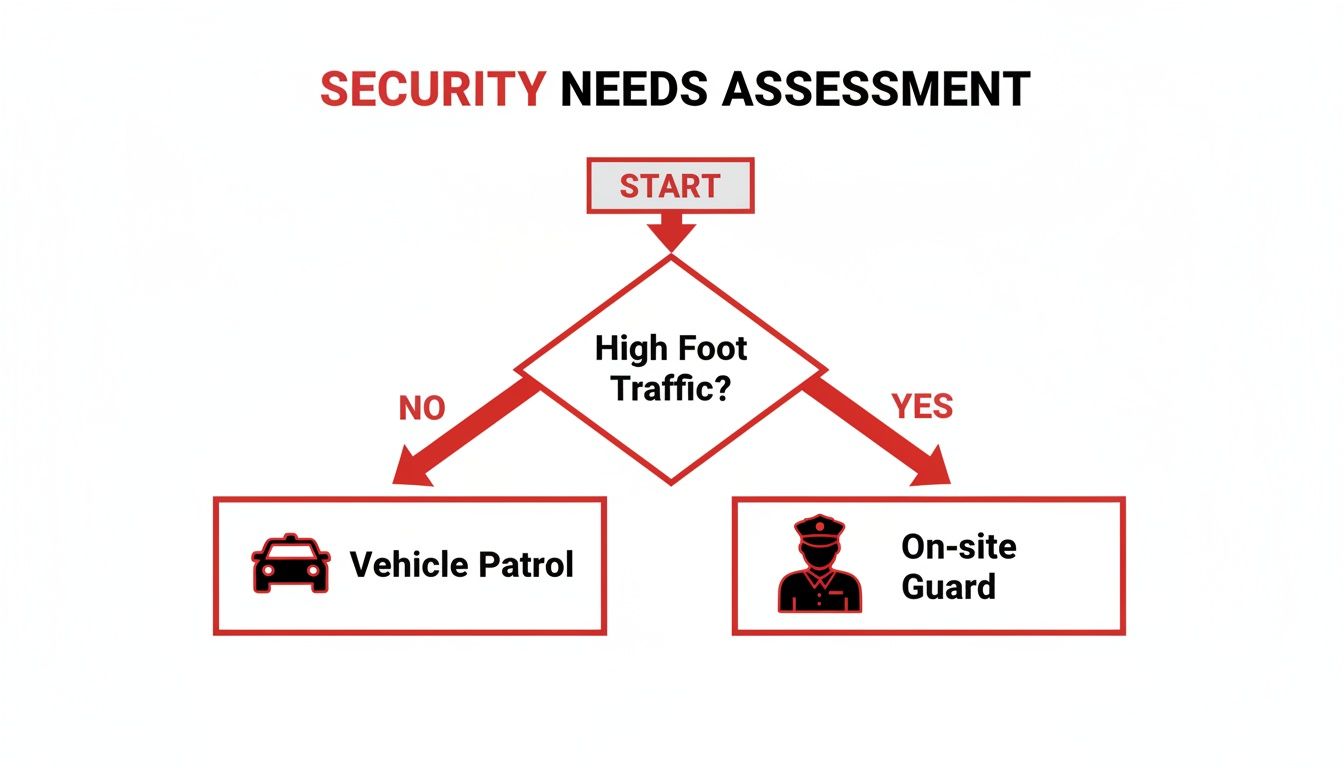
As the chart shows, high-traffic areas often demand the immediate response capabilities of an on-site guard. On the other hand, properties with lower foot traffic can achieve excellent deterrence with strategic, well-timed vehicle patrols.
More and more businesses are recognizing this value. The global contract security market is projected to reach approximately USD 175.2 billion by 2033. This growth shows that decision-makers are increasingly viewing security as a critical operational investment, not an optional expense.
From Cost to Value: A Real-World Scenario
Imagine an HOA board struggling with persistent issues: late-night noise complaints, residents using the pool after hours, and a recent string of car break-ins. The initial quote for a vehicle patrol service might seem like a significant expense.
But what is the alternative cost? You're facing frustrated residents, declining property values, and the considerable liability of a serious incident happening on your watch. A professional patrol service doesn't just drive by. They document violations, de-escalate conflicts, and create a consistent enforcement presence that brings order back to the community.
Within a few months, the break-ins stop. The noise complaints decrease. Residents feel safer and more content. Suddenly, the cost of that security contract is easily offset by the value of a peaceful community and the avoidance of far more expensive problems.
To get a better handle on the numbers, check out our guide on how much you should pay for security guard services. This is the true ROI of a professional security partnership—it transforms a reactive expense into a proactive asset.
How to Choose the Right Security Partner

Choosing a vendor for your contract security services can be a daunting process. Every company’s website promises professionalism, reliability, and peace of mind. How do you cut through the marketing language to find a partner who will actually deliver on those promises?
Making the right choice can transform your property’s safety and reputation. The wrong one can cause more headaches and liabilities than you started with. The key is knowing what to ask. You need to look past the pricing and get to the heart of how they operate.
The Litmus Test Questions for Any Security Vendor
When you are meeting with a potential security company, a few key questions will reveal their true priorities. A top-tier partner will be eager to discuss these points, while a company cutting corners may provide vague answers.
Get straight to the point with these non-negotiable questions:
- What is your officer training and retention strategy? High turnover is a significant red flag in this industry. A firm that invests in its people with competitive wages, real benefits, and a clear career path will provide you with experienced, motivated officers who care about your property.
- What is your manager-to-client ratio? If an account manager is juggling 50 different clients, you are unlikely to get the attention you deserve. A low ratio is critical—it means your point of contact is available, performs regular site visits, and can proactively solve problems before they escalate.
- What technology do you use for reporting and accountability? Vague, handwritten logs are a thing of the past. Demand a modern system that uses GPS tracking to provide verifiable, real-time reports with photos and timestamps. This isn't a "nice-to-have"; it's essential for transparency.
These questions expose a company’s core philosophy. A firm like Overton Security, built on supporting its officers and maintaining a low manager-to-client ratio, shows a foundational commitment to quality service, not just filling a shift.
A security provider’s investment in its own team is a direct investment in the safety of your property. Companies that treat officers as disposable assets will deliver disposable service.
Beyond the Basics: What to Look for in a Proposal
Once you’ve established a company’s operational integrity, it’s time to scrutinize their proposal. A good proposal is far more than a price sheet; it should be a customized security plan built specifically for your property.
Look for evidence that they’ve done their homework. Did they conduct a thorough site assessment? Does the proposal address your unique pain points, like after-hours loitering at a shopping center or unauthorized access at a construction site?
A great security partner will present a plan that clearly outlines:
- Customized Post Orders: These are the detailed, site-specific instructions that tell an officer exactly what to do. If the post orders are generic, the service will be, too.
- Clear Escalation Protocols: The plan must define precisely what happens during an incident. Who gets called? When do they get called? How is the information relayed?
- Transparent Reporting Procedures: You should know exactly what kind of reports you’ll receive, how often you’ll get them, and what format they’ll be in. This ensures you’re always in the loop.
For property managers who want to dig even deeper, our guide on how to find quality security services offers a comprehensive checklist to use before you sign any contract.
Finding a Partner, Not Just a Provider
Ultimately, your goal shouldn’t be to hire a security provider. You need to find a security partner. There is a significant difference.
A provider simply fills a slot in the schedule. A partner, on the other hand, becomes an extension of your own management team. They work with you to actively prevent issues, offer strategic advice, and enhance the overall value and safety of your site.
This kind of relationship is built on trust, transparency, and a shared dedication to getting it right. When you find a company that confidently answers the tough questions and presents a thoughtful, detailed plan, you’ve found more than a vendor. You’ve found a true partner you can count on.
Making Sense of Security Contracts and Post Orders
A security contract should be a clear blueprint for success, not a dense legal document that causes confusion. When you sign an agreement for contract security services, you're forming a partnership. For a property manager or facilities director, this document is your single best tool for holding your provider accountable.
Too often, managers can get lost in boilerplate language and miss the parts that truly matter. While broad terms like scope of work and liability clauses are standard, the real power is in the operational details. A solid contract goes beyond vague promises, clearly defining specific duties, reporting protocols, and what to do in any foreseeable situation. This level of clarity protects both you and your security partner from misunderstandings.
The contract sets the stage, but the post orders direct the performance. Without detailed, customized post orders, even the best security officer is operating without a script, leading to inconsistent service and potential security gaps.
Think of it this way: the contract is the "what" (e.g., provide one unarmed officer, 40 hours a week). The post orders are the "how" (e.g., patrol the east perimeter every hour, physically check all ground-floor doors, and report any unsecured gates via the app with a photo).
The Crucial Role of Post Orders
Post orders are the most important document in day-to-day security operations. These are the specific, on-site instructions that tell an officer exactly what to do during their shift. They are what transforms a simple "security presence" into a targeted security solution.
Be wary of vendors who provide generic, copy-pasted post orders. It is a significant red flag that signals they are not invested in learning your property’s unique challenges. A true security partner will work with you to build these instructions from the ground up, walking the site and asking insightful questions to create directives their officers can execute flawlessly.
Your post orders should always include:
- Specific Patrol Routes and Checkpoints: Clearly defined paths and mandatory check-in points—often verified with GPS or NFC tech—to guarantee full coverage.
- Access Control Procedures: Step-by-step instructions for everything from greeting visitors and verifying credentials to managing after-hours deliveries.
- Emergency Response Protocols: A clear playbook for handling incidents ranging from a fire alarm to a medical emergency, including who to call and in what order.
- Incident Reporting Guidelines: Firm directions on what qualifies as an "incident" and exactly how it needs to be documented in the reporting software.
This detail is non-negotiable for consistent, high-quality service. It ensures every officer, regardless of who is on shift, performs their duties to the exact same standard. To dig deeper, check out our complete guide on writing effective security guard post orders.
Key Contract Sections You Cannot Ignore
A strong security program is built on a strong contract. When you're reviewing a proposal for contract security services, it's time to scrutinize the fine print. You're looking for clear, unambiguous language that defines every responsibility.
Below is a quick checklist of the core components every security agreement should have clearly spelled out. These sections form the legal backbone of your partnership and prevent simple misunderstandings from turning into major problems.
| Key Elements of a Strong Security Service Contract |
| :— | :— | :— |
| Contract Section | What to Look For | Why It Matters |
| Scope of Work (SOW) | Precise details on officer count, coverage hours, patrol frequency, and specific tasks. Avoid vague terms like "general security." | This is the heart of the agreement. A detailed SOW removes ambiguity and becomes the standard against which performance is measured. |
| Liability & Insurance | Clear language on who is responsible for what. The vendor must provide a Certificate of Insurance (COI) listing your property as additionally insured. | This protects your organization from financial risk if an incident occurs. Without adequate coverage, you could be left footing the bill. |
| Personnel & Training | Requirements for officer screening, background checks, licensing (e.g., BSIS in California), and site-specific training. | Ensures the people protecting your property are qualified, professional, and prepared for your environment, not just warm bodies in a uniform. |
| Reporting & KPIs | Specifics on what reports you will receive (e.g., daily activity, incident reports) and the metrics used to measure success (e.g., response times). | "What gets measured gets managed." This holds the vendor accountable to tangible results, moving beyond subjective feelings of safety. |
| Termination Clause | The conditions under which either party can end the contract, including notice periods and definitions of "for cause" termination. | Provides a clear exit strategy if the partnership isn't working, protecting you from being locked into a long-term agreement with a poor performer. |
A transparent, detailed contract is the foundation of any successful security partnership. It’s a sign that a vendor is committed to accountability and gives you the confidence that your property is truly in capable hands.
Blending Human Expertise with Modern Security Tech

The best contract security services program isn't about choosing between experienced officers and advanced technology. It’s about making great people even more effective by equipping them with the right tools. Technology in security was never meant to replace human judgment; it’s meant to amplify it, providing better information, stronger accountability, and faster communication.
This combination of human expertise and smart tech is what separates a modern security partner from the rest. It’s how a security program goes from being a simple presence to an active, intelligent force protecting your property. For property managers and facility directors, this integrated approach delivers the transparency and reliability you need to feel confident in your security investment.
Empowering Officers with Smarter Tools
Gone are the days of paper logs and guesswork. Today, leading security providers arm their officers with technology that sharpens their performance and gives clients complete visibility. These tools don't just track activity—they create a verifiable record of service that holds everyone accountable.
Key technologies that empower our officers include:
- GPS-Enabled Guard Tour Systems: Officers use handheld devices to scan checkpoints along their patrol routes. This provides a time-stamped, GPS-verified record of their movements, ensuring no corner of your property is overlooked and patrols are completed exactly as promised.
- Real-Time Digital Reporting: Instead of waiting for a summary at the end of the week, you get digital reports with photos and notes the moment an incident happens or a patrol is finished. This means immediate awareness and faster decision-making on your end.
This level of detail means you never have to wonder if a patrol was missed or if an issue was properly documented. The proof is delivered right to your inbox in real-time.
A professional security officer with a smartphone and the right software is more effective than a team of guards relying on outdated methods. Technology gives them the power to see more, report faster, and respond smarter.
The Security Operations Center as a Force Multiplier
Think of a 24/7 Security Operations Center (SOC) as the central nervous system of a modern security program. It acts as a force multiplier, providing a critical layer of oversight and immediate support for every single officer in the field. The SOC isn't just a dispatch line; it’s a hub of information and command.
An effective SOC provides:
- Constant Oversight: SOC specialists monitor officer locations via GPS, conduct regular wellness checks, and ensure personnel are safe and alert throughout their shifts.
- Immediate Support: If an officer encounters a situation they cannot handle alone, the SOC can dispatch backup, contact law enforcement, or provide clear guidance based on established protocols.
- Incident Management: The SOC serves as the primary point of contact for alarms and emergencies, ensuring a coordinated and efficient response every time.
This constant connection demonstrates a core philosophy at Overton Security: our officers are our most valuable asset. By giving them unwavering support, we ensure they are always prepared to protect your property safely and effectively. You can learn more about the evolution of hybrid security in this market report on private security service trends.
Common Questions About Contract Security Services
When you start looking into professional security, a few key questions always come up. Property managers and HOA board members need straight answers on cost, reliability, and accountability before they can move forward. Getting this right is the difference between hiring a vendor and finding a true security partner.
Here are the practical, straightforward answers to the questions we hear most from clients across California.
What Is the Typical Cost for Contract Security in California?
There is no single answer, as the cost for contract security services depends on the type of service—an onsite guard is priced differently than a vehicle patrol—your location, and the specific duties required. It can be tempting to choose the lowest bid, but true value comes from a provider who invests in their people and their technology.
A quality partner won't just give you a number; they'll perform a thorough site assessment and provide a transparent, detailed quote. The goal shouldn't be to find the cheapest hourly rate, but to implement a plan that prevents costly incidents from happening in the first place.
How Can I Ensure the Officers on My Property Are Reliable?
Officer reliability comes down to the vendor's company culture. How do they hire, train, and manage their people? This is where you need to ask direct questions about their screening process, ongoing training, and the level of supervisor involvement.
A security company’s commitment to its own team directly reflects the quality of service you will receive. Companies that prioritize officer support and career development consistently deliver more professional and dependable personnel because their team is valued and invested in their role.
What Kind of Reporting Should I Expect?
You should expect detailed, timely, and verifiable reporting. In this day and age, old-fashioned paper logs and clipboard check-ins are unacceptable.
A modern security partner will use GPS-enabled software to deliver digital reports in real-time, complete with photos, timestamps, and detailed notes on any incidents. This technology removes guesswork from the equation. It provides you with complete, transparent proof of service and total accountability for everything that happens on your property.
Ready to build a security program based on transparency and reliability? For over 26 years, Overton Security has been the trusted partner for properties across California. We combine experienced officers with smart technology to deliver results you can count on.