
A Fire Watch isn't just a "nice-to-have"—it's a temporary, and often legally mandated, safety measure where trained personnel actively patrol a property to watch for signs of fire. This service becomes essential when a building’s fire alarm, sprinkler, or suppression systems are offline, creating a critical gap in your protection.
What Is a Fire Watch and Why Is It So Critical?
Think of your building’s automated fire safety system as its silent, ever-watchful guardian. But what happens when that system needs maintenance, has a malfunction, or isn't even active yet, like on a new construction site? Suddenly, your property is vulnerable. A professional Fire Watch service is designed to step directly into that gap, acting as a vigilant, human-powered fire detection and response system.
A Fire Watch officer is like a smoke detector with a brain and legs. Instead of just waiting for a sensor to trip, the officer is constantly moving, actively patrolling every floor, stairwell, and hidden corner of your property. Their sole focus is to spot potential fire hazards, detect the very first signs of smoke or flames, and execute a well-rehearsed emergency plan with speed and precision.
The Core Purpose of a Fire Watch
Ultimately, the goal is simple: ensure the safety of every person on the premises and protect the property itself from catastrophic damage. This is far more than just having someone walk the halls; it's a structured, fully documented process built to manage significant risk.
A professional Fire Watch delivers on several key fronts:
- Early Detection: Officers are trained to pick up on the subtle signs of a fire that an untrained person would almost certainly miss, like faint chemical smells, unusual heat radiating from a wall, or the slightest wisp of smoke.
- Immediate Notification: If a fire is detected, the officer’s first priority is to alert everyone in the building and immediately contact emergency services. This ensures the fastest possible response from the fire department.
- Hazard Identification: While on patrol, officers are also your eyes and ears for potential risks—think blocked fire exits, overloaded electrical circuits, or improperly stored flammable materials. This proactive approach contributes directly to better workplace fire prevention.
- Compliance and Liability Protection: A properly executed and documented Fire Watch satisfies the strict legal requirements set by local fire marshals. This protects property managers and business owners from crippling fines, forced shutdowns, and massive liability claims.
A professional Fire Watch transforms a high-risk situation into a managed, compliant, and safe environment. It’s an essential service that bridges the gap when your primary fire safety systems are down, offering peace of mind to property managers, HOA boards, and construction superintendents.
The fundamental aim of a Fire Watch is to safeguard lives and property by preventing fires before they can escalate. For a broader look at preventative strategies, you can check out a guide on how to prevent house fires. When you partner with a trusted provider like Overton Security, you're ensuring this critical responsibility is handled by experienced professionals dedicated to maintaining a secure environment.
Understanding the Legal Mandates for Fire Watch
If you’re a property manager, construction superintendent, or HOA board member, calling in a Fire Watch isn't just a good idea—it's often a legal requirement. These mandates aren't suggestions. They are enforced by local and national authorities, and ignoring them can lead to crippling fines, operational shutdowns, and significant legal liability.
The foundation for these rules comes from the National Fire Protection Association (NFPA), the leading authority on fire safety in the United States. Think of their standards as the blueprint that most local fire codes, including the strict California Fire Code, are built upon.
The NFPA and Your Local Fire Marshal
When it comes to a compromised fire system, two NFPA standards are especially important:
- NFPA 101, Life Safety Code®: This one is all about protecting people. It lays out the bare-minimum requirements for building design and operation to ensure everyone can get out safely during a fire.
- NFPA 72, National Fire Alarm and Signaling Code®: This code is the rulebook for how fire alarm and signaling systems must be installed, maintained, and tested.
A key takeaway from these codes is the "four-hour rule." In most cases, if your building's fire alarm or sprinkler system is down for more than four hours in a 24-hour period, you are required to implement a Fire Watch until everything is back up and running.
However, the final call always rests with the local Authority Having Jurisdiction (AHJ), which is usually your city’s Fire Marshal. They have the power to order an immediate Fire Watch, regardless of the four-hour window, if they feel the risk is high enough.
This simple decision tree shows the logic you need to follow the moment a system goes down.
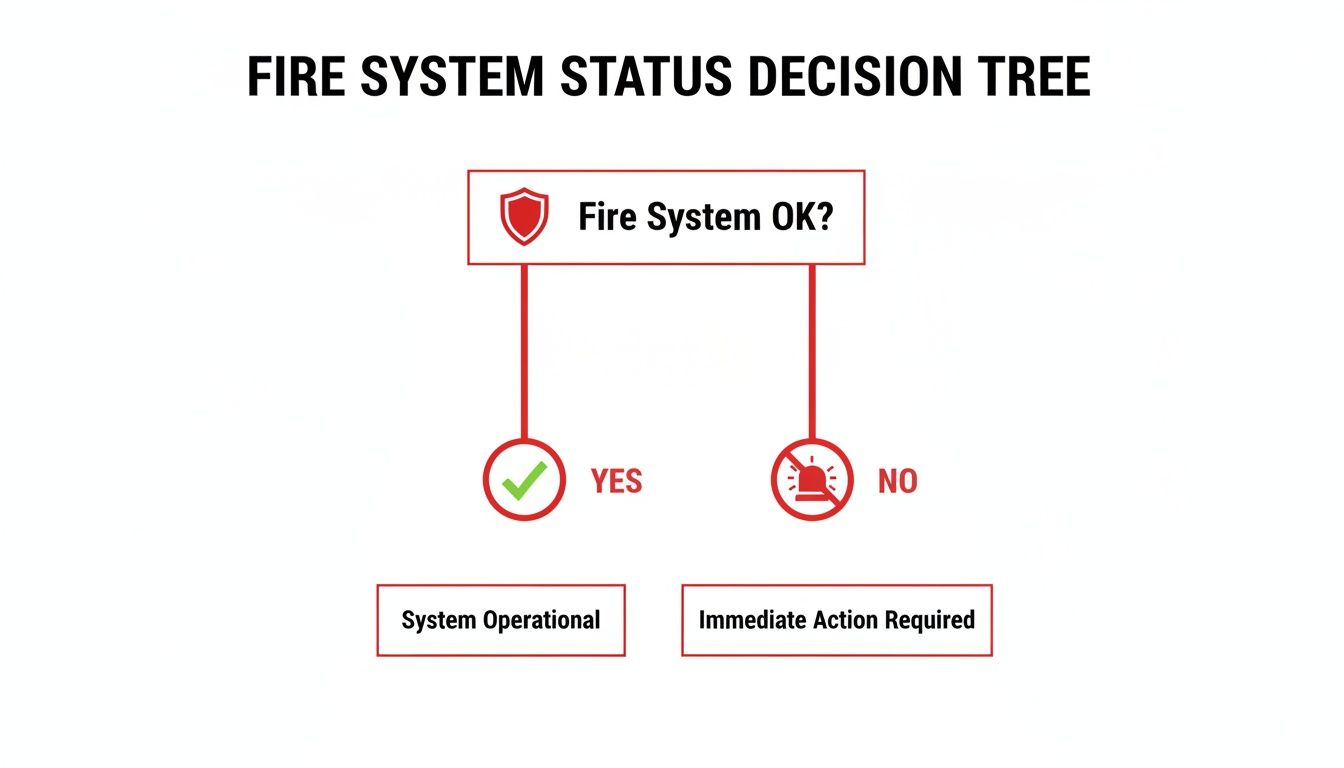
As you can see, any break from a fully operational system demands swift action to keep people safe and stay on the right side of the law.
Why Compliance Is Non-Negotiable
Failing to follow a Fire Watch order from the Fire Marshal is a serious offense. The consequences aren't just a slap on the wrist; they can be immediate and severe, showing a clear neglect of your duty to provide a safe environment.
At its core, a Fire Watch is a human-powered safety net. It’s about maintaining an equivalent level of life safety when your automated systems fail—it’s not just about checking a box.
For properties like healthcare facilities or large HOAs, system downtime is a regular occurrence, happening during 20-30% of annual maintenance periods. Codes like NFPA 101 demand hourly patrols during these gaps. Overton's 24/7 Security Operations Center and Guard Tour Management System ensure 100% verifiable tours, helping you avoid non-compliance fines that can hit $50,000 per violation in California. You can dig deeper into fire trends by reviewing these fire-related statistics and insights.
This is exactly why partnering with a proven security provider is so critical. A professional service doesn’t just provide boots on the ground; it provides the detailed, legally defensible documentation that fire marshals require. With over 26 years of experience, Overton Security knows the local codes inside and out. We make sure our Fire Watch services not only meet but exceed every regulation, giving you documented proof of compliance and, more importantly, peace of mind.
A Day in the Life of a Fire Watch Officer
What does a Fire Watch officer actually do all shift? It’s far more than just walking around. Think of them less as a passive observer and more as an active, detail-oriented first line of defense. Understanding their routine shows how they turn a high-risk situation—like a sprinkler system outage—into a managed and secure period.
It all starts with a thorough briefing. Before stepping foot on the patrol route, the officer reviews site-specific orders, becomes familiar with the emergency action plan, and confirms the location of every fire extinguisher and communication device. They then conduct an initial walkthrough of the entire property to get a baseline, noting any immediate risks.
Conducting Methodical Patrols
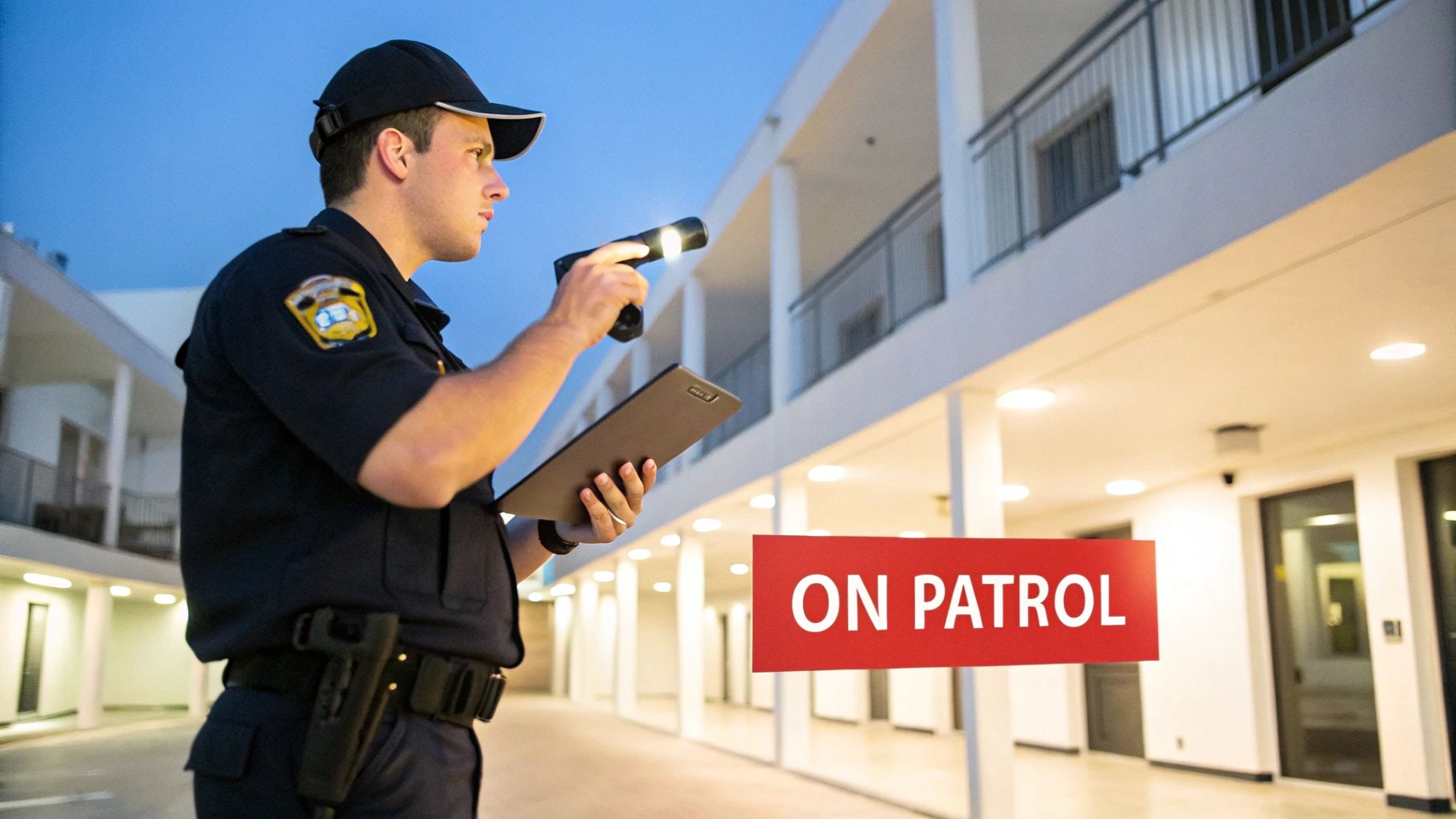
The core of the job is the continuous patrol, and this is no random stroll. Each patrol follows a carefully planned route designed to cover every square foot of the area, hitting all floors, stairwells, mechanical rooms, and any other potential hotspots. The frequency is usually dictated by the fire marshal—typically every 30 or 60 minutes—and it's done with clockwork consistency.
During these rounds, the officer is using all their senses. They are trained to look, listen, and smell for anything that’s even slightly out of the ordinary.
- Visual Hazards: They're scanning for smoke, sparks from welding or grinding, blocked fire exits, cluttered hallways, or overloaded outlets.
- Olfactory Clues: Sometimes you smell a fire before you see it. They’re alert for the scent of burning plastic, electrical smells, or strange chemical fumes that could point to a hidden danger.
- Auditory Signals: Listening for the faint crackling of a small fire or the tell-tale hiss of a gas leak.
- Tactile Sensations: Checking for unusual heat coming from walls, doors, or electrical panels.
This methodical approach ensures that small issues are flagged before they have a chance to grow.
Proactive Hazard Identification and Correction
Here’s what separates a professional from someone just going through the motions: identifying and correcting risks before they become emergencies. This is where solid training and real-world experience make all the difference. An Overton Security officer doesn't just spot a problem; they act on it.
For instance, if they find a fire door propped open, they close it and log the finding. See flammable materials stored too close to a heat source on a job site? They’re on the phone with the site supervisor to get it moved, right then and there. It's this proactive mindset that stops small oversights from turning into full-blown disasters.
The duty of a Fire Watch officer is not just to react to fire, but to actively prevent the conditions that allow a fire to start. This preventative mindset is the hallmark of a truly effective safety professional.
Meticulous Documentation and Reporting
Every patrol, every observation, every single action taken is meticulously documented. This isn't just busywork; it's a legal and compliance requirement. The officer maintains a detailed, continuous log that becomes your legally defensible proof for the Fire Marshal that the watch was performed correctly.
This log captures everything:
- The exact time each patrol started and ended.
- The specific areas that were inspected on each round.
- Any hazards found and the corrective actions taken.
- A record of all communications with management or emergency services.
At Overton Security, we take this a step further. Our officers use a GPS-enabled Guard Tour Management System, scanning checkpoints along their route. This creates an unchangeable, time-stamped digital record of their patrols, giving our clients total transparency and the concrete proof they need to know their property was in good hands.
Real Scenarios That Demand a Professional Fire Watch
Knowing the rules is one thing, but seeing how they play out in the real world makes the need for a Fire Watch crystal clear. For property managers and construction superintendents, the requirement often appears without warning and with incredibly high stakes.
Let’s walk through a few common situations where a professional Fire Watch service isn't just a good idea—it's an absolute necessity. These examples show how a seasoned partner like Overton Security understands the unique risks of your environment and provides the critical layer of protection you need.
The High-Rise Sprinkler Retrofit in Los Angeles
Imagine you’re managing a 20-story residential tower in downtown L.A. A mandatory sprinkler system upgrade is underway, which means taking the system offline, floor by floor, over two full weeks. During that time, hundreds of residents are going about their lives, completely unaware that their primary fire protection is down.
This is a huge risk. A small kitchen fire that one sprinkler head could have handled in seconds now has the potential to spread uncontrollably. The local fire marshal is firm: a continuous, 24/7 Fire Watch is non-negotiable for the entire project.
In a situation like this, a professional Fire Watch officer from a trusted provider would:
- Patrol all affected floors hourly, checking common areas, hallways, and stairwells.
- Keep a detailed, legally compliant logbook ready for the LAFD to inspect at any time.
- Serve as a reassuring presence for residents, letting them know that safety measures are still actively in place.
This is about much more than checking a box for compliance; it's about closing a critical safety gap and protecting lives.
The New Construction Site in San Diego
Picture a massive new commercial construction site. The building is framed, but the fire alarm and sprinkler systems won't be live for another month. At the same time, "hot work" is happening all over the site—welders joining steel beams, plumbers soldering copper pipes. Sparks and molten metal are flying constantly.
According to the National Fire Protection Association (NFPA), an average of 4,630 structure fires related to hot work are reported each year. Without a working suppression system, a single stray spark landing on scrap lumber or other flammable materials could ignite a blaze that wipes out millions of dollars of work in minutes. This level of risk is also present in industrial settings, especially during modifications like safely accessing live gas lines through hot tapping, where a Fire Watch becomes absolutely critical.
Here, the Fire Watch officer's job is highly specialized. They need to:
- Stay right next to the hot work for the entire duration of the job.
- Keep watching the area for at least 30-60 minutes after the work stops to catch any smoldering embers.
- Have fire extinguishers ready and be trained to use them on a fire in its earliest stages.
Their dedicated focus lets welders and other contractors concentrate on their jobs, knowing a trained set of eyes is devoted solely to fire prevention.
The Unexpected Alarm Failure in a Sacramento Retail Center
It's a packed Saturday at a busy retail center you manage in Sacramento when you get the call: the main fire alarm panel is dead. The technician says it could be eight hours before they can get the part and fix it. The fire marshal gives you two options: either shut down the entire center—costing your tenants tens of thousands in lost sales—or get a Fire Watch in place immediately.
A sudden system failure forces an immediate, high-stakes choice. A professional Fire Watch service allows you to maintain business operations safely and legally, turning a potential crisis into a manageable event.
In an urgent scenario like this, having a responsive security partner is everything. Overton Security can deploy trained officers fast to cover the property. Their job is to patrol all public areas and back hallways, knowing exactly who to call in an emergency to ensure a fast, orderly evacuation if needed. This decisive action keeps shoppers safe, tenants in business, and the property compliant with the fire code, all while avoiding a costly shutdown.
How Technology Creates an Accountable Fire Watch
In a high-stakes situation like a Fire Watch, "trust but verify" isn't just a clever phrase—it's an operational necessity. While having a trained officer on-site is the core of the service, modern technology is what transforms their presence into a documented, verifiable, and completely transparent process. For property managers and business owners, this blend of human expertise and smart tech provides the concrete proof needed for total peace of mind.
Forget the days of relying on flimsy paper logs that could get lost, damaged, or even falsified. Today, real accountability is built on hard data. At Overton Security, we deliver this through our advanced Guard Tour Management System (GTMS), which creates an unchangeable digital record of every single patrol.
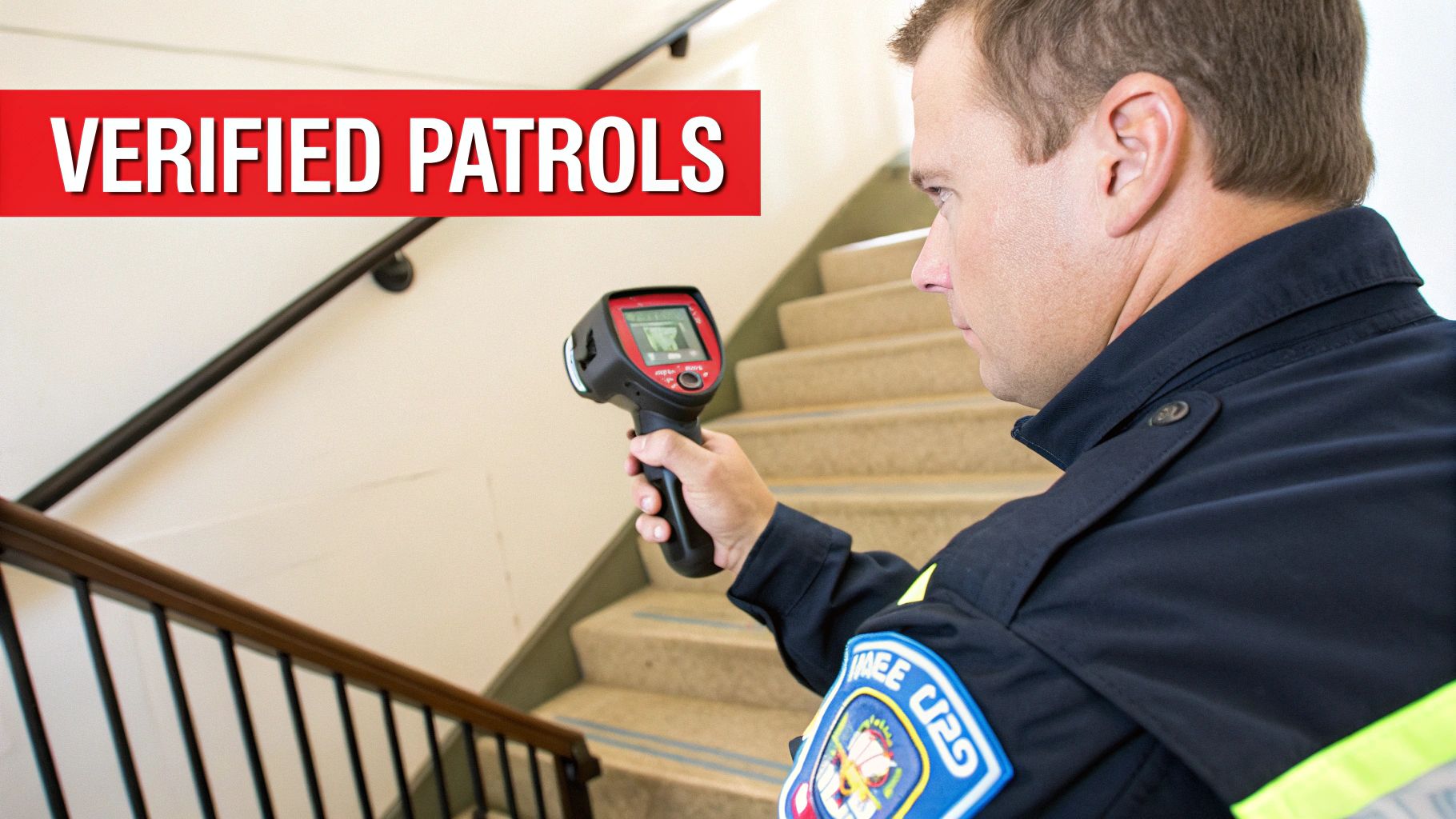
GPS-Enabled Patrol Verification
Our system is as straightforward as it is powerful. Officers carry GPS-enabled devices and must scan specific checkpoints placed strategically along their patrol route. Each scan creates an undeniable digital footprint.
Technology doesn't replace the officer; it validates their diligence. It gives you objective, time-stamped proof that every corner of your property was checked as required, protecting you from liability and satisfying the fire marshal.
This system guarantees that every patrol is executed with precision. There are no skipped rounds or missed areas—just a clear and consistent record of service delivered right to you.
Real-Time Reporting and Oversight
This technological backbone does more than just create a historical record. It offers immediate insights and provides a constant layer of support for the officer on the ground.
Here’s how our integrated approach delivers unmatched accountability:
- Instant Digital Reports: The moment an officer completes a patrol or logs an issue, the report is generated. You receive detailed summaries—complete with photos and officer notes—documenting any hazards found or actions taken.
- 24/7 SOC Support: Our Security Operations Center (SOC) provides constant oversight. SOC dispatchers can watch patrol progress in real-time, ensuring the officer is safe and following post orders. If a checkpoint is missed, the SOC is immediately alerted to investigate.
- Enhanced Situational Awareness: This steady flow of information allows for smarter, faster decisions. If a minor issue is found, like a blocked exit, it’s documented and can be fixed before it becomes a major liability. This system pairs perfectly with other solutions, like our expertise in remote video monitoring, to create a comprehensive safety net.
The concept of a Fire Watch has deep roots, surging in importance during World War II when civilian volunteers manned lookout towers to spot incendiary bombs. In California alone, where Overton Security now operates with 26 years of expertise, the state built over 5,000 fire watch towers by 1942. This history highlights why a modern Fire Watch remains so vital, especially when you consider that NASA satellites now detect around 10,000 active fires daily worldwide. Technology simply allows us to apply that same vigilant spirit with a level of precision and proof our predecessors could only have dreamed of. You can learn more about NASA's long-term fire detection records.
Choosing the Right Fire Watch Partner
When your property’s safety and legal compliance are on the line, picking a Fire Watch provider is one of the most critical decisions you'll make. The gap between a truly professional partner and a low-bid alternative is massive, affecting everything from your legal liability to the actual safety of everyone in the building.
Frankly, not all security companies are equipped to handle the specific, demanding duties of a Fire Watch.
Making the right call means digging deeper than a simple price quote. You need to ask pointed questions that get to the heart of a company's experience, their accountability, and what they can actually deliver. This isn't just about hiring a guard to walk around; it’s about entrusting a vital life-safety function to a team that knows exactly what they’re doing.
Non-Negotiables for Your Fire Watch Provider
Before you consider signing a contract, make sure any potential partner can provide solid, reassuring answers to these questions. These are the absolute basics for a reliable and legally sound Fire Watch service.
- Verifiable Licensing and Insurance: Does the company have all the right state and local licenses? Ask to see a certificate of insurance that specifically covers Fire Watch duties. This is the most fundamental test of legitimacy.
- Specialized Officer Training: How are their officers specifically trained for Fire Watch? You need to hear about their knowledge of NFPA standards, how they identify hazards, their emergency communication plans, and proper fire extinguisher use. General security training isn’t enough.
- Proven Documentation System: What kind of reports will you get? Don’t just take their word for it; insist on seeing samples. A provider should offer much more than a handwritten log. Look for modern, technology-backed systems that provide GPS verification and time-stamped proof of every patrol.
- Relevant Experience: How long have they been providing Fire Watch services in your specific area, whether it's Los Angeles or San Diego? An experienced provider understands the local fire marshals and the unique risks of your property type, be it a high-rise, apartment complex, or active construction site.
The Overton Security Difference
With 26 years of focused experience, Overton Security has built its reputation on quality service and total accountability. We understand that a Fire Watch isn’t just about having someone on-site; it's about proven, documented performance.
Our officers receive specialized training that goes far beyond the industry standard, and our GPS-enabled Guard Tour Management System delivers the transparent, data-driven reports you need for complete peace of mind. For more on what to look for when choosing a partner, check out our guide to hiring a security agency.
Choosing a partner for a Fire Watch is a decision about risk management. The right provider delivers not only compliance but also confidence, knowing that a dedicated, professional team is protecting your property and the people within it.
Fire Watch FAQs
If you're a property manager, construction superintendent, or business owner, navigating the rules for a Fire Watch can be confusing. Let's clear up some of the most common questions we hear so you can understand your responsibilities and make the right call.
How Long Is a Fire Watch Typically Required?
The short answer: for as long as your fire protection system is down. It's not a suggestion; it's a hard rule.
According to NFPA standards, if your system is out of commission for more than four hours in a 24-hour window, you need a continuous watch on site. This isn't a "check-in every so often" situation—it means boots on the ground, without a break, until the system is fully fixed, tested, and officially back online.
Remember, your local Fire Marshal always has the final say. If they see a significant risk at your property, they can order a watch even for shorter outages.
Can My Own Staff Perform a Fire Watch?
While some local rules might technically allow it, putting your own staff on Fire Watch is a significant liability and something we strongly advise against. Professional Fire Watch officers aren't just extra bodies; they're trained specifically to spot hazards, follow emergency protocols, and keep logs that will hold up under scrutiny.
Think about the risks of using untrained staff:
- Divided Attention: An employee juggling their regular job and a Fire Watch is a distracted employee. It’s too easy to miss a patrol or a subtle sign of danger.
- Lack of Training: Do they know how to properly identify different types of fire hazards? Do they know exactly what to do—and who to call—the second they smell smoke?
- Major Liability: A professional provider carries the right insurance and bonding for this specific, high-stakes job. If something goes wrong on an employee's watch, that liability falls directly on you.
What Documentation Should I Expect From a Fire Watch Service?
You need more than just a simple sign-in sheet. You should demand detailed, legally-sound documentation that will satisfy the Fire Marshal and your insurance company without question. At a minimum, this means a continuous log showing patrol times, notes on property conditions, and any hazards found or fixed.
A professional Fire Watch log is more than just a piece of paper; it's your proof of due diligence and compliance. Without it, you are legally exposed.
This is where we've raised the bar. At Overton Security, our Guard Tour Management System provides real-time, GPS-verified digital reports. These aren't just notes in a binder; they're immutable, time-stamped records, often with photographic evidence, giving you undeniable proof of service and total peace of mind.
When safety and compliance are on the line, you can't afford to guess. Overton Security provides professional, technology-backed Fire Watch services that protect your property and deliver the verifiable documentation you need. Contact us today to discuss your site’s specific safety requirements.