
Is your supply chain truly a competitive advantage, or is it a source of constant stress? For businesses relying on efficient distribution, the answer often lies in location. Fort Worth's logistics support network is the lifeblood of supply chains across North America, serving as a crucial link between coastal ports and the American heartland. For facilities directors, business owners, and operations managers, leveraging this hub translates into significant gains in speed, cost-effectiveness, and reliability.
Why Fort Worth Is a Premier Logistics Hub
Fort Worth isn’t just another city in Texas; it’s a strategic linchpin for the national supply chain.
Imagine your distribution network as a powerful wheel. Fort Worth sits at the center, the hub with infrastructure spokes reaching out to every corner of the country. This isn't just about being centrally located—it’s about the seamless convergence of transportation systems designed to work in harmony.
This prime geographic position is supercharged by a mix of assets that make it a magnet for commerce and distribution, offering a stable and efficient environment for businesses to thrive.
The Power of Unmatched Connectivity
At the core of Fort Worth's dominance is its multimodal infrastructure. Major interstate highways like I-35, I-20, and I-30 create a web of ground transport options, allowing trucks to reach an incredible 93% of the U.S. population within just 48 hours. This network keeps goods moving from warehouses to their final destinations with minimal delays.
Adding another layer of strength, the city is a major junction for Class I railroads, including BNSF and Union Pacific. This rail access is critical for moving heavy freight and containers from coastal ports into the country's interior, reducing reliance on long-haul trucking and lowering transportation costs.
The real advantage is how seamlessly these systems are integrated. A container can arrive by rail, be transferred to a truck, and head to a distribution center within hours. This is the foundation of a fluid and resilient supply chain.
This infographic provides a clear visual of how Fort Worth’s central hub connects its highway, rail, and air infrastructure to create one powerful logistics network.
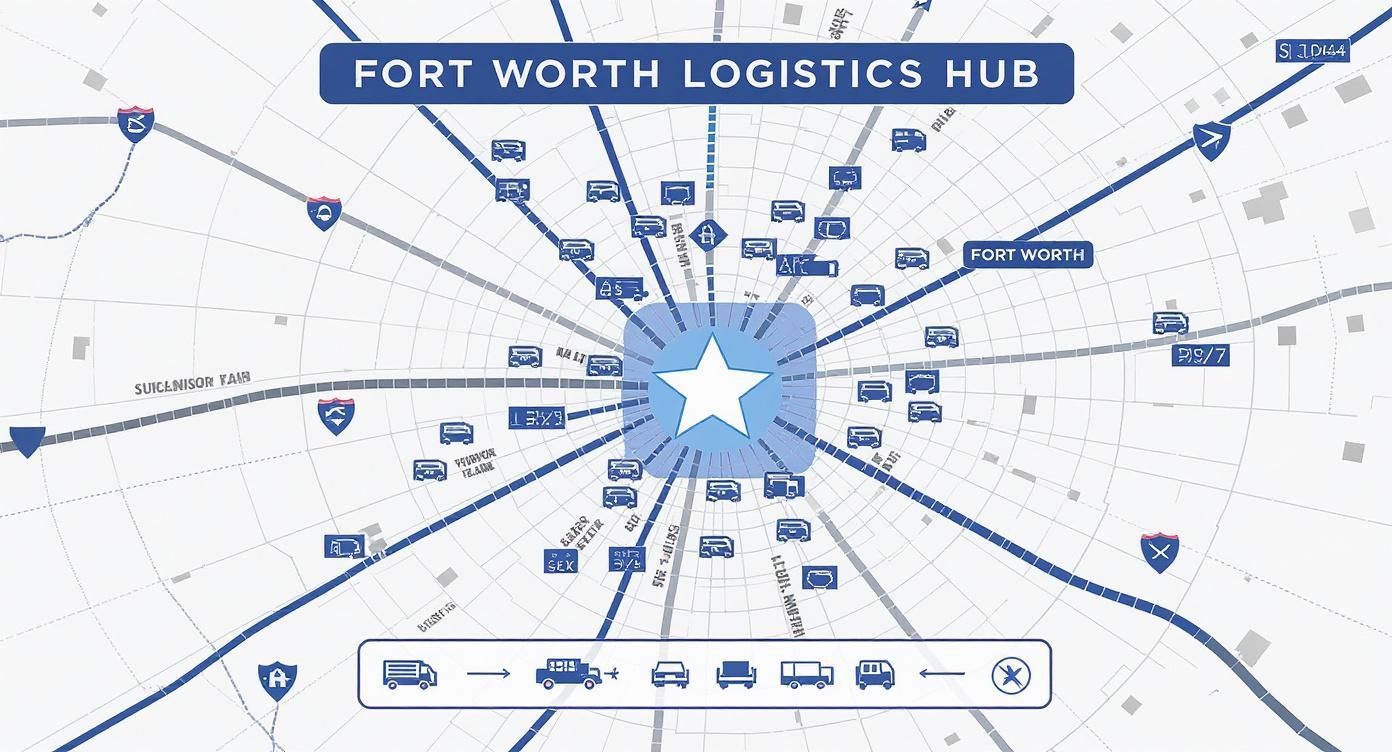
As you can see, the city is a critical node where different modes of transport intersect, making efficient national and international distribution not just possible, but practical.
A Thriving Business and Trade Ecosystem
Of course, infrastructure is only part of the story. The Dallas-Fort Worth metroplex consistently ranks as a top national region for transportation and supply chain activity. It's home to 22 Fortune 500 companies and an impressive 32 Foreign Trade Zones (FTZs), which allow businesses to streamline customs oversight for manufacturing and processing goods. You can learn more about the DFW distribution advantage from NFI Industries. This powerful blend of major corporate presence and trade-friendly policies cements Fort Worth’s role in global commerce.
Finally, the close proximity to DFW International Airport—one of the world's busiest cargo hubs—opens a gateway for international air freight. This capability is essential for businesses dealing with high-value goods or time-sensitive shipments, completing the city’s powerful air-rail-road trifecta. This robust ecosystem doesn't just support local businesses; it provides a reliable, cost-effective platform for national and global distribution.
Understanding Your Logistics Support Options
The term "logistics support" can feel broad, but it boils down to a collection of specialized services that manage the physical journey of your products. For business owners and facility managers in Fort Worth, understanding these components is key to building a supply chain that is both resilient and efficient.
Think of it less as a single service and more like a menu of options you can tailor to your business needs. These services cover everything from the moment your goods arrive at a Fort Worth loading dock to the second they land on a customer's doorstep. They are the gears turning behind the scenes, keeping your operation humming so you can stay focused on growth and customer service.
Core Components of Logistics Support
At its heart, logistics support can be split into two primary areas: warehousing and transportation. The value lies in the specific tasks that fall under each one.
- Warehousing and Distribution: This is much more than stacking boxes. Modern warehousing involves fulfillment (the pick-and-pack process), cross-docking (moving goods directly from an incoming truck to an outgoing one with minimal storage), and smart inventory management to ensure optimal stock levels.
- Transportation Management: This is about getting your products from Point A to Point B in the most intelligent way possible. It includes optimizing shipping routes, managing fleets, and freight brokerage—finding the most efficient and cost-effective carrier for your shipments.
A reliable logistics partner in Fort Worth doesn't treat these as separate tasks. They weave them together seamlessly, actively managing the movement of your goods to ensure every step is fast, accurate, and cost-effective.
Strategic Partners: Third-Party and Fourth-Party Logistics
As your business grows, managing every piece of the supply chain in-house becomes impractical. That’s where partners like Third-Party Logistics (3PL) and Fourth-Party Logistics (4PL) providers become invaluable.
A 3PL provider is an outsourced partner that handles your day-to-day operational logistics. They provide the warehouses, trucks, and technology, becoming the hands-on team that executes your supply chain strategy.
A 4PL provider acts more like a general contractor for your entire supply chain. They manage the relationships between your company and various 3PLs, serving as a single point of contact to optimize the whole system. They focus on high-level strategy, not the daily operations.
To give you a clearer picture, here’s a quick breakdown of what some of these core services look like in action.
Key Logistics Services and Their Business Impact
| Logistics Service | Description | Primary Business Benefit |
|---|---|---|
| Warehousing & Storage | Securely storing products in a managed facility with systems for tracking inventory levels. | Frees up capital and operational resources by eliminating the need to own or lease a warehouse. |
| Order Fulfillment | The process of picking products from inventory, packing them for shipment, and labeling them. | Increases order accuracy and shipping speed, leading to higher customer satisfaction. |
| Transportation Management | Arranging and optimizing the movement of goods from the warehouse to the final destination. | Reduces shipping costs and improves delivery times through route optimization and carrier negotiation. |
| Inventory Management | Using software (WMS) to track stock levels, forecast demand, and manage reordering. | Prevents stockouts and overstocking, ensuring capital isn't tied up in unsold products. |
| Reverse Logistics | Managing the process of customer returns, including inspection, restocking, or disposal of goods. | Creates a smooth, positive return experience for customers, which builds brand loyalty and trust. |
Choosing the right mix of these services allows a business to build a logistics operation perfectly suited to its specific needs in the Dallas-Fort Worth market.
For most growing businesses in Fort Worth, a 3PL is the most practical and impactful partner. They provide the physical infrastructure and operational expertise needed to scale efficiently without massive capital investment. To gain a deeper understanding of the various external resources available, consider consulting a complete guide to Third-Party Logistics.
A Practical Example: An E-commerce Brand’s Journey
Let's walk through how this works for a growing e-commerce brand that sells outdoor gear. Their products are made overseas and arrive in the U.S. through a coastal port before heading to North Texas.
- Inbound Logistics: The shipping containers are brought by rail to a Foreign Trade Zone (FTZ) in the Fort Worth area. A 3PL partner handles customs clearance and unloads the goods at their local warehouse.
- Warehousing and Inventory Management: The 3PL team inspects the inventory, logs it into a shared warehouse management system (WMS), and stores it properly. The brand owner gets real-time visibility into stock levels from anywhere. Of course, keeping that inventory safe is paramount. A solid security plan is a necessity, not a luxury. You can learn more about the essentials of facility protection in our guide to effective warehouse security.
- Order Fulfillment: A customer places an order online. That order is instantly pushed to the 3PL's WMS. From there, the warehouse crew picks the items, packs the box, and prepares it for shipment.
- Final-Mile Delivery: The 3PL then hands the package off to the best carrier for the job—whether that’s FedEx, UPS, or a local courier—to handle the final-mile delivery.
By working with a Fort Worth 3PL, this e-commerce brand gains access to world-class infrastructure and expertise without the massive upfront cost, allowing them to focus on growing their business.
Digging Into Fort Worth's Unmatched Infrastructure
While Fort Worth's central location is a significant natural advantage, the city's logistical power comes from the incredible infrastructure built to capitalize on it. This network of hubs, terminals, and connections is the engine of the regional supply chain, creating a powerful ecosystem that gives businesses a competitive edge.
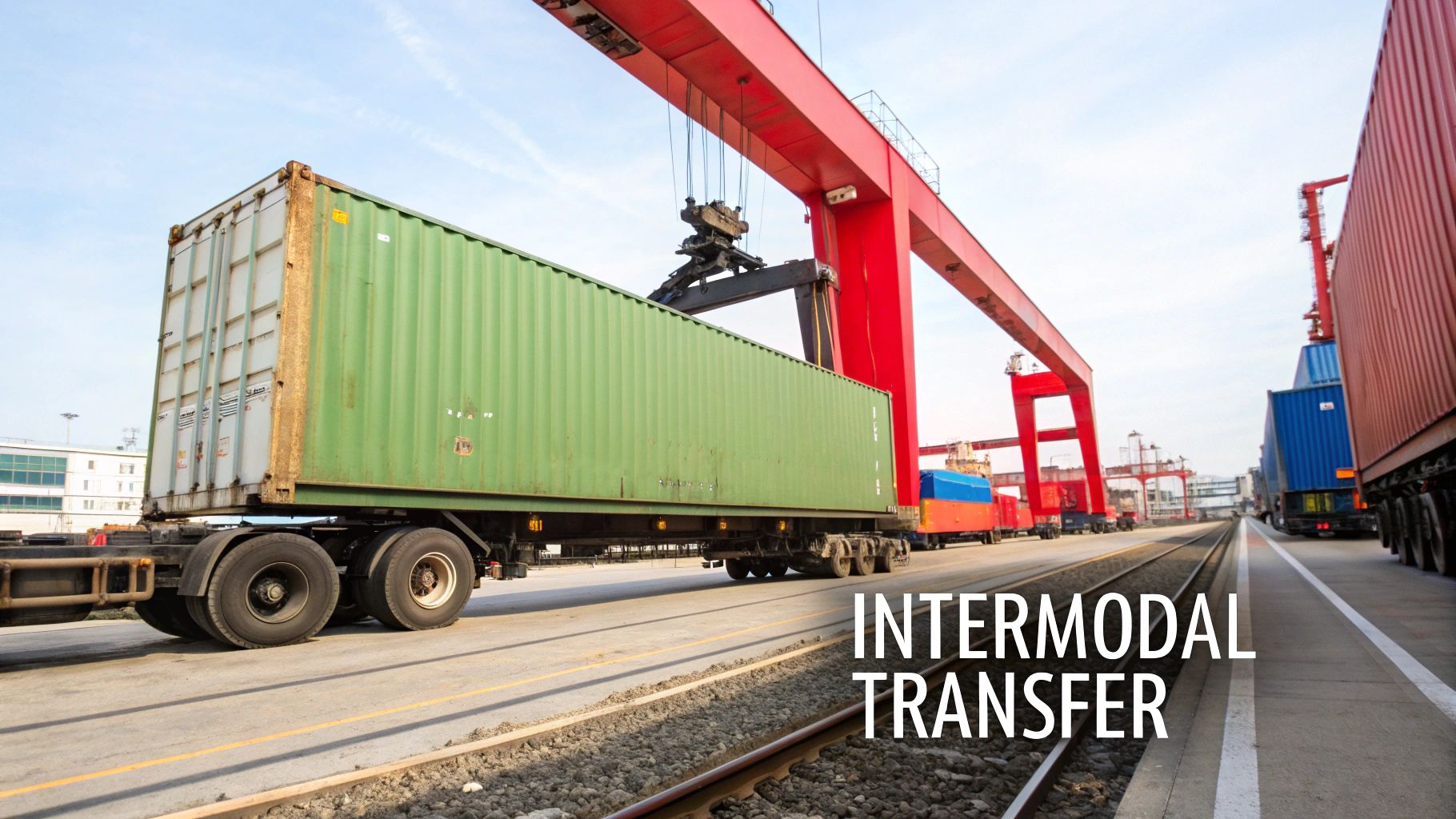
At the heart of this system is AllianceTexas, a global logistics hub that functions like a major inland port. It's a perfect example of an intermodal facility—a place engineered specifically to move freight from one type of transport to another seamlessly.
Think about a shipping container arriving from a coastal port by train. At an intermodal hub like this, that container is lifted directly off the rail car and placed onto a truck chassis, often in minutes. This single move can shave days off transit time and reduce transportation costs compared to relying solely on long-haul trucking.
The Sheer Scale of an Inland Port
The size and scope of AllianceTexas are remarkable and truly anchor Fort Worth’s status as a top logistics hub. The facility grew from handling 120,000 lifts a year in 1994 to over 600,000 by 2006, with a goal of reaching a staggering 1,000,000 lifts per year. That volume rivals some of the nation's busiest seaports.
This capacity means businesses operating in and around Fort Worth deal with fewer bottlenecks and enjoy more reliable timelines for both inbound supplies and outbound products.
This efficiency is the core of what makes Fort Worth so valuable. The ability to move goods between rail and road with such speed and scale directly translates into a more resilient and cost-effective supply chain for any company that plugs into this network.
A Powerful Network of Hubs
AllianceTexas doesn't exist in a vacuum. It works in concert with other critical pieces of infrastructure, creating a combined effect that's greater than the sum of its parts.
- Union Pacific Dallas Intermodal Terminal: This massive facility adds even more rail capacity to the region, providing another key connection point for goods crisscrossing the country. Its modern technology and strategic location complement the operations at AllianceTexas.
- The Dallas Logistics Hub: Spanning an enormous 6,000 acres, this master-planned logistics park offers immense space for warehousing, distribution, and manufacturing, all with direct access to the region's main transportation arteries.
Together, these hubs create a network where each part strengthens the others. A company can establish a distribution center in one hub, tap into the intermodal capabilities of another, and access the highway system with ease. It’s an environment built for flexibility and efficiency.
For companies establishing a presence in Fort Worth, understanding facility options is key. A good place to start is this guide to warehouse steel buildings, which can be a crucial part of your infrastructure. This robust physical network, powered by world-class intermodal facilities, is what makes Fort Worth logistics support so dependable.
Finding Your Place in the Industrial Real Estate Market
Every logistics operation needs a home base, and securing the right property is a critical moment for your business. Diving into Fort Worth's industrial real estate market may seem complex, but understanding a few key concepts will help you identify the perfect warehouse or distribution center with confidence.
Industry professionals often use terms like 'net absorption' and 'speculative development.' Net absorption is a measure of demand—it tracks how much space was occupied versus how much became vacant over a period. Speculative development, or 'spec' space, refers to new warehouses built without a tenant already secured, reflecting a developer's confidence in future demand.
Keeping a finger on the pulse of these indicators gives you a significant advantage. It signals market health and can influence your leverage during lease negotiations.
Understanding Key Market Trends
The Fort Worth industrial market is enormous and constantly evolving. A major driver of this is the expansion of e-commerce giants, which occupy massive facilities. While this might seem intimidating for smaller companies, it actually creates numerous opportunities.
When a large tenant vacates a building or a wave of new spec buildings is completed, the amount of available space increases. This provides more choices and often leads to more favorable lease terms. This is particularly true as the market normalizes from its recent rapid pace. Knowing when these shifts occur is key to finding value.
The sheer size of the Dallas-Fort Worth market is one of its greatest strengths. With a colossal inventory and new buildings always under construction, there's a constant churn that opens doors for businesses of all sizes to find their ideal operational footprint.
Analyzing the Fort Worth Submarkets
Fort Worth is not a single, uniform market. It’s a collection of distinct submarkets, each with its own characteristics and advantages. The best fit depends on your operational needs—whether you're focused on national distribution, manufacturing, or last-mile delivery.
Two of the most prominent submarkets you should know are:
- North Fort Worth: This is the epicenter of large-scale logistics, particularly around the AllianceTexas hub. Its access to intermodal rail, DFW Airport, and major highways is unparalleled, making it ideal for companies running national distribution networks.
- South Dallas/South Fort Worth: This corridor is another powerhouse, packed with large, modern industrial parks and offering excellent highway connections. It’s a strategic location for businesses serving the entire DFW metroplex and markets to the south.
Of course, securing the building is just the first step. Protecting what’s inside—your inventory, equipment, and people—is equally critical. Overton Security offers specialized commercial and industrial security services designed to protect logistics facilities from theft, vandalism, and unauthorized access.
Fort Worth Real Estate by the Numbers
To put this in perspective, the Fort Worth industrial real estate market is one of the largest in the nation. The total inventory is projected to surpass 1.16 billion square feet by early 2025.
In the first quarter of 2023 alone, a record-breaking 19.7 million square feet of new space was completed, with the North Fort Worth submarket contributing 2.5 million of that. While the pace has moderated slightly, the market's scale and competitive lease rates continue to attract a steady stream of logistics and distribution companies. You can dive deeper into the data by checking out the full report on these DFW industrial real estate trends. These figures confirm the region has immense capacity and is still growing, ensuring businesses can find the space they need to succeed.
How to Choose the Right Fort Worth Logistics Partner
Once you understand the Fort Worth logistics landscape, the next step is finding the right guide to help you navigate it. Choosing a logistics partner is one of the most important decisions for your business, directly impacting operational efficiency, customer satisfaction, and your bottom line.
This isn't just about finding the lowest price. It's about finding a strategic ally who understands your business goals. The right provider of Fort Worth logistics support should feel like an extension of your team—one who understands your industry's demands and is prepared for local challenges. You’re looking for a partnership built on trust, not just a simple vendor transaction.
Evaluating Their Technology Stack
In a modern supply chain, data is as valuable as the products on the shelves. A potential partner’s technology reveals their efficiency and transparency. Outdated systems are a major concern, as they can create blind spots that lead to costly mistakes, lost inventory, and customer frustration.
You need a partner who invests in modern tools that provide a clear, real-time view of your operations. Here are the essentials to look for:
- Warehouse Management System (WMS): This is the central nervous system of a warehouse. A good WMS offers real-time inventory tracking, manages intelligent picking strategies, and ensures high order accuracy.
- Transportation Management System (TMS): This software optimizes shipping routes, manages carriers, and provides live tracking, which reduces costs and improves delivery predictability.
- Real-Time Reporting and Analytics: You shouldn't have to ask for updates. A solid partner provides access to a dashboard showing key performance indicators (KPIs), inventory levels, and order statuses on demand.
A partner’s ability to smoothly integrate their systems with your e-commerce platform or ERP is non-negotiable. Seamless data flow is the backbone of an efficient, modern logistics operation.
Scalability and Industry Specialization
Your business is going to grow, and your logistics partner must be able to grow with you. One of the most important things to verify is their ability to scale. Can they handle your normal volume and still manage a surge during your peak season? A company that sees a 234% increase in holiday orders needs a partner with flexible labor and space to adapt.
Ask them directly how they manage significant swings in demand. Do they have flexible staffing models? Can their warehouse physically accommodate your inventory as you expand? If they can show how they've helped other clients through rapid growth, it's a positive sign.
Industry experience is also crucial. A partner who understands the specific regulations for your products—whether that means handling temperature-sensitive goods, managing lot control, or securing high-value electronics—will be invaluable. That experience means better handling, fewer damaged goods, and a smoother operation.
We've put together a simple checklist to help you get organized. Use this table to compare potential partners and ensure you're asking the right questions.
Criteria for Selecting a Fort Worth Logistics Provider
| Evaluation Criteria | Key Questions to Ask | Why It Matters |
|---|---|---|
| Technology & Integration | What WMS and TMS do you use? Can you integrate with my Shopify/ERP system? Can I see a demo of your client portal? | Modern systems provide the visibility and accuracy needed to prevent errors, track inventory in real-time, and manage orders efficiently. |
| Scalability & Flexibility | How do you handle seasonal spikes in volume? What are your plans for facility expansion? Can you share a case study of a client you've scaled with? | Your partner must be able to support your growth, not hold it back. Their ability to handle increased demand prevents service disruptions. |
| Industry Expertise | Do you have experience with [Your Product Type]? How do you handle specific requirements like lot tracking or cold storage? | Specialized knowledge ensures proper handling, reduces the risk of damage or compliance issues, and leads to a more efficient process. |
| Service Quality & Reputation | Can I speak with a few of your current clients? What are your key performance indicators (KPIs) for order accuracy and on-time shipping? | Client testimonials and performance data provide unbiased proof of their reliability and commitment to high standards. |
| Local Network & Reach | How long have you operated in the DFW area? What is your relationship with local and regional carriers? Do you service other key markets? | A strong local presence means better navigation of regional challenges (like traffic) and access to a reliable network of transportation providers. |
A truly great partner will have confident, detailed answers to these questions, giving you peace of mind that your business is in capable hands.
Local Network and Service Quality
Finally, don’t underestimate the power of a deep local network. A well-connected partner can navigate regional challenges, from DFW traffic patterns to local carrier availability, far more effectively. Their established relationships can be invaluable when you need to solve an unexpected problem quickly. As you evaluate providers, it’s also wise to check their entire service area, as many top-tier partners support a wide range of Texas cities with logistics and security services.
Look for concrete proof of their commitment to quality. Ask for case studies, speak with their current clients, and learn about their process for continuous improvement. The best partners are proactive—they might suggest packaging changes to lower your shipping costs or prevent damage. Finding that kind of forward-thinking support is how you build a resilient and successful supply chain in Fort Worth.
Common Questions About Fort Worth Logistics
Let's address some of the most common questions that arise when businesses explore logistics support in Fort Worth. This should help clarify the final details so you can move forward with confidence.
What Makes Fort Worth a Better Logistics Hub Than Other Major Texas Cities?
While a coastal city like Houston is a powerhouse for imports, Fort Worth’s strength lies in being the premier inland distribution hub for North America. Its primary advantage is the convergence of rail, road, and air infrastructure connecting it to the rest of the continent.
Major arteries like I-35, I-20, and I-30 allow trucks to reach the vast majority of the U.S. population within two days. Supporting this are two Class I railroads, BNSF and Union Pacific, making Fort Worth a natural nexus for companies moving goods nationwide.
Furthermore, being inland insulates supply chains from the disruptions that coastal weather events like hurricanes can cause. That stability, combined with the global reach of DFW International Airport and the massive AllianceTexas logistics hub, creates a reliable operational environment that is difficult for any other single city to replicate.
What Is a Foreign Trade Zone and How Can My Business Benefit?
A Foreign Trade Zone (FTZ) is a secured area within the U.S. that is considered outside of U.S. Customs territory for administrative purposes. This allows businesses to bring foreign and domestic goods into the zone without immediately facing customs entry, duties, or taxes.
Those fees are only applied when the products move from the FTZ into the U.S. market for sale. For businesses using one of Fort Worth's many FTZs, this creates significant financial and operational benefits.
- Duty Deferral: You don't pay customs duties until your goods leave the zone to be sold in the U.S. This improves cash flow by freeing up capital.
- Duty Reduction: If you perform assembly or manufacturing inside an FTZ, you can often choose to pay the duty rate on either the imported parts or the final product—whichever is lower.
- Duty Elimination: For goods brought into an FTZ and then re-exported to another country, you pay no U.S. duties at all, making FTZs a powerful tool for international distributors.
Is Fort Worth Logistics Support Only for Large Corporations?
Not at all. While Fort Worth is home to massive distribution centers for Fortune 500 companies, the ecosystem is built to support businesses of all sizes. The key is the large number of Third-Party Logistics (3PL) providers in the area.
A 3PL partner allows a small or medium-sized business (SMB) to outsource its warehousing, fulfillment, and shipping, removing the need for the significant capital investment of owning or leasing a warehouse.
This levels the playing field, giving smaller businesses access to the same world-class infrastructure, technology, and transportation networks that large corporations use. An SMB can compete on a national scale by tapping into Fort Worth’s strategic advantages without the prohibitive upfront costs.
How Does Technology Impact Logistics Services in the Area?
Technology is the central nervous system of modern Fort Worth logistics. The best providers use a suite of sophisticated tools to ensure operations run efficiently, accurately, and transparently. When selecting a partner, their technology stack is one of the most important factors to consider.
A Warehouse Management System (WMS) provides real-time inventory tracking, helps manage labor, and drives near-perfect order accuracy. A good WMS is critical for handling complex needs like lot control or First-Expired, First-Out (FEFO) rotation for perishable goods.
A Transportation Management System (TMS) optimizes shipping routes, consolidates freight to reduce costs, and provides live tracking for you and your customers. That visibility builds trust and reduces customer service inquiries.
You'll also see increasing automation and robotics in newer distribution centers. These systems handle repetitive tasks like picking and packing, which increases speed, reduces human error, and keeps operations running 24/7. This deep integration of technology allows Fort Worth logistics to perform at an exceptionally high level.
Your supply chain is the backbone of your business, and securing its physical assets is just as critical as managing its operations. At Overton Security, we have over 26 years of experience providing professional, reliable security solutions for warehouses, distribution centers, and industrial properties. Our blend of experienced officers and smart technology protects your inventory and keeps your Fort Worth logistics operations running without interruption. Learn how our hands-on leadership and real-time accountability systems can make the difference for your facility. Visit us at https://www.overtonsecurity.com.