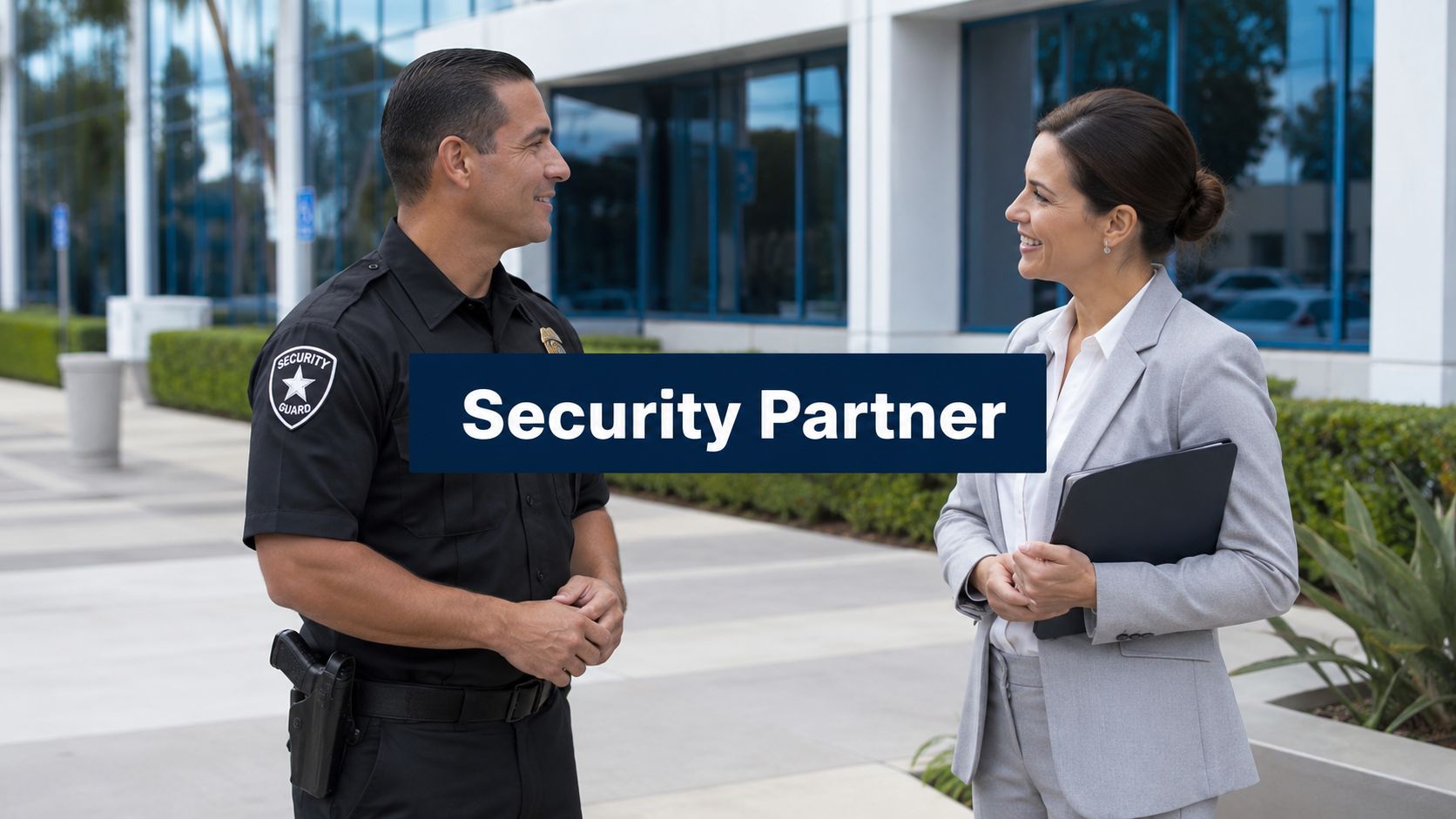

A lot of Oakland property managers start looking for security after a frustrating week.
A resident reports someone sleeping in the lobby entry alcove. A retail tenant complains about repeated loitering near the storefront. A construction superintendent arrives Monday morning and finds a gate unsecured and materials disturbed. None of those issues feel large in isolation. Together, they tell you the property is drifting into a reactive cycle.
That is usually the point when the search begins for how to hire professional guards Oakland property owners and managers can rely on. The challenge is not finding a company that can send a body in a uniform. The challenge is finding a partner that can stabilize daily operations, document what is happening, and make your site easier to manage.
The right security program should lower friction for tenants, residents, staff, and vendors. It should also give you a clearer picture of risk, not just a larger invoice.
Moving Beyond Reactive Security in Oakland
A common Oakland scenario looks like this. A mixed-use property has decent lighting, cameras, and locks, but recurring small incidents keep slipping through. Delivery doors are left open. Non-residents tailgate into a garage. Store managers call after hours because no one is sure whether a suspicious person is just passing through or testing the property.
At that point, many managers think in narrow terms. They ask, “How much is one guard per hour?” That is understandable, but it is the wrong first question.

A better question is this. “What operating problems am I trying to stop from repeating?”
That shift matters because security works best when it is planned as part of site operations. A professional guard presence can help deter theft, vandalism, and trespassing at apartment complexes, retail centers, and similar properties. In Oakland, hourly security rates typically range from $22 to $50 and experience matters in how effectively officers handle those environments, as noted in this overview of the best security guard companies in Oakland.
What proactive security looks like on a real property
Reactive security waits for the call. Proactive security builds routines that reduce the number of calls you get in the first place.
That usually includes:
- Visible patrol patterns that discourage opportunistic behavior
- Clear access control procedures for residents, vendors, and visitors
- Documented incident reporting so property teams can spot patterns
- Defined escalation steps so guards know when to observe, intervene, or contact law enforcement
- Ongoing communication between the security team and site management
If you are building your own checklist, these proactive risk and risk mitigation strategies provide a useful framework for thinking beyond single incidents and toward repeatable control measures.
Why the contract is only part of the decision
A guard company becomes part of your daily operation. That means your results depend on more than coverage hours.
You need officers who understand the property, supervisors who respond when expectations slip, and reporting that shows whether post orders are being followed. A security team should feel like an extension of management, not a separate vendor you only hear from when something goes wrong.
For a practical look at how an onsite officer can support Oakland properties day to day, this guide on the benefits of a security guard in Oakland is worth reviewing.
Security becomes costlier when it is purchased only as emergency response. It becomes more valuable when it is used to create order, predictability, and accountability on the property.
First Step Defining Your Actual Security Needs
Most disappointing security programs start with a vague instruction such as “we need a guard at night.” That is not a plan. It is a staffing request.
The first useful step is a site-specific risk audit. Best practice includes mapping checkpoints with a GPS-Enabled Guard Tour Management System, or GTMS. In Oakland, where there are over 1,000 security guard jobs available, post orders developed for the layout and risk profile of the property are associated with stronger officer stability and effectiveness, according to this Oakland security guard jobs market overview.
Start with the problem that keeps repeating
Look at the property from the perspective of routine failures, not dramatic worst-case scenarios.
Ask yourself:
Where does unauthorized access happen most often
Front desk, garage entry, side gates, loading areas, or vacant suites.When do issues usually occur
Overnight, during shift changes, after leasing office hours, or on weekends.Who is affected first
Residents, retail tenants, janitorial staff, contractors, or delivery teams.What behavior needs to change
Loitering, tailgating, unsecured doors, parking abuse, trespassing, or theft opportunity.
A retail center may need a different outcome than a residential tower. One manager may care most about reducing after-hours disturbances. Another may need tighter loading dock control and better incident documentation for insurance and ownership reporting.
Separate visibility from actual coverage
Many first-time buyers of private security ask for a visible presence. That is reasonable, but visibility alone can become expensive theater if it is not tied to tasks.
A useful needs assessment distinguishes between:
- Deterrence needs such as lobby presence, patrol visibility, and parking lot checks
- Control needs such as key management, access screening, and perimeter lock verification
- Response needs such as alarm investigation, incident escalation, and emergency coordination
- Service needs such as tenant assistance, visitor directions, and front desk support
A guard who looks professional but has no clear post orders will improvise. On a high-risk property, improvisation creates inconsistency. Residents notice it. Tenants notice it. Your staff notices it too.
Turn site pain points into post orders
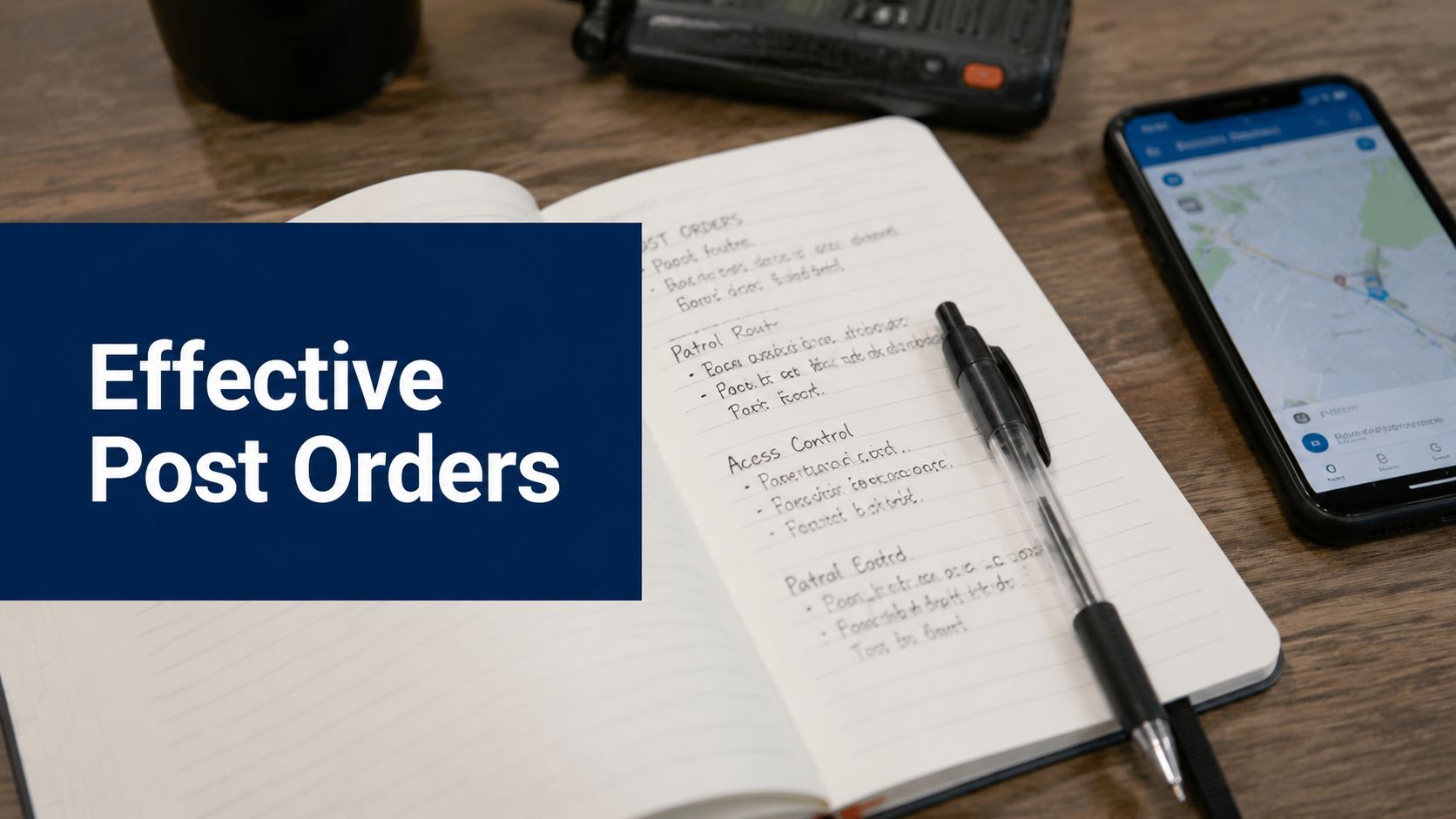
The strongest security programs convert broad concerns into specific instructions. Instead of saying “watch the garage,” a better post order might require timed garage rounds, door status checks, photo documentation of damage, and immediate reporting of non-resident vehicle activity.
That level of detail matters because officers rotate, supervisors visit, and site conditions change. Written post orders keep the assignment stable even when personnel or circumstances shift.
Here is a practical way to frame it:
- If the issue is package theft, define parcel room checks, camera view verification, and resident access rules.
- If the issue is loitering, define the patrol route, contact standards, trespass procedures, and when management should be notified.
- If the issue is construction risk, define material laydown inspections, gate lock checks, and after-hours perimeter verification.
- If the issue is tenant confidence, define lobby coverage, greeting standards, badge verification, and escort support.
A good needs assessment does not produce a generic security schedule. It produces instructions that tell officers what “doing the job correctly” looks like on your property.
Questions to ask before requesting a proposal
Before you call providers, get your internal answers straight.
- What are the top three recurring incidents on the property?
- Which areas create the most manager callbacks after normal business hours?
- Do you need one service model or a blend of standing guard coverage and patrol support?
- What reports do ownership, residents, or tenants expect after an incident?
- What would make you say this program is working after the first few months?
Those questions help vendors build a useful scope. They also help you compare proposals on quality, not just on hourly price.
Choosing the Right Security Service Model for Your Property
Once you know the job, you can choose the right model. Often, Oakland buyers get stuck at this point. They compare bids without comparing service types, and then wonder why one proposal looks cheaper than another.
Different properties need different forms of coverage. A front-desk-heavy residential high-rise does not need the same setup as a warehouse yard or a retail strip center with repeated parking lot issues.
Data from Oakland-adjacent and national benchmarks shows that armed security patrols can cut vandalism by as much as 40 to 60 percent on high-risk properties like construction sites, and tech-driven firms in Bay Area markets report up to 20 percent lower theft claims than providers that do not use modern systems, according to this loss prevention and guard benchmark overview.
Security Service Models at a Glance
| Service Model | Primary Function | Best For… | Key Consideration |
|---|---|---|---|
| Onsite Unarmed Guards | Deterrence, access control, patrols, reporting, customer-facing presence | Apartments, offices, retail centers, healthcare lobbies, HOA communities | Best when the main need is professionalism, visibility, and consistent site procedures |
| Onsite Armed Guards | Higher-deterrence presence for elevated-risk environments | Construction sites, sensitive facilities, high-risk commercial properties | Requires tighter screening, role clarity, and a clear reason for armed coverage |
| Vehicle Patrol Services | Mobile checks of larger or multiple areas | Large apartment communities, industrial parks, parking assets, multi-building portfolios | Coverage is intermittent unless you choose a dedicated patrol model |
| Concierge Security | Front-of-house presence that blends service and control | Class A offices, luxury residential towers, mixed-use lobbies | Works only when officers are trained in both hospitality and security procedures |
Onsite unarmed guards
For many Oakland properties, unarmed guards are the right starting point.
They are often the best fit when the daily job includes access control, routine patrols, resident or tenant interaction, and immediate documentation of small issues before they become larger ones. This model works well for apartment complexes, office buildings, HOA communities, and retail centers where professionalism matters as much as deterrence.
The trade-off is straightforward. If your property faces repeated violent threats or a very high-risk operating environment, unarmed coverage may not match the site profile.
Onsite armed guards
Armed officers are not a prestige option. They are a risk-based option.
This model is appropriate when the property has a clearly elevated threat profile, high-value assets, isolated overnight operations, or repeated criminal targeting. Construction sites and certain industrial environments may fall into that category.
What does not work is assigning armed coverage because it “feels stronger” without defining why. Armed service requires tighter scope control, careful hiring standards, and strong supervision. If you cannot explain the operational reason for it, you may be buying intensity instead of the right solution.
Vehicle patrol services
Vehicle patrol is often the most practical choice for properties that are spread out, lightly occupied after hours, or part of a multi-site portfolio.
For example, a community with multiple entrances, detached garages, and several common-area touchpoints may benefit more from marked patrol checks than from one stationary officer. The same is true for industrial yards, business parks, and satellite locations where you need perimeter verification and lock checks.
There is one major decision inside this model. Do you need shared patrol or dedicated patrol?
Shared patrol can be useful for routine deterrence when the site does not need a constant officer. Dedicated patrol fits better when timing, route control, and property familiarity matter more.
Concierge security
Concierge security works best when your front desk is both a service point and a control point.
Residential towers, Class A office buildings, and mixed-use developments often need officers who can greet visitors, verify access, monitor lobby activity, and support building rules without turning the entrance into a checkpoint culture. Done well, concierge security improves both order and perception.
Done poorly, it becomes a greeter position with little actual security value.
Blended programs often work better than one model alone
Some sites need more than one layer.
A property may use a concierge officer in the lobby during business hours and vehicle patrol after hours. A construction site may need standing coverage during critical delivery windows and mobile checks overnight. A retail center may need a visible officer near tenant storefronts plus parking lot patrol for the outer edges of the property.
One provider operating in Oakland, Overton’s 24/7 security guards in Oakland, presents this kind of blended coverage approach with onsite staffing paired with broader support options.
The best service model is not the one with the longest menu of services. It is the one that matches the risk pattern, property layout, and operating hours of your site.
Vetting Security Companies Beyond the Price Tag
Price matters. It should not drive the whole decision.
A low rate can hide weak supervision, poor scheduling discipline, rushed hiring, and thin reporting. Those problems do not always show up in the first week. They show up after missed rounds, inconsistent officers, and incident reports that tell you almost nothing.
In Oakland, many providers advertise competitive pricing but do not explain how they retain officers. That matters because post-2025 labor shortages have pushed industry-wide guard turnover up by 35%, and high turnover is a red flag for inconsistent service and hidden long-term costs, according to this review of the Oakland security market and provider claims.

What to verify before you shortlist anyone
Start with the fundamentals. If a company is vague on these points, move on.
Licensing status
Confirm the company operates properly under California requirements and ask whether the officers assigned to your account hold the credentials needed for the role.Insurance coverage
Request proof of insurance and review it with the same seriousness you would apply to any contractor working on your property.Training standards
Ask how officers are prepared for de-escalation, report writing, site-specific duties, emergency response, and customer-facing interactions.Supervision model
Find out who checks officer performance, how often supervisors visit, and what happens when standards slip on nights or weekends.
These are not administrative details. They shape the quality of service you receive.
Ask how the company runs the account after the sale
Significant differences become apparent here.
Some firms close the contract and then overload account managers. The manager becomes reactive, site visits become infrequent, and communication narrows to scheduling and billing. The property manager ends up doing extra follow-up just to keep the post functioning.
Ask direct questions such as:
- Who is my main point of contact?
- How many accounts does that manager oversee?
- How are post orders updated when site conditions change?
- What happens if the assigned officer is absent?
- How quickly will I hear about a serious incident?
- Can I see sample reporting before I sign?
A low manager-to-client ratio is not a marketing phrase. It affects how quickly small issues get corrected.
Technology should support accountability, not replace management
A company does not become reliable because it uses software. The technology must connect to supervision and client visibility.
Look for practical tools such as:
- GTMS patrol verification with checkpoint scans
- Digital Daily Activity Reports
- Photo-based incident documentation
- Real-time dispatch or operations support
- Clear escalation records
Those systems are useful because they reduce guesswork. You should be able to confirm patrol completion, review incident timelines, and identify whether an officer followed post orders.
Retention is a quality issue, not just an HR issue
Property managers often underestimate how much officer continuity matters.
When officers stay on an account, they learn the difference between normal and suspicious activity. They remember tenant patterns, vendor schedules, loading dock rhythms, and recurring access problems. That familiarity improves judgment and reduces avoidable disruptions.
When officers churn constantly, your property effectively trains a new person over and over. You lose consistency. Residents and tenants lose confidence. Managers spend more time re-explaining the basics.
Ask every bidder what they do to retain officers. If the answer is vague, expect the service to be vague too.
Reputation should be local and operational
Do not stop at polished sales language. Ask for examples of similar properties and similar operating conditions.
A company that performs well at a temporary event may not be the right fit for a residential high-rise. A vendor strong in lobby staffing may not be disciplined enough for a construction perimeter. The right reference point is not “do they have clients?” It is “do they understand my type of site?”
A serious security partner should be able to discuss trade-offs with you plainly. Where a standing officer makes sense. Where mobile patrol is enough. Where a visible presence helps, and where better access control matters more than more bodies.
Understanding Pricing and Contract Essentials
Most buyers eventually come back to the hourly number. That is fair. Budgets are real.
In California, security guard costs generally average $22 to $50 per hour, and rates can rise for armed, specialized, or high-risk assignments in cities like Oakland, as explained in this overview of Oakland security guard services and pricing factors. The important point is not just the range. It is what the rate includes.

What your hourly rate is really buying
A quote should reflect more than the officer standing on site.
You are also paying for:
- Recruiting and screening
- Training and onboarding
- Field supervision
- Scheduling backup
- Reporting systems
- Administrative support
- Operational oversight
That is why the cheapest bid often creates the most frustration later. If the provider trims management support, weakens reporting, or cycles through officers, the property absorbs the difference in disruption and oversight burden.
Contract terms that deserve a close read
A security agreement should be easy to understand. If it is hard to interpret, that alone is a concern.
Review these points carefully:
Scope of duties
The contract should match the actual post orders. “General security services” is too vague for a complex property.Hours and coverage model
Make sure the agreement states whether coverage is standing, mobile, shared patrol, dedicated patrol, or some combination.Billing for extra coverage
Ask how the company handles holidays, emergency fill-ins, special events, or temporary schedule extensions.Cancellation and adjustment terms
Properties change. Contracts should explain how to scale service up or down without unnecessary friction.Liability and reporting expectations
You want clarity on incident notification, documentation standards, and who communicates what during a serious event.
Value usually beats the lowest bid
The hourly number is easy to compare. Service quality is harder, but it affects your operation more.
A higher rate may be justified if the program includes stable staffing, better supervision, cleaner reporting, and a process for updating post orders as risks change. A lower bid can still be a good value, but only if the company can explain how it will maintain quality over time.
The right question is not “who is cheapest?” It is “which proposal gives this property the strongest operational control for the budget available?”
Onboarding Your Security Partner for Long-Term Success
Signing the contract is the start of the essential work.
A security program becomes effective when the site team and the guard team operate from the same playbook. That means your onboarding process should be deliberate from day one.
Build the launch around post orders and site familiarity
Walk the property with the assigned team. Show them the areas that matter, not just the obvious entrances.
Point out the recurring trouble spots, the doors that are often propped open, the vendor patterns that are normal, and the tenant sensitivities that require tact. A strong launch gives officers context, which improves judgment.
Then make sure post orders are specific, current, and practical. They should cover access procedures, patrol routes, reporting standards, emergency contacts, and escalation steps.
Establish communication routines early
Most security frustration comes from unclear communication, not from a lack of effort.
Set expectations for:
- Who receives incident reports
- How urgent issues are escalated
- When routine updates are sent
- How post order changes are approved
- Who joins regular review calls
Do not assume everyone shares the same definition of urgent. Write it down.
Decide how you will measure whether the program is working
You do not need a complicated dashboard. You need a few meaningful indicators.
For many properties, that includes cleaner incident documentation, better patrol consistency, fewer recurring access failures, and stronger feedback from tenants or residents. If your provider uses time-stamped patrol and activity reporting, those records can help you review whether the agreed coverage happened.
For a practical view of day-to-day service expectations, this guide on what to expect from security guards in Oakland is a useful reference point.
The strongest security relationships are built on shared expectations, fast communication, and routine review. That is what turns a guard contract into a working protection program.
If you are evaluating how to hire professional guards Oakland property managers can depend on, Overton Security is one California-based option to review. The company has over 26 years of experience and provides onsite guards, vehicle patrol, concierge coverage, fire watch, and technology-supported reporting for properties that need structured, accountable security operations.