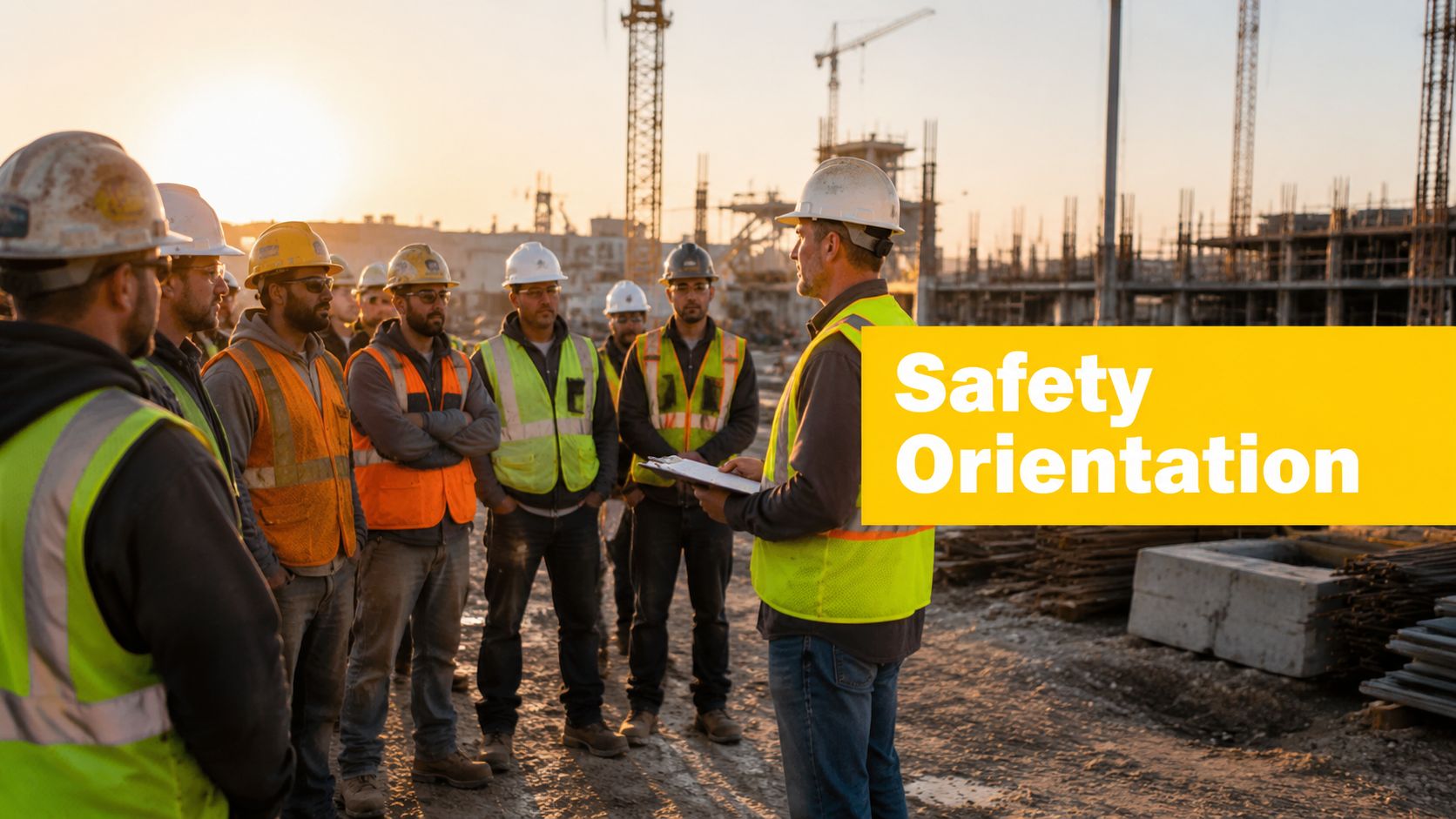
The first day of a project rarely feels orderly. Trucks arrive early. Subcontractors check in at once. Deliveries show up before laydown areas are fully sorted. Someone is asking where to park, someone else needs access credentials, and a new worker is already walking toward an active zone because nobody stopped him at the gate.
That's exactly why construction site safety orientation matters so much. The first hour sets the tone for the next several months. If the site starts with clear rules, controlled access, and verified understanding, crews usually move with more discipline. If it starts with a rushed sign-in sheet and a fast verbal warning, the same confusion tends to repeat all job long.
A lot of incidents begin with ordinary gaps. A worker doesn't know the restricted route. A delivery driver cuts through the wrong area. A subcontractor assumes the fall protection plan is the same as the last project. Those aren't paperwork problems. They're exposure problems.
The First Hour on a New Job Site
On a new job, the superintendent usually has ten priorities competing at once. Getting concrete, steel, deliveries, manpower, and schedules aligned feels urgent. Safety orientation can get pushed into the background because it looks administrative. In practice, it's one of the few controls that affects every worker before exposure begins.
Construction still carries unusually high risk. The industry accounts for about 1 in 5 workplace deaths in the United States, and OSHA's Fatal Four hazards, falls, struck-by incidents, electrocutions, and caught-in/between events, cause over 60% of construction fatalities according to OSHA common statistics.
What the first hour usually looks like
A realistic opening hour includes all of this at once:
- New arrivals checking in with inconsistent paperwork, different employers, and different experience levels
- Equipment movement starting early before pedestrian routes are fully familiar to everyone
- Vendors and visitors appearing unexpectedly and needing escort or direction
- Unclear boundaries between active work zones, storage areas, and no-entry spaces
That mix is where small mistakes become serious ones.
A rushed site introduction doesn't save time. It usually shifts the delay to later, after a near miss, an injury, or a stop-work issue.
What a good opening changes
A strong construction site safety orientation does three things immediately. It tells people how the site works, it tells them what hazards matter most, and it tells them who will enforce the rules.
Workers need to know more than where to sign. They need to know where they can walk, where they can't, how to report a problem, what to do during an emergency, and what standards apply before work starts. On a well-run site, nobody has to guess.
Security matters here more than many teams expect. If gate control is loose, orientation becomes theoretical. If access is controlled, PPE is checked, and unbriefed workers don't get waved through, the orientation becomes operational.
Why Your Safety Orientation Is More Than a Formality
Some orientations are built to satisfy a file. Others are built to prevent incidents. The difference is obvious within a few days on site.
A check-the-box orientation usually sounds familiar. A supervisor talks quickly. Workers sign a sheet. Topics are listed, but little is verified. No one confirms comprehension, no one demonstrates equipment use, and no one follows up once the site changes.
A real orientation is different. It treats onboarding as a risk control tied to schedule protection, legal diligence, and day-to-day site discipline.

The business case is straightforward
The strongest reason to invest time up front is that better orientation correlates with better outcomes. The Associated Builders and Contractors reported that companies using an in-depth new-hire safety orientation had 52% lower TRIR and 56% lower DART rates than companies that limited orientation to basic compliance topics, based on analysis covering more than 1 billion work hours in construction and related trades, as detailed in the ABC construction safety report.
That matters to every project leader because recordables, restricted work, and lost-time cases don't stay inside the safety department. They affect sequencing, subcontractor coordination, inspections, morale, and owner confidence.
What a formal orientation should accomplish
A useful orientation should give each worker:
| Focus area | What the worker needs to leave with |
|---|---|
| Site expectations | Clear rules on access, conduct, PPE, reporting, and restricted areas |
| Hazard awareness | A short list of the site's highest-consequence exposures |
| Emergency readiness | Exact actions for alarms, evacuation, first aid, and muster procedures |
| Accountability | Understanding that rules are monitored and enforced daily |
Practical rule: If the worker can't explain the rule back to you, the orientation isn't finished.
What doesn't work
The weak version usually fails in predictable ways:
- Too much generic content that doesn't match the actual phase of work
- No site walk or visual reference for exits, aid stations, and restricted zones
- No language adaptation for crews that need translated or simplified instruction
- No enforcement plan at the gate, on patrol, or in supervisory rounds
The strongest sites don't treat orientation as a legal shield alone. They use it as the first operational meeting of the project.
Essential Topics Every Safety Orientation Must Cover
A construction site safety orientation should be short enough to hold attention and specific enough to shape behavior. Trying to cover every rule in one sitting usually backfires. Workers remember the hazards they expect to face that day, not a long lecture that sounds the same on every project.
That's why effective orientations should prioritize the 3 to 5 topics that reduce the most risk for the specific site and workforce, rather than trying to cover everything at once, as noted by ABC SoCal's guidance on construction site safety.

Start with site-wide rules
Before trade-specific issues, every worker needs the same ground rules. Many orientations are too vague on this point.
Cover the basics in plain language:
- Access and check-in procedures so workers know which gate to use, how credentials are handled, and what happens if someone arrives without clearance
- Parking, deliveries, and traffic flow so pedestrian and vehicle routes don't overlap casually
- Restricted areas and permit-only zones including roofs, energized spaces, trenches, lift zones, and equipment laydown areas
- Conduct expectations for reporting hazards, housekeeping, smoking areas, break locations, and who has authority to stop unsafe work
If the site uses visual reinforcement, this is also the right time to point crews to posted resources such as these construction site safety posters.
Cover emergency response like people will need it today
Emergency procedures often get buried in the middle of orientation. They should be front-loaded and specific.
Workers should leave knowing:
- Where to go during evacuation
- Who to contact first
- Where first aid and spill supplies are located
- How emergency vehicles will enter the site
- What information to give when reporting an injury or hazard
Crews also benefit when emergency training extends beyond minimum discussion. For teams that want a practical companion resource, this guide to non-medical CPR training is useful because construction sites often rely on fast action from non-clinical personnel before outside responders arrive.
Focus on the highest-risk exposures on that job
This part should never sound copied from another project. A tilt-up site, an interior tenant improvement, and a civil excavation project don't have the same exposure profile.
Common priorities include:
Fall protection
Workers need to know where fall hazards exist, what protection is required, who inspects the systems, and what they must never alter without authorization.
Equipment and tool safety
The orientation should explain who may operate what, where equipment travel lanes are, and how workers stay clear of blind spots, swing radius, or suspended loads.
Hazard communication
Crews should know what substances are present, how they're labeled, and where the information is kept on site.
Electrical and excavation awareness
If energized work, temporary power, trenching, or underground utility exposure exists, those rules can't be treated as side notes.
Generic topic lists create attendance. Site-specific priorities create retention.
Don't skip reporting expectations
A worker who notices a missing guardrail or damaged extension cord should know exactly what to do next. “Tell someone” isn't enough. Name the role, the reporting path, and whether the condition requires immediate stop-work.
A Sample Agenda and Customizable Checklist
Many teams don't need a complicated orientation program. They need a repeatable one. The easiest way to keep it consistent is to use a standard agenda, then customize only the site-specific sections.
A practical orientation agenda
Here's a field-friendly format that works well on active projects.
| Orientation segment | What to cover |
|---|---|
| Welcome and verification | Employer, trade, sign-in, credentials, language needs |
| Site rules | Access points, parking, restricted areas, reporting chain |
| Emergency procedures | Evacuation routes, muster point, first aid, alarms, medical response |
| High-risk hazards | Current phase hazards, required controls, permit issues, exclusion zones |
| PPE and equipment | Required PPE, inspection expectations, prohibited shortcuts |
| Site walk or visual review | Exits, aid station, break area, toilets, spill response, key boundaries |
| Comprehension check | Worker questions, demonstration, verbal confirmation, final approval to start |
What should be on the checklist
A good checklist protects the worker and the employer. It also gives the superintendent something far more useful than memory if there's an audit, dispute, or incident review.
Include these items:
- Attendance record with printed name, employer, date, and supervisor or presenter
- Topics covered with room to note project-specific hazards
- Location verification confirming workers were shown exits, first aid, restrooms, and break areas
- Demonstration fields for PPE or equipment use when hands-on verification is required
- Understanding confirmation through questions, initials, or observed demonstration
- Re-orientation trigger line for return visits, phase changes, or new task assignments
For teams that want a ready-made template, this construction site safety checklist is a solid starting point.
Customize the checklist without overcomplicating it
Keep the core form stable, then add only what changes from job to job. Typical custom fields include crane activity, trenching zones, hot work controls, temporary power areas, or owner-specific access rules.
That balance matters. If the form changes every week, supervisors stop using it correctly. If it never changes, it stops reflecting real conditions.
The best checklist isn't the longest one. It's the one crews actually use, update, and verify.
Keeping Safety Top of Mind After Day One
Most sites don't fail because the first orientation was missing. They fail because the orientation expired in practice. Conditions changed, crews rotated, new hazards appeared, and the original message stayed frozen.
Public guidance gets this right. Task-specific safety issues must be “continually updated throughout the course of the project” on changing and multi-employer job sites, according to American Family Insurance's site safety orientation guidance.

Different reinforcement methods serve different jobs
Not every update belongs in the same format.
Daily huddles
These work best for immediate exposure changes. They're fast, practical, and tied to today's tasks. They're less effective when the crew is large and distracted, or when supervisors treat them as routine script reading.
Toolbox talks
These are useful for one topic at a time, especially after a near miss, a phase transition, or a recurring bad habit. They give more depth than a quick huddle but still fit field conditions.
Digital updates
Texts, apps, and digital acknowledgment systems help when subcontractors rotate often or when the site spans multiple areas. Their weakness is obvious. A digital notice isn't proof of understanding unless a supervisor reinforces it in person.
The strongest approach is blended
Use each method for what it does well:
- In-person orientation for first exposure and clear expectations
- Daily briefings for changing site conditions
- Toolbox talks for focused retraining
- Digital tracking for records, reminders, and accountability
- Posted signage for constant visual reinforcement
Triggers that should prompt re-orientation
A worker shouldn't need a full restart every morning. But some changes should trigger a reset.
Examples include:
- A new work phase such as excavation, steel erection, or scaffolding
- A new employer or crew rotation entering active areas
- A layout change affecting access routes, exits, or muster locations
- A serious near miss or repeated violation showing the original message didn't land
On complicated projects, safety communication has to move at the same speed as site conditions. Anything slower becomes outdated.
How Security Services Enforce and Verify Your Safety Plan
Orientation tells people what the rules are. Security determines whether those rules stay real after the meeting ends.
That's especially true on construction projects with multiple trades, changing perimeters, after-hours deliveries, and workers arriving in waves. Without a gate process, perimeter control, and documented field checks, even a well-designed orientation can lose force within days.

Best-in-class orientation isn't just about what was said. It's validated by documentation and comprehension verification, including sign-in, records of topics covered, and proof that workers understand how to use safety equipment before starting work, as outlined in Travelers job site orientation guidance.
Where security adds operational value
A professional security team can support the safety plan in practical ways:
- At access points by checking whether workers have completed orientation, are entering through the correct gate, and are arriving with required PPE
- During patrols by identifying open hazards, unsecured restricted areas, blocked exits, or unauthorized persons in active zones
- In documentation through time-stamped reports, photos, checkpoint scans, and incident escalation records
- During emergencies by helping direct responders, preserving access lanes, and communicating with site leadership
A dedicated construction security program offers more than a basic standing post; its assignment isn't only to deter theft. It's to help maintain controlled entry, policy compliance, and auditable field conditions. One example is construction site security guards, which are used on some projects to support access control, perimeter monitoring, and incident reporting alongside site management.
Enforcement works best when expectations are shared
Security can't enforce a plan that hasn't been translated into post orders. The site team has to define what officers are checking, what gets documented, and what requires immediate escalation.
A workable division of responsibility often looks like this:
| Site function | Primary role |
|---|---|
| Orientation delivery | Superintendent or safety lead |
| Worker-specific trade training | Employer or subcontractor |
| Gate verification and access checks | Security team |
| Restricted area monitoring | Security and supervision |
| Corrective action on unsafe work | Site leadership |
Security should never guess which violations matter most. The site has to define them clearly, then require consistent documentation.
Technology tightens the loop
The best enforcement setup combines people and systems. GPS-stamped patrol activity, digital incident logs, checkpoint scans, and photo documentation give the project team something defensible if a question comes up later.
On sites where access control itself is part of the problem, teams may also need to upgrade gate access technology so entry permissions, visitor handling, and rule enforcement are easier to manage.
Building a Safer Site from the Ground Up
A strong construction site safety orientation does one job better than anything else on day one. It reduces ambiguity. Workers know where to go, what hazards matter, what rules apply, and who is responsible for enforcing them.
That alone isn't enough. Sites stay safer when the original orientation is supported by daily briefings, visible controls, updated hazard communication, and documented verification in the field. Planning matters. Reinforcement matters more.
The practical standard is simple. Keep orientation short, specific, documented, and tied to the actual phase of work. Verify understanding before work starts. Revisit the message when conditions change. Make sure gate control, patrol activity, and supervisory follow-up all support the same expectations.
For project teams thinking beyond the current job, it also helps to design safety into the physical environment as early as possible. This resource on how to engineer safety into your floorplan focuses on warehouse settings, but the same principle applies to staging, circulation, access, and visibility on construction projects.
A safe site doesn't come from one meeting. It comes from one clear standard, repeated and enforced every day.
If you're managing a construction project in California and want help strengthening access control, daily enforcement, and incident documentation, contact Overton Security. Their team supports construction sites with staffed guards, mobile patrols, GPS-based reporting, and 24/7 SOC oversight that can help turn your safety plan into a working site process.