
Is there anything worse than arriving at your job site on a Monday morning only to find thousands of dollars in copper wire, tools, or heavy machinery has vanished? For construction superintendents, this isn't just a hypothetical scenario—it's a costly reality. Professional construction site security guards are the crucial human element that transforms a vulnerable site into a secure asset, actively protecting your bottom line and keeping your project on schedule.
Why Your Jobsite Needs More Than Just a Fence
A chain-link fence and a "No Trespassing" sign are standard, but they often create a false sense of security. Let's be honest: for a determined thief, they're little more than a suggestion. Construction sites are uniquely tempting targets for everyone from opportunistic criminals to organized rings. After your crew clocks out, these busy work zones become quiet, isolated, and full of high-value assets that are surprisingly easy to sell.
The fallout from a site breach goes far beyond the replacement cost of stolen materials. The real damage is found in project delays, spikes in insurance premiums, and the hit your company’s reputation can take. A simple perimeter fence is only a minor hurdle for someone who's determined to get in.
The Real Risks of an Unsecured Site
An unprotected jobsite is an open invitation for significant loss. The vulnerabilities are everywhere and often overlooked until it’s too late. The biggest risk factors we consistently see are:
- High-Value, Liquid Assets: Items like copper wiring, lumber, power tools, and raw materials are hot commodities. They are easy to grab, transport, and sell quickly on the black market.
- Heavy Equipment Theft: Losing a single piece of heavy machinery can bring a project to a screeching halt for weeks and represents a massive financial blow.
- Vandalism and Sabotage: Unsupervised sites are magnets for property damage that requires expensive and time-consuming repairs, setting your timeline back.
- After-Hours Accessibility: Without a human presence, fences are easily cut and locks are quickly broken. This gives thieves hours of uninterrupted time to help themselves to your assets.
Construction site theft in the U.S. is a staggering problem. Industry estimates put annual losses from equipment and material theft at over $50 billion. A single stolen skid-steer loader can cost $35,000 to replace, underscoring why these sites are prime targets.
Moving from Reactive Cost to Proactive Investment
Viewing security as just another line-item expense is one of the most common—and costly—mistakes a project manager can make. Effective security is an investment in risk management that directly protects your bottom line.
A solid fence is a good start, and physical measures like heavy-duty mesh wraps for site security can certainly bolster your perimeter by adding a visual deterrent.
However, no physical barrier can replace the judgment and active presence of a professional security officer. A trained guard does more than just observe; they identify suspicious activity, control access, and respond to incidents the moment they happen. That active presence is the single most powerful deterrent, transforming your security from a passive hope into a proactive strategy that safeguards your project from groundbreaking to ribbon-cutting.
The True Role of a Construction Security Guard
What does a professional construction security guard really do all night? If you’re picturing someone just sitting in a truck, you’re missing the bigger picture. An effective officer isn't just a uniform; they are an active risk manager, serving as the eyes and ears for the project superintendent long after the last hammer swings.
Their role extends far beyond simply watching for trespassers. While a uniformed presence is a powerful deterrent, the real value lies in the specific, proactive tasks they perform. These duties are what prevent theft, ensure safety, and keep your project moving forward without costly surprises.
More Than Just a Uniform
A top-notch construction security guard is a dynamic asset to your team, constantly observing, documenting, and ready to respond. This turns a passive security presence into an active shield for your job site.
Consider these key duties:
- Managing Access Control: This is about more than waving trucks through. Guards are responsible for verifying the credentials of every individual coming onto your site, from subcontractors to late-night material deliveries. This process ensures only authorized personnel are present, reducing both external threats and internal theft.
- Performing Routine Patrols: A guard's patrol isn't a casual stroll—it’s a systematic inspection. They walk the entire perimeter, checking fence lines for weak spots, ensuring storage containers are locked, and confirming that heavy equipment is secure. These regular tours spot vulnerabilities before they can be exploited.
- Monitoring for Safety Hazards: A guard’s role often includes spotting non-criminal threats that can derail a project just as quickly as theft. This includes identifying a water leak, smelling gas, or noticing an emerging fire hazard. A timely call can prevent catastrophic damage and save you a fortune.
The Power of Detailed Post Orders
How does an officer know exactly what to protect or who to call at 3 AM? The answer is well-defined Post Orders.
Think of post orders as a customized security playbook for your specific site, created collaboratively between you and your security partner. This document is the single most important tool for effective site protection.
Post Orders transform a guard from a passive observer into an intelligent agent acting on your behalf. They are a clear set of instructions outlining every critical detail, from the location of valuable materials to the exact emergency contact protocol for a fire versus a theft.
Without these detailed instructions, a guard is just guessing. With them, they become a true extension of your management team. Clear post orders ensure every officer on your site knows your priorities and can perform their duties with precision, giving your project the active, intelligent protection it deserves.
Here's a quick breakdown of a guard's core functions in practice.
Core Duties of a Construction Security Guard
| Duty Category | Specific Actions | Impact on Site Security |
|---|---|---|
| Access Control | Verifying IDs, managing visitor/delivery logs, securing entry points. | Prevents unauthorized access, reduces internal theft risks, and maintains a clear record of site traffic. |
| Perimeter Patrols | Inspecting fences, checking locks on containers, monitoring equipment. | Identifies and deters potential breaches, ensuring the site's physical security is maintained after hours. |
| Hazard Monitoring | Looking for fire risks, water leaks, or unsafe conditions. | Mitigates non-criminal threats that can cause costly damage and project delays, adding another layer of risk management. |
Ultimately, a professional guard isn't just watching your site—they are actively protecting it from a wide range of threats, both criminal and environmental.
How to Assess Your Site's Security Vulnerabilities
To effectively protect your construction site, you have to start by thinking like a thief. Where are the easy entry points? What expensive materials are left unsecured? A thorough security assessment is the first and most important step in building a smart, effective security plan that addresses your project’s real-world risks.
This isn’t about paranoia; it’s practical risk management. An honest look at your weak spots allows you to allocate your security budget where it’s needed most. It’s the same foundational process a trusted security partner like Overton Security uses to develop a strategy for every client.
Starting Your Onsite Security Walkthrough
Grab a clipboard or tablet and walk your site with a critical eye. Pretend you're trying to sneak in after everyone has gone home. This simple shift in perspective will reveal security gaps you’d never notice during a busy workday.
As you walk the perimeter and through the site, ask yourself these key questions:
- Perimeter Integrity: Are there gaps in the fence? Broken gates? What about spots where someone could easily climb over or crawl underneath? A fence is only as strong as its weakest link.
- Lighting Conditions: Walk the site again around dusk. Are there dark corners or deep shadows near storage containers, equipment, or main gates? Poor lighting provides cover for criminal activity.
- Access Points: How many ways can someone get on and off the site? Are all gates and entryways locked and secured after hours? Every uncontrolled entry point is a liability.
- Asset Staging: Where are your most valuable tools and materials kept? Are they consolidated in one well-lit, secure area, or are they scattered, making them an easy target for a quick theft?
Identifying High-Risk Zones and Blind Spots
Every construction site has hotspots—areas that demand extra attention where theft or vandalism would hit your budget and timeline the hardest. Pinpointing these zones is crucial for deploying your security resources effectively.
Your high-risk zones will almost always include:
- Material Laydown Yards: Stacks of lumber, pallets of copper wire, and other raw materials are goldmines for thieves.
- Tool and Equipment Storage: Whether in shipping containers or trailers, these spots hold thousands of dollars in portable, high-value assets.
- Heavy Machinery Staging Areas: While it's tougher to steal a bulldozer, it happens. Ensuring keys are secured and machinery is immobilized is critical.
This simple decision tree shows how professional construction site security guards are specifically deployed to address these core vulnerabilities.
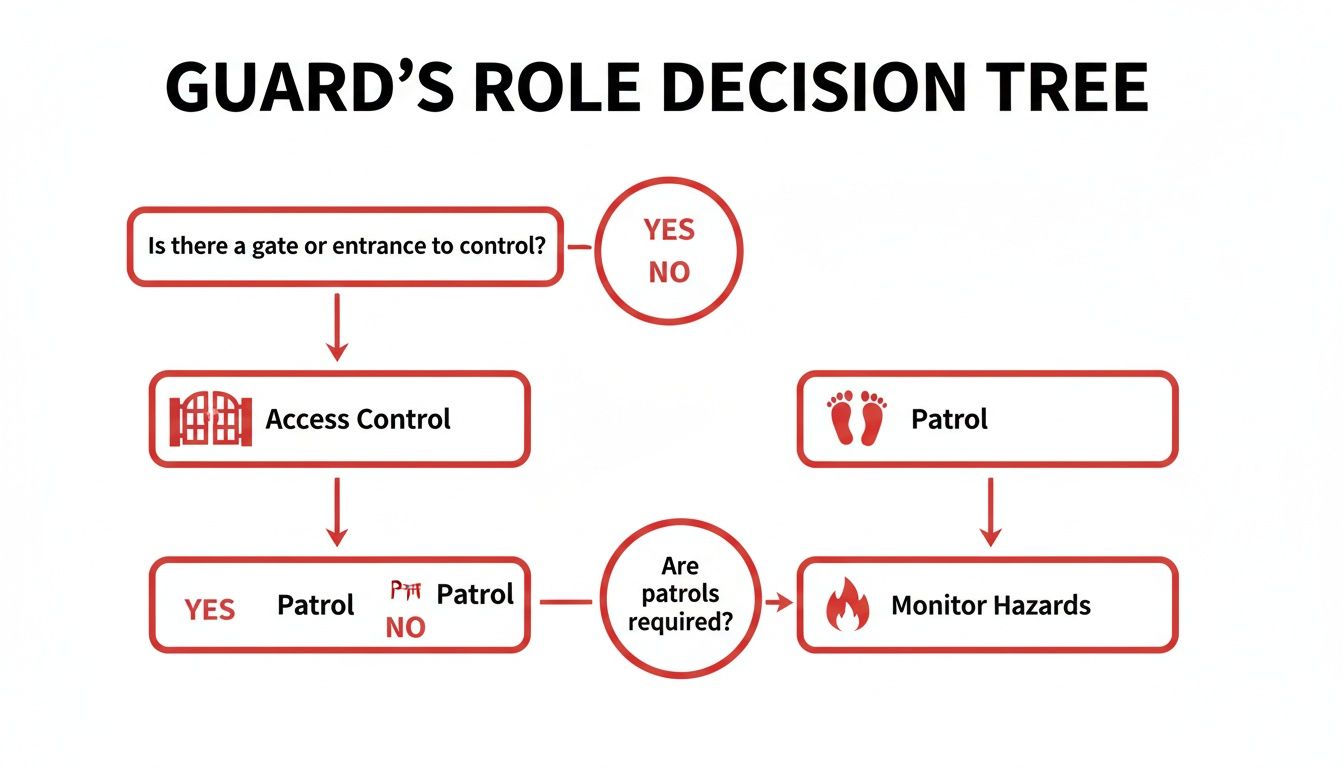
As you can see, a guard's duties—from access control and patrols to monitoring hazards—are direct solutions to the problems identified during a thorough site assessment.
A professional site assessment does more than just spot problems; it forms the blueprint for an efficient security plan. By understanding exactly where your risks lie, we can strategically place officers and leverage technology to provide maximum protection without wasted expense.
This hands-on evaluation provides invaluable insight. With over 26 years of experience, this is a process Overton Security has perfected, ensuring our clients receive a security solution that is both highly effective and aligned with their budget. The goal is always to provide real peace of mind through smart, proactive protection.
Blending Human Expertise with Security Technology
Effective construction site security isn't just about placing a guard at the gate; it's about equipping that guard with the right tools. Modern technology doesn't replace an experienced officer—it enhances their capabilities, creating a security program that’s transparent, accountable, and far more effective. When you combine skilled professionals with smart systems, you get a powerful defense.
This blend of on-the-ground presence and smart technology is essential. It's why the market for manned security services, particularly in construction, is projected to grow significantly, driven by the need to protect valuable assets on projects from San Diego to Sacramento.
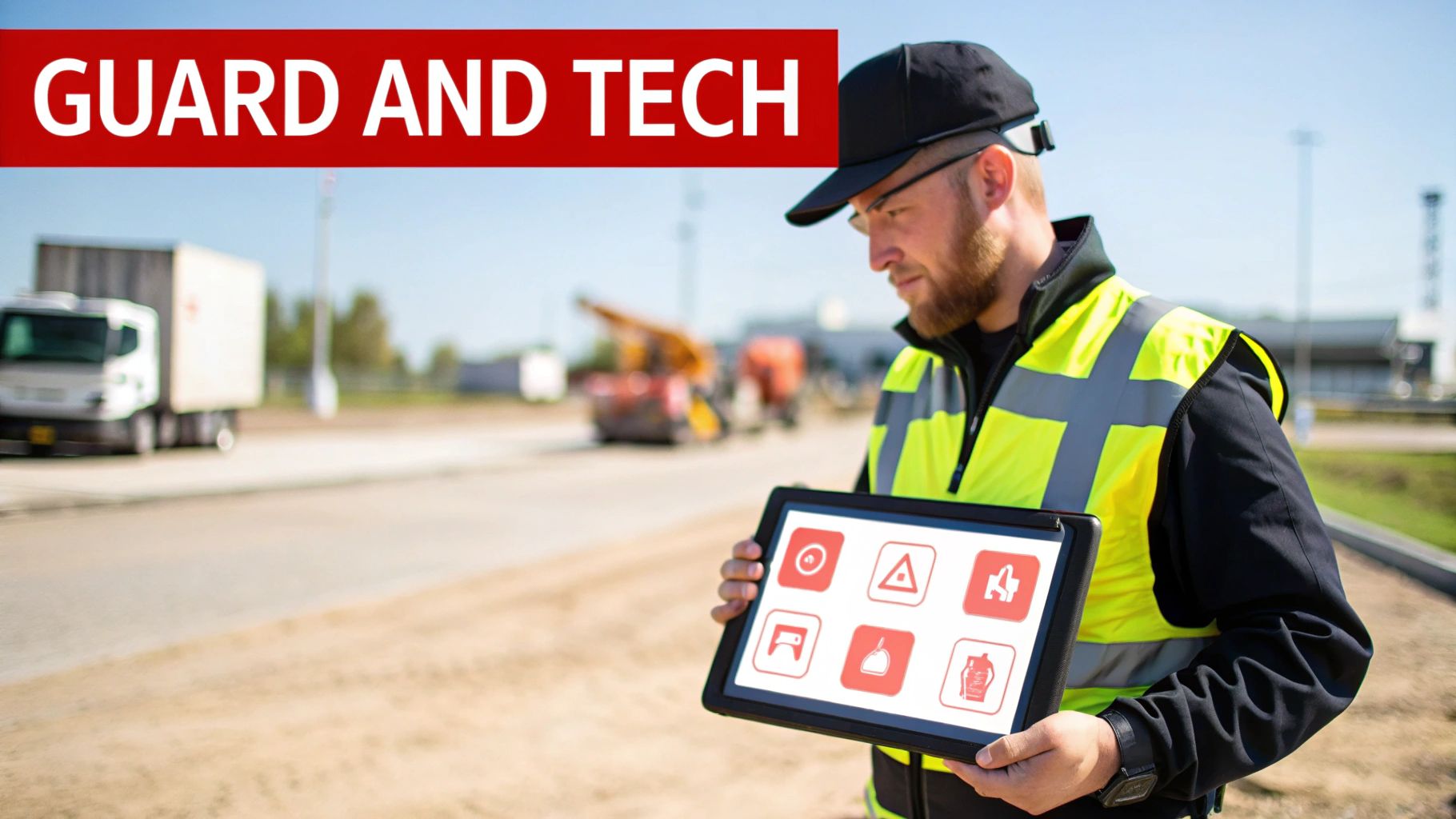
Verifying Patrols with Guard Tour Management Systems
How do you know your guard is walking the entire site and not just sitting in their vehicle? The answer is a Guard Tour Management System (GTMS).
A GTMS is like a digital breadcrumb trail. We place small, rugged checkpoints—usually NFC tags—at critical points on your property, such as the fuel depot, high-value material containers, or a weak spot in the fence.
As the officer makes their rounds, they tap their device on each checkpoint, instantly logging the time and GPS location. This creates an undeniable record of their patrol, feeding into detailed reports you can access anytime. It’s a simple but powerful tool for accountability, giving you full confidence that every corner of your site is receiving attention.
The SOC as a Force Multiplier
An onsite guard is your first line of defense, but they should never be on an island. At Overton Security, every officer is connected to our 24/7 Security Operations Center (SOC). The SOC acts as a constant layer of remote support and backup.
This integrated approach means your guard is never truly alone. If they encounter a serious situation, need to request backup, or see something suspicious, the SOC team is there to assist. They can immediately dispatch law enforcement or notify you based on the agreed-upon post orders.
The combination of a dedicated onsite officer supported by a state-of-the-art SOC is a key differentiator. It offers clients peace of mind that their site is protected not just by one person, but by a coordinated, tech-enabled team.
Integrating Surveillance for Total Coverage
While a guard provides a critical physical presence, cameras offer constant vigilance. Strategically placed cameras can cover large areas and eliminate the blind spots a single officer can't watch all at once. When these cameras are monitored by the SOC, you create a formidable security net.
For example, if a camera's motion sensor is triggered after hours, an alert goes straight to the SOC. The operator can view the live feed, assess the situation, and radio the onsite guard to investigate—stopping an incident before it escalates. You can learn more in our guide on where to place surveillance cameras.
This blend of technology and human expertise ensures your security program is:
- Accountable: GTMS reports provide undeniable proof of every patrol.
- Responsive: The SOC provides immediate backup and ensures incidents are handled correctly.
- Comprehensive: Guards and cameras work together to cover all your bases.
By choosing a security partner that masters this blend, you’re not just hiring a guard. You're investing in a complete, transparent, and highly effective security solution.
Choosing the Right Security Partner for Your Project
Selecting the right security provider is one of the most important decisions you'll make for your construction project, and it involves more than just comparing hourly rates. While budgets are always a consideration, the cheapest bid often comes with hidden costs like inexperienced officers, nonexistent supervision, and unreliable service. Real value is found in genuine security and the peace of mind that comes with it.
To make a smart choice, it's important to understand what contributes to the cost of professional construction site security guards. You’re not just paying for someone's time; you're investing in their training, the technology that supports them, and the management structure that ensures accountability. A suspiciously low rate is often a red flag that corners are being cut in these critical areas, leaving your site exposed.
Cost Versus Value in Security Services
The old saying, "you get what you pay for," is especially true in the security industry. A rock-bottom price might look appealing, but it can quickly lead to losses from theft or project delays that cost far more in the long run.
Here are key factors that separate a high-value partner from a low-cost provider:
- Officer Compensation and Training: A company that pays competitive wages and offers benefits attracts and retains high-caliber, professional officers. Low-bid companies often experience high turnover, resulting in a revolving door of new, inexperienced guards on your site.
- Supervision and Management: At Overton Security, we maintain a low manager-to-client ratio, which means your site gets the hands-on attention it deserves. Low-cost firms often spread their managers thin, leading to little or no oversight.
- Technology Integration: Does the company use a Guard Tour Management System (GTMS) to verify patrols? Is there a 24/7 Security Operations Center (SOC) for support? These tools are standard for a quality partner but are often absent in low-cost solutions.
- Insurance and Compliance: A reputable firm will carry robust liability insurance and ensure every officer is properly licensed. This protects you from potential legal headaches.
Key Indicators of a High-Value Security Partner
When vetting potential security companies, look beyond the hourly rate and examine their operations. Remember, effective security is a key component of the project management best practices that keep your job on track.
You can uncover a company's true value by asking direct questions.
A great security partner is an open book about their operations. They should have no problem explaining their officer retention strategy, what technology they use, and exactly how their supervisors actively support the guards protecting your assets.
Look for a provider who can confidently answer "yes" to these questions:
- Do you maintain a low manager-to-client ratio for hands-on support?
- Can you show me a sample of your daily activity and incident reports?
- What are your officer retention and turnover rates?
- How do you use technology like GTMS to ensure accountability?
Before making a final decision, it helps to compare what you're really getting. A high-value partner invests in quality across the board, while a low-cost provider often cuts corners where it matters most.
Comparing Security Provider Attributes
| Attribute | High-Value Partner (e.g., Overton) | Low-Cost Provider |
|---|---|---|
| Officer Quality | Professional, experienced, low turnover | Inexperienced, high turnover |
| Supervision | Active, hands-on, low manager-to-client ratio | Minimal to none, managers stretched thin |
| Technology | Standard use of GTMS, SOC, and reporting software | Outdated or no technology used |
| Accountability | Transparent reporting, verifiable patrols | Inconsistent reports, no patrol verification |
| Client Support | Proactive, responsive, partnership-focused | Reactive, hard to reach, transactional |
| Compliance | Fully licensed, insured, and compliant | Potential gaps in licensing and insurance |
Ultimately, a quality security partner acts as an extension of your own team, proactively protecting your investment.
For more tips, check out our in-depth resource on how to hire security guards for a full checklist. With over 26 years of experience, Overton Security was founded on the principle of quality over quantity. We focus on supporting our officers, because we know that’s how they provide the consistent, reliable service your project depends on.
Your Essential Construction Site Security Checklist
Let's pull everything together into a practical tool you can use on your next project. Think of this as your pre-launch checklist for security operations. Protecting your site, assets, and timeline comes down to a clear, methodical approach from day one.
This isn't just about hiring a guard; it's about building a robust security plan. By following these key steps, you can confidently create a program that delivers real peace of mind.
Pre-Deployment and Planning
Before any officer sets foot on your property, the foundational work begins. This phase is about translating your project’s unique risks into a clear, actionable plan.
- Conduct a Thorough Risk Assessment: Walk the site, preferably with a potential security partner. Identify weak spots in the fence line, poorly lit corners where materials are stored, and high-value equipment staging areas.
- Define Clear and Detailed Post Orders: This is your security playbook. Don't just say "patrol the site." Map out exact patrol routes, specify which assets need the most attention, and create contact lists for every imaginable scenario.
- Verify Security Provider Credentials: Ask for proof that the company is fully licensed and carries adequate liability insurance. A reputable partner will provide this readily.
A well-structured plan is the foundation of effective security. The time you invest in defining your needs upfront will pay dividends by ensuring your security program is perfectly aligned with your project’s unique vulnerabilities.
Vetting and Implementation
With a solid plan in hand, it’s time to choose the right partner. This is where you separate the pros from low-cost alternatives by examining the quality of their people, processes, and technology.
- Evaluate Officer Training and Retention: Ask pointed questions about their training programs and employee turnover rate. A company like Overton Security that invests in its people provides more consistent and professional construction site security guards.
- Confirm Technology and Accountability Systems: Does the provider use a modern, GPS-enabled Guard Tour Management System (GTMS)? You need verifiable proof of patrols. Also, confirm they operate a 24/7 Security Operations Center (SOC) for backup.
- Establish Communication Protocols: Define the communication flow from the start. Who is your single point of contact? How will you receive daily activity reports and, more critically, instant incident notifications?
For a more detailed breakdown, you can download our free security patrol checklist template to help guide your planning process.
Diligently working through this checklist will put your project on the right track. With over 26 years of experience, we at Overton Security know that real security is a partnership—one built on transparency, expertise, and a shared goal of protecting your investment.
Answers to Your Top Questions
When it comes to putting security guards on a job site, construction managers often have the same key questions. Let's provide some straightforward answers based on our decades of experience.
Armed vs. Unarmed Guards: Which Is Right for My Site?
For the vast majority of construction sites, unarmed guards are the most effective and appropriate choice. Their role is to be a powerful visual deterrent, trained in observation, de-escalation, access control, and reporting. Their presence is designed to prevent opportunistic theft and manage site access securely.
Armed guards are a specialized solution reserved for exceptionally high-risk situations, such as a site with a documented history of violent crime or one storing unusually high-value, targeted materials. The decision should always be based on a professional risk assessment that weighs the specific threats to your project.
How Many Guards Do I Actually Need?
There's no one-size-fits-all answer. The right number of construction site security guards depends entirely on the layout of your project—its size, the number of entry points, and the value of the assets on hand.
- A small residential build may only require a single guard for overnight patrols.
- A sprawling commercial development could easily need multiple guards to cover gate access, patrol the perimeter in a vehicle, and monitor different zones simultaneously.
The best way to determine staffing is to have an experienced security partner walk the site with you. They can map out a plan that provides effective coverage without unnecessary costs.
Can a Guard Really Stop Someone from Stealing a Bulldozer?
Yes, a professional guard is one of the most effective deterrents against heavy equipment theft. Organized thieves look for the path of least resistance—an easy target. An unsecured, dark jobsite is an open invitation.
The moment a guard is seen actively patrolling, the risk calculation for a potential thief changes entirely. It's no longer an easy score.
A guard’s presence immediately signals that a site is actively monitored, which is often enough to make thieves move on to an easier target. It transforms your site from a potential victim into a fortified position.
Officers are trained to spot suspicious activity, challenge unauthorized individuals, and ensure access points are secure. This active presence dramatically lowers the odds of a major theft and keeps your most expensive assets right where you left them.
What Should I Look for in a Security Company's Proposal?
Look beyond the hourly rate. A professional proposal should clearly outline the value you're receiving. It should detail their officer training programs, their supervisor-to-guard ratio (a key indicator of support), and the technology they use for accountability, like a GTMS.
Ask about their employee retention rates. High turnover is a significant red flag. A reliable partner like Overton focuses on providing consistent, well-supported officers who know your site—and that is far more valuable than the cheapest bid.
Protecting your project requires a security partner you can trust. With over 26 years of experience, Overton Security provides reliable, professional construction site security backed by hands-on leadership and transparent technology. Contact us today for a complimentary site assessment.