
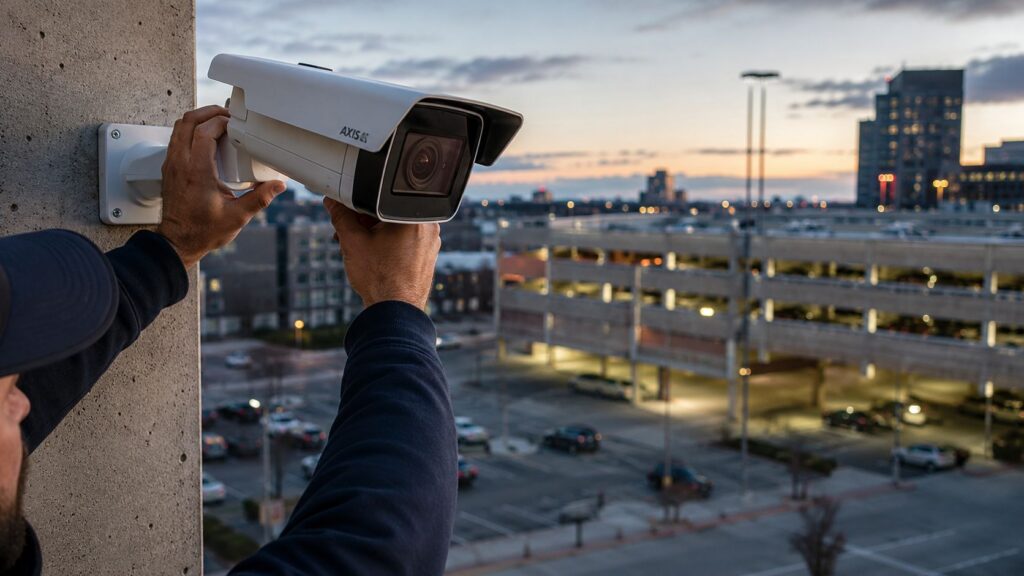
A property manager reviews footage after a break-in, expecting a clean timeline of what happened. Instead, the image is soft, the subject is backlit, and the only useful detail is that someone crossed the frame. The camera was installed. The incident was recorded. But the system still failed.
That gap is what trips up a lot of camera projects. People buy hardware, mount it where it seems logical, and assume coverage equals protection. It doesn't. CCTV camera coverage only works when the camera, the angle, the light, the recorder, and the purpose all line up.
That matters more now because camera deployment is no longer a niche security measure. One market forecast values the global CCTV market at USD 59.64 billion in 2025 and projects USD 263 billion by 2035, with 16% CAGR from 2026 to 2035, reflecting broad adoption across commercial, residential, and public safety environments (Precedence Research CCTV camera market). More cameras are going up every year. That doesn't mean more systems are producing better evidence.
Beyond Just Installing Cameras
A common version of the problem looks simple on paper. A retail center in Los Angeles has cameras at the storefronts, the parking lanes, and the loading area. An incident happens at night. Management pulls footage and realizes the camera that “covers” the scene was really set up for general observation, not identification. It saw movement, but not who caused it.
That's the difference between having video and having usable video.
Most weak systems fail in one of three ways:
- The view is too wide: The camera sees a lot of area, but not enough detail where it counts.
- The light wasn't considered: Daytime glare, shadows, and poor low-light performance ruin footage.
- The camera is pointed at space, not at a task: It watches an area generally instead of capturing the one thing the property specifically needed.
Practical rule: If you can't say what a camera must prove after an incident, you probably haven't planned that camera yet.
For schools and campus environments, this planning issue shows up even faster because entrances, hallways, and shared spaces all have different evidence requirements. If you're comparing hardware approaches in that setting, Splash Access education pricing is a useful example of how camera selection is often tied to the larger question of manageability and coverage intent, not just device count.
After 26 years of working with California properties, one pattern stays constant. The camera system that looks affordable at install often becomes expensive later, when management discovers it can't answer basic post-incident questions. Good coverage reduces that risk because it starts with outcomes, not equipment.
The Foundation of Smart Coverage Planning
A property manager usually calls after the same kind of disappointment. There was an incident, the cameras recorded it, and the footage still could not answer the question that mattered. The person was too small in frame. The vehicle entered at the wrong angle. The plate blew out under headlights.
That failure starts in planning.
The foundation of good CCTV camera coverage is defining the job of each camera in measurable terms before anyone chooses a model, lens, or mounting point. A parking area may only need scene awareness. A front entry may need facial identification at the threshold. A vehicle gate may need a tight, controlled view that can support plate review. Those are separate operational requirements, and each one drives different decisions on distance, angle, resolution, and field of view.

Start with the zone, not the catalog
On real properties, the expensive mistake is usually overgeneralizing. A team tries to cover a broad area with one camera, then expects that same image to provide evidence-quality detail. It rarely does.
Plan by zone. Then assign the standard of proof the camera must support.
For each location, answer four questions before selecting equipment:
Purpose
Is the camera there for deterrence, observation, identification, access verification, or post-incident review?Target
What must be clear in frame? A face at a door, a person at a package room, a vehicle in a lane, or activity around a loading area?Conditions
What will interfere with the image at that spot? Backlight, low light, reflective surfaces, shadows, weather, or headlights?Outcome
After an incident, what decision should the footage support?
That last question matters most. It turns coverage planning from a placement exercise into an evidence standard.
Know What Field of View Costs You
A wide view feels efficient because it covers more ground. It also spreads image detail across more ground.
That trade-off is where many camera plans fail. If the scene is too wide, the subject becomes too small to identify with confidence. In practice, one overview camera often needs a second camera with tighter framing to capture usable evidence at an entry, gate, cashier point, or other decision point.
Use this as a quick check:
| Coverage goal | What works | What often fails |
|---|---|---|
| General area awareness | Wide framing across open space | Expecting the same image to identify a person later |
| Entry verification | Tight framing on the approach and threshold | Mounting too far back and losing facial detail |
| Vehicle or gate review | Controlled lane view with a predictable angle | Trying to capture plates from a broad parking lot view |
A camera can cover an area and still fail the assignment.
Resolution matters only when the scene is framed for the task
Higher resolution helps only when the subject occupies enough of the frame and the lighting supports the shot. A sharper image does not fix poor positioning, bad angle, or an exposure problem at night.
This is why good planning ties camera specifications to the result you need to prove. If the requirement is facial identification, the camera must be close enough and tight enough for that purpose. If the requirement is plate capture, the lane has to be controlled and the angle has to support that task. Coverage should be judged by whether it can answer a post-incident question, not by how much ground appears on screen.
For homeowners comparing smaller installs, smart home security camera setup is a useful reference point because the same planning discipline applies. The difference on commercial and multifamily properties is scale. One weak assumption gets repeated across entries, parking areas, service zones, and common spaces, and the replacement cost climbs fast.
Conducting a Thorough Site Assessment
During the site walk, a paper plan meets reality. At this stage, many camera layouts either get sharper or fall apart.
A drawing might suggest a clean view of a side gate or parking aisle. On site, you notice tree growth, stacked deliveries, headlight glare, fence slats, or tenant signage blocking part of the image. Those details are why good CCTV camera coverage is built on walking the property, not just marking symbols on a blueprint.

Walk the property in incident order
Don't start with the easiest mounting locations. Start with the places where something is most likely to happen or where you'd most need evidence afterward.
A solid assessment usually checks these areas first:
- Entrances and exits: Front doors, side doors, loading entries, vehicle gates, and pedestrian cut-throughs.
- Perimeter lines: Fence corners, rear property lines, service alleys, and blind side yards.
- High-value spots: Mailrooms, package lockers, leasing offices, tool storage, dumpsters near access points, and equipment yards.
- Natural choke points: Stairwells, garage ramps, breezeways, corridors, and narrow walk paths where people must pass.
This is also where the measurable question has to be asked. One industry guide points out that much of the CCTV advice online still stops at general placement and doesn't answer the property manager's core concern: will the camera capture a usable face at the gate? That gap is especially important on commercial, retail, and construction sites where footage is needed for incident review, not just deterrence (understanding and optimizing CCTV camera coverage distance and range).
Check the environment at the times that matter
A camera that looks fine at noon can fail at sunset. A driveway that looks open in winter can disappear behind landscaping in spring.
Use this field checklist during the walkthrough:
- Look into the light: Stand where the camera would be and note sunrise and late-afternoon glare.
- Watch nighttime contrast: Check whether the area has deep shadows, uneven lighting, or direct headlights.
- Track temporary obstructions: Parked trucks, open gates, trash enclosures, and seasonal banners often block more of the view than expected.
- Test approach angles: An entrance camera should capture people approaching, not only the tops of heads after they pass under it.
Good assessment work asks, “What will this image look like during the incident we haven't had yet?”
Document what the camera must prove
A site assessment should produce more than a rough list of mounting spots. It should generate a decision log.
For each location, note:
| Zone | Primary concern | What the footage must show |
|---|---|---|
| Lobby entrance | Unauthorized access or after-hours entry | Clear view of approach and entry event |
| Parking area | Vehicle activity and loitering | Movement path and connection to nearby access points |
| Tool yard or lockup | Theft or tampering | Who entered, when, and what area was accessed |
That record keeps the project disciplined. It also helps avoid scope drift, where extra cameras get added in convenient places while the original problem areas stay weak.
Selecting and Placing Your Cameras

A good camera plan starts with a blunt question: what must this camera prove on its own worst day? If the answer is "identify a face at the side entry" or "read a plate leaving the garage," that requirement should drive the hardware, lens, height, and angle. Camera count matters less than whether each view can produce usable evidence.
Match the camera type to the task
Different camera types solve different operational problems. Treating them as interchangeable usually leads to gaps that only show up after an incident.
| Camera type | Where it fits | Trade-off to watch |
|---|---|---|
| Dome | Lobbies, hallways, covered entries, aesthetic-sensitive areas | Harder to use as a visible deterrent from a distance |
| Bullet | Perimeters, fence lines, parking edges, loading zones | Easier for people to spot and avoid |
| PTZ | Large open areas where staff actively review video | Leaves blind areas whenever it turns away |
| Panoramic or fisheye | Broad common areas needing scene awareness | Wide view spreads pixels thin, so detail drops fast |
Panoramic views help with observation and incident context. They rarely replace a dedicated identification camera. In practice, the wide camera explains what happened, and the tighter camera answers who did it.
That distinction saves money. Property teams often overspend on high-resolution wide-angle cameras, expecting them to handle both overview and identification. A better design usually pairs an overview camera with a second camera aimed at the exact choke point where a person or vehicle can be captured cleanly.
Fixed versus adjustable views
Use a fixed lens where the target area is precise and unlikely to change. Doors, transaction points, package rooms, and gate pedestrian entries are good examples because the capture zone is known before installation.
Use a varifocal lens where the drawing only gets you part of the way. Parking lanes, drive aisles, long approaches, and mixed-use outdoor spaces often need field adjustment after the camera is live.
The practical trade-off is simple:
- Choose fixed views for repeatable framing and lower chance of someone changing the scene later
- Choose varifocal views when distance, traffic path, or final framing needs on-site adjustment
I usually caution clients against solving every problem with adjustability. Varifocal flexibility is useful, but it also creates opportunities for poor final setup if no one verifies the image against the original objective.
Place cameras for evidence, not just visibility
Mounting height should protect the device without sacrificing the image. Set a camera too low and it becomes an easy target. Set it too high and you get a clean shot of shoulders, hats, and vehicle roofs.
For entrances, cover the approach first. A camera pointed straight down at the threshold may confirm that someone entered, but it often misses the face until the subject is already underneath the lens. A better layout captures the person several steps before the door, with the angle set for a natural face view.
Use these field-tested placement habits:
- Aim for the decision point: Capture the gate, door pull, intercom, register, or turn point where someone slows down
- Use camera pairs at critical areas: One overview for context, one tighter shot for identification
- Keep strong backlight out of the main scene: Glass storefronts, headlights, and reflective pavement can wash out the subject
- Protect exterior cameras without pushing them too high: Tamper resistance matters, but evidence quality matters more
- Plan for the target, not the space: A large parking lot does not need equal detail everywhere. Payment kiosks, exits, and pedestrian crossings usually need the densest coverage
Here, coverage becomes measurable. If the operational requirement is facial identification, the subject must occupy enough of the frame at the expected distance and angle. If the requirement is license plate capture, the camera needs a narrow enough view, controlled lighting, and a position that handles headlight glare and vehicle speed. "We can see the area" is not the same as "we can prove what happened."
Don't let the recorder ruin the system
I have seen well-chosen cameras produce disappointing evidence because the recorder, storage settings, or network limits were never checked against the camera plan.
A camera can send a strong image, then lose useful detail through channel limits, aggressive compression, low frame rates, or short retention settings. The result is familiar. Live video looks fine during commissioning, but exported footage from an actual incident turns soft, choppy, or incomplete. The external reference on CCTV video resolutions is a helpful reminder that image quality depends on the full recording path, not just the camera spec sheet.
Review the chain all the way through:
- Camera native resolution
- Lens and scene width
- NVR channel capacity
- Compression and frame rate settings
- Retention period
- Export quality for evidence review
If you're comparing layouts, hardware, and recording limits for a business property, this guide to commercial security camera systems is a useful reference because it frames the decision around operating requirements, not product labels alone.
Mapping Coverage and Avoiding Common Pitfalls
A professional camera plan should exist on paper before crews start drilling. The coverage map doesn't need to be complicated. A marked-up floor plan, site map, or aerial image is enough if it clearly shows camera positions, viewing direction, and each zone's purpose.
That document helps you catch mistakes before they become installation costs. It also gives your maintenance team, property leadership, and monitoring partners a shared reference.
Build a coverage map that answers real questions
For each camera, mark:
- Location: Exact mounting point
- Direction: What the lens is aimed at
- Primary task: Deterrence, observation, identification, access review, or incident reconstruction
- Critical overlap: Which neighboring camera backs it up
- Scene conditions: Night lighting, glare exposure, likely obstructions, and weather impact
A good map also marks what is not covered. That sounds obvious, but it's useful. Every property has lower-priority areas, and documenting those areas keeps people from assuming they are protected when they aren't.
If you're refining your plan, this practical guide on where to put surveillance cameras can help translate the layout into install decisions that match the way people move through the property.
Density matters more than count
Modern planning isn't just about whether a site has cameras. It's about whether camera placement is dense enough around the right zones.
Comparative surveillance research has highlighted how concentrated coverage can become. It estimated around 1 billion surveillance cameras worldwide from 2021 onward, with 700 million in China, and reported 44.0 cameras per 1,000 people in Washington, D.C. in one city ranking (Comparitech surveillance cities analysis). For property managers, the useful takeaway isn't to mimic public-sector density. It's to think in terms of coverage concentration at the points that matter most.
A sparse layout often creates a false sense of security. A denser layout around gates, garage entries, package rooms, loading areas, and choke points usually delivers better results than spreading the same budget thinly across low-value views.
The mistakes that cost the most
Some failures show up again and again:
One camera doing two incompatible jobs
A wide shot is expected to provide identification detail. It usually won't.Ignoring low-light performance
The daytime image looks fine, but night footage is noisy, washed out, or reflective.No storage planning
The footage exists, but not for long enough to support an investigation or claim.Weak privacy boundaries
Cameras capture more neighboring or public space than the property needs.No post-install validation
The system is installed, but nobody verifies whether the recorded image answers the original operational question.
Broad coverage can create confidence. Only tested coverage creates evidence.
Integrating Technology with Professional Oversight
A property manager usually finds the gap in a camera program after something goes wrong. The footage exists, but nobody reviewed the alert in real time, no one knew who owned the response, and the recorded video does not answer the question that matters. Was that person identifiable? Was that vehicle plate readable? Could staff act while the event was still in progress?
Installing cameras solves only part of the problem. A useful system ties camera performance to an operating plan, then assigns people to verify alerts, document incidents, and trigger the right response.
That matters even more as adoption keeps rising. One market forecast projects the global CCTV camera market will grow from USD 59.64 billion in 2025 to USD 263 billion by 2035 (Precedence Research CCTV camera market). More cameras on more properties do not automatically produce better evidence. The difference comes from management, testing, and accountability.

What oversight changes
On paper, a camera at a gate covers the gate. In practice, the question is whether the image supports the action your team may need to take. If a late-night trespass alert comes in, can someone review it immediately and tell the difference between a resident, a vendor, and an intruder? If a vehicle enters a garage after hours, does the view support plate capture, or only confirm that a car was present?
Professional oversight closes that gap. A monitored program adds live review, event handling, escalation rules, and reporting. Security camera monitoring works best when it is tied to clear post orders, verified camera views, and a response path your property team will execute.
This is also where the quantifiable side of coverage planning proves its value. If a camera was installed to identify faces at a lobby entrance, the oversight team should be able to confirm that the recorded image still delivers that level of detail at the expected distance and lighting condition. If the goal is license plate capture at a garage entry, the test is straightforward. Review actual footage and confirm that plates are readable during daytime, at night, and during headlight glare.
Why people and process still decide the outcome
The strongest camera programs line up three parts of the same system:
- Operational purpose: Each camera supports a defined task, such as identification, recognition, overview, or plate capture.
- Verified image quality: The lens, angle, lighting, frame rate, and retention settings preserve the detail required for that task.
- Assigned response: A person or team owns alert review, incident logging, escalation, and follow-up.
Properties run into trouble when one of those parts is missing. I have seen sites with expensive cameras and no usable incident workflow, and others with active guards watching views that were never validated for identification in the first place. In both cases, the equipment was present. The proof value was weak.
A well-run program treats camera coverage as an evidence standard, not just a hardware checklist. That standard should be reviewed after installation, after tenant or traffic pattern changes, and after any incident that exposes a blind spot or weak response.
If you're reviewing a property in Los Angeles, San Diego, San Jose, Oakland, or anywhere in California and aren't sure whether your current footage would hold up after a real incident, Overton Security can help you assess camera placement, identify blind spots, and align your system with the way your site operates.