A California property manager often lands on the same question after a few vendor calls. A firm looks established, the website lists impressive property types, and the proposal sounds polished. Then the practical concern shows up: will this company manage a California property well, or are you buying a remote operation with a local subcontracting problem?
That question matters more than brand familiarity. Security is local work. Post orders have to reflect the site, supervisors have to know the neighborhood, and account leadership has to respond fast when a trespass issue, access-control failure, or after-hours incident starts affecting tenants.
For owners and managers who also weigh neighborhood conditions during leasing or acquisition, local context shapes more than security planning. It affects operations, staffing expectations, and even smarter home buying decisions when residential communities are involved. The same principle applies to vendor selection. A security partner has to understand the block, the asset class, and the state-specific rules that govern the work.
Evaluating Security Partners For Your California Property
A common scenario goes like this. A regional or national search turns up Parrish Security Group, a Texas-based provider that appears to have meaningful scale and experience in complex environments. On paper, that can look reassuring, especially if you're trying to standardize service across multiple sites or replace an underperforming guard company.
The problem is that paper strength doesn't always translate into field performance in California. A property in Los Angeles, San Jose, Sacramento, or Oakland doesn't just need officers on a schedule. It needs responsive supervision, clean documentation, reliable shift coverage, and management that understands California service expectations from the start.
What usually matters most on the ground
When I evaluate a security company for a client, the first screen isn't marketing language. It's operational fit.
- Local management presence: Who visits the property, how often, and how quickly can they intervene when coverage slips?
- Officer continuity: Are the same officers likely to stay on post long enough to learn tenant patterns, access procedures, and reporting expectations?
- Site-specific adaptation: Can the provider handle the difference between a residential community, a corporate lobby, a yard, and a mixed-use site?
- Reporting discipline: Will you get timely logs, incident reports, and escalation records that are useful?
A strong security contract doesn't fail because the proposal looked weak. It fails because daily execution wasn't built for the property.
That is why many California buyers compare broad-market vendors against firms with a more localized operating model. If you're making that comparison, it's worth reviewing what separates a commodity guard service from a dependable account partner, including the standards outlined in this guide to choosing a security guard company.
Who Is Parrish Security Group An Objective Profile
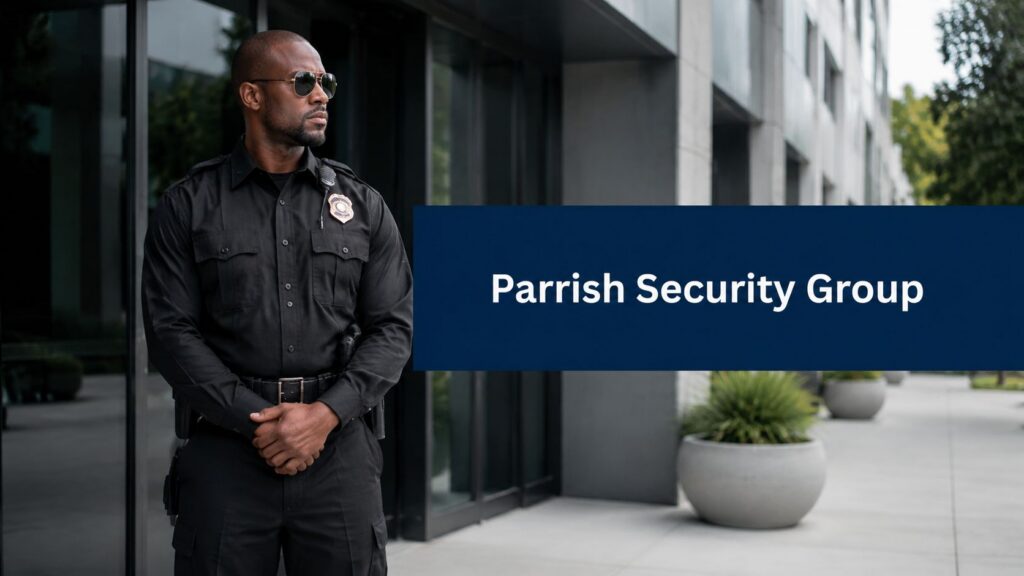
Parrish Security Group is not a small local startup. It appears to be a meaningful mid-market security firm based in Dallas, with headquarters listed at 1420 W Mockingbird Ln, Ste 295, Dallas, Texas, and a reported $25.6 million in revenue according to its ZoomInfo company profile.

That revenue figure is important because it places Parrish in a category above a neighborhood guard firm that mainly covers a handful of posts. Companies at that scale usually have to think in terms of staffing depth, recurring contracts, account management, and service consistency across multiple properties.
The market segments Parrish appears to target
Parrish's positioning centers on property types that usually require customized programs rather than generic standing-post coverage.
Its profile emphasizes work tied to:
- Commercial real estate
- Corporate campuses
- Industrial warehouses
- Technology and data centers
- Residential communities
That matters because these aren't casual one-off assignments. They tend to involve recurring post orders, multiple shifts, visitor-management expectations, patrol requirements, and a client relationship that depends on stable execution.
Why that profile matters to a California buyer
A California property manager shouldn't dismiss Parrish solely because it's Texas-based. The company appears to serve substantial account types, and firms that operate in those sectors often build useful discipline around reporting, staffing, and site customization.
Still, scale by itself is neutral. It can support better service, or it can create distance between field operations and the client. The main question isn't whether Parrish is a legitimate provider. Based on the available profile, it is. The question is whether its operating structure aligns with what a California asset needs from day to day.
A mid-market provider can look strong in a portfolio summary and still struggle if local supervision is thin, if escalation chains are slow, or if field leadership isn't close enough to the account. That's the lens California clients should use from the beginning.
Analyzing The Parrish Security Group Service Model
Parrish's stated focus suggests a company built for properties with different risk patterns, not a one-template guard operation. According to an Atomic Design & Consulting portfolio description, Parrish Security Group's focus on high-complexity segments like data centers, industrial warehouses, and corporate campuses requires a security model that can manage heterogeneous risk profiles, blending fixed posts, mobile patrols, and remote monitoring.
That blend tells you a lot about the likely operating DNA.
What that portfolio implies operationally
A provider serving data centers and industrial sites has to think beyond visible presence. Those environments usually demand layered procedures.
For example:
- Fixed-post coverage supports access control, lobby screening, and gate operations.
- Mobile patrols handle perimeter checks, parking areas, yard conditions, and lock verification.
- Remote observation adds another layer where camera review, alarm review, or off-hours monitoring matters.
A company built around those modalities usually understands that a post order can't be generic. A warehouse and a residential community may both need patrols, but the patrol objective is different. One centers on asset protection and controlled entry. The other often adds resident interaction, amenity checks, parking enforcement support, and a service-oriented tone.
Where that model can work well
This kind of service model tends to fit clients with:
- Multiple buildings or broad footprints
- Varied access points
- A mix of daytime public traffic and after-hours risk
- Sensitivity around liability and documentation
Those are real strengths if the provider has disciplined field supervision behind them.
Practical rule: The more varied the property risks are, the more important site-specific post engineering becomes.
Where buyers need to probe deeper
A mixed-modality model sounds good in a proposal, but execution depends on whether the company can keep each layer connected. Patrol activity has to inform incident reporting. Camera observations have to trigger action. Fixed-post officers have to hand off information cleanly at shift change.
For California managers, that means asking less about the list of services and more about integration. Who reviews overnight activity? Who corrects missed patrol patterns? Who updates post orders when a building changes access procedures or tenant use shifts?
Parrish's stated market focus suggests it understands complexity. That's a positive sign. But complexity also exposes management weaknesses faster than a simple front-desk account ever will.
Strengths And Potential Watch Outs For California Clients
Parrish has some clear strengths on paper. It appears to operate at meaningful scale, and its sector focus points to experience in higher-liability environments where clients usually expect more than a warm body at the post.
For a buyer with industrial property, a corporate campus, or a site with layered access needs, that background may be relevant. A provider that already works in operationally demanding settings often understands SOP discipline, patrol variation, and the need for consistent escalation.

Where the California fit gets harder
The first concern isn't capability. It's distance.
A Dallas-based firm can absolutely serve California accounts, but the service model has to answer some uncomfortable questions. Who owns the local relationship? Who is physically inspecting posts? Who handles last-minute staffing issues without turning your property into a phone-tree exercise?
California also isn't a plug-and-play extension of another state. Security operations here touch different labor expectations, documentation habits, client service norms, and licensing oversight. Buyers who want a grounded view of those requirements should review the basics of California security guard licensing before assuming any out-of-state operating model will transfer cleanly.
Workforce signals worth paying attention to
One useful signal in any guard company review is how the labor model appears to function. Salary.com reported Parrish Security Group's average annual employee salary at $77,688 in the United States as of May 2026, and public employee reviews on Indeed and Glassdoor showed mixed sentiment around 3.0 out of 5, with Glassdoor ranges around 2.8 to 3.0 out of 5 across categories, according to Salary.com company salary data.
That doesn't prove service quality one way or the other. Employee review platforms are imperfect. But they do tell a buyer that workforce management is a real operational issue, which is true for every serious guard company.
What I'd watch in a proposal review
If a California client is considering Parrish, I wouldn't reject the firm out of hand. I would test it hard in diligence.
Ask for clarity on:
- Supervision structure: Who in California is responsible for inspections, officer coaching, and emergency response support?
- Account ownership: Will one manager know your site well, or will the account pass through layers?
- Shift continuity: How does the company prevent frequent officer swaps on sensitive posts?
- Client communication: Who sends updates, who answers after-hours concerns, and how fast do corrections happen?
The risk with remote security management isn't that the vendor lacks experience. It's that the property becomes one more account on a map.
For many California properties, especially HOAs, mixed-use assets, retail centers, and tenant-sensitive office environments, the winning service model is usually the one closest to the ground. Hands-on local leadership tends to outperform distant scale when actual work starts at 2 a.m., not during the sales presentation.
A Comparison Checklist Parrish Vs Overton Security
A side-by-side comparison helps strip away branding and focus on fit. The question isn't which company sounds larger or more polished. The question is which operating model matches the needs of a California property.
Security Partner Comparison
| Evaluation Criterion | Parrish Security Group | Overton Security |
|---|---|---|
| Geographic base | Texas-based, with a Dallas headquarters and a service profile centered around major property types | California-based |
| California operating familiarity | Needs close diligence from a California buyer to confirm local management depth and state-specific execution | 26 years of California experience |
| Service orientation | Appears built for customized coverage across commercial, industrial, campus, residential, and other complex environments | Focused on customized California programs across residential, retail, construction, office, industrial, healthcare, and government properties |
| Management model | Should be evaluated carefully for local supervision and response structure if serving California sites | Known for a low manager-to-client ratio and hands-on leadership |
| Officer accountability tools | Buyers should ask detailed questions about patrol verification, reporting flow, and after-hours oversight | Uses GPS-enabled patrol verification, digital reporting, and 24/7 SOC oversight |
| Flexibility of deployment | Portfolio suggests capability across fixed posts, patrol, and remote-style support | Offers onsite guards, vehicle patrol, concierge security, fire watch, remote monitoring, and event coverage |
| Best fit | Buyers comfortable validating an out-of-state service structure for California operations | California owners and managers who want local accountability and field support |
What the table really says
Parrish may be a reasonable option for a client that values scale and is willing to investigate the California delivery model in detail. That can work, especially if the account has a narrow scope and the local support plan is strong.
The more complicated the asset becomes, the more this comparison shifts toward management proximity. A high-rise residential site, a mixed-use property, or a multi-location portfolio usually benefits from a team that already lives inside California operating realities.
If your property depends on fast supervisor involvement, vendor fit is less about brochure strength and more about who can show up, solve the issue, and document it well.
Your Essential Guide To Vetting Any Security Partner
Most disappointing security contracts share one problem. The client bought promises instead of verifying operations.
A useful vetting process doesn't need to be complicated, but it does need to be disciplined. Whether you're reviewing Parrish, a local guard company, or a regional provider, use the same checklist.

Ask how the account will actually be run
Start with the management chain, not the sales rep.
- Who is my day-to-day account manager? Get a name, role, and service area.
- Who conducts site inspections? If the answer is vague, expect supervision gaps.
- What happens after an incident at night or on weekends? You want an escalation path, not a generic assurance.
A property manager can learn a lot from how a company answers operational questions under light pressure.
Examine the labor model
Retention affects service quality more than most buyers realize. Parrish states that it offers employee benefits including medical, dental, vision, and life insurance, and the company has also noted hourly wages around $17/hour in some markets in its own write-up on what makes Parrish Security Group different.
That doesn't tell you whether officers will stay on your account, but it does point to the right diligence question: what supports continuity?
Ask:
- How are officers assigned to posts? Dedicated placement usually performs better than constant rotation.
- What benefits are offered to front-line staff? Stability often follows stronger employment practices.
- How are call-offs handled? The answer should include coverage protocol, not just reassurance.
For property owners juggling broader vendor decisions, this kind of structured interview process mirrors the way managers screen other critical partners. The same mindset appears in this resource for California property owners on hiring a property manager. Operations matter more than polished positioning.
Test the reporting and technology stack
Don't settle for "we send reports." Ask to see samples.
Look for:
- Time-stamped activity reporting
- Clear incident narratives
- Photo documentation when appropriate
- Patrol verification
- Supervisor review and follow-up
One example in the California market is Overton Security's outsourcing partner checklist, which reflects the kind of questions serious buyers should ask any provider about reporting, accountability, and service oversight.
Request proof that the model fits your asset
A good final test is scenario-based.
Ask the vendor how it would handle:
- A gate left unsecured after hours
- An aggressive trespasser in a residential common area
- A recurring parking problem in a retail center
- A missing key or access credential
- An officer no-show before the start of shift
The right answer isn't generic toughness. It's a specific chain of actions involving communication, documentation, supervisor response, and client notification.
The vendors worth shortlisting are the ones that can explain ordinary failures clearly. That's where real service quality shows up.
Conclusion Choosing A Partner Aligned With Your Goals
Parrish Security Group appears to be a legitimate mid-market security company with experience in serious property types. For some buyers, that alone will earn it a place on the consideration list.
For California properties, though, the decision shouldn't stop at scale or sector fit. The harder questions involve local supervision, account ownership, officer continuity, reporting discipline, and how well the provider understands the realities of serving California clients day after day.
That is where many security evaluations become clearer. A remote or out-of-state model can work, but only if the company has built real local infrastructure around it. If it hasn't, the property often absorbs the consequences through slower response, thinner oversight, and more client effort spent managing the vendor.
The best security partner is usually not the one with the broadest pitch. It's the one whose service model matches your asset, your tenants, and your operating expectations.
If you'd like a second opinion on your current guard program or a practical review of proposals you're considering, Overton Security can help assess the fit, identify service gaps, and outline a California-focused security plan built around your property's actual risks and daily operations.