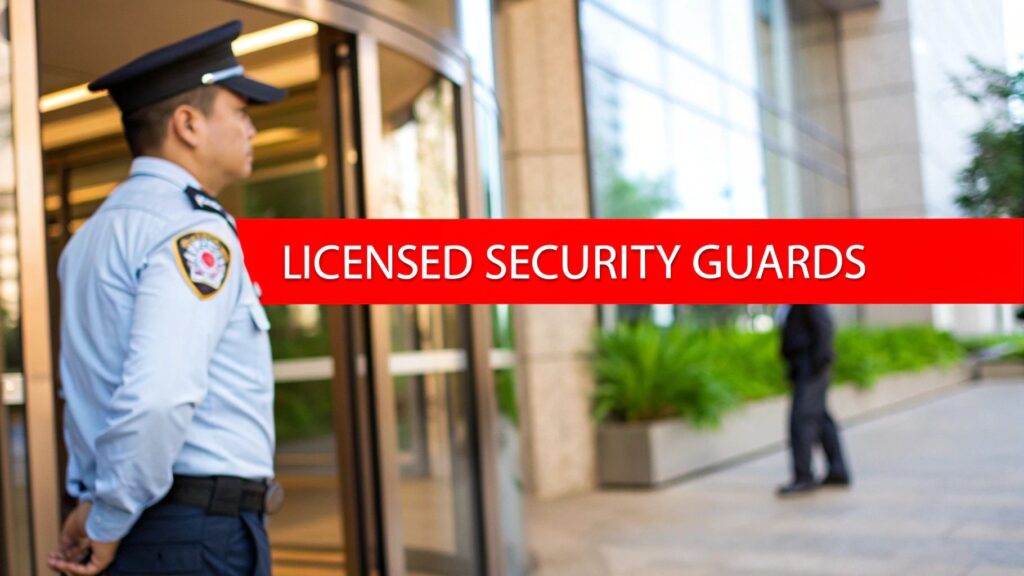
A licensed security guard is more than just a person in a uniform. They are a trained professional who has met strict, state-mandated requirements, including comprehensive background checks and specialized training. Hiring a licensed guard ensures the individual protecting your property is vetted, accountable, and legally compliant—a critical distinction from simply hiring an unverified person.
Why Licensed Security Is a Non-Negotiable Asset
Imagine a serious incident unfolding on your property—a heated tenant dispute, a break-in, or a medical emergency. Now, picture the realization that the guard you hired has no legal authority, proper training, or background clearance to handle it correctly. This is the exact risk many property managers and HOA board members unknowingly take.
Hiring a licensed security guard isn't about appearances; it's a fundamental business decision that protects your property, people, and reputation. That license is far more than a piece of paper.
A security license is your primary guarantee of professionalism, accountability, and compliance. It confirms the officer has cleared extensive state and federal background checks and completed rigorous, state-approved training on critical procedures.
This process is designed to filter out unreliable individuals and equip qualified professionals with the skills needed to protect people and property effectively.
The True Cost of Unlicensed Alternatives
Opting for an unlicensed individual might seem to save money upfront, but it opens your organization to significant liability. An unvetted person likely lacks knowledge of the legal limits of their authority, which can cause a situation to escalate or lead to negligence. If something goes wrong, the legal and financial consequences could land squarely on you.
Here are the key benefits you receive only with a licensed professional:
- Verified Background: You have confirmation that the individual has no disqualifying criminal history, providing essential peace of mind.
- Formal Training: There is documented proof of their education in crucial skills like de-escalation, emergency response, legal powers to arrest, and proper report writing.
- Legal Compliance: You gain the assurance that your security operation adheres to state regulations, shielding you from potential fines and lawsuits.
- Professional Accountability: Licensed officers and their agencies are held to a higher standard of conduct and are answerable to a state licensing board.
A key reason to hire licensed security guards is their ability to effectively deter criminal activity. They are trained to apply practical security tips for preventing break-ins in real-world situations, spotting vulnerabilities and acting as a credible deterrent.
Ultimately, choosing a licensed provider like Overton Security isn't an expense—it's an investment in risk management. With over 26 years of experience, we understand that real security comes from proven processes and qualified people. Our commitment to hiring and retaining top-tier licensed officers ensures your property is protected by professionals you can trust.
The Journey to Becoming a Licensed Professional
What truly separates a professional security officer from someone merely wearing a uniform? The answer is a demanding, state-mandated journey that ensures competence, character, and accountability.
You wouldn’t allow an unlicensed contractor to work on your building or an unlicensed doctor to provide medical care. The same logic applies to the security of your property, assets, and tenants. A security license is proof that before someone takes control of protecting your site, they have proven they can handle it responsibly.
To earn this credential, a licensed security guard must clear a series of high hurdles designed to confirm they are trustworthy and capable of protecting your community and reputation under pressure.
Meeting California's High Standards
In California, the Bureau of Security and Investigative Services (BSIS) sets the standard for every licensed security guard. This isn't a simple online course; it's a multi-stage process that removes unqualified candidates and ensures every officer meets a baseline of professionalism.
The demand for these qualified professionals is significant. In 2023, the U.S. employed around 1.2 million licensed security guards, with the investigation and security services industry making up over 735,000 of those roles. This large workforce underscores how critical it is for guards to have completed rigorous, state-approved vetting.
The core requirements every applicant must meet include:
- Comprehensive Background Checks: Candidates must clear both FBI and Department of Justice (DOJ) criminal history checks to screen for any disqualifying offenses.
- Mandatory Initial Training: Before stepping foot on a property, recruits must complete foundational training, including an intensive "Power to Arrest" course that clarifies the legal boundaries of their authority.
- Ongoing Education: A guard’s training is continuous. California mandates continuing education to ensure officers remain current on best practices and regulations.
This diagram breaks down the pillars that support a truly professional security officer.
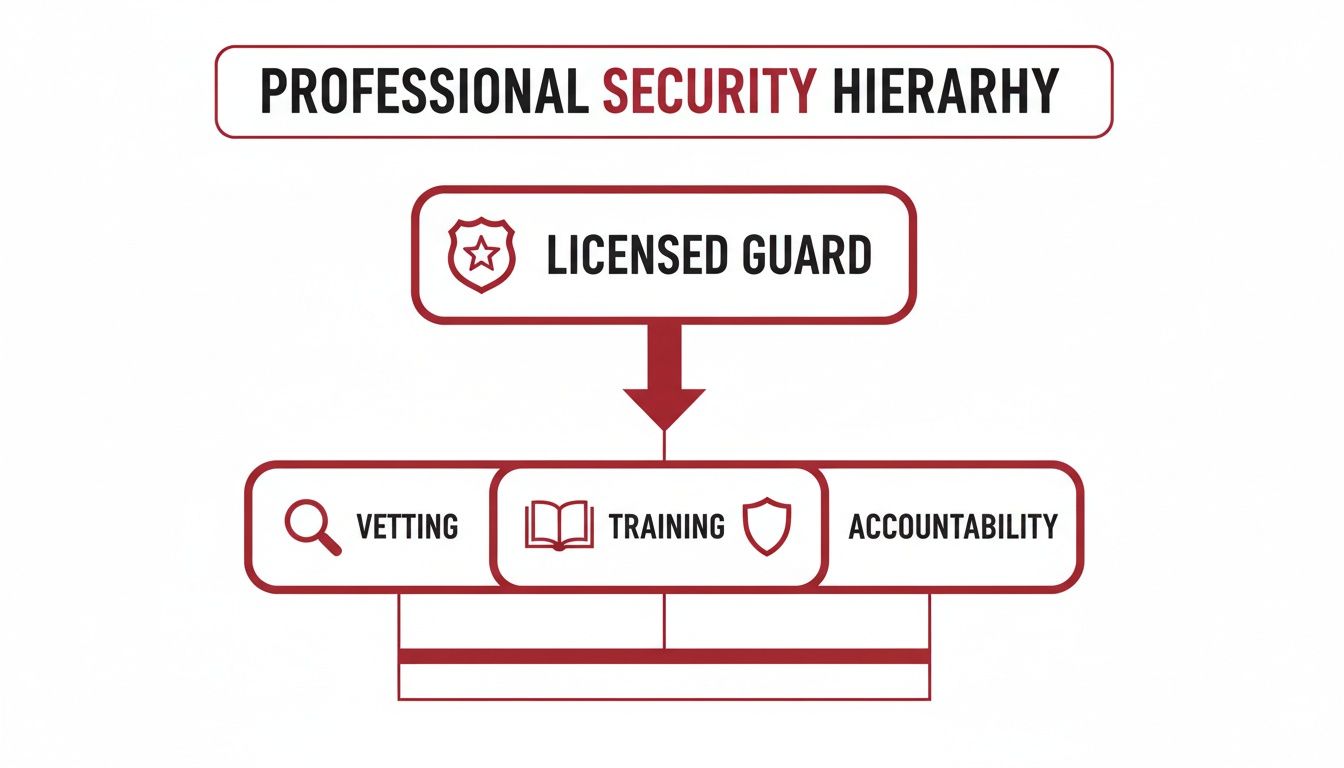
As you can see, a licensed guard is the product of a system built on vetting, training, and accountability—three elements that are absent with unlicensed individuals.
Licensed vs Unlicensed Security at a Glance
It's clear why cutting corners with unlicensed individuals is a gamble. This table highlights the key differences.
| Attribute | Licensed Security Guard (Professional Standard) | Unlicensed Individual ('Security') |
|---|---|---|
| Training & Vetting | State-mandated training (e.g., Power to Arrest), FBI/DOJ background checks. | No formal training required. No background checks. |
| Legal Authority | Clearly defined and legally recognized authority to detain suspects. | No legal authority beyond a private citizen's arrest. |
| Accountability | Accountable to the state licensing board (BSIS in CA) and the security company. | Accountable to no one but their direct employer, with no professional oversight. |
| Liability | Covered by company insurance; actions are legally defensible. | Creates massive liability for the property owner due to lack of training and oversight. |
| Professionalism | Adheres to a professional code of conduct and ongoing education requirements. | No professional standards or requirements for continuing education. |
The takeaway is clear: one is a professional supported by a system of accountability, while the other represents a significant, unpredictable risk.
Specialized Training for Elevated Risks
The journey doesn't stop with a basic guard card. For roles that require a higher level of response, there are additional, even more demanding licensing tiers, especially for armed security officers.
An armed guard must first earn their standard Guard Card and then obtain a separate Firearms Permit from the BSIS. This involves extensive additional training on firearms safety, marksmanship, and the legal use of force, plus a psychological evaluation.
This tiered system ensures that officers are appropriately qualified for the specific risks of your property. It’s another layer of protection that gives property managers and HOA board members confidence that the person on-site has the precise skills needed for the job.
Companies that prioritize officer development, like Overton Security, invest heavily in ensuring their teams meet and exceed these standards. You can learn more about our commitment in our overview of security officer training programs. This focus on continuous improvement is what transforms a guard into a genuine security partner.
What's the Real Risk of Unlicensed Security?
For anyone managing a property—whether you're a property manager, an HOA board member, or a facilities director—liability is always a top concern. While hiring security is a step toward reducing risk, choosing an unlicensed individual can unfortunately increase it. It’s a decision that can invite serious legal, financial, and reputational challenges.
This isn't about hypotheticals; it's about the real-world fallout when you place your trust in someone operating outside legal standards. Partnering with a proven, fully licensed, and insured security company isn't just a good idea—it's an essential shield for your property and your peace of mind.
The Liability Chain Starts—and Ends—with You
When you hire an unlicensed person for security tasks, you effectively become their manager and assume full responsibility for their actions. If they mishandle a situation, such as an improper detention or a tenant dispute that turns physical, the lawsuit won't just target them. It will target you and your organization for negligent hiring.
This direct exposure can have serious consequences that extend far beyond a single incident.
- Vulnerability to Civil Lawsuits: A mistake by an unlicensed guard can draw you into expensive legal battles and result in significant damage awards.
- Rising Insurance Premiums: Insurance carriers view unlicensed personnel as a major red flag. A single claim can cause your general liability premiums to spike, or your provider may even drop your coverage.
- Hefty State Fines: In states like California, hiring unlicensed security is illegal. You could face significant fines and sanctions from regulatory bodies like the Bureau of Security and Investigative Services (BSIS).
A Real-World Example
Consider this scenario: on your commercial property in Los Angeles, an unlicensed guard confronts someone they believe is shoplifting. Without proper training in de-escalation or the legal limits of their authority, the guard physically restrains the person, causing an injury.
It turns out the person was innocent. Now, your business faces a lawsuit for assault, battery, and false imprisonment. Because the guard wasn't licensed, trained, or properly vetted, your defense is weak. The court will focus on a simple question: did you perform your due diligence?
Hiring an unlicensed individual creates a direct line of liability to your organization. When you partner with a licensed and insured security firm, you transfer that risk to a professional entity built to manage it.
The Overton Security Difference: Protection You Can Count On
At Overton Security, our company is built on a foundation of compliance and professionalism. For over 26 years, we've understood that our role is to reduce our clients' risks, not create new ones. We carry comprehensive liability insurance and workers' compensation, and we meticulously verify that every one of our officers holds a valid, current security license.
This isn't just about checking boxes; it's the core of our promise to be a security partner you can rely on. When you work with us, you are shielded from the dangers of non-compliance. You can focus on managing your property, confident that the professionals protecting it are fully vetted, properly trained, and legally authorized to be there.
How to Verify a Security Guard License
You've decided to hire licensed security guards—an excellent first step. But how do you confirm that the officers assigned to your property, and the company they work for, are legitimate?
Taking a few minutes to verify credentials is not just "good practice." It's a critical risk management step that protects your business, tenants, and reputation. The best approach is to trust, but verify.
Fortunately, states like California make this process simple and transparent. The state’s official online database is your single source of truth, allowing you to quickly confirm a guard's license status and a security company’s authority to operate. This due diligence ensures you're partnering with qualified, accountable professionals from the start.
Verification is the act of replacing assumptions with certainty. It’s the final check that ensures the professionalism you were promised is the professionalism being delivered on-site.
This simple action builds a foundation of trust and confirms your security partner meets every legal and regulatory standard.
A Step-by-Step Guide to License Verification
In California, this process is managed by the Department of Consumer Affairs' Bureau of Security and Investigative Services, or BSIS. They maintain a public, online database for this exact purpose, and using it is quick and easy.
Here is what the official BSIS search portal looks like—your go-to tool for verification.
The portal lets you search by a guard’s name, license number, or the security company's business name to instantly check their status.
Here’s how to do it in four simple steps:
- Visit the BSIS Search Portal: Go to the official DCA Search website at
search.dca.ca.gov. - Select the Board: From the dropdown menu, choose "Bureau of Security and Investigative Services."
- Enter the Information: You can search by a person's name for their Guard Card or a business name for the company’s Private Patrol Operator (PPO) license. Using a license number is the fastest and most accurate method.
- Review the Results: The search will show the license type, number, status (like "Current" or "Expired"), and the expiration date. A "Current" status is the only acceptable result and is non-negotiable.
What to Look For and What to Ask
True verification goes beyond a simple database search. When vetting a potential security provider, you should ask direct questions about their internal compliance processes.
Think of it as a due diligence checklist:
- Proof of PPO License: The first item to request is a copy of the company's current Private Patrol Operator (PPO) license. This is the master license that proves the business is legally authorized to provide security services in California.
- Guard Card Verification Process: Ask, "How do you track your officers' Guard Card status?" A reputable firm like Overton Security will have a robust internal system for tracking license expirations to ensure every officer on duty is compliant, 100% of the time.
- Insurance Certificates: Don't forget insurance. Request proof of their general liability, workers' compensation, and commercial auto policies. This documentation protects you from liability if an incident occurs.
- Requesting Officer Credentials: You have the right to ask for the name and Guard Card number of any officer assigned to your site. You can—and should—run these through the BSIS portal yourself.
For a closer look at California's requirements, you can learn more about the state's security guard licensing process and what it means for protecting your property.
By making verification a standard part of your procurement process, you guarantee that every layer of your security program is built on a solid, compliant, and trustworthy foundation.
What to Expect from Professional Security Services
When you hire licensed security guards from a professional firm, you’re not just getting a person in a uniform; you’re engaging a proactive partner in protection. The difference between a basic guard and a professional security program lies in the infrastructure that supports the officer on the ground.
A professional service provides a system of accountability, transparency, and operational intelligence. This system transforms security from a simple cost into a valuable asset that protects your property and provides peace of mind. It’s the combination of skilled people and smart, supportive technology that makes the difference.

Real-Time Reporting and Total Transparency
The days of finding a handwritten, barely legible report slipped under your door are over—or they should be. A modern, professional security firm provides transparent, real-time reporting through digital tools.
Every property manager and HOA board member should expect detailed Digital Activity Reports (DARs). Officers complete these reports in the field on a mobile app, and they should always include:
- Time-Stamped Entries: A clear log of every patrol, observation, and action as it happens.
- Photo and Video Attachments: Visual proof of a broken fence, an unlocked gate, or a potential safety hazard.
- GPS Verification: Confirmation of the officer's exact location for every entry, proving patrols are being completed as required.
This isn't just about receiving a report; it's about having a verifiable log of all security activity. This data is invaluable for identifying trends, addressing recurring issues, and maintaining solid records for liability purposes.
Accountability Through GPS-Verified Patrols
How can you be sure your security team is covering every critical checkpoint? The answer is a GPS-enabled guard tour management system. It's a straightforward yet powerful tool.
Officers use a mobile device to scan checkpoints—like NFC tags or QR codes—placed at key locations, such as an equipment storage area on a San Jose construction site or the pool gate in a Los Angeles residential community.
This technology provides irrefutable proof of presence. It eliminates "ghosting" patrols and gives you confidence that every corner of your property is receiving the attention it needs, every shift.
This system does more than keep officers accountable; it empowers them. It provides a clear structure for their patrols, ensuring consistency and thoroughness, all while creating a digital trail that proves their hard work.
The Power of a 2-Hour Security Operations Center
An officer patrolling a large commercial property at 3 a.m. should never be truly alone. This is where a 24/7 Security Operations Center (SOC) becomes essential. As the nerve center of the entire operation, the SOC provides a critical support layer for every officer in the field.
This command center is constantly:
- Providing Real-Time Officer Support: Offering immediate guidance if an incident occurs.
- Handling Dispatch and Escalation: Coordinating with police or emergency services when a situation requires it.
- Conducting Wellness Checks: Actively monitoring officer safety, especially during late-night and overnight shifts.
The SOC ensures every officer is part of a connected, responsive team. This oversight transforms an isolated guard post into a dynamic security hub that can manage complex situations with confidence.
The demand for this level of robust, professional service is growing. The global security guarding services market, driven primarily by licensed professionals, was valued at USD 184.33 billion in 2025 and is projected to hit USD 247 billion by 2029. This is a clear indicator that businesses are increasingly seeking reliable, accountable security partners. You can find out more about the growth of the security services market and why this trend is accelerating.
Choosing the Right Licensed Security Partner
Selecting a security provider is more of a partnership than a purchase; it's about establishing trust. After understanding why licensing, training, and accountability are non-negotiable, the final step is to find a firm that embodies these principles.
You're not just filling a post; you are seeking a partner committed to quality, dedicated to supporting their officers, and providing hands-on management. It requires a careful look at who you are bringing in to protect your property.
Your Vetting Checklist
When speaking with security firms, a structured approach is helpful. A simple checklist ensures you cover all critical bases, from their legal standing to their day-to-day operations.
Here are the must-haves to review:
- Verify Company Licensing: First, confirm they hold a current Private Patrol Operator (PPO) license. This is the foundational legal requirement for any legitimate security provider in California.
- Confirm Comprehensive Insurance: Ask for their certificates of insurance. You need to see proof of general liability, workers' compensation, and commercial auto coverage. This is your shield against unexpected liability.
- Review Officer Training and Retention Programs: Ask directly about their approach to ongoing education and how they retain their officers. Low turnover is a strong indicator of a well-run company that invests in its people.
- Assess Technological Capabilities: Ask about their reporting software, use of GPS-verified patrol systems, and whether they operate a 24/7 Security Operations Center (SOC) to support their field teams.
Choosing a partner is more than a transaction. It’s an investment in a relationship built on reliability, proactive service, and a shared commitment to protecting your assets.
This level of scrutiny ensures you find a partner who truly aligns with your property's needs. For a more detailed guide on this process, check out our post on the top considerations when choosing a security outsourcing partner.
Experience, Service, and Trust
In a crowded market, real-world experience is what separates true professionals. With over 26 years of service, Overton Security has built its reputation on a simple promise: quality over quantity. Our intentionally low manager-to-client ratio guarantees every client receives direct attention from our leadership—a stark contrast to the impersonal service often found at large national firms.
The private security industry is vast. North America holds 41% of the global market, and the U.S. alone is projected to have over 1.1 million licensed security guards on duty in 2025. With commercial properties making up 61% of that demand, finding a proven expert in this space is critical.
At Overton Security, we blend seasoned human expertise with smart, accountable technology to deliver protection you can count on. We invite you to experience the peace of mind that comes from working with a trusted, experienced partner ready to address your unique security challenges.
Frequently Asked Questions
When you're managing a property or serving on an HOA board, navigating professional security can bring up many questions about compliance, liability, and best practices. Here are straightforward answers to the questions we hear most often.
Are Armed Guards Licensed Differently Than Unarmed Guards?
Yes, the difference is significant. In California, an officer must first earn their standard Guard Card before they can even begin the application process for a Firearms Permit from the BSIS.
Obtaining a firearms permit involves another level of scrutiny. It requires extensive training on firearms safety, the legal use of force, and proven marksmanship. Applicants must also pass a psychological evaluation and requalify at a firing range regularly. When you hire armed security, you are hiring someone who has cleared a much higher bar for skill and vetting. Always verify both credentials.
What Is a Guard Card and Does Every Officer Need One?
A Guard Card is the official registration issued by California's Bureau of Security and Investigative Services (BSIS). It is the absolute, non-negotiable legal requirement for anyone performing security duties in the state.
This card is significant because it proves the holder has passed comprehensive DOJ and FBI background checks and has completed all state-mandated training.
By law, every single officer must carry their Guard Card while on duty. Hiring someone to act as security without a valid, current Guard Card isn't just a poor decision—it's illegal and exposes your property to massive liability.
Can My Own Staff Perform Security Duties Without a License?
This is a common question that often stems from a misconception. If an employee's primary job involves security tasks—like patrolling grounds, actively monitoring surveillance, or controlling access—they legally must be licensed as a security guard.
Assigning these duties to an unlicensed employee, such as a front desk receptionist or maintenance worker, creates a significant legal risk for your organization. These individuals lack critical training in de-escalation, legal authority, and incident response. If an incident occurs, a negligence lawsuit is almost certain.
How Is a Company License Different From a Guard License?
Understanding this distinction is crucial when hiring a security provider. An individual officer holds a Guard Card to work legally. The security company itself must hold a Private Patrol Operator (PPO) license.
The PPO license is the company-level credential. It proves the business is legally authorized to offer security services in California and meets all state insurance and bonding requirements. It also confirms the company is managed by a qualified, vetted professional. Before signing a contract, you must verify the company’s PPO license to ensure you’re partnering with a legitimate, insured, and compliant business.
Making the right choice in a security partner isn't just about protecting your assets; it's about gaining invaluable peace of mind. For over 26 years, Overton Security has been that trusted partner for properties across California, delivering professional, licensed security services built on a foundation of experience and accountability.
Ready to discuss your property’s unique security needs? Contact us for a personalized consultation.