
When you hear "loss prevention," what comes to mind? For many, it's the classic image of a security guard standing by a department store exit. While that’s part of the story, the reality today is far more comprehensive.
True lossprevention is less about reacting to theft and more about proactively building a strategy that stops losses before they happen. For property managers, HOA boards, and business owners, it’s about identifying and neutralizing risks before they turn into expensive operational headaches, providing genuine peace of mind.
What Modern Loss Prevention Really Means
At its core, modern loss prevention is a fundamental shift in mindset. Instead of just responding to emergencies, a proactive approach is designed to protect your bottom line from the start.
This also means we need to redefine what "loss" actually means. The term no longer applies only to stolen merchandise from a retail shelf.
A Broader Definition of Loss
Today’s loss prevention strategies address a much wider range of vulnerabilities that can impact profits and compromise safety across different sectors:
- For Retail Centers: This goes beyond simple shoplifting to tackle organized retail crime, sophisticated fraud, and even employee theft.
- For Construction Sites: Here, loss means preventing the theft of expensive equipment, power tools, and valuable materials like copper wiring that are prime targets for criminals.
- For Residential Communities: The focus is on mitigating safety liabilities from accidents, stopping vandalism, and protecting residents' property from theft or damage.
A successful program creates an environment where potential issues are identified and addressed long before they escalate. It’s a direct safeguard for your assets, your tenants, and your operational budget.
Why Yesterday’s Tactics Aren't Enough
In today's world, simply posting a guard at an entrance isn’t nearly enough. The threats property and retail managers face are more complex, and the financial stakes have never been higher.
Just look at the numbers. Recent data shows that retail shrinkage—which includes all forms of theft and fraud—has exploded to an estimated $132 billion. That’s a massive jump from $112.1 billion just a year prior, showing just how fast losses can pile up when security measures haven't kept pace with modern risks.
To get a handle on what works now, you have to dig into the details of proactive risk analysis, much like understanding the components of What is a Fire Risk Assessment. This kind of forward-thinking is the heart of an effective strategy.
It’s not just about stopping theft anymore; it’s about building a complete defense against all potential forms of loss. You can explore a more modern loss prevention definition in our detailed guide. The most effective approach blends on-the-ground human expertise with smart technology to deliver consistent, verifiable protection built around your specific property’s needs.
The Three Pillars of an Effective Strategy
A truly effective loss prevention program isn't about one magic bullet. It’s a carefully balanced system built on three core pillars that must work together: People, Processes, and Technology. When these pieces are properly integrated, security stops being a passive line item on a budget and becomes a dynamic system that actively protects your property.
Think of it as a hierarchy of protection, where every layer works to safeguard your most critical concerns—your assets, your equipment, and the safety of everyone on site.
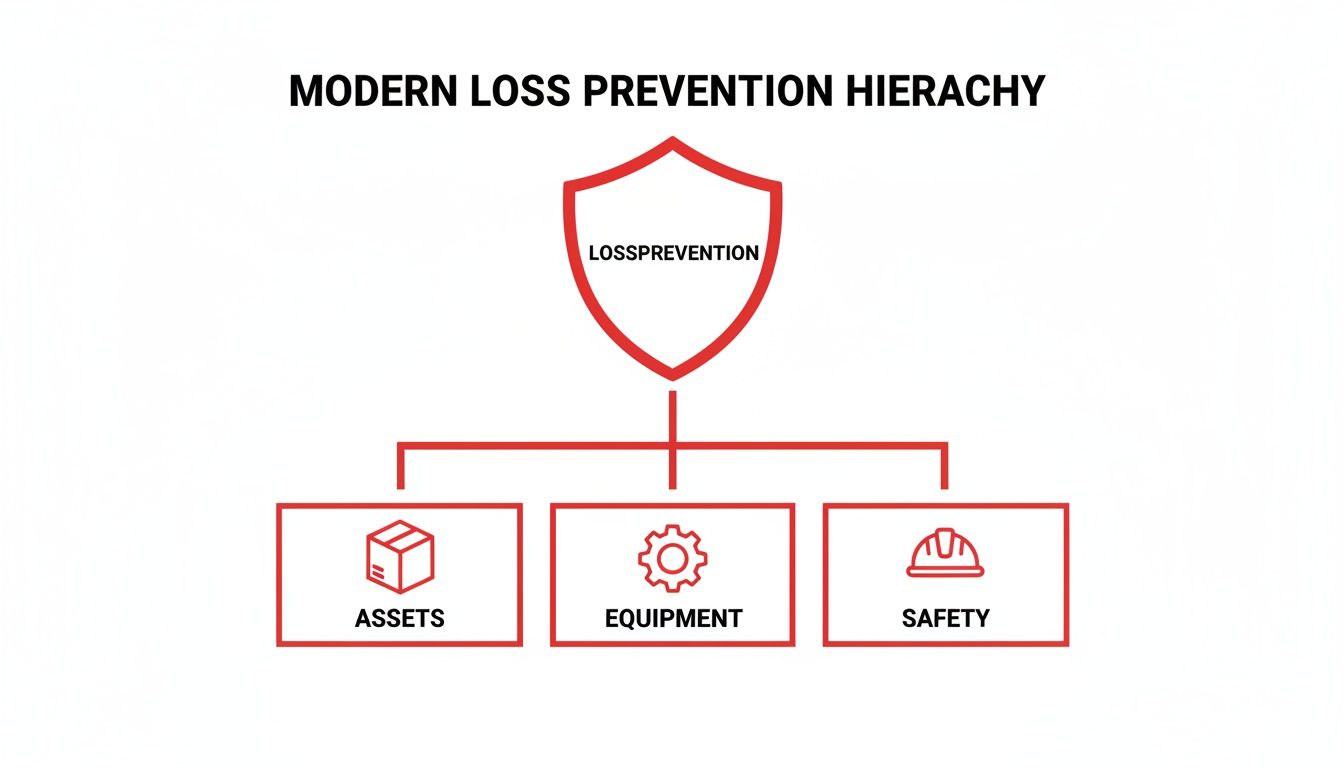
As you can see, a solid strategy doesn't just focus on one area. It’s about creating a unified defense that covers the physical, operational, and human elements of your property. Let's look at how each pillar makes that happen.
A modern, integrated approach to loss prevention relies on the seamless interplay between human expertise, operational excellence, and technological support. We've broken down how these three pillars function in the table below, showing how they combine to create a comprehensive security posture for properties like yours.
The Three Pillars of an Integrated Loss Prevention Strategy
| Pillar | Key Components | Overton Security's Approach |
|---|---|---|
| People | Professional on-site guards, mobile patrol officers, and remote monitoring specialists. | We focus on career-minded professionals, not temporary placements. Our commitment to supporting our officers leads to low turnover, ensuring you have experienced personnel with site-specific knowledge. |
| Process | Customized post orders, strategic patrol routes, clear incident reporting protocols, and emergency procedures. | We reject one-size-fits-all plans. Every process, from patrol routes to reporting, is tailored to your property’s unique layout, vulnerabilities, and operational goals. |
| Technology | GPS Guard Tour Management Systems (GTMS), 24/7 Security Operations Center (SOC), and integrated communication. | Technology is a force multiplier for our people. Our GTMS provides proof-of-presence, while our SOC offers real-time support and oversight to every officer in the field. |
By weaving these three elements together, we create a security solution that is far more effective than the sum of its parts. It's a system built on accountability, expertise, and intelligent support.
The People Pillar: Professional Officers
Let's be blunt: the foundation of any security program is the quality of its people. In an industry known for high turnover, we have built our 26-year reputation on creating a stable, well-supported team of security officers who get to know the unique rhythm and challenges of your property.
When you have a consistent officer on-site, they learn what’s normal and what’s not. They recognize residents, tenants, and vendors. This is a world away from the common "burn and churn" model that cycles new, inexperienced guards through your property.
An officer who feels valued and supported is more vigilant, more proactive, and a greater asset to your property. They aren't just a uniform; they are a key part of your loss prevention team.
We invest in our officers with competitive pay, benefits, and clear career paths, which fosters a sense of ownership. That commitment directly benefits you. Low turnover means the professional protecting your property today will likely be there tomorrow, bringing irreplaceable site-specific knowledge that a constantly rotating guard force cannot achieve.
The Process Pillar: Customized Operations
Great people need great direction. That’s where the second pillar comes in: establishing clear, strategic processes that guide our officers' actions and guarantee consistent service. This is exactly where generic, off-the-shelf security plans fall short.
A retail center in Los Angeles has fundamentally different needs than a sprawling construction site in Sacramento. Effective processes are what turn a guard’s passive presence into an active defense. We make this happen through a few key operational components:
- Customized Post Orders: We don't use templates. We develop detailed, site-specific instructions that outline every duty, from access control protocols at a luxury apartment community to specific patrol checkpoints in a commercial parking garage.
- Strategic Patrol Routes: Patrols aren't random walks. They're designed to maximize visibility and cover known vulnerable areas, creating a powerful deterrent effect. We also regularly review and adjust these routes based on incident data to stay ahead of new threats.
- Clear Reporting Protocols: Every observation, every interaction, and every incident is documented through our digital reporting system. This gives you clear, actionable intelligence about what’s really happening on your property.
These documented processes create a framework for accountability. They ensure every action our security team takes is deliberate, purposeful, and perfectly aligned with your goals.
The Technology Pillar: Empowering Human Expertise
The final pillar is technology. We use it not to replace our highly-trained officers, but to make them smarter, safer, and more effective. The right tools add a critical layer of oversight and verification, giving you unshakable confidence that your security investment is working for you 24/7.
Our approach blends human expertise with smart, practical tech. For example, our 24/7 Security Operations Center (SOC) acts as a central command hub, providing real-time support and oversight to every officer in the field. This ensures no officer is ever truly alone on a post and that backup is always just a radio call away.
On top of that, our GPS-enabled Guard Tour Management System (GTMS) delivers unparalleled transparency. Officers use handheld devices to scan checkpoints and file digital reports on the spot, giving you time-stamped proof of every patrol and instant documentation of any incidents. This system eliminates guesswork and gives you the hard, verifiable data needed to make informed decisions.
Tailoring Loss Prevention for Your Property
A generic security plan is a recipe for failure. Anyone in property management knows the risks at a busy San Jose retail center are worlds apart from those at a quiet Sacramento HOA or an active L.A. construction site. Truly effective loss prevention is about crafting a specific playbook for the unique vulnerabilities of your property.
This means you need a partner who understands the distinct operational rhythms, the types of assets you're protecting, and the potential weak points unique to your sector. When security measures are aligned with these specific needs, the plan stops being just another expense and becomes a strategic asset that delivers results.
Commercial and Retail Properties
For managers of commercial offices and retail centers, loss prevention is a balancing act. The goal is to create a safe, welcoming environment for tenants and customers while simultaneously warding off everything from petty theft to organized retail crime. Public access is necessary for business but creates vulnerabilities that demand a proactive security posture.
The focus here is twofold: deterrence and rapid response.
- Deterring Organized Crime: Professional, uniformed officers are a powerful deterrent. Their consistent presence disrupts criminals who look for predictability and weak points.
- Managing Public Spaces: Well-trained officers can handle loitering and other disturbances calmly and effectively using de-escalation techniques, preserving a positive atmosphere.
- Tenant and Customer Assurance: A visible security presence provides peace of mind. It makes employees feel safer during early morning openings and late-night closings and encourages shoppers to stay longer.
Retailers are investing more to combat rising losses. In fact, 42% of retailers have recently increased their budgets for third-party security services. This is part of a larger trend, with over 64% adding new roles or boosting staff in their loss prevention teams since 2019, showing a clear industry shift toward more robust security.
Residential Communities and HOAs
In residential communities, whether sprawling suburban HOAs or luxury high-rises, "loss" means more than just stolen property. For board members and community managers, the priority is resident safety, quality of life, and protecting shared amenities from vandalism or misuse. The right strategy fosters a sense of community and security that directly enhances property values.
A successful residential plan hinges on two things:
- Strengthening Access Control: An on-site officer or concierge can manage visitor access, verify vendors, and prevent unauthorized entry far more effectively than an unattended gate ever could.
- Making Vehicle Patrols a Visible Deterrent: Random, high-visibility patrols are excellent for disrupting criminal patterns. A marked security vehicle driving through a community at unpredictable times is one of the best ways to deter everything from car break-ins to porch piracy.
For an HOA, a well-executed security program isn't just about stopping incidents; it's about preserving the peaceful and safe environment that residents pay for and expect.
Construction Sites
Construction sites are uniquely vulnerable. They're often open, accessible, and filled with thousands of dollars in high-value materials and heavy equipment left unattended overnight. For a construction superintendent, preventing theft is a direct defense of the project's timeline and budget. A single major theft can trigger costly delays and wipe out profit margins.
An effective construction security plan puts asset protection above all else. This is where a dedicated vehicle patrol can be a complete game-changer. Instead of sharing a patrol route with other properties, a dedicated vehicle stays focused solely on your site or industrial park.
Real-World Example: An industrial park in Sacramento was being targeted by persistent copper theft. We implemented a dedicated vehicle patrol from Overton Security. By maintaining a constant, unpredictable presence all night, every night, our officers interrupted a theft in progress and deterred future attempts. This custom approach solved a chronic problem that a standard, shared patrol model simply couldn't touch.
This sector-specific approach is crucial. When your loss prevention plan is built around the risks you actually face, it stops being a cost center and becomes a core part of your operational success. Learn more about our specialized retail loss prevention services and how we can support your property.
How Technology Reinforces Human Expertise

In modern security, technology doesn't replace professional officers. It makes them smarter, more accountable, and better connected. The right tools are a true force multiplier, giving a single officer on your property the backup and support of an entire command team.
This combination of human experience and smart tech is the backbone of any serious lossprevention program. It’s the difference between just having a uniform on-site and having provable, data-backed performance protecting your assets around the clock.
The SOC as a Central Nervous System
Picture our 24/7 Security Operations Center (SOC) as the central nervous system for our entire field team. It’s a dedicated command hub staffed with specialists who provide real-time support and oversight to every single officer, whether they’re at a high-rise in San Francisco or patrolling a community in Los Angeles.
This constant connection is crucial for a few key reasons:
- Real-Time Support: If an officer faces a challenging situation, they aren't alone. They have an immediate line to a supervisor for guidance, ensuring proper protocol is followed every time.
- Incident Escalation: The SOC coordinates directly with law enforcement or emergency services, feeding them accurate, live information when seconds count.
- Officer Wellness: We run regular check-ins to make sure our officers are safe and alert—a critical layer of support, especially on overnight shifts.
The SOC turns a lone officer into a fully connected part of a larger, responsive security apparatus. No matter what happens, an experienced hand is always there to guide the response.
GPS-Enabled Systems for Total Transparency
How do you know your patrols are actually happening as scheduled? In the past, you had to rely on paper logs and trust. Today, technology provides undeniable proof. Our GPS-Enabled Guard Tour Management System (GTMS) gives property managers complete transparency and peace of mind.
Officers use handheld devices to scan checkpoints at key locations around your property. Each scan logs a time and GPS stamp, creating an unchangeable digital record of their patrol. This isn't just about collecting data; it's about delivering real accountability.
This technology completely eliminates guesswork. You get detailed digital reports that verify every patrol, document every incident with photos, and give you a clear, auditable trail of all security activity on your site.
Actionable Data, Not Just More Reports
The point of this tech is to give you actionable intelligence, not just another stack of reports to file away. The data we gather from our GTMS helps us spot patterns and identify potential vulnerabilities on your property. For example, if we see incident reports consistently coming from one specific area, we can adjust patrol routes or recommend additional security measures.
This data-driven approach means we're always fine-tuning your lossprevention strategy. It’s a proactive cycle:
- Patrol and Observe: Officers conduct their rounds, using the GTMS to log every action.
- Report and Document: Incidents and observations are filed instantly from the field.
- Analyze and Adapt: We review the data with you to refine post orders and strengthen security measures.
This feedback loop ensures your security plan evolves with your property's needs. For a closer look at how all these pieces fit together, our guide on the integration of security systems is a great resource. Ultimately, technology is how we reinforce our commitment to you—by providing the proof and performance you deserve.
Measuring the ROI of Your Security Program
How do you prove that your security investment is paying off? For any property manager or business owner, this is a critical question. A professional security program should never feel like just another expense; it should deliver a clear, measurable Return on Investment (ROI) you can confidently show to your stakeholders.
Calculating that ROI goes beyond just the monthly invoice. It’s about a simple but powerful shift in thinking: comparing the predictable cost of a proactive loss prevention program against the chaotic, unpredictable—and often hidden—costs of theft, vandalism, liability claims, and operational disruption.
Key Performance Indicators That Matter
To demonstrate success, you have to track the right data. These Key Performance Indicators (KPIs) provide the hard evidence that your security strategy is working and directly protecting your bottom line.
- Reduction in Incident Reports: This is the most straightforward metric. A noticeable drop in reports of theft, vandalism, trespassing, or general disturbances is a clear win.
- Lower Shrinkage Rates: For our retail clients, this is vital. Tracking inventory loss before and after implementing a security plan shows direct financial savings.
- Decreased Repair and Maintenance Costs: Less vandalism and property damage means you spend less time and money on repairs, from broken windows and cut fences to graffiti removal.
- Improved Tenant or Resident Satisfaction: Happy tenants and residents are the goal. Surveys and direct feedback can show that people feel safer, which is a significant boost for retention and overall property value.
A well-executed security program pays for itself not just by stopping incidents, but by creating a stable, predictable, and safe environment where your business or community can thrive.
Calculating the Financial Value of Prevention
Putting a dollar value on prevention is straightforward. First, add up all the costs tied to security incidents before you had a professional program in place. This isn't just the value of stolen goods; it includes repair bills, rising insurance premiums, and even the staff hours wasted dealing with the aftermath of each incident.
Then, compare that number to the cost of your security services. In almost every case, the cost of prevention is a fraction of the cost of reaction. This proactive approach is no longer a luxury—it’s a business imperative. That’s why the global retail loss prevention market, valued at US$44.17 million in 2023, is projected to climb significantly. You can find more insights on this trend by exploring findings on the retail loss prevention market.
This simple comparison gives you the power to justify the security budget with hard numbers. It reframes the conversation from "How much are we spending?" to "How much are we saving?" With over 26 years of on-the-ground experience, Overton Security is focused on delivering this tangible value, providing the detailed reports and transparent data you need to see the positive impact on your property firsthand.
How to Choose the Right Security Partner
Selecting the right security provider is a critical decision. The right partner isn't just another contractor; they become an extension of your team, actively working to protect your assets and make your property a place where people feel safe. This guide will help you see past the sales pitch and ask the questions that reveal a company's real commitment to quality and service.
Making the right choice starts with knowing what to look for. Think of the following points as a practical checklist for evaluating potential providers. This isn't about finding the lowest bidder—it's about finding a partner who is genuinely invested in your success.
Key Questions for Any Potential Provider
Before signing a contract, you need clear answers to these critical questions. A quality partner will have this information ready.
- Officer Retention and Support: What is your average officer turnover rate? High turnover is a significant red flag in the security industry. It often points to poor support and low morale, and you can't build effective loss prevention with a revolving door of new faces.
- Management Accessibility: What is your manager-to-client ratio? A low ratio, like the one we maintain at Overton Security, means you get hands-on attention from leadership—not just a call center agent.
- Technology and Transparency: Can you provide a live demo of your reporting technology? You should see exactly how their Guard Tour Management System (GTMS) works. Ask to see sample reports to ensure they deliver the transparency your property deserves.
A truly professional security firm has nothing to hide. They should be proud to show you how they train their officers, support their team, and use technology to verify that they’re delivering on their promises.
Your Partner in Prevention
At the end of the day, modern loss prevention is about building a proactive shield around your property. An effective strategy is built on three pillars working in harmony: professional people, customized processes, and smart technology. Your security partner needs to be an expert at weaving these elements together to address your specific vulnerabilities.
With over 26 years of experience protecting properties across California, from Los Angeles to San Francisco, we know what it takes to deliver security you can count on. We invite you to contact Overton Security for a no-pressure security assessment. Let's discuss your unique challenges and build a plan that delivers real results and genuine peace of mind.
Your Loss Prevention Questions Answered
When you're considering a security strategy, questions naturally arise. Here are some of the most common ones we hear from property managers and business owners, with clear, straightforward answers.
What's the Real Difference Between Security and Loss Prevention?
This is a great question. Think of Security as the specific action—like an officer at a front desk checking IDs. It’s focused on immediate threats and controlling access.
Loss prevention, on the other hand, is the bigger picture. It’s the entire business strategy designed to proactively stop any kind of financial or asset loss before it happens. This includes everything from theft and vandalism to liability risks. A security officer is a critical part of a loss prevention plan, but they are just one tool in a comprehensive strategy.
How Fast Can I Get a Security Program Running?
The timeline depends on your property’s needs. For a straightforward, single-officer post, we can often have a professional in place within a few days.
However, for a more comprehensive plan—one that involves customized post orders, mapping out strategic patrol routes, and special client-specific training—it's best to plan for one to two weeks. This allows us the time needed to do it right. A well-planned launch is far better than a rushed one, ensuring our officers are prepared from day one.
Many believe that more security automatically means better security. But in our 26 years of experience, we've seen that a smarter, more targeted strategy will always outperform a generic, expensive one. It’s all about putting the right resources in the right places at the right times.
Is an Onsite Guard Better Than a Vehicle Patrol?
One isn't "better" than the other; they solve different problems. The best choice comes down to your property’s size, layout, and specific security goals.
- Onsite Guards are perfect for controlling a specific chokepoint. Think of a building lobby, a retail storefront, or a single gate. They provide a constant, visible presence in a concentrated area.
- Vehicle Patrols are the solution for covering a lot of ground. They’re ideal for large industrial parks, sprawling apartment communities, or active construction sites. Their mobility and unpredictable timing create a powerful deterrent across a much wider area.
For more answers and to dig deeper into different loss prevention tactics, you can explore their blog for further insights. The more you know, the better decisions you can make.
Protecting your property takes more than just a uniform; it requires a partner with proven experience and a deep commitment to service. Overton Security has spent over 26 years building security solutions that deliver real results and genuine peace of mind. To discuss your property's specific needs and get a complimentary security assessment, visit us at https://www.overtonsecurity.com.