
Is your data center’s security strategy built on a foundation of proactive, layered defense, or is it a collection of separate systems reacting to threats? For facilities directors and corporate leaders, the answer to that question is critical. Effective security for data centers is a blend of physical barriers, smart technology, and disciplined operational protocols, all working together in a seamless, resilient ecosystem.
This integrated approach is essential for preventing downtime, costly data breaches, and significant regulatory penalties. It’s about building confidence and ensuring the digital assets driving our economy are protected around the clock.
Why Data Center Security Demands a Proactive Approach
A data center is far more than a room full of servers; it's the operational heart of modern business, government, and communication. These facilities are the guardians of sensitive financial records, proprietary corporate data, and critical healthcare information. The immense value they hold makes them a prime target for a wide range of threats.
A single breach can trigger a cascade of consequences—from operational downtime that costs thousands per minute to severe reputational damage and steep fines for failing to comply with regulations like SOC 2 or HIPAA. For decision-makers, the stakes couldn't be higher.
The Exploding Demand for Secure Infrastructure
Our world’s reliance on data is growing at an incredible pace, accelerating the need for ironclad security. Fueled by AI, streaming services, and cloud computing, the demand for data center capacity is skyrocketing. Global projections show an annual growth rate between 19% and 22% until 2030. In the U.S. alone, demand is expected to more than triple.
This expansion transforms data centers into indispensable national infrastructure, demanding an unprecedented focus on security. You can read more about the top trends driving data center security on securitas.com. This growth magnifies existing risks, making a proactive, layered security strategy more critical than ever.
Adopting a Layered Security Framework
The only strategy that holds up against modern threats is a layered security framework. Think of it like a medieval castle's defenses—security isn't just about the outer wall. True, robust protection relies on a series of interdependent barriers that work together to deter, detect, and delay unauthorized access.
A comprehensive data center security plan is built on three core pillars that must work together seamlessly.
| Security Layer | Focus Area | Example Controls |
|---|---|---|
| Physical Security | Protecting the physical premises, hardware, and infrastructure from unauthorized access, theft, or environmental damage. | Fencing, mantraps, biometric scanners, video surveillance, security officers, fire suppression systems. |
| Technical Security | Using technology to protect the network, systems, and data within the data center from digital threats and breaches. | Firewalls, intrusion detection systems (IDS), encryption, network segmentation, access control lists (ACLs). |
| Operational Security | Implementing policies, procedures, and human-led processes to manage and maintain security on a day-to-day basis. | Background checks, security awareness training, incident response plans, vendor management, access logging. |
This tiered approach ensures that a weakness in one layer can be caught and mitigated by the strengths of the others, leaving no single point of failure. This is how potential vulnerabilities are transformed into fortified strengths.
The infographic below helps visualize how these core tiers of a resilient data center security plan fit together.
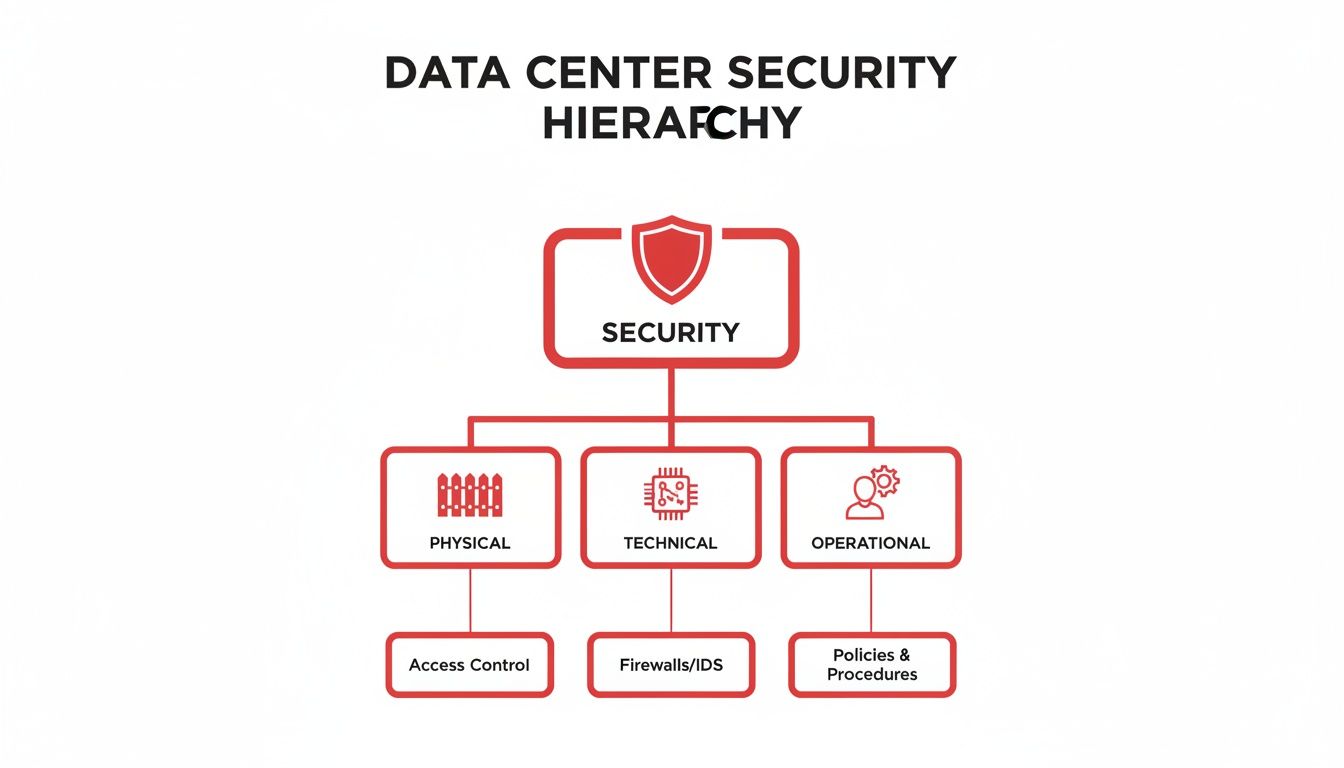
As you can see, this hierarchy shows how deeply physical, technical, and operational controls must be integrated to create a truly comprehensive defense. This isn't just a checklist; it's a living system designed for total asset protection.
Building Your Physical Defense Layers
Real security for a data center starts long before anyone swipes an access card. It begins at the property line with physical defenses designed to deter, detect, or delay anyone who isn’t supposed to be there. This foundational strategy protects your most critical hardware from theft or sabotage by creating a series of barriers an intruder must overcome.
Think of it as concentric rings of protection. If one wall is breached, another stands ready behind it. This "defense-in-depth" model contains a threat before it can escalate, ensuring the heart of your facility—the data halls—remains completely secure. It’s the only reliable way to protect digital assets in the physical world.
Starting with the Perimeter
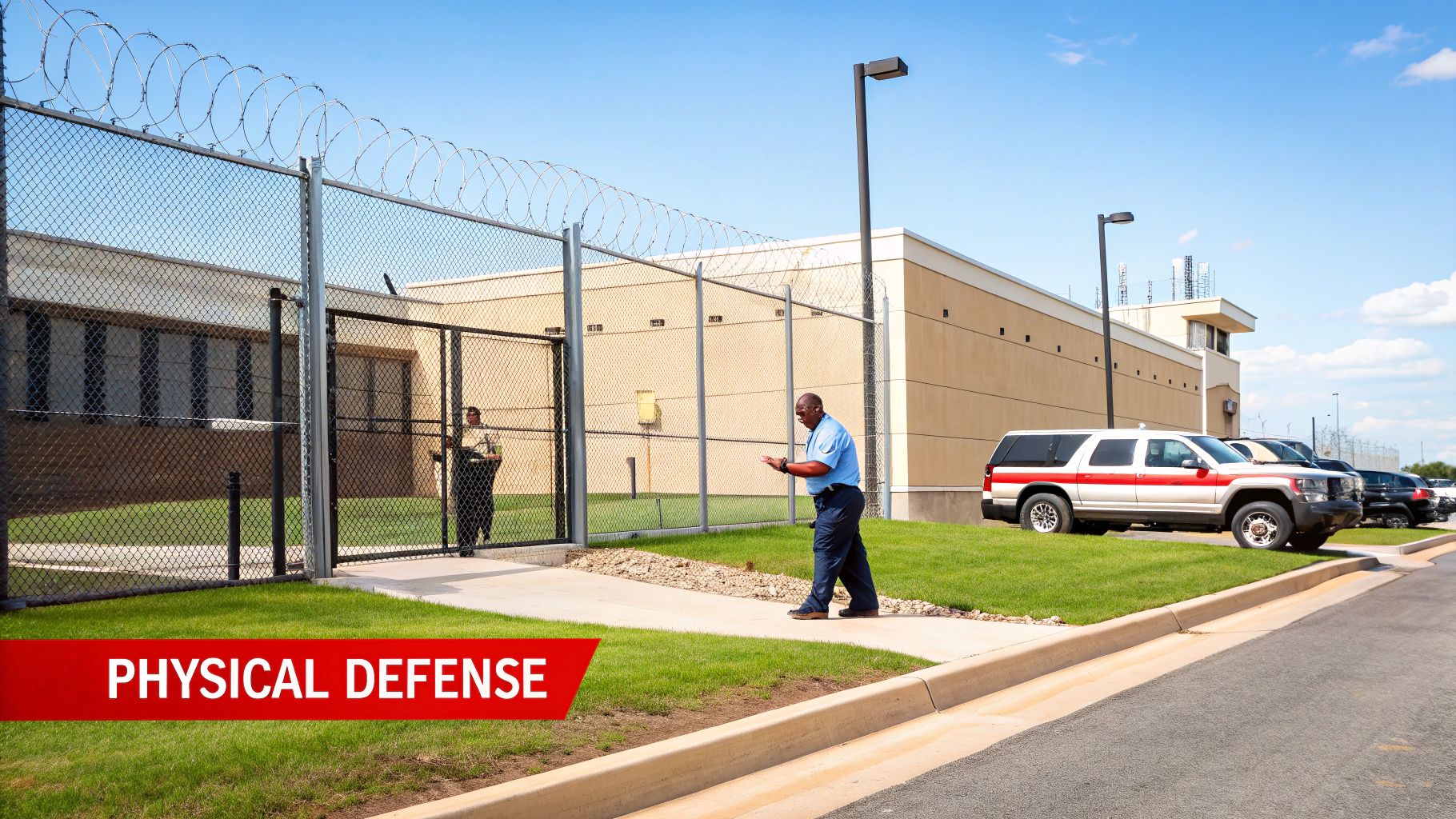
Your first line of defense is the outermost layer, which creates a clear, controlled boundary around the property. Its main job is to stop casual trespassers and buy your security team precious time to respond to a more determined threat.
A strong perimeter isn't just a fence; it includes:
- Anti-Climb Fencing and Walls: Built to be difficult to scale, these are often topped with features like barbed or concertina wire to deter intrusion.
- Secure Vehicle Gates and Bollards: Every vehicle entrance must be controlled with reinforced gates and strategically placed bollards to stop ramming attempts or unauthorized vehicle access.
- Clear Zones and Lighting: A well-lit, open area around the fence line gives intruders nowhere to hide and provides surveillance cameras and patrol officers with clean, unobstructed sightlines.
For anyone planning a new build, designing security in from day one is far more effective than trying to retrofit these foundational elements later.
Securing the Facility Itself
Once past the perimeter, the building itself is the next challenge. This layer is about hardening the structure and maintaining strict control over every door, window, and entry point. Even if the perimeter is breached, getting inside the building should remain a monumental task.
A secure facility incorporates:
- Reinforced Entry Points: Every door and window should be fortified against forced entry. Access points must be limited, and every one must be monitored 24/7.
- Visitor Management Systems (VMS): A formal process to verify, log, and badge every visitor, contractor, and vendor is non-negotiable. No one gets inside unaccounted for.
- Loading Dock Security: As high-traffic zones, shipping and receiving docks are potential weak spots. They require strict access protocols and thorough inspections to remain secure.
This is where professional security officers make a real difference. They aren't just watching monitors; they are the human intelligence that makes the system work—verifying IDs, escorting visitors, and actively patrolling the facility. Their visible presence is a powerful deterrent, and their ability to respond instantly is invaluable. To see the tech that powers this, you can explore how Overton Security designs and implements comprehensive building access control systems.
Protecting the Inner Sanctum
The final and most critical physical layer protects the data halls, server cages, and individual cabinets. Access here operates on a "zero trust" principle: nobody gets in without explicit, verified authorization for that specific time and purpose.
This layered approach is just as effective at stopping insider threats as it is against external ones. By segmenting access, you ensure that even authorized staff can only get into areas directly related to their jobs, minimizing risk.
Controls here are the tightest and often include:
- Biometric and Multi-Factor Authentication: Moving beyond a simple keycard to require a fingerprint, iris scan, or a combination of multiple credentials to enter sensitive zones.
- Anti-Tailgating Mantraps: These interlocking door systems only allow one person to pass through at a time after successful authentication, making it physically impossible for someone to sneak in behind an authorized person.
- Secure Cages and Cabinets: Within the data hall, server racks are often locked inside separate cages or cabinets, adding one final layer of security that limits access down to specific hardware.
At Overton Security, we understand that physical layers are only as strong as the people enforcing the rules. Our commitment to retaining highly trained officers, backed by engaged, hands-on leadership, ensures these critical protocols are followed with precision. This blend of physical barriers and professional oversight turns a facility into a true fortress.
Integrating Advanced Security Technology
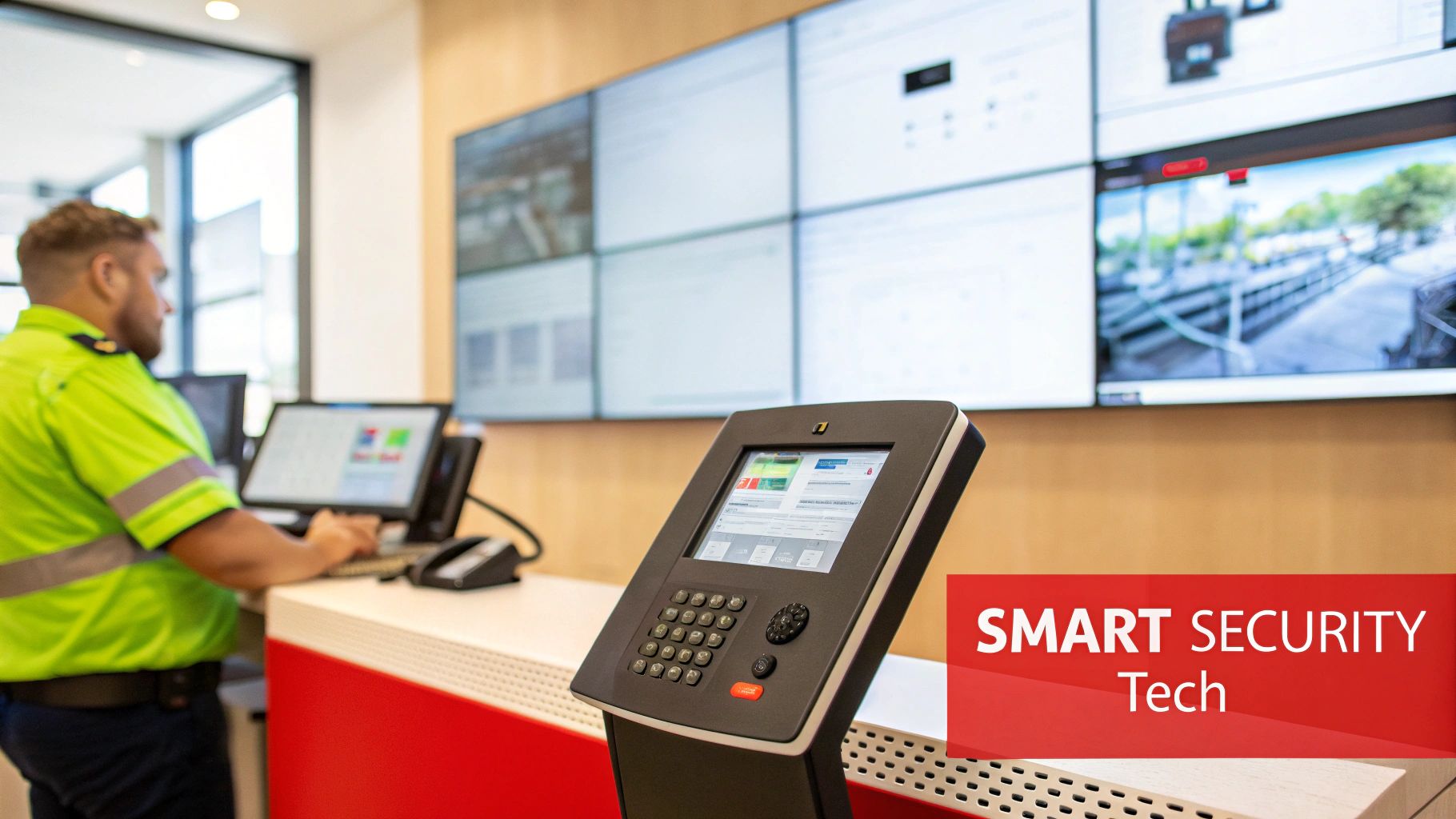
While physical barriers are essential, modern data center security relies on smart technology to turn a secure building into a responsive fortress. This technology acts as a force multiplier for your security team, giving them the tools to see more, react faster, and stay ahead of threats.
This blend of human expertise and advanced tech creates the real-time awareness needed to protect such critical assets. The market understands this, too. Global spending on data center security is expected to jump from USD 17.7 billion in 2025 to a staggering USD 55.0 billion by 2035. This growth is driven by one fact: integrated systems are a necessity against modern threats.
Advanced Surveillance and Intelligent Analytics
Modern surveillance is much more than just recording video. High-resolution cameras armed with intelligent video analytics (IVA) can spot potential threats as they happen, automating the heavy lifting of monitoring for your security team.
Key surveillance technologies include:
- Motion Detection and Object Tracking: The system can automatically flag unusual movement or follow an unauthorized person from one camera to the next.
- Facial Recognition and License Plate Recognition (LPR): These tools help confirm identities at entry points and maintain a solid log of every vehicle that enters and exits.
- Behavioral Analytics: Smart AI learns the normal rhythm of your facility and can alert operators to anything out of the ordinary, like someone loitering near a secure door.
These systems don't replace skilled officers; they sharpen their focus, directing them to what matters most.
Sophisticated Access Control and Intrusion Detection
Controlling who gets in—and where they can go—is the foundation of data center security. Modern technology adds layers of verification that are incredibly difficult to bypass. Mantraps, for example, work like an airlock, enforcing a strict one-person-at-a-time rule to physically stop tailgating.
A "mantrap" is a perfect example of technology enforcing a physical security protocol. By requiring separate authentication for two interlocking doors, it ensures that only one verified individual can pass through, eliminating a common security vulnerability with absolute certainty.
A robust access control setup should also include:
- Biometric Scanners: Using fingerprints, iris patterns, or palm veins offers a level of certainty that a keycard alone cannot match.
- Multi-Factor Authentication (MFA): Requiring two or more proofs of identity—like a keycard plus a PIN, or a biometric scan plus a mobile app code—adds a powerful hurdle at your most sensitive checkpoints.
- Discreet Intrusion Sensors: Motion, glass-break, and vibration sensors create an invisible safety net, instantly alerting your team to any physical breach attempt. For a look at the broader principles that guide these strategies, check out Streamkap's approach to security.
The Role of a 24/7 Security Operations Center (SOC)
All of this technology produces a constant stream of data. A Security Operations Center (SOC) is the human-led nerve center where all that information is monitored, analyzed, and acted upon, 24/7. This is where technology and human expertise truly come together.
The SOC team serves as the command hub, verifying automated alerts, dispatching officers to investigate potential issues, and coordinating with first responders when needed. This centralization ensures every alert receives a consistent, professional response according to your specific protocols. It’s how a truly unified and effective security operation is created. You can learn more about what a Security Operations Center is and see how it becomes the anchor for a modern security program.
Mastering Your Operational Security Protocols
High-tech cameras and reinforced doors provide a powerful defense, but the true strength of your data center security comes down to your people and processes. This operational layer—the collection of rules, daily habits, and procedures—dictates how everything gets done. Without disciplined protocols, even the most expensive security systems can be undermined by simple human error.
For facility directors, this is where the rubber meets the road. Juggling a constant flow of contractors, enforcing visitor management policies, and securing busy loading docks are daily tests of your security posture. A single oversight, like an improperly vetted technician, can create a massive vulnerability. A well-defined and consistently enforced operational plan is essential.
Building a Security-First Culture
Great operational security is about creating a security-first culture. This is an environment where every employee and contractor understands their role in protecting the facility. This culture is built on a foundation of clear policies, thorough training, and absolute consistency.
Here are the pillars of a strong security culture:
- Strict Visitor and Contractor Management: No one gains entry without pre-approval, identity verification, and a documented purpose for their visit. Contractors should always be escorted in sensitive areas, and their access credentials must be temporary.
- Rigorous Access Review: Access rights must be audited on a regular schedule. When an employee changes roles or leaves the company, their permissions must be updated or revoked immediately.
- Comprehensive Training and Drills: Regular training ensures everyone knows the protocol for everything from visitor check-ins to emergency evacuations. Drills are critical for testing these procedures under pressure, revealing gaps before a real incident.
This proactive approach helps eliminate simple but dangerous mistakes, like an employee politely holding a door open for an unauthorized person behind them—a classic breach known as tailgating.
The Critical Role of Professional Security Officers
Your security officers are the frontline enforcers of your operational rules. They are the human element making sure your policies are followed every minute of every day. Their effectiveness depends on their training, professionalism, and deep familiarity with your specific site.
This is where the difference between a dedicated security partner and a low-cost provider becomes clear. The high-turnover "burn and churn" model common in the industry creates constant instability and security gaps. An endless cycle of new officers means they never truly learn your facility’s unique needs or policies.
In a high-stakes environment like a data center, consistency is a core component of security. A stable, professional security team that understands your specific operational playbook is not a commodity; it is a critical asset that actively reduces risk.
Overton Security’s commitment to officer retention and professional development tackles this problem head-on. By investing in our people, we provide a consistent, experienced team on-site. Our officers become an extension of your staff, familiar with your procedures and empowered to enforce them with confidence.
Ensuring Accountability with Digital Reporting
How do you know your operational protocols are being followed correctly? The answer is transparent, real-time reporting. Modern guard tour management systems provide the accountability needed to ensure compliance and drive continuous improvement.
With GPS-enabled systems like those from TrackTik, every patrol, checkpoint scan, and incident is logged with a precise timestamp and location data. Officers can attach photos and detailed notes to their digital activity reports, giving you a clear, auditable record of all security activities. This data is invaluable for:
- Verifying Compliance: Proving to auditors, clients, and internal stakeholders that security procedures are being executed as required.
- Identifying Weaknesses: Analyzing patrol data to spot patterns or areas that may need reinforced security coverage.
- Improving Performance: Using detailed reports to refine post orders and provide targeted training to the security team.
This technology-driven accountability transforms security from a subjective service into a measurable, data-backed operation. It closes the gap between policy and practice.
To help you get started, we've put together a practical checklist to evaluate your own protocols. It highlights key actions and points out common areas where things can fall through the cracks.
Operational Security Checklist for Data Centers
| Protocol Area | Key Action/Verification | Common Oversight |
|---|---|---|
| Visitor Management | Verify all visitors are pre-registered with a valid business reason. Are IDs checked against a government-issued database? | Allowing "piggybacking" at entry points or failing to retrieve temporary badges upon exit. |
| Contractor & Vendor Access | Confirm work orders and scope of work before granting access. Are tools and equipment inspected on entry and exit? | Granting overly broad or long-term access instead of time-limited, zone-specific credentials. |
| Access Control Audits | Conduct quarterly reviews of all active access cards. Is there a documented process for immediate deactivation upon employee termination? | "Ghost" accounts remaining active for months after an employee has left the company. |
| Shipping & Receiving | Are all deliveries scheduled in advance? Is there a secure, isolated area for unboxing and inspection away from the data hall? | Uninspected packages being brought directly into secure areas, bypassing security screening. |
| Emergency Drills | Run and document at least two types of drills per year (e.g., fire, unauthorized access). Were response times and actions logged? | Treating drills as a "check-the-box" exercise instead of a serious opportunity to find and fix procedural flaws. |
| Security Officer Patrols | Review digital guard tour logs weekly. Are checkpoints being hit consistently and on schedule? Are incident reports detailed? | Patrol routes that are predictable and never change, making them easy for an observer to bypass. |
Using a checklist like this helps move your operational security from theory to practice, ensuring every part of your human-led defense is as strong as your technology.
Navigating Compliance and Incident Response
Solid physical, technical, and operational security are the bedrock of any protected data center. But two other pillars guarantee its long-term resilience and trustworthiness: rigorous compliance with industry standards and a tested, actionable incident response plan.
These elements shift your security program from being purely defensive into a strategic asset. They build client confidence and ensure business continuity.
For any facility manager, the alphabet soup of regulations like SOC 2, ISO 27001, and HIPAA can feel daunting. But these aren’t just boxes to check; they are frameworks that demand meticulous, verifiable proof that your security controls are working. A failed audit can mean lost contracts, steep fines, and a hit to your reputation.
Maintaining Auditable Compliance Standards
Achieving and keeping compliance certifications requires more than just having security systems. It demands a detailed, unbroken chain of evidence that proves your protocols are followed every time. This is where a professional security partner becomes essential.
Every action taken by a security officer—from a routine patrol to checking a visitor's ID—must be logged. Modern guard tour systems are perfect for this, creating unchangeable, time-stamped digital records. This auditable trail is the hard proof that:
- Access controls are enforced without exception.
- Perimeter patrols are completed on schedule.
- Visitor and vendor logs are accurately maintained.
- Incidents are documented with photos and detailed notes.
This kind of detailed reporting, which a partner like Overton Security provides, isn't just for your peace of mind. It’s the concrete evidence auditors need, making the certification process smoother.
Preparing for the Unexpected with Incident Response
While strong defenses stop most problems, a truly resilient data center is always ready for the unexpected. An incident response plan is your playbook for a crisis. It lays out the exact steps your team will take, ensuring a calm, coordinated reaction instead of chaos.
This plan has to cover a range of scenarios, from a physical breach to an environmental threat like a fire or flood. The goal is always to minimize damage, protect people, and get back to normal as quickly and safely as possible. After all, great security for data centers is defined not just by how it prevents incidents, but by how smoothly it responds when they happen.
A well-rehearsed incident response plan is a critical component of business continuity. It ensures that even during a significant event, your team can protect core assets and maintain operational integrity, reassuring clients and stakeholders that their data is in capable hands.
Developing these playbooks is a core part of a strategic security partnership. You can get a feel for the fundamentals by reading our guide on how to build a security incident response plan.
From Planning to Practice
A plan sitting on a shelf is useless. It must be tested. Regular drills and tabletop exercises are crucial for finding weak spots and building muscle memory, so when a real event unfolds, everyone knows their role and can act without hesitation.
We can't forget about the digital side of things, either. With the world projected to store an incredible 200 zettabytes of data by 2025, the potential attack surface is exploding. Cyber risks are climbing, with ransomware damages expected to rocket past $265 billion annually by 2031. As you can see from these cybersecurity trends on cybersecurityventures.com, these numbers show why it's so urgent to have integrated response plans that cover both physical and digital threats.
At the end of the day, compliance and incident response are two sides of the same coin. One demonstrates your proactive commitment to security, while the other proves you're ready to handle adversity. Together, they create a resilient security posture that protects your assets, satisfies auditors, and earns the unwavering trust of your clients.
How to Choose the Right Data Center Security Partner
Selecting a partner to secure your data center is one of the most important decisions you will make. This isn't about comparing line items on a proposal; it's a choice that directly impacts your operational resilience, your compliance, and the trust your clients place in you.
The right partner becomes an extension of your team—a trusted advisor invested in your success, not just a vendor filling shifts. The goal is to find a provider who understands that data center security is a game of precision, consistency, and expertise. You have to look past the sales pitch and focus on the operational realities that define a quality service.
Focus on Experience and Stability
With over 26 years of experience protecting high-value assets across California, Overton Security has built its name on stability and service. We understand the unique pressures of high-compliance environments because we've been successfully navigating them for decades. Our philosophy is simple: quality over quantity. We only take on a new client when we are confident we can deliver the exceptional service they deserve.
This approach is the opposite of the "burn and churn" model common in the security industry. We invest in our officers with competitive pay, solid benefits, and career development. The result is higher retention and a more professional, consistent team watching over your facility.
Evaluate Leadership and Accountability
True security excellence starts at the top. When vetting potential partners, ask about their leadership structure and the systems in place to ensure accountability.
A low manager-to-client ratio is a key indicator of a service-oriented security firm. It ensures your facility gets dedicated, hands-on attention from a manager who intimately knows your site, your team, and your specific operational needs.
Overton Security was built on this very principle. Our leadership team, including a CEO who started his career as a security officer, stays actively involved in client relationships. This hands-on approach is backed by technology that drives total transparency:
- GPS-Enabled Patrols: Every patrol and checkpoint is verified with a timestamp and location data.
- Real-Time Digital Reports: You get instant access to detailed activity reports, complete with photos and notes, as events unfold.
- 24/7 SOC Oversight: Our Security Operations Center provides constant support and oversight for our teams in the field, ensuring every protocol is followed.
Choosing the right security partner is a strategic investment in your facility's future. It comes down to finding a provider who shows a deep commitment to their people, transparent processes, and engaged, hands-on leadership. These are the qualities that build a resilient, reliable, and effective security program.
Your Data Center Security Questions, Answered
When you're evaluating security for something as critical as a data center, you need straight answers. Let's tackle some of the most pressing questions that facility directors and IT managers bring to the table.
What Is the Most Common Point of Failure?
It’s easy to focus on sophisticated cyber threats, but the most common vulnerabilities often come down to people. Simple human error—like an employee holding a secure door open for someone behind them (tailgating), incomplete visitor logs, or lax vetting protocols—can create gaping holes that bypass millions of dollars in technology.
This is precisely why having consistently trained, professional security officers is non-negotiable. They act as a human firewall, ensuring your strict procedures are followed to the letter, day in and day out. They turn a potential weakness into a rock-solid defense.
How Does Physical Security Impact Cybersecurity?
Think of it this way: a physical breach makes every digital defense you have instantly irrelevant. If an unauthorized person gets onto your data floor, they don't need to hack a firewall from the outside. They can plug a malicious device directly into your network, physically remove servers, or walk out with hard drives.
Physical and cybersecurity aren't two separate things; they're two sides of the same coin. An effective security strategy must tightly weave them together. One cannot function without the other when it comes to protecting your most critical assets.
What Should I Look for in a Data Center Security Officer?
You need much more than just a person in a uniform. A top-tier data center security professional requires specialized training for high-compliance environments. They need a razor-sharp eye for detail and a foundational understanding of the technology they're protecting.
They aren't just watching a door; they are actively enforcing complex protocols for access control, managing vendor escorts, and executing incident reports with precision. These are the qualities that separate a simple guard from a professional security officer who actively reduces your risk—and it’s the standard we hold for every member of our team.
Protecting your facility isn't just another contract; it's a partnership built on trust and expertise. With over 26 years of specialized experience, Overton Security provides the proven stability, expertise, and accountability required to safeguard the heart of your operations.