Let's be honest, traditional lock-and-key systems can be a constant source of headaches. If you’ve ever managed a commercial property, a residential community, or a busy construction site, you know the drill. A lost key means calling a locksmith for an expensive re-keying job. A former employee might still have a copy. And you have no record of who's coming and going.
These aren't just minor inconveniences; they're significant security gaps that leave your property vulnerable.
Building access control systems provide the solution. Think of them less as a simple lock and more as a smart security framework that gives you precise control over who can enter your property, when they can enter, and which specific areas they can access. This technology moves your property management from a reactive position to a proactive one.
Moving Beyond Traditional Lock and Key
Modern access control fundamentally solves the problems of physical keys. Instead of a piece of metal, an individual uses a credential—this could be a key card, a fob, a mobile app on their phone, or even a biometric scan like a fingerprint.
The system verifies the credential instantly. It checks the person's permissions, and if they're approved, the door unlocks. Every event, successful or not, is logged, creating a clear digital audit trail. It’s a simple concept with powerful implications. (If you want to dive deeper into the basics, you can explore our detailed guide on what access control is in security).
For property managers, HOA boards, and business owners, this shift provides a powerful toolkit for securing assets and protecting people. It establishes a managed environment where access is a trackable privilege, not an unchecked assumption.
A well-implemented access control system does more than just secure doors; it provides invaluable operational data, streamlines visitor management, and reinforces a professional, secure image for your property.
Why Modern Access Control is Essential
The benefits of a modern system are clear, compelling, and deliver a level of security that old-fashioned keys simply can't match. The advantages are both immediate and practical for day-to-day operations.
- Enhanced Security: An employee leaves the company? Simply deactivate their credential in seconds. There's no need to spend hundreds on a locksmith to change every lock they had access to.
- Complete Visibility: You get a detailed digital log of every entry attempt. This audit trail is crucial for investigating incidents, giving you concrete data to work with.
- Operational Efficiency: Need to let a contractor in for a few hours on a Saturday? Grant them temporary access for a specific door and time window right from your computer. No more coordinating key handoffs.
- Improved Tenant and Employee Experience: People are far less likely to lose their smartphone than a physical key. Offering modern options like mobile credentials is a convenient and appreciated perk.
Ultimately, these systems are a strategic investment. They reduce long-term costs tied to re-keying, lower the risk of theft and unauthorized entry, and deliver the peace of mind that comes from knowing your property is truly secure.
The Core Components of Modern Access Control
To understand how building access control works, it helps to know its fundamental parts. Think of the system like a highly coordinated security team where every member has a specific, vital job. When they all work together, they create a seamless, reliable barrier that protects your property, assets, and people.
The demand for these coordinated systems is growing rapidly. The global building access control market is a significant industry, with projections showing it could reach $15–$28 billion by the early 2030s. This growth highlights how much modern properties now rely on these solutions.
This map illustrates how the core concepts behind access control—control, safety, and efficiency—all work together to build a complete security framework.
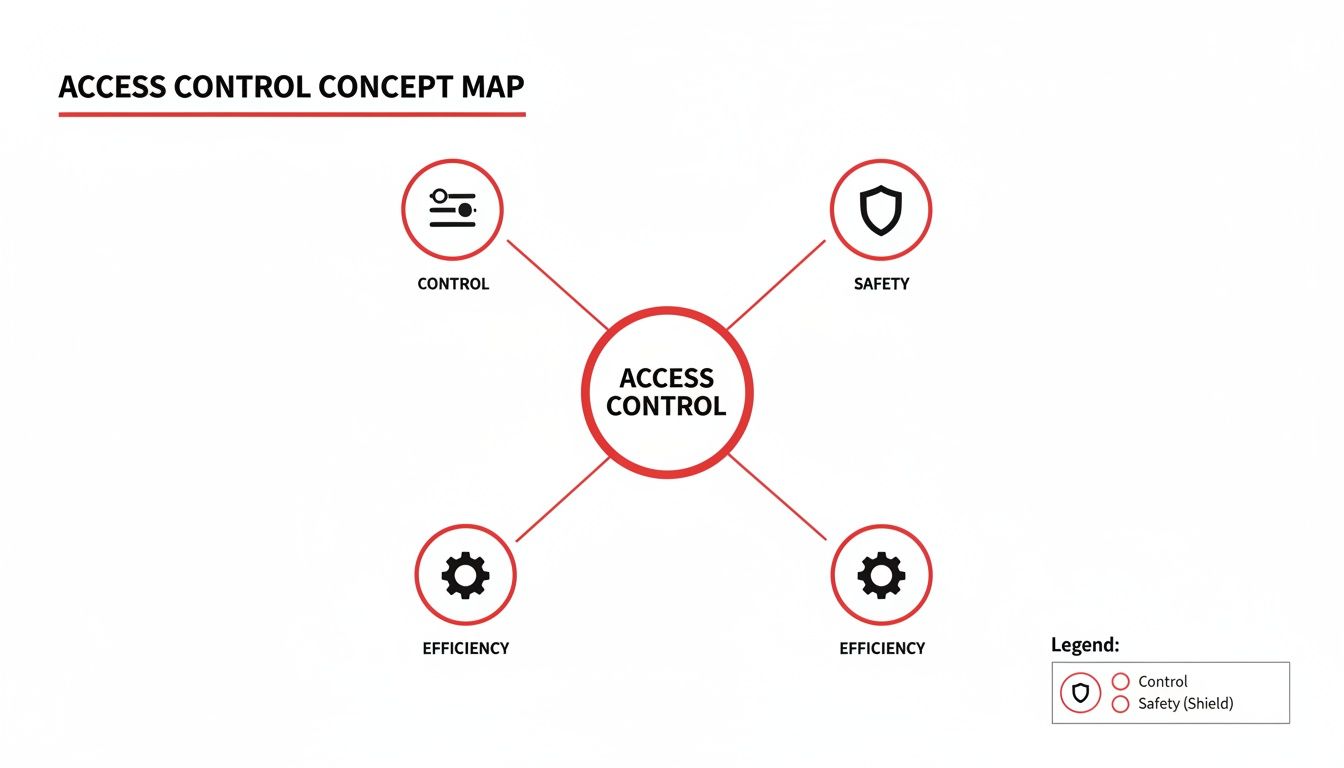
As you can see, each benefit reinforces the others. It’s solid proof that a well-designed system makes you more secure without hindering day-to-day operations. Let's look at the individual components that make it all happen.
Credentials and Readers
The first two parts of the system are a classic pair: the digital key and the gatekeeper that verifies it.
-
Credentials: This is what a person uses to identify themselves. It could be a physical RFID key card or fob, a digital credential on their smartphone, or a biometric factor like a fingerprint. Each credential is a unique ID tied to one specific individual.
-
Readers: These devices are mounted at every secured door or gate. When someone presents their credential, the reader scans the information and sends it to the system's brain—the controller—for verification.
This simple interaction is the starting point for every access attempt and represents a world of difference from the traditional metal key.
Controllers and Management Software
Working behind the scenes, the controller and software are the brains and the command center of your entire security setup.
The access control panel, also known as the controller, is the decision-maker. It receives data from the reader and instantly checks it against the rules you've established. Based on those permissions—such as the user's role, the time of day, and the specific door—it sends a signal to either unlock the door or keep it locked.
Then you have the management software, which is your dashboard for controlling all those rules. This is where a property manager or business owner can:
- Add a new employee or remove a former one instantly
- Change an individual's access level with a few clicks
- Create schedules that only allow entry during certain hours
- Pull up detailed reports and logs of who went where and when
It's also helpful to know a bit about the infrastructure. For example, understanding technologies like Power over Ethernet (PoE) technology can make installation cleaner and simpler, reducing complex wiring for readers and controllers.
By getting familiar with these components, you’ll be in a much better position to implement access control best practices that truly fit your property’s unique security needs.
Choosing the Right Access Control for Your Property
When it comes to security, a one-size-fits-all approach doesn’t work. The best building access control system isn't the one with the most features—it's the one with the right features for your specific environment. Every decision should be guided by your property's purpose, the flow of people, and its overall risk profile.
Choosing the right system is about matching the technology to your daily operational needs. A busy commercial office tower has completely different requirements than a quiet apartment community or a high-value construction site. Each has its own challenges and needs a security strategy that makes sense for its context.
Commercial and Office Buildings
For corporate spaces, the main goals are clear: keep employees safe, protect sensitive information, and manage visitor flow without causing bottlenecks. A good access control system should make daily operations smoother while keeping the building secure.
Here’s what matters most for an office environment:
- Tiered Access Levels: Not everyone on staff needs access to the server room. Role-based access is crucial, allowing you to grant all employees entry to common areas while restricting sensitive zones like executive suites or IT closets to authorized personnel only.
- Visitor Management Integration: Modern systems make handling guests seamless. You can pre-register visitors, send them a temporary QR code for their phone, and maintain a clean digital log of everyone who enters for security audits.
- Scalability: As your business grows, your security system needs to grow with it. Cloud-based systems are excellent for this, letting you add new employees, doors, or even new office locations without a massive hardware overhaul.
This is a large market for a reason. Commercial buildings represent about 40–43% of the entire access control market as more businesses replace older systems with more capable, modern solutions.
Multifamily Residential Properties
In apartment complexes, HOAs, and other residential communities, the focus shifts to balancing security with resident convenience. The goal is to create a safe, welcoming home without making life a hassle. A frustrating or unreliable system will quickly become a major source of complaints.
Priorities for residential properties often include:
- Multiple Credential Options: Residents appreciate having choices. Offering a mix of mobile credentials, classic key fobs, and even PIN codes ensures no one is locked out if they forget their keys or their phone battery dies.
- Amenity and Common Area Control: Securing shared spaces like gyms, pools, laundry rooms, and parking garages is essential. The system should also allow you to set operating hours for these amenities automatically.
- Delivery and Guest Access: Features that let residents remotely grant temporary access to delivery drivers or visiting friends add real-world value and convenience.
Construction Sites and Industrial Facilities
Construction sites and industrial facilities are a different challenge entirely. They're often temporary, rugged environments filled with expensive equipment and materials—making them prime targets for theft. Security here must be tough, flexible, and built to handle harsh conditions.
Key features for these demanding sites include:
- Durability: The hardware, from readers to locks, must be weather-resistant and able to stand up to dust, debris, and impacts.
- Temporary Credentials: The workforce on a construction site can change daily. You need the ability to quickly issue and revoke access for contractors and delivery drivers to maintain control.
- Audit Trails: If something goes missing, a detailed log showing who was on-site and when is invaluable for any investigation. Tying this into a mobile patrol service can add another layer of verification.
Before settling on any system, it's critical to consider its digital vulnerabilities, not just its physical strength. A practical cybersecurity risk assessment can uncover digital threats that could compromise your physical hardware, helping you choose a truly resilient solution.
By taking the time to match the system to the specific needs of your property, you'll end up with an access control solution that does more than just lock doors—it will actually improve your daily operations. This thoughtful approach ensures you get real peace of mind and lasting value.
Integrating Access Control with Your Overall Security
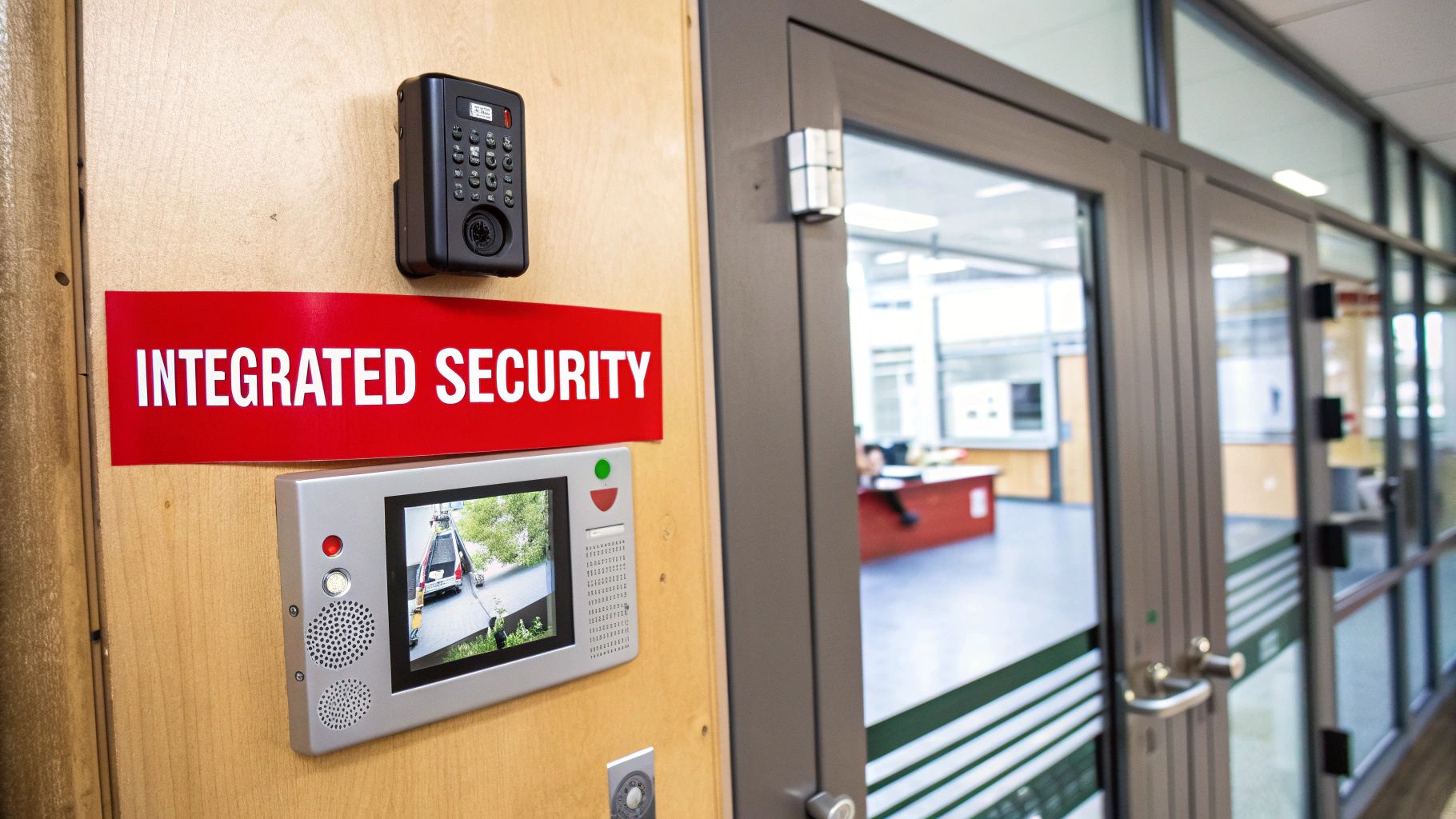
A modern access control system is a powerful tool on its own, but its true potential is unlocked when it’s integrated into a larger security ecosystem. Instead of a standalone gatekeeper, picture it as the central nervous system for your entire security strategy. When your systems communicate, they create a smarter, stronger shield around your property.
This integrated approach shifts your security from a collection of separate devices to a single, coordinated defense. Every piece of technology shares information, which leads to faster responses, better verification, and a much clearer picture of what’s happening on-site.
Blending Technology for a Stronger Defense
When your access control system works in tandem with other security measures, you achieve layers of protection that are impossible with isolated components. This synergy provides confidence that every event is captured, verified, and handled correctly.
Key integrations include:
- Video Surveillance: This is a classic pairing. Linking access control to security cameras gives you instant visual confirmation. When an employee swipes their card, the system can display the camera feed, confirming their identity. An "access denied" event can automatically trigger the nearest camera to record, capturing crucial footage.
- Alarm Systems: This integration is essential. An attempted forced entry at a secured door can automatically trigger an audible alarm, notifying your security team or monitoring center of a direct threat.
- Fire and Life Safety Systems: In an emergency, every second counts. An integrated system can be configured to automatically unlock specific escape route doors when a fire alarm is triggered. This guarantees a clear path for evacuation and helps you remain compliant with safety codes.
The Human Element: The 24/7 SOC Advantage
Technology is a fantastic tool, but human expertise makes it truly effective. This is where a 24/7 Security Operations Center (SOC) becomes an invaluable part of your security plan. Think of the SOC as a real-time command center, staffed around the clock by trained professionals who are watching over your systems.
A SOC provides the critical link between a digital alert and an intelligent, real-world response. It ensures that every event—from a simple "door propped open" notification to a forced entry alarm—is seen, assessed, and acted upon immediately.
For property managers and business owners, this oversight delivers ultimate peace of mind. It means you don't have to monitor alerts after hours. If something happens, SOC operators can verify the situation with live video, dispatch a mobile patrol, and contact law enforcement—all based on your pre-set security protocols.
This blend of smart technology and dedicated human oversight elevates the standard of security for buildings, turning a passive system into an active, responsive protective force. This proactive management is a hallmark of Overton Security’s 26-year commitment to providing reliable and comprehensive security solutions.
From Blueprint to Reality: Our Approach to System Deployment
Choosing the right access control system is just the starting point. The real value—and your peace of mind—comes from how that system is designed, installed, and supported. A system that’s poorly implemented can cause more headaches than it solves, leaving you with security gaps, frustrated users, and ongoing repair bills.
After 26 years in this business, we at Overton Security know that a successful deployment is a partnership. Our process is built on careful planning and expert execution, ensuring your system works exactly as it should from day one. This is what turns a simple installation into a real security solution.
A Partnership Built on Quality
We do not use a "one-size-fits-all" approach. Our work begins with a deep dive into your property’s unique layout, traffic flow, and challenges. We maintain a low manager-to-client ratio, which guarantees you get the dedicated attention you deserve through every step of the process.
Our deployment is a clear, multi-phase engagement designed for total reliability:
- Thorough Site Assessment: We walk your property with you to identify every critical entry point, understand how people move through your space, and pinpoint specific vulnerabilities. This allows us to gain a firsthand grasp of your operational needs.
- Custom System Design: Using our findings, we design a system tailored to your environment. We map out where every reader, controller, and piece of software will go to create a security framework that is both seamless and effective.
- Professional Installation and Commissioning: Our skilled technicians install every component with precision. We then conduct a commissioning phase, rigorously testing every reader, lock, and software feature to confirm the system is 100% operational.
- Comprehensive Team Training: A great system is only effective if your team knows how to use it. We provide practical, straightforward training for your staff on everything from managing credentials to reviewing logs and handling daily operations.
- Ongoing Maintenance and Support: Our partnership doesn't end when the system is live. We offer ongoing maintenance plans to keep your system in peak condition, providing proactive service to address small issues before they become large problems.
Our Deployment and Commissioning Process
We believe in complete transparency. To ensure every detail is accounted for, we follow a structured process that minimizes disruption and guarantees a reliable outcome.
An access control system is a long-term investment in your property’s safety and efficiency. The quality of its deployment directly impacts its performance, reliability, and ultimately, its return on investment.
Here’s a clear breakdown of what you can expect when you partner with Overton Security.
Our Deployment and Commissioning Process
This table walks you through our step-by-step process, so you know exactly what’s happening and why it matters to you.
| Phase | Key Activities | Client Benefit |
|---|---|---|
| Discovery & Planning | Conduct a detailed site walk, review floor plans, and discuss security goals and operational workflows with your team. | A solution perfectly matched to your property’s layout and specific security risks, preventing costly design changes later. |
| System Design | Create a comprehensive system architecture, selecting appropriate hardware (readers, locks, controllers) and software. | A cohesive and scalable system that meets both current needs and future growth plans, ensuring a sound long-term investment. |
| Installation | Professionally install all physical hardware, including wiring and mounting, with minimal disruption to your daily activities. | A clean and reliable installation performed by experienced technicians, ensuring system integrity and longevity. |
| Commissioning & Testing | Rigorously test every door, credential, and software function to verify performance and identify any potential issues. | Day-one reliability and the assurance that every component is working exactly as it should before the system goes live. |
| Training & Handover | Provide in-depth training for your designated administrators and staff, and deliver all necessary documentation. | An empowered team capable of managing the system effectively, maximizing its security and operational benefits. |
By following this proven method, we ensure your access control system not only meets but exceeds your expectations for security and performance.
Looking at the Real Return on Your Security Investment
It’s easy to view a modern access control system as just another expense. However, a well-planned system is a strategic investment that provides measurable returns—from stronger security and better efficiency to higher property value. The initial cost is just the starting point; the real value emerges over the long term.
The return on investment (ROI) begins immediately with tangible savings. Consider the last time a physical key was lost or an employee left. Calling a locksmith to re-key doors is expensive. With an electronic system, you simply deactivate a credential in a few clicks—instantly and at no cost.
Calculating the Tangible Financial Returns
Eliminating re-keying costs is just the beginning. A smart access control system directly impacts your bottom line in several other ways. Property managers and business owners are often surprised by the clear financial case.
- Reduced Risk of Theft and Vandalism: A clear audit trail of who goes where and when acts as a powerful deterrent. Fewer incidents of property damage or theft mean you avoid costly repairs and losses.
- Lower Insurance Premiums: Insurance carriers look favorably on proactive risk management. Many providers offer lower annual premiums for properties with professionally installed and monitored access control systems.
- Improved Operational Efficiency: Think about the time your team spends coordinating key handoffs or manually signing in visitors. Automating access frees them to focus on more important work while the system handles the logistics.
The Invaluable Benefits Beyond the Balance Sheet
Not every benefit fits neatly on a spreadsheet, but that doesn't make them any less valuable. These "intangible" returns create a safer, more professional environment that directly boosts your property's reputation and appeal.
A secure environment is a productive one. When employees and tenants feel safe, it has a real impact on morale, satisfaction, and retention—benefits that far outweigh the initial cost of the system.
A modern system sends a clear message that you are serious about safety, giving tenants, employees, and customers peace of mind. That heightened sense of security builds trust and can become a deciding factor for someone choosing between your property and a competitor's.
Furthermore, the system becomes a source of operational intelligence. Data from entry logs can reveal traffic patterns, helping you optimize staffing schedules or verify a contractor's billed hours. You can make smarter, data-driven decisions about how your building runs, turning your security system into a powerful management tool.
Your Access Control Questions, Answered
When you're considering a new access control system, many practical questions arise. Whether you're managing a commercial property, serving on an HOA board, or running a business, you need clear, straightforward answers. Let's tackle some of the most common inquiries we receive.
What Happens If the Power or Internet Goes Out?
This is a critical question, and for good reason. A security system must be reliable, especially during an outage.
Rest assured, any quality access control system is designed with fail-safes. Most systems include a battery backup that keeps door controllers and locks running smoothly during a power outage. This ensures your building remains secure and authorized people can still get in and out.
If the internet connection is lost, the system continues to function. The local door controllers store all credential information directly on the device. This allows them to operate "offline," granting or denying access based on the last set of permissions they received. While remote management may be temporarily unavailable, on-site security continues without interruption.
How Much Does a Building Access Control System Cost?
The price of a building access control system can vary, but you can typically expect a range of $500 to over $3,000 per door. Several factors influence the final cost.
- Hardware Selection: The specific readers (card, mobile, biometric), electronic locks, and controllers all have different price points.
- Number of Doors: The more entry points you need to secure, the more hardware and installation time will be required.
- Software and Features: Cloud-based platforms often involve a subscription fee, which typically covers software updates, remote management tools, and support.
- Installation Complexity: The current condition of your building's wiring and door frames can affect labor costs.
It is helpful to view this as an investment. The long-term savings from eliminating re-keying costs, combined with the prevention of costly security incidents, often provides an excellent return.
How Does the System Handle Visitors and Deliveries?
This is an area where modern access control systems truly excel. They make it simple to manage temporary access for guests, contractors, and delivery drivers without creating security vulnerabilities. You can create credentials that are only active for a specific time and date, then expire automatically.
A key feature of an effective system is its ability to grant temporary access without creating permanent security loopholes. This allows for seamless operations while maintaining a full audit trail of every visitor.
For example, you can issue a one-time PIN code to a courier or text a scannable QR code directly to a visitor’s smartphone. They gain access when and where they need to, and that access is revoked when their appointment is over. This process is efficient and leaves a complete record of who came and went.
Can the System Scale as My Property or Business Grows?
Absolutely. Scalability is one of the biggest advantages of modern systems, especially cloud-based ones. Whether you're adding a new wing to your office or acquiring a new building, a scalable system is designed to grow with you.
Adding new doors or users is typically a straightforward process that doesn't require a complete overhaul of your existing setup. This flexibility ensures your initial investment continues to provide value for years to come, adapting to your security needs as they evolve.
At Overton Security, we have over 26 years of experience designing and installing access control solutions that are reliable, scalable, and built for the real-world needs of your property. To see how we can help secure your building, contact us for a professional consultation.