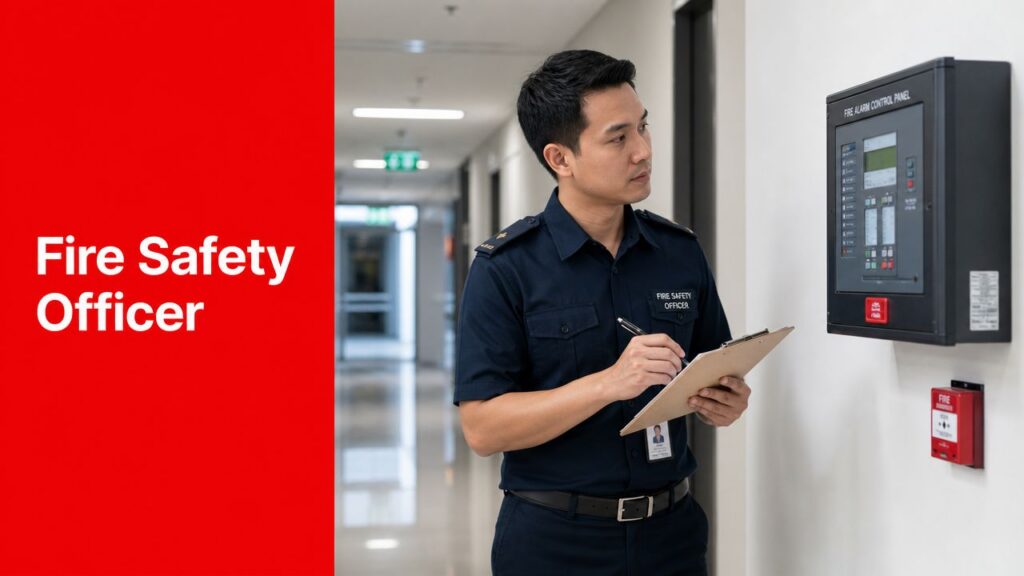
A property manager usually doesn't get much warning. The fire alarm panel starts chirping. A vendor says part of the system has to stay offline during repairs. Tenants still need access, contractors are moving through the building, and now someone has to answer the hard question fast. Who is watching the property while a life-safety system isn't fully working?
That's where many teams confuse a last-minute body on site with an actual fire and safety officer function. They're not the same thing. A professional fire watch presence is part compliance tool, part risk-control measure, and part operational bridge between your building staff, vendors, and emergency responders.
For California property managers, that distinction matters. If you run a multifamily community in Los Angeles, a retail center in San Jose, a mixed-use tower in San Francisco, or a construction project in Sacramento, the issue isn't only “Do I need someone here?” The key issue is whether the person on site can spot hazards, document conditions, maintain a defensible log, and help keep occupants safe until full protection is restored.
The stakes aren't abstract. Fire service work remains dangerous. The National Fire Protection Association is cited as estimating about 61,000 firefighter injuries per year and nearly 100 line-of-duty deaths annually in this overview of the critical role of safety officers. That should tell any property team something important. Fire safety isn't paperwork. It's a disciplined operating function built around prevention, judgment, and response.
A good fire and safety officer makes an unstable situation manageable. Instead of guessing your way through an outage, hot work operation, or temporary impairment, you get patrols, observation, records, and a clear chain of action. That's what brings legal peace of mind. It also helps protect your tenants, staff, vendors, and reputation.
Introduction
The familiar version of this problem looks simple at first. Your sprinkler contractor needs part of the system offline. Your fire alarm vendor is troubleshooting a panel issue. Or a renovation crew is doing work that changes normal life-safety conditions for the day. Then the calls start. Building engineers want direction. Tenants want reassurance. Ownership wants to know whether the property is exposed.
In practice, the answer is rarely “just post someone by the lobby.” A real fire and safety response requires active movement through the site, constant awareness of changing conditions, and written documentation that would still make sense if the fire marshal, insurer, or legal counsel reviewed it later.
Practical rule: If a life-safety problem would be hard to explain after the fact, it needs a structured fire watch plan now.
For private properties, the role often sits between public-sector safety doctrine and everyday facility operations. Municipal fire departments treat safety officer responsibilities as formal, defined work. Washington State's rule for a fire department health and safety officer includes planning and coordinating safety activities, working with the safety committee, ensuring accident investigations and corrective measures, and verifying that safety training and records are maintained across accidents, injuries, inspections, exposures, medical monitoring, safety meetings, apparatus, equipment, and protective clothing in the state code section on fire department health and safety officers. The same rule also gives the officer authority, through the fire chief, to identify hazards and recommend corrections.
Property managers don't need to copy that model exactly. But they should understand the principle behind it. The role is not passive. It combines hazard recognition, documentation, corrective follow-up, and operational influence. That's why the right officer matters when systems are impaired, occupancy is high, or work conditions are changing hour by hour.
What Is a Fire and Safety Officer
A fire and safety officer is a person assigned to identify hazards, maintain life-safety awareness, and support safe operations through inspection, observation, documentation, and corrective action. In a public fire department, that may be a formal internal safety position with defined operational authority. In private property management, the role is usually narrower but still serious. It centers on life-safety compliance, active patrol, and risk reduction during normal operations or temporary impairments.
For a commercial or residential property, think of the role this way. The officer stands in for missing layers of protection when normal systems, staffing, or conditions aren't enough by themselves. If a fire alarm system is impaired, the officer doesn't replace the system. The officer reduces the gap by watching for signs of fire, checking key areas, keeping exits clear, reporting hazards, and initiating the right response if conditions change.
Public-sector role versus private-site role
The public-sector version often includes broad program responsibilities such as safety planning, recordkeeping, investigation, and coordination across department operations. The private-site version is more focused on the property itself.
That usually means the officer is responsible for things like:
- Patrol coverage of interior and exterior risk areas
- Hazard recognition such as blocked egress, unauthorized hot work, overloaded storage, or tampered equipment
- Fire watch documentation that shows where patrols occurred and what conditions were found
- Escalation to building engineers, property management, contractors, or emergency services
- Occupant awareness when temporary instructions or route changes need to be reinforced
What the role is not
It's not just a warm body with a clipboard.
It's also not the same as a general security guard who happens to be standing at a desk while a fire system is offline. A lobby officer may be excellent at access control and customer service, but unless that person has the right post orders, patrol expectations, and fire watch training, you still have a gap.
A weak fire watch usually fails in the same place. The officer is present, but no one can prove what was checked, when it was checked, or what happened when a hazard was found.
That's why property teams should define the assignment by function, not title. If you need active patrols, hazard detection, log discipline, contractor coordination, and immediate reporting, you need a fire and safety officer operating with those responsibilities in mind.
Core Duties and On-Site Responsibilities
The day-to-day value of a fire and safety officer comes from specific actions on the ground. Good officers don't wait for smoke or alarms. They work through a routine that is designed to catch small failures before they become emergency conditions.

A professional fire and safety officer's role is proactive, not just reactive. Their duties include continuous hazard identification, risk assessment, and direct verification that extinguishers, alarms, and sprinklers are operational. This preventive inspection process is described in Michigan's fire and safety officer job specification and it reflects what works on private properties too.
What good officers actually do on site
- Walk the property, not just the obvious path. That includes riser rooms, electrical areas, loading zones, stairwells, roof access points, storage rooms, trash enclosures, and any tenant spaces affected by the impairment.
- Check egress conditions. Doors need to open, corridors need to stay clear, and exit routes can't be blocked by deliveries, renovation materials, carts, or temporary fencing.
- Verify visible fire protection equipment. Officers should note whether extinguishers are accessible, pull stations aren't obstructed, and affected equipment is tagged or identified correctly during outages.
- Watch contractor activity. Welding, cutting, soldering, temporary power setups, and housekeeping failures create risk quickly when no one is actively supervising the area.
- Maintain a time-based log. The log should show patrol intervals, areas checked, hazards observed, corrective actions taken, and who was notified.
- Report changes immediately. If a blocked stairwell, smoke condition, electrical odor, disabled door closer, or unauthorized work appears, the officer has to escalate it right away.
- Assist first responders with location intelligence. That includes building access points, affected floors, shutoff areas, utility rooms, and current site conditions.
What works and what doesn't
What works is a patrol pattern built around risk. A high-rise in Oakland doesn't need the same route as a garden-style apartment community in Fresno. A construction site in San Diego doesn't need the same checks as a medical office building in Long Beach.
What doesn't work is a generic loop done from memory with no site-specific instructions.
A practical fire watch post order should identify:
| Focus area | What the officer needs |
|---|---|
| Impaired systems | Which devices or zones are offline |
| Patrol route | Required checkpoints and frequency |
| Contacts | Engineer, property manager, vendor, fire department contact path |
| Hazard areas | Hot work, storage, vacant units, roof, electrical rooms |
| Documentation | Log format, photo requirements, escalation notes |
When a fire event has already happened, cleanup and stabilization become part of the broader life-safety conversation. Property teams dealing with the aftermath often also need guidance on professional commercial fire cleanup so the building can be secured, documented, and restored without creating new hazards during recovery.
When California and NFPA Require a Fire Watch
For most property managers, this is the operational question that matters most. When does a fire watch move from “good idea” to “required action”? The answer depends on the condition of the building, the system impairment, the local authority having jurisdiction, and the applicable code or fire department direction.

The trigger most managers run into first
The most common trigger is an impaired fire protection system. If a fire alarm or sprinkler system is out of service beyond the threshold recognized by code guidance and local enforcement practice, a fire watch may be required until the system is restored or another approved measure is in place.
In California, the practical mistake isn't usually ignorance. It's delay. Teams spend too long trying to decide whether the outage is “serious enough” while the clock is running. The better approach is to treat any substantial impairment as a compliance event early, notify the right parties, and confirm expectations with the local fire authority rather than assume the issue can wait.
Common scenarios that call for fire watch coverage
A fire watch is commonly used in situations like these:
- Alarm system outage during service, repairs, malfunction, or panel replacement
- Sprinkler impairment tied to maintenance, valve issues, leaks, or construction work
- Hot work activity where welding, torch cutting, or similar operations create ignition risk
- Special events or temporary occupancy changes where normal fire protection assumptions no longer fit the use
- Repeated nuisance alarms or unstable systems that leave management uncertain whether a new activation is real
- Construction and renovation phases where walls are opened, systems are altered, or egress patterns shift
If a contractor tells you the system will be down “for a while,” that's not enough. Ask what is impaired, which areas are affected, when restoration is expected, and whether the fire department or AHJ needs notice.
The California decision process
A useful way to think about this is as a short decision tree.
- Identify the impairment clearly. Is it alarm, sprinkler, both, or a zone-specific issue?
- Define the affected footprint. One tenant suite is different from a full tower, podium, or campus area.
- Notify the people who need to know. That may include ownership, engineering, tenants, vendors, and the fire department or AHJ.
- Decide whether patrol-based fire watch is required now. Don't wait for uncertainty to sort itself out.
- Document every step. If someone reviews the event later, your records should show timing, communication, staffing, and restoration.
For California property teams that need a clearer picture of deployment and expectations, this guide to building fire watch services is a useful reference point for how a contractor-based fire watch is typically structured.
NFPA matters, but local enforcement decides the last mile
NFPA guidance shapes expectations nationally, but your local fire authority decides how requirements apply to the actual building and impairment. That's why strong providers don't treat every assignment the same way. They confirm the occupancy, impairment type, patrol requirement, and reporting chain before the first patrol starts.
Essential Certifications and Training for Officers
A fire watch assignment can look simple from a distance. Walk the property. Keep a log. Call if there's a problem. In reality, the assignment falls apart fast if the officer doesn't understand fire code basics, emergency communication, hazard recognition, and what site conditions matter.
Government and university job specifications consistently require familiarity with fire codes, emergency procedures, first aid and CPR, and hazardous-material or flammable-storage risks in South Carolina's fire and safety officer class concept. That's a good benchmark for the private sector as well. The officer has to convert observations into corrective action, not just collect them.
What to look for beyond a guard card
In California, a state-issued security license is part of the baseline, not the finish line. Property managers should ask what training sits on top of that licensing requirement.
Look for evidence of:
- Fire watch instruction that covers patrol methods, log procedures, emergency notification, and building-specific post orders
- Code and life-safety familiarity so the officer understands egress, extinguisher access, alarm impairment issues, and occupancy concerns
- First aid and CPR knowledge because incidents on impaired sites aren't limited to fire
- Hazard awareness training tied to electrical rooms, fuel storage, mechanical spaces, loading docks, and contractor operations
- Communication discipline so reports to managers, engineers, and first responders are clear and useful
A provider that explains California licensing requirements well is usually easier to vet across the board. This overview of security guard licensing in California helps frame what the legal baseline covers and what it doesn't.
Why training quality changes the outcome
Two officers can walk the same route and produce very different results. One notices a stairwell door propped open near a construction floor, asks who authorized it, and gets it corrected. The other walks past it because it didn't look urgent.
That's the difference between presence and competence.
Field test: Ask a provider how officers are trained to handle hot work, blocked exits, alarm impairments, and contractor-created hazards. If the answer stays vague, the site coverage probably will too.
Strong training also has to account for your property type. A retail center, warehouse, healthcare site, and luxury residential high-rise each create different traffic patterns, access problems, and after-hours risks. The officer doesn't need to be a fire marshal. But that officer does need enough structured training to recognize what's wrong, know who to call, and document it in a way that protects the property.
How Fire Watch Integrates with Modern Security Operations
A fire watch officer should never operate as an island. On a well-run property, fire watch becomes one layer inside a broader security and operations system. That matters because impairments rarely stay contained to one issue. A fire alarm outage can create access-control complications. A construction phase can affect cameras, loading operations, elevator use, and tenant communication at the same time.

Technical guidance for incident safety officers expects them to monitor the incident action plan, challenge unsafe tactics, and forecast dangerous conditions before they escalate, as described in this article on incident safety officer duties and responsibilities. Private security assignments aren't identical to fireground command, but the operating lesson carries over. Effective oversight is active, real-time, and tied to decision-making.
The practical operating model
On a modern property, the best fire watch programs connect officers to tools and people who can support the assignment.
That usually includes:
- Guard tour checkpoints using NFC or similar systems to prove patrol completion
- Digital daily activity reports with time stamps, notes, and photos
- Supervisor visibility into whether patrols are happening on schedule
- SOC support for escalation, wellness checks, dispatch coordination, and record retention
- Camera awareness so officers can pair physical patrol findings with monitored areas when available
In operations, a provider's operating discipline becomes visible. Overton Security, for example, uses GPS-enabled guard tour reporting and SOC oversight as part of its broader field accountability model. That doesn't replace the officer's judgment. It gives the client a clearer record of what the officer did and when.
Why integration reduces friction for property teams
A disconnected fire watch creates extra work for the manager. You end up chasing logs by text, calling the site to confirm presence, and trying to reconstruct events after a contractor complaint or alarm issue.
An integrated model is cleaner:
| Operational need | Better approach |
|---|---|
| Proof of patrols | Digital checkpoint verification |
| Incident reporting | Time-stamped reports with photos and notes |
| Escalation | Live contact path to supervisor or SOC |
| Site coordination | Shared post orders with engineering and management |
| Client visibility | Reports delivered in a consistent format |
For sites with cameras, access control, or remote oversight already in place, the fire watch function should fit into that ecosystem rather than bypass it. This broader view of the integration of security systems is useful because it shows how human patrols and technology support each other when conditions are changing.
A fire watch log is useful. A fire watch log backed by patrol verification, supervisor oversight, and documented escalation is much more defensible.
A Checklist for Hiring Your Fire Watch Provider
Most providers can tell you they “do fire watch.” The better question is whether they can do it in a way that stands up to scrutiny from a fire marshal, risk manager, ownership group, or attorney after an incident. That's where the hiring checklist matters.

The questions worth asking before service starts
Use this list when you evaluate a vendor:
- Licensing and insurance. Confirm the company is properly licensed for security work in California and can document insurance that fits your property requirements.
- Fire watch training. Ask how officers are trained for impaired-system assignments, hot work support, report writing, and emergency escalation.
- Site-specific post orders. Require written instructions specific to your building, not generic standing orders copied from another account.
- Reporting method. Ask whether logs are handwritten only, digital, or both, and how quickly you'll receive incident documentation.
- Supervision model. Find out who checks on the officer, reviews patrol performance, and responds if the assignment changes after hours.
- Property-type experience. Multifamily, retail, office, healthcare, warehouse, and construction sites all create different fire watch demands.
- Escalation discipline. Make them explain exactly who gets called for blocked exits, smoke odor, contractor violations, or system-status changes.
- Technology support. Guard tour proof, GPS visibility, and SOC support don't make an officer better by themselves, but they do make performance easier to verify.
What a usable post order should contain
A lot of service problems start here. The provider sends an officer, but the officer arrives with little more than the property address and the phrase “do fire watch.”
A usable post order should include:
| Post order element | Why it matters |
|---|---|
| Impairment details | Tells the officer what protection is down |
| Patrol route and frequency | Prevents random or incomplete rounds |
| Hazard zones | Focuses attention on high-risk spaces |
| Notification chain | Removes guesswork during escalation |
| Occupant instructions | Helps officers answer common questions correctly |
| Documentation rules | Creates a consistent record for compliance |
Don't ignore modern hazards
Traditional fireground thinking still emphasizes fundamentals like accountability, radio discipline, collapse zones, and apparatus positioning. Those are important, but they don't answer every risk a California property faces now. Fire service commentary has pointed to the growing gap between traditional safety roles and modern hazards like lithium-ion battery incidents and energy storage systems in this discussion of fireground risk management and the real work of the incident safety officer.
That matters for private property too. If your garage includes EV charging, your tenants store battery-powered equipment, or your site includes newer electrical infrastructure, your provider should show that officers are trained to think beyond yesterday's checklist.
Conclusion
A fire and safety officer fills a very specific need. When systems are impaired, work conditions are changing, or compliance pressure is rising, the role brings patrol discipline, hazard recognition, documentation, and a clear response path to the property. For managers in California, that isn't extra administration. It's part of running a defensible life-safety program.
If a fire loss has already happened, it also helps to understand the claims side of recovery. Property teams dealing with documentation and insurance questions may find For The Public Adjusters useful as a general resource on fire-claim handling.
If you need a practical fire watch plan for a commercial building, residential community, construction site, or mixed-use property in California, contact Overton Security. A clear scope, trained officers, and accountable reporting can make a fast-moving compliance issue much easier to manage.