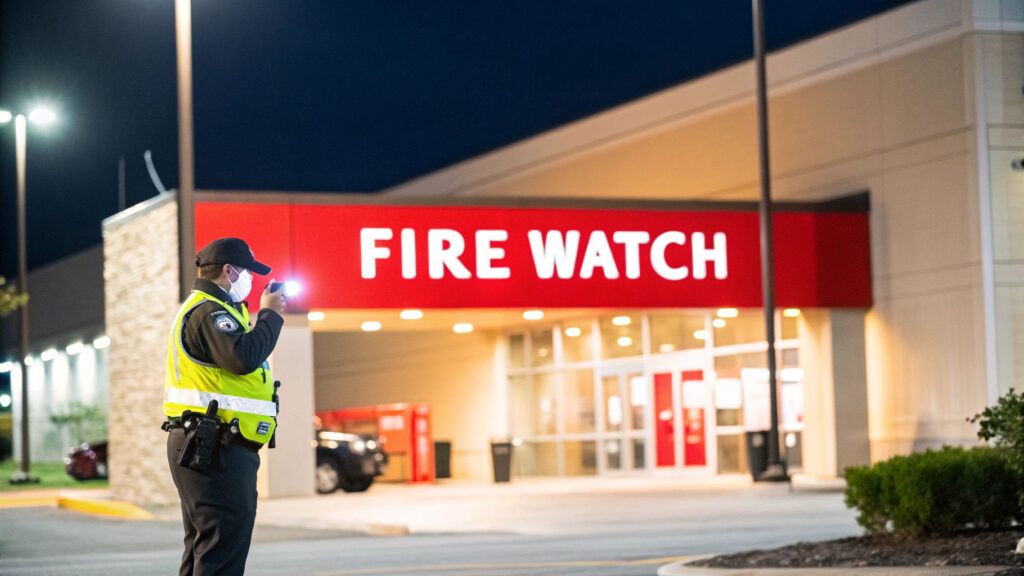
When your building's fire alarm or sprinkler systems are offline, what stands between a minor issue and a major disaster? The answer is a building fire watch—a temporary but critical safety measure involving trained personnel who patrol your property to detect any signs of fire.
Think of them as a human–to-ground safety measure. It involves trained personnel who physically patrol a property to spot signs of fire when your automated alarm or sprinkler systems are down.
Essentially, they are your eyes and ears, providing the on-site vigilance that technology can't when it's out of commission. A fire watch is a non-negotiable requirement from local Fire Marshals, stepping in to keep people safe when your building's electronic guardians are offline.
Understanding the Purpose and Triggers for a Fire Watch
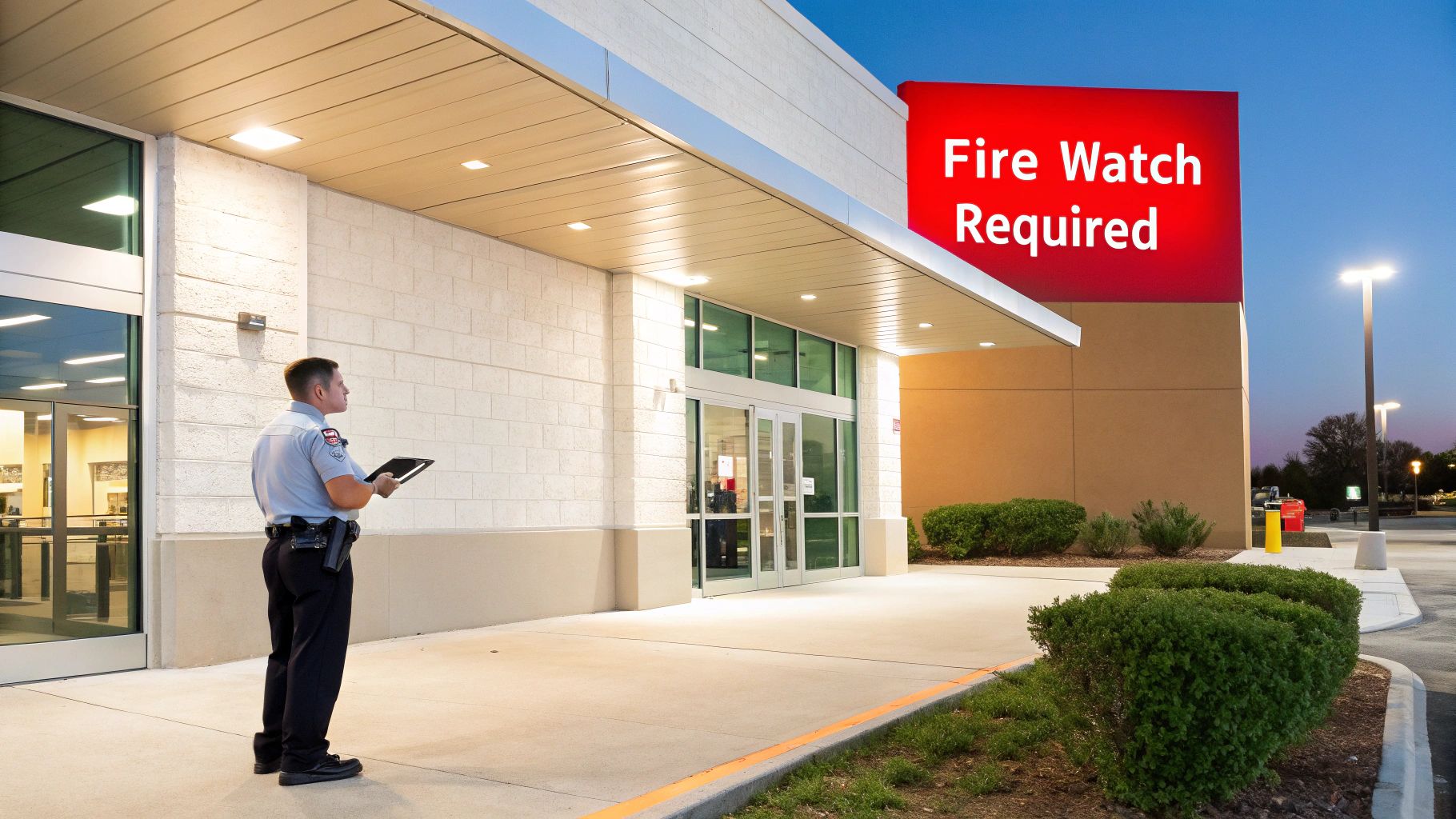
Imagine a traffic controller stepping into a busy intersection when the signal lights go out. Their presence prevents chaos and keeps everyone moving safely. A building fire watch fills that exact same role, bridging a critical safety gap whenever your property’s fire detection and suppression systems are out of commission.
This system impairment can happen for several reasons, both planned and unexpected. As a property manager, facilities director, or construction superintendent, recognizing these triggers promptly is essential for staying compliant and protecting your assets.
Failing to implement a required fire watch can lead to serious consequences, including significant fines, legal liability, and, most importantly, a preventable tragedy.
Common Scenarios Requiring a Fire Watch
There are several common situations that can compromise your fire safety systems and legally require you to establish a fire watch. Knowing what to look for helps you act with confidence.
- Planned System Maintenance or Testing: Anytime technicians are servicing your fire alarm panels, sprinkler systems, or smoke detectors, those systems are usually taken offline.
- Unexpected System Malfunctions: A sudden failure, damage from a burst pipe, or an electrical short can knock your fire systems out of commission without warning.
- New Construction or Renovations: During construction, fire systems often aren't fully installed or activated yet, creating a fire risk that needs professional oversight.
- Power Outages: If the power goes out and your fire alarm's backup battery fails, a fire watch is needed immediately until service is restored.
- Orders from the Fire Marshal: The local Authority Having Jurisdiction (AHJ)—like the Fire Marshal in Los Angeles or San Jose—can order a fire watch if they find a building’s systems are inadequate or discover other fire code violations.
A fire watch is far more than a compliance checkbox. It's your active, on-the-ground defense against disaster, providing the human observation and rapid response that technology can't deliver when it fails.
For property managers, knowing when to call for a fire watch is crucial. To make it easier, here's a quick-reference table outlining the most common triggers.
Common Triggers That Mandate a Building Fire Watch
| Triggering Event | Description | Typical Duration | Primary Risk |
|---|---|---|---|
| System Maintenance | Scheduled servicing of fire alarms, sprinklers, or suppression systems. | 4-8 hours | Delayed fire detection while systems are offline. |
| System Malfunction | An unexpected breakdown, often due to equipment failure or damage. | Hours to Days | Complete loss of automated detection and suppression. |
| Construction/Renovation | Fire systems are not yet active or are temporarily disabled. | Weeks to Months | Increased fire hazards (e.g., hot work, flammable materials). |
| Power Failure | Both primary and backup power to fire systems are lost. | Hours | No power for alarms, strobes, or monitoring panels. |
| Fire Marshal Order | An official mandate from the AHJ due to code violations or perceived risk. | Variable | Non-compliance fines and potential building closure. |
This table can help you quickly assess a situation and determine if you need to bring in professional support to keep your building and its occupants safe.
The need for these measures is underscored by national trends. The U.S. has seen a troubling rise in fire-related incidents, with total fire losses hitting $23.2 billion in 2023 alone, according to the U.S. Fire Administration. This figure highlights the immense financial and human cost of fire, reinforcing why a professional fire watch is an essential service for any responsible property manager.
At Overton Security, we have been providing state-mandated fire watch services for over 26 years. We help property managers across California handle these situations with confidence. Our experienced officers are trained to conduct meticulous patrols and maintain detailed logs, ensuring your property, your tenants, and your legal standing are all protected. To get a better sense of the details, you can check out our guide on what a fire watch entails.
The Core Duties of a Fire Watch Officer
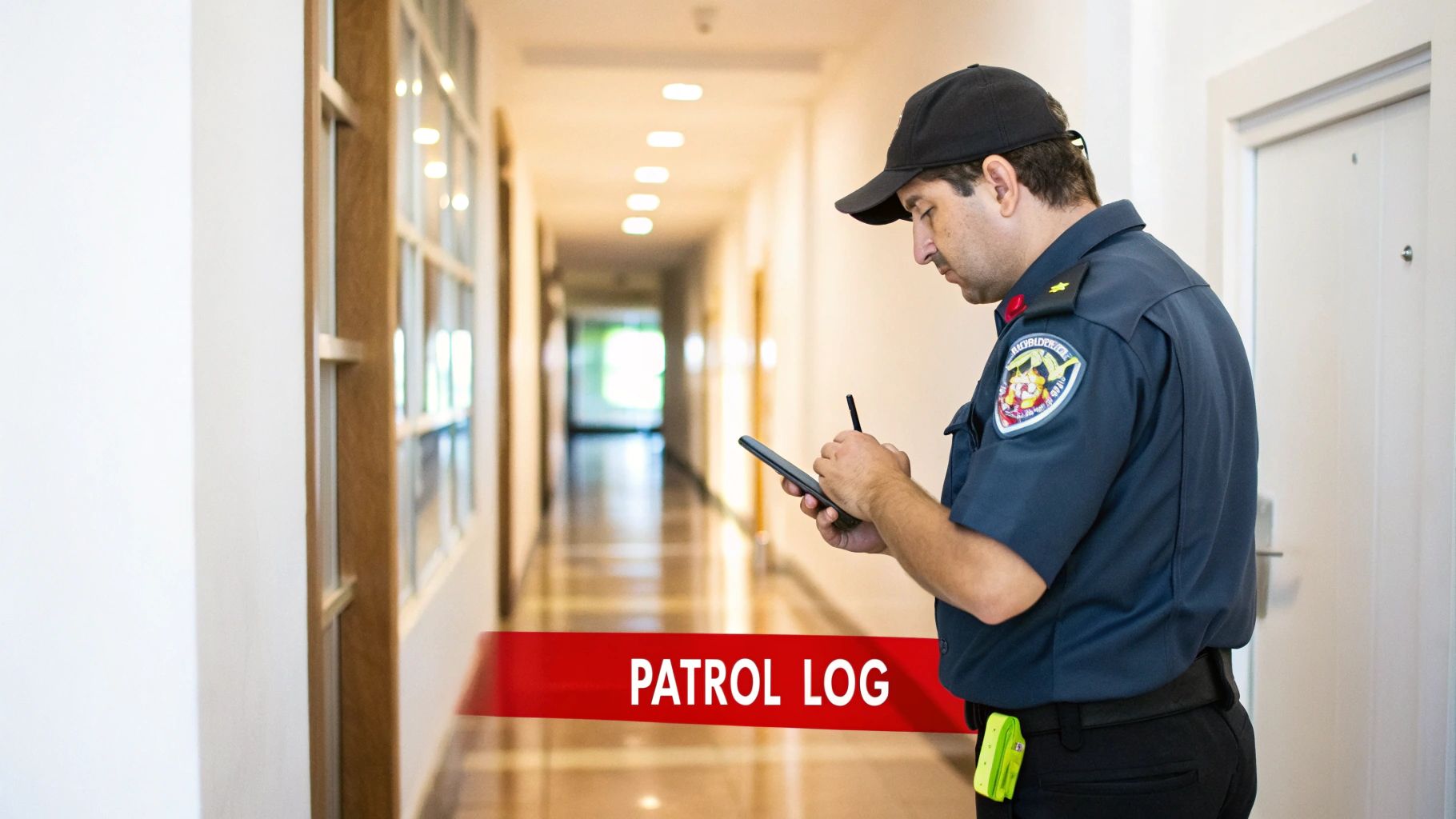
A professional fire watch is much more than having someone walk the halls. It's a disciplined safety protocol carried out by trained officers who understand what's at stake. Their duties are methodical and specific, designed to create a human shield of protection when your automated systems are down.
The core of their job is to conduct consistent, thorough patrols of every designated area on the property. This isn't a casual stroll; it's a dedicated inspection of every floor, hallway, and critical space—from basements and boiler rooms to rooftops and tenant areas.
During these rounds, officers are actively looking for the earliest signs of a fire. That could be the faint smell of smoke, unusual heat from a wall, or visible flames. This hands-on, proactive observation is what replaces the electronic sensors that are temporarily offline.
Patrolling with Purpose and Precision
An effective fire watch patrol is built on structure and consistency. Officers must adhere to a pre-planned route and a strict schedule, ensuring no area is missed and patrols occur as often as the local fire authority requires—usually every 30 to 60 minutes.
Their responsibilities extend beyond just looking for fire. Officers perform several other critical duties that are vital for life safety.
- Verifying Clear Egress: They continuously check that all fire exits, stairwells, and escape routes are completely clear and unobstructed. A propped-open fire door or a cart blocking an exit can turn a small problem into a catastrophe.
- Checking Fire Extinguishers: Part of the patrol includes a quick check to confirm fire extinguishers are in their designated locations, are easily accessible, and appear ready for use.
- Identifying New Hazards: Officers are also trained to spot new fire hazards that might arise, like flammable materials stored improperly or malfunctioning equipment.
The real value of a professional fire watch isn't just presence; it's diligence. A trained officer knows that a meticulous patrol log and an unobstructed fire exit are just as critical as spotting smoke in the first moments of an incident.
The Critical Role of Documentation and Communication
One of the most important duties is maintaining a detailed and accurate fire watch log. This isn't just for your internal records; it's a legal document. It serves as your official proof of compliance for the local Fire Marshal and your insurance company, showing you took your safety obligations seriously.
The log must be maintained with precision, recording specific details for every patrol.
- Time-Stamped Entries: The start and end time of every patrol route must be recorded.
- Areas Patrolled: The log needs to show the exact locations that were inspected.
- Officer’s Name and Signature: The officer on duty must be clearly identified.
- Observations: Any unusual findings—even if they aren’t an immediate fire threat—must be noted.
If a fire is detected, the officer's training immediately takes over. Their first, most critical action is to call 911 and alert the fire department. They then notify building management and begin alerting occupants to facilitate a safe evacuation.
This is where Overton Security’s commitment to officer training and retention makes a difference. With over 26 years of experience, we ensure our officers are not just observant and proactive, but also calm and decisive under pressure. They are your reliable, on-site guardians, providing diligent patrols, meticulous documentation, and the rapid response that protects what matters most.
Maintaining Compliance and Managing Documentation
When your fire systems go down, a building fire watch isn't just a safety precaution—it's a critical compliance task with serious legal weight. For property managers and facilities directors, the local Authority Having Jurisdiction (AHJ), typically your fire department, expects meticulous, verifiable proof that you’ve kept your building safe. That responsibility lands squarely on your shoulders, and solid documentation is your best defense against liability.
The moment you know a fire system is significantly impaired, your first call should be to the local fire department. This is a required notification that demonstrates good faith and starts the process correctly, but it must be followed by flawless record-keeping.
This kind of rigorous documentation is similar to other safety protocols. For instance, anyone familiar with the rules for Mastering Safety Data Sheet Compliance knows how critical precise, accessible records are. The same detailed mindset is exactly what's needed for a compliant fire watch.
The Anatomy of a Compliant Fire Watch Log
Your fire watch log is more than just a checklist; it's a legal document. In the event of an incident, fire officials and insurance adjusters will scrutinize it. To be defensible, it needs to be detailed, accurate, and consistently maintained for the entire duration of the fire watch.
Every entry must be clear, leaving no doubt that each patrol happened as required. This is one area where working with a professional security firm can make a world of difference.
A compliant log must always include:
- Time-Stamped Patrols: Each patrol needs a clearly recorded start and end time.
- Specific Locations Checked: Vague entries are insufficient. The log should note exact areas, like "Stairwell B, Floors 1-10" or "East Wing, all common areas."
- Officer Identification: The name and signature of the guard on duty must be tied to each entry.
- Detailed Observations: Guards must note anything out of the ordinary—a blocked hallway, a strange smell, a propped-open fire door—even if it isn't an immediate fire hazard.
Leveraging Technology for Irrefutable Proof
While paper logs were once the standard, today's technology offers a much stronger, more reliable solution. This is how Overton Security lifts the documentation burden and protects our clients from risk. We equip our officers with a GPS-enabled Guard Tour Management System.
This system creates a digital, undeniable record of every patrol. Our officers scan checkpoints at key locations throughout your property, providing time-stamped, location-verified proof that every critical area was inspected on schedule. This data flows into detailed digital reports you can access through our client portal.
With our technology, there’s no more wondering if a patrol was missed. You get complete transparency and peace of mind, knowing you have a defensible, digital record that proves your due diligence and meets AHJ requirements.
This level of documentation is essential in complex properties. High-rise buildings, for example, present unique challenges. Between 2009 and 2013, U.S. fire departments responded to an average of 14,500 high-rise fires annually. These incidents often led to massive property damage and loss of life, amplified by the difficulties of evacuating such large structures. For managers of high-rise buildings, these statistics are a stark reminder of why irrefutable documentation is non-negotiable.
With Overton Security, managing compliance becomes a seamless process. Our blend of highly trained officers and smart technology ensures your building fire watch is not only performed correctly but also documented perfectly. To see how our clients get real-time visibility into their security operations, take a look at the benefits of our Direct Access client portal. We handle the details so you can focus on getting your systems back online.
How to Implement an Effective Fire Watch Program
Implementing a fire watch is a structured safety program that demands careful planning and flawless execution. A properly run program ensures every patrol is purposeful, every risk is covered, and all legal requirements are met. It’s a vital piece of a complete Occupational Health and Safety Management System that stands between a minor issue and a major catastrophe.
The process begins with a rapid assessment of your property's specific needs. A sprawling retail center in Los Angeles has different requirements than a high-rise residential tower in San Jose, and the fire watch plan must reflect that. The goal is to shift from a reactive scramble to proactive control as smoothly as possible.
This shift involves a few key steps that form the foundation of an effective and compliant fire watch.
Determining Staffing and Patrol Frequency
First, you need to determine how many officers are needed and how often they must patrol. This isn't a guess—it's a calculation based on your building's size, layout, and, most importantly, the local Fire Marshal's explicit requirements.
Most fire departments mandate patrol frequencies of every 30 to 60 minutes. A larger or more complex property, like a multi-building apartment community, may require multiple officers to ensure all areas are physically checked within that time frame. The absolute non-negotiable is achieving 100% coverage of all common areas, mechanical rooms, exit paths, and other critical spots.
This is particularly important in residential buildings. Simple cooking accidents remain a leading cause of fires. In fact, the U.S. Fire Administration reported an estimated 344,600 residential building fires in 2023 alone. For a property manager, that number is a sobering reminder of how quickly a kitchen mishap can escalate when fire systems are offline.
Developing Customized Post Orders
Once staffing is determined, the next step is to create post orders. Think of these as the on-site, customized playbook for your fire watch officer. Generic instructions are not enough; post orders must be tailored to your specific building, its unique layout, and its inherent risks.
These orders are the bedrock of an officer’s duties and must clearly lay out:
- The Exact Patrol Route: A detailed, floor-by-floor map or checklist of every area the officer is required to inspect on every tour.
- Emergency Contact List: All key names and phone numbers—property management, maintenance personnel, and the local fire department—readily accessible.
- Site-Specific Instructions: Notes on "hot spots" that need extra attention, like active construction zones, storage rooms with flammable materials, or the locations of manual fire alarm pull stations.
- Documentation Protocol: Crystal-clear instructions on how to fill out the fire watch log, including what details to record and how often.
At Overton Security, our leadership team is hands-on. A manager will personally walk your site with you to build these post orders from the ground up. It’s a collaborative process we’ve refined over 26 years to ensure nothing gets missed and our officers know exactly what is expected of them.
Equipping Officers and Ensuring Oversight
An effective program also hinges on providing officers with the right tools. This includes reliable communication gear like two-way radios, high-powered flashlights for checking dark areas, and immediate access to a digital reporting system for logging their patrols in real time.
The process for documenting each patrol is simple but absolutely critical, as this flow shows.
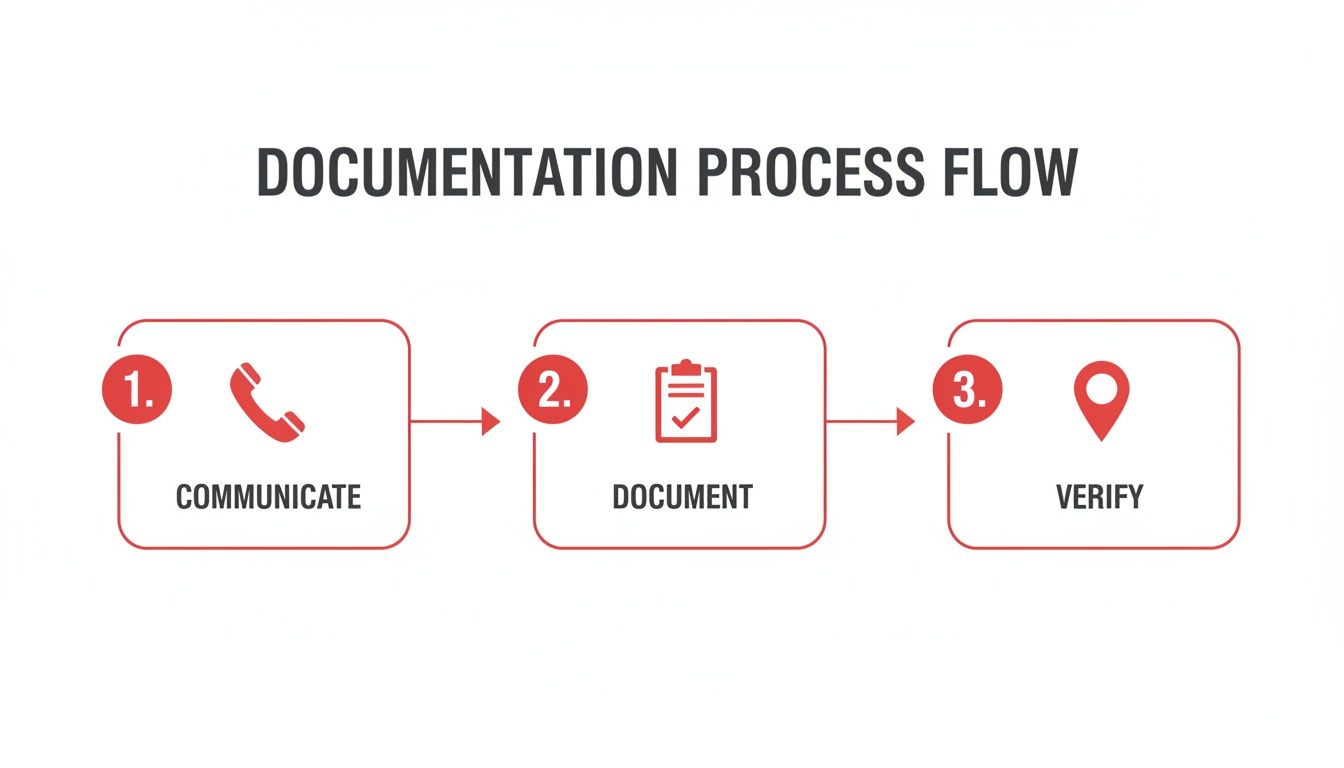
This workflow—communicating status, documenting observations, and verifying location with GPS—creates a transparent and legally defensible record of every action taken on your property.
Finally, a truly effective program needs real oversight. This is where our 24/7 Security Operations Center (SOC) adds an essential layer of assurance. The SOC team monitors officer check-ins, provides real-time support, and ensures that if an incident does happen, emergency protocols are executed without a hitch. This constant oversight guarantees the program is running as designed, giving you genuine peace of mind.
Choosing the Right Fire Watch Security Partner
When your building’s fire safety systems go offline, the security partner you choose is one of the most critical decisions you can make. This isn't just about checking a box for the fire marshal. You’re entrusting them with the safety of your tenants, the integrity of your property, and your legal compliance.
The right partner operates as a seamless extension of your own team. The wrong one can introduce risk and liability during an already stressful situation.
While it can be tempting to focus on the hourly rate, a fire watch is a specialized safety service. Choosing a partner based on price alone is a gamble where experience, reliability, and accountability are non-negotiable. Your goal should be to find a team whose operational standards give you complete confidence while your systems are being restored.
To do that, you need to ask the right questions to separate true professionals from the rest.
Key Questions to Vet Potential Providers
When evaluating a security firm for fire watch duties, how they answer questions about their people and processes tells you everything you need to know. A seasoned, professional company will have solid, verifiable answers ready.
Before signing a contract, be sure to get clear answers on these points:
- What's your officer training and retention strategy? High turnover is a common challenge in the security industry. A company that invests in its officers through better pay, ongoing training, and real support will provide a more professional and alert person on-site. This is a core part of our philosophy at Overton Security, and it's why our clients get stable, experienced officers.
- How do you prove patrols were completed? Ask them point-blank if they use a GPS-enabled guard tour system. This technology provides irrefutable, time-stamped proof that every required patrol was completed on schedule and in the right location. Without it, you are relying solely on a paper log, which leaves a gap in accountability.
- Can you show me your experience in California? Fire codes and AHJ expectations can differ from Los Angeles to San Francisco or San Diego. You need a partner with deep, local experience who understands the specific compliance nuances you face.
- How do you create site-specific post orders? A top-tier provider will insist on walking your property before the watch begins to create customized instructions. This hands-on approach ensures the officer truly understands your building’s layout, potential hazards, and exactly what you need them to do.
Choosing a fire watch partner is an investment in risk management. The right choice provides not only compliance but also genuine peace of mind, backed by verifiable performance and 26 years of specialized experience.
Look for a Partner, Not Just a Provider
The best fire watch service comes from a security company that sees itself as your partner in safety. They should be transparent, communicative, and focused on protecting your interests. At Overton Security, we maintain a low manager-to-client ratio to ensure you always get hands-on attention and that our team knows your property's needs inside and out.
We pair our highly trained officers with transparent, technology-driven documentation to deliver a service you can trust.
Below is a checklist to help you systematically evaluate potential partners.
Checklist for Vetting Fire Watch Service Providers
Ask these key questions to ensure a potential security partner meets the stringent requirements for compliance, reliability, and safety.
| Evaluation Criteria | What to Look For | Why It Matters |
|---|---|---|
| Licensing and Insurance | Valid BSIS license, adequate liability insurance, and workers' compensation. | Protects you from liability if an incident occurs and ensures the company is legally operating in California. |
| Officer Training | Specific training modules on fire safety, hazard identification, and emergency response. | General security training isn't enough. Officers must be experts in the specific duties of a fire watch. |
| Technology and Verification | Use of a GPS-enabled guard tour system for patrol tracking. | Provides indisputable proof of service, ensures accountability, and gives you peace of mind that patrols are being completed. |
| Local Experience | Proven track record with properties similar to yours within your specific jurisdiction (city/county). | Demonstrates familiarity with local fire codes and the expectations of your Authority Having Jurisdiction (AHJ). |
| Documentation and Reporting | Clear, professional, and timely fire watch logs and incident reports. | This documentation is your proof of compliance for the fire marshal and your insurance carrier. |
| Management and Support | 24/7 dispatch and a responsive management team that is easy to reach. | In an emergency, you need immediate support, not an answering machine. Strong supervision ensures quality control. |
Taking the time to properly vet your options using this framework will pay dividends.
Making the right choice from the beginning is key. For more guidance, you can learn about the top considerations when choosing a security outsourcing partner in our detailed article. This decision is far too important to leave to chance; it demands a partner with a proven history of quality and reliability.
Common Questions About Building Fire Watch Services
When a fire alarm system goes down, questions arise quickly. For property managers, HOA board members, and facilities directors, getting clear answers is critical to keeping everyone safe and staying compliant. Let's walk through some of the most common questions we hear from clients across California.
Having these answers ready before an emergency happens can make all the difference, helping turn a potentially chaotic situation into a calm, managed process.
How Long Can a Building Be on Fire Watch?
This is usually the first question on everyone's mind. The short answer is: a fire watch is strictly a temporary measure.
The exact timeline is not up to you or your security provider; it's determined by your local Authority Having Jurisdiction (AHJ)—such as the fire marshal in Los Angeles or the fire department in San Diego. They need to see that you have a solid plan and a reasonable schedule for getting your fire systems repaired and fully operational again.
For scheduled maintenance, you will typically arrange the duration with the AHJ in advance. For an unexpected outage, you must notify them immediately and provide regular updates on repair progress. A good security partner can help manage communications with the fire department and ensure all required paperwork is in order.
Can My Own Staff Conduct the Fire Watch?
While some jurisdictions might technically allow this, we strongly advise against it. Using your own maintenance or janitorial team for a fire watch can create significant liability and place your staff and property in a difficult position.
Professional fire watch officers undergo specific training for a reason. Your staff, however capable, likely have not been trained on:
- Methodical Patrol Routes: Officers are taught to conduct thorough, systematic patrols that cover every critical area, every time, without fail.
- Emergency Response Protocols: They know the exact steps to take the moment they spot a fire, from calling 911 without hesitation to facilitating a calm and orderly evacuation.
- Legally Defensible Logs: Their reports are written to meet strict regulatory standards, which is vital for proving compliance to fire officials and insurers.
Relying on untrained staff can lead to missed patrols, incomplete paperwork, or a delayed response when seconds matter. This could not only lead to a tragedy but also potentially void your insurance coverage and result in serious legal consequences. Bringing in a licensed and insured provider like Overton Security shifts that risk and places the responsibility in the hands of dedicated experts.
What Is the Protocol If a Fire Is Discovered?
The protocol is simple, immediate, and focused on protecting lives. If a fire watch officer spots any sign of a fire, their first action is to call 911 immediately. There is no hesitation.
At the same time, they will activate any manual fire alarms to alert occupants and begin moving through the building to help guide people out safely. It's important to remember that these officers are trained for detection and notification, not firefighting. Their job is to get professional firefighters on the way as quickly as possible and to help people evacuate.
In a crisis, a trained fire watch officer is a calm, decisive presence. The right actions taken in those first critical moments can be the difference between a minor incident and a full-blown catastrophe.
At Overton Security, our 24/7 Security Operations Center (SOC) adds another vital layer of support. The SOC team ensures every emergency communication step is followed perfectly, coordinating in real-time between the officer on site, your management team, and first responders.
How Much Does a Fire Watch Service Cost in California?
The cost for a fire watch is almost always based on an hourly rate per officer. This rate can vary based on a few factors, such as your location, how quickly you need service (an emergency call-out versus a planned event), and the number of officers required to cover your property adequately.
While often an unplanned expense, the cost of a professional fire watch is minor compared to the alternatives. It must be weighed against the potential for devastating property damage, loss of life, and the significant non-compliance fines from the fire department, which can reach thousands of dollars per day.
We believe in transparent, straightforward pricing. At Overton Security, we work directly with property managers to establish an effective and cost-efficient fire watch tailored to your building’s unique layout and compliance needs. You get the protection you need without surprises or hidden fees.
When your property requires a dependable, professional, and fully compliant building fire watch, trust the experts with over 26 years of proven experience. Overton Security provides expertly trained officers, transparent technology-driven reporting, and the peace of mind that comes from working with a true security partner. Contact us today to ensure your property remains safe and compliant. Learn more at https://www.overtonsecurity.com.