When you start searching for a "security guard company near me," you're not just looking for a uniform to stand watch. You're looking for a reliable solution to a real problem.
Maybe you're a property manager tired of dealing with after-hours loitering. A construction superintendent worried about expensive equipment walking off the site overnight. Or an HOA board member trying to give residents a genuine sense of safety. The concerns are valid, and the potential costs are high.
Too often, though, the search ends in disappointment. You get unreliable guards who are more interested in their phones than your property. Management is impossible to reach. The "security plan" feels like a cookie-cutter template that doesn't fit your site's actual needs. This is where you learn the hard lesson: there's a huge difference between a security vendor and a security partner.
A vendor just fills a shift. A partner takes ownership of your security outcomes.
The Difference Experience Makes
After 26 years in this business, we’ve seen what separates a security program that works from one that's just for show. It isn’t about being the biggest company on the block; it's about a relentless focus on quality over quantity.
This isn't just a slogan. It's a philosophy that shows up in tangible ways:
- Hands-On Leadership: We keep our manager-to-client ratio low. This means your point of contact is deeply involved in your security plan, not a distant voice you only hear from when there's an issue. They know your property and they know your officers.
- Officer Retention: The security industry is notorious for its "burn and churn" approach to staffing, leading to inconsistent service. We do the opposite. By investing in our officers with better training and real support, we build stable, reliable teams you can count on.
- A True Partnership: A real partner doesn't just react to incidents; they work with you to anticipate and prevent them. This collaborative approach is the bedrock of a secure environment. As we've seen time and again, effective community security relies on teamwork between businesses and their providers.
This commitment to partnership is more important than ever. The global security guard market is set to grow significantly, driven by rising security concerns. With so many options available, finding the right local security company means cutting through the noise. It’s about finding a team that invests in its people, uses smart technology for accountability, and truly puts your peace of mind first. This guide is designed to show you exactly how to find that partner.
Figure Out What You Actually Need Before Making the Call
Before you type "security guard company near me" into a search bar, it’s worth taking a moment to assess your property. A brief, practical evaluation will save you time, money, and headaches down the road. When you have a clear picture of your property's unique vulnerabilities, you can request accurate quotes and compare providers on an apples-to-apples basis.
This first step is crucial. It’s the difference between getting the right security solution and paying for a generic service that doesn't solve your real problems.
What's the Core Problem You're Trying to Solve?
Start with the most fundamental question: What specific problem am I trying to solve? The answer will shape your entire security plan.
Are you trying to deter trespassers from using your parking lot as a hangout spot after hours? Or perhaps you need to manage visitor access in a bustling corporate lobby without creating a bottleneck. For a residential community, the goal might be providing a reassuring presence that makes residents feel safe coming home at night.
Each objective demands a different strategy. A construction superintendent is likely most concerned about preventing the theft of thousands of dollars in copper wiring and equipment. On the other hand, an HOA board might need professional officers who can consistently and calmly enforce parking rules or address late-night noise complaints.
Walk Your Property and Pinpoint the Weak Spots
Once you’ve defined your main goal, take a walk around your property. Look at it with a critical eye. What are the areas that concern you most? These are the specific pain points a professional security partner should address.
Keep an eye out for these common vulnerabilities:
- Poorly Lit Areas: Are there dark corners in your parking garage? What about shadowy alleyways or walkways that feel unsafe after sunset? These are magnets for unwanted activity.
- Unsecured Entry Points: Do you have gates that are frequently propped open? Doors with broken locks? A sprawling perimeter with no real access control?
- High-Value Assets: Where do you keep your most expensive equipment or inventory? Is it sitting out in the open, easily visible to anyone passing by?
- Known Problem Zones: Have you had the same issues over and over again? Recurring problems with loitering, vandalism, or unauthorized access in specific spots need to be addressed directly.
This thought process often follows a familiar path for property managers and business owners. You start with a problem, become frustrated trying to find a solution, and eventually realize you need a real partner, not just another vendor.
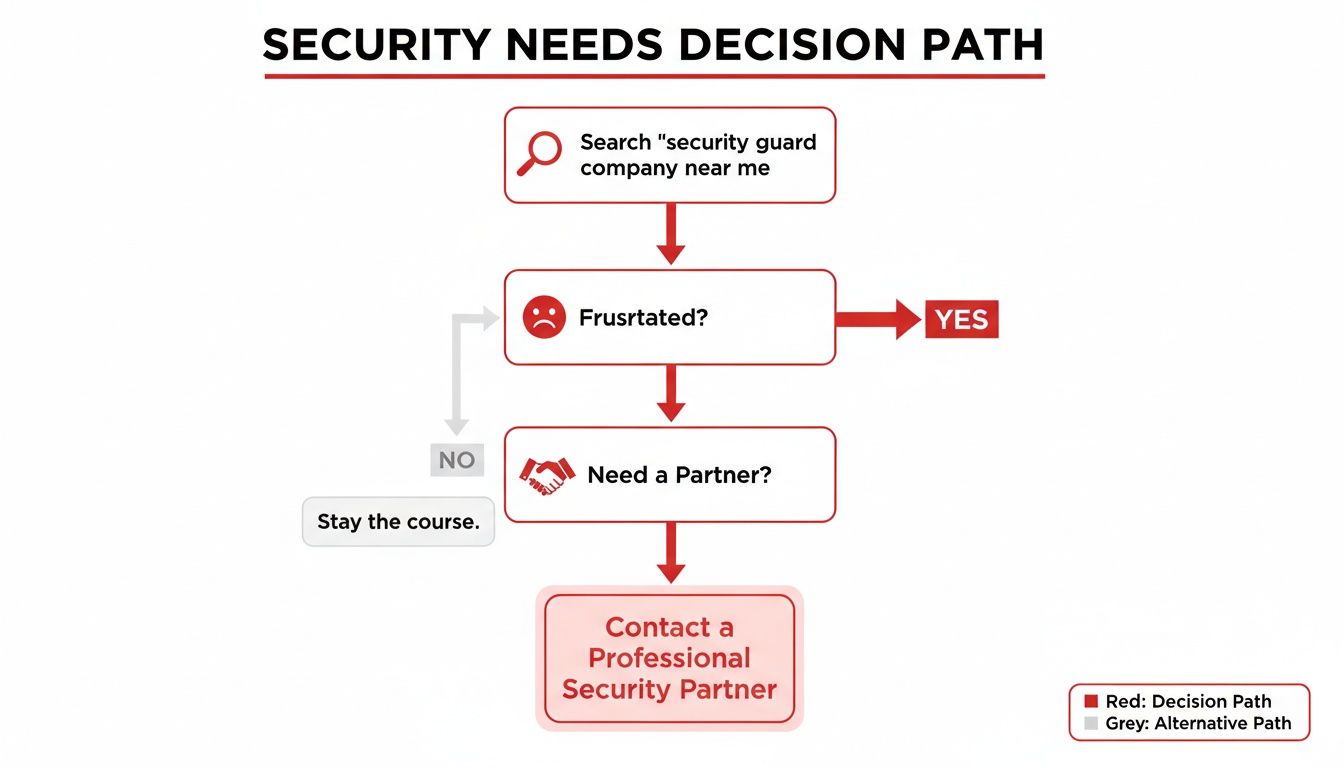
By defining your needs first, you can move past the frustration and find a company that truly understands what you're trying to accomplish.
Match the Right Service to the Right Problem
With your goals and a list of vulnerabilities in hand, you can start to determine what kind of security service makes sense. Not every issue requires a 24/7 onsite guard, but a simple mobile patrol might be inadequate for a high-traffic retail center.
Our Pro Tip: When you can clearly articulate your needs, you control the conversation. Instead of asking for a generic quote, you can say, "I need to secure three entry points, deter loitering in our back parking lot between 10 PM and 6 AM, and receive daily reports with photos."
This level of detail is a game-changer. It encourages a quality security company to propose a thoughtful, customized plan.
For example, a retail manager dealing with organized theft needs a highly visible, proactive officer trained in loss prevention. A facilities director for a quiet suburban office park, however, might only need random vehicle patrols to check that doors are locked and report maintenance issues like burst pipes or HVAC failures.
Different properties have different pressure points. The table below breaks down some common scenarios to help you connect your property type to the most effective service model.
Matching Security Services to Your Property Type
This table helps property managers and business owners identify the most effective security solutions based on their specific environment and common challenges.
| Property Type | Common Security Pain Points | Recommended Service Model | Key Officer Duties |
|---|---|---|---|
| Corporate Office Building | Unauthorized access after hours, visitor management, parking lot incidents | Onsite Concierge/Lobby Ambassador + Mobile Patrols | Access control, visitor check-in, enforcing parking, after-hours patrols |
| HOA / Apartment Community | Amenity access control, noise complaints, package theft, parking enforcement | Onsite Officer (peak hours) or Dedicated Mobile Patrol | Enforce community rules, respond to resident calls, visible deterrence |
| Retail Shopping Center | Shoplifting, loitering, vandalism, customer/employee safety | Standing Onsite Officer + Mobile Patrol | Visible presence, loss prevention, assist store managers, escort employees |
| Construction Site | Theft of materials (copper, lumber), equipment vandalism, trespassing | Overnight Onsite Officer or Remote Video Monitoring | Perimeter security, access control for contractors, equipment log checks |
| Industrial / Warehouse | Cargo theft, access control at gates, employee security checks | Mobile Patrols (randomized) + Gate Officer | Check seals on trailers, verify BOLs, patrol fence lines, monitor cameras |
Understanding these pairings gives you a significant head start.
By doing this homework first, you shift from being a reactive buyer to a strategic planner. You'll be far better equipped to evaluate proposals, ask thoughtful questions, and ultimately find a local security company that acts as a genuine partner in protecting your property.
Digging Into a Security Company’s Credentials and Reputation
Once you have a shortlist of potential security partners, the real work begins. A quick search for a "security guard company near me" will give you a dizzying array of options, from massive global corporations to small, local operators. Their sales pitch, however, rarely tells the whole story.
Your job is to look past the promises and focus on the fundamentals. A company's credentials aren't just bureaucratic checkboxes; they are your first line of defense against liability and a clear indicator of their professionalism.
The Non-Negotiables: Licensing and Insurance
Before you get lost in reviewing a lengthy proposal, confirm two absolute must-haves: state licensing and proper insurance coverage. Think of these as the minimum requirements for any security provider you would consider.
-
State Licensing: In California, security companies must be licensed by the Bureau of Security and Investigative Services (BSIS). You should always verify their license status online. Working with an unlicensed operator is a significant red flag that opens you up to legal and financial risks.
-
Insurance Coverage: Ask them for a Certificate of Insurance (COI) that names your company as an additional insured. Don't just glance at it. Look for substantial general liability, workers' compensation, and commercial auto policies. If an incident occurs on your property involving one of their officers, their insurance needs to be the primary line of defense—not yours.
A slick website or a low price can be tempting, but it means nothing if the company isn't legitimate. Verifying these credentials takes just a few minutes and can save you from a potential disaster by weeding out unprofessional providers immediately.
Hiring a company without proper licensing and insurance is like inviting uninsured, unvetted strangers to protect your most valuable assets. It’s a risk no property manager or business owner should ever take.
Beyond the Paperwork: Reputation and Reliability
With the basics confirmed, it’s time to see how the company actually performs in the real world. This means looking beyond their polished marketing materials to find out what their service is truly like on the ground.
Start with online reviews on platforms like Google or Yelp, but don't stop there. The most valuable insights will come from talking to current or former clients, especially those in an industry similar to yours. A reputable company with a strong track record won't hesitate to provide you with local references.
Here’s a pro tip that’s often overlooked: ask about their employee retention rate. The private security industry is known for high turnover, which directly translates to inconsistent service, undertrained officers, and a revolving door of new faces at your property. When you're vetting a company, it’s important to understand their internal hiring practices, including how security firms conduct pre-employment assessment tests to ensure they're bringing reliable people on board.
Don't be shy about asking direct questions:
- "What's your average officer turnover rate?"
- "What kind of ongoing training do you provide your team?"
- "How do you support your officers to keep them engaged and professional?"
A company that invests in its people—something we've focused on at Overton Security for 26 years—is a company that invests in its clients' success. Low turnover is a sure sign of a healthy company culture that values consistency and professionalism. That’s exactly what you should be looking for in a security partner.
Understanding the Industry Landscape
While you're likely focused on finding a great local partner, it helps to understand the scale of the security industry. A handful of dominant players generate enormous revenues, showing the kind of resources available at the top. For example, Allied Universal Security Services LLC brings in around $20 billion globally, and Securitas AB generates $15.5 billion.
The entire investigation and security services sector employs over 735,000 guards, who make up almost 74% of the industry’s workforce, mostly through contract services.
This context is important. While the giants have vast resources, they can sometimes make you feel like "just another number." A dedicated local or regional firm can often deliver more hands-on management and a level of service that’s truly tailored to your community's specific needs.
Evaluating Technology and Real-Time Accountability
Not too long ago, the tools of the security trade were a clipboard, a pen, and a flashlight. Today, that’s no longer enough. When you’re looking for a security partner, you need to look past the uniform and examine the technology that proves they're doing the job effectively.
Modern security isn’t about flashy gadgets; it’s about verifiable proof of service. The right tech gives you a clear, unbiased record of an officer’s activities, which is the only way to have real confidence that your property is being protected as promised. It transforms security from a blind-faith agreement into a transparent partnership.
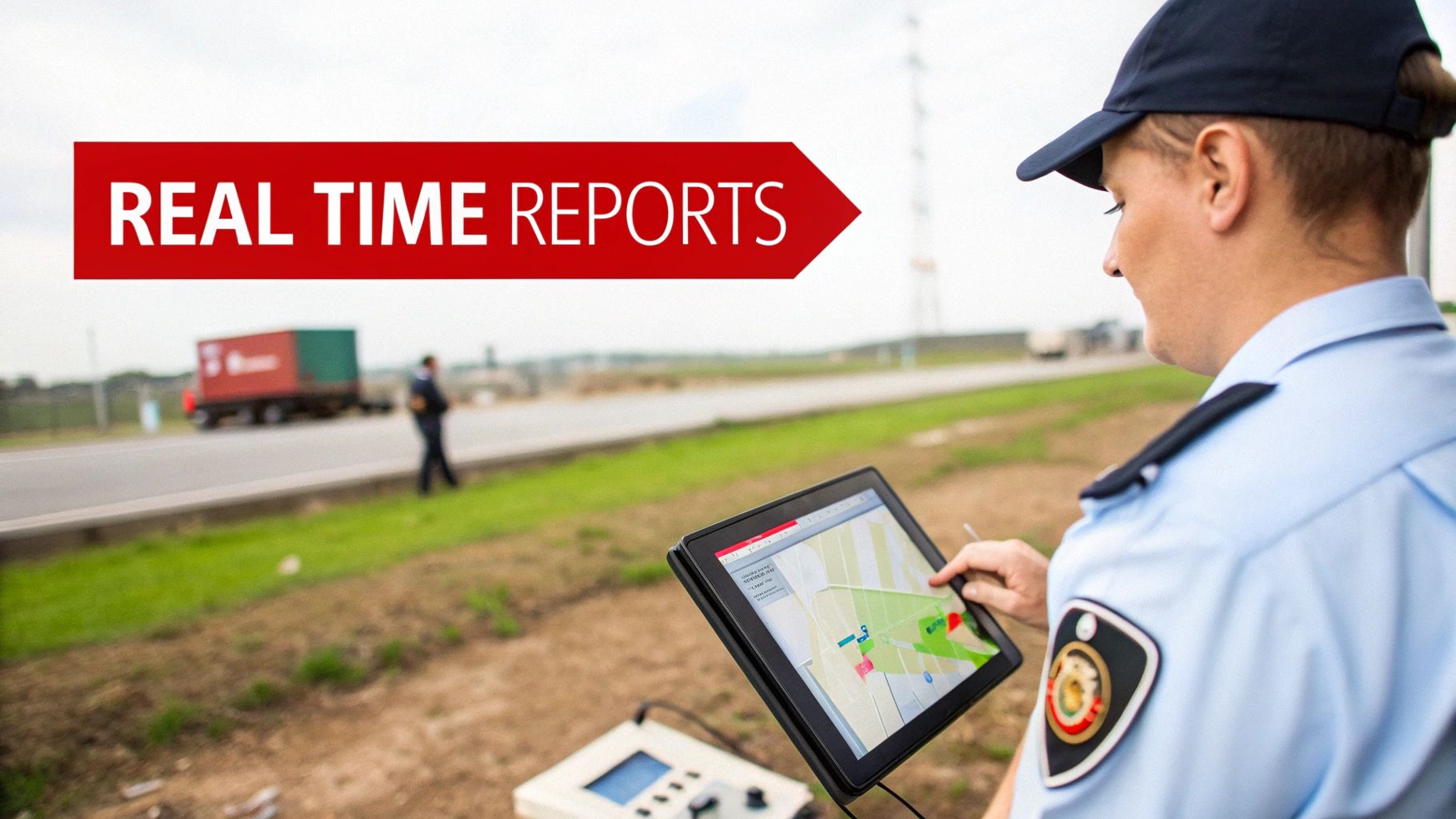
This is what separates a professional, modern security firm from one that’s stuck in the past. It’s the difference between hoping your property is safe and knowing it is.
From Clipboards to Cloud-Based Reporting
The absolute baseline for any modern security company is a Guard Tour Management System (GTMS). This software replaces old paper logs with a dynamic, real-time reporting platform that officers use directly from a smartphone or tablet.
Instead of trying to decipher illegible handwritten notes the next day, a GTMS provides instant, detailed information. Officers can document patrols, report incidents, and immediately upload photos or videos of things like a broken gate lock or an unauthorized vehicle—all tagged with a precise timestamp and GPS location.
This technology delivers a few critical benefits:
- Verifiable Patrols: Officers scan NFC tags or QR codes at designated checkpoints, proving they were physically present at crucial spots like your back fence line or server room door. No more guessing if rounds were completed.
- Instant Incident Alerts: You can be notified the moment a serious issue is logged, allowing you to respond in minutes instead of finding out hours later.
- Rich, Actionable Data: Digital Daily Activity Reports (DARs) give you a clean, clear log of everything that happened on a shift. This data, complete with photos, is invaluable for liability and operational insights.
When you’re vetting a potential company, ask them this specific question: "Can you walk me through a sample daily activity report from your system?" A professional firm will be proud to show you their reporting. A less advanced one might get defensive. This simple request reveals a great deal about their commitment to transparency.
The Power of a 24/7 Security Operations Center
A professional team in the field needs professional backup. That’s where a Security Operations Center (SOC) comes in. Think of it as a 24/7 command hub—the nerve center for the entire security operation. A real SOC isn't just an answering service; it’s a critical layer of oversight and support.
An effective SOC provides:
- Real-Time Officer Monitoring: SOC specialists track officers via GPS to ensure they're safe, on schedule, and actively patrolling. They also perform regular wellness checks, which is especially important for officers working alone on large or high-risk sites.
- Intelligent Dispatch: If an incident occurs, the SOC can dispatch the nearest mobile patrol unit, coordinate with law enforcement, and ensure the on-site officer has the support needed to handle the situation calmly and effectively.
- After-Hours Emergency Handling: When you’re asleep, the SOC is your first line of defense. They manage alarms, respond to tenant calls, and escalate critical issues based on the exact protocols you’ve established.
The presence of a fully staffed, 24/7 SOC is the mark of a serious security company. It shows they have invested significantly in their infrastructure and are committed to officer safety and client support. It’s also the hub for more advanced services; you can learn more about how technology and human oversight work together in this property manager's guide to remote video monitoring.
By prioritizing companies that blend human expertise with smart, practical technology, you ensure you’re not just hiring a guard—you’re investing in a comprehensive and accountable security program.
Getting Down to Brass Tacks: The Contract and the People
After you’ve done your homework on a company’s credentials and technology, it all comes down to two things: the agreement you sign and the people you’ll be dealing with day-in and day-out. A solid service agreement is your safety net, but the quality of their management team will make or break your experience. This is where you move beyond just looking for a "security guard company near me" to finding a true partner.
The fine print matters. A professional, well-written contract is a hallmark of a company that takes its responsibilities seriously. Before signing, focus on the terms covering liability, contract length, and especially the cancellation policies. A good provider will be completely transparent and happy to walk you through these details.

However, a contract is only as strong as the people who stand behind it. That's why the human element is absolutely critical.
The Overlooked Metric That Changes Everything: Manager-to-Client Ratio
In the security industry, it's common for large national providers to assign hundreds of clients to a single account manager. This approach often leads to communication breakdowns and unresolved issues, making you feel like just another invoice. When your manager is stretched too thin, your property’s security suffers.
This is why a low manager-to-client ratio is one of the clearest signs of a company that prioritizes service. It's a foundational principle we’ve built our business on for 26 years. When a manager has a portfolio they can truly manage, they can give your property the hands-on attention it deserves.
Here’s what that looks like in the real world:
- Proactive Site Visits: Your manager is on your property regularly—not just when a crisis hits. They get to know your site's unique characteristics and can adjust the security plan before a small issue becomes a major liability.
- Real Problem-Solving: If a question or issue arises, you get a fast, informed answer from someone who knows your account inside and out. No endless phone trees or waiting for a callback.
- Better Officers: A present and engaged manager provides better support to the officers on the ground. This boosts morale, reduces turnover, and results in a more alert, professional team protecting your property.
You're making a significant investment in your security program. You deserve a dedicated point of contact who is just as invested in its success. A low manager-to-client ratio makes that possible.
Asking the Right Questions to Find a Real Partner
Your evaluation shouldn't end with the bill rate. To truly understand the quality of the team you'll be working with, shift the conversation to the people who will be running your account. It’s a simple change that separates true security partners from vendors just selling a uniform.
During your final meetings, ask these direct questions:
- Who is my direct, day-to-day contact? Push for a name and a title. If they give you a vague answer or point you to a generic 800-number, that's a red flag.
- What’s their experience with properties like this one? A manager who understands residential communities has different expertise than one who specializes in construction sites. Relevant experience matters.
- Realistically, how often should I expect to see my account manager on-site? Their answer speaks volumes about their commitment to being hands-on.
- How do you support your officers to keep them engaged and professional? This question gets to the core of their company culture and approach to retention.
Even as technology gets smarter, the demand for reliable human oversight isn't going anywhere. In fact, the global market for manned security services is on track to hit $24.60 billion in 2025. Businesses are realizing that you just can't replace human judgment when things get unpredictable. You can dig into the full research about these security market trends to see where the industry is heading.
Ultimately, choosing a security provider is an act of trust. By focusing on the strength of their management team and the clarity of their contract, you’re not just hiring a service—you’re gaining a partner who is committed to your peace of mind.
Common Questions We Hear About Hiring Local Security
When you start searching for a "security guard company near me," questions are bound to come up. Here are some of the most common ones we hear from property managers, HOA board members, and business owners, along with our straightforward answers.
What Is the Difference Between Onsite Guards and Mobile Patrols?
This is one of the most fundamental questions, and getting it right is key to an effective security plan.
An onsite guard provides a dedicated, continuous presence at your property. This is the ideal solution for controlling access at a busy corporate lobby, managing a gatehouse for an apartment community, or protecting a high-value construction site overnight. Their job is to be a constant, visible deterrent and the immediate first responder if an incident occurs.
Mobile patrols, on the other hand, are a cost-effective way to create a security presence over a larger area. A marked patrol vehicle making visible, randomized checks at a business park, shopping center, or sprawling apartment complex is a powerful tool for discouraging opportunistic crime. We can help you assess your property’s specific risks and budget to determine which model—or a hybrid of both—makes the most sense.
How Much Does a Quality Security Guard Service Cost?
The cost depends on several key factors: the officer's experience and qualifications (armed vs. unarmed), the complexity and risk level of your site, and the number of coverage hours you need. While it can be tempting to choose the lowest bidder, this is one area where that strategy often leads to disappointment.
An unusually low bill rate is a significant red flag. It often indicates minimal officer training, high employee turnover, inadequate insurance, and liability risks that can ultimately fall on you, the client.
It’s better to view security as an investment in protecting your assets and managing risk, not just another line-item expense. A quality company that pays its officers a competitive wage and supports them properly will deliver a far greater return in reliability and peace of mind. For a deeper look, our guide on how to hire security guards breaks down what to look for beyond just the price tag.
What Should I Do If I'm Unhappy with My Current Security Company?
Making a change can feel like a challenge, but you should never feel stuck with a security provider who isn't meeting your expectations.
The first step is to review your current contract and take a close look at the termination clause and any required notice periods.
Next, document the specific issues. Keep a simple log of missed patrols, late arrivals, unprofessional behavior, or poor communication. Having clear, factual evidence makes your position stronger and justifies the need for a switch. From there, a professional security partner can work with you to plan a seamless and discreet transition, ensuring there are no gaps in coverage during the handover.
How Involved Is Your Management Team with Client Accounts?
This question gets to the heart of what separates a true security partner from a faceless national vendor.
Our entire approach is built on hands-on leadership and a low manager-to-client ratio. This isn’t just a talking point; it’s a structural commitment that ensures your account gets the dedicated attention it deserves.
Our managers are not just sitting in an office. They are out in the field conducting regular site visits, maintaining open lines of communication directly with you, and actively overseeing officer performance. We believe in being an accessible, accountable partner who knows your property and your priorities—not just another name on an invoice.
At Overton Security, we've spent over 26 years building a reputation for reliability and hands-on service. If you're ready to partner with a local security company that prioritizes transparency and accountability, contact us today for a complimentary security assessment.