
Deciding to hire a security guard for your home is a significant step. It’s a move that goes beyond installing cameras or an alarm system; it involves bringing a proactive, physical layer of safety—a thinking, observant professional dedicated to protecting your property and family.
This is a choice many homeowners make when they determine that technology alone isn't enough. They need a human presence to deter potential threats, manage access, and provide an immediate, intelligent response when a situation arises.
Is a Security Guard Right for Your Home?
For many homes, a quality alarm system and well-placed cameras provide a solid baseline of protection. However, certain situations and elevated risk factors call for a more direct, human-centric approach to security.
This isn’t about just placing a uniform on your driveway. It’s about strategically integrating an experienced, professional officer into your overall security plan. You're adding a dimension of security that technology, for all its advances, simply can't replicate. A camera records an event; a guard can often prevent it from ever happening. An alarm alerts you after a breach; a guard can investigate a noise, assess the situation, and de-escalate it on the spot.
When to Consider Professional Home Security
The need for a personal security guard often stems from specific circumstances. You might find yourself considering this level of protection if any of these scenarios feel familiar:
- You're Facing Targeted Threats: If there's a known risk aimed at you, your family, or your home, a physical deterrent is one of the most powerful and reassuring tools you have.
- You Have High-Value Assets On-Site: Collections of fine art, classic cars, jewelry, or other irreplaceable items often justify having dedicated, professional protection right there at home.
- Your Property is Large or Secluded: A home with a sprawling perimeter, multiple entry points, or an isolated location can be a challenge to secure with tech alone. A patrolling guard covers those blind spots and provides a crucial visible presence.
- You Travel Frequently or Are Gone for Long Stretches: An empty house can be a magnet for trouble. A residential security officer ensures your property is actively protected and monitored, even when you're thousands of miles away.
- You Simply Want Ultimate Peace of Mind: For some families, nothing compares to the constant, reassuring presence of a trained professional. That feeling of safety is invaluable.
To help put this in perspective, let's look at how different security measures stack up against each other.
Comparing Home Security Solutions at a Glance
This table helps you see where a security guard fits into the bigger picture of home protection.
| Security Measure | Best For | Key Benefit | Typical Limitation |
|---|---|---|---|
| DIY Alarm/Cameras | Basic deterrence and self-monitoring. | Low cost and user control. | Relies on you to respond; no professional backup. |
| Monitored Alarm System | Standard residential protection. | Professional monitoring and emergency dispatch. | Reactive; alerts after a breach has occurred. |
| On-Site Security Guard | High-risk properties, proactive deterrence. | Immediate, on-site response and prevention. | Higher cost; requires vetting a quality service. |
| Mobile Patrol Service | Neighborhoods or properties needing a visible presence. | A visible deterrent that covers a wider area. | Response times can vary; not dedicated solely to you. |
Each option has its place, but as you can see, a dedicated guard offers a unique level of proactive engagement that other solutions can't match.
The decision to hire a guard almost always boils down to one thing: wanting proactive prevention instead of just reactive alerts. A trained officer’s judgment and their ability to act intelligently in those first critical moments of an incident is an asset you simply can't put a price on.
This desire for personalized protection is clearly a growing trend. The global market for private security services, which includes residential protection, was valued at USD 4.62 billion in 2024 and is on track to hit nearly USD 8 billion by 2030. You can read more about the private security market's growth to see the full picture. This shift shows that more homeowners are actively seeking reliable, hands-on security.
Ultimately, choosing to hire a security guard is about taking a clear look at your unique risks and deciding that a human element is the missing piece of your safety puzzle. It's a serious investment in active deterrence and the kind of immediate, professional response that brings true peace of mind.
Conducting a Realistic Home Security Risk Assessment
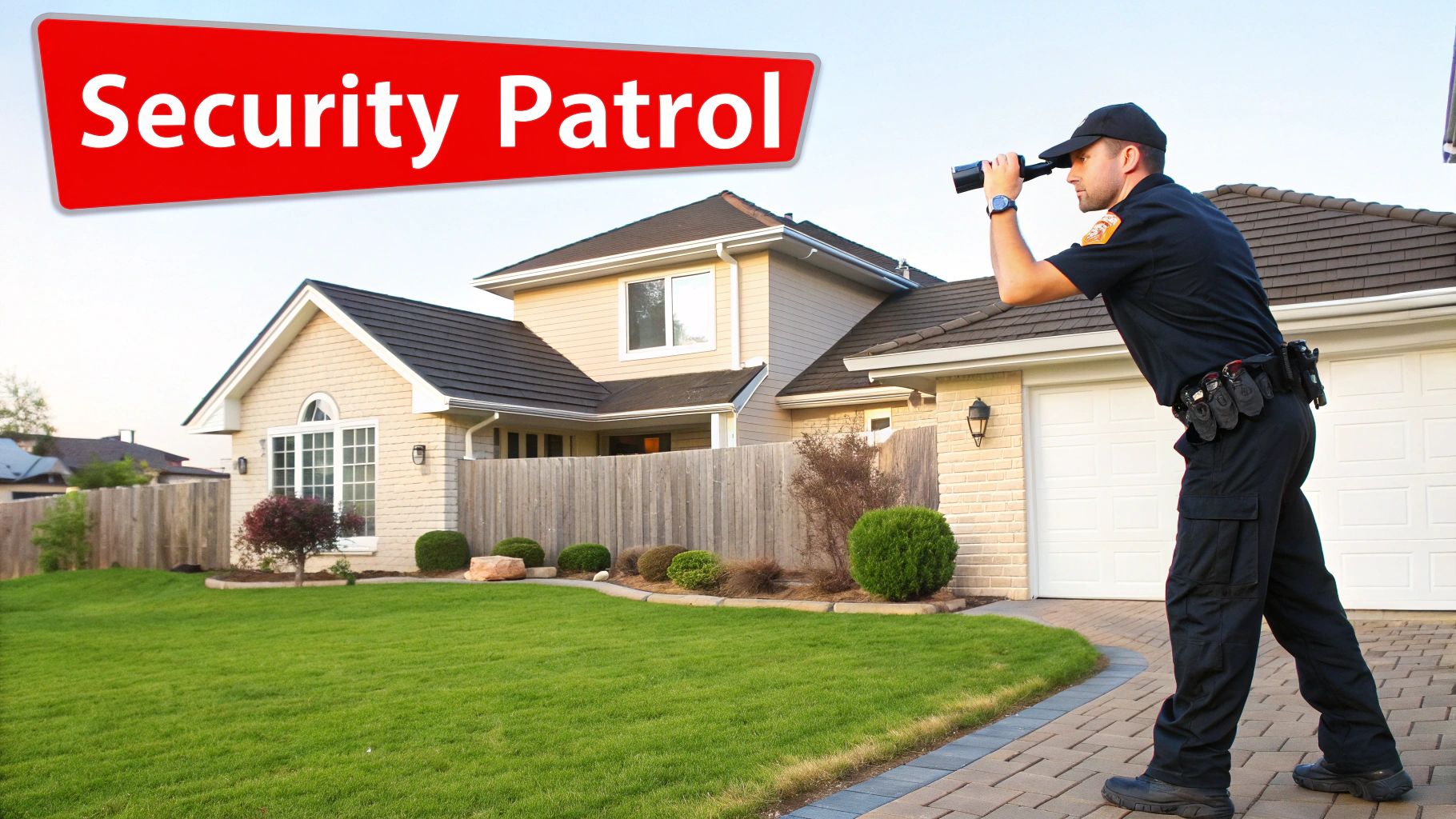
Before you can effectively secure your home, you have to learn to see it through the eyes of someone who might wish to do it harm. A proper risk assessment isn't just about checking locks; it's a thoughtful look at your property's specific weak spots. This process is the foundation for determining what kind of security guard for home protection you actually need.
Think like a security professional for a moment. They are trained to look for the path of least resistance. Start by walking your property's perimeter, both during the day and again at night. Take note of overgrown bushes that offer hiding spots, gates that don’t latch properly, or poorly lit corners that cast deep shadows. These are precisely the kinds of details our officers are trained to identify and monitor.
A complete assessment goes deeper than physical weaknesses. It also means taking stock of your personal risk factors. Your lifestyle, profession, and the assets you own play a significant role in what level of protection makes sense for you.
Identifying Key Vulnerability Points
Every property has potential vulnerabilities. The key is to identify them before an intruder does. When you are proactive, you can direct your security officer to focus on these specific areas, effectively turning a potential weakness into a monitored strength.
Consider a common scenario: a family leaving for a two-week vacation. Their home, now sitting empty, can become a more attractive target. A security professional wouldn't just glance at the front door; they would check second-story windows, the unlit back patio, and the side gate that offers a discreet path from the street.
To help with your own assessment, focus on these critical areas:
- Perimeter and Access: How easy is it for someone to get onto your property? Check fences, walls, and gates. Are there spots where someone could enter without being seen?
- Lighting and Visibility: This is a major factor. Walk around after dark and identify blind spots where an intruder could hide from the street or your windows. Inadequate lighting is a common security flaw but is often one of the easiest to correct.
- Entry Points: Look at every door and window—including those upstairs or in the basement. Are the locks high quality? Do sliding glass doors have a secondary lock or a blocking bar?
- Camera and Sensor Blind Spots: Review your security camera footage. Are there significant gaps in coverage? A security guard provides the human oversight that technology can sometimes miss.
A professional assessment isn't about creating concern; it’s about building awareness. Understanding where you are most vulnerable is the first step toward creating a security plan that provides genuine peace of mind and proactive protection.
Evaluating Personal and Asset-Related Risks
Beyond the physical layout of your home, your personal situation shapes your security needs. Having a security guard for home services becomes especially critical when you face risks that go beyond a random break-in. This is about protecting more than just a building; it's about safeguarding your family, your assets, and your peace of mind.
Different communities face different threats, which can be reflected in their security investments. For example, certain faith-based communities have reported spending as much as 14% of their annual budgets on security. A single guard can cost around $90,000 per year, which shows how specific threat profiles demand a serious investment in professional human security.
Your own risk profile might be higher if you:
- Possess High-Value Assets: This could be fine art, jewelry, a collection of exotic cars, or sensitive business documents kept at home. These items may require a level of protection that a simple alarm system cannot provide.
- Have a High Public Profile: Executives, public figures, or those involved in contentious legal matters may be potential targets. A visible, capable guard is a powerful deterrent.
- Travel Frequently: An empty house can be a target for opportunistic criminals. A residential security officer ensures the property is looked after, can manage deliveries, and provides a constant presence.
- Are Experiencing Specific Threats: In difficult situations like domestic disputes, issues with disgruntled former employees, or targeted harassment, a guard provides an immediate line of defense and a de-escalating presence.
By honestly evaluating these physical and personal factors, you can build a clear risk profile. This detailed picture is the most important tool you'll have when you begin speaking with security providers, ensuring that conversation is productive and focused on solutions for your real-world needs.
Defining Your Security Needs and Budget
Once you have a clear picture of your property's risks, it's time to translate that knowledge into a concrete plan. This is where you move from theory to action, outlining the exact services you need and determining a realistic budget. Getting these details right ensures you find a security guard for home protection that genuinely fits your situation.
Two of the biggest decisions you'll face are choosing between armed and unarmed guards and deciding on the type of patrol that makes the most sense. Each choice directly impacts the service's effectiveness and its cost. Understanding these nuances is key to creating a security plan that delivers real value.
Armed vs. Unarmed Guards: Which Is Right for You?
The decision to station an armed officer at your home is a serious one and should be based entirely on your risk assessment. This isn't about choosing the "strongest" option; it's about choosing the appropriate one for your circumstances.
-
Unarmed Security Officers: For the vast majority of residential needs, an unarmed officer is the ideal choice. Their primary role is to deter, observe, and manage access to your property. A professional, visible presence is often more than enough to discourage opportunistic crime. These officers are trained in de-escalation, reporting, and coordinating with local law enforcement.
-
Armed Security Officers: This level of protection is reserved for situations with known, elevated threats. If your assessment uncovered specific dangers to you or your family, an armed guard provides a necessary layer of defense. These officers undergo intensive, specialized training in firearms use, use-of-force protocols, and how to respond to immediate threats.
Naturally, armed services come at a higher cost due to the advanced training, licensing, and liability involved. The goal is to match the service level to the actual risk, not to over- or under-protect your home.
Stationary Post vs. Mobile Patrols
Next, you'll need to consider how the guard will cover your property. The best approach depends on the size and layout of your home and its specific weak points. A stationary post provides focused protection on a key area, while mobile patrols create a broader, more unpredictable deterrent.
Key Takeaway: A security plan’s value is measured by its effectiveness, not its price tag. A single, well-trained, and properly compensated officer from a reputable firm will always deliver greater peace of mind and better results than several undertrained guards from a low-bid company.
At Overton Security, we live by this principle. Our 26-year history is built on providing quality over quantity. We ensure our officers are well-supported and have high retention rates, which translates directly to more consistent and reliable service for our clients.
Establishing a Realistic Security Budget
When you set a budget for security guard for home services, it's important to look beyond the simple hourly rate. The total investment reflects the professionalism, training, and support system behind the officer. For example, some communities dealing with specific, ongoing threats may spend around $90,000 annually for a single dedicated guard, demonstrating that serious risks require a serious investment.
Your budget should account for a few key factors:
- Guard Type: Armed officers will cost more than unarmed officers.
- Coverage Hours: Are you looking for 24/7 protection, or just overnight and weekend coverage? The number of hours directly impacts the investment.
- Service Model: A dedicated guard posted at your gate is priced differently than a mobile patrol that visits several properties in a circuit.
A true security partner will work with you to balance these factors against your budget. They should offer transparent pricing that clearly explains what you’re paying for—not just the officer's time, but the 24/7 dispatch support, real-time reporting technology, and hands-on management that ensures quality.
For a deeper look at what separates a great provider from the rest, our guide on finding the best security guards in Sacramento has some valuable tips that apply no matter where you are in California. Taking this thoughtful approach ensures you’re making a sound investment in your family’s safety.
How To Vet And Select A Professional Security Company
Choosing the right security partner for your home is a decision built entirely on trust. You're not just hiring a service; you're inviting a team of professionals into your life to protect your family and your property. After you've assessed your risks, the next step is to look past the slick marketing and find a company that's truly reliable.
This means checking for the essentials, asking insightful questions, and understanding what separates a quality-focused partner like Overton Security from companies that just see officers as disposable commodities. Your goal is to find a provider whose entire philosophy matches your need for consistent, professional protection.
This simple workflow shows the path from understanding your needs to finalizing your security partnership.
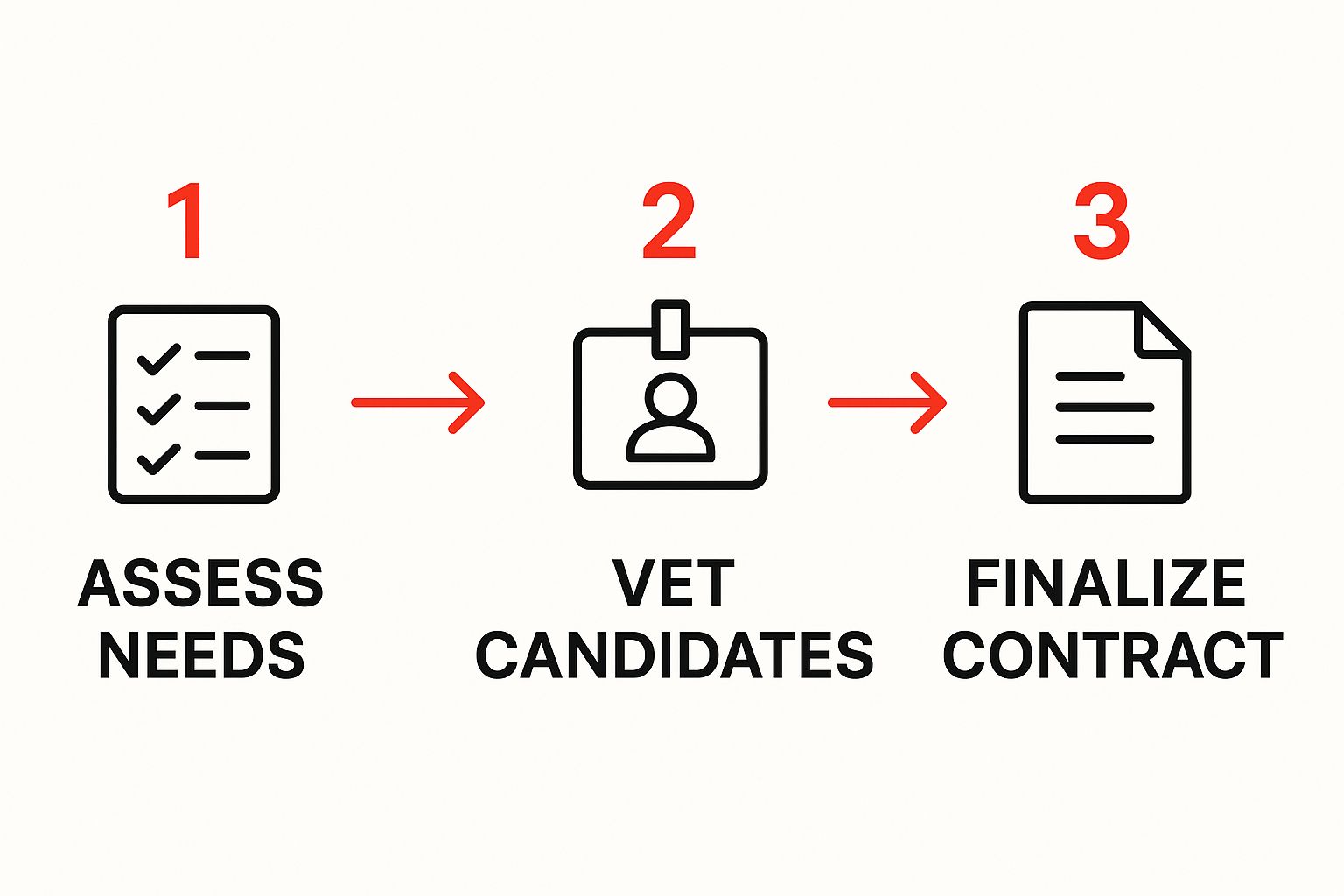
As you can see, a successful outcome depends on a methodical approach. It starts with a clear assessment and moves deliberately through vetting and final selection.
The Non-Negotiable Credentials
Before you discuss services or pricing, any potential company must clear several fundamental hurdles. These are the absolute, must-have qualifications that prove they are a legitimate, professional, and responsible business.
Any hesitation on their part to provide this documentation is a major red flag.
Essential Vetting Checklist:
- Proper Licensing: Verify the company holds a valid Private Patrol Operator (PPO) license from the relevant state authority, like California's Bureau of Security and Investigative Services (BSIS).
- Comprehensive Insurance: Ask for their certificate of insurance. At a minimum, they need general liability, workers' compensation, and an umbrella policy. This protects you from liability if an incident occurs on your property.
- Rigorous Employee Screening: A professional company will have a thorough screening process that includes background checks, reference verifications, and drug testing for every security guard for home assignments.
Think of these items as the baseline. A company that has this all in order is showing its commitment to operating legally and professionally.
Differentiators That Signal A Quality Partner
Once the basics are covered, it's time to dig deeper. This is where you separate a company that delivers genuine value from one that simply fills a shift. The best security providers are defined by how they operate and how they treat their people.
At Overton Security, we've built our 26-year reputation on these very principles. We deliberately maintain a low manager-to-client ratio, which means our leadership team provides hands-on support and makes frequent site visits. This structure prevents that common industry problem where clients feel ignored the second the contract is signed.
A security company's officer retention rate is a direct reflection of its service quality. High turnover—the "burn and churn" model—leads to inconsistent service, missed details, and a constant rotation of unfamiliar faces at your home.
When you're vetting a company, you have to ask direct questions that reveal their operational integrity. Don't be shy; a confident, professional provider will welcome the scrutiny.
Key Questions To Ask Potential Providers
Your conversation with a potential security company should feel like a consultation, not a high-pressure sales pitch. Use these questions to guide the discussion and get a real feel for their professionalism and transparency.
- What is your officer training and retention strategy? A good answer will detail their investment in employees. They should talk about competitive pay, ongoing professional development, and opportunities for advancement. This shows they value their officers, which always leads to better service for you.
- Can you show me a sample of your digital incident reports? Modern security relies on technology for accountability. Their reports should be clear, detailed, and backed by a system like a GPS-enabled guard tour that gives you time-stamped, verifiable data.
- What is your supervisory structure? Find out who your direct point of contact will be and ask how often supervisors actually visit the property. Hands-on leadership is absolutely crucial for maintaining quality service over the long haul.
Asking the right questions is vital to making a choice you can be confident in. For more guidance, our detailed resource on how to choose a security company in San Jose offers additional insights that are valuable for any homeowner. By taking a thoughtful and inquisitive approach, you empower yourself to select a true security partner who will provide lasting peace of mind.
Fusing Human Instinct with Your Smart Home Tech
A truly secure home doesn't make you choose between technology and people—it blends them into one powerful, cohesive system. Your smart home devices, from doorbell cameras to motion sensors, are excellent at flagging activity. But what happens after the alert? That’s where a professional security guard for home protection changes the game, turning automated notifications into intelligent, human-led responses.
This combination of human expertise and smart technology is the new standard in residential security. Think of it as a powerful synergy: your tech provides the initial heads-up, and a trained officer provides the on-the-ground investigation, critical thinking, and decisive action. They don’t replace your tech; they make it smarter.
The market is already shifting this way. In 2024, the home security systems market was valued at over USD 54 billion, and it's expected to hit around USD 58 billion in 2025. A big part of that growth comes from homeowners who want to pair their smart devices with professional services. You can discover more about these home security market trends to see how integrated solutions are becoming the norm.
How Guards Turn Tech into Action
A professional security company doesn't just send an officer to your property; they send a trained professional who knows how to use your existing technology to its fullest potential. At Overton Security, we see technology as a tool that enhances our officers' instincts and training, not a replacement for them.
Let's play out a common scenario. It's 2 AM, and your perimeter camera sends a motion alert. On its own, that's just a notification on your phone, leaving you to wonder if it's a real threat or just a raccoon. With an integrated security plan, that alert can be sent directly to your on-site guard.
This immediately empowers the officer to:
- Investigate on the Spot: The guard can walk the perimeter, assess the situation in person, and quickly determine if it's a false alarm or a genuine threat.
- Leverage Your Eyes and Ears: They can pull up your camera feeds on a tablet to get a live view of the area before they even approach, boosting their safety and effectiveness.
- Provide a Verified Response: If there is a legitimate threat, the officer is already there to respond and provide law enforcement with verified, real-time information. This often leads to a much faster police response compared to an unverified alarm.
Using Technology for Verifiable Patrols
Trust must be earned, and in security, that comes from transparency. Modern security tools provide a way to give clients undeniable proof that their property is being watched over with care. This is something we're serious about at Overton, where our hands-on leadership team ensures these systems are used correctly on every property.
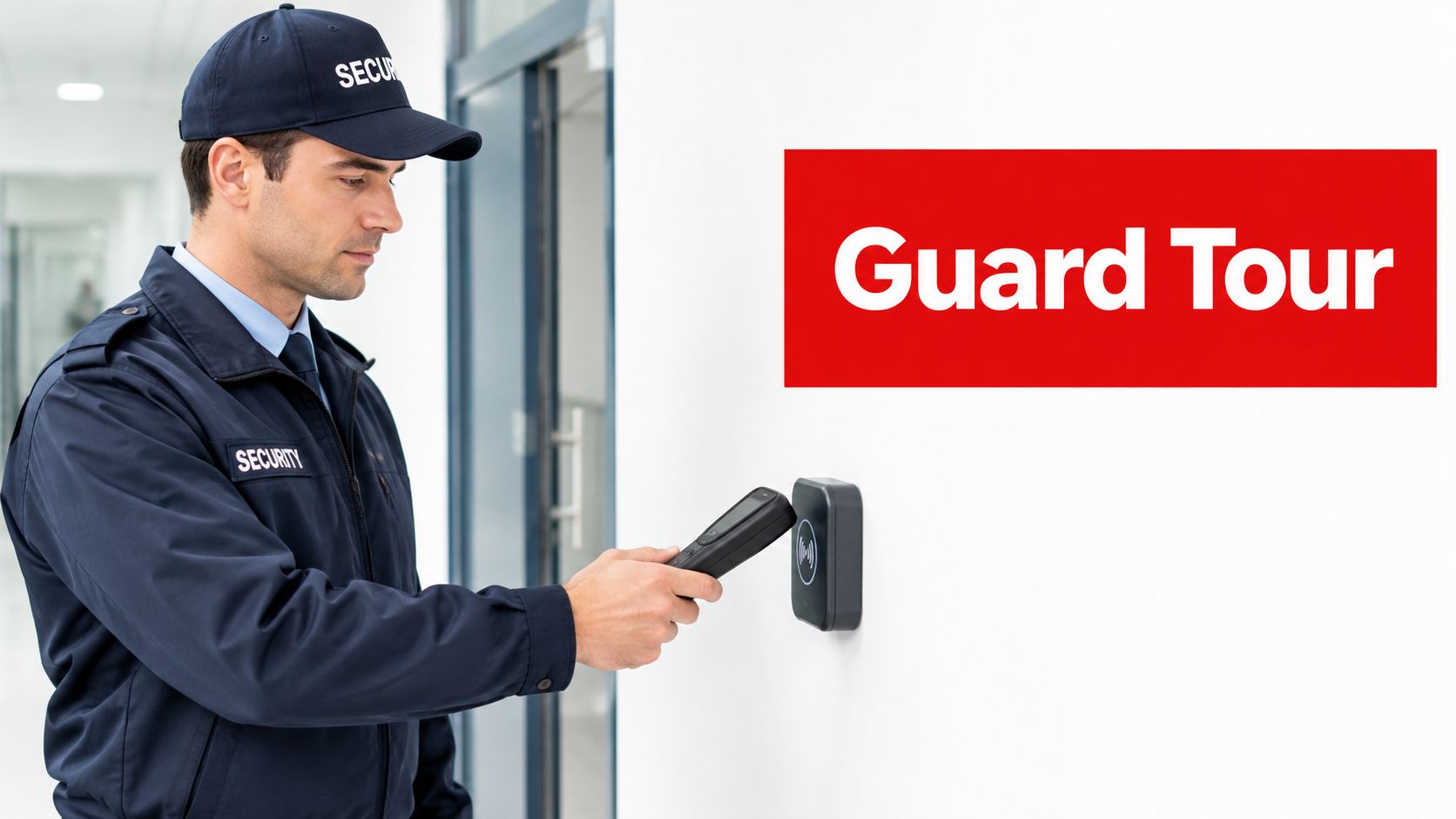
A key piece of technology we use is a GPS-enabled guard tour system. Officers carry a device that tracks their patrols in real time. They scan checkpoints at key locations around your property—think the back gate, the pool house, or a poorly lit corner of the yard. Each scan creates a time-stamped digital record of their exact movements.
This technology completely removes the guesswork. You get detailed reports showing not just that a patrol happened, but precisely when and where each checkpoint was verified. It's concrete proof of service that builds confidence and delivers real peace of mind.
This system also doubles as an instant reporting tool. If an officer discovers a broken window, a faulty sprinkler head, or a gate left ajar, they can log the issue, snap a photo, and send the report straight from the field. You get immediate, documented awareness of any issue, no matter how small. It’s this blend of sharp human observation and seamless digital documentation that sets a truly professional service apart.
Building a Partnership for a Safer Home
Signing a contract isn't the finish line—it’s the start of a security partnership. When you choose a security guard for home protection, the work that follows is what turns that decision into genuine peace of mind. A top-tier security company doesn't just clock in and out; it builds a true partnership dedicated to your family's safety.
This isn't about just placing an officer on your property. It's a collaborative journey that begins with a detailed and structured onboarding process. This foundation is what ensures the service is effective from day one and remains so for the long term.
The Onboarding Process: Your First Step Together
The initial setup period is absolutely critical. This is where your security partner takes all the planning and assessments and turns them into clear, actionable instructions for the officer protecting your home. It’s a meticulous, hands-on effort designed to eliminate any room for error or confusion.
A proper onboarding has several key components:
- Creating Detailed Post Orders: Think of this as the operational guide for your property's security. It outlines every specific duty, from patrol routes and access control to emergency contacts and special instructions—like keeping a closer eye on the back gate.
- Establishing Clear Communication Channels: You should know exactly who to call, for any reason, day or night. This includes your dedicated account manager, our 24/7 dispatch center, and the specific ways you'll receive important updates or daily reports.
- Introducing Your Dedicated Team: We believe you should meet the primary officers assigned to your home. This simple step helps build familiarity and trust, turning the guard from a stranger into a familiar, reassuring presence.
This initial phase sets a professional tone right from the start and establishes a clear rhythm for how things will operate.
Ongoing Communication and Performance Reviews
A home's security needs can change over time. A renovation project, a new valuable asset, or a shift in neighborhood risk can alter the landscape. A true security partner understands this and maintains an open line of communication to adapt the service as your needs evolve.
The real value of a professional security service isn't just in the guard's presence, but in the ongoing management and oversight that ensures consistent, high-quality protection. It's an active partnership, not a passive service.
Regular check-ins and performance reviews are the hallmarks of a company that is serious about excellence. These meetings ensure the post orders are still relevant, the officer is performing to your standards, and any new vulnerabilities are addressed before they become problems. This philosophy is at the core of how Overton Security operates, built on our 26 years of experience forging long-term relationships founded on trust and accountability.
We believe that protecting your home is a profound responsibility. It demands more than a uniform; it requires a dedicated partnership, transparent communication, and an unwavering commitment to your safety. We invite you to experience this level of service firsthand and discover what it means to have a true security partner by your side.
Common Questions About Home Security Guards
Deciding to bring a professional security guard to your property is a big step, and it's natural to have questions. This decision involves your family’s safety and privacy, so getting clear, direct answers is essential. Here are some of the most common questions homeowners ask before making this commitment.
How Much Does a Home Security Guard Cost?
This is often the first question on everyone's mind, and the answer is: it varies based on your specific needs. Key factors that influence the cost include whether the officer is armed or unarmed, the number of coverage hours you require, and the specific duties they will be performing on your property.
We advise looking beyond just the hourly rate and considering the overall value and peace of mind you are receiving. A well-paid, professional officer supported by a reputable company with hands-on management will be far more reliable and effective. The best approach is always to request a custom proposal after a thorough risk assessment of your home.
Will My Family’s Privacy Be Respected?
Absolutely. Discretion and confidentiality are fundamental to our work. A professional security company's reputation is built on its commitment to client privacy.
Everything our security officers do is dictated by "post orders"—a detailed set of instructions created in partnership with you. These orders clearly map out their patrol routes, which are almost always focused on the perimeter of your property, key access points, and the grounds. Unless you specifically request and define an interior presence, their duties are strictly external. Protecting your family's personal space is always the top priority.
For a better sense of what a guard's day-to-day responsibilities look like, check out our article on the duties of security guards in Oakland. The insights there apply to high-end residential security anywhere.
Your family's safety is a profound responsibility, and choosing the right security partner is a decision built on trust. For over 26 years, Overton Security has provided homeowners with professional, reliable, and discreet protection. Contact us today to discuss your security needs and learn how our experienced team can provide you with true peace of mind.