
Security in construction is about proactively protecting your job site. It's a smart, layered strategy to stop theft, vandalism, and unauthorized access. This goes beyond a simple fence; it's a complete system designed to safeguard your high-value materials, expensive equipment, and, most importantly, your project’s timeline from costly disruptions.
Why Your Job Site Is More Vulnerable Than You Think
Every construction superintendent knows that sinking feeling. You arrive on a Monday morning to find the generator gone, a pallet of lumber vanished, or thousands of dollars in copper wire ripped from the walls.
This isn’t just bad luck. It's a calculated move by thieves who see your construction site for what it is: an open-air warehouse packed with valuable, untraceable assets.
Relying on a chain-link fence and a "No Trespassing" sign is a common mistake that can cost you dearly. Today’s job sites are a magnet for trouble for a few key reasons:
- High-Value Targets: From heavy machinery and power tools to raw materials like lumber, copper, and steel, your site is a goldmine for both organized criminals and thieves looking for a quick score.
- Constant Flux: The site is never the same from one day to the next. New access points open, different subcontractors come and go, and materials are constantly on the move. This chaos makes it difficult to maintain control.
- After-Hours Exposure: Most sites are empty at night and on weekends. This gives criminals long, uninterrupted windows to operate completely undetected.
The Human Element of Site Vulnerability
Beyond the risk of theft, you have to consider the people on your site. Robust security is a massive part of overall site safety. The U.S. construction sector employed nearly 8.3 million workers as of January 2025.
Despite that growth, the industry remains one of the most dangerous to work in. According to ISHN.com, both fatal and non-fatal injuries were up in 2024 compared to the previous year, with falls, slips, and trips leading the charge. A professional security presence helps control exactly who is on-site, ensuring only authorized, properly trained personnel are present and contributing to a safer work environment for everyone.
Evolving Threats Require a Modern Strategy
With 26 years of experience, we've seen firsthand how the security landscape has changed. The threats are more sophisticated than just a thief with bolt cutters.
Modern construction relies heavily on digital tools and shared data, opening a new world of vulnerability to cyberattacks. Professional managed IT and cybersecurity services have become a non-negotiable part of a comprehensive security plan. It's another complex layer to account for on a modern project.
It's clear why outdated security measures no longer suffice. They were designed for simpler times and simpler threats.
Modern Site Threats vs. Traditional Security
| Modern Threat | Traditional Method | Effective Modern Solution |
|---|---|---|
| Organized theft rings targeting high-value materials. | Chain-link fence and basic locks. | Layered security: perimeter fencing, mobile surveillance with AI, and on-site guards. |
| Insider threats from subcontractors or temporary staff. | Manual sign-in sheets. | Digital access control with keycards or biometrics to track every entry and exit. |
| Vandalism and property damage during off-hours. | "No Trespassing" signs. | Motion-activated lighting, high-definition cameras with night vision, and live remote monitoring. |
| Cyberattacks targeting project data or connected equipment. | No digital security plan. | Secure networks, regular data backups, and managed IT services to protect digital assets. |
The table above drives home the point: you can't fight today's problems with yesterday's tools. The risks have become far more sophisticated.
Proactive planning is not just an expense; it is a direct investment in protecting your project's budget, timeline, and profitability. A single major theft can cause delays that cascade through every phase of construction, costing far more than a comprehensive security plan.
This guide is about moving past outdated ideas and providing actionable strategies for the real-world challenges superintendents face today. By understanding these vulnerabilities, you can build a layered, intelligent security plan that protects your bottom line.
How to Create a Site-Specific Security Blueprint
A generic, one-size-fits-all security plan is the wrong tool for the job and is bound to fail when you need it most. Every construction site has its own unique mix of challenges and weak points. A project in a busy Los Angeles urban center faces different threats than a sprawling development in a quiet, rural part of Fresno.
Effective security in construction starts with a custom blueprint built on a detailed risk assessment. This isn’t just a quick walkthrough; it's about getting into the mindset of a potential intruder to spot every vulnerability before they do.
Mapping Your Site’s Unique Vulnerabilities
First, you must break down the specific factors that make up your project's risk profile. It’s important to remember that security needs will change as the project moves from breaking ground to the final punch list.
Consider these key variables:
- Project Location: A city site might have constant foot traffic, creating opportunities for casual theft. A remote, rural site could be a magnet for larger, more organized heists precisely because of its isolation.
- Project Phase: During excavation, your biggest assets are heavy machinery. But once you move into finishing stages, high-value materials like copper wiring, HVAC units, and new appliances become top targets.
- Asset Types: There’s a world of difference between protecting $50,000 in copper wire and a $500,000 excavator. The specific assets on your site dictate the kind of threat you need to deter.
This infographic shows the shift from an exposed site with outdated security to one that’s properly secured with a modern, layered strategy.
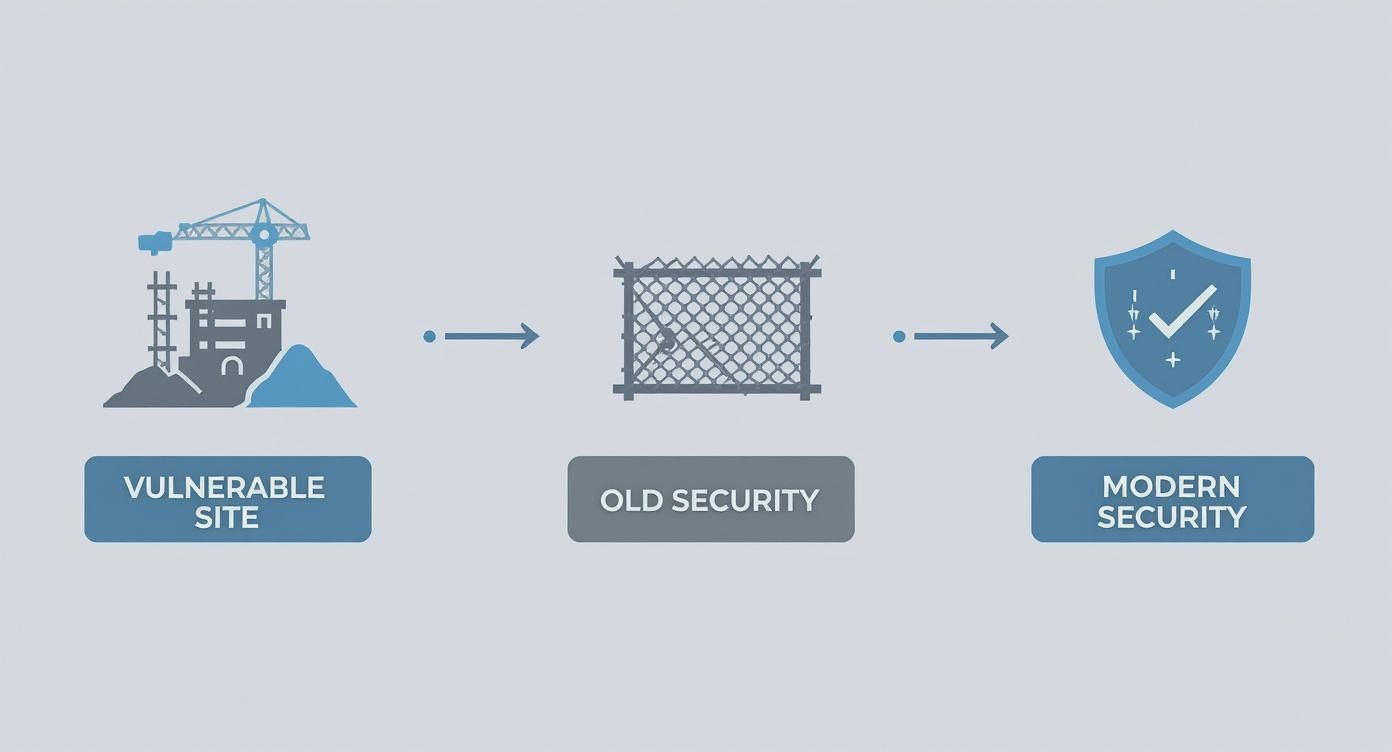
As you can see, a simple fence isn't enough anymore. A truly secure site integrates multiple layers of defense to create an environment that’s difficult for criminals to penetrate.
Thinking Like a Thief
Once you have a handle on the big-picture risks, it's time to get granular. Walk your site with a critical eye, actively looking for the path of least resistance. Your goal is to map out every potential weak point.
Pay close attention to these areas:
- Perimeter Weaknesses: Are there gaps in the fence? Broken gates? What about spots where someone could easily climb over? A reliable gate access system is a foundational piece for securing any job site's perimeter.
- Poorly Lit Areas: Shadows are an intruder’s best friend. Pinpoint every corner, alley, and storage area that lacks good, consistent lighting—or at least motion-activated lights.
- Hidden Access Points: Could someone slip in through an adjacent property? Is there a drainage culvert or a patch of woods that provides cover?
- Subcontractor and Delivery Traffic: How are you vetting the people and vehicles coming and going? Uncontrolled entry and exit points are a massive liability.
A thorough security blueprint does more than just list potential problems—it creates a clear, actionable roadmap for your entire security operation. This document should inform everything from camera placement and patrol routes to access control protocols and emergency response plans.
Putting together a customized plan requires a deep understanding of both construction site operations and modern security best practices. Our comprehensive construction site safety checklist provides a practical framework to ensure you cover all critical bases.
This level of detail is what separates a reactive security team from a proactive one that actively protects your project's bottom line. With a solid blueprint in hand, you’re not just hoping for the best—you’re actively shaping a secure and successful project.
Blending Smart Technology with Human Expertise
Technology alone can't secure your job site. We've seen many projects loaded with the latest gadgets that still get hit. The real effectiveness comes from pairing powerful tools with the judgment and quick thinking of a skilled security professional. For any superintendent, understanding this synergy is key to building a defense that works.
Modern security tech creates force multipliers for your team. These tools feed our officers the crucial alerts and data they need to respond faster and smarter. The goal is simple: get the right information to the right person at the right time.
This isn't just a hunch; it's where the entire industry is headed. The global market for construction worker safety technologies is projected to double, jumping from USD 3.5 billion in 2025 to a projected USD 7.0 billion by 2035. This boom is about adopting digital tools that make sites safer and more secure. A full report from Future Market Insights explores this trend.
Practical Tech for Modern Job Sites
Integrating technology doesn't have to be a headache. The most effective solutions are practical ones, built to solve the specific, on-the-ground problems you face every day.
Here are a few game-changers we rely on:
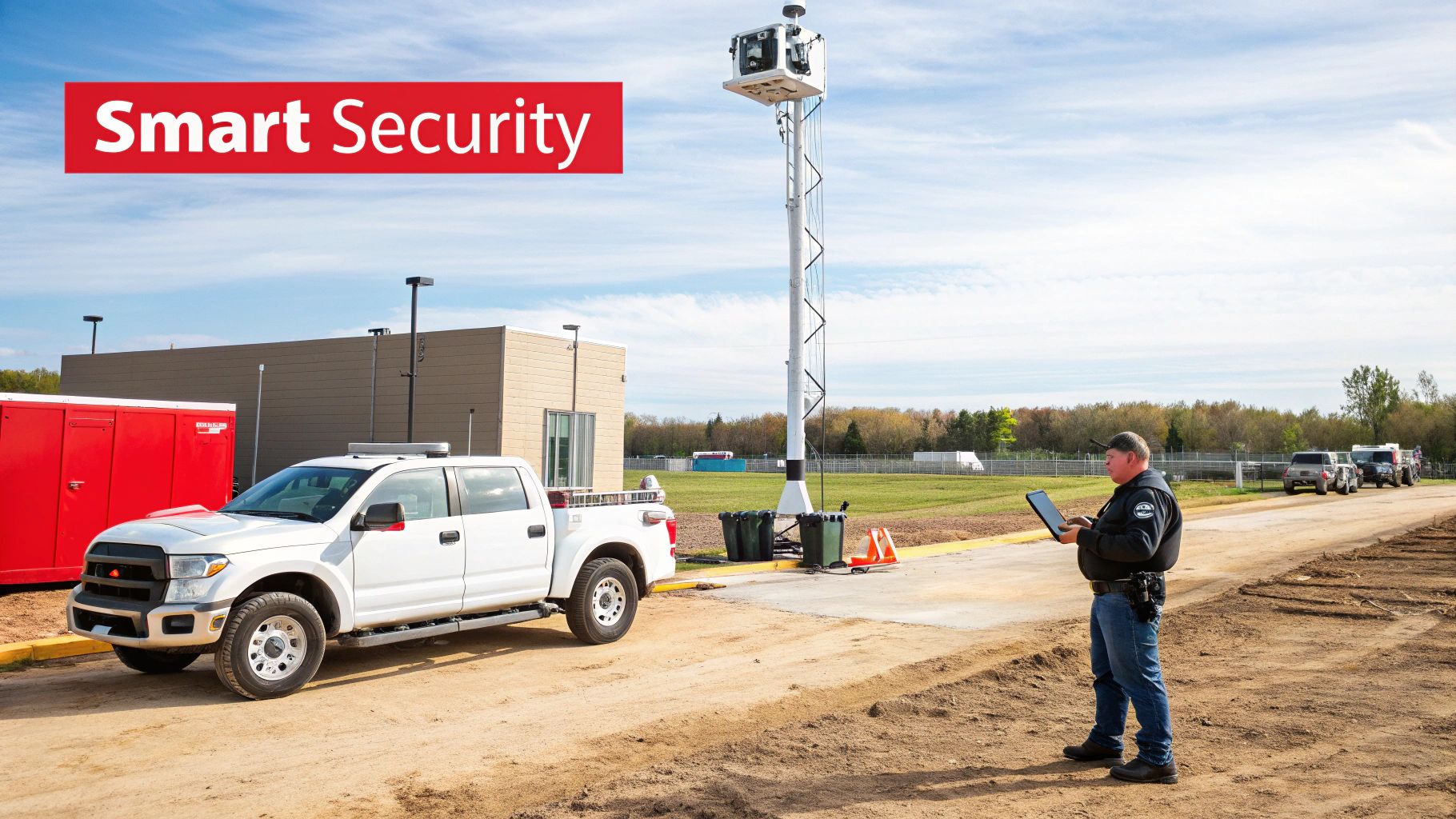
- Mobile Surveillance Units: Think of these as self-contained, solar-powered camera towers you can place anywhere on site. They provide high-definition eyes on vulnerable spots like material laydown yards or fuel tanks, with no permanent power or wiring required.
- IoT Equipment Sensors: We attach these small, durable GPS sensors to high-value assets—generators, welders, skid-steers. If a piece of equipment moves after hours or leaves a geofenced area, our 24/7 Security Operations Center (SOC) and the on-site patrol get an instant alert.
- Advanced Access Control: The old sign-in sheet is a thing of the past. Modern systems use keycards or mobile apps to track everyone coming and going, creating a clear digital log and preventing unauthorized individuals from wandering on site.
These tools don't work in isolation; they create a web of protection. High-def cameras from our remote video monitoring services can visually confirm a threat, while GPS tracking pinpoints its exact location. This allows for an intelligent, targeted response instead of a blind search in the dark.
Where Technology and Expertise Intersect
Let’s walk through a real-world scenario. It's 2 a.m. on a site in San Jose. An IoT sensor on a new forklift triggers an alert—the machine has moved 50 feet toward a back fence line.
Technology fired the first shot, giving us the initial alert. But it can't make a judgment call. It doesn't know if high winds knocked something over or if it's a legitimate theft in progress. This is where a person must take over.
The alert hits our SOC instantly. An operator pulls up the live feed from a nearby mobile surveillance unit and confirms it: two individuals are trying to cut through the fence. At the same time, the operator dispatches the closest GPS-tracked patrol vehicle, feeding the officer real-time updates on the suspects' movements.
The patrol officer arrives in minutes—not driving around aimlessly, but heading straight to the breach. The sight of a professional security vehicle and a uniformed officer is often all it takes. The thieves flee. The officer then secures the perimeter, documents the attempted theft with photos using our digital reporting system, and sends a detailed report to the superintendent before the morning crew even clocks in.
In this situation, technology gave us the what and the where. But the professional officer provided the critical judgment, response, and resolution that tech alone never could. This blend of smart tools and skilled people is the foundation of effective security in construction. It’s how you turn a passive monitoring system into an active, intelligent defense that truly protects your project.
The True Value of a Professional Security Officer
It’s easy to think of a guard on a construction site as just a person in a uniform—a simple deterrent. But there is a significant difference between hiring a basic security guard and partnering with a truly professional security officer. One is a passive presence. The other is an active asset, protecting your project from a host of threats beyond a thief with bolt cutters.
While technology is excellent for sending alerts, a trained officer brings something technology can't: human judgment. A professional becomes an integrated part of your site team, a proactive force working to maintain security and operational safety around the clock. Their real value is measured not just in the incidents they stop, but in the ones they prevent from happening in the first place.
More Than Just a Deterrent
A common misconception is that an officer's primary job is to just be seen. While a visible presence is a powerful deterrent, the duties of a professional run much deeper. They become your eyes and ears after hours, handling tasks that protect your project in ways you might not even consider.
These responsibilities are all about active engagement:
- Meticulous Access Control: They don't just wave people through. They maintain detailed, accurate logs of every person, vehicle, and delivery that enters or leaves, creating an undeniable record and ensuring only authorized personnel are on site.
- Active Safety Hazard Identification: They proactively patrol the site to spot and report safety issues—unsecured scaffolding, improperly stored flammable materials, or potential trip-and-fall hazards.
- Detailed Digital Reporting: Using modern systems, they provide real-time, photo-documented reports of any incident, from a suspicious vehicle to a damaged fence. You get immediate awareness of what's happening on your property.
This level of involvement transforms security from a simple cost into a vital piece of your risk management strategy, making your project safer and more efficient.
An Officer's Role in Site Safety
A professional officer's vigilance has a direct impact on site safety. They are often the first to spot issues that could lead to accidents or serious damage, which is critical in an industry where risks are everywhere.
For instance, recent data highlighted some alarming trends involving workers being struck by falling objects. A staggering 69% of these incidents occurred on construction sites, resulting in 5 fatalities and 4 major injuries. An officer trained to spot unsecured materials at height and report them immediately can be the difference-maker.
We had a dedicated officer report a slow water leak from a newly installed pipe at 3 AM. His quick observation prevented what would have been catastrophic flooding and tens of thousands of dollars in water damage by the time the morning crew arrived. This is the true value—protecting your project from more than just theft.
This proactive approach is at the core of what we do at Overton Security. We focus on building a team of experienced, career-oriented officers. We refuse to participate in the "burn and churn" so common in the security industry. Instead, we invest in high-quality professionals who take real ownership of their role. That commitment means you get a consistent, reliable partner who truly understands your site's unique challenges.
The Overton Difference in Officer Quality
Our commitment to our people allows us to deliver exceptional service. By fostering a supportive environment with competitive pay and real opportunities for growth, we attract and retain officers who see security as a profession, not just a temporary job. This is central to everything we do.
This focus on quality is what sets our services apart. We believe the right person on your site can make all the difference, providing a level of observation and critical thinking that automated systems alone can't match. For construction superintendents wondering about the next steps, we put together a helpful guide on how to hire security guards that breaks down what to look for in a quality provider.
Ultimately, the real value of a professional security officer lies in their ability to think, adapt, and act. They are the human element that connects your security blueprint, technology, and safety culture into a single, effective system that protects your project, your people, and your bottom line.
Fostering a Security-First Culture on Your Job Site
Technology and security officers are the cornerstones of any solid job site security plan, but they can't do it all. The most sophisticated camera system or diligent guard can be undermined if the people on your site aren't bought in. Real security on a construction project happens when everyone—from your PMs down to every subcontractor and laborer—starts thinking about security as part of their job.
This means getting people to see security not as someone else's problem, but as a shared responsibility. When your crew becomes an extension of your security team, your whole operation gets tighter and tougher to target. The goal is to build a culture where vigilance is simply how things are done.
Turning Your Workforce into a Security Asset
A security-conscious culture doesn't happen overnight. It's built on clear rules, consistent reinforcement, and a real partnership between your leadership, the crews, and your security provider. Your workforce is one of your best deterrents—they are the first to notice a truck that doesn't belong or a gate left unlocked.
Getting there means putting practical, easy-to-follow procedures in place that become part of the daily routine. These are simple habits that, together, make a huge impact.
Start with some non-negotiables for everyday tasks:
- Strict Tool Check-In/Out: Set up a simple logbook or system. All company tools get signed out at the beginning of a shift and signed back in before heading home. This creates instant accountability and makes it much harder for expensive tools to "disappear."
- Delivery and Visitor Verification: No one gets past the gate without being checked. Every delivery needs to be matched to a purchase order, and every visitor must be pre-approved and signed in by a supervisor. No exceptions.
- Secure End-of-Day Lock-Up: Give your foremen a clear checklist for securing their areas. This should cover everything from locking up copper wire and other valuable materials to ensuring all gang boxes are shut and portable equipment is stored away properly.
A security-first culture is all about shared ownership. When every worker knows they have a role to play in protecting the site, they're the ones who will report a suspicious vehicle or question an unfamiliar face without having to be told.
The Role of Your Security Partner in Building Culture
Your security provider should be a partner in this effort, not just an observer at the gate. An effective security partner actively helps you build and maintain that culture. It's a core part of our service.
Our officers are trained to be more than just a uniform; they become a familiar, professional presence on your project. They help brief new crews on security protocols during orientation, making sure everyone is on the same page from day one.
Throughout the project, they reinforce these standards by managing access control and conducting regular patrols to spot and fix security gaps. Their constant presence and professional approach set the tone for the entire site, sending a clear message that security is a top priority.
With 26 years of experience in this field, we know that this kind of collaborative effort is what truly secures a project. It’s the combination of your team, our officers, and smart, simple protocols that turns a vulnerable site into a hard target.
Your Partner in Protecting Project Profitability
Construction site security isn't just about buying a few cameras and hiring a guard; it’s about building an integrated system that protects your project from day one to the final handover. It all starts with a custom risk assessment that addresses your site’s unique vulnerabilities. From there, it's about blending smart technology with the irreplaceable judgment of professional officers.
When you also foster a security-aware culture among your crews, everyone on site becomes a protective asset. This layered strategy—planning, tech, people, and culture—is the only reliable way to defend your timeline and budget from the constant threats of theft, vandalism, and the costly delays they cause.
With over 26 years of hands-on experience protecting complex job sites across California, from sprawling developments in Los Angeles to high-stakes projects in Sacramento, we know how to build this system. We’ve built our reputation at Overton Security on quality, consistency, and hands-on leadership.
Your focus should be on building the project, not worrying about what happens after your crews leave for the day. True security provides peace of mind and protects your bottom line.
Ready to stop reading about security and start implementing it? Let our experts help you build a security plan that works for your site.
Contact Overton Security today for a complimentary, site-specific security consultation and protect your project’s profitability from day one.
Answering Your Top Construction Security Questions
When it comes to securing a job site, many practical questions arise. With 26 years of experience, we've guided countless construction superintendents through these very same issues. Here are the answers to the questions we hear most often.
When Should I Hire Security For a New Construction Project?
Ideally, before you even break ground. The best time to bring a security partner on board is during the pre-construction planning phase. It is far more effective—and cost-efficient—to build security into your plan from day one rather than adding it on later.
When you involve security early, you can design the site layout for maximum protection. We can help you strategically place access control points, plan camera coverage, and map out lighting. This approach helps prevent unauthorized access before the first high-value materials even arrive, heading off risks from the very beginning.
What’s Better: Mobile Patrols or a Stationary Guard?
This is a common question, and there's no single right answer. The best solution usually involves a smart mix of both, designed specifically for your site's size, risks, and budget. It all comes down to what you need to protect.
Here’s how we break it down for our clients:
- Stationary Guards are perfect for controlling a critical choke point, like the main gate when crews are coming and going. They're also the best choice for watching over a high-value storage area or laydown yard overnight.
- Mobile Patrols offer a powerful, visible deterrent across large or sprawling sites. They can sweep the entire perimeter, check multiple gates, and respond to an alarm on the far side of the project in minutes. Their random patterns keep potential thieves guessing.
We often recommend a hybrid approach. For example, a stationary officer at the main gate can manage daytime traffic, backed by GPS-tracked mobile patrols making random, unpredictable checks throughout the night. This creates layers of security that cover your bases without breaking the bank.
The right security mix isn't about choosing one service over another. It's about layering solutions to create a system where each component supports the others, covering all potential vulnerabilities without overspending.
How Much Does Professional Construction Security Cost?
The cost for professional security in construction depends on your site's unique profile—its size, location, risk level, and the specific services you need. It’s a serious investment, but it must be weighed against the potential cost of a major incident.
Think about it: a single theft of copper, lumber, or heavy equipment can easily cost tens or even hundreds of thousands of dollars. That’s before you factor in project delays and liquidated damages, which can make the initial security cost seem minor by comparison.
A good security provider will start with a detailed risk assessment. From there, they can provide a clear, customized quote that shows exactly how they’ll protect your bottom line.
Ready to get real answers for your project? Overton Security has the hands-on expertise to protect your job site and your profitability. Get in touch with our security experts today.