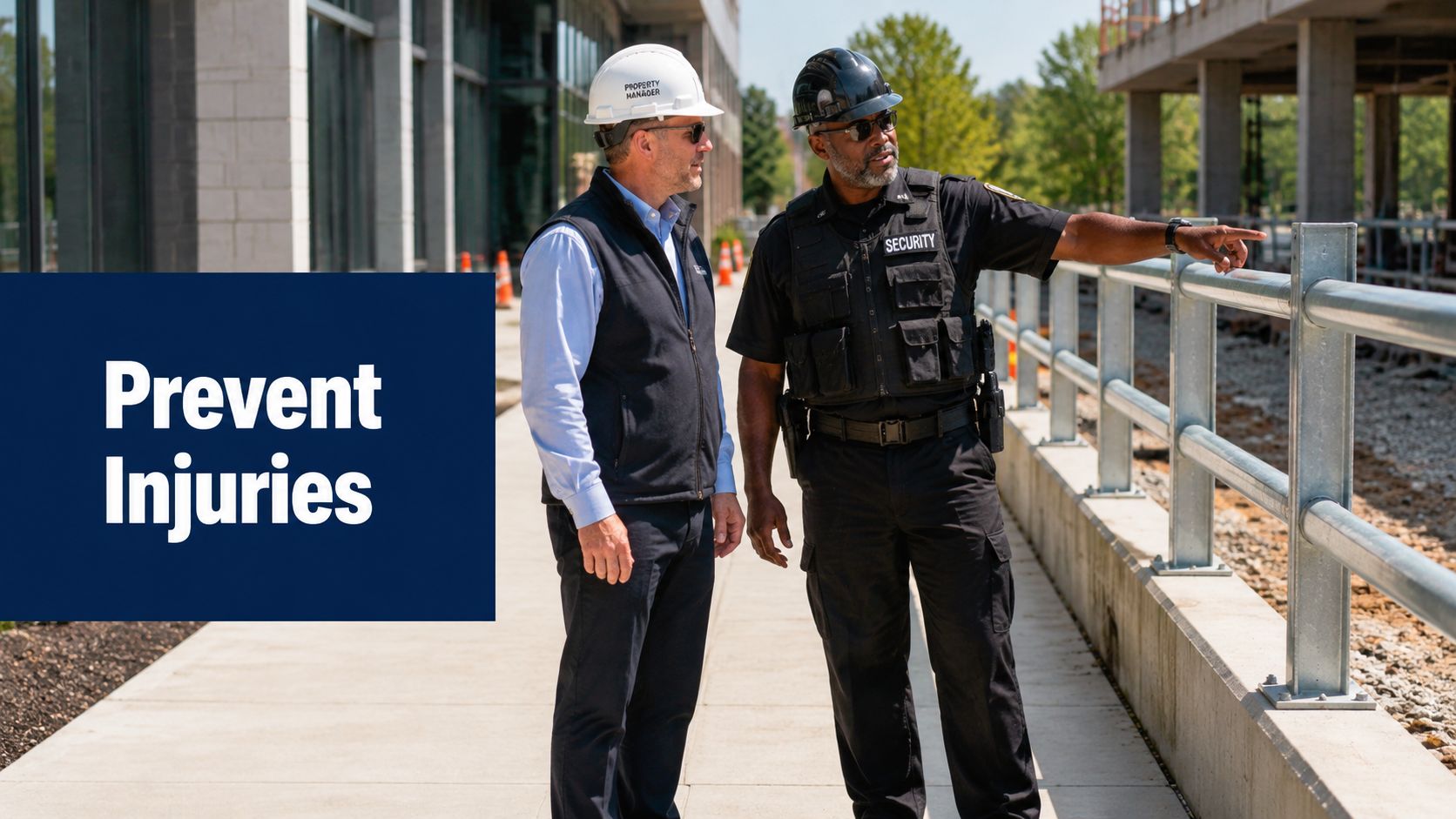
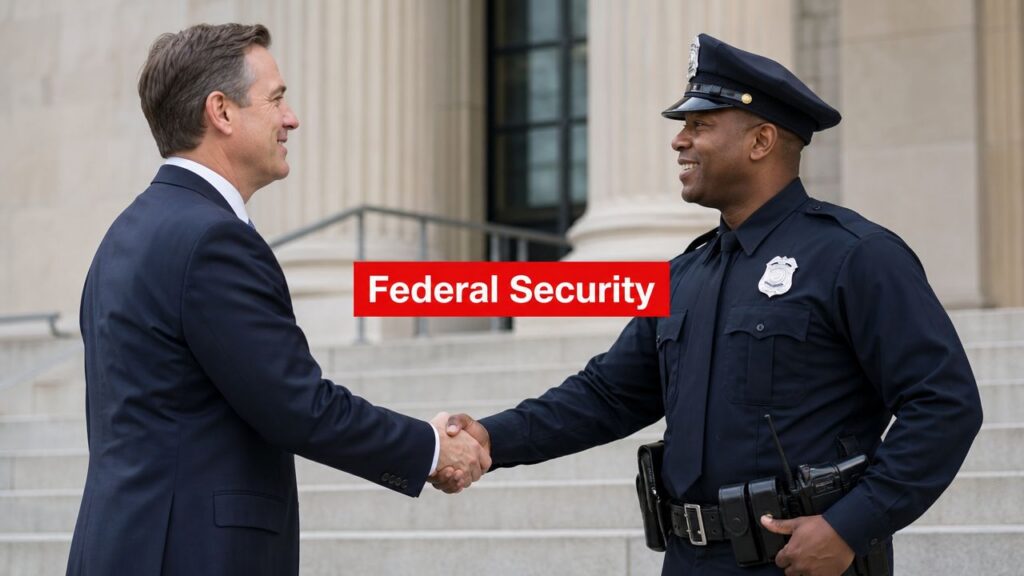
A lot of property managers run into the same problem at the worst possible time. A disturbance starts near a federal building, your tenants call the lobby, local police are en route, and someone on your team asks whether the armed officers next door can help secure your entrance too.
Usually, the answer is more limited than people expect.
Federal armed security is one of those terms that sounds straightforward until you have to make an operational decision around it. If you manage a commercial tower in Los Angeles, a mixed-use property in San Francisco, or a medical office campus near a federal tenant, the important question isn't just what federal armed security is, but where federal authority stops, where private responsibility begins, and how to protect your property without assuming someone else has your perimeter covered.
Navigating Complex Security Scenarios
A common urban scenario goes like this. A protest forms on the public sidewalk between your building and a federal courthouse. The federal side increases its posture. Your tenants see armed personnel nearby and assume security coverage has expanded across the whole block.
It hasn't.
Federal officers are there for the federal mission. Your responsibility is still your property, your entrances, your loading dock, your parking structure, your after-hours access points, and your tenant movement. If your team doesn't separate those responsibilities quickly, confusion spreads fast. Front desk staff hesitate, building engineers get pulled into crowd-management questions, and nobody is fully sure who is making the next call.
The first decision is always boundary control
When an incident unfolds near federal property, facilities directors should sort the situation into three zones:
Federal space
This includes the federal building, its controlled access points, and the areas under federal protection protocols.Public space
Sidewalks, curb areas, and streets usually involve municipal rules and local law enforcement response.Private property
Your lobby, garage, service corridors, stairwells, roof access, leasing office, and shared amenities remain your problem to solve.
That sounds simple, but under pressure people blur those lines.
Practical rule: If the risk can move onto your property within minutes, treat it as your incident even if it started next door.
What facilities teams need in the moment
The best response isn't guessing who has authority. It's having a clear private-side plan that works alongside public agencies without interfering with them.
That usually means:
- Locking down access points: Shift from convenience access to controlled entry.
- Updating post orders: Give officers clear direction on perimeter observation, visitor restrictions, and escalation.
- Coordinating with law enforcement: Report conditions, don't freelance.
- Documenting movement: Track who entered, who was denied, and what changed by the hour.
For many properties, contract security becomes far more useful than people assume. A well-run private team can handle access control, post rotation, incident documentation, and tenant reassurance without crossing jurisdictional lines. If you're weighing where contract coverage fits across public and private environments, this guide on contract security for public and private sectors is a useful starting point.
Defining Federal Armed Security
Federal armed security isn't just private security with a tougher uniform. It exists to protect U.S. government assets, facilities, personnel, and sensitive operations.
That mission is the key difference.
A private property owner hires security to protect a business, residents, staff, visitors, or physical assets on privately controlled property. Federal armed security serves a government mandate. The client isn't a shopping center, HOA, or office landlord. The protected interest is federal.

What the role actually covers
Think of federal armed security as the protective layer around government operations. That can include:
- Government assets such as records, equipment, evidence, and controlled materials
- Facilities and infrastructure including courthouses, office buildings, labs, ports, and secured compounds
- Personnel and information involving employees, visitors, contractors, and sensitive data environments
One of the clearest reference points is the Department of Homeland Security. DHS was created in response to the September 11, 2001 attacks and began operating in 2003. In fiscal year 2024, DHS spent $89.3 billion, which was 1.3% of total federal spending of $6.78 trillion, and ranked 10th among federal agencies by spending, according to USAFacts' overview of the Department of Homeland Security. That matters because DHS houses major security functions tied to anti-terrorism, border security, immigration and customs enforcement, cybersecurity, and disaster management.
Why this matters to private property managers
The biggest misunderstanding is assuming federal armed security is a premium version of commercial guard service. It isn't. Federal posts are designed around agency protocols, federal rules, protected spaces, and mission-specific response expectations.
For a facilities director, that means two practical things:
| Security question | Federal armed security | Private property security |
|---|---|---|
| Who are they protecting? | Federal mission and federal assets | Your tenants, staff, visitors, and property |
| Who directs the work? | Federal agency and contract requirements | Property ownership and site-specific post orders |
| What drives deployment? | Government risk and agency operations | Business risk, liability, service needs, and site conditions |
Federal armed security is closer to an in-house protective force for government operations than a general-purpose armed guard service you can call in for a private property problem.
That distinction helps clear up a lot of confusion. If your building sits near a federal tenant or facility, their security posture may affect your planning. But it doesn't replace your own.
Jurisdiction and Authority Differences
If you only remember one distinction, remember this one. Authority follows jurisdiction.
Federal armed security and private armed security may both wear a duty belt and carry a firearm. That visual similarity leads people to assume they can act in the same way, in the same places, for the same reasons. They can't.

Federal authority is tied to the federal mission
Federal armed personnel operate under federal statutes, agency directives, and assigned facility rules. Their authority is generally connected to federal property, federal persons, and federal operations.
That doesn't mean they automatically become a roaming security resource for nearby private buildings. In practice, their job is narrow and specific. They are there to secure the federal side of the line.
The public often focuses on the firearm. But the day-to-day role is broader. The Department of the Interior states that federal security guards protect against terrorism, vandalism, sabotage, trespass, theft, and security breaches, and that their duties also include access control, patrol, and dispatcher functions, as described on the Department of the Interior security guard career page.
Private authority is narrower and contract-driven
Private armed officers work under state and local law plus the authority granted by the property owner or lawful occupant. Their job is to protect the site they are assigned to, enforce site rules, observe and report, deter misconduct, manage access, and escalate to law enforcement when required.
That makes private security highly useful, but it also means clients need to understand the limits. Your officer can't act like a federal agent because your contract says "armed." The assignment has to be built around lawful private security functions.
Here is the cleaner comparison:
| Area | Federal armed security | Private armed security |
|---|---|---|
| Primary jurisdiction | Federal property and assigned federal functions | Private property under client control |
| Source of authority | Federal law and agency directives | State law, licensing rules, and client authorization |
| Core mission | Protect government operations | Protect people, property, and operations at a private site |
| Accountability path | Federal chain of command | Security company supervision, client reporting, and local legal standards |
| Common use cases | Courthouses, federal offices, secured government sites | Offices, retail centers, residential communities, healthcare, construction |
If a threat starts on the sidewalk and then moves toward your lobby, the handoff matters. Federal officers may secure their space. Your team still needs a plan for yours.
What works in real operations
Facilities directors don't need to memorize legal theory. They need to know how to avoid the most common mistakes.
The mistakes usually look like this:
- Assuming nearby federal presence covers your entrances
- Expecting private officers to intervene outside their lawful role
- Skipping joint communication plans with local police
- Using armed coverage when the actual gap is access control or screening
What works is much more disciplined.
A better operating model
Use a layered model instead of a weapon-centered model:
- At the perimeter: Control entry points, loading docks, garage gates, and credential checks.
- At the lobby: Train officers to handle visitor screening, de-escalation, and clear denial procedures.
- At incident level: Require immediate reporting, supervisor escalation, and law enforcement coordination.
- After the event: Review logs, camera footage, and officer actions against post orders.
One other federal baseline is worth knowing. For federally regulated armed-security functions, 49 CFR 1562.29 states that each armed security officer must be qualified to carry a firearm, as shown in the eCFR firearms qualification requirement. That tells you something important. In regulated settings, carrying a weapon is treated as a formal qualification requirement, not a branding decision or a client preference.
For private property, the same principle should apply. Armed coverage only makes sense when the site, threat profile, legal framework, and supervision model all support it.
Federal Security Certification and Clearance
Federal security work sits in a different vetting category from ordinary guard placement. That doesn't mean every federal post requires the same background process or clearance level. It does mean the standard is tied to the sensitivity of the mission, the facility, and the information environment.
For facilities directors, the takeaway is simple. Federal armed security is specialized because the hiring, qualification, and documentation standards are specialized.

Hazardous duty is built into the classification
In federal qualification standards, security guard work is treated as hazardous. The Office of Personnel Management states that qualifying experience includes protecting property against fire, theft, damage, accident, or trespass, or maintaining order and protecting life. OPM also notes that training in physical security procedures, local laws, or investigative techniques counts as qualifying experience at the GS-4 level on a month-for-month basis, as described in the OPM Security Guard Series 0085 qualification standards.
That tells you two things right away:
- The work isn't viewed as casual post coverage.
- Relevant training is part of qualification, not an optional add-on.
Why paperwork matters in federal environments
Security in federal contracting often turns on documentation, classification handling, and exact scope definitions. When a site touches defense-related work or classified contract performance, the paperwork isn't administrative clutter. It's part of the security program itself.
If you deal with contractors, cleared vendors, or adjacent defense work, SamSearch's Dd Form 254 guide is a practical reference for understanding how contract security classification requirements are communicated.
For California property owners who are comparing public-sector standards to private guard requirements, this summary of California security guard licensing requirements helps clarify what state licensing does and does not cover.
What private buyers should learn from the federal model
You usually won't need federal clearance protocols for a private office building or residential site. But there are lessons worth borrowing:
Screen deeper than the license
A guard card tells you someone met a baseline. It doesn't tell you how the company checks judgment, reliability, and past conduct.Match training to assignment
A lobby post, a high-rise access desk, a hospital entrance, and a construction laydown yard all require different officer skills.Write post orders like operating documents
Good instructions define response thresholds, radio procedures, visitor handling, incident reports, and who approves escalation.
The strongest security programs aren't built on uniforms. They're built on selection standards, repeatable procedures, and proof that the officer on post can perform under pressure.
Many buyers make a common mistake. They compare hourly rates and equipment lists, but they don't ask how the provider qualifies officers for the exact environment. Federal security requirements make that gap obvious. Private buyers should take the same issue seriously.
Choosing the Right Security Partner for Your Property
For private property managers, the decision usually isn't whether to hire federal armed security. You can't hire federal protection for a shopping center, office park, apartment community, or logistics yard because the site has heightened concerns.
The decision is what level of private security coverage fits your property, your risk profile, and your operational reality.

Start with the property, not the weapon
A lot of buyers begin with the wrong question. They ask, "Do we need armed guards?" before they ask what the officers need to do.
A better sequence is:
Identify the operating problem
Is the issue unauthorized entry, after-hours trespassing, hostile visitors, package theft, vandalism, tailgating, or employee safety during shift changes?Map the site conditions
High-rise tower, open retail, medical campus, gated residential, parking garage, and active construction site all produce different coverage needs.Define the officer's real tasks
Access control, patrol, visitor management, incident response, escort duties, camera review, loading dock checks, or alarm follow-up.Decide whether visible deterrence is enough
Many sites need consistency and supervision more than they need an armed posture.
The gray area where buyers make expensive mistakes
Some properties do sit close to federal tenants, transportation nodes, courthouses, or other sensitive locations. That can create spillover concerns. But proximity to a federal operation doesn't automatically justify a federal-style security model.
What matters more is whether your provider can manage the basics without fail.
A major challenge in security is quality control. Independent reporting has documented serious vetting problems in the armed security industry, which is why buyers need to ask how a provider verifies officer competence, supervision, and accountability. The broader staffing and resilience issue is reflected in how federal systems track critical service shortages, which is why the HRSA shortage area data overview is useful context even though it doesn't track security roles directly.
What to ask before signing with any provider
Use questions that expose operational discipline:
How do you screen officers for reliability?
Ask about background review, reference checks, behavioral expectations, and removal procedures.Who supervises the account day to day?
If you can't identify the manager responsible for site quality, you will feel that gap later.How is activity documented?
Look for digital daily activity reports, time-stamped checkpoints, photo documentation, and incident narratives.What happens when an officer calls off?
Coverage reliability matters as much as training.How do you separate armed posts from unarmed posts?
The provider should explain the criteria, not just sell the higher-cost option.
Ask for the supervision model before you ask for the rate sheet. Cheap coverage gets expensive when nobody can explain what happened on your property.
What a strong private partner should provide
For most commercial and residential properties, a capable private firm is the right tool. That means site-specific post orders, officers trained for the environment they will work in, local legal compliance, dependable supervision, and reporting systems that let the client see what happened without chasing updates.
For example, Overton Security's private security services include armed and unarmed coverage, GPS-supported patrol reporting, digital incident documentation, and 24/7 SOC oversight. For a facilities director, those features matter because they improve visibility, escalation, and accountability on private property.
If you're comparing vendors and want another outside perspective on what to review when evaluating firms, the Wisenet Security Ltd guide to choosing a security company is a useful checklist-style resource, even though it's written for a different market.
A simple decision framework
Use this when you're deciding between unarmed, armed, patrol, or mixed coverage:
| Property condition | Usually the better fit |
|---|---|
| Busy lobby, frequent visitors, tenant service needs | Unarmed or concierge-style access control |
| Large open property with after-hours trespassing | Vehicle patrol with documented checks |
| High-value materials, credible threat concerns, restricted access points | Armed post combined with strict post orders |
| Multi-building campus with mixed risk | Layered model with lobby staffing, patrol, and remote monitoring |
Most sites don't need the most aggressive posture. They need the most reliable one.
Building a Proactive and Professional Security Strategy
Once you understand where federal armed security fits, private-side decisions get easier. Federal protection is built for federal assets and federal missions. Your job is different. You need a safe property, predictable operations, clear escalation, and confidence that tenants and staff are being protected by people who know the site.
That usually points to a layered strategy instead of a single dramatic measure.
What holds up over time
Strong property security programs tend to share the same traits:
- Visible presence that deters misconduct before it becomes an incident
- Controlled access so the wrong person doesn't get deep into the building
- Clear reporting so managers know what happened without piecing together rumors
- Tight supervision so post orders are followed consistently
- Coordination with public agencies when an event crosses into law enforcement territory
The federal workforce is large and spread across many sites. In November 2024, the federal government employed just over 3 million people, or 1.87% of the civilian workforce, with more than 600,000 at the U.S. Postal Service. Excluding USPS, federal employment stood at about 2.4 million, and the federal workforce has grown by a little over 1% per year since 2000, according to Pew Research Center's analysis of federal workers. For private-sector readers, the lesson isn't to imitate the federal system. It's to recognize that dispersed operations require consistent protection, clear standards, and dependable coverage.
The practical takeaway
Don't treat armed coverage as the strategy. Treat it as one tool inside a broader plan.
The best outcome for a property manager is simple. Fewer surprises, faster escalation, better documentation, and a security team that knows exactly where its authority starts and stops.
If your property needs a clearer security plan, Overton Security can help you evaluate the site, define realistic coverage options, and build post orders that fit the way your building operates.