
Stopping shoplifting isn’t just about dramatic confrontations at the front door. It’s about building a smart, multi-layered security strategy that makes your business an unattractive target in the first place. A successful approach always weaves together attentive employee training, strategic store design, and smart technology.
Confronting the Reality of Retail Theft
It’s easy for property managers and business owners to get frustrated staring at shrinkage reports. Theft can start to feel like an unavoidable cost of doing business. But accepting losses as a simple line item on a profit and loss statement is a missed opportunity. This is a manageable challenge, but it requires a well-thought-out plan, not just a single, isolated solution.
The financial impact from shoplifting is significant. As of 2025, U.S. retailers lose over $13 billion a year—that’s more than $35 million every single day. This single issue accounts for about 36% of all retail losses, placing it at the forefront of the industry's battle against shrinkage.
Moving Beyond a Reactive Mindset
The key is to shift your mindset from reactive to proactive. Instead of focusing solely on catching thieves after the fact, the goal is to create an environment where theft is far less likely to occur. A crucial first step is truly understanding the challenges within the retail industry and its unique pressures.
This requires a holistic view that integrates multiple layers of defense. The most effective loss prevention strategies we've seen are always built on a foundation of three core pillars:
- People: Your team is your first and most valuable line of defense. A well-trained, engaged staff can spot and deter potential issues before they escalate.
- Environment: The physical layout of your store can either invite theft or discourage it. The details, from sightlines to product placement, make all the difference.
- Technology: Modern tools like cameras and monitoring systems are powerful force multipliers, providing your team with eyes and awareness everywhere.
Many people think shoplifting is a victimless crime, but its effects are widespread. Customers face higher prices, businesses lose profits, and employees are put in less safe situations.
Building a Proactive Security Culture
Ultimately, an effective strategy isn't just about installing cameras or hiring a guard. It’s about creating a culture of awareness. When your entire operation—from how you train new hires to how you arrange your shelves—is aligned with sound security principles, you build a powerful, silent deterrent.
This guide will provide actionable steps to protect your assets by focusing on these core areas. We'll explore the specifics of how to deter both the casual opportunist and the more organized professional, turning your store into a harder target and protecting your bottom line. It’s about being prepared, not paranoid, and taking confident control of your environment.
Train Your Team to Be Your Best Deterrent
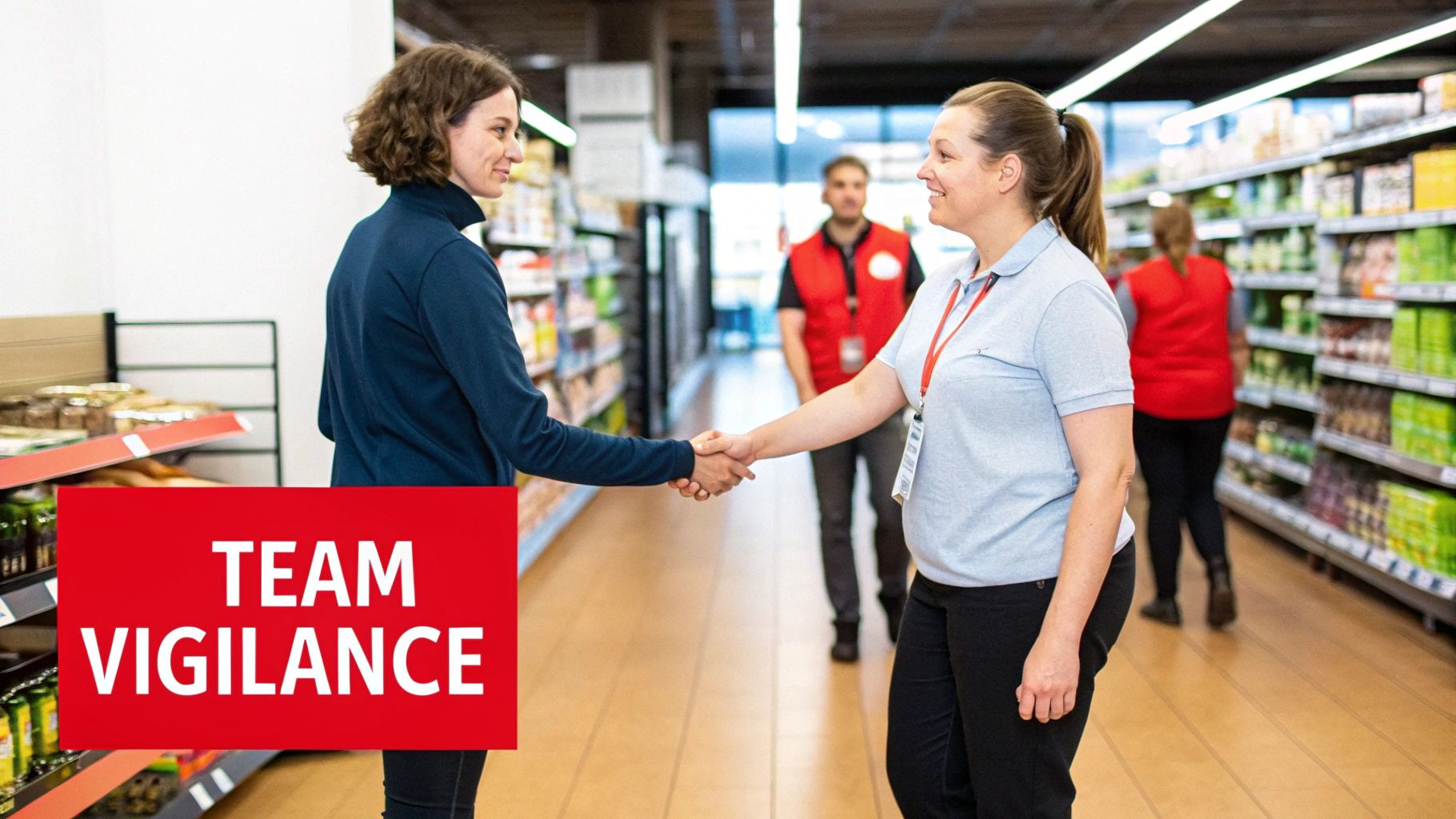
While cameras and alarms have their place, they are primarily reactive tools. Your employees, on the other hand, are your most powerful and immediate defense against shoplifting. The real deterrent isn't confrontation; it's proactive, friendly customer service that makes potential thieves feel seen, disrupting the anonymity they rely on.
Building a security-aware culture starts with consistent, high-quality training. It's about empowering your team with the knowledge and confidence to act correctly and safely. Think of exceptional customer service as your first line of defense—the goal is to deter theft long before it happens.
Cultivating Observational Awareness
The first step is teaching your team what to look for without encouraging profiling. Shoplifters don’t fit a single mold, but they often exhibit specific behaviors before attempting a theft. Training must focus squarely on these observable actions, never on a person's appearance.
Key behaviors to train staff to recognize include:
- Lingering without interest: An individual spending a long time in one area without engaging with the merchandise.
- Constant scanning: Someone who seems more focused on camera locations, employee positions, or exits than on your products.
- Wearing bulky or out-of-season clothing: Large coats or baggy clothes are classic tools for concealing items.
- Carrying large, empty bags: Professional shoplifters may bring their own large shopping bags, backpacks, or even strollers to hide stolen goods.
This isn't about making your team suspicious of every customer. It’s about equipping them to notice unusual behaviors, which should always trigger a customer service response, not an accusation.
The Power of Proactive Customer Engagement
The single most effective and low-cost tactic to stop shoplifting is attentive customer service. A potential thief’s greatest advantage is feeling invisible. When a team member makes direct, friendly contact, that invisibility vanishes.
Your training should emphasize specific, non-accusatory phrases. Move beyond the generic "Can I help you?" which is easily brushed off with a "No thanks." Instead, teach your staff to use open-ended, service-focused questions.
The most powerful phrase in loss prevention might just be, "Hi, welcome! I see you're looking at our new jackets. That blue one is a great choice—would you like me to get that in your size so you can try it on?" This is not confrontational; it is exceptional service that also communicates, "I see you, and I am here to help."
This proactive engagement makes honest customers feel valued and potential thieves feel watched. It’s a win-win that can boost both sales and security. A key part of training is showing your team the difference between helpful, deterrent behavior and risky, reactive behavior.
Proactive vs. Reactive Customer Service in Loss Prevention
| Strategy | Proactive Approach (Deterrent) | Reactive Approach (High-Risk) |
|---|---|---|
| Initial Greeting | Warmly welcoming every customer upon entry, making eye contact. | Ignoring customers unless they look "suspicious." |
| On the Floor | Offering specific help: "Can I start a fitting room for you?" | Following a customer around the store silently. |
| Observing Behavior | Noticing unusual behavior and approaching with a service offer. | Openly staring at a suspected individual, creating tension. |
| Language Used | "Let me know if you need another size!" | "Are you going to pay for that?" |
| Outcome | Customer feels seen and valued; thief feels exposed and leaves. | Escalates the situation, risks safety, and creates liability. |
Ultimately, a proactive strategy rooted in good service defuses potential problems before they begin, while a reactive one can create them.
Establishing Clear Policies and Procedures
Confidence comes from clarity. Every team member must know precisely what to do—and what not to do—when they suspect theft. A vague policy creates hesitation and risk, both for your employees and your business.
Your shoplifting policy should be written down, easily accessible, and a core part of employee onboarding. It must clearly outline:
- The "Observe and Report" Rule: Staff should never physically confront, accuse, or detain a suspected shoplifter. Their role is to observe, remember details, and report to a manager or security professional.
- De-escalation Techniques: Provide simple scripts for disengaging if a situation becomes tense. The safety of your employees and other customers is always the top priority.
- Communication Protocol: Who gets notified when a theft is suspected or confirmed? Create a clear chain of command, whether that’s the manager on duty, an in-house loss prevention specialist, or a security partner.
Well-defined loss prevention strategies for retail businesses are non-negotiable for protecting your assets while minimizing liability. When your team is trained on these protocols, they can act decisively without crossing legal or safety lines. This non-confrontational approach is critical. With our 26 years of experience, we've seen time and again that a well-supported team is a confident team—one that can handle security concerns with professionalism and care.
Designing a Store That Discourages Theft
Long before an employee says hello, your store’s physical layout is already sending a message. It can either create a welcoming environment that subtly discourages theft or, frankly, offer a playground full of opportunities for it. Strategic store design is a powerful deterrent that turns your space into an active part of your loss prevention team.
The core principle is simple: eliminate anonymity and concealment. Shoplifters thrive where they feel unseen and have spots to hide merchandise. By focusing on visibility and organization, you disrupt their process and make your store a much harder target. These design principles are scalable for any setting, from a small boutique to a large electronics store.
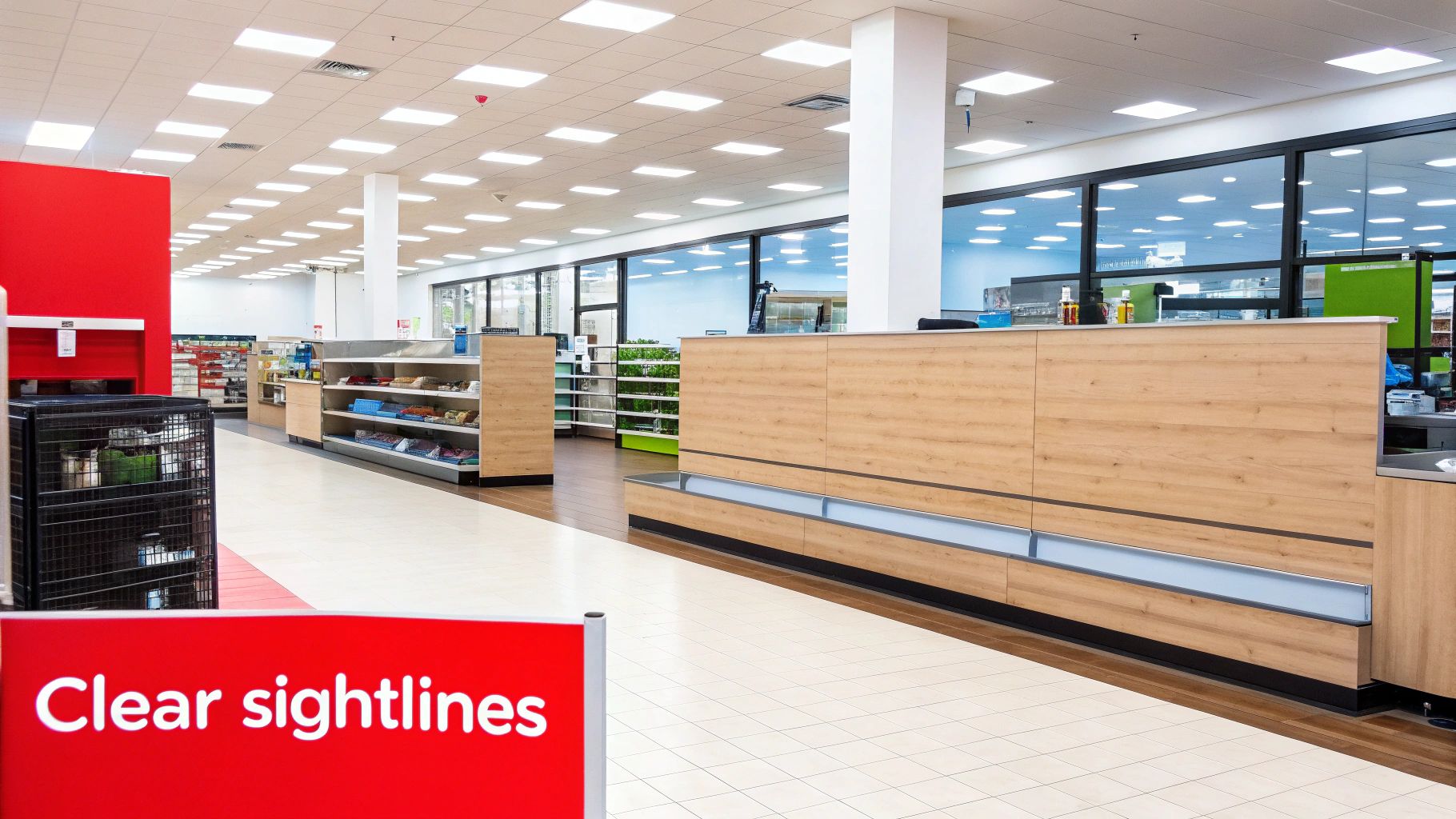
Maximize Visibility and Eliminate Blind Spots
A thief’s best friend is a blind spot. These are the areas hidden from the view of your staff, especially from the cash wrap or other high-traffic zones. Addressing these is one of the most effective ways to stop shoplifting before it starts.
Your primary goal should be to create clear, unobstructed sightlines across the sales floor. Tall shelving units, poorly placed promotional displays, and cluttered aisles create the perfect cover for someone looking to pocket an item.
Here are a few practical adjustments you can make:
- Lower Your Fixtures: Keep shelving and display units at a height that allows employees to see over them. Chest-height is a good rule of thumb for central floor displays.
- Use Convex Mirrors: A classic for a reason. Strategically place large, convex mirrors in corners and at the ends of long aisles to provide visibility into hard-to-see areas.
- Mind Your Aisles: Keep aisles wide and straight, allowing for a direct line of sight from one end to the other. Avoid maze-like layouts that offer too many hiding places.
Think of your store from the perspective of someone standing at the register. Can they see the main entrance, the back corners, and the ends of most aisles? If the answer is no, you have visibility gaps that need to be addressed.
This kind of environmental control requires ongoing evaluation, especially when bringing in new merchandise or seasonal displays that could inadvertently create new blind spots.
The Psychology of a Clean and Organized Space
There's a powerful psychological component at play in store design. A clean, well-lit, and meticulously organized store sends a message of care and attention to detail. This implies that your staff is just as attentive to their customers and inventory as they are to the store's appearance.
Shoplifters often seek out messy, disorganized environments because they suggest a lack of oversight. Clutter provides easy opportunities for concealment and gives the impression that a missing item might go unnoticed.
Here’s why organization is a key deterrent:
- It Signals Attentiveness: A tidy store suggests that staff members are actively managing the space and are more likely to notice unusual behavior.
- It Makes Missing Items Obvious: When products are neatly arranged and "faced" (pulled to the front of the shelf), a gap is immediately noticeable.
- It Improves the Customer Experience: A clean, organized space is more inviting for legitimate shoppers, which increases foot traffic and adds more "eyes" to the floor.
Strategic Placement of High-Value Merchandise
Not all merchandise carries the same risk. Small, expensive, and easily resold items—like electronics, designer accessories, or premium cosmetics—are magnets for theft. The placement of these products needs to be a deliberate part of your security strategy.
Position your high-value merchandise in areas with the most natural surveillance. This means placing them:
- Near the cash register or other constantly staffed service counters.
- In direct sightlines of employee workstations.
- Away from store entrances and exits to prevent easy grab-and-run thefts.
For your most sought-after items, consider using locked display cases or cabinets. This simple step forces a customer to interact with an employee to handle the product, adding a significant layer of security. In addition, strategically placed custom warning signs can serve as a powerful visual deterrent, informing potential thieves that you are vigilant.
Ultimately, a well-designed store makes security feel like a natural part of the shopping experience. It reassures honest customers while quietly communicating to potential thieves that they are being watched. This proactive approach, built on over 26 years of experience, is the foundation of an effective loss prevention program.
Using Smart Technology as a Force Multiplier
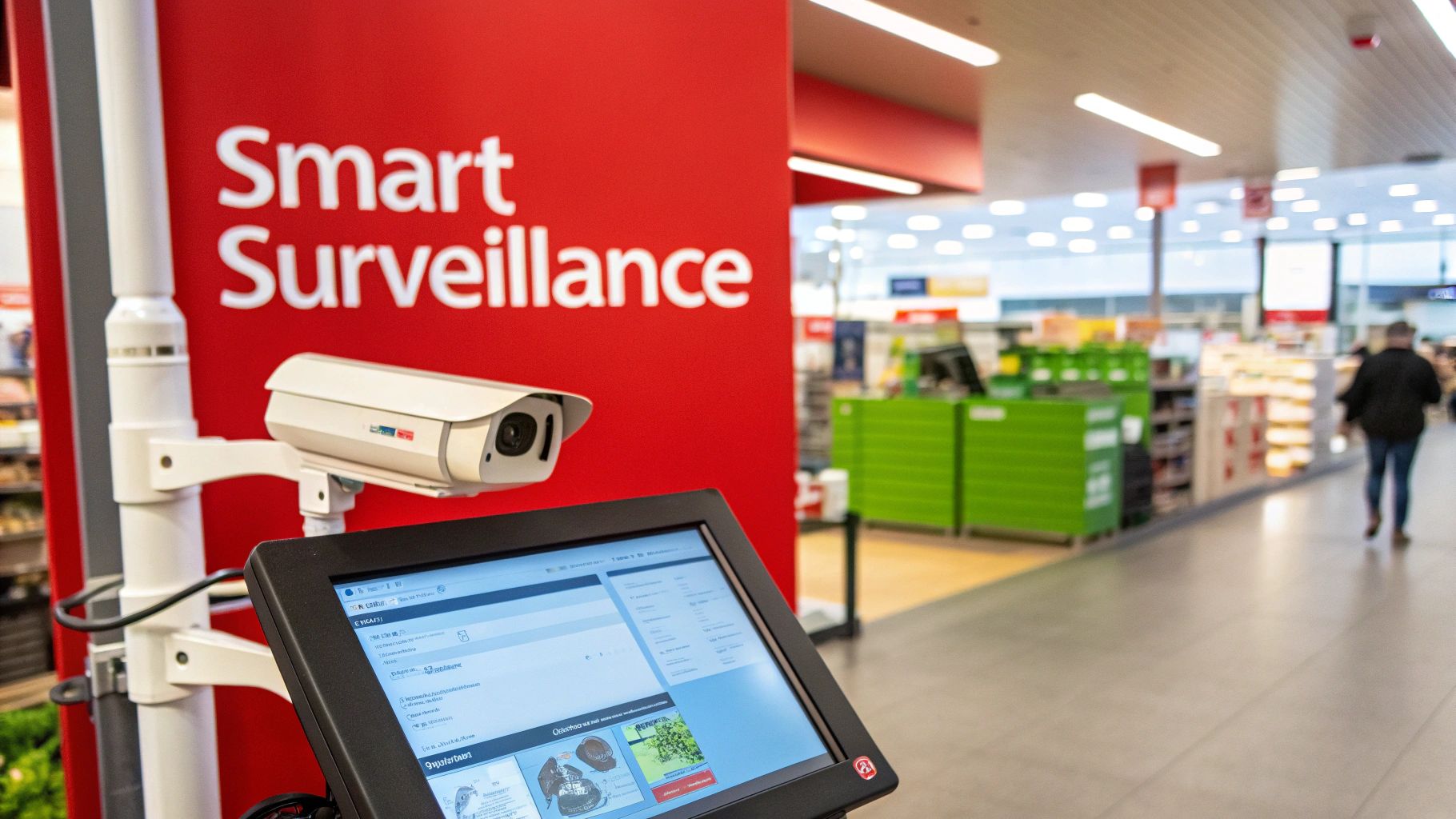
Technology isn't a replacement for your team; it's a tool to make them smarter and more effective. For any modern retailer or property manager, security tech is a powerful force multiplier, giving you eyes and intelligence where you can't physically be. The goal is to build an integrated system where human expertise is enhanced by smart technology.
The conversation has moved beyond simple cameras and security tags. Today's tools offer a level of awareness that was once only available to large corporations. It's about having the real-time data and evidence to act decisively and safely.
Modern CCTV with Intelligent Analytics
A standard CCTV system is useful for reviewing what has already happened. But modern intelligent video surveillance can help you prevent an incident before it escalates. These systems use analytics to spot and flag specific behaviors in real time.
This means your system can automatically detect things like:
- Loitering: An alert can be triggered if someone lingers near a high-value display or in a low-traffic corner for an unusual amount of time.
- Unusual Motion: The system can recognize when someone sweeps a whole shelf of products into a bag in one quick motion.
- Entry/Exit Violations: An alert can be sent if someone tries to enter through an exit-only door or leaves during off-hours.
These alerts can go directly to a manager's phone or a central monitoring station, prompting an immediate response. Often, a timely offer of customer service is all it takes to deter a potential theft. This turns a passive recording device into an active security partner.
The true value of modern surveillance isn't just catching someone in the act. It's about using data to understand vulnerabilities and prevent the next incident from happening.
Electronic Article Surveillance and Discreet Tags
Electronic Article Surveillance (EAS) systems—the pedestals at the store exit—have become more sophisticated and subtle. Modern EAS tags are smaller, harder to remove, and can even be built directly into product packaging.
A successful EAS program relies on consistency. If only some items are tagged, professional thieves will quickly spot the gaps in your strategy. A comprehensive tagging policy for high-risk merchandise creates a deterrent they can't ignore. When an alarm does sound, it gives your staff a clear, non-confrontational reason to engage a customer at the door.
The Power of Real-Time, Remote Monitoring
For most businesses, having an on-site security guard watch camera feeds 24/7 isn't practical. This is where the synergy of technology and human expertise shines. By connecting your on-site cameras to a professional Security Operations Center (SOC), you add a critical layer of oversight without a major payroll expense.
With remote video monitoring, trained security professionals actively watch your property during its most vulnerable hours, like overnight or during shift changes. They can use two-way audio to speak directly to trespassers or would-be thieves, often deterring them without needing to involve law enforcement. It's an incredibly effective way to extend your security presence beyond your physical staff.
Using Data to Reveal Theft Hotspots
An integrated technology stack produces a wealth of data. By analyzing incident reports, EAS alarms, and flagged video clips over time, you can begin to see patterns you might have otherwise missed.
This data helps you answer critical questions:
- Which specific products are being stolen most frequently?
- Are thefts occurring in certain aisles or "blind spots"?
- Do incidents spike at particular times of day or on certain days of the week?
Armed with these answers, you can make smarter, data-driven decisions. You might move a high-theft item closer to the registers, adjust staffing schedules to cover peak theft times, or reconfigure an aisle to improve sightlines. This transforms your security setup from a reactive expense into a proactive business intelligence tool that safeguards your assets with precision.
When to Bring in Professional Security Officers
There comes a point when even a well-trained staff and a smartly designed store aren't enough. For businesses dealing with persistent theft, high-value merchandise, or the growing threat of organized retail crime, engaging professional security officers is a decisive step to regain control.
A professional security presence is a powerful deterrent. It sends a clear message to potential thieves: this is not an easy target. But this isn’t just about placing a uniform at the front door. An active security partner becomes an extension of your team, working to prevent loss and ensuring customers and employees feel safer.
Differentiating a Guard from a Security Partner
A true security partner elevates your entire safety strategy. They aren’t just there to observe; they’re trained to act as a visible deterrent, engage with shoppers in a helpful way, and be a calm authority figure when needed.
Here’s what a professional security officer brings to your business:
- Proactive Engagement: They greet customers, offer directions, and maintain a friendly but watchful presence. This visibility makes honest shoppers feel secure and potential thieves feel seen.
- Incident Management: When an incident occurs, they are trained to manage and document it with precision, providing the detailed reports needed for police follow-up and internal reviews.
- Law Enforcement Liaison: A professional officer becomes a credible point of contact for the police, ensuring that when an incident occurs, the response is swift and information is communicated clearly.
This level of service requires a serious commitment to quality. At Overton Security, our low manager-to-client ratio ensures hands-on leadership. This means the officer at your location is always supported, accountable, and performing at their best.
Advanced Skills for Complex Threats
Today’s retail environment faces challenges that go far beyond petty shoplifting. The rise of organized retail crime (ORC) has introduced a more aggressive, sophisticated threat that demands an equally sophisticated response.
The numbers are concerning. U.S. shoplifting incidents have surged 93% since 2019 and are already up another 14% year-over-year in 2024. According to research on the rise of organized retail crime at i3international.com, these criminal networks target high-value goods for resale, operating with a level of coordination that can overwhelm a standard retail team.
This is where an officer's advanced training becomes critical.
A professional security officer isn’t just a deterrent; they are a trained first responder for your business. Their ability to de-escalate a confrontation, preserve evidence, and act as a reliable witness is invaluable when facing coordinated theft attempts.
Key skills to look for include:
- Advanced De-escalation: Professionals are trained to defuse volatile situations using proven verbal techniques. This minimizes the risk of violence and protects everyone on-site—a skill your regular employees shouldn't be expected to have.
- Evidence Preservation: If a major theft occurs, the officer knows how to secure the scene, identify witnesses, and preserve crucial evidence like surveillance footage in a way that is useful for law enforcement.
- Legal Knowledge: They understand the legal lines. They know when and how they can legally act versus when the priority should be observation and reporting.
The Overton Difference: Officer Retention and Reliability
The effectiveness of any security program comes down to the quality of the people implementing it. In an industry often known for high turnover, Overton’s 26-year commitment to supporting our officers makes a tangible difference. We focus on quality over quantity, investing in our team with competitive pay, ongoing training, and real career paths. The result is lower turnover and a more stable, reliable team for our clients.
When you partner with us for your retail security guard services, you’re not just getting a uniform. You’re getting an experienced, accountable professional backed by a hands-on support system. Our GPS-enabled patrols and detailed digital reports provide complete transparency, ensuring the person protecting your store is a dependable and effective part of your team.
Common Questions About Stopping Shoplifting
When it comes to loss prevention, business owners and property managers often have specific, practical questions. They are looking for direct advice on everything from budget-friendly first steps to the legal complexities of confronting a suspect.
Here are clear, actionable answers to some of the questions we hear most often.
What Is the Most Effective First Step Without a Big Budget?
Your most powerful, cost-effective first move is something you already have: your staff. Training your team in proactive customer service costs very little and is often more effective than any technology you can install.
A simple, friendly "Hello, welcome in! Let me know if I can help you find anything" completely changes the dynamic. It tells a potential shoplifter they've been seen and acknowledged, stripping away their anonymity. An attentive team that's visible on the floor, organizing merchandise, and offering assistance creates an environment where shoplifting is much more difficult. As a bonus, this approach also dramatically improves the experience for your legitimate customers.
When Is It Legally Okay for Staff to Confront a Suspect?
This is a critical question, and the answer requires extreme caution. The short answer is: regular retail staff should never physically confront or detain a suspected shoplifter. The risk of physical harm and the significant legal liability that comes with it are simply too high.
Most jurisdictions have very strict legal standards for detaining someone, often called the "Five Steps" or "Six Points" of proof. This usually requires an employee to have an unbroken line of sight as a person selects an item, conceals it, and then tries to leave the store without paying. That is a very high bar to clear.
Your internal policy needs to be simple and absolute: "Observe and Report." Train your team to mentally note details—what the person looks like, what they’re wearing, and what they took. Their only job is to then alert a manager or a professional security officer who is trained in de-escalation and proper legal procedures.
This approach keeps your employees safe, protects your customers, and shields your business from a potential lawsuit.
Are Visible Security Cameras More Effective Than Hidden Ones?
For stopping the average, opportunistic thief, visible security is almost always the better choice. When someone sees a camera pointed at them, a monitor at the entrance showing a live feed, and clear signs saying "Area Under Surveillance," it acts as a powerful psychological deterrent. It’s a constant reminder that they are being watched.
Hidden cameras have their place, but they are more of an investigative tool. They are useful for addressing organized retail crime groups who know how to spot and evade visible cameras, or for tackling internal theft issues.
The best strategy often uses a mix of both:
- Use highly visible cameras at all entrances, exits, and over cash registers. Make them obvious as your first line of defense.
- Place more discreet cameras to cover known blind spots or high-value merchandise areas that professionals might target.
This layered approach gives you the best of both worlds. You deter the casual thief while still having the tools to address more determined ones.
Getting these basics right is the foundation of a solid security plan. If you're ready to create a safer, more secure environment for your business, the team at Overton Security is here to help. With over 26 years of experience, we provide professional, reliable security solutions that fit your specific needs. Contact us today to learn how our expert officers can protect your assets.