Protecting Your Bottom Line: A Manager's Guide to Spotting Theft
Retail shrinkage is a persistent challenge that affects margin, staff confidence, and the customer experience. If you're managing a store, shopping center, or multi-tenant retail property, you've probably dealt with the uneasy moment when something feels off, but no one is quite sure whether it's poor service coverage, a policy gap, or active theft.
The signs of shoplifting usually aren't dramatic. They're small behavior patterns, repeated choices, and timing. A person lingers where visibility is weak. Someone avoids staff, then circles back to the same display. A group splits up at the exact moment your team gets pulled into a distraction.
The right response isn't suspicion for its own sake. It's professional awareness, consistent documentation, and calm intervention. National survey data published in Public Health found that about 10 to 11.3% of U.S. adults report shoplifting at some point in their lives, roughly 1 in 11 adults, which is one reason ordinary-looking customers can't be ruled in or out based on appearance alone (national prevalence findings in Public Health).
That makes training and structure more important than instinct. If you want a broader risk lens beyond retail theft alone, it's also worth reviewing insights on fraud prevention from Lighthouse Consultants.
This guide breaks down seven practical signs of shoplifting, with a simple framework for each one: what it looks like, how much risk it usually signals, what a professional response looks like, and what prevention steps help.
1. Frequent, Prolonged Loitering in Non-Customer Areas

A common theft scenario starts before anyone touches merchandise. Someone spends too long near a fitting room corridor, an endcap close to the exit, or a low-visibility corner. They are not shopping in any normal sense. They are watching coverage, testing staff response times, and learning where attention drops.
Retail loss prevention guidance from the Loss Prevention Research Council on suspicious retail behavior and situational risk supports that basic pattern. Time spent in the wrong place, without a clear shopping purpose, matters more than appearance. On the floor, the concern rises when lingering is paired with repeated glances toward exits, cameras, staff routes, or blind spots.
What it looks like on the floor
Legitimate shoppers usually move with a purpose, even when they browse slowly. They compare products, read labels, check prices, or ask for help. A higher-risk loiterer often breaks that pattern. The person stays near the same area without engaging merchandise naturally, pauses when associates approach, and repositions to keep vulnerable product in view.
Three examples come up often in real stores:
- Blind-spot hovering: A person stays near a camera gap, corner fixture, or exit-adjacent display and keeps checking the path out.
- Repeat section visits: Someone returns to the same high-value bay several times but never builds a basket or heads toward checkout.
- Staff timing: An individual waits for an associate to leave the area, then closes distance to the product as soon as coverage drops.
Professional view: Loitering alone is a weak signal. Loitering combined with staff tracking, exit awareness, or concealment opportunities deserves a documented response.
Risk level, response, and prevention
Risk level is usually moderate at first. It moves higher when the person is studying non-customer areas, staying outside normal traffic flow, or repeating the behavior over multiple visits.
The first response should be calm and visible. A standard customer-service contact often disrupts reconnaissance without escalating the situation. Good teams do not rely on vague instructions like “watch that person.” They define what to observe, where to stand, and what to record if the pattern continues.
A practical response framework looks like this:
- Recommended response: Make a polite service approach, then maintain visible presence in the area.
- What to document: Time, location, repeat visits, direction of travel, and any focus on exits, cameras, or staffing gaps.
- Prevention tip: Adjust floor coverage so high-risk zones are checked on a schedule, especially near fitting rooms, premium displays, and tenant-facing entrances.
- Management action: Review whether the area invites lingering because of poor sightlines, weak camera coverage, or inconsistent staffing.
Structure assists property and retail managers. A trained officer or supervisor can separate ordinary browsing from pre-theft reconnaissance and record the behavior in a way staff can use later. Retail security guard services from Overton Security support that process with visible deterrence, incident reporting, and coordination between store teams, shared corridors, parking areas, and tenant-facing entrances, locations where pre-theft reconnaissance often starts.
2. Concealment Techniques and Suspicious Clothing

Clothing and bags don't prove intent. Deliberate preparation for concealment is the core issue. The distinction matters, especially for teams trying to reduce bias and keep interactions professional.
An oversized coat on a cold day is normal. A heavy coat in warm weather, paired with constant pocket checks, odd bag positioning, or repeated clothing adjustments near high-value product, is different. The same goes for an empty tote or backpack that suddenly appears full after time in a vulnerable area.
What raises the risk
Concealment behavior usually has a rhythm. The person selects compact, high-value, or easy-to-resell items. Then they create privacy with their body, a bag, a cart angle, or a fitting room. Staff often notice repeated hand movements toward the same jacket pocket, tote opening, or waistband area.
Common examples include someone carrying multiple bags and shifting them to hide hand movement, a customer wearing layered clothing that creates easy storage space, or a shopper who enters a fitting room with several items and leaves with fewer visible items than they took in.
Teams should focus on actions, not appearance. The question is never “Who looks suspicious?” It's “What behavior did we observe, where, and in what sequence?”
Recommended response and prevention tips
Risk level is moderate to high, depending on whether concealment is only being set up or has already occurred. The correct response is presence, not accusation. Move an associate or officer into the area, offer assistance, and tighten observation.
Useful prevention steps include:
- Set fitting room controls: Count items in and out consistently.
- Clarify bag policies: If your store requires large bags to stay at customer service or checkout, post and enforce that policy evenly.
- Improve camera placement: High-definition coverage near high-risk shelves and fitting room approaches helps clarify behavior later.
- Write better reports: Note clothing, bag type, movements, and product interaction in sequence.
One reason disciplined reporting matters is that subjective cues can be unreliable if teams rely on them loosely. A 2023 meta-analysis cited in industry coverage found that more than 60% of security staff relied on subjective behavioral indicators, while those indicators showed only 30 to 40% predictive accuracy for actual theft and were associated with bias in self-reported data analysis (discussion of bias and subjective indicators in retail security).
That doesn't mean behavior observation is useless. It means stores need standardized observation, better supervision, and clear thresholds before escalation.
3. Avoiding Eye Contact and Refusing Staff Assistance

Managers hear this one constantly from frontline staff. “They wouldn't look at me.” On its own, that isn't enough. Plenty of legitimate customers are distracted, shy, overwhelmed, or don't want help.
What matters is the pattern around the avoidance. A person turns away when greeted, relocates when staff enters the aisle, keeps their hands out of view, then resumes close product handling once the area clears. That's a stronger signal than eye contact alone.
What a professional read looks like
Avoidance becomes meaningful when it shows active effort to reduce accountability. The person may refuse assistance while clearly needing it, step away from displays as soon as an associate approaches, or watch staff until they leave before returning to the same item.
Evidence-based prevention reviews consistently treat staff training around these common signs of shoplifting as a core part of in-store prevention, especially when employees are taught to respond early and consistently (staff training guidance on common warning signs). The strongest version of this tactic isn't aggressive. It's simple customer service repeated at the right time.
Response that works better than confrontation
Risk level is usually moderate. It rises when avoidance is paired with loitering, concealment attempts, or repeated movement toward exits. The most effective response is often the least dramatic one.
Try this approach:
- Make contact twice: A first greeting establishes presence. A second check-in confirms that staff remain aware.
- Use specific questions: “Are you looking for a particular size?” works better than a vague “Need help?”
- Keep hands visible: Position staff so the customer knows the area is being observed without feeling cornered.
What doesn't work is interpreting nervousness as guilt. Some of the classic signs of shoplifting can overlap with ordinary stress, unfamiliarity with the store, or non-criminal behavior. That's why managers should train for observable sequences, not single cues.
I've seen this on retail accounts across California. A calm associate who stays engaged will often deter low-level opportunistic theft faster than a hard stare from across the aisle.
4. Comparison Shopping Without Making Purchases
Some theft starts before the theft. The customer isn't selecting a product yet. They're studying how the product is displayed, how easy it is to remove, how much staff attention it gets, and which version is easiest to conceal.
This can look a lot like ordinary browsing, so context matters. A shopper comparing tablets, fragrance sets, electric tools, or razors isn't suspicious by default. The concern starts when the comparisons focus less on product choice and more on size, packaging, security devices, and camera exposure.
When browsing turns into reconnaissance
A manager should pay attention when someone repeatedly handles multiple versions of the same item, checks package dimensions, observes where associates are posted, then leaves without any checkout attempt or assistance request. If that pattern repeats over multiple visits, it may be pre-theft reconnaissance rather than indecision.
A separate market trend also matters here. Industry reporting has noted that retailers using integrated camera systems with motion analysis have reported reductions in write-down rates for high-risk SKUs when those systems are paired with targeted SOPs and associate coverage near vulnerable displays (video analytics and zone-specific loss prevention discussion from DTIQ). The important takeaway isn't the technology alone. It's the combination of analytics, staff placement, and documented follow-up.
Some of the most useful footage in a theft case isn't the exit. It's the earlier visit where the person learned your routine.
Risk level and practical response
Risk level is low to moderate on a single visit, but higher when the same person repeats the behavior or combines it with concealment setup. A good response is informed engagement.
Use tactics like:
- Ask decision-focused questions: “What features are you comparing?” helps distinguish a real buying process from security assessment.
- Capture repeat visits: Keep short pattern logs with date, time, area, and behavior.
- Share across locations: Multi-site retailers and shopping centers should compare recurring descriptions and methods.
What usually fails is relying only on memory. If no one writes it down, pre-theft behavior gets treated as a collection of unrelated hunches instead of a pattern.
For property managers overseeing multiple storefronts, that same discipline matters in common areas. A person may scout one tenant, then act at another location with weaker staffing.
5. Switching Price Tags or Removing Security Devices
This isn't just a warning sign. It's direct theft activity or immediate theft preparation. Once someone starts manipulating tags, packaging, or security devices, the question is no longer whether risk exists. It's how quickly your team can document, verify, and respond within policy.
Typical examples include swapping labels, placing a higher-value item into lower-priced packaging, damaging labels to create confusion at checkout, or trying to remove hard tags in fitting rooms or corners of the store.
Why this behavior needs a tighter protocol
Unlike loitering or avoidance, tag-switching is overtly deceptive conduct. It often happens fast, and it can involve more than one person. One individual distracts an associate while another handles the product.
Modern camera coverage can help, but only if someone reviews the right alerts and footage. Industry coverage has noted that many large-format retailers now use video analytics for patterns such as dwell time, repeated visits, or exit gate violations, while staff training on interpreting those alerts still lags behind adoption (analysis of analytics use and alert interpretation from Lightspeed). In real stores, poor alert handling leads to missed interventions and too many low-value false alarms.
What the response should look like
Risk level is high. Staff should not freelance a confrontation. They should follow a defined chain: observe, notify management or security, preserve footage, and maintain visual continuity if policy requires it.
Best practices include:
- Verify at checkout: Cashiers should inspect mismatched packaging, damaged labels, and odd tag placement.
- Cover fitting room approaches: That's often where tag removal or package switching starts.
- Audit tag-heavy categories: Apparel, cosmetics, accessories, and small electronics need regular spot checks.
- Preserve evidence quickly: Save time-stamped clips before routine overwrites remove them.
For teams evaluating systems and response workflows, technology in modern retail security solutions is most effective when it supports a documented SOP, not when it replaces judgment. Cameras help confirm events. They don't fix a weak floor process by themselves.
6. Coordinated Group Activity and Distraction Tactics
A common retail loss scenario starts with a harmless-looking distraction. One person asks for help at the register, another pulls an associate toward a fitting room, and a third member of the group moves straight to a blind spot or a high-theft category. The individual actions may look ordinary. The pattern is what raises the risk.
What this looks like in practice is coordinated positioning. One person keeps staff busy. Another watches employee movement. A third tests exits, line breaks, or areas with weak coverage. The National Retail Federation's reporting on organized retail crime consistently reflects the same operational problem for stores: theft groups use teamwork, speed, and distraction to create short windows where no one is watching the merchandise that matters most (NRF coverage of organized retail crime and retailer response challenges).
What separates coordination from ordinary group shopping
Normal groups browse unevenly. Coordinated groups divide responsibilities.
Watch for repeated visual check-ins, staged questions that pull employees away from one zone, or members who appear more interested in staff location than in product selection. Another reliable sign is timing. The distraction starts, and within seconds another person changes direction, enters a restricted sightline, or heads for a category that is easy to conceal and easy to resell.
Risk level is high once those behaviors line up.
Professional response and prevention
The right response is controlled coverage. One designated employee or officer handles the customer-facing issue. Someone else keeps eyes on the rest of the group, preserves camera views, and updates management or security using the store's reporting chain. That trade-off matters. If every employee turns toward the loudest problem, the group gets exactly the opening it came to create.
Useful controls include:
- Assign roles before peak hours: Decide who responds to disruptions, who maintains floor observation, and who contacts management or security.
- Protect likely target zones: Keep coverage on cosmetics, accessories, small electronics, liquor, and other fast-carry categories when a distraction starts.
- Use common-area awareness: On multi-tenant properties, exterior officers or mobile patrols can continue observation after the group leaves the store.
- Share pattern information: If nearby tenants report the same team behavior, supervisors should pass along descriptions, timing, and direction of travel.
- Review the incident the same day: Save footage, note staff actions, and close any gap the team exposed.
For managers building a repeatable response plan, shoplifting prevention strategies for stores and properties work best when floor procedures, camera coverage, and reporting responsibilities match. Overton supports that process by helping properties set post orders, coordinate tenant communication, and maintain calm, visible coverage during active incidents.
On larger California properties, hands-on security leadership matters. A well-briefed officer, backed by real-time reporting and SOC oversight, can coordinate with store staff and property management without turning a prevention effort into a scene.
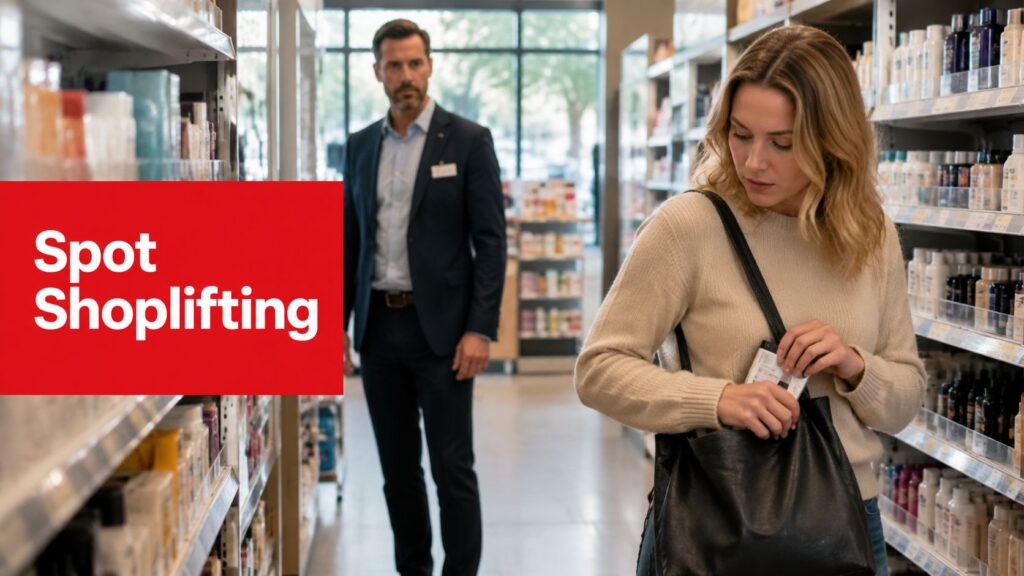
7. Items Going Into Bags Before Checkout or Merchandise Leaving the Store
This is the clearest sign on the list. If merchandise goes into a personal bag, under clothing, or toward an exit before checkout, the risk is immediate. At that point, staff are no longer interpreting vague cues. They're observing concealment or loss activity.
The same applies when video shows merchandise leaving the store without any checkout event. On self-checkout formats, it can also include bypassing normal payment behavior if your policy and evidence support that conclusion.
What counts as a strong indicator
A shopper carrying items openly to the register is normal. A shopper slipping merchandise into a handbag in the aisle isn't. Neither is covering items on the lower shelf of a cart, tucking product into a jacket, or walking straight to the exit with goods that never passed through payment.
Research on informational anti-shoplifting messaging found that general warnings can reduce theft, but targeted communication around specific high-theft items can drive theft of those marked items down to near-zero levels (problem-oriented policing research on targeted anti-shoplifting information). That's a useful reminder. The best intervention often starts before concealment, through display design, signage, and item-level controls.
If your team sees merchandise enter a personal bag before checkout, the next steps should come from policy, training, and local law. Not improvisation.
Response, legal caution, and prevention
Risk level is very high. The response must be structured and lawful. Managers should know exactly who can approach, what observations must be confirmed, and when law enforcement or security should take over.
Effective prevention steps include:
- Protect vulnerable items earlier: Move high-risk products away from exits and out of blind spots.
- Use sight lines and lighting: Environmental design measures like clearer visibility, fewer blind corners, and reduced clutter make concealment harder to attempt and easier to notice (environmental design guidance for reducing shoplifting opportunities).
- Coordinate exit observation: Staff and officers should know who monitors egress points during peak periods.
- Train on detention limits: Your state law and company policy must guide every stop decision.
For a practical overview of policy, prevention, and professional response, how to stop shoplifting is a useful next read for managers building a more formal loss prevention process across one location or an entire retail portfolio.
Shoplifting Signs: 7-Point Comparison
| Suspicious Sign | Implementation Complexity | Resource Requirements | Expected Outcomes | Ideal Use Cases | Key Advantages |
|---|---|---|---|---|---|
| Frequent, Prolonged Loitering in Non-Customer Areas | Low–Moderate (staff patrols, monitoring routines) | Staff presence, CCTV coverage, training | Early detection; deterrence; pattern identification | Small aisles, blind spots, high-value displays | Easy to observe; enables preventive engagement |
| Concealment Techniques and Suspicious Clothing | Moderate (training to avoid profiling) | Staff training, camera detail, bag policies | Prevention before theft; documented evidence | Fashion, seasonal stores, dressing rooms | Observable pre-theft indicators; less subjective than profiling |
| Avoiding Eye Contact and Refusing Staff Assistance | Low (behavioral engagement protocols) | Staff hospitality training, SOC support | Increased voluntary departures; reduced theft attempts | Customer-service-oriented stores, boutiques | Non-discriminatory; creates natural deterrence via engagement |
| Comparison Shopping Without Making Purchases | Moderate (pattern tracking over time) | Video analytics, incident logs, staff engagement | Identification of reconnaissance; stronger evidence with repeats | Electronics, high-value goods, multi-visit theft patterns | Behavior-focused, documentable across visits and locations |
| Switching Price Tags or Removing Security Devices | High (active monitoring and intervention) | Close CCTV, staff at fitting/checkout, tag technology | Immediate recovery; clear legal evidence | Fitting rooms, checkout lanes, luxury items | Direct evidence of theft intent; supports prosecution |
| Coordinated Group Activity and Distraction Tactics | High (multi-person detection, intel sharing) | Multi-camera monitoring, trained loss-prevention team, inter-store alerts | Disruption of organized theft; identification of rings | Malls, large-format stores, shopping centers | Detects organized retail crime; scalable across properties |
| Items Going Into Bags Before Checkout or Merchandise Leaving the Store | Moderate–High (exit monitoring, immediate response) | Exit staff, gates/alarms, video proof, clear policies | Immediate interception or post-exit prosecution | Store exits, high-theft categories, self-checkout areas | Conclusive observable theft; reduces loss when intercepted |
From Observation to Prevention Your Security Partnership
Recognizing the signs of shoplifting is only the starting point. What protects a store over time is consistency. Staff need clear observation standards, managers need documentation they can trust, and security teams need a response plan that holds up during busy hours, repeat incidents, and multi-site operations.
That matters even more because national headlines don't always reflect local conditions. A 2023 analysis across 24 major U.S. cities by the Council on Criminal Justice found that the average reported shoplifting rate declined from about 45 offenses per 100,000 people in January 2019 to roughly 40 per 100,000 by June 2023, even as some cities such as New York and Los Angeles posted sharp local increases that shaped public perception (city-level retail theft trend analysis summarized by the Brennan Center). For managers, that's a practical lesson. Security staffing and patrol design should follow your property's local pattern, not the loudest narrative.
A strong loss prevention plan usually combines several layers:
- Trained people: Associates, supervisors, and security officers who know what behaviors matter and how to document them.
- Better layout: Clear sight lines, controlled fitting rooms, visible coverage of exits, and thoughtful placement of high-risk merchandise.
- Reliable technology: Cameras, analytics, and alerts that support action instead of creating confusion.
- Steady oversight: Someone reviews incidents, updates post orders, and adjusts coverage when patterns change.
A professional security partner can make a measurable difference in day-to-day operations. Overton Security has 26 years of experience supporting clients across California, including retail centers, mixed-use properties, office campuses, residential communities, and commercial sites. The company focuses on quality over quantity, with a low manager-to-client ratio, hands-on leadership, trained officers, GPS-enabled patrol accountability, digital reporting, and 24/7 SOC oversight.
For retail managers in Los Angeles, San Jose, Long Beach, Sacramento, Oakland, San Diego, Fresno, and other California markets, that blend of human presence and structured reporting helps close a common gap. Too many programs rely on either guards with limited supervision or cameras with no disciplined follow-up. The better model uses both.
Store layout also plays a real role in prevention. If you're reviewing product placement, customer flow, or display visibility alongside your security plan, Display Guru's advice for shops is a useful companion read.
The main takeaway is simple. Don't train your team to chase stereotypes. Train them to recognize repeatable behavior patterns, respond professionally, and escalate through policy. If your store or portfolio needs a more consistent security presence, Overton Security is one relevant option for onsite officers, mobile patrols, remote monitoring, and customized retail security support across California.
If you're reviewing theft patterns at one store or across a larger portfolio, Overton Security can help you build a practical prevention plan with trained officers, mobile patrol options, real-time reporting, and 24/7 SOC-backed oversight customized for your property.