
When your building’s fire alarm or sprinkler system goes down, it's a major problem. That automated, 24/7 guardian is suddenly off-duty, leaving your property, tenants, and customers exposed. This is precisely when a fire watch becomes non-negotiable.
It’s a temporary but essential safety measure where a trained professional is assigned to patrol your property, specifically looking for any sign of fire. It’s required when your primary fire protection systems are offline for maintenance, repair, or have simply malfunctioned. For property managers and construction superintendents, understanding this responsibility is key to preventing a minor issue from becoming a catastrophe.
Understanding the Role of a Fire Watch
Think of your fire suppression system as an electronic safety net. It’s always there, ready to detect smoke or heat and knock down a fire before it has a chance to spread. But what happens when that net is taken away?
Whether it’s for a planned system upgrade or because of unexpected damage, a non-functional fire protection system creates a dangerous gap in your safety plan. A fire watch is the mandated, professional solution to bridge that gap.
A trained fire watch officer steps in to become a temporary, human-based detection system. They effectively take over the duties of the disabled equipment, providing a crucial, active layer of protection. Properly implementing a fire watch can be the key to preventing a minor incident from escalating into a disaster that requires extensive fire restoration services.
What a Fire Watch Is Not
It's critical to understand that a professional fire watch is much more than just having someone stand around on-site. Simply stationing an untrained employee at the front door doesn't meet fire code requirements and, more importantly, doesn't keep anyone safe.
A compliant, effective fire watch involves several key duties:
- Active Patrolling: Officers must conduct regular, documented patrols of all designated areas of the building—from the basement and boiler room to every floor and the rooftop.
- Hazard Identification: They are trained to spot potential fire hazards that others might miss, like blocked exits, improperly stored flammable materials, or overloaded electrical circuits.
- Emergency Readiness: In the event of a fire, they are the first line of defense. Their job is to immediately alert the fire department and then help coordinate a safe, orderly building evacuation.
- Meticulous Logging: Every single patrol, observation, and action is recorded in a detailed log. This log isn't just paperwork; it’s your official proof of compliance for the local Fire Marshal.
A fire watch is not just a security measure; it is a life-safety protocol. Its purpose is to ensure the continuous protection of people and property when automated systems cannot, making it an indispensable part of responsible property management and risk mitigation.
For property managers, construction site superintendents, and business owners, initiating a fire watch is an immediate responsibility the moment fire systems are impaired. It shows due diligence, keeps you in compliance with local fire codes, and—most importantly—protects the lives of everyone inside your building. It’s the professional solution that delivers real peace of mind when your property is most vulnerable.
When Is a Fire Watch Legally Required?
So, you know what a fire watch is. Now for the critical question every property manager and facilities director faces: when is it actually required by law?
A fire watch isn’t an optional security add-on. It's a mandatory life-safety measure triggered the moment your building’s fire protection systems go down. When your automated defenses are compromised, your legal responsibility to put a temporary, human-based solution in place begins immediately.
Ignoring this is a serious mistake. It doesn't just put your property and the people inside at risk; it’s an open invitation for consequences like hefty fines, mandatory business shutdowns, or even a forced evacuation order from the local Fire Marshal. These rules exist because the danger is real and immediate.
When your suppression systems are out of service, a fire watch becomes your primary line of defense. Trained personnel conduct regular patrols, actively looking for fire hazards. This is absolutely critical in high-risk environments like construction sites and commercial buildings across California, especially as fire incidents continue to rise. The U.S. Fire Administration (USFA) reported a staggering 1,389,000 fires in 2023 alone. That’s a 9.1% jump from 2014 and led to $23.2 billion in property losses. You can read the full statistics on recent fire trends to see why preventative measures are more important than ever.
The Role of the AHJ and NFPA Standards
The legal requirements for a fire watch are mainly set by two groups: the National Fire Protection Association (NFPA) and the local Authority Having Jurisdiction (AHJ). The AHJ is simply a formal term for your local Fire Marshal or fire department—and they have the final say on enforcement.
The NFPA provides the national standards that are widely adopted, like NFPA 1, NFPA 72 (for alarms), and NFPA 25 (for sprinkler systems). However, it’s the local AHJ that adopts, modifies, and enforces these codes. So, while NFPA guidelines might suggest a fire watch is needed if a system is down for more than four hours in a 24-hour period, your local fire code in Los Angeles or San Jose could be much stricter.
Key Takeaway: Always consult your local Fire Marshal or AHJ to confirm the exact requirements for your area. A trusted security partner like Overton Security will verify these local mandates before deployment, ensuring your property remains 100% compliant.
Common Triggers That Mandate a Fire Watch
Several common scenarios can disable a fire protection system and legally require you to start a fire watch immediately. For facility directors and property managers, knowing these triggers is the first step to keeping everyone safe and staying on the right side of the law.
This simple flowchart breaks down the core reason a fire watch becomes necessary.
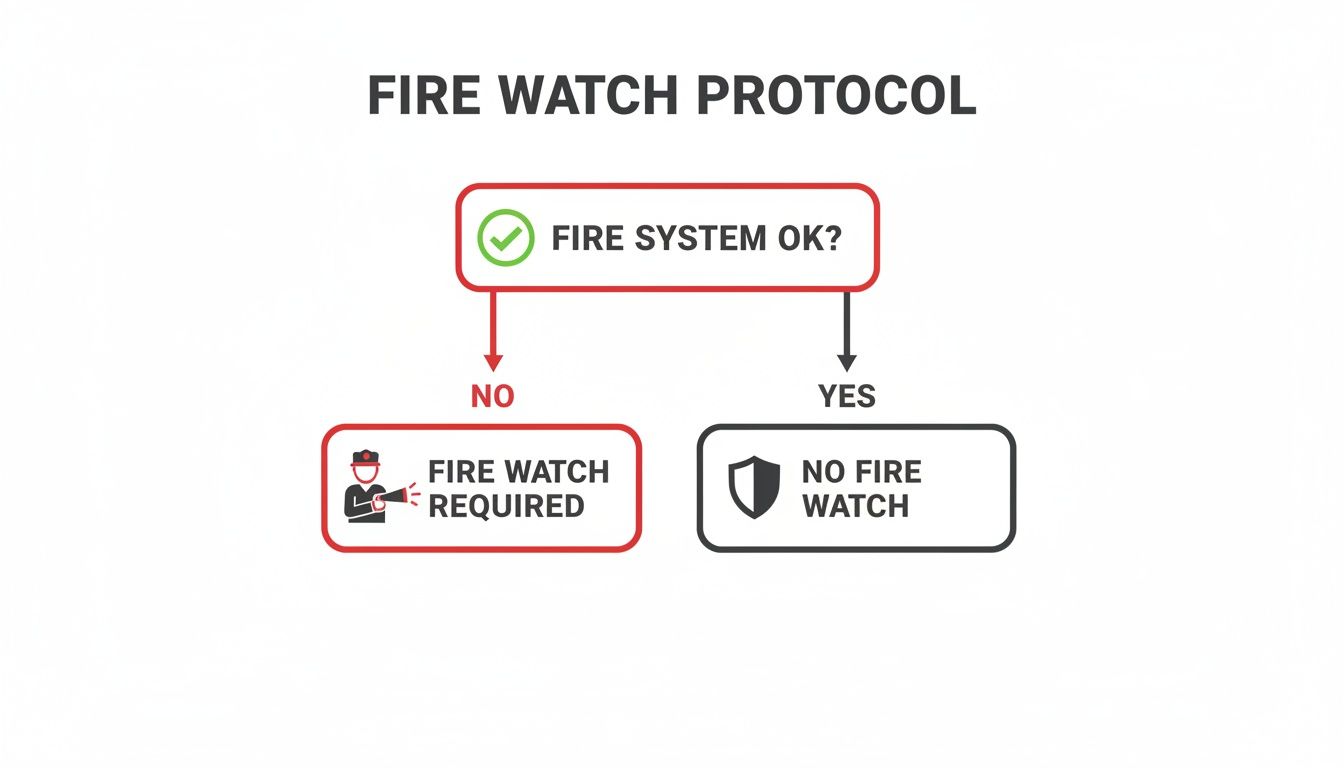
As the chart shows, if your fire protection system isn't fully operational for any reason, a fire watch is the required response.
Here's a quick look at some of the most frequent situations that legally mandate a fire watch.
Common Triggers for a Mandatory Fire Watch
| Scenario | Description of Trigger | Typical Duration |
|---|---|---|
| Malfunctioning Fire Alarm | The control panel is beeping, showing a "trouble" or "supervisory" signal, or is completely dead. | Until a licensed technician certifies the system is fully repaired and operational. |
| Impaired Sprinkler System | The water supply is shut off, a fire pump is out of service, or sprinkler heads are damaged or missing. | For the entire duration of the impairment, until the system is back online and tested. |
| Planned System Maintenance | You've scheduled work that requires taking the alarm or sprinkler system offline for testing or repairs. | For the full period the system is offline, from start to finish of the maintenance work. |
| Construction & "Hot Work" | Activities like welding, grinding, or cutting are taking place, or construction has damaged fire systems. | During all "hot work" activities and often for a cool-down period afterward (e.g., 30-60 minutes). |
| Prolonged Power Outage | A loss of power compromises the fire alarm panel and fire pump, and backup systems are depleted or fail. | Until full power is restored and all fire protection systems have reset and are fully functional. |
Recognizing these triggers is your first and most important step. In every one of these cases, the objective is the same: have a trained, alert human presence fill the gap left by the temporary failure of your automated safety systems.
The Core Duties of a Fire Watch Professional
A fire watch is much more than just having someone on your property. When you engage a professional service, you are deploying a trained officer whose entire role is to carry out a specific set of active, life-saving duties. It's a highly structured role, designed to be a reliable human stand-in for your automated fire protection systems.
From the moment they arrive, their first task is to become familiar with your property. They need to understand the layout, including every exit, stairwell, and the location of critical fire suppression equipment. This knowledge is essential for patrolling effectively and, if necessary, guiding people to safety.
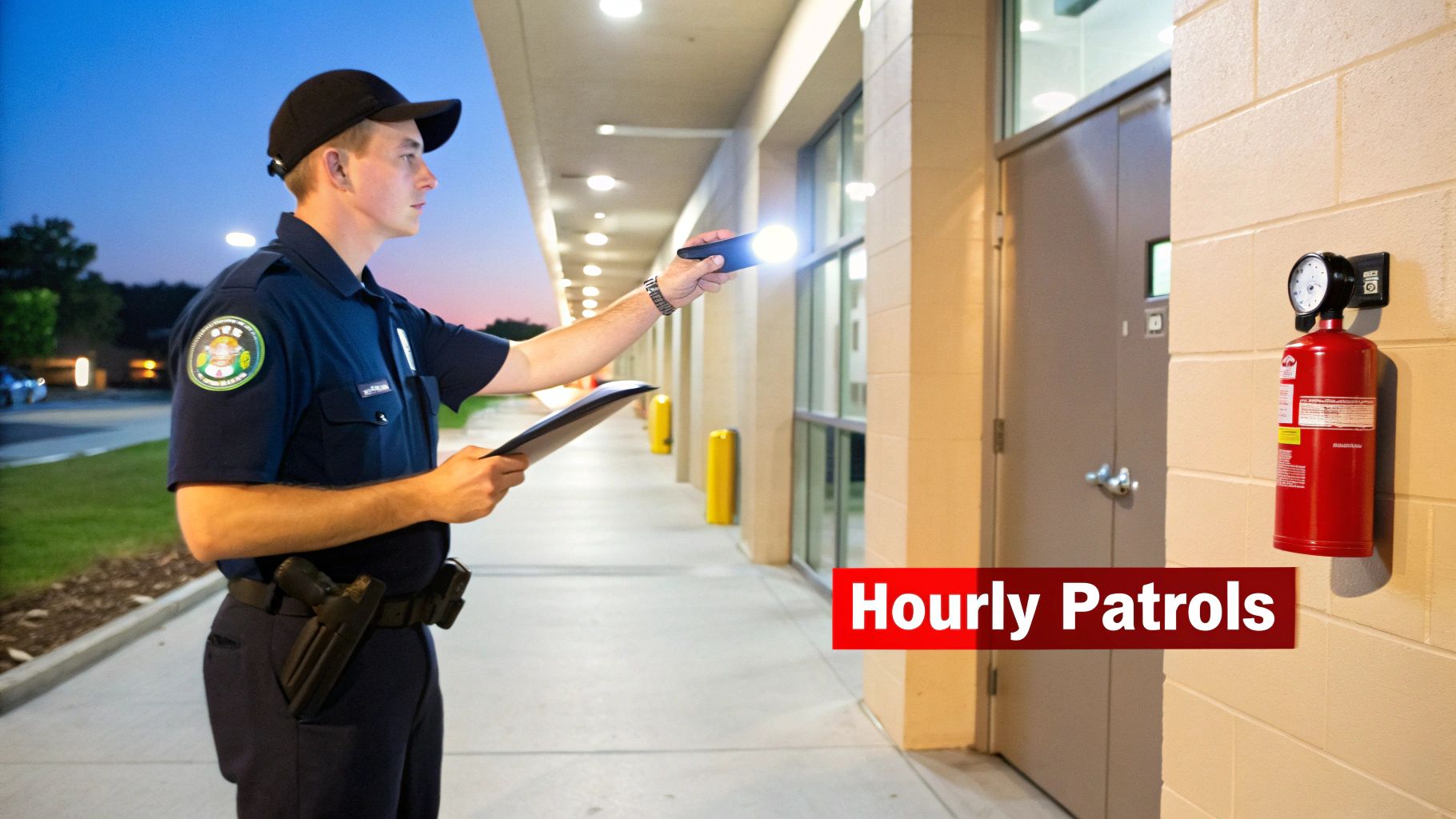
The role is defined by a strict protocol of constant monitoring and detailed logging. This ensures every corner of the facility is checked regularly. It's this structured approach that separates a professional fire watch from asking an employee to "keep an eye out," giving property managers and business owners genuine peace of mind.
Conducting Systematic Patrols
The backbone of any effective fire watch is the systematic patrol. Officers are required to continuously walk the entire property on a strict schedule, often every hour or even every 30 minutes, depending on the local fire marshal's requirements. These aren't casual strolls; they are deliberate inspections of every designated area.
This includes checking places often overlooked, like basements, mechanical rooms, storage closets, and parking garages. The goal is to ensure no potential hazard goes unnoticed for long. Every patrol route and observation is meticulously recorded in a fire watch log, creating a clear, auditable record that proves your compliance.
Identifying and Reporting Fire Hazards
While on patrol, officers are trained to be keen observers, spotting potential fire hazards before they can escalate into emergencies. Their duty is to identify and immediately report a wide range of common risks.
- Blocked Egress Routes: Ensuring all fire exits, hallways, and stairwells are completely clear of obstructions like boxes, trash, or equipment that could block an escape route.
- Improper Storage of Flammables: Identifying and reporting any improperly stored flammable liquids, chemicals, or other combustible materials.
- Electrical Hazards: Noticing red flags like overloaded outlets, frayed wires, or the unsafe use of extension cords.
- Accessibility of Equipment: Verifying that fire extinguishers and other safety equipment are visible, accessible, and appear to be in good working condition.
A professional fire watch officer essentially acts as the eyes and ears of the Fire Marshal. Their proactive hazard spotting is a crucial layer of prevention that protects both people and property when your automated systems can't.
Executing the Emergency Plan
If a fire does break out, the fire watch officer is your first line of response. Their training dictates a clear, immediate set of actions designed to maximize safety. The first and most critical step is to contact 911 immediately to get the fire department on its way. There is no hesitation.
After alerting emergency services, the officer’s focus shifts to notifying building occupants and assisting with an orderly evacuation. They are not firefighters and are not expected to fight a blaze. Their job is to help get everyone out of the building swiftly and safely. This entire process is guided by a detailed set of instructions known as post orders. For property managers who want to create their own effective guidelines, you can learn more about developing clear security post orders to ensure every officer knows exactly what to do.
By following these strict protocols, a trained fire watch professional provides a solid safety net. It’s an active, engaged service that reflects Overton Security’s commitment to reliable risk management when your property is at its most vulnerable.
Why Meticulous Documentation Is Non-Negotiable
In the world of fire safety, there's a principle every property manager needs to take to heart: if it isn’t documented, it never happened. When your building’s fire protection system goes down, that fire watch log isn't just paperwork—it becomes your single most important piece of evidence.
This documentation is far more than a procedural step. It’s your official proof of compliance for the local Fire Marshal and your insurance provider. If an incident were to occur, this log is what proves you performed your due diligence and took the legally required steps to protect people and property. Without it, you could be exposed to significant liability, fines, and legal consequences.
The Anatomy of a Compliant Fire Watch Log
A proper fire watch log must tell a clear, chronological story of every action taken by the officer on patrol. To hold up under official scrutiny, it must be filled with specific, verifiable details. Anything less is insufficient.
Each entry needs to be precise and legible, leaving no room for misinterpretation. A solid log provides a transparent account of the entire fire watch operation, from the moment it starts to the second it ends.
Here’s what every compliant log must include:
- Officer and Site Details: The name of the fire watch officer, the full property address, and the date of service.
- Patrol Timestamps: The exact time each patrol starts and stops for every single designated area.
- Specific Locations Checked: A detailed list of all areas patrolled, such as "Basement Boiler Room," "Floor 3, East Wing," or "Rooftop Access." Vague descriptions are not acceptable.
- Condition of Equipment: Brief notes on the status of fire extinguishers, emergency lights, and the clearance of exit paths.
- Hazard Notations: A clear record of any potential fire hazards identified—blocked exits, unusual odors, etc.—and what actions were taken.
- Incident Reports: Any documentation of alarms, unusual events, or communication with emergency services.
Modernizing Accountability with Technology
For years, paper logs were the standard. However, they come with inherent risks—they can be lost, damaged, or difficult to verify. When proof of compliance is critical, relying on paper can be a gamble. This is where modern technology provides real peace of mind.
At Overton Security, we utilize a GPS-enabled Guard Tour Management System (GTMS). Our officers carry handheld devices and scan NFC tags placed at critical checkpoints throughout your property. Every scan creates an undeniable, time-stamped digital record of their patrol.
This technology transforms fire watch documentation from a matter of trust to a matter of fact. It gives property managers real-time, verifiable proof that every required patrol was completed on schedule and in the correct location.
This system provides a level of transparency that paper logs cannot match. You receive detailed digital reports, often with photos and incident notes, giving you an immediate window into what’s happening on your property. It's the ideal blend of trained human expertise and smart technology, delivering the accountability every property manager needs.

Through our client portal, you have instant access to these verifiable reports, ensuring you always have the proof of compliance you need at your fingertips. You can learn more about how clients get complete visibility with our Direct Access portal and see why it’s a better way to manage security services.
How to Select a Qualified Fire Watch Provider
When your fire protection system goes down, the decision to hire a fire watch service is often mandated by the Fire Marshal. It’s immediate and non-negotiable. But selecting the right provider is a decision that requires careful consideration.
Not every security company has the training, experience, or infrastructure to handle the high-stakes responsibility of a fire watch. Making the wrong choice can be just as risky as having no coverage at all. You're not just looking for an available person; you're vetting a partner for a critical life-safety function. They need to deliver reliable, compliant, and fully documented services from the moment they arrive on your property.
Core Qualifications to Look For
To ensure you’re entrusting your property to professionals, focus on a few key qualifications. These are the factors that separate true experts from companies that simply view fire watch as another shift to fill.
-
Specialized Fire Safety Training: Ask potential vendors about their training programs. A qualified provider will have a dedicated training module for fire watch duties that goes beyond basic security tasks. Officers need to be knowledgeable about fire behavior, common hazards, proper extinguisher use, and emergency evacuation procedures.
-
Verifiable Licensing and Insurance: Your provider must hold all necessary state and local licenses to operate as a security service. Crucially, they should carry comprehensive liability insurance that specifically covers fire watch operations. Don't just take their word for it—ask to see their certificates of insurance to protect your property.
-
24/7 Dispatch and Support: Fire watch needs often arise unexpectedly and demand an urgent response. A qualified provider must have a 24/7 dispatch and operations center ready to deploy officers at a moment’s notice. This ensures a rapid response and provides constant support for officers on your site, which is essential for managing any incidents.
The Dangers of Using Untrained Staff
In a pinch, some property managers might be tempted to use their own maintenance or janitorial staff to conduct a fire watch to save money. This is a significant and dangerous mistake. Fire Marshals strongly discourage this practice because in-house employees almost never have the specialized training required for this critical role.
Their primary duties can also easily distract them from the singular focus a fire watch demands. A compliant patrol requires the officer's undivided attention; they cannot be expected to perform their regular job simultaneously. Using an untrained internal employee not only fails to meet the spirit of the law but also exposes your organization to immense liability if a fire were to occur.
A professional fire watch is performed by a dedicated officer whose only job is to patrol and monitor for fire hazards. This singular focus is what makes the service effective and compliant, ensuring nothing gets missed when your property is at its most vulnerable.
Technology and Reporting Capabilities
A modern, professional fire watch provider leverages technology to provide transparency and accountability. You should ask if they use a Guard Tour Management System (GTMS) with GPS tracking. This technology provides undeniable proof that patrols were conducted on time and in the right locations—exactly the kind of documentation the Fire Marshal expects.
At Overton Security, we know our clients in demanding markets like Los Angeles and San Diego need more than just a presence; they need proof of performance. Our 26 years of experience are built on a foundation of reliability, backed by hands-on leadership and a deep commitment to professional development. The quality of our service starts with the quality of our people. By investing in our team, we ensure every uniformed security officer is prepared to handle critical tasks like fire watch with the diligence and expertise you deserve. When you partner with us, you’re choosing a company that values consistency and has the systems in place to prove it.
Partnering with Overton for Compliant Fire Watch Services
Choosing a fire watch service is a significant decision, and it’s often one you have to make quickly and under pressure. This is about more than just plugging a temporary hole in your safety plan; it’s a critical investment in managing risk, maintaining compliance, and keeping your business operational. A professional fire watch is what stands between your property and a potential disaster when your automated systems can't.
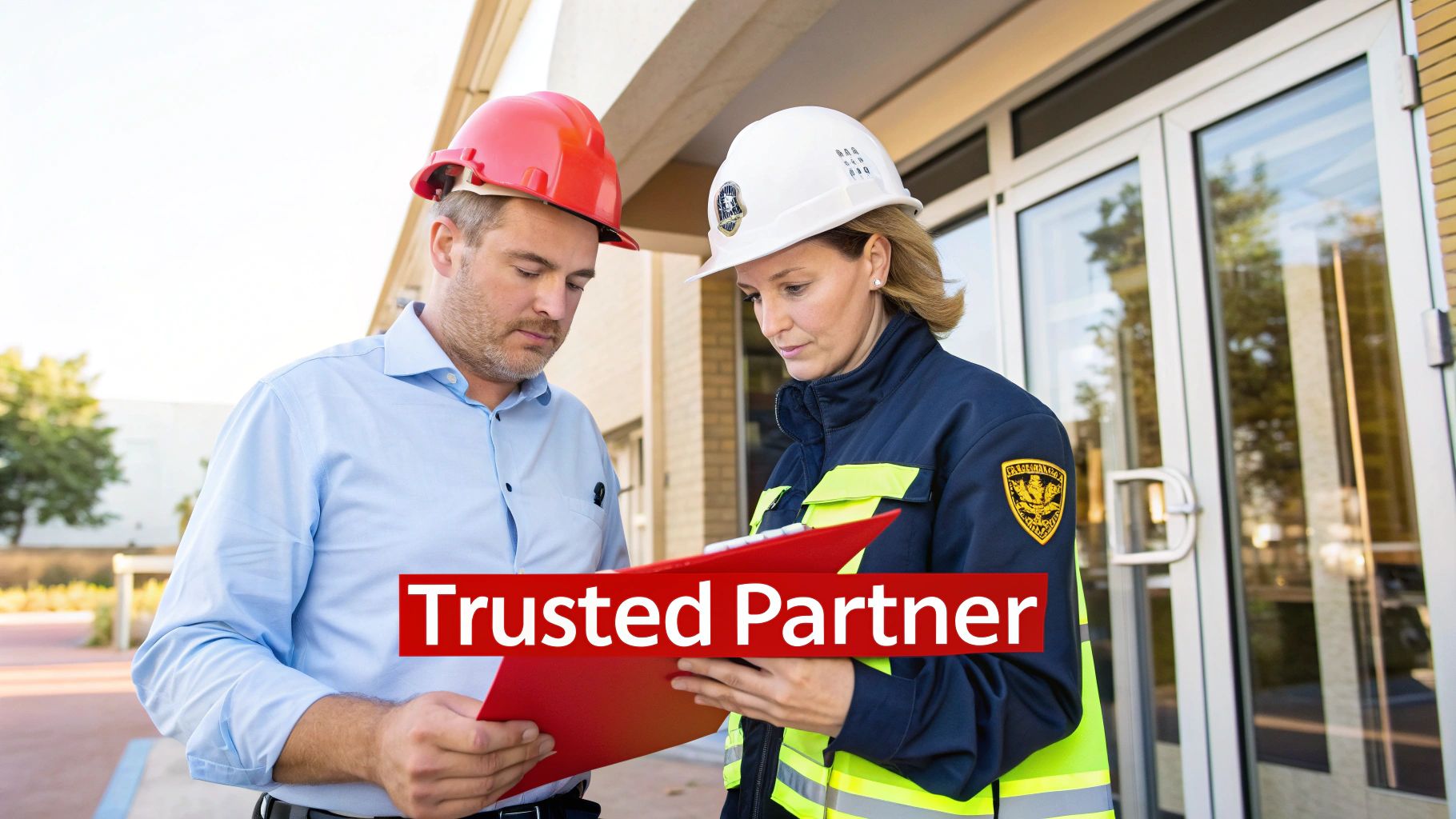
This is precisely where Overton Security’s 26 years of experience makes the difference. We understand that property managers and construction superintendents need a partner they can count on to respond quickly and execute flawlessly. Our entire approach is built on three core pillars to provide you with complete peace of mind.
The Overton Advantage
Our service is grounded in reliability and total transparency, ensuring your site is secure and your compliance is ironclad.
- Experienced Officers: Our security professionals receive specific, rigorous training for fire watch duties. They are proactive and laser-focused on their life-safety mission, not just standing by.
- Attentive Management: Unlike large national firms where you might feel like just an account number, our low manager-to-client ratio means you get direct, hands-on support. We ensure our post orders are crystal clear and our officers have the oversight needed to perform perfectly.
- Modern Technology: We use a GPS-enabled Guard Tour Management System. This isn't just a feature—it provides you with real-time, verifiable digital reports that serve as undeniable proof of compliance for the Fire Marshal.
A professional fire watch is your first and best defense when automated systems are offline. It’s an active, documented safety measure that demonstrates due diligence and protects your assets from unacceptable liability.
When a fire protection system goes down, you need a partner who can get a compliant solution in place immediately. Overton Security offers rapid-response consultations and deployment to ensure your property remains safe, secure, and fully operational.
Don't wait for an emergency to find a partner you can trust. Contact our team today to discuss your fire watch needs and ensure your property is protected by proven professionals.
Your Top Fire Watch Questions Answered
When a fire alarm or sprinkler system goes down unexpectedly, it can be a stressful situation. Suddenly, you're responsible for a whole new set of rules and procedures. To help clarify, we've answered the most common questions we hear from property managers, HOA boards, and construction superintendents.
How Often Do Patrols Need to Happen?
This is a critical question. The exact frequency is determined by your local Authority Having Jurisdiction (AHJ)—your city or county Fire Marshal. While there can be slight variations, the most common standard is at least one patrol every hour, 24/7, for as long as the system is impaired.
However, certain high-risk environments may require increased frequency. These often include:
- Buildings with large assemblies of people, like theaters or event venues.
- Active construction sites, especially where "hot work" like welding or grinding occurs.
- Facilities storing hazardous or flammable materials.
In these cases, the AHJ might require patrols as often as every 30 minutes. A professional fire watch provider will always verify the exact local requirements to keep your property fully compliant and safe.
Can I Just Have My Own Staff Do It?
While some jurisdictions might not explicitly prohibit it, this practice is strongly advised against by fire officials and insurance carriers. A compliant fire watch requires a person whose sole and exclusive duty is to patrol for fire hazards and maintain a detailed log.
That individual cannot be distracted by other responsibilities, whether it's maintenance, cleaning, or customer service. Using an employee who isn't properly trained or equipped creates a significant safety blind spot and exposes your business to immense liability if an incident occurs.
Bringing in a professional service means you have an officer who is trained, equipped, and 100% focused on this critical life-safety mission. Their patrols are tracked and documented through verifiable systems, giving you the proof of diligence needed to protect your organization.
How Do I Officially End a Fire Watch?
You cannot simply stop patrols once the repair technician leaves. A fire watch has a formal, non-negotiable process for conclusion to ensure you are legally compliant.
-
System Repair and Certification: A licensed fire systems contractor must complete all repairs. They must then test the system and provide you with official documentation certifying that it is 100% functional again.
-
Notify the Fire Marshal: With that certification in hand, you must formally notify the AHJ that your system is back online. This typically involves sending a copy of the contractor's certification and the complete, final fire watch log.
-
Get the Official Go-Ahead: This is the most critical step. You must wait for the AHJ to give you their official confirmation or clearance before you end the service. Stopping the patrol prematurely can lead to significant fines. Only a direct sign-off from the fire authority officially concludes your responsibility.
When a fire system fails, you need a partner who can provide a compliant, rapid-response solution. Overton Security has over 26 years of experience delivering reliable, fully documented fire watch services across California. Contact our team for an immediate consultation and deployment.