Imagine this: the fire alarm panel in your commercial building suddenly goes dark. The system is down for emergency repairs, and the fire marshal has just left your office. In that critical gap, what stands between your property and a potential disaster?
That's where a fire watch comes in. It’s the immediate, on-the-ground human solution legally required to ensure life safety when your automated fire detection systems are compromised.
What a Fire Watch Is and Why It’s Essential
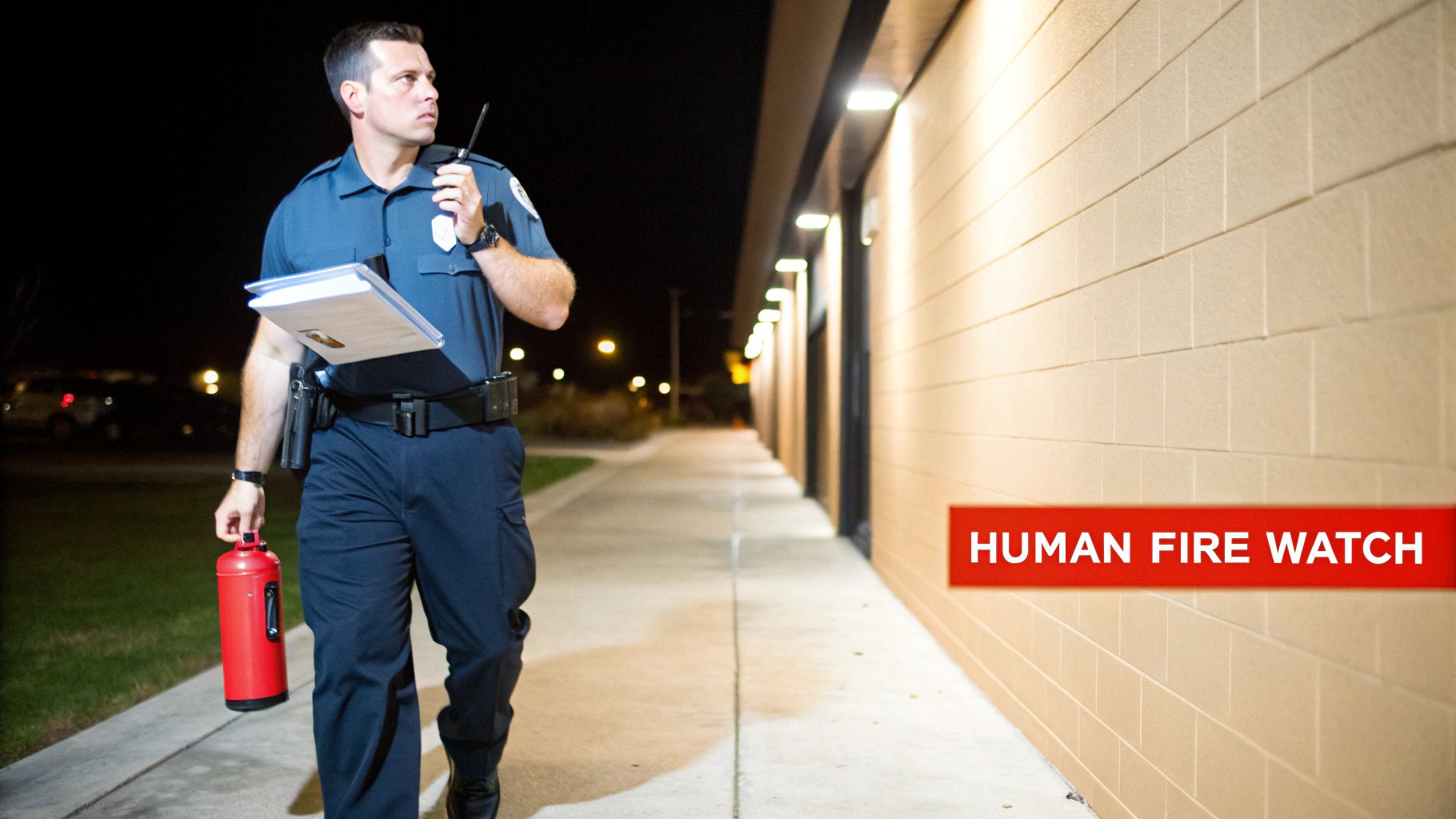
Simply put, a fire watch is the continuous patrol of a building by one or more qualified individuals to spot and report fires. It's a temporary but mandatory measure you must take when your building’s fire alarm, sprinkler system, or other suppression equipment is out of service.
This isn't just a suggestion; it's a legal requirement enforced by fire authorities everywhere, including right here in California. The goal is to have trained eyes and ears on-site, acting as a human replacement for the technology that normally protects your people and your property.
The Role of a Fire Watch Officer
You can think of a fire watch officer as a human fire alarm system. Their duties are incredibly specific and vital for keeping everyone safe.
Here's what a trained officer will do during their shift:
- Patrol Designated Areas: They conduct methodical patrols of all floors, hallways, and high-risk zones, making sure every part of the property is covered.
- Identify Fire Hazards: These officers are actively looking for potential risks—like blocked fire exits, improperly stored flammable materials, or any sign of smoldering.
- Maintain Detailed Logs: Every patrol and observation is meticulously recorded in a fire watch log. This log is your legal proof of compliance for the fire marshal.
- Alert and Evacuate: If a fire does break out, their first job is to call 911 and immediately alert everyone in the building to begin evacuating.
To give you a clearer picture, here's a quick breakdown of what triggers a fire watch and what it involves.
Fire Watch Services at a Glance
| Triggering Condition | Primary Responsibility | Commonly Affected Properties |
|---|---|---|
| Malfunctioning or offline fire alarms/sprinklers | Patrol, detect fire hazards, and alert occupants/authorities | Office buildings, construction sites, apartments, warehouses |
| Scheduled system maintenance or testing | Maintain a continuous, documented patrol of the property | Hospitals, manufacturing plants, high-rise buildings |
| Hot work (welding, cutting, grinding) | Monitor the area for sparks and smoldering materials | Industrial facilities, shipyards, construction sites |
| Fire marshal order due to code violations | Provide temporary safety coverage until issues are fixed | Any property with identified fire safety deficiencies |
This table shows just how critical these services are for maintaining safety and compliance across a wide range of situations.
A fire watch isn't passive security; it's an active, focused safety detail. Its purpose is to bridge the gap when technology fails, ensuring that the duty of care to every person on the property is upheld without interruption.
This proactive service is essential for any property manager, construction superintendent, or business owner dealing with a system impairment. It demonstrates a serious commitment to safety and is the only approved way to keep your building legally occupied and operational during a system outage.
You can dive deeper into this service in our comprehensive guide, What Is A Fire Watch. At Overton Security, we bring over 26 years of experience to these critical situations, offering a reassuring and professional presence when you need it most.
When Fire Watch Becomes a Legal Requirement
For property managers and construction superintendents, navigating the maze of fire codes can feel overwhelming. But one rule is crystal clear: understanding when a fire watch becomes a legal necessity isn't just good practice—it's non-negotiable. This isn't a choice you get to make; it's a direct order from local fire authorities and national safety standards.
The trigger is surprisingly simple. A fire watch is mandated whenever a building's primary fire protection systems are down or impaired for any significant length of time, generally more than four hours within a 24-hour period. This mandate ensures that even without your automated systems, the building remains safe for everyone inside and, crucially, avoids a costly shutdown order from the fire marshal.
Common Triggers for Mandatory Fire Watch
Certain situations will automatically require you to implement a fire watch. Getting this wrong can lead to serious fines, liability issues, and even the immediate closure of your property or job site.
Here are the most common triggers you need to know:
- Fire Alarm System Malfunctions: If your fire alarm panel goes offline—whether due to a glitch, power outage, or maintenance—you are legally required to have a human substitute. Without working smoke detectors, a manual patrol is the only reliable way to spot a fire and help people get out safely.
- Impaired Sprinkler Systems: When a sprinkler system is shut down for repairs, maintenance, or has lost water pressure, your building has lost its main line of defense. A fire watch must be in place to monitor the property until that system is fully back online.
- Power Outages: A widespread power failure can knock out fire pumps, alarm panels, and other life-saving equipment. Until power is fully restored, a fire watch provides that essential, continuous monitoring.
- High-Risk Activities (Hot Work): Construction sites are a prime example. Imagine a busy L.A. job site where welders are working on steel beams, but the fire alarm system is temporarily down for maintenance. This is precisely when a fire watch becomes critical. A trained professional patrols the area, often every 30 minutes, scanning for smoke, stray sparks, or any potential fire source, ready to sound the alarm. This isn't just a suggestion; it's a legal requirement under NFPA 241 for construction sites. In California, where Overton Security has provided these exact services for over 26 years, this diligence has helped protect countless projects from potential disaster.
Navigating Fire Codes and Standards
Staying compliant means keeping up with a mix of local and national rules. For anyone managing property in California, the California Fire Code and the standards from the National Fire Protection Association (NFPA) are your essential guides.
Key Takeaway: Think of a fire watch as your legal bridge to safety and compliance. It allows your business to stay open and operate safely when your critical fire protection systems are temporarily down, satisfying the requirements of the local Authority Having Jurisdiction (AHJ), which is almost always the fire marshal.
Part of a fire watch provider's job is staying current with evolving regulations, like the new fire safety codes in Dubai, which can change when a watch is legally required. For expert guidance on keeping your property compliant, you can learn more about our specific building fire watch services and how we handle every detail.
Onsite Duties of a Professional Fire Watch Officer
When you bring in a fire watch service, you’re not just hiring someone to stand by the door. A professional fire watch officer has a specific, active, and legally required set of duties designed to protect your property and everyone inside it. Their role is a dedicated mission of constant vigilance, detailed record-keeping, and immediate readiness to respond.
From the moment an officer arrives on-site, their focus is singular: life safety. They aren't there for general security tasks. This laser focus is what makes a professional fire watch so effective.
Conducting Methodical Patrols
The foundation of any fire watch is the physical patrol. This isn't just a casual walk-through; it's a structured and systematic sweep of the entire property. A trained officer follows a set route to ensure no area is overlooked, from the boiler room in the basement to the storage closet on the top floor.
During these patrols, the officer is actively looking for specific hazards, including:
- Signs of smoke or fire, like strange smells, visible smoke, or actual flames.
- Blocked escape routes, such as hallways cluttered with equipment, propped-open fire doors, or blocked emergency exits.
- Improperly stored flammable materials that could easily fuel a fire.
- Malfunctioning equipment or other potential ignition sources.
The local fire marshal dictates how often these patrols happen, which is usually every 30 to 60 minutes, depending on the property's risk level. This constant movement ensures a continuous human presence watching over every corner of your building.
Maintaining the Critical Fire Watch Log
Perhaps the most important duty of a fire watch officer is keeping the fire watch log. This isn't just an internal memo; it's a legal document that serves as your official proof of compliance for the fire department and your insurance company. If that log is incomplete or inaccurate, you could be facing serious fines and liability issues.
At Overton Security, we utilize a GPS-enabled guard tour management system to create detailed, time-stamped digital reports. Every checkpoint is scanned and every observation is logged in real-time, giving you verifiable, transparent proof that your property is being watched diligently.
This technology-driven approach removes guesswork and creates a solid chain of accountability. You can see exactly when and where each patrol was completed, giving you total peace of mind that you're meeting your legal obligations. It's the difference between just having a person on-site and having a truly professional, accountable service.
Emergency Preparedness and Response
A fire watch officer is more than just an observer; they are a first responder. Every officer we deploy is trained and equipped to act decisively in an emergency. They arrive at every assignment with the essential gear they need.
Essential On-Site Equipment Includes:
- Fire Extinguisher: To handle small, early-stage fires before they have a chance to spread.
- Communication Device: A reliable radio or phone for instant contact with our 24/7 Security Operations Center (SOC) and emergency services.
- Flashlight: To see clearly in all areas, especially during a power outage or in dimly lit spaces.
If a fire is discovered, the officer follows a strict protocol: first, call 911, and second, immediately begin alerting occupants to evacuate the building. Their training ensures they can manage a high-stress situation with a calm, orderly response, always putting human safety first.
How to Implement an Effective Fire Watch Plan
Discovering your building’s fire safety system has failed is a moment no property manager wants to face. The stress is immediate, and your priority is keeping everyone safe while meeting your legal obligations. Fortunately, implementing an effective fire watch plan is a clear, manageable process when you know the steps.
The moment you learn a system is down for more than four hours, your first call must be to the local fire department. This is a mandatory notification that shows you're managing the situation responsibly. Your very next call should be to a trusted security partner like Overton Security to get trained officers on site quickly.
Establishing Patrol Routes and Frequency
Once officers are on their way, the next task is to map out a strategic patrol plan. This isn’t just about having someone walk around; it’s about creating a methodical route designed to cover every critical part of your property. A key first step here is performing a solid risk assessment for small business to pinpoint potential fire hazards.
This is where Overton’s hands-on management style makes a difference. Our managers work directly with you to map out a custom plan that accounts for your property's unique layout and risks, whether it’s a high-rise office in Los Angeles or a sprawling construction site in Sacramento.
A strong patrol plan always includes:
- Defining Critical Areas: We'll help you identify high-risk zones like mechanical rooms, storage closets with flammable materials, kitchens, and electrical panels.
- Mapping the Route: Together, we create a logical path that ensures officers cover all floors, stairwells, common areas, and access points without missing anything.
- Setting Patrol Frequency: The fire marshal will almost always mandate how often patrols need to happen, typically every 30 or 60 minutes. Our plan is built to meet or exceed that requirement.
This structured approach ensures every patrol is purposeful and thorough, giving you the comprehensive coverage you need.
The process is a continuous loop of vigilance, documentation, and readiness. It's an active, not passive, role.
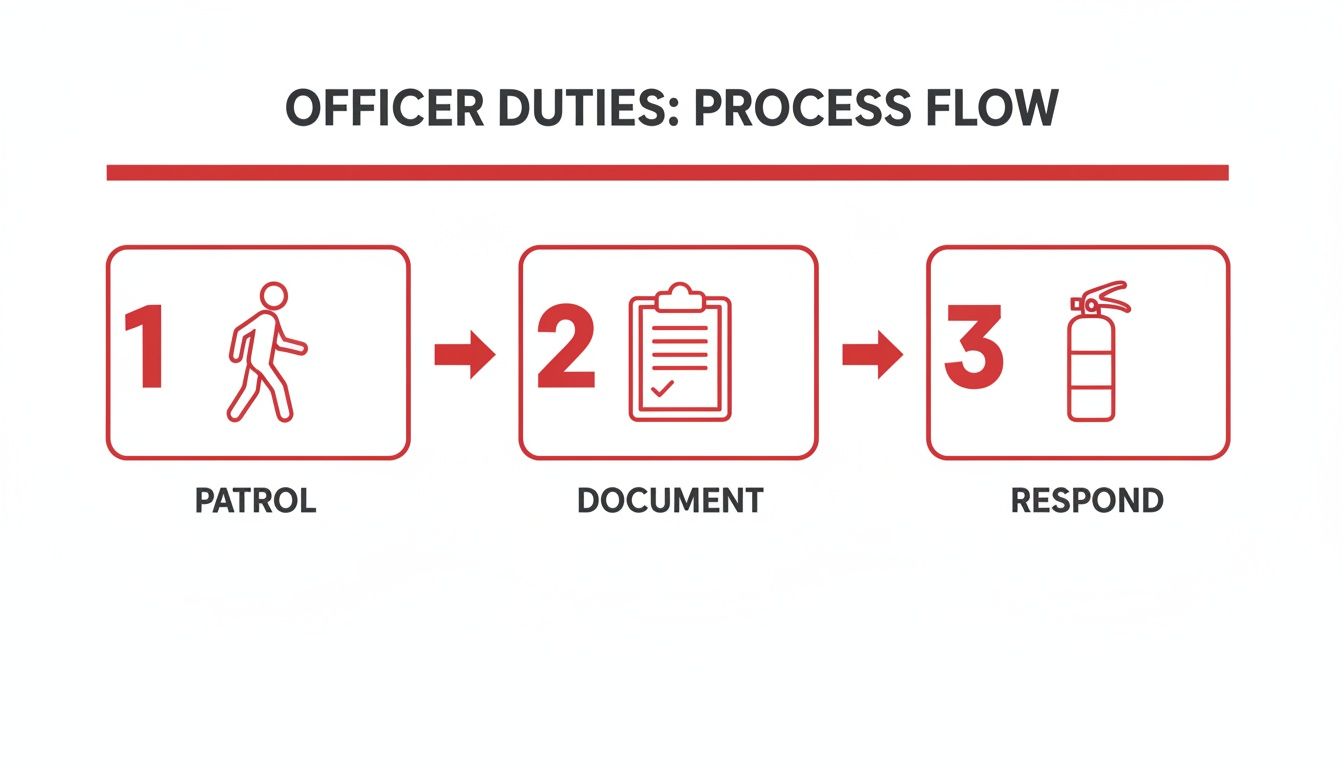
This simple flow shows that a fire watch isn't just about waiting for something to happen. It's an active cycle of patrolling, logging everything, and being ready to respond in an instant.
Your Fire Watch Implementation Checklist
When a fire safety system goes down, having a clear checklist can turn a chaotic situation into a controlled process. Here’s a step-by-step guide for property managers.
| Step | Action Required | Key Consideration |
|---|---|---|
| 1. Immediate Notification | Call your local fire department immediately to report the system impairment. | This is a non-negotiable compliance step. Document who you spoke to and when. |
| 2. Engage Security | Contact a licensed and insured fire watch provider like Overton Security. | Speed is critical. You need a partner who can deploy officers quickly. |
| 3. Develop Patrol Plan | Work with the security manager to map patrol routes and identify critical areas. | The plan must cover all high-risk zones, exits, and common areas. |
| 4. Set Up Logging | Ensure officers have a fire watch log and understand the documentation requirements. | The log is your proof of compliance. It must be detailed and accurate. |
| 5. Inform Occupants | Notify all tenants, residents, or employees about the situation and the active fire watch. | Transparency builds trust and prevents panic. Keep it simple and reassuring. |
| 6. Establish Communication | Create clear communication channels between your staff, the officers, and the security provider. | Everyone needs to know who to call if an issue arises. |
Following these steps ensures you’re not just meeting the bare minimum requirements but are actively managing the safety of your property and its occupants.
Communicating the Plan Effectively
With officers on-site and a plan in hand, clear communication is what holds everything together. A well-communicated plan keeps everyone calm, informed, and confident that the situation is under control.
Start by notifying all tenants, employees, or residents that the fire alarm system is temporarily offline but that a professional fire watch is active. This transparency goes a long way. You also need to ensure your on-site staff and the fire watch officers have direct lines of communication with each other and with our 24/7 Security Operations Center (SOC).
An effective fire watch plan is built on a foundation of clear communication, detailed post orders, and seamless collaboration between your team and your security provider. It transforms a reactive emergency into a proactively managed safety operation.
The instructions we provide our officers, known as post orders, are absolutely critical. These documents spell out the specific patrol routes, logging requirements, emergency contacts, and response protocols for your exact site. You can learn more about how we develop detailed post orders for every client to ensure our team is perfectly aligned with your property’s needs from the moment they arrive.
By following this roadmap, you can confidently navigate a system failure. With Overton Security's 26 years of experience, we've guided countless clients through this exact process, providing a calm, professional, and reliable partnership when it matters most.
Choosing the Right Fire Watch Provider
When your fire safety systems go down, you’re already in a stressful situation. This is a critical moment where you don’t just need a security company—you need a reliable, experienced partner you can trust completely. Selecting the right provider for a fire watch is one of the most important decisions a property manager or construction superintendent can make to keep people safe and comply with the law.
The truth is that not all security firms are equipped or properly trained for the specific duties of a fire watch. If you make the wrong choice, you could end up with incomplete logs, missed patrols, and serious liability issues with the fire marshal. Your decision should be based on proven experience, solid accountability, and a real understanding of fire safety regulations.
Key Questions to Ask Any Provider
Before signing a contract, it's essential to vet the company thoroughly. A truly professional provider will have confident, immediate answers to these questions.
Start by asking about their specific experience and training.
- Do your officers hold specific training for fire watch duties? General security training isn't enough; officers need specialized knowledge of fire hazards, extinguisher use, and evacuation procedures.
- Can you share examples of fire watch services you’ve provided for properties similar to mine? Experience in your specific environment—whether it's a high-rise, a busy construction site, or a residential community—is incredibly valuable.
- How do you document patrols and create the fire watch log? Vague answers are a deal-breaker. They should be able to describe a clear, reliable system for creating this legally required document.
These initial questions will help you quickly separate the dedicated specialists from the generalists.
Technology and Accountability
In today's world, real accountability is backed by technology. A provider still using handwritten paper logs is leaving you exposed. Modern systems offer undeniable proof of service, which is exactly what you’ll need when the fire marshal asks for your records.
At Overton Security, we believe transparency is non-negotiable. Our officers use a GPS-enabled guard tour management system that provides real-time, time-stamped digital reports. This technology confirms every patrol and creates an unchangeable record, giving you verifiable proof of compliance and complete peace of mind.
This blend of human expertise with smart technology is what sets a premium provider apart. It’s not just about having a person on-site; it’s about having a system of accountability that protects your property and your liability.
Verifying Insurance and Experience
Finally, don't overlook the fundamentals. A fire watch is a high-stakes service, and your provider must be fully prepared to handle that responsibility. With over 26 years in business, Overton Security has built its reputation on consistency and reliability.
Consider a real-world scenario. In a large Sacramento healthcare facility, the fire sprinklers are offline for maintenance. With vulnerable patients inside, there's zero room for error. This is where the fire watch is critical. Uniformed officers from a company like Overton Security conduct hourly patrols, checking doors, exits, and high-hazard areas. They carry extinguishers and two-way radios connected to a 24/7 Security Operations Center. This service ensures life safety compliance when systems are down, a requirement under California Fire Code Section 901.7. This is a vital need that is growing everywhere, especially in industries like healthcare. You can learn more about why these measures are so important by exploring recent fire safety statistics.
When you're ready to choose, insist on seeing proof of the following:
- Adequate Liability Insurance: Ask to see their certificate of insurance. A reputable company will carry significant coverage to protect you.
- State Licensing: Ensure they are fully licensed to operate in California. It's a basic but essential check.
- A Commitment to Officer Retention: High turnover is a common problem in the security industry. Ask them how they support and retain their officers. A company that invests in its people delivers more consistent, professional service.
By asking these tough questions, you can confidently find a fire watch provider who will be a true partner—one focused on quality, reliability, and protecting what matters most.
Need a Reliable Fire Watch Partner? That's Where We Come In.
When it comes down to it, a fire watch isn't just a compliance task to check off a list. It’s an active investment in protecting people, your property, and your ability to stay in business. When your fire alarm or sprinkler system goes offline, the provider you choose for this critical service has immediate, real-world consequences.
The risks of getting it wrong are just too high. We're talking steep fines from the fire marshal, forced operational shutdowns, and liability nightmares—all of which are completely avoidable.
Choosing an unproven provider is like trading one risk for another. Instead, working with a specialist brings a sense of calm and confident control to a stressful situation. It’s the difference between crossing your fingers and knowing you’re protected by a professional, diligent team.
Your Trusted Partner in Critical Moments
For over 26 years, property managers and construction superintendents across California have trusted Overton Security when things go wrong. We understand—a fire watch is almost always an urgent need, and it demands a rapid, reliable, and professional response.
Our commitment has always been quality over quantity. That means you get the hands-on management and dedicated support your property deserves. We blend human expertise with smart technology, using GPS-enabled systems that give you verifiable, time-stamped proof of every single patrol. This isn't just about having someone on-site; it's about performance and total accountability.
When your property's safety is on the line, you need more than just a guard—you need a security partner. Overton Security provides the experience, reliability, and peace of mind to turn a potential crisis into a well-managed operation, protecting your people and your investment.
Take Proactive Steps Today
Whether you're dealing with a system failure right now or simply want to create a solid contingency plan for the future, our team is ready to help. Let us show you the difference that hands-on leadership and a deep commitment to service can make.
Contact Overton Security today to talk about your fire watch needs. We can provide immediate emergency deployment or help you build a proactive safety plan for your property.
Answering Your Fire Watch Questions
Even when you know what a fire watch is, practical questions often arise when it's time to put one in place. Property managers and construction superintendents frequently find themselves needing clear answers right away.
We understand. Let's walk through the most common concerns we hear about cost, deployment speed, and what makes a fire watch officer truly qualified. This way, you'll have the confidence to make the right call when a fire system goes down.
How Is the Cost of a Fire Watch Service Determined?
The price for a fire watch service is almost always based on an hourly rate for each officer. However, that rate can vary based on several key factors to ensure it's fair and accurate for your specific situation.
Here’s what typically goes into the calculation:
- Property Location: Rates can shift based on the city or county to reflect local labor costs.
- Risk Level: The environment matters. A construction site with active welding carries a different risk profile—and a different rate—than a standard office building with a temporarily disabled sprinkler system.
- Duration of Service: We consider how long you'll need our services and whether it's a planned shutdown or an unexpected emergency.
- Local Mandates: Sometimes the local fire marshal has specific requirements that can influence the scope of the job.
At Overton Security, we believe in being completely upfront. We’ll give you a clear, straightforward quote based on your site's unique needs. There are no hidden fees—just reliable, compliant service.
How Quickly Can You Deploy an Officer in an Emergency?
We know that a fire watch is rarely needed on a convenient schedule. When a system fails, it’s an emergency, and every minute your property is unprotected is a liability. That’s why our operation is built for speed.
Our 24/7 Security Operations Center (SOC) is always ready to dispatch our dedicated teams across California at a moment's notice. In most major areas like Los Angeles, San Diego, and the Bay Area, we can have a qualified, fully-equipped fire watch officer on-site within just a few hours of your call.
Getting someone to your property quickly is a core part of our promise. We work fast to get you protected and compliant, minimizing your downtime and letting you get back to business.
What Specific Training Do Your Fire Watch Officers Have?
This is a critical question. A fire watch isn't just about having a person on-site; it demands specialized skills that go beyond a general security guard’s training. The legal requirements are strict, and the responsibilities are serious.
Our officers go through targeted training that covers every aspect of the job. This ensures they are not just a presence, but a proactive layer of protection.
All Overton fire watch officers are trained in:
- Fire Hazard Identification: They know how to spot the small things that can become big problems, from a blocked fire exit to improperly stored flammable materials.
- Fire Extinguisher Use: Every officer is trained and proficient in using an extinguisher to handle a small fire in its earliest stage.
- Emergency Evacuation Protocols: They understand how to take charge and guide people to safety calmly and efficiently if an incident occurs.
- Code Compliance: Our team is well-versed in the specific mandates of the California Fire Code and NFPA standards that govern fire watch duties.
- Reporting Technology: Each officer uses our GPS-enabled reporting system, which guarantees that every patrol is logged and documented, providing an unbreakable record for your legal protection.
This focused training means the professional who arrives at your property is truly prepared to keep it safe.
When your property's safety is on the line, you need a partner with a proven track record. Overton Security provides the experience, technology, and accountability to manage your fire watch needs with complete confidence. Contact us today to arrange for immediate deployment or to build a proactive contingency plan for the future.