
As a property manager or HOA board member, you’re all too familiar with the routine: late-night noise complaints, creative parking interpretations, and after-hours pool parties. This is precisely where a courtesy officer steps in—acting as your first line of response for non-emergency issues and bridging the gap between inaction and a formal security call.
What Is a Courtesy Officer, Really?
Think of a courtesy officer as a unique blend of a security professional and a customer service specialist, specifically trained for residential communities. Their primary function isn't just to watch over property; it's to preserve peace and uphold community standards in a professional, approachable manner.
For property managers, this role is a game-changer. Instead of letting a minor dispute simmer until it escalates and lands on your desk, a courtesy officer can address it calmly and effectively in the moment.
More Than Just a Uniform
A courtesy officer serves as a reassuring extension of your management team, especially after hours. Their visible presence provides comfort to residents and acts as a natural deterrent to anyone considering bending the rules.
Here’s what truly defines the role:
- Community Engagement: Our officers are trained to build trust. They interact with residents respectfully, encouraging compliance through positive communication rather than intimidation.
- Proactive Presence: By conducting regular, visible patrols of common areas, parking lots, and amenities, they prevent potential issues before they can begin.
- De-escalation Focus: Their training is centered on resolving conflict calmly. The goal is to ensure a minor disagreement doesn't escalate into a significant disturbance.
A courtesy officer is your on-site ambassador for a safe and orderly community. Their value is measured not just in the incidents they handle, but in the ones that never happen due to their consistent, professional presence.
Ultimately, the goal is to maintain a high quality of life for your residents. A well-trained professional can significantly lighten the load on property managers while making the community a more desirable place to live. While specific duties vary, the core function remains a blend of observation, reporting, and resident support.
To see how this specialized role fits into a complete security plan, you can learn more about our uniformed security officer services.
What Does a Modern Courtesy Officer Actually Do?
So, what are a courtesy officer’s day-to-day responsibilities? Their value comes from being a proactive, visible presence on your property, not just a reactive enforcer. Think of them as the eyes and ears of your community after the leasing office closes, ensuring everything runs smoothly and professionally.
A courtesy officer's primary job is to be an approachable resource for your residents. This involves consistent—and often randomized—patrols through common areas like parking lots, hallways, and pools. Their mere presence is often enough to deter policy violations before they occur.
Core Duties and On-Site Actions
The role is a unique combination of security awareness and customer service. Unlike a traditional security guard focused solely on asset protection, a courtesy officer becomes an integral part of the community's fabric.
Their key functions typically include:
- Enforcing Community Policies: They handle common issues like noise complaints, parking violations, or misuse of amenities with a firm but respectful approach focused on education and de-escalation.
- Securing Amenities: After hours, they are responsible for ensuring the pool, fitness center, and clubhouse are locked securely and vacated.
- Observing and Reporting: Officers are trained to spot and document anything unusual, from maintenance needs like a broken gate to potential security risks. This information is logged in a detailed digital report, often with photos, so management stays fully informed.
- Assisting Residents: They can be a crucial point of contact for a resident who is locked out or needs assistance, providing a helpful presence when the main office is closed.
This type of service is becoming increasingly essential. The private security field is substantial, with over 1.1 million security professionals in the U.S. compared to about 666,000 sworn police officers. This highlights how experienced firms like Overton Security fill crucial safety and service gaps for property managers. You can learn more about the role of private security from recent data here.
By managing these non-emergency situations, a great courtesy officer frees up property managers to focus on their core responsibilities, providing peace of mind that smaller issues are being handled efficiently and professionally.
Courtesy Officer vs. Security Guard vs. Concierge
Choosing the right personnel for your property can be challenging, especially when titles seem to overlap. Do you need a courtesy officer, a security guard, or a concierge? Understanding the distinct differences between these roles is the first step toward a smart decision that fits your community’s culture and budget.
Each of these roles fills a specific need. A traditional security guard’s mission is to protect physical assets and deter crime. A concierge, conversely, is focused on hospitality and enhancing the resident experience.
The courtesy officer sits squarely in the middle, blending a security mindset with a community-focused, service-oriented attitude.
A Clear Comparison of Roles
To simplify the choice, let's break down how these professionals operate on your property. This side-by-side view will help clarify the best fit, whether you’re managing a bustling apartment building or a quiet HOA.
This concept map illustrates the core functions of a courtesy officer, showing how their duties interconnect to foster a safer, more pleasant community.

As you can see, it’s all connected. Proactive patrols enable the fair and consistent handling of rule violations, which in turn helps keep community spaces secure and enjoyable for everyone.
Here’s the simplest way to think about it: a security guard protects the property, and a concierge serves the people. A courtesy officer does both. They’re trained to be the eyes and ears that keep a community safe while also improving the resident experience through helpful, professional interactions.
Role Comparison: Courtesy Officer, Security Guard, and Concierge
Sorting out specific duties can be challenging. This table provides a clear, at-a-glance comparison of what each role focuses on and where they excel.
| Role | Primary Focus | Typical Duties | Best Suited For |
|---|---|---|---|
| Courtesy Officer | Community Harmony & Policy Adherence | Patrols, noise/parking violation response, amenity lock-up, resident assistance | Residential communities, HOAs, apartment complexes |
| Security Guard | Asset Protection & Deterrence | Access control, monitoring surveillance, incident response, detailed reporting | Commercial properties, construction sites, industrial facilities |
| Concierge | Hospitality & Resident Services | Greeting guests, managing packages, scheduling amenities, coordinating services | Luxury high-rises, Class A office buildings, corporate lobbies |
Seeing it laid out this way helps clarify the unique value each professional brings. By identifying what your community truly needs, you can select the right person for the job.
If you want to explore this topic further, be sure to check out our detailed guide on the key differences between courtesy patrol and security guards.
Understanding Legal Boundaries and Authority
Liability is a significant concern for any property manager, making it crucial to understand the clear line between what a courtesy officer can and cannot legally do. Simply put: a courtesy officer is a private citizen, not a sworn law enforcement officer.
Although they are an official representative of your property, their authority is limited to enforcing community rules. Think of them as your trusted eyes and ears on the ground.
Their role is defined by three key actions: observe, report, and de-escalate. They do not have the power to arrest or detain individuals. Their true strength lies in their training in conflict resolution and communication, enabling them to handle situations professionally while operating well within legal guidelines. This distinction is paramount for protecting your property from risk.
Mitigating Liability Through Training and Support
At Overton Security, we understand that a courtesy officer's actions directly reflect on your management. We take this responsibility seriously, which is why we take extensive measures to mitigate your liability by ensuring our officers operate with precision and professionalism.
Here’s our approach:
- Comprehensive Training: Our officers receive extensive training in de-escalation, conflict resolution, and the specific legal boundaries they must respect. For a deeper dive, review our guide on what security guards can and can't do in California.
- Detailed Post Orders: We eliminate guesswork. We develop custom post orders for every property, clearly outlining the officer’s duties, patrol routes, and exact protocols for handling common issues.
- 24/7 Command Center Support: Our officers are never alone. They have a direct line to our Security Operations Center (SOC) for immediate guidance, backup, or assistance in escalating a situation to local law enforcement.
This structured approach provides peace of mind. You can be confident that the officer on your property is not just a presence, but a well-trained, fully supported professional who protects your community while operating safely within their legal authority.
When to Hire a Courtesy Officer for Your Property
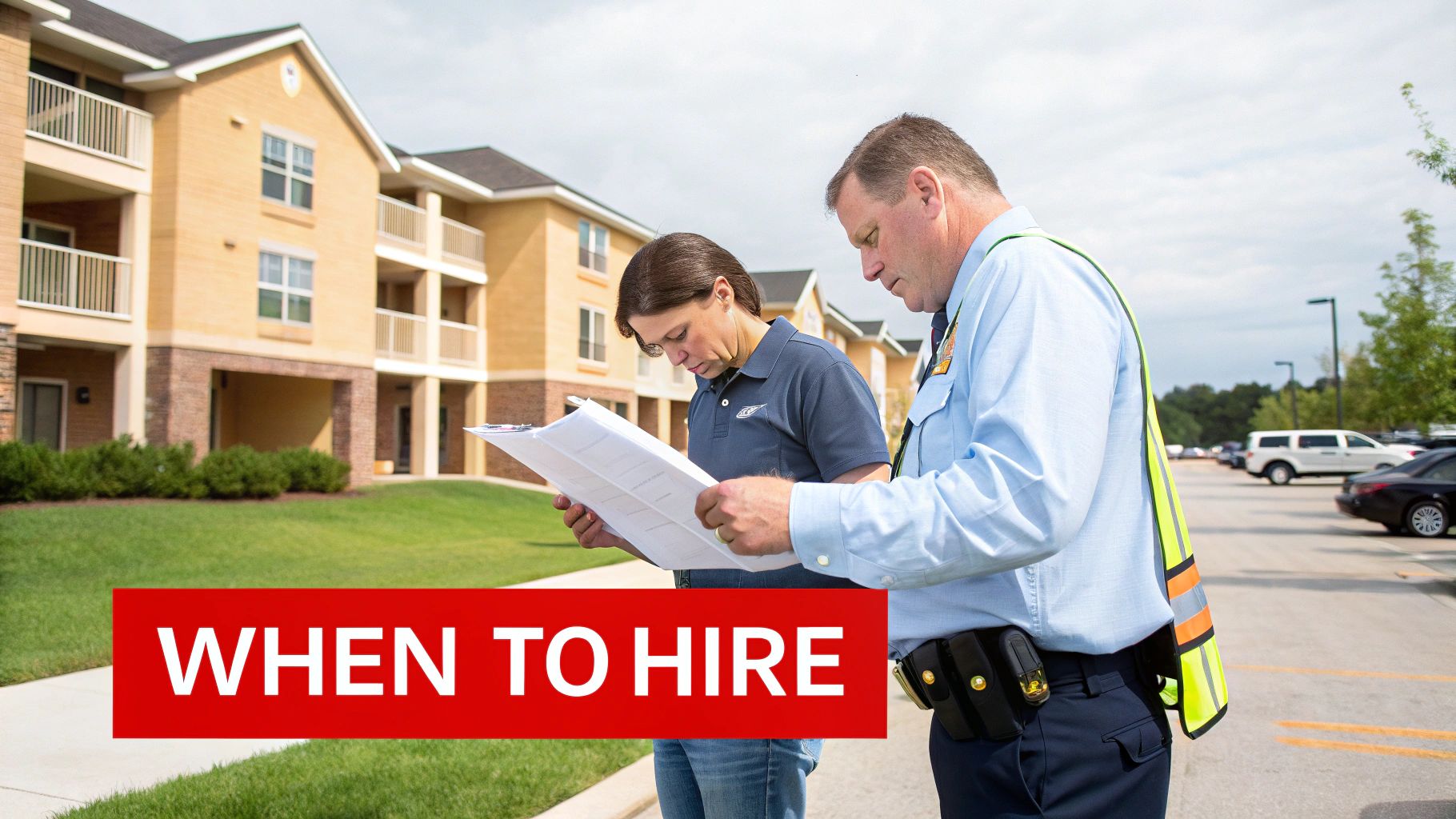
Deciding to hire a courtesy officer can feel like a significant step, but often, the signs are clear. If your management team is consistently being pulled into after-hours issues, it’s a strong indicator that you need on-site support.
This role isn't just for luxury high-rises; it adds tremendous value whenever community harmony is a top priority. A courtesy officer is your frontline solution for maintaining a peaceful and respectful environment long after your office has closed for the day.
Key Scenarios for Hiring a Courtesy Officer
It might be time to consider this role if your property is facing one or more of these common challenges. A professional presence can make a night-and-day difference in both resident satisfaction and your team's workload, which directly impacts retention.
-
Persistent After-Hours Complaints: Are you receiving late-night calls about noise, unauthorized parties, or disputes in common areas? A courtesy officer can address these issues immediately, preventing them from escalating or disrupting you at 2 a.m.
-
Parking Enforcement Headaches: Nothing frustrates residents faster than inconsistent parking enforcement. An officer can patrol lots, issue friendly reminders or official warnings, and ensure residents and guests adhere to policies, freeing your team from this thankless task.
-
Amenity Misuse and Oversight: Properties with appealing amenities like pools, gyms, and clubhouses often contend with unauthorized guests or rule-breaking. An officer ensures these spaces are used correctly and, just as importantly, secured on schedule every night.
A courtesy officer is a strategic investment in the resident experience. Their presence sends a clear message that you care about maintaining a safe, orderly, and high-quality community around the clock.
To better manage all property operations, including security personnel, it’s worth looking into a property management software comparison. The right tools can often integrate with security reporting systems, streamlining everyone's workflow.
How Overton Security Delivers a Better Officer
Understanding what a courtesy officer should be is one thing; finding a security partner who consistently delivers that level of service is another. For 26 years, Overton Security has built its reputation on quality over quantity. That philosophy shapes the caliber of the professionals we assign to your property. We believe a better officer starts with a better company culture.
Many security companies are caught in a cycle of high turnover, cycling through new faces so quickly that an officer never truly understands a community's unique dynamics. We take the opposite approach. By investing in our team with competitive pay, comprehensive benefits, and defined career paths, we earn their loyalty. This means you get experienced professionals who bring stability and reliability to your site—not just a uniform, but a dedicated partner.
The Overton Difference in Action
Our commitment extends beyond hiring good people. We support them with a powerful operational framework built for accountability and transparency. You should always have confidence that the service you pay for is the service you receive.
This structure is built on three key pillars:
- Hands-On Leadership: Unlike large national firms where clients can feel like just an account number, we maintain a low manager-to-client ratio. Your account manager is actively involved, conducting frequent site visits and providing personalized attention. Our leadership is always accessible and ready to address your concerns.
- Technology-Driven Accountability: Every Overton officer utilizes a GPS-enabled guard tour system. They file detailed digital activity reports in real-time, complete with photos and time-stamped entries. This gives you a transparent, verifiable record of every patrol and incident response.
- 24/7 Professional Support: Our officers are never on their own. They have the full backing of our 24/7 Security Operations Center (SOC), which provides immediate guidance and support. This adds a critical layer of oversight, ensuring every situation is handled according to your property’s specific post orders.
With Overton Security, a “courtesy officer” is more than just a friendly presence. It’s a well-trained, highly supported professional who combines human expertise with smart technology to protect your property and genuinely improve your community’s quality of life.
Your Top Questions About Courtesy Officers, Answered
If you're a property manager or serve on an HOA board, the idea of bringing in a courtesy officer has likely crossed your mind. It’s a strategic decision, but one that often comes with questions. Let’s address some of the most common ones.
Are Courtesy Officers Armed or Unarmed?
In most residential communities, courtesy officers are unarmed. This approach helps foster a welcoming, less intimidating atmosphere that is ideal for community engagement. The final decision is always based on a professional security assessment of your property's specific needs and risk profile.
Do They Have to Live On-Site?
Not necessarily. While some properties arrange for a rent reduction in exchange for having an officer live on-site, it is not a requirement. Many property managers find it more reliable to partner with a professional firm like Overton Security. We provide officers for scheduled shifts, guaranteeing consistent coverage without the complexities of resident-officer dynamics.
What's the Real Difference Between a Courtesy Officer and a Standard Guard?
This is an excellent question, as the distinction is significant. A standard security guard’s role is primarily focused on asset protection—monitoring access points and preventing theft. A courtesy officer, however, is a unique blend of security and genuine customer service.
They are trained to enforce community rules but also act as a friendly, helpful resource for residents. They excel at de-escalating minor issues before they become major problems, all while enhancing the community's overall living experience.
How Can I Actually Measure the ROI on This?
Thinking about return on investment is smart business. With a courtesy officer, ROI is measured through a collection of positive outcomes. Key metrics to track include:
- A reduction in resident complaints related to noise and parking.
- Fewer negative online reviews for your property.
- Improved resident retention rates, as satisfied residents are more likely to stay.
- A noticeable decrease in vandalism or misuse of common amenities.
Ready to bring a professional, service-first presence to your property? The team at Overton Security has over 26 years of experience providing top-tier courtesy officers trained to protect your community and enhance the resident experience. Contact us today to start building a security plan that truly fits your needs.