
Industrial site security in Dallas demands a careful blend of seasoned professionals and smart technology. With Overton Security’s 26 years of experience, hands-on leadership, a low manager-to-client ratio, and real-time accountability systems, every detail is covered—strict reporting, custom safeguards, and continuous oversight that close common gaps.
Overview Of Industrial Site Security Dallas
Industrial complexes in Dallas often stretch across hundreds of acres, with loading docks, warehouses, heavy equipment and multiple entry points. Standard, off-the-shelf security plans can leave critical blind spots. A tailored strategy, however, ensures comprehensive coverage.
- Seasoned officers on patrol, providing visible deterrence across 500+ acres
- GPS-enabled tracking for live location updates and detailed digital logs
- 24/7 SOC oversight centralizing camera feeds and sensor alerts into one command hub
Key Takeaway: Combining on-site patrols with continuous monitoring accelerates threat detection and response times.
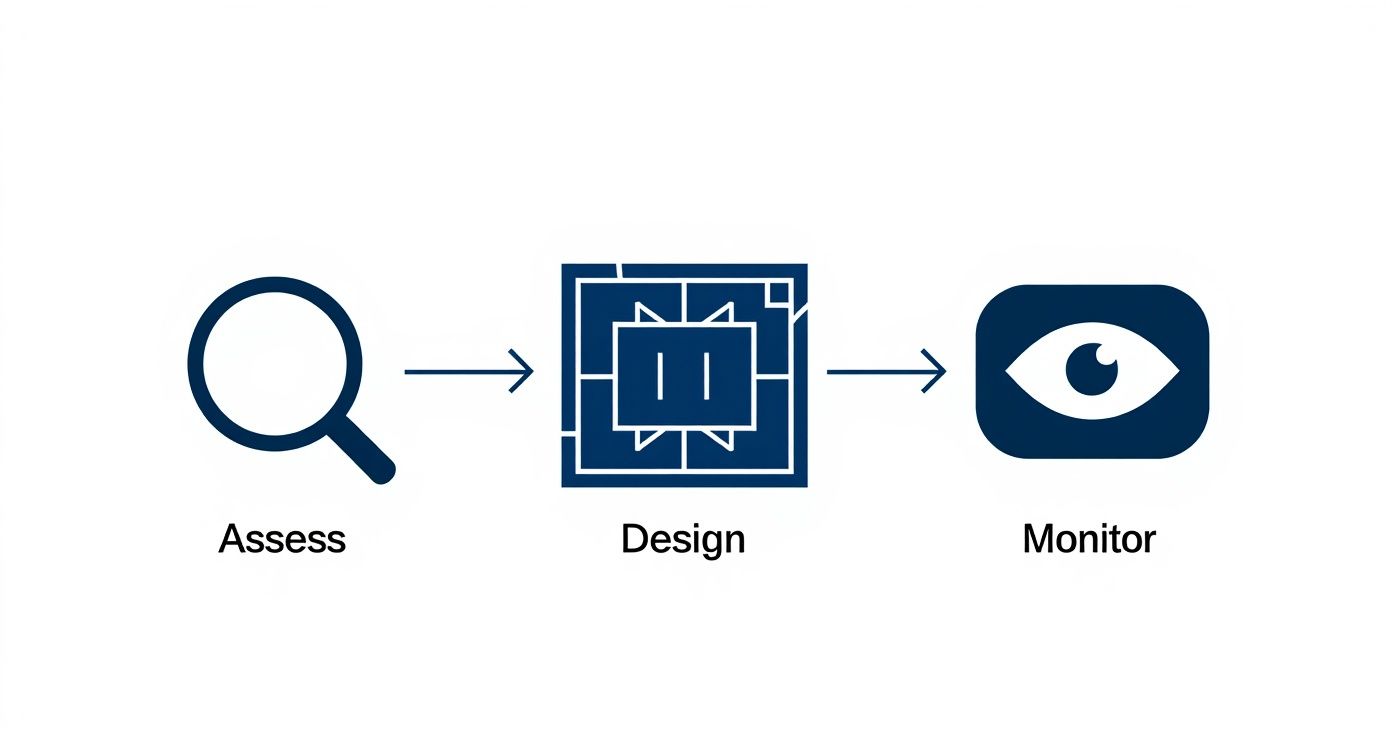
This visual lays out our Assess, Design, and Monitor phases—showing how technology and patrols work in tandem to secure every inch of a sprawling facility.
Key Challenges And Solutions
Large footprints, unpredictable weather, and poorly lit zones all heighten risks. A multi-layered defense is essential:
- Perimeter sensors flag fence breaches and alert the SOC instantly
- Night-vision cameras survey dimly lit docks and storage areas
- Access control systems log credentials and lock down restricted zones
Overton’s low manager-to-client ratio means you receive hands-on guidance and rapid adjustments. Detailed digital reports land in your inbox, and regular review meetings keep all stakeholders aligned.
In the next section, we explore risk assessment techniques—from physical walkthroughs to data-driven analysis.
Five Phases You’ll Follow
- Comprehensive Site Survey: Walk every gate, corridor, and parking lot to map vulnerabilities.
- Access Control & Patrol Design: Configure gate readers, badge systems, and guard schedules to match your layout.
- Service Selection: Decide on unarmed guards, mobile patrols, or remote video monitoring based on real-world threats.
- Technology Integration: Link cameras, sensors, and cloud analytics into an automated, responsive network.
- Ongoing Review & SOC Support: Schedule periodic reassessments and rely on SOC teams to keep security aligned with evolving needs.
Each phase builds on the last, creating a security posture that adapts as your operations grow.
Assessing Security Risks At Dallas Industrial Sites
Securing an industrial site in Dallas begins with identifying unique blind spots. Dark loading bays often become hideouts for copper wiring thieves, unmonitored yards attract forklift battery rings, and badge sharing opens doors for tailgating.
Our assessment combines hands-on checks with data analysis:
- Physical Surveys mapping fence lines, gates, and blind spots
- Employee Interviews tapping frontline insights
- Local Crime Data Analysis spotting trending incident types
- Asset Value Prioritization zeroing in on high-impact targets
- Incident Likelihood Ranking to guide resource allocation
Prioritizing Site Vulnerabilities
Zones are scored by threat level and asset criticality. This scoring matrix informs patrol schedules, lighting upgrades, and sensor placement so your team tackles the highest risks first.
Dallas Industrial Crime Statistics
| Crime Type | Number Of Incidents | Risk Implication |
|---|---|---|
| Robberies | 4,202 | Targets high-value goods during business hours |
| Burglaries | 14,516 | Exploits after-hours perimeter weaknesses |
| Thefts | 30,374 | Drives warehousing losses from organized rings |
| Auto Thefts | 7,384 | Indicates risk to mobile equipment and vehicles |
These figures highlight how burglars prey on perimeter gaps and organized rings drive theft counts, guiding our initial focus.
Detailed Physical Surveys
Our field teams log lighting intensity, camera angles, and sensor coverage to plot a geospatial vulnerability map:
- Install LED wall packs in corridors with low light
- Reposition CCTV cameras to cover rack blind spots
- Test intrusion sensors on emergency exit doors
- Inspect fence wear and mark potential cut points
Survey observations are cross-checked with equipment logs and incident histories, sharpening our list of immediate fixes.
Gathering And Interpreting Crime Data
Dallas-Fort Worth’s industrial belt tallied 4,202 robberies, 14,516 burglaries, 30,374 thefts, and 7,384 auto thefts last year. Read the full research on local crime trends and mitigation strategies with more insights.
Key Insight: Internal theft can cost up to 5% of annual revenue, making insider threats as critical as external ones.
Collaborating With Overton Security Analysts
When you engage Overton Security’s experts, raw data evolves into a dynamic, site-specific risk profile. Our analysts conduct thorough audits and fine-tune vulnerability matrices based on real-time field feedback. For fast-paced builds, see our guide on security for construction sites.
We also recommend reviewing risk management in manufacturing for lithium-ion battery hazards to handle high-energy equipment safely in storage and charging zones.
Frontline Staff Interviews
Shift supervisors and operators uncover patterns data alone can miss. Their first-hand accounts of near misses and minor thefts add crucial context:
- When does foot traffic near docks spike?
- Which small tools vanish most often?
- What areas feel under-monitored after hours?
These insights, paired with survey maps, deliver a full-spectrum view of site vulnerabilities.
Checklist For Finalizing Risk Assessment
- Confirm perimeter weakness scores reflect recent incident data
- Validate insider threat indicators using HR and security logs
- Adjust patrol routes and schedules based on zone criticality
- Coordinate technology overlays like cameras, sensors, and alarms
- Plan quarterly reassessments to stay ahead of site changes
Once this living blueprint is in place, you’re ready to move from assessment to action. Reach out to Overton Security’s analysts to start your tailored mitigation roadmap.
Design Customized Security Plans for Industrial Facilities

At Overton Security, our team reviews facility blueprints and walks every corner before laying out patrol routes or installing cameras. In Dallas, offices, docks, storage yards, and perimeter gates each carry access challenges. Matching guard schedules to those areas plugs potential gaps before they appear.
- Map Facility Zones by function and risk level to target resources
- Pinpoint Entry Points for employees, vendors, and visitors
- Assign Zone Leads so each sector has a dedicated officer
Mapping Facility Zones
Imagine a 500,000-sq-ft warehouse divided between raw materials and finished goods. High-value zones drive budget decisions:
- Define clear security objectives aligned with daily operations
- Establish spending limits and identify cost-effective measures
- Vet vendors for proven track records and responsive communication
- Test patrol patterns and tech tools in a pilot area before full deployment
Rotating officers on varied routes keeps coverage unpredictable and resilient.
Layered Defense Checkpoints
Blending on-site personnel, CCTV, and smart environmental design builds serious deterrence. Each layer delays or stops intruders:
| Security Layer | Purpose | Key Benefit |
|---|---|---|
| On-Site Security Guard | Visible deterrence | Immediate response |
| Surveillance Cameras | Continuous monitoring | Evidence collection |
| Environmental Design | Natural barriers and lighting | Passive risk reduction |
Wide-angle cameras fill blind spots, while guards handle incidents as they happen. For related insights, check our guide on warehouse security in San Diego.
Securing Docks And Storage Areas
Loading docks often become hotspots during shift changes. Badge readers at dock doors, paired with video sensors, flag unauthorized entry. Adding bollards and reinforced fencing raises the bar:
- Schedule timed access windows for approved hours
- Install motion-activated lighting around pallet racks
- Run surprise guard checks during evening turnovers
- Coordinate with forklift operators to track equipment movement
Fine-tuning sensor sensitivity cuts false alarms while still catching real threats. Hands-on officer training around dock protocols reduces human error.
Case Study Of A Large Warehouse
When Overton Security tackled a half-million-square-foot facility, tenant separation required two distinct patrol circuits. Within three months, perimeter breaches hit zero and alarm response times dropped by 40%.
“Running pilot schedules and setting clear objectives saved the client money while raising the safety bar,” says our Operations Manager.
Quarterly assessments and performance tracking ensure secure results every time.
Choosing Security Services For Industrial Sites In Dallas
After mapping vulnerabilities, build a security lineup that fits like a glove. Each layer—from boots on the ground to eyes in the sky—brings unique strengths and costs. Calibrating the mix to your footprint and risk profile prevents gaps without overspending.
Core options include:
- Unarmed Guards for visible deterrence and instant human judgment
- Mobile Patrols with GPS to roam remote perimeters
- 24/7 Video Monitoring delivering nonstop surveillance and instant alerts
Evaluating Guard Services
Unarmed officers do more than patrol—they greet drivers, verify deliveries, and handle unexpected situations with a human touch. Their presence builds relationships and discourages casual theft:
- Training Standards: Verify certification levels and practical drills
- Retention Metrics: Look for turnover under 20% annually
- Management Support: Ensure supervisors conduct weekly site visits
Demand clear performance guarantees—minimum patrol frequencies, rock-solid response times, and non-negotiable escalation protocols.
A swift patrol response recovered a $52,000 excavator stolen from a Denton site and tracked to Fort Worth, showcasing real-time deterrence in action.
Construction sites in Dallas face organized heists targeting high-value gear. Learn more from ECAM’s construction monitoring research.
Mobile Patrol Extensions
Static posts cover only so much ground. GPS-enabled patrol vehicles mix scheduled and random routes, keeping intruders guessing. Live tracking and instant logs offer visibility across sprawling sites:
| Service Type | Key Benefit | Ideal Use |
|---|---|---|
| Unarmed Guard | On-site deterrence | Entry points and high-traffic zones |
| Mobile Patrol | Campus-wide visibility | Remote perimeters and off-hours |
| Video Monitoring | 24/7 surveillance | Extended coverage and analytics |
Pair patrols with motion-activated lighting and smart locks for an extra layer. Sync IoT sensors with your SOC so any fence breach triggers immediate dispatch. This proactive blend cuts theft attempts by 45%.
Setting Contract Essentials
Clear contracts spell out shift flexibility, reporting formats, and escalation pathways. Tie service tiers directly to your risk score and budget:
- Minimum guard hours and patrol visit commitments
- Digital report templates and delivery schedules
- Escalation protocols for missed checks or incidents
- Performance metrics paired with penalty clauses
Review renewal terms annually and negotiate caps on price increases. Include upgrade options—add cameras, extend patrols, or integrate new sensors as your site evolves.
Implementing Technology Solutions to Enhance Site Protection

Smart tools amplify what security teams achieve at Dallas industrial sites. When patrol officers work alongside real-time analytics, managers see every corner of the facility and can act faster. Overton Security invests in officer retention, ensuring each team member is trained on these systems and committed long term.
Since 2023, the Dallas-Fort Worth industrial market has added over 115 million sq ft, yet nearly 40% remains available for lease. A 9.2% vacancy rate leaves noticeable blind spots, so modern safeguards are non-negotiable. For deeper regional trends, see Bradford Market Insights.
GPS Tracked Patrol Management
GPS-enabled platforms reveal exactly where each guard is—and when they checked each checkpoint. Overton’s SOC dashboard mirrors live locations and time-stamped logs, cutting false alarms by 70% and unauthorized access attempts by 85% in three months.
- Geofenced patrol zones keep every fence line covered
- NFC tags validate checkpoint visits and auto-generate reports
- Live mapping and instant alerts speed up dispatch decisions
“Our SOC platform turned raw patrol data into actionable intelligence, boosting efficiency and accountability,” explains an Overton Security Operations Manager.
IoT Sensors For Fence Breach Detection
IoT vibration strips and beam sensors along perimeters create an early-warning net. Any tap, cut, or climb triggers an instant SOC alert:
- Vibration strips trip alarms when stretched or severed
- Microwave and infrared beams catch movement in blind spots
- Encrypted wireless modules link sensors back to the SOC
As facilities adopt more connected devices, addressing IoT security challenges is essential.
Cloud Based Video Analytics
AI-powered cloud analytics spotlight real threats instead of hours of footage review. These platforms sync with existing cameras and control panels, avoiding lengthy downtime:
| Feature | On-Premise Analytics | Cloud Video Analytics |
|---|---|---|
| Scalability | Limited by hardware | Elastic resource allocation |
| Maintenance | Manual firmware updates | Automatic platform upgrades |
| Advanced Motion Filters | Basic threshold settings | AI-driven false-alarm reduction |
| Remote Access | VPN or LAN | Secure web portal with roles |
Dashboards display live hotspots, repeat alerts, and key performance metrics.
Biometric Access Controls
Biometric readers at entry points verify fingerprints or faces, backed by PIN fallback—greatly reducing tailgating and card sharing:
- Multi-factor authentication enforces tight access rules
- Time-of-day locks align with shift patterns
- Detailed audit logs support compliance reviews
Rollout tips:
- Pilot hardware in a low-risk area first
- Train staff on privacy and enrollment steps
- Fine-tune sensor sensitivity based on real events
- Track KPIs like fewer badge-sharing incidents
Phased Implementation And Staff Training
Rolling out new tech in phases keeps operations steady and gives teams time to adapt:
- Map clear milestones for each launch stage
- Define success criteria for hardware and software
- Host hands-on workshops with frontline officers
- Appoint tech champions for peer support
Document configurations, integration notes, and troubleshooting steps. Then schedule refresher sessions whenever new features roll out.
Explore continuous oversight through our remote video monitoring solutions.
Keep tracking ROI—incident reductions, alarm fatigue, response times and cost savings—to stay a step ahead of threats.
Maintaining And Reviewing Your Security Strategy
Securing an industrial site isn’t a one-and-done project. As you add equipment, adjust workflows, or face evolving crime trends, your security plan must keep pace. Overton Security’s living maintenance process cycles through monthly patrol report audits, quarterly threat reassessments, and annual technology health checks. This steady rhythm catches small cracks before they turn into breaches.
Visual checks show real-time conditions. Data-driven reviews indicate where to redeploy resources. For example, if cameras flag an uptick in third-shift break-ins, patrol timing can shift to seal the gap. Many Dallas facilities adopting this approach slash surprise incidents by nearly a third.
- Monthly Audits uncover odd activity in loading docks and storage yards
- Quarterly Reassessments realign priorities based on fresh Dallas crime data
- Annual Tech Checks verify cameras, sensors, and access controls perform flawlessly
Monthly Audits And Trend Analysis
Each month, we analyze patrol logs, incident reports, and officer notes. This often reveals recurring issues—such as tailgating at a secondary gate or unauthorized vehicles in a seldom-used lot.
Metrics To Track Monthly
- Patrol Completion Rate
- Incident Response Time
- Repeat Incident Locations
Quarterly Threat Reassessments
Three times a year, revisit your entire threat profile. Local crime rings shift tactics, new contractors arrive, and operational tweaks can open vulnerabilities.
Key Activities Each Quarter
- Re-score Vulnerability Zones with Updated Data
- Re-map Access Points after Workflow Changes
- Review Frontline Feedback from Officers
Annual Technology Health Checks
Once a year, conduct a deep dive on hardware and software—firmware updates, sensor calibration, and camera alignment.
Checklist Items Include
- Camera Lens Cleaning and Angle Verification
- Sensor Battery Tests and Recalibration
- Access Control Software Patches and Audit Log Reviews
“Consistent tech maintenance cut false alarms by 30% and improved detection accuracy,” says Overton Security’s SOC lead.
Stakeholder Communication And Dashboards
Clear reporting wins executive support and unlocks upgrade budgets. Dashboards often feature:
- Patrol Completion Percentage
- Average Incident Response Time
- Trend Graphs for Theft or Breach Spikes
- ROI Calculations Showing Cost Savings
Regularly sharing these visuals makes every security dollar’s impact unmistakable.
Continuous Improvement And Team Onboarding
When patrol routes or protocols change, teams need hands-on training. Onboarding and refresher sessions keep everyone synchronized.
Training Best Practices
- Walkthroughs of Revised Patrol Routes
- Digital Manuals with Embedded Video Demos
- Shadow Shifts Pairing New Hires with Veterans
Overton Security’s real-time accountability tools log each guard’s adherence to post orders. That data drives performance and proves ROI.
Partnering with Overton Security also taps you into deep Dallas-area crime analytics and decades of industrial security know-how. Together, we fine-tune your plan so your site remains steps ahead of any threat—no matter how it evolves.
Frequently Asked Questions
Many facility directors and property managers face similar puzzles when planning industrial site security in Dallas—chiefly around budgets and deployment schedules. Below are clear answers drawn from real-world experience.
What Factors Influence Security Service Costs For Industrial Facilities In Dallas?
Costs hinge on several elements:
- Site Size: Bigger footprints need more personnel and technology
- Coverage Hours: 24/7 protection costs more than daytime patrols
- Access Point Count: More gates and doors mean extra monitoring
- Technology Integration: Cameras, sensors, and analytics add to upfront fees
- Monitoring Level: A simple alarm plan differs from a fully staffed 24/7 SOC setup
A detailed risk assessment ties these elements together, revealing the right balance of human guards and digital tools.
How Quickly Can I Deploy A Full Security Solution At A Large Warehouse?
Typically, Overton Security can have guards on-site and remote monitoring live in 2–4 weeks. Permitting and site complexity play a role. For urgent needs, we often launch a pilot patrol within days to seal major gaps while the full solution comes online.
Measuring Security Plan Success
Track these metrics to prove your plan’s effectiveness:
- Incident Response Time: Minutes from alarm to officer arrival
- False Alarm Rate: Percentage of activations that aren’t real threats
- Patrol Completion Rate: Share of scheduled patrols carried out
- Breach Count: Unauthorized access events over time
“Focusing on response time and patrol compliance transformed our industrial security outcomes,” notes a Dallas operations manager.
Can I Integrate My Existing Cameras And Access Controls With New Services?
Absolutely. Modern platforms offer API connections that link legacy systems into a single dashboard. Overton Security’s 24/7 SOC team performs compatibility audits, configures integrations, and tests end-to-end monitoring. The result: your cameras, sensors, and access panels all speak the same language—and you manage them from one central console.
Ready to elevate your protection? Contact Overton Security for expert guidance and customized solutions.