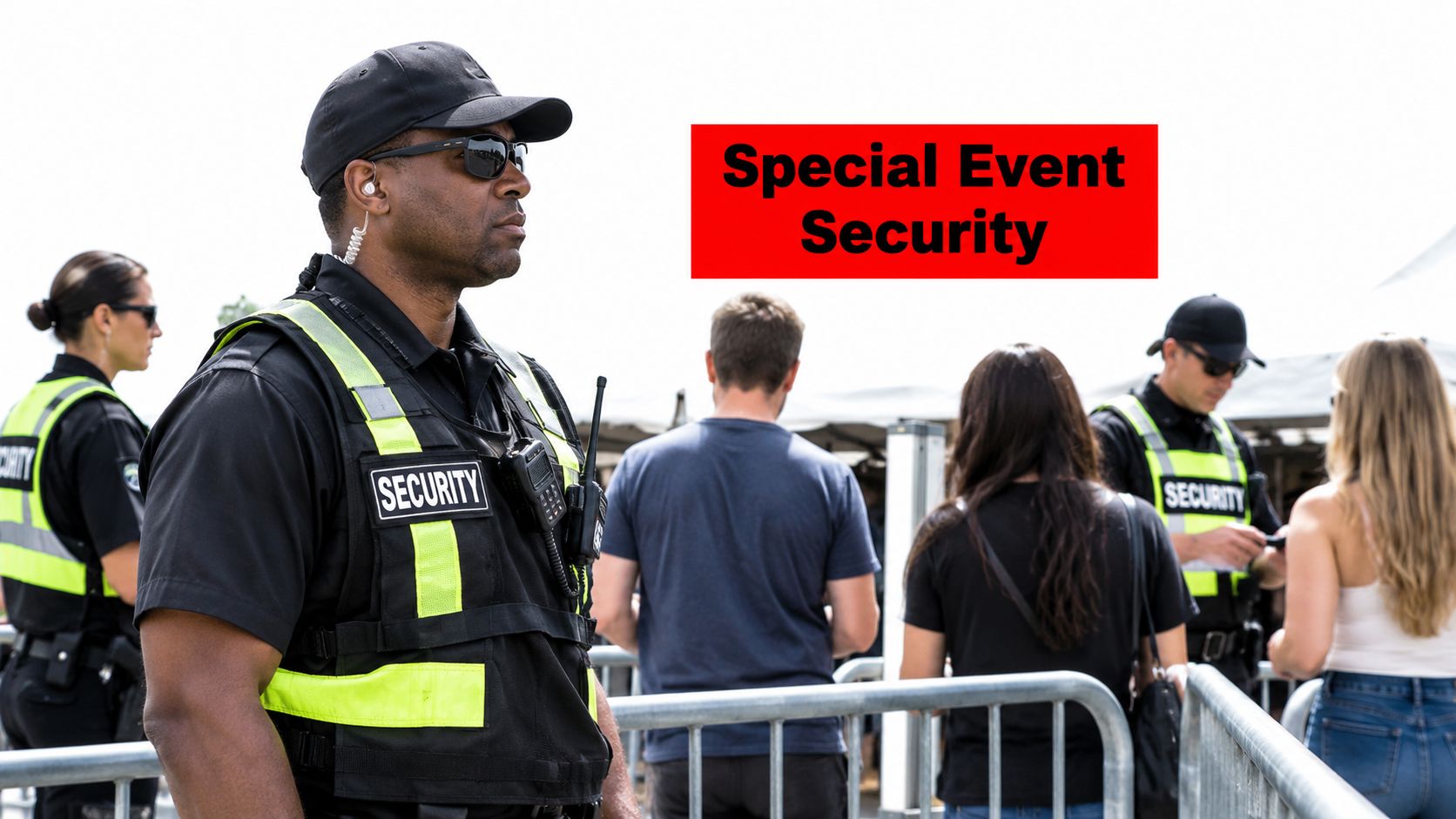

Is your property truly secure after hours? An onsite security guard is often the most effective tool for deterring crime, ensuring a rapid incident response, and guaranteeing the safety of your property, staff, and visitors. While technology like cameras can record what happens, a professional human presence actively prevents those events from happening in the first place.
The Real Value of an Onsite Security Guard
It’s a scenario we hear from property managers across California. A sudden spike in after-hours loitering at a San Jose retail center. A frustrating string of car break-ins in a Los Angeles apartment complex. Unauthorized access at a construction site in Fresno.
In these situations, a reactive approach isn't enough. Your security cameras might provide excellent footage of a crime, but they do very little to stop it while it's in progress.
This is where a professional onsite security guard changes the game. Their value extends far beyond simply wearing a uniform; they are a proactive, indispensable part of a robust risk management strategy. A visible security presence is one of the strongest deterrents available, encouraging opportunistic criminals to look for easier targets elsewhere.
Let's compare the two approaches.
Onsite Guard vs. Remote Monitoring: A Quick Comparison
This table helps clarify the distinct advantages and ideal use cases for an onsite presence compared to purely technological solutions.
| Security Function | Onsite Security Guard | Remote Monitoring (Cameras Only) |
|---|---|---|
| Deterrence | High (Visible, proactive presence) | Low to Moderate (Passive presence) |
| Response Time | Immediate | Delayed (Requires dispatch) |
| Incident Handling | Can de-escalate, assist, and report | Records event for later review |
| Access Control | Can physically manage entry/exit points | Can only observe and report |
| Customer Service | High (Can direct, assist, and engage) | None |
| Flexibility | High (Can adapt to changing situations) | Low (Fixed camera views) |
While cameras are a crucial layer, they cannot replicate the judgment, authority, and immediate physical response of a trained officer on the ground.
More Than Just a Uniform
A well-trained officer quickly becomes an ambassador for your property. They are the first friendly face for tenants, the watchful eyes that notice a door propped open, and the calm authority that can de-escalate a tense situation before it escalates.
Consider a residential community. A guard does more than patrol. They learn residents' routines, enforce parking rules fairly, and provide a reassuring presence that makes people feel safer at home. On a construction site, they are critical for controlling access, protecting thousands of dollars in materials, and preventing costly theft and vandalism after hours.
The decision to hire an onsite security guard is an investment in prevention. It’s about creating an environment where potential issues are identified and resolved before they become significant problems, protecting both your people and your property.
A Growing Need for Proactive Security
This demand for reliable, professional security isn't just anecdotal. The numbers back it up. The global security guard market was valued at around $220 billion in 2023 and is projected to reach an impressive $350 billion by 2032.
This growth underscores the vital role that onsite guards play in providing the visible deterrence and immediate response that technology alone cannot deliver. You can explore these industry trends in the full report from Dataintelo.
At Overton Security, we blend this essential human element with smart technology. Our officers are supported by our 24/7 Security Operations Center (SOC) and use GPS-enabled systems for verifiable patrols. This ensures you get a security program that is both accountable and effective, transforming the role of a guard from a passive observer into an active protector of your assets.
Defining Your Property's True Security Needs
Before hiring a security guard, it's essential to have a clear picture of your property's specific vulnerabilities. An effective security program isn't a one-size-fits-all solution; it's a tailored response to the real-world risks you face. Hiring a guard without a defined mission is like building a house without a blueprint—it’s expensive and unlikely to succeed.
Start with a practical security assessment. Walk your property from the perspective of someone looking for an easy target. Where are the dark corners? Which gates or doors are unmonitored after hours? Are there significant blind spots in your camera coverage?
Tailoring Security to Your Environment
Every property has a unique risk profile, and your security goals must reflect that reality. Your objectives will dictate the type of officer you need, the duties they perform, and how you measure success.
The challenges of a property manager differ greatly depending on the asset type:
- An HOA Manager in Fresno: The focus is on resident safety and quality of life. Key tasks include enforcing parking rules, managing access to amenities like the pool, and deterring loitering. The goal is to provide peace of mind.
- A Construction Superintendent in San Diego: This is about asset protection. The primary goal is preventing the theft of expensive materials like copper wiring, tools, and machinery. This requires strict after-hours access control and diligent perimeter patrols.
Setting clear goals is crucial. Instead of a vague objective like "improve security," aim for something measurable, such as, "reduce after-hours vandalism incidents by 50% within six months" or "eliminate unauthorized vehicle parking in fire lanes."
Armed vs. Unarmed: A Collaborative Decision
One of the most critical decisions is whether to deploy an armed or unarmed guard. This choice should be based on a careful analysis of tangible risks, not on gut feelings.
An unarmed officer is the right solution for the vast majority of properties. They provide a powerful visual deterrent and are ideal for handling routine tasks like access control, customer service, and enforcing property rules. Their presence is professional, reassuring, and effective at preventing common issues.
Armed security is a significant step reserved for environments with a documented history of violent crime or those protecting exceptionally high-value assets, such as certain financial institutions or high-risk retail locations.
Choosing between armed and unarmed security shouldn't be made in a vacuum. It should be a collaborative process with an experienced security partner who can help you analyze your property's specific threat level and recommend the most appropriate and responsible solution.
This flowchart breaks down the core functions of a solid security program.
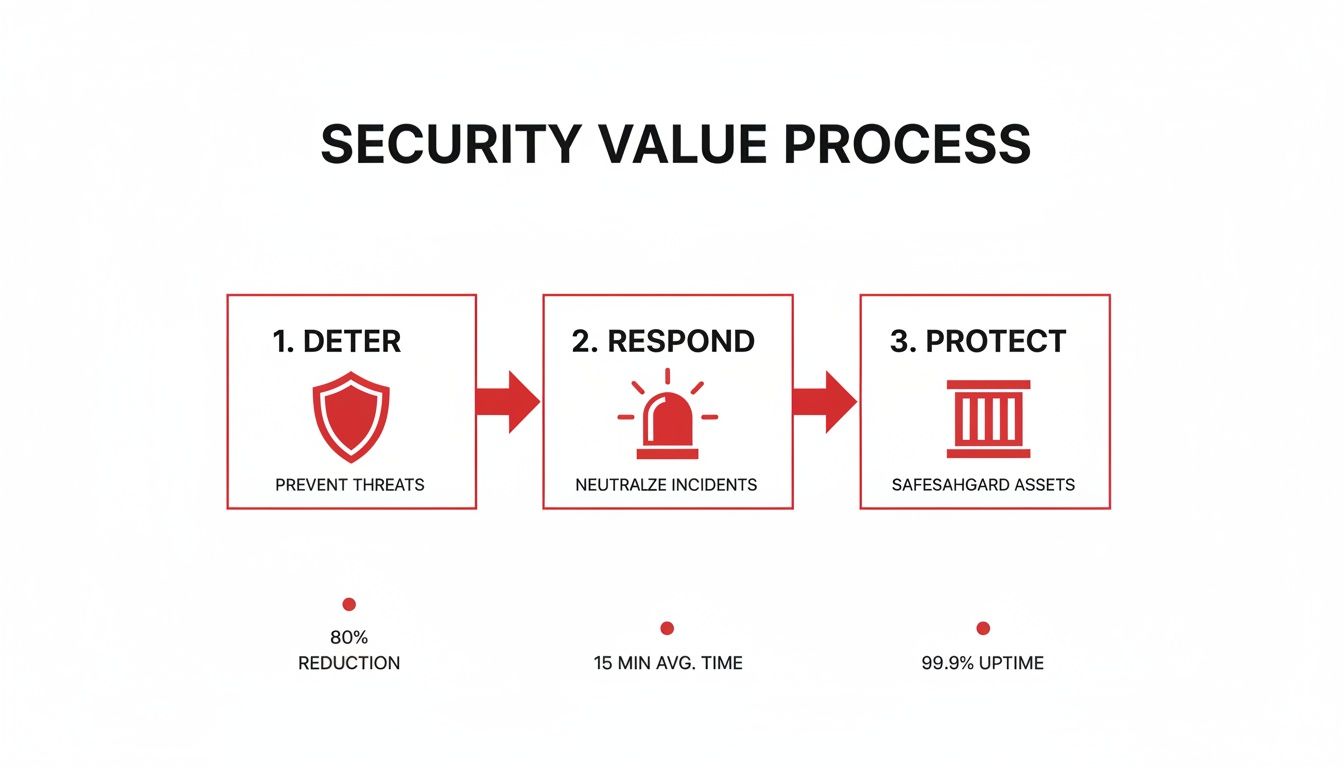
As you can see, a proactive security presence starts by deterring threats, stands ready to respond to incidents, and ultimately protects your property's value.
Integrating People and Technology
Defining your security needs also means looking at modern tools. Technology and human expertise should work together seamlessly. For instance, when evaluating access points, consider tools like AI visitor management solutions for on-site security and compliance.
These systems can automate guest check-ins, verify identities, and create an auditable record of everyone on your property. This frees up your guard to focus on more critical duties, like patrols and observation, rather than being tied to a desk.
The demand for this smart, human-centric approach is clear. The global security services market is projected to grow from $101.3 billion in 2025 to over $154.3 billion by 2035. This growth is driven by rising corporate security concerns where a human presence—for patrols, customer service, and immediate response—is irreplaceable. A thorough needs assessment ensures you invest in a security solution that delivers real, measurable results.
Creating Post Orders That Actually Work
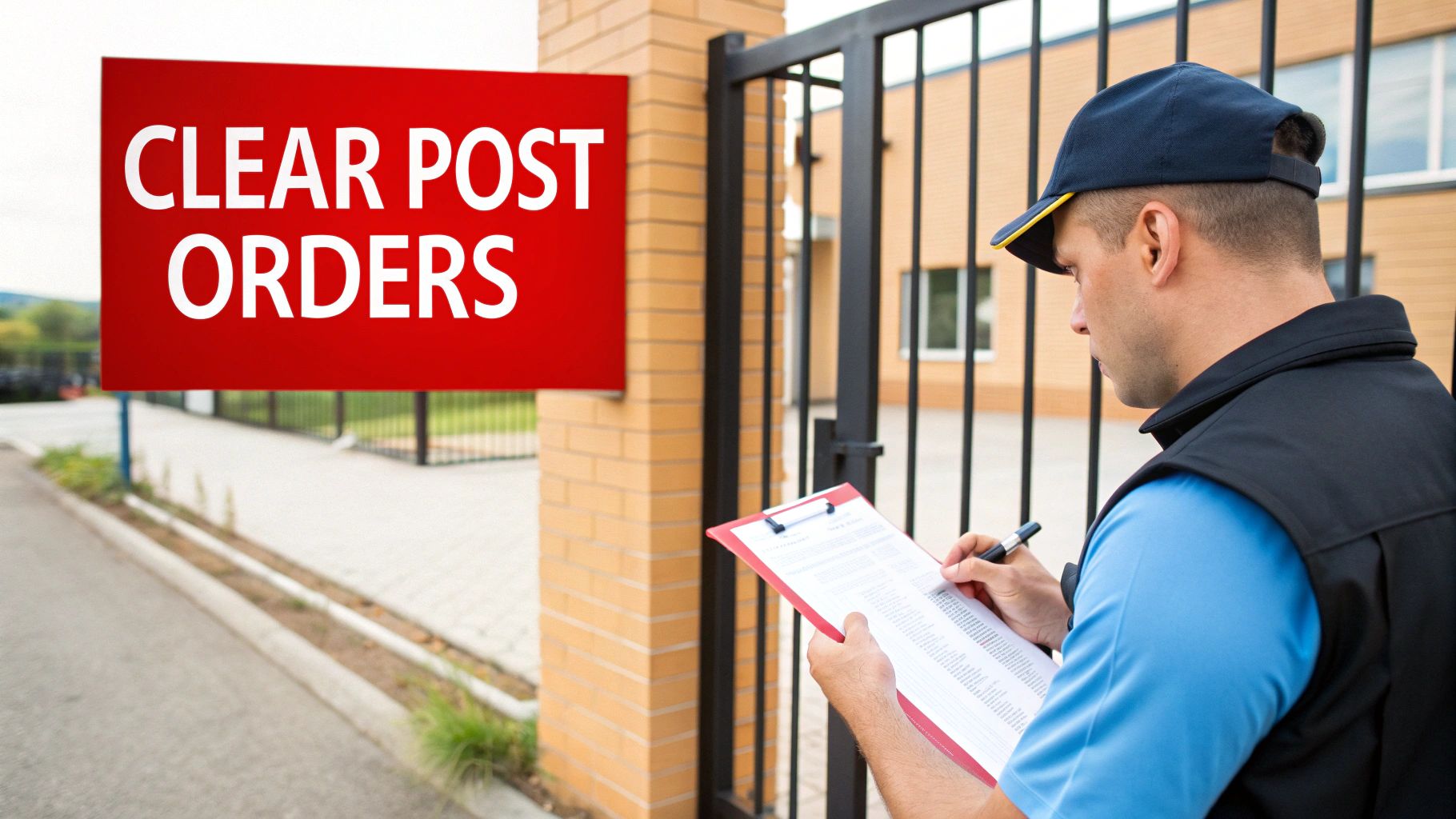
Once you've defined your property’s security needs, the next step is to translate those goals into clear, actionable instructions for your onsite guard. These are your Post Orders—the operational playbook for your entire security program.
Without them, even the most experienced officer is left guessing what you expect them to do.
Vague instructions are a primary reason security programs underperform. A simple directive like "Patrol the property" is nearly useless because it leaves too much to interpretation. What does "patrol" mean? Where should they go? How often? What should they be looking for?
This ambiguity leads to inconsistency, missed vulnerabilities, and a poor return on your investment. A professional security partner will work with you to eliminate guesswork.
From Vague Directives to Specific Duties
Effective Post Orders replace ambiguity with precision. They break down a guard's responsibilities into specific, measurable tasks. This not only empowers the officer to perform their job well but also gives you a clear standard for accountability.
Consider the difference:
- Weak Directive: "Watch the loading dock."
- Strong Directive: "From 6 PM to 6 AM, verify the credentials of all delivery drivers at the loading dock. Log all vehicle license plates and entry/exit times in the digital activity report. After 10 PM, ensure the dock door is secured and report any unauthorized individuals within 15 minutes."
This level of detail leaves no room for error. The officer knows exactly what is expected, and you receive a clear record of their activity.
Essential Components of Effective Post Orders
Well-written Post Orders are the foundation of a successful security program, ensuring every officer understands your property's unique requirements.
Key components include:
- Site-Specific Duties: The core of the document, outlining all day-to-day tasks like patrol routes, access control procedures, lock-up schedules, and rules enforcement (e.g., parking).
- Emergency Contact List: A clear, prioritized list of contacts for different situations, including property management, maintenance, local law enforcement, and the security company's 24/7 dispatch center.
- Incident Reporting Protocols: Detailed instructions on how to document and report various incidents, from a maintenance issue to a serious security breach.
- Rules of Engagement: Clear guidelines on how officers should interact with tenants, visitors, and unauthorized individuals, including de-escalation techniques.
Your Post Orders should be a living document. As your property’s needs change, they should be reviewed and updated with your security provider to remain relevant and effective.
Connecting Post Orders to Your Service Level Agreement
While Post Orders define what the officer does, your Service Level Agreement (SLA) defines how well it gets done. The SLA is the part of your contract that establishes measurable performance metrics, creating a framework for transparency and accountability.
A strong SLA transforms your security program into a set of verifiable deliverables.
Key Metrics for a Security SLA
Your SLA should include specific goals tied directly to the duties in your Post Orders.
- Patrol Verification: 100% of scheduled patrols must be completed, with each checkpoint scanned and time-stamped in the Guard Tour Management System.
- Incident Report Submission: All incident reports must be submitted through the digital system within one hour of the event's conclusion.
- Officer Check-Ins: Officers must perform hourly wellness checks with the 24/7 Security Operations Center (SOC).
- Response Times: For dedicated vehicle patrols, a commitment to be on-site within a specific timeframe (e.g., under 15 minutes) for client-requested assistance.
These metrics provide a clear, data-driven way to evaluate the performance of your onsite security guard and the company. At Overton Security, we believe clear Post Orders and a robust SLA are non-negotiable. They are the tools that transform security from a line-item expense into a strategic, accountable asset for your property. For a great starting point, this helpful security patrol checklist template can ensure you cover all your bases.
How to Properly Vet a Security Guard Company
Choosing a security partner is a significant decision. The right company becomes an extension of your team, while the wrong one can create more problems than it solves. This isn't about finding the lowest bidder; it's about investing in a partnership that protects your people and assets.
The security industry is crowded. In the U.S. alone, there are over 112,000 security businesses. With a market that saturated, you must look past sales pitches and examine a company's operational strength. Understanding the security industry's competitive landscape highlights the importance of choosing a stable, reliable partner.
Verifying the Non-Negotiables
Before discussing services or rates, there are foundational credentials every legitimate California security company must possess. Skipping this step is a significant risk.
Always verify these three things:
- State Licensing: The company must hold a valid Private Patrol Operator (PPO) license from the California Bureau of Security and Investigative Services (BSIS).
- Insurance Coverage: Request a certificate of insurance and ensure it shows adequate general liability, workers' compensation, and auto liability coverage. Never consider a proposal without proof of insurance.
- Officer Credentials: Confirm that every onsite security guard assigned to your property has a current Guard Card issued by the BSIS.
These are the basics. A professional firm will provide this documentation readily. If a vendor is hesitant, consider it a major red flag and move on.
Asking Questions That Reveal True Capability
Once the basics are confirmed, it's time to ask questions that distinguish professional firms from those that just fill shifts. The answers will reveal their operational depth, management structure, and commitment to quality. This is a critical part of our guide on how to hire the best security guards.
Here’s a practical checklist for your interviews.
Security Vendor Vetting Checklist
Use these questions to get a clear picture of each potential partner. The "Overton Standard" shows what a high-quality, client-focused response sounds like.
| Vetting Category | Key Questions to Ask | What to Look For (The Overton Standard) |
|---|---|---|
| Management & Support | "What is your manager-to-client ratio?" | A low ratio. This ensures your manager knows your property intimately, not just as a name on a list. Hands-on attention is key. |
| Technology & Transparency | "Can you show me a sample digital activity report?" | Look for detail: GPS time-stamps, embedded photos from your site, and clear, actionable notes. It should be easy to see what the officer did. |
| Officer Retention | "How do you support and retain your officers?" | A focus on competitive pay, benefits, and ongoing training. High turnover is common; a company that invests in its people provides better service. |
| Operational Infrastructure | "Describe your 24/7 dispatch and support system." | A dedicated Security Operations Center (SOC). This is the lifeline for officers, providing oversight, backup, and an immediate point of contact. |
These questions cut through marketing fluff and get to the core of a company's capabilities.
The goal is to understand the system that supports the guard. A great security company doesn't just hire an officer; it surrounds them with robust management, transparent technology, and a culture of accountability.
This vetting process is your best tool for finding a partner with the experience and infrastructure to deliver on their promises. It’s the same foundation of hands-on leadership and real-time accountability that Overton Security has built its reputation on for over 26 years.
Using Technology to Empower Your Security Team
Modern security isn't about replacing onsite security guards with technology. It's about making them smarter, more accountable, and better connected. The right tools elevate a security program from adequate to exceptional, giving you a clear line of sight into what’s happening on your property. This is how you achieve a real return on your security investment—by blending human expertise with smart technology.
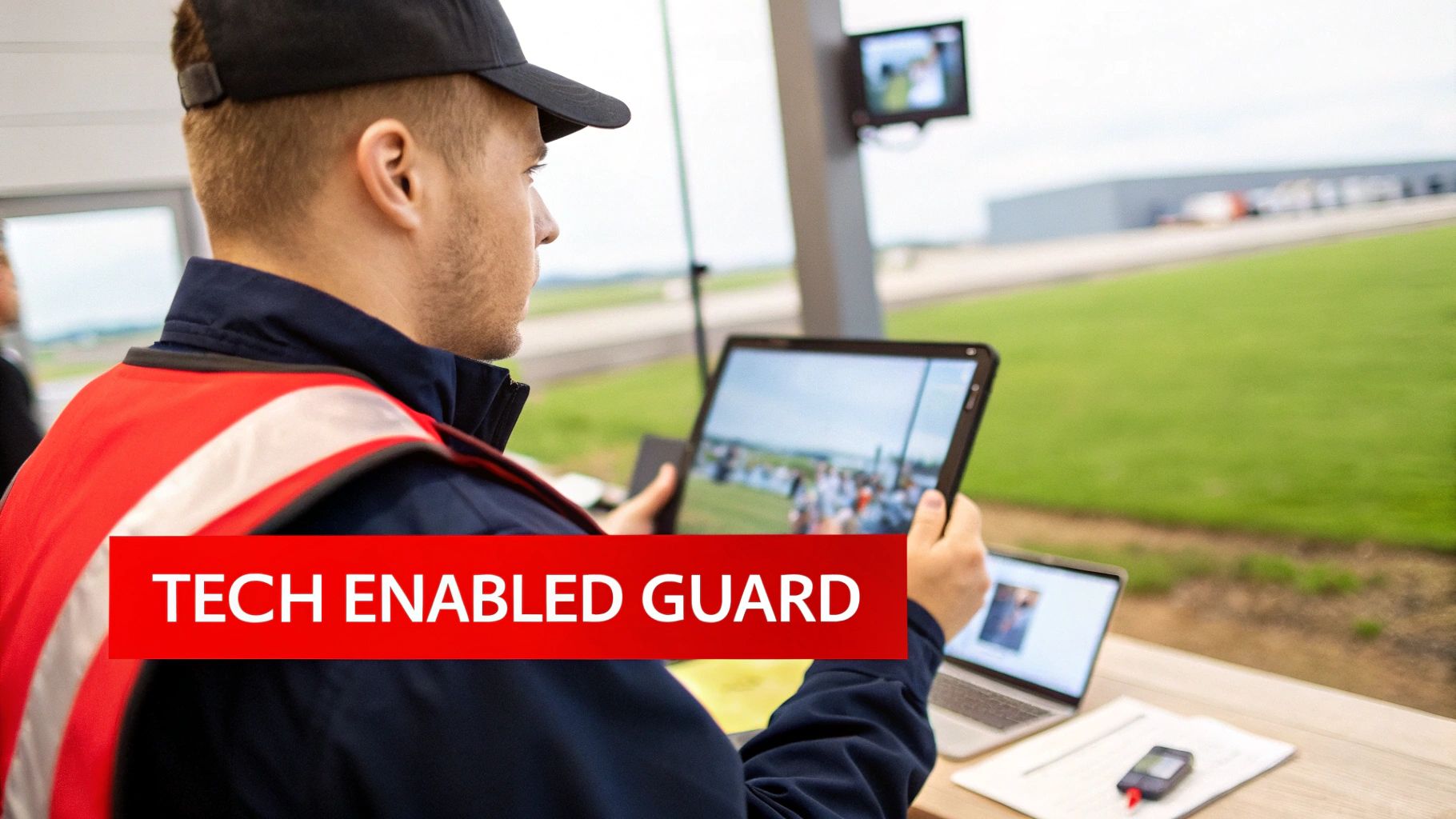
When this synergy is achieved, guesswork disappears, building a foundation of trust and transparency. You never have to wonder if a patrol was completed or what an officer observed during their shift.
The Power of a Guard Tour Management System
A Guard Tour Management System (GTMS) is the backbone of modern security accountability. It uses GPS and scannable checkpoints—often simple NFC tags—placed at critical locations around your property, such as a back gate, pool entrance, or remote utility room.
When an officer makes their rounds, they scan each tag. This instantly creates a time-stamped, GPS-verified record, confirming their exact location and the time they were there.
This technology is a game-changer for property managers. For example, if you manage a commercial property in Oakland, a GTMS can send you a real-time alert with photos the moment an officer discovers a broken fence. This immediate notification allows you to dispatch maintenance or escalate the issue before it becomes a major liability.
The 24/7 Security Operations Center Lifeline
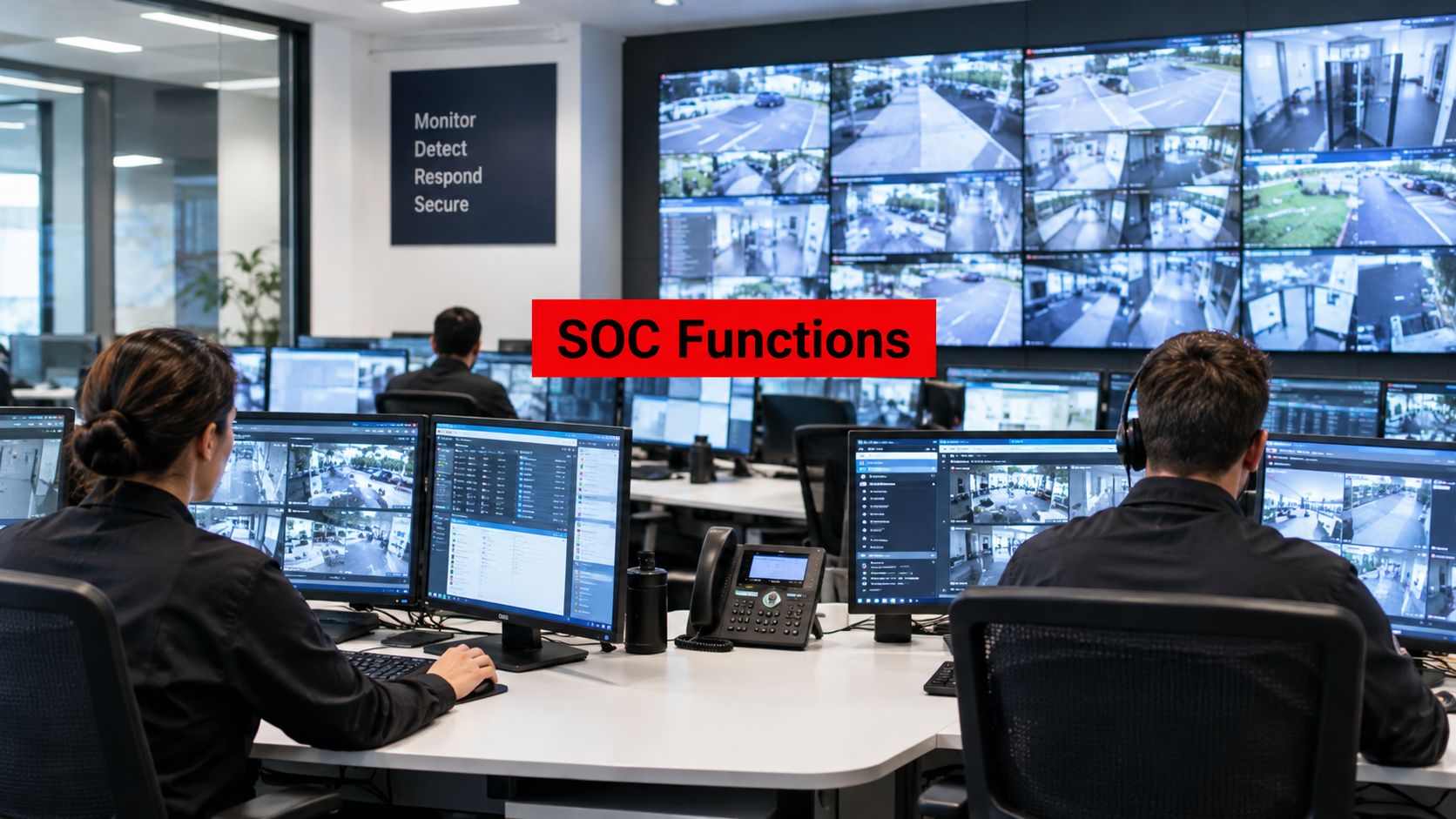
While a GTMS ensures accountability on the ground, a 24/7 Security Operations Center (SOC) acts as the central nervous system of your entire security program. It’s a command center staffed around the clock by trained dispatchers who provide mission-critical support to your onsite guard.
The SOC serves several vital functions:
- Oversight and Wellness: The SOC performs regular check-ins with officers to ensure their safety, especially during long overnight shifts.
- Backup and Dispatch: If an officer needs backup, the SOC coordinates the response instantly, whether it's law enforcement or another security unit.
- Real-Time Intelligence: The SOC can access camera feeds and provide an officer with crucial information as an incident unfolds, acting as their eyes in the sky.
This infrastructure is what separates a professional security partner from a simple staffing agency. An officer on your property is never alone; they are part of a connected, responsive system. This constant supervision is a core part of our strategy, and you can learn more about tech-driven oversight in our guide to remote video monitoring.
The combination of a GTMS for on-the-ground verification and a SOC for constant oversight creates a proactive, efficient, and reliable security program. It ensures every action is documented and that support is always just a radio call away.
Forward-thinking providers are always exploring new ways to empower their teams. For instance, some are using tools like augmented reality for training to create hyper-realistic scenarios. This sharpens an officer's preparedness long before they step foot on your site, keeping your security program ready for what's next.
From Vendor to Partner: Nurturing a Lasting Security Relationship
Signing a contract is just the beginning. The transition from selecting a vendor to cultivating a long-term partnership is what distinguishes successful security programs. This isn't a "set it and forget it" service; it's a dynamic process built on clear communication and mutual trust.
When you get this right, your security provider becomes an integrated, proactive part of your operations team, focused on preventing problems before they start.
Communication is Everything
The foundation of any strong partnership is open and consistent dialogue. You should never be left wondering what’s happening on your property. Your dedicated account manager is your single point of contact, and regular check-ins are non-negotiable.
Schedule a standing meeting—weekly or bi-weekly—to stay on track. Your agenda should cover these key points:
- Review Reports: Go through digital activity and incident reports together. Look for trends or recurring issues and discuss how the officer is handling them.
- Provide Feedback: If you see an area for improvement, share it constructively. A quality partner will view feedback as an opportunity to refine their service.
- Plan Ahead: If you have a tenant event, construction project, or major move-out planned, give your manager a heads-up so they can adjust the security posture accordingly.
This communication loop ensures everyone is aligned and that your security program adapts to your property's evolving needs.
Set Your Officers Up for Success
An often-overlooked step that makes a world of difference is the onboarding of new officers at your site. While a great security company handles formal training, your involvement in their site-specific orientation is invaluable.
The most effective security officers feel like part of your community, not just contractors. They learn your property's unique culture, get to know key personnel, and feel empowered to be proactive.
Take the time to walk the property with a new onsite security guard and your account manager. Introduce them to your lead maintenance tech and key tenants. Most importantly, explain the why behind the rules in your Post Orders. This small investment of time helps the officer understand the nuances of your site and deliver a higher caliber of service.
At Overton Security, we have built our reputation on these strong, collaborative relationships. With over 26 years of experience, we know that open communication and hands-on management are the cornerstones of a security program that truly protects and enhances your property.
Your Onsite Security Questions Answered
When considering onsite security guards in California, a few questions always come up. Here are straightforward answers based on our daily experience.
What's the Real Cost of an Onsite Security Guard in California?
Costs can vary significantly based on whether you need an armed or unarmed officer, your location, and the complexity of their duties. A quality security partner invests in better wages and benefits to attract and retain top-tier officers, which is reflected in the bill rate.
While budgets are important, be cautious of the lowest bid. Rock-bottom pricing often leads to high officer turnover and inconsistent service. You are investing in a complete package—management oversight, technology, and dependability. Always consider the total value, not just the hourly rate.
Should I Hire an Armed or Unarmed Guard?
This decision depends entirely on your property's specific risk profile. For the vast majority of commercial, residential, and retail properties, an unarmed onsite security guard is the ideal solution. They excel at access control, provide a professional customer service presence, and act as a powerful visual deterrent.
Armed guards are a serious measure recommended only for properties with a documented history of violent crime or those protecting extremely high-value assets. A true security partner will conduct a thorough risk assessment with you to determine the appropriate level of protection.
Choosing the right security level isn't something you should have to figure out alone. A genuine partner analyzes your vulnerabilities with you, making sure the solution fits the risk without creating unnecessary liability or expense. This collaborative approach is a key sign of an experienced provider.
What Happens If a Security Guard Doesn't Show Up for a Shift?
This question goes to the heart of a provider's reliability. A well-run company will have a deep bench of cross-trained officers and a dedicated 24/7 dispatch center managing schedules and ready to handle emergencies.
If an officer has an unexpected issue, our system instantly flags it to management. We then dispatch a qualified replacement from our standby pool to your property immediately. Your site should never be left exposed. This operational depth is what separates a professional service from the rest.
Protecting your property requires a partner with proven experience and a deep-seated commitment to quality. For over 26 years, Overton Security has been the trusted choice for California properties, delivering reliable and professional security solutions built on transparency and trust.
Ready to create a safer environment for your tenants and community? Let's talk about your security needs.
Learn more about our professional security services at Overton Security