
Is your current San Diego warehouse security plan doing enough to protect your facility, or is it just checking a box? For many facilities directors, true peace of mind comes from knowing your security strategy is more than just a few cameras on a wall. An effective plan is multi-layered, blending professional on-site officers with smart, verifiable technology to protect your supply chain and your bottom line.
It’s about moving from a reactive stance to a proactive one, designed to stop threats like theft and vandalism before they have a chance to impact your operations.
Why Warehouse Security in San Diego Demands a Proactive Approach
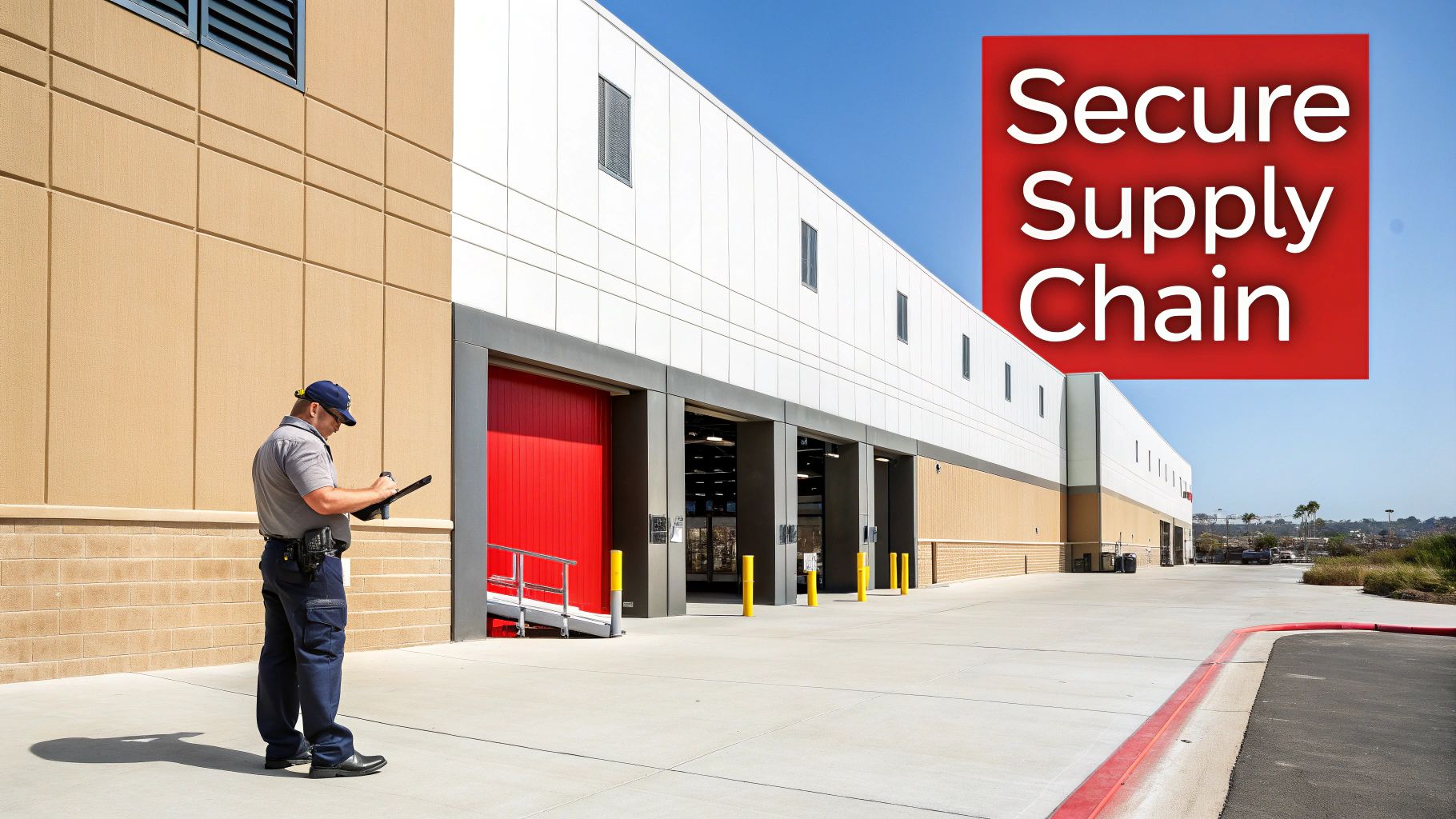
If you’re running a warehouse or distribution center in San Diego County, you're not just managing a building; you’re overseeing a vital hub in our regional supply chain. That constant flow of goods, vehicles, and people makes your facility a magnet for everything from petty theft to highly coordinated criminal operations. The generic, set-it-and-forget-it security plans that might have worked a decade ago are no longer sufficient.
Today’s challenges demand a smarter, more robust strategy. The risks facing facilities directors and property managers are more complex than ever. We have to shift from simply reacting to incidents to actively preventing them. That proactive mindset is the key to keeping your operations running smoothly and your assets protected.
The Evolving Threat Landscape
The pressure on local warehouses has intensified. San Diego's position near major trade routes makes it a hot spot for organized retail crime, which often begins further up the supply chain—right at the warehouse door. Criminal groups have become savvier, targeting facilities to steal high-value goods before they ever reach a retail shelf.
The numbers tell the story. Across the state, reported shoplifting incidents in California jumped by 39% in 2023, hitting the highest point in over twenty years. At the same time, commercial burglaries have stayed well above pre-pandemic levels. While other cities may get more headlines, these same criminal networks see San Diego's logistics sector as a prime target. You can read the full analysis of top security threats to California commercial properties to see how these trends are impacting our region.
Beyond Basic Security Coverage
A modern approach to San Diego warehouse security is about an integrated system where human expertise and smart technology work together. It’s about building layers of defense designed to address the specific vulnerabilities of your facility.
This means looking at a complete toolkit of solutions, such as:
- On-site security officers who provide a powerful visual deterrent and can respond in seconds.
- Mobile security patrols to cover large perimeters and parking areas cost-effectively.
- GPS-verified reporting that gives you proof of presence and guarantees every checkpoint is covered during patrols.
- Managed access control to maintain a tight log of every person and vehicle entering sensitive zones.
An effective security program is built on a partnership, not just a service contract. It begins with understanding your operational pain points and designing a solution that provides both protection and peace of mind.
Conducting Your Own Warehouse Security Walkthrough
Before engaging a security partner, it’s helpful to view your facility through the eyes of someone looking for an easy target. A simple security walkthrough can uncover subtle but significant gaps you might overlook in your day-to-day operations. This self-assessment gives you a baseline understanding of your vulnerabilities, which leads to a more productive conversation with a security professional.
The real risks often hide in plain sight—a poorly lit corner of the fence line, a loading dock camera with a blind spot, or an unmonitored side entrance. Each of these is a potential failure point an opportunist could exploit.
Starting Your Assessment From the Outside In
Your property’s perimeter is its first and most important line of defense. Begin your walkthrough here. Try to imagine how someone might approach your building after hours without being seen.
Ask yourself these questions:
- Fencing and Gates: Are there any bent sections, gaps under the fence, or easy-to-climb spots? Are your gate locks heavy-duty and regularly checked?
- Lighting: Do you have bright, consistent lighting around the entire building? Pay special attention to access points, loading bays, and employee parking. Dark spots are an open invitation for trouble.
- Landscaping: Could overgrown hedges provide cover for someone to hide? Keeping bushes and trees trimmed is a simple way to eliminate concealment.
- Signage: Are your security signs visible from a distance? A simple, well-placed sign announcing surveillance can be a surprisingly powerful deterrent.
This initial external check provides a solid foundation. To keep things organized, you can download a comprehensive security patrol checklist template that covers these points and more.
Examining Access Points and Interior Zones
After assessing the perimeter, turn your attention to the building itself. Every door, window, and loading bay is a potential entry point. Uncontrolled access, even by trusted vendors, can lead to significant inventory loss over time. Consider who comes and goes daily and whether their access is managed and logged.
A common oversight is focusing only on preventing external break-ins while ignoring internal threats. Inventory shrinkage and theft are often inside jobs, which makes access control as critical as perimeter security.
Wider market trends can also increase these risks. In San Diego, the industrial vacancy rate recently climbed to 7.7%. This means more high-value goods are being concentrated into fewer, busier facilities. With warehouses running at higher capacities, the impact of a single security breach—whether internal or external—is that much greater. You can get a deeper dive into these market trends by checking out Cushman & Wakefield's analysis.
This is why a thorough self-assessment has never been more critical. It’s the essential first step toward building a truly resilient San Diego warehouse security plan that protects your facility from the inside out.
Common Warehouse Security Vulnerabilities and Solutions
| Vulnerability Area | Potential Risk | Effective Security Solution |
|---|---|---|
| Perimeter Fencing | Unauthorized entry, trespassing, and hiding spots for intruders. | Regular mobile patrols, motion-activated lighting, and immediate fence repairs. |
| Loading Docks | Cargo theft, unauthorized personnel entry, and insider collusion. | Access control systems, dedicated standing guards, and CCTV monitoring. |
| Employee/Visitor Entrances | Unauthorized access, tailgating, and internal theft. | Key card or biometric access control, visitor sign-in/out logs, and guard presence. |
| Parking Lots | Vehicle break-ins, employee safety risks, and after-hours loitering. | Marked security vehicle patrols, high-visibility lighting, and surveillance cameras. |
| Interior Storage Areas | Inventory shrinkage, product tampering, and internal theft rings. | Zoned access control, internal CCTV, and randomized employee bag checks. |
| After-Hours Operations | Burglary, vandalism, and fire or water damage going unnoticed. | Mobile security patrols, alarm response services, and remote video monitoring. |
By identifying these weak spots in your own facility, you're taking the first and most important step toward building a security strategy that truly works.
Building Your Layered Security Defense
A truly secure warehouse never relies on a single point of protection. Instead, real security comes from an intelligent, multi-layered defense where different elements work together to create a formidable barrier.
Think of it like a medieval castle. You wouldn't rely solely on the main gate. You'd have high walls, vigilant watchtowers, and guards patrolling the grounds. Each layer has its own purpose, and together, they make the structure incredibly difficult to breach.
Effective San Diego warehouse security is built on the same principle. It’s about strategically combining on-site personnel, mobile patrols, and smart technology to cover all your bases—from the perimeter fence to high-value storage areas deep inside your facility. This integrated approach elevates your protection from just having "a guard" to running a full-fledged security operation that mitigates risks before they impact your business.
Core Components of a Modern Security Program
The foundation of any solid warehouse security plan rests on a few key pillars. Each one addresses a different type of vulnerability, and when combined, they create a shield that is far stronger than the sum of its parts.
A successful strategy nearly always includes:
- On-Site Security Officers: An experienced officer stationed at your facility is the ultimate deterrent. They are your frontline for managing access control, conducting regular foot patrols, and providing an immediate response to anything from a suspicious vehicle to a policy violation.
- Mobile Security Patrols: For sprawling industrial parks or warehouses with large perimeters and parking lots, mobile patrols are a game-changer. A marked security vehicle making random, unpredictable rounds is an incredibly powerful and cost-effective tool for discouraging after-hours crime.
- Access Control Management: This is your critical internal layer. Strictly managing who enters your facility—and specific zones within it—is paramount for preventing both external threats and internal shrinkage. This can range from an officer verifying IDs to sophisticated keycard systems that track every entry.
This visual breaks down the three primary zones of vulnerability that a layered security plan must address.
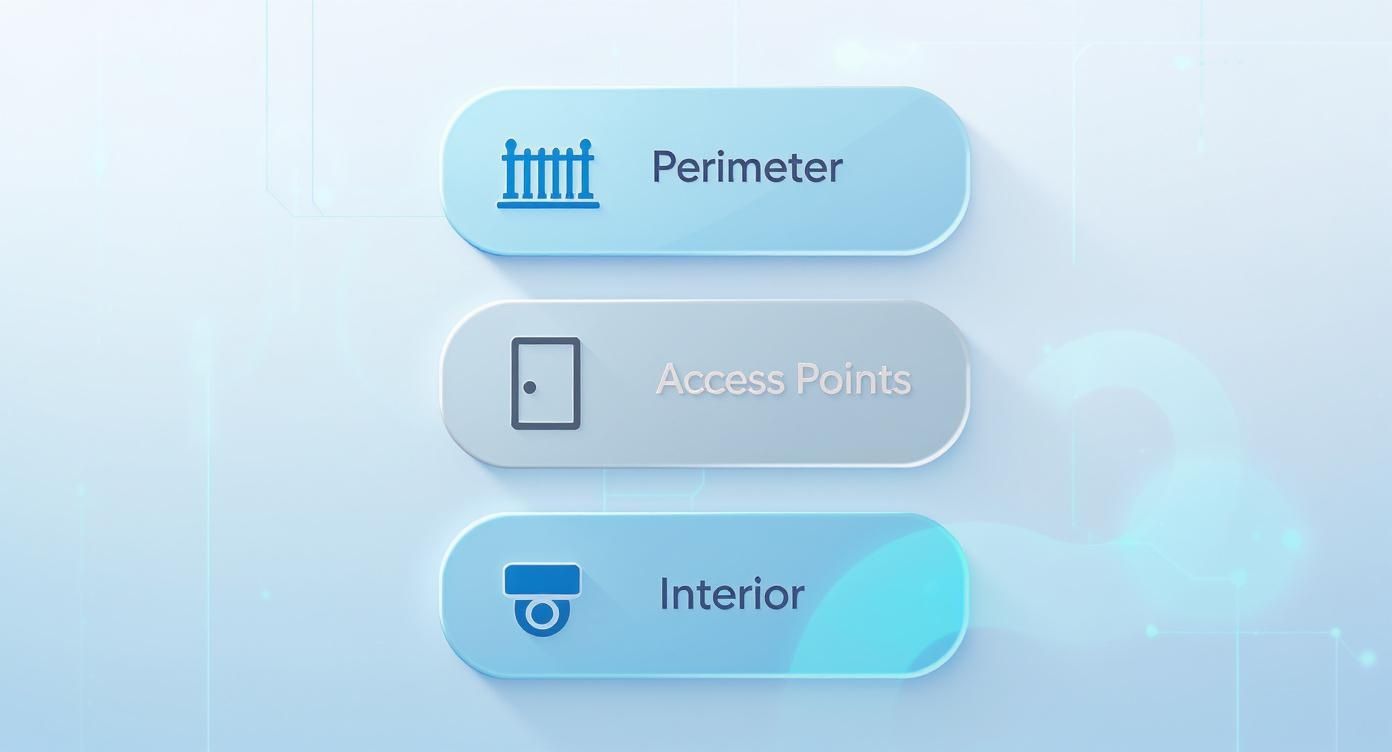
As you can see, security should start at the outermost perimeter and become progressively tighter as you move toward your most valuable assets.
Layering security isn't about redundancy; it's about creating overlapping fields of protection. If one layer is bypassed, another is already in place to detect and stop the threat. This is the hallmark of a resilient security program.
How Technology Makes Good Officers Great
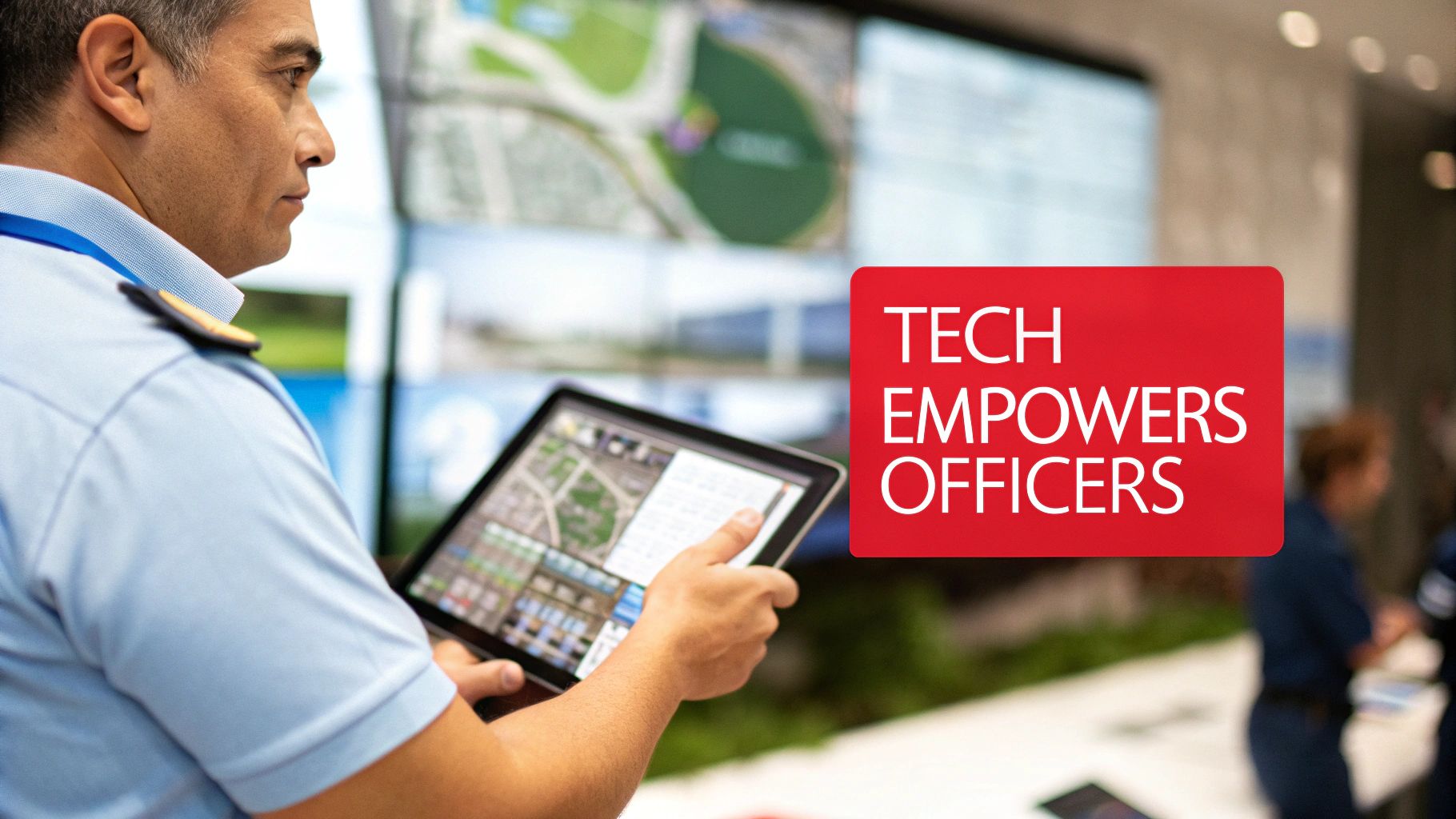
Many facility managers believe that technology is meant to replace people. We see it differently. At Overton Security, we know that technology is a force multiplier—it empowers a good officer and makes them great. The strongest San Diego warehouse security plans are those that combine the sharp judgment of a seasoned officer with smart, reliable tech.
This isn't about automating security; it's about empowering the people on the ground. The technology feeds them data, expands their capabilities, and creates a solid, verifiable record of their work. At the end of the day, it's the professional officer who interprets that information, makes critical decisions, and delivers real security.
Creating Verifiable Accountability
One of the biggest concerns for any warehouse manager is wondering if security patrols are actually happening as they should. Technology removes that doubt completely.
When you have modern systems in place, all guesswork disappears. Every patrol is tracked, timed, and verified, giving you total confidence that you're getting the service you're paying for.
- GPS-Verified Patrols: We use GPS-enabled systems to confirm our officers are on-site and hitting every checkpoint on their route, exactly on schedule.
- Digital Reporting Software: Forget about sloppy, handwritten logs. Our officers use software to file detailed digital reports from the field, often including photos, so you know what's happening on your property in near real-time.
- 24/7 SOC Support: Every officer in the field has the full backing of our 24/7 Security Operations Center (SOC). This gives them a vital layer of backup and oversight, ensuring our teams have the support they need to handle anything that comes their way.
A Data-Driven Approach to Security
This type of tech integration is becoming the standard in San Diego. The San Diego Police Department’s 2025 annual surveillance report points to a growing reliance on tools like CCTV for monitoring industrial zones. Warehouse operators are using similar technology not just to deter crime but also to tighten inventory control.
As you explore how technology can elevate your security, it's worth looking into the evolving space where innovation meets security to see what's possible. Advanced surveillance isn't just about recording what happens; it provides actionable intelligence that helps officers get ahead of incidents. This is particularly true when an expert is watching, which is why our remote video monitoring services are so effective.
The right technology in the hands of a trained professional transforms security from a passive expense into a proactive, data-driven operation. It builds trust through transparency and delivers results you can see.
How to Choose the Right San Diego Security Partner
Selecting a company for your San Diego warehouse security is one of the most critical decisions you'll make. This isn't just about comparing hourly rates. It’s about finding a true partner you can trust with your entire operation.
When you get it right, your security provider feels like an extension of your own team. When you get it wrong, you're left dealing with a revolving door of officers, missed patrols, and a lack of communication. The cheapest bid rarely accounts for the real-world cost of unreliable service.
Look for Verifiable Local Experience
San Diego’s industrial zones have their own unique challenges. A security company that has been on the ground here for years understands the landscape in a way an out-of-town firm cannot. They know the crime trends in Otay Mesa versus Miramar and the logistical challenges unique to certain industrial parks.
Always ask potential vendors for references from other warehouses in San Diego County. A company with a long, stable history—like our 26 years of experience—is proof of their commitment and reliability. That local expertise means you get a security plan built for your specific location, not a cookie-cutter template. You can learn more in our guide to trustworthy security guard companies in San Diego explained.
Prioritize Officer Training and Retention
The security industry can have a reputation for high turnover. This "burn and churn" approach is a major red flag because it directly undermines your safety. A constant parade of new, undertrained officers means the people protecting your assets don't know your facility's vulnerabilities or what a normal day looks like.
A security provider that invests in its people is investing in your protection. Low turnover means you get experienced, consistent officers who know your property, understand your procedures, and can identify when something is out of place.
This is why it's important to ask about their hiring, training, and retention programs. Look for companies that provide competitive pay, benefits, and a path for career growth. That commitment to building a professional team is the clearest sign of a quality operation.
Insist on Hands-On Leadership
Finally, you need to know who you will be dealing with. With large national firms, it’s easy to become just another account number, assigned to an overworked manager who rarely visits your property. The difference between a vendor and a partner often comes down to a low manager-to-client ratio and direct involvement from company leadership.
This hands-on approach ensures your concerns will be heard and issues will be resolved quickly. It means your security program isn't just set and forgotten; it's constantly being evaluated and refined. When leadership is actively engaged, it creates a culture of accountability that you'll see in every officer.
Security Provider Evaluation Checklist
| Evaluation Criteria | What to Look For | Why It Matters |
|---|---|---|
| Local Experience | Verifiable references from San Diego warehouses. Deep knowledge of local industrial areas. | A local expert understands regional crime trends and logistical challenges, creating a more effective security plan. |
| Officer Retention | Ask for their employee turnover rate. Inquire about pay, benefits, and career development programs. | Low turnover means consistent, experienced officers who know your site and can spot trouble more effectively. |
| Training Programs | Specific details on initial and ongoing training. Certifications (e.g., CPR/First Aid, BSIS). | Well-trained officers are better prepared to handle emergencies, de-escalate situations, and follow your procedures. |
| Leadership Involvement | Low manager-to-client ratio. Direct access to supervisors and company leadership. | Hands-on management ensures accountability, quick problem resolution, and a security program that adapts to your needs. |
| Technology Integration | Use of modern reporting software, GPS tracking for patrols, and reliable communication systems. | Technology provides transparency, verifies patrols are being completed, and ensures clear communication. |
| Licensing & Insurance | Proof of current BSIS license and adequate liability insurance coverage. | Protects your business from liability and ensures the provider is operating legally and professionally. |
Taking the time to vet a security company on these points will help you see past the sales pitch and find a partner truly committed to protecting your facility.
Designing Your Custom Warehouse Security Plan
A strong, resilient San Diego warehouse security plan comes down to three essential pillars. Think of it as a clear, actionable path that takes you from spotting risks to actively preventing them. This is how you protect your facility from every angle.
The process doesn't start with a contract; it starts with a conversation. The best security programs are born from a deep understanding of a business's specific operational challenges, the unique layout of their property, and their budget. It's about building something that truly fits your business, not forcing you into a one-size-fits-all solution.
The Three Pillars of a Robust Plan
A plan that works in the real world weaves these core elements into one cohesive strategy:
- A Thorough Risk Assessment: This is the foundation. It means an on-site walkthrough of the entire property to pinpoint vulnerabilities—from the perimeter fence line and access gates to interior zones.
- A Tailored Blend of People and Technology: Finding the right mix of on-site officers, mobile patrols, and smart tech creates overlapping layers of protection. This approach is not only more effective but also more cost-efficient.
- A Partnership with an Experienced Provider: You need a partner who knows the local landscape, is committed to retaining quality officers, and has hands-on leadership. They should treat your security as if it were their own.
The goal is to shift out of a reactive mode. A well-designed plan anticipates potential threats and puts proactive measures in place, giving you confidence that your assets, inventory, and people are protected 24/7.
This proactive mindset is what separates a basic security presence from a comprehensive security operation.
At Overton Security, our 26 years of experience have taught us that the best results come from collaboration. We invite you to connect with our team for a no-obligation consultation to discuss your facility’s needs and start designing a security plan that delivers true peace of mind.
Got Questions About Warehouse Security? We've Got Answers.
When you're evaluating options for San Diego warehouse security, many questions can arise. To help facility directors and property managers gain clarity, we've answered some of the most common questions we hear, drawing from our 26 years of protecting commercial properties.
How often should mobile patrols visit my warehouse?
There is no single answer—it depends on your facility's specific risks. A busy distribution center near a major highway might need several staggered visits per night, while a quieter storage facility may only require one or two checks.
The key is unpredictability. A random patrol schedule is a much stronger deterrent than one that criminals can anticipate. A good security partner will work with you to find the right frequency that maximizes deterrence without exceeding your budget.
Armed or unarmed guards: which is right for a warehouse?
For the vast majority of warehouses, unarmed security officers are the industry standard and the appropriate choice. Their primary role is to be a visible presence—to deter, observe, and report. They manage access control, patrol the perimeter, and respond to issues according to the established security plan.
Armed guards are typically reserved for facilities with exceptionally high-value inventory (like pharmaceuticals or high-end electronics) or those located in documented high-crime areas. This decision should always be based on a professional risk assessment.
What's the difference between a security vendor and a true partner?
A true security partner does much more than ensure a guard is on-site. They become an extension of your own team, constantly looking for potential risks and bringing you practical solutions before they become problems.
A partner invests in quality and officer retention. That means you get experienced, consistent officers who know your property, its routines, and your people. They are defined by hands-on leadership, clear reporting, and a genuine commitment to building a plan that fits your facility, not just selling a standard service.
Ultimately, the relationship is built on trust and measurable results. A vendor provides coverage; a partner delivers value and peace of mind.
Ready to enhance your facility's security? The team at Overton Security is here to help you design a plan that protects your assets and aligns with your operational goals. Contact us today for a complimentary, no-pressure consultation.