
Choosing a security guard company is one of the most important decisions a property manager or business owner will make. This isn't just about hiring a person in a uniform; it's an investment in a trusted partner who provides reliable protection, reduces liability, and delivers genuine peace of mind.
Rethinking Your Approach to Property Security
For property managers, HOA boards, and facilities directors, the old way of hiring security doesn't address today's challenges. The outdated model of simply "filling a post" is insufficient for managing modern risks. Selecting a security partner is a crucial operational decision that directly impacts tenant safety, asset protection, and your bottom line.
A high-quality security company now acts as a true extension of your management team, blending human expertise with smart technology to create a comprehensive safety ecosystem.
The Shift from Coverage to Partnership
Many property managers know the frustration that comes from choosing a security provider based on the lowest bid. It often starts a cycle of high officer turnover, missed patrols, sloppy incident reports, and poor communication. We’ve seen over our 26 years in this industry that the most effective security programs are built on a solid partnership, not just a physical presence.
So, what does a true security partnership look like?
- Proactive Problem-Solving: A real partner doesn't just report incidents. They actively identify vulnerabilities on your property—like a broken fence or a poorly lit walkway—and suggest practical solutions.
- Consistent Personnel: A company that invests in its people sees far lower turnover. This means the officers at your site actually know the property, the tenants, and your specific post orders. No more training a new face every week.
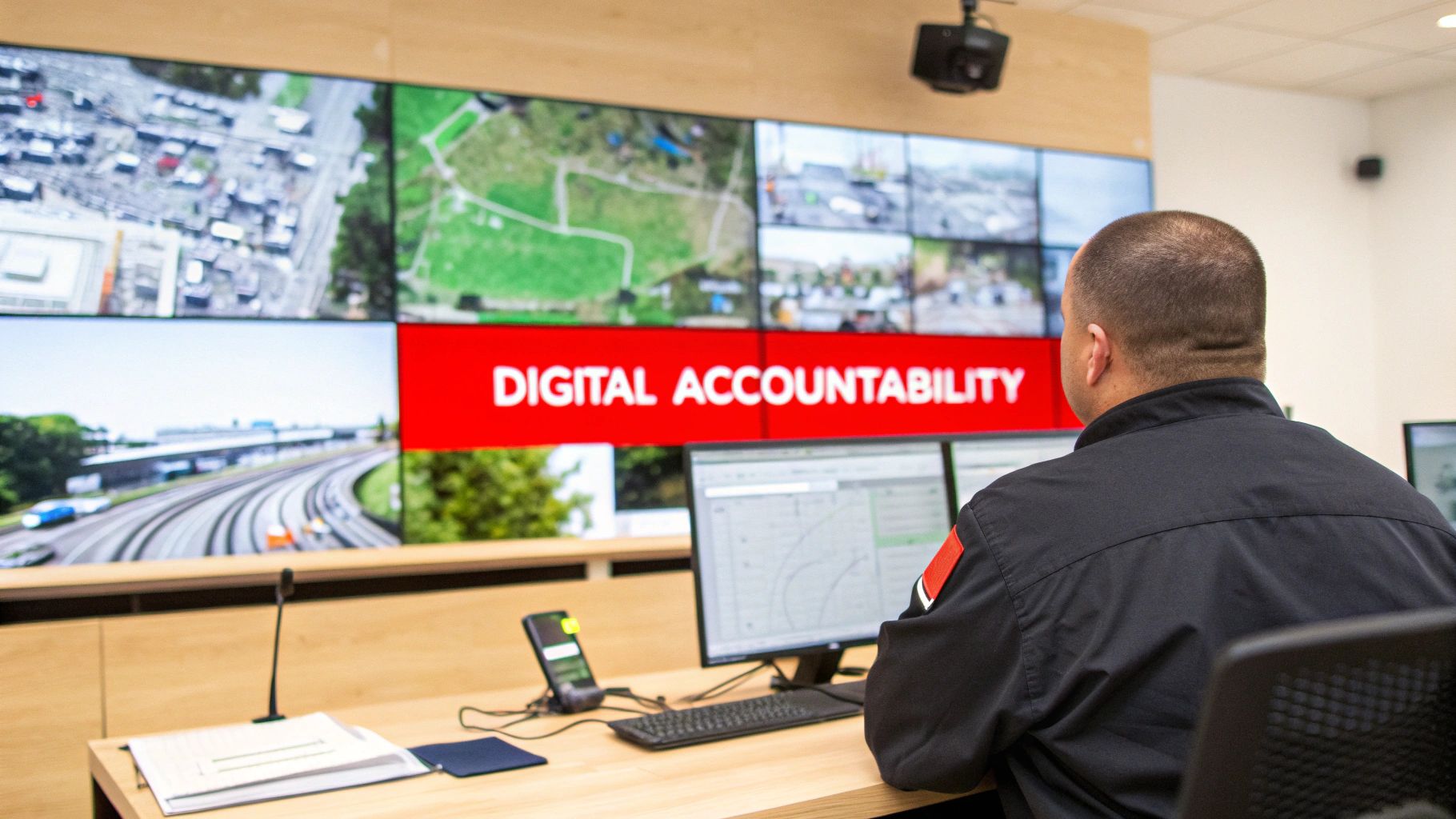
- Transparent Accountability: Modern security is built on verifiable data. You should expect GPS-tracked patrols, time-stamped checkpoints, and detailed digital reports with photo and video evidence, all accessible in real-time.
- Responsive Leadership: When an issue arises, you need a direct line to a manager who knows your account intimately and isn't juggling 50 other clients. Our low manager-to-client ratio ensures you get a swift, informed response.
The goal is to move from the reactive "guard in a shack" model to an integrated security solution that actively reduces liability and enhances your property's value. This demands a provider focused on quality over quantity.
This change in thinking is why the industry is growing so rapidly. The global security services market was valued at around $143.55 billion in 2024, with projections showing continued demand as businesses prioritize asset protection. This growth highlights the need for skilled, professional security officers who can do more than just stand watch.
Ultimately, the right security firm functions as a trusted advisor. It deters unwanted activity, provides a reassuring presence for residents and employees, and frees up your time to focus on other management duties. For a deeper dive into the core components of a robust safety plan, explore our detailed guide on what is physical security.
Defining Your Property's True Security Needs
Before you start contacting a security guard company, it’s essential to have a clear picture of what your property actually needs. Many property managers begin the process without a defined scope, which can lead to confusion, mismatched expectations, and a service that doesn't fit.
The first step is to move beyond a generic desire for "a guard" and drill down into your unique goals and vulnerabilities. Are you trying to prevent theft at a San Jose construction site, or do you need a polished, customer-service-focused officer for a Class A high-rise in Los Angeles? Each scenario requires a different skillset and operational plan.
Think of it as an evolution—from simply observing the property to creating a genuine security partnership.
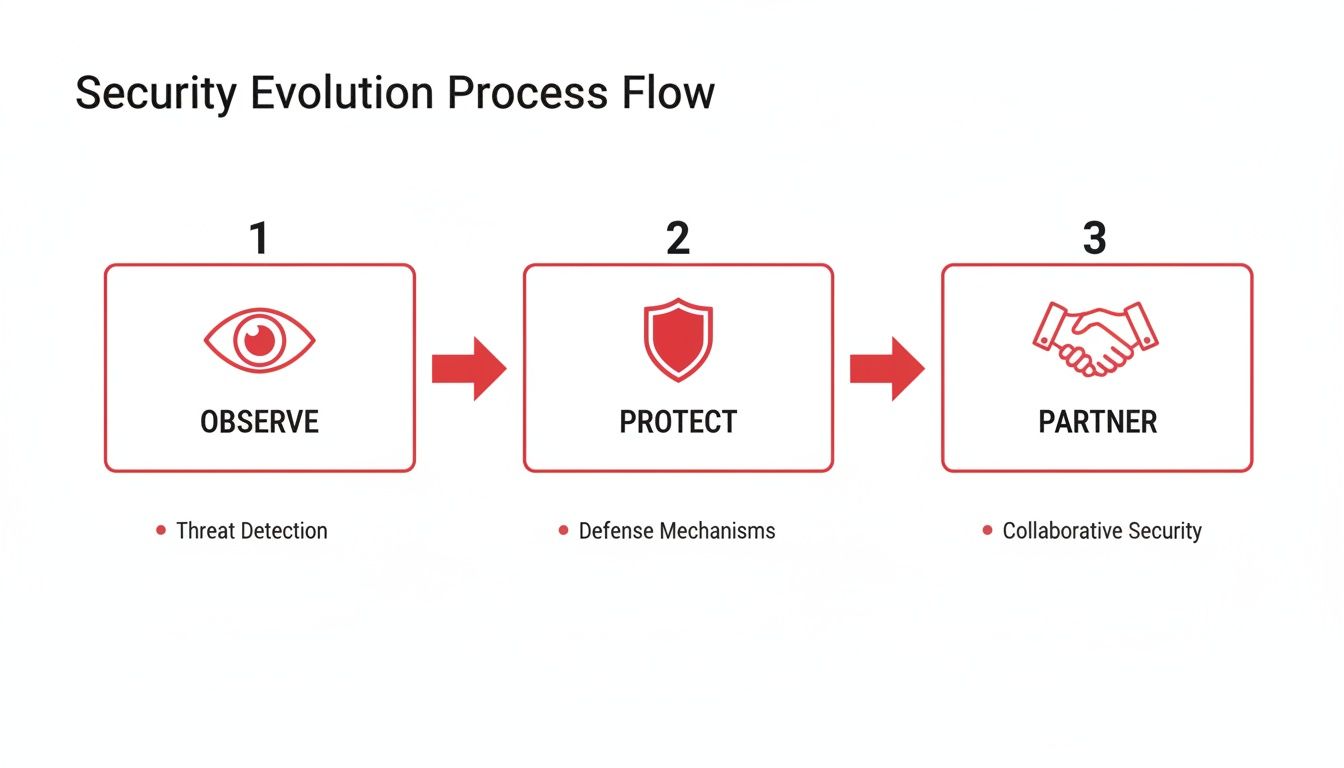
This shift in mindset is crucial. You want to move from just observing problems to actively protecting your assets and working with a partner who helps prevent issues before they start.
From General Worries to Specific Duties
The best way to begin is to walk your property with a critical eye. Document every potential weakness, from a dimly lit corner in the parking garage to a side door that doesn't always latch.
As you do this walk-through, ask some pointed questions to start building a preliminary Scope of Work (SOW):
- What are our absolute non-negotiables? This could be ensuring all perimeter gates are locked by 10 PM or checking in every delivery truck at the loading dock.
- When are we most vulnerable? Crime data often points to spikes overnight or on weekends. Pinpoint your high-risk windows.
- What exactly are we protecting? It’s not just physical assets. It's also the safety and peace of mind of your tenants, employees, or residents.
Answering these questions transforms vague concerns into a concrete list of tasks. This list becomes the backbone of your post orders—the detailed instructions your security officers will follow on every shift.
A well-defined SOW is your most powerful tool in the hiring process. It forces potential vendors to propose real solutions to your actual challenges, not just a generic hourly rate.
Deciding on Officer Presence and Type
Once you have a list of duties, you can determine what kind of officer and presence you need. This decision is one of the biggest drivers of both effectiveness and cost.
Unarmed vs. Armed Officers
For the vast majority of commercial, residential, and construction properties, a highly-trained unarmed security officer is the most effective and appropriate solution. Their primary role is to observe, report, and professionally de-escalate situations.
An armed guard is a specialized requirement, typically reserved for environments with a documented high threat level. The legal and liability implications are significant, and it’s a decision that should not be taken lightly.
Stationary vs. Mobile Patrols
Does your site need a fixed post or a moving patrol? It depends on your property's layout and risks.
- Stationary Guards: Ideal for controlling a single point of entry, monitoring a busy lobby, or providing a constant, visible presence at a critical location like a data center.
- Mobile Vehicle Patrols: A cost-effective way to cover large areas like industrial parks, sprawling apartment communities, or a portfolio of multiple properties. These patrols create a strong deterrent through scheduled and random checks.
Sometimes, a hybrid approach is the smartest solution. You might have a stationary officer managing a front desk during business hours, with a mobile patrol conducting perimeter checks overnight. For sites with a particularly high threat profile, you might even need a fortified physical post, like a Guard Shack Built With Ballistic Rating.
Taking the time to map out these specifics ensures that when you approach a security provider, the conversation is productive and focused on real solutions.
Your Vetting Checklist for Potential Security Partners
Once you've mapped out your property's needs, it's time to evaluate potential security partners. Not every security company is created equal, and it's critical to look past a slick sales presentation.
The right partner becomes a true extension of your team, while the wrong one can create more headaches than they solve. This vetting process is where you separate the professional, service-oriented firms from the rest.
The Foundational Non-Negotiables
Before you review proposals, there are a few essentials to verify. Any legitimate company will have this information readily available. If they hesitate to provide proof, consider it a major red flag.
- Proper State Licensing: In California, a security provider must have a valid Private Patrol Operator (PPO) license from the Bureau of Security and Investigative Services (BSIS). You can and should verify their license status online.
- Adequate Insurance Coverage: Ask for their Certificate of Insurance (COI). You need to see current policies for General Liability, Automobile Liability, and Workers' Compensation. The minimum should be $1 million per policy, though your own corporate requirements may demand higher limits.
- 100% BSIS-Certified Officers: Every single officer on your property must hold a valid California Guard Card. Ensure the company has a robust system for tracking these credentials. Our guide dives deeper into the specifics of security guard licensing in California.
- Industry Accreditations: Confirming that a potential partner holds relevant industry accreditations demonstrates a commitment to recognized standards and best practices.
Think of these items as the absolute baseline. If a company can't meet these requirements, they don't belong on your property.
Security Company Vetting Checklist
| Evaluation Criteria | What to Look For | Red Flags to Avoid |
|---|---|---|
| Licensing & Insurance | Valid CA PPO License, current COI with at least $1M liability. | Hesitation to provide documents, expired licenses, or under-insured policies. |
| Officer Certification | Proof of a system to ensure 100% of officers have valid Guard Cards. | Vague answers about compliance, "in-process" certifications for active guards. |
| Employee Retention | High retention rates, clear career paths, competitive pay/benefits. | High turnover, evasive answers about retention numbers. |
| Ongoing Training | Programs beyond basic BSIS requirements (e.g., de-escalation, CPR). | Training is limited to the bare minimum required for licensing. |
| Management Structure | A dedicated account manager with a manageable client load. | Vague points of contact, managers juggling too many accounts. |
| Leadership Involvement | A commitment to regular, in-person site visits from management. | Management is disconnected from day-to-day operations; no site visits. |
This checklist provides a solid framework for making an apples-to-apples comparison and quickly identifying potential deal-breakers.
Digging Deeper Into Operational Quality
With the basics confirmed, you can dig into the factors that truly separate average from exceptional. This is where premier providers like Overton Security—with our 26-year history—stand out. The answers to these questions will reveal a company's core philosophy and its ability to deliver consistent, reliable service.
Focus on Officer Support and Retention
The single greatest indicator of a security company's quality is how it treats its people. An unstable, undertrained, and poorly supervised workforce cannot protect your assets effectively.
A security company that doesn't invest in its own team cannot properly invest in your safety. High officer turnover is a direct threat to your security program's consistency.
Here are the questions to ask:
- "What is your average employee retention rate?"
- "What kind of ongoing training do you provide beyond the basic Guard Card requirements?"
- "How are your field supervisors trained, and what does their site-visit schedule look like?"
A company that values its officers will offer competitive wages, good benefits, and opportunities for advancement. That culture of support translates directly into a more professional, engaged, and reliable officer protecting your property.
The Importance of Hands-On Leadership
Another key differentiator is the level of management involvement. In an industry with huge national firms, it’s easy for clients to become just another number.
This is why we intentionally maintain a low manager-to-client ratio. It guarantees our leadership team has the bandwidth to be actively and personally involved with your account, not just sitting in an office.
When you're vetting a company, drill down on their management structure:
- Who is my direct point of contact? You need a dedicated manager, not a generic call center.
- How many other accounts does my manager handle? A high number suggests you can expect slow response times.
- How often will management visit my site? Regular, in-person visits from leadership are non-negotiable for quality control.
This hands-on approach is what stops small issues from becoming major problems and ensures your needs are met for the long term.
Understanding the Technology That Ensures Accountability
In the past, hiring a security service often felt like a leap of faith. You signed a contract and hoped the patrols were being done correctly. Today, technology provides undeniable proof of service, giving you the transparency and peace of mind you deserve.
This isn't about replacing a skilled officer with a gadget. It's about empowering that officer with tools that create a clear, verifiable record of their work. It transforms security from a service you assume is happening into one you can see and measure.
Guard Tour Management Systems: The Proof of Presence
The cornerstone of modern security accountability is the Guard Tour Management System (GTMS). Think of it as a digital trail that shows you exactly where your officer was and when. A quality provider uses a smartphone-based system with GPS and NFC technology.
How does this work on your property? Let's take a commercial building in San Jose as an example:
- Checkpoint Scans: We place small, durable NFC tags at critical points—the server room door, the back perimeter fence, the main lobby entrance.
- Real-Time Data Capture: As the officer patrols, they tap their phone on each tag. This instantly logs their location and the exact time of the scan.
- Digital Reporting: That scan data flows straight into a digital activity report (DAR). If an officer finds a propped-open door, they can snap a photo and attach it directly to the report.
This system gives you irrefutable proof that every checkpoint was hit and every patrol was completed according to your post orders.
The Security Operations Center: The Human Backup
While a GTMS provides data, a 24/7 Security Operations Center (SOC) provides live support. A true SOC is a command center staffed by trained dispatchers who are the lifeline for officers in the field.
Technology is only as good as the human response behind it, and that’s where the SOC comes in.
A professional security officer backed by a 24/7 SOC is never truly alone. This constant oversight ensures adherence to protocols, provides immediate support during incidents, and adds a crucial layer of safety for both the officer and your property.
Imagine an officer at a Sacramento construction site at 2 AM encounters a trespasser. They are in constant communication with the SOC.
What the SOC provides:
- Real-Time Officer Support: The SOC dispatcher can document the event, offer guidance, and contact law enforcement if needed, letting the officer focus on safely resolving the situation.
- Incident Escalation: The SOC follows your pre-approved call list, ensuring the right people on your team are notified immediately when an incident occurs.
- GPS Monitoring and Wellness Checks: The SOC actively tracks the location of every on-duty officer. If an officer's "panic button" is hit, the SOC can dispatch immediate assistance to their exact location.
Bringing It All Together With Actionable Reports
The real power of this technology is how it’s delivered to you. A top-tier security firm provides access to a client portal where you can see everything for yourself.
You should receive a daily activity report delivered to your inbox every morning. It should be a clear, concise summary of the last 24 hours—every patrol, observation, and incident, complete with photo and video evidence. This level of transparency is the hallmark of a true security partner.
How to Compare Proposals and Uncover True Costs

Once you've narrowed down your list of potential security partners, the proposals will arrive. It’s tempting to scan for the lowest number, but the cheapest bid is almost never the best value.
A suspiciously low hourly bill rate isn't a bargain; it's a warning sign. It often masks issues that will cost you more down the road in high turnover, poor performance, and increased liability. To make a true apples-to-apples comparison, you must look past the final number and dig into what’s included.
Beyond the Bill Rate
Think of a security company's bill rate as a reflection of its philosophy. Firms that pay officers minimum wage with few benefits are caught in a constant cycle of hiring and replacing guards.
This "burn and churn" approach means you’ll have a revolving door of inexperienced officers who never get a chance to learn your property’s specific needs.
On the other hand, a bill rate that supports competitive wages, solid benefits, and ongoing training creates a stable, professional security force. This is how we operate at Overton Security. Our focus is on retaining high-quality officers because that translates directly into consistent, reliable service for you. For a deeper dive, check out our article on how a security guard service bill rate is calculated.
As you review each proposal, look for these key items:
- Officer Wages: Is the pay rate competitive enough to attract and keep good people in your specific market, whether it’s Los Angeles or the Bay Area?
- Benefits & Payroll Taxes: Does the rate properly account for health insurance, overtime, and California’s significant payroll burdens?
- Supervision Overhead: Is there a clear allocation for field supervisors and management support? Who is checking on the guards and ensuring quality?
- Technology & Equipment Costs: Is the cost of the GTMS software, professional uniforms, and any necessary vehicles included in the price?
If these pieces aren't clearly spelled out, ask for a more detailed breakdown. Transparency is the signature of a trusted security partner.
Analyzing Your Security Service Proposal
To help you get a clear picture of what you're paying for, the table below breaks down the common components of a security proposal. Use it to understand how each line item affects both your budget and the quality of service you’ll receive.
| Cost Component | What It Covers | Impact on Service Quality |
|---|---|---|
| Officer Wages & Benefits | The direct hourly pay, health insurance, and paid time off for the officers on your site. | High Impact. Competitive pay attracts and retains professional, experienced officers, leading to lower turnover and higher performance. |
| Statutory Costs | Payroll taxes (Social Security, Medicare), unemployment insurance, and workers' compensation. | High Impact. Non-negotiable costs. Unusually low bids may signal a company is misclassifying employees or is underinsured. |
| Supervision & Management | The cost of field supervisors, account managers, and 24/7 SOC support personnel. | High Impact. Proper supervision ensures accountability, provides officer support, and guarantees your needs are being met proactively. |
| General & Administrative (G&A) | Includes office rent, insurance, licensing fees, and other operational business expenses. | Moderate Impact. Reflects the company’s stability and professionalism. A well-run back office supports a well-run field operation. |
| Uniforms & Equipment | The cost of professional uniforms, communication devices, and any required technology. | Moderate Impact. Ensures officers present a professional image and have the tools they need to perform their duties effectively. |
| Profit Margin | The amount the company earns after all expenses are paid. | Low Impact. A reasonable margin allows the company to reinvest in training, technology, and people, ensuring long-term service quality. |
A thorough review using this framework will help you quickly spot which companies are investing in quality and which are just trying to win on price.
National Giants vs. Quality-Focused Partners
The security industry is a massive, competitive space dominated by giants like Allied Universal and Securitas AB. These global players control a huge slice of the market, and their business model is built on scale.
The challenge is that scale can often come at the expense of personalized service and real accountability. This is where a quality-focused, regional provider like Overton Security stands apart.
We intentionally maintain a low manager-to-client ratio. This ensures our leadership team provides direct, hands-on support. Instead of getting lost in a corporate maze, you have a direct line to a manager who knows your property and is empowered to solve problems. This model builds a true partnership based on responsiveness and trust.
Answering Your Top Questions About Hiring a Security Guard Company
Choosing the right security partner is a major decision, and if you’re a property manager, facilities director, or HOA board member, you undoubtedly have questions. Let's address the common concerns we hear every day to help you focus on what really matters.
What Is the Most Important Thing to Look For?
While technology and pricing are important, the single most critical factor is how a company treats its security officers.
It comes down to this: a provider that invests in its team with comprehensive training, strong field supervision, and competitive pay will always deliver a more consistent and reliable service. A stable, professional, and well-supported officer is your best defense against risk. High turnover, often a result of low pay and poor management, leads directly to inconsistent coverage and the headache of retraining new people on your property’s needs.
Always ask a potential vendor about their employee retention rate and what they do to support their team. That number is a direct window into the quality of service you can expect.
A company that invests in its people is a company that will invest in keeping your property safe.
How Much Should I Expect to Pay for Unarmed Security?
In California, bill rates for unarmed security officers can vary significantly by location and complexity of duties. It’s tempting to go with the lowest bid, but an unusually low hourly rate should be a major red flag.
A suspiciously cheap proposal often means the company is cutting corners on wages, benefits, supervision, or insurance. This model can lead to high turnover and poor on-site performance that costs you far more in the long run.
A reputable security firm will be transparent about its rate, which needs to realistically cover:
- Competitive officer wages and benefits to attract and retain quality professionals.
- All statutory costs, including payroll taxes and workers' compensation.
- Supervision and management overhead to ensure quality control.
- Technology fees for tools like GPS-enabled patrol tracking systems.
Your focus should be on the overall value and the provider’s demonstrated ability to reduce your risk, not just the number on the invoice.
How Do I Know the Officers Are Actually Doing Their Job?
Today, accountability is a mix of smart technology and hands-on management. You should never have to wonder if your property was properly patrolled. Your security partner needs to provide concrete, verifiable proof of service.
This is best achieved through two components working together:
- A GPS-Enabled Guard Tour Management System (GTMS): This is non-negotiable. Technology like this tracks officer patrols in real-time by having them scan checkpoints at critical locations around your property.
- Detailed Digital Activity Reports (DARs): You should receive a daily report that summarizes all patrol activity, including exact timestamps, officer notes, and any photos or videos of notable findings.
On top of that, look for a company with a low manager-to-client ratio. This ensures supervisors are making frequent, unannounced site visits, adding another layer of quality assurance and giving you complete peace of mind.
What Needs to Be in the Security Contract?
A solid security service contract is designed to protect both you and the provider by leaving no room for misunderstandings. Before you sign, make sure the agreement is detailed and explicitly outlines several key areas.
Your contract must include:
- A detailed Scope of Work (SOW) and specific post orders.
- Clearly defined bill rates, payment terms, and any potential extra fees.
- The contract term length and specific conditions for termination.
- Proof of adequate insurance, including General Liability, Auto, and Workers' Compensation.
- Confirmation of state licensing (a valid PPO license in California).
- Clauses outlining liability and indemnification.
- Protocols for incident reporting and emergency communication.
A professional security partner will want a thorough contract that sets clear expectations and builds a foundation for a successful, long-term relationship.
Ready to work with a security company that puts transparency, officer stability, and hands-on leadership first? Overton Security has spent over 26 years building a reputation for reliable, high-quality service across California. Contact us today for a personalized security assessment.