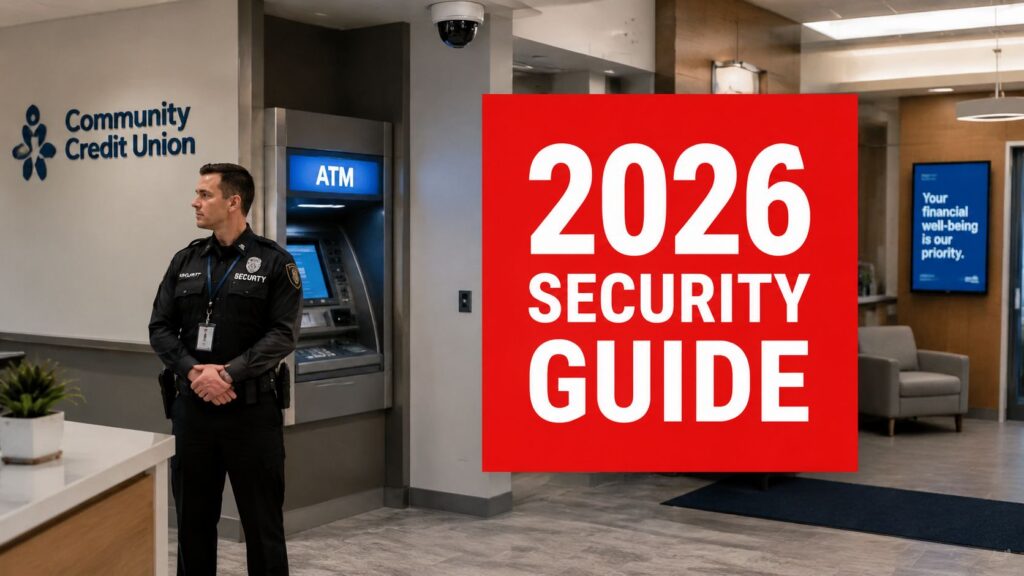
A lot of credit union leaders are looking at the same uncomfortable problem right now. The branch looks calm during business hours, the alarm system is active, cameras are recording, and the guard contract has been in place for years. Yet the questions keep getting harder. Are patrols being completed the way you expect? Are after-hours exterior areas getting enough attention? If a member or employee feels unsafe in the parking lot, would your current program prevent the next incident or just document it after the fact?
That's the issue with security at a modern credit union. A static coverage model can create the appearance of control while leaving operational gaps in the places that matter most. Credit unions protect cash, sensitive member information, staff, ATMs, night depositories, and brand trust all at once. Security has to support all of them together.
The strongest approach isn't a simple list of services. It's a unified security ecosystem where professional officers, site procedures, and smart reporting tools work together. That model produces better visibility, better accountability, and better decisions.
Is Your Credit Union's Security Program Secure?
A branch can look under control at 2:00 p.m. and still leave leadership exposed by 8:00 p.m. The lobby is staffed, cameras are recording, and the guard has checked in. Then a member reports suspicious activity near the ATM vestibule, a supervisor cannot confirm whether the last exterior round happened, and the incident report arrives the next morning with more gaps than answers.
That is usually the point where leadership realizes the issue is not coverage alone. It is whether the full security program can prevent avoidable problems, document what happened, and give managers enough visibility to correct weak spots before they become losses, complaints, or audit findings.
Credit unions need a security program that works as one system. Officers, post orders, patrol verification, camera review, incident reporting, and management oversight should reinforce each other. Overton has spent 26 years building that kind of unified security ecosystem because isolated services rarely hold up under real operational pressure.
What outdated security plans usually miss
An older security plan often describes who is on site and when, but not how performance is verified or how small warning signs are handled before they become larger events. In practice, that means leadership may be paying for presence while operating without clear accountability.
Common gaps include:
- Exterior areas after hours: Parking lots, sidewalks, drive-up lanes, and ATM zones get less attention once branch traffic drops.
- Pattern recognition: Repeated loitering, suspicious vehicles, and low-level disorder are observed but not logged in a way that supports escalation.
- Supervisor visibility: Managers receive schedules and invoices, but not consistent proof of patrols, site activity, exception reports, or corrective action.
- Disconnected tools: Cameras, officers, and reports operate separately, so no one gets a clear operational picture in time to act.
A mature program closes those gaps with defined procedures and verified execution. That is the difference between a vendor filling hours and a partner helping the credit union manage risk. Teams that need a clearer framework for security risk management in financial environments should start by tying each control to a specific operational exposure.
If leadership cannot confirm what happened, when it happened, and how the issue was handled, the program is harder to defend and harder to improve.
The same discipline supports budgeting and board communication. Leadership teams looking at data-driven security decisions for banks are usually trying to answer a practical question. Which controls reduce risk, which ones only create the appearance of control, and where should the next dollar go?
What a stronger security model looks like
The best credit union programs combine professional officers with technology that verifies performance and gives leadership usable records. Officers handle presence, deterrence, and judgment calls. Technology supports them with patrol tracking, time-stamped reporting, and faster review of incidents or service failures.
That structure improves member safety and operational resilience at the same time. Staff know what to escalate. Managers can see whether site expectations are being met. Compliance conversations get easier because the institution can show how security controls are monitored, documented, and adjusted when conditions change.
Member confidence is built in those ordinary details. A visible officer who knows the post. A parking area that receives documented checks. A suspicious person addressed early, not after a complaint. A leadership team that can see the whole program, not just the contract.
Building Your Credit Union's Risk Profile
A branch can look calm at 2:00 p.m. and still carry serious exposure. The member lobby may be orderly, but the ATM vestibule draws loitering after dark, a side door is used inconsistently by staff, and incident notes live in three different places. Leadership needs a risk profile that captures how the branch operates in practice, not how the floor plan looks on paper.
That discipline matters even more at scale. Security Service Federal Credit Union has grown from a small founding operation into a large institution with broad member responsibilities, as noted earlier in the article. Organizations at that level do not manage security with a generic guard request. They document risk by location, by function, and by operating condition so security decisions can stand up to board review, examiner questions, and day-to-day operational demands.

Map the branch by function
Start with how the branch is used. A useful assessment separates spaces by activity, access level, and consequence if something goes wrong. That gives security officers, branch managers, and compliance leaders a shared view of where controls need to be tighter and where visibility matters more than restriction.
Use these categories:
- Member-facing areas: Lobby, teller line, waiting area, vestibule, and self-service stations. Review queue buildup, privacy gaps, disruptive behavior, and how quickly staff can get support.
- Back-office operations: Cash handling rooms, records storage, equipment rooms, and management offices. These spaces need stronger access control, cleaner key or badge discipline, and clear escalation procedures.
- Exterior assets: ATM surrounds, night depositories, parking lots, loading areas, and perimeter doors. These are often the first places where weak lighting, poor sightlines, or inconsistent patrol coverage show up.
- Special-use conditions: Community events, marketing promotions, maintenance work, and temporary closures. Short-term changes often create confusion about access and responsibility.
A sound review also looks at process and digital exposure. Teams working on understanding digital security vulnerabilities can use IT risk examples to spot the overlap between physical access, device exposure, and staff procedure.
Document threat patterns, not just assets
An inventory is not a risk profile. The stronger approach is to document what happens, where it happens, who is affected, and what conditions make it more likely.
In practice, that means looking for repeat behaviors and weak routines. Loitering near ATMs on payday. Members walking to poorly lit parking spaces after closing. Contractors entering through staff doors without consistent escort. Cash movement that depends too heavily on habit instead of written procedure.
A working worksheet usually includes:
| Area | Typical concern | What to verify |
|---|---|---|
| Lobby | Disorder, distraction, privacy breaches | Sightlines, officer positioning, duress procedures |
| Teller and cash areas | Robbery, internal misuse, unauthorized access | Access layers, escort rules, incident reporting |
| ATM and night deposit | Skimming, tampering, loitering | Inspection routine, lighting, patrol timing |
| Parking lot | Member safety, after-hours contact, vehicle presence | Visibility, patrol routes, response plan |
This is also where leadership should compare formal reports with informal signals. Staff complaints, member comments, maintenance tickets, and camera review often reveal the same weak point from different angles. When those signals line up, the issue deserves attention even if it has not produced a major incident yet.
Prioritize by impact and frequency
Every exposure does not need the same control. A low-frequency, high-impact event such as robbery calls for layered response planning, training, and coordination with law enforcement. A high-frequency nuisance issue such as repeated after-hours loitering usually calls for visible presence, schedule changes, lighting corrections, and tighter documentation.
The goal is to build a unified security ecosystem, not a loose collection of fixes. Officers bring judgment, presence, and intervention. Technology records patrol activity, verifies inspections, and gives leadership a defensible record of what happened and how the response held up. That model supports compliance, member safety, and operational resilience at the same time.
For teams building that structure, security risk management for operational decision-making gives a practical framework for aligning controls with actual exposure.
Practical rule: If the same issue appears more than once in incident notes, staff complaints, or member feedback, treat it as a pattern and change the control.
Matching Security Services to Your Specific Risks
Buying security from a menu usually leads to waste. A credit union says it needs “a guard,” but that doesn't answer the core question. What problem is that guard supposed to solve?
The better approach is prescription, not selection. If the risk profile shows recurring loitering around ATMs, vulnerable parking areas after closing, and uneven after-hours visibility at perimeter doors, those are different problems. They don't all need the same service model.
This visual captures the logic well:

Where onsite officers make the most sense
A professional onsite officer is best when the branch needs active deterrence, immediate intervention, and visible support for staff and members. This is especially true in busy branches, high-contact urban environments, or locations where member reassurance matters as much as incident response.
An onsite officer is usually the right fit when you need:
- Front-of-house presence: Someone who can greet, observe, de-escalate, and control access without slowing operations.
- Immediate response: Fast action for disturbances, medical events, trespassing, or suspicious behavior inside the branch.
- Consistent routine control: Daily opening and closing support, perimeter checks, and staff escorts.
When patrols and remote oversight work better
A full-time officer isn't always the efficient answer. A branch with limited business hours, multiple detached ATM locations, or lower daytime activity may benefit more from vehicle patrols and remote monitoring.
That setup works well for:
- After-hours vulnerability: Mobile patrols can inspect doors, ATM surrounds, parking lots, and night depositories on a varied schedule.
- Multi-site coverage: One program can cover several branches or service points without assigning static personnel to each one.
- Short-duration risk spikes: Temporary increases in patrol frequency can address a specific issue without rebuilding the whole contract.
If your biggest concern starts after the branch closes, don't buy a daytime-heavy solution.
Match the service to the behavior
A practical way to decide is to name the behavior you want to stop, then choose the service that interrupts it.
| Risk pattern | Best-fit response |
|---|---|
| Loitering near entrance or ATM | Visible officer presence, clear reporting, repeat-issue escalation |
| Tampering concerns at self-service areas | Scheduled inspections, documented patrols, camera review support |
| Sparse after-hours supervision | Vehicle patrol, alarm response coordination, perimeter checks |
| Temporary system outage or unusual compliance condition | Fire watch or temporary coverage with clear post orders |
Many security service credit union programs experience quick improvement. Once leadership stops asking “Which service is cheapest?” and starts asking “Which service changes this risk condition?”, the plan gets sharper.
How to Select the Right Security Partner
The wrong security vendor can still look good in a proposal. The pricing is polished, the promises are broad, and the staffing model sounds flexible. Then service begins, turnover climbs, supervisors disappear, and the branch team ends up managing the contractor instead of the contractor managing the post.
That's why vendor selection should be treated as a long-term operating decision, not a bid exercise. Price matters, but price without service structure usually creates hidden cost. Missed patrols, weak reporting, retraining, branch frustration, and member complaints all consume time and trust.
What to test in the RFP and interview process
Ask questions that reveal how the company operates when things are normal, not just when leadership is present for the kickoff meeting.
Focus on:
- Officer retention: How does the firm keep trained officers on account? Stable staffing usually produces better site knowledge and fewer service disruptions.
- Management coverage: How often do supervisors visit? Who responds when the branch manager has an issue after hours?
- Training depth: Can the firm tailor post orders to a teller environment, ATM perimeter checks, opening and closing routines, and member-facing conduct?
- Reporting discipline: What does the client receive after an incident, a patrol, or an unusual contact?
One strong signal is whether the company is built for hands-on service or volume. Overton Security's bank security officers approach is one example of the kind of specialization leadership teams should evaluate when comparing providers.
Why operating model matters more than marketing language
Overton Security Services has operated for 26 years, since 1998, and emphasizes officer stability and a low manager-to-client ratio to support hands-on service, according to its California security guard services page. Those are the kinds of structural indicators that matter in vendor review because they directly affect consistency and accountability.
A provider with overloaded account managers may still promise responsiveness, but branch leaders usually feel the difference quickly. Issues linger. Site knowledge gets shallow. Small warning signs don't get escalated until they become expensive.
Vendor filter: If a company can't explain who supervises your account, how reports are verified, and how officers are retained, keep looking.
What usually works best
The best partner is the one that can translate your branch conditions into site-specific post orders, staffing expectations, escalation rules, and reporting standards. That requires listening, not template selling.
Security at a credit union works best when the provider understands two truths at once. Members need to feel welcome, and risks still need to be managed firmly. A firm that can't balance both will create friction on one side or vulnerability on the other.
Integrating Technology for Transparency and Accountability
A solid officer program improves when technology removes guesswork. The goal isn't to automate judgment out of the job. The goal is to verify that rounds happened, incidents were documented correctly, and supervisors can see what's happening in real time.
That matters in a credit union because leadership can't stand at every branch, review every exterior check, or personally validate every after-hours patrol. You need systems that convert field activity into evidence.
The basic flow looks like this:

What GTMS actually changes
Leading security firms use a GPS-Enabled Guard Tour Management System (GTMS) where officers scan NFC tags at checkpoints to complete digital Daily Activity Reports (DARs), giving clients verifiable, real-time performance data, as described on the Overton Security website.
That sounds technical, but the value is simple. If a patrol includes the ATM surround, perimeter doors, parking lot corners, and night deposit area, the system creates a time-stamped record of those checks. If an officer finds graffiti, a damaged lock, suspicious activity, or a lighting issue, that can be documented on the spot with notes and photos.
Why technology should support, not replace, officers
The mistake some buyers make is treating technology as a substitute for professional field presence. Cameras don't greet members. A dashboard doesn't de-escalate a confrontation in a lobby. A sensor doesn't reassure an employee walking to a car after closing.
What technology does well is strengthen discipline:
- Verification: Patrol completion is recorded, not assumed.
- Visibility: Branch leadership can review events without waiting for a paper log.
- Escalation: A suspicious condition can be documented and routed quickly.
- Trend analysis: Repeat issues become easier to identify across days and shifts.
A mature security ecosystem also includes a staffed operations layer behind the scenes. A 24/7 Security Operations Center can provide dispatch support, wellness checks, monitoring, and escalation oversight for officers in the field. That extra layer matters when a branch issue starts small and develops quickly.
Good technology answers the question, “How do we know?” without slowing down the officer doing the work.
What to require from your reporting stack
Ask vendors to show the actual client-facing output, not just the software name. Many systems sound impressive until you see that the final report is hard to read, inconsistent, or too generic to act on.
For a security service credit union program, useful reporting should include:
| Reporting feature | Why it matters |
|---|---|
| Time-stamped checkpoints | Confirms rounds happened at required locations |
| Photo-supported incident notes | Reduces ambiguity and helps facilities teams act |
| Shift summaries | Gives branch leadership a clean operational snapshot |
| Escalation logs | Shows who was notified and when |
| Searchable history | Helps identify repeat patterns and audit readiness |
Budgeting for Security and Measuring Your Return
Security budgets get easier to defend when leadership stops treating them as a guard line item and starts treating them as an operational control. The question isn't only what coverage costs. The core question is what level of protection, documentation, and resilience the credit union needs to operate responsibly.
That's especially true for large institutions. By 2024, Security Service Federal Credit Union's assets had reached $13.71 billion, up 85% from 2013, according to its historical asset data on Wikipedia. Growth on that scale increases operational responsibility. Security and compliance planning have to keep pace.
The budgeting image below is useful as a concept model only. Don't treat the sample figures as universal benchmarks for your institution.

Build the budget around controls, not categories
Start by tying each budget item to a specific operational need. If a branch has repeated after-hours issues, fund patrol and reporting around that condition. If auditors want clearer incident documentation, budget for systems and training that improve traceability.
A practical budgeting framework includes:
- Core protection: Onsite officers, patrol coverage, or a hybrid model based on branch conditions
- Technology support: Reporting systems, checkpoint verification, monitoring tools, and related maintenance
- Compliance readiness: Training, post-order updates, documentation standards, and review cycles
- Contingency response: Temporary coverage for outages, special events, or heightened risk periods
Measure outcomes that leadership can actually use
“Nothing happened” isn't enough. Sometimes that's success. Sometimes it just means your team isn't tracking the right things.
Use a small scorecard with measures such as:
- Issue reduction: Fewer nuisance incidents, trespass contacts, lock failures, or unresolved exterior problems
- Response quality: Faster reporting, clearer escalation, and fewer undocumented exceptions
- Member and staff confidence: Feedback about feeling safer entering, exiting, or working in the branch
- Audit support: Records that demonstrate due diligence, consistency, and follow-through
If you're reviewing budget ranges for systems and implementation, broad market references like Wisenet Security on 2026 pricing can help frame the conversation qualitatively. Final numbers should still come from your site conditions, service expectations, and internal requirements.
For ongoing evaluation, a scorecard built around security performance indicators for service oversight helps leadership judge whether the program is improving execution, not just consuming budget.
Frequently Asked Questions About Credit Union Security
Should a credit union use armed or unarmed officers
Start with the branch environment, not personal preference. If the primary need is visible deterrence, professional member interaction, access control, and nuisance issue management, unarmed officers are often the better fit. If the branch handles heightened threat exposure, high-risk cash movement, or a site profile that clearly justifies a higher-force posture, armed coverage may be appropriate.
This decision should involve legal review, insurance considerations, site history, officer qualifications, and leadership comfort with use-of-force implications. Armed service is never a branding choice. It's a risk decision.
How can smaller or rural branches stay protected without a full-time officer
Many smaller branches do well with a layered model. That might include scheduled or randomized vehicle patrols, strong opening and closing procedures, better exterior lighting discipline, alarm response coordination, and remote oversight tied to clear escalation rules.
The key is consistency. A smaller branch doesn't need a scaled-down version of a large urban program. It needs a right-sized program with documented checks and clear accountability.
How long does implementation usually take
The answer depends on branch count, service type, technology setup, and whether post orders already exist. A simple deployment can move quickly if expectations are clear, site instructions are current, and branch leadership is aligned. A more complex rollout takes longer because it should.
The fastest start isn't always the safest start. Good implementation includes site walks, post-order drafting, checkpoint planning, reporting setup, escalation contacts, and branch-level orientation.
The cleanest rollout happens when operations, facilities, compliance, and the security provider agree on who owns each decision before the first shift begins.
If your leadership team is reevaluating branch coverage, patrol accountability, or bank and credit union site protection, Overton Security is a practical next step. Their team brings 26 years of experience, hands-on service, and technology-backed reporting that helps organizations build a security program around real operating conditions, not generic templates.