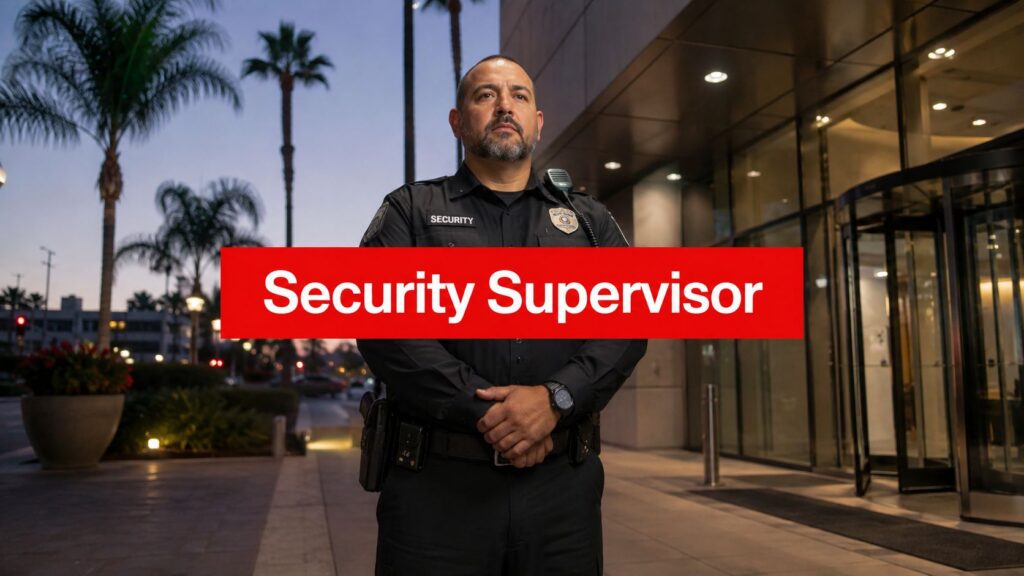
You may already be doing the work that resembles a security supervisor's job. You're assigning posts, answering radio calls, checking reports, coaching officers, and explaining problems to a property manager. Yet when you apply for security supervisor jobs in California, your application can still look like a guard resume with a different title.
That gap matters. Established security companies and demanding clients want supervisors who can protect a site in real time while also controlling documentation, staffing, compliance, and service quality. The strongest candidates can show where they've worked, what they owned, how they handled incidents, and how they improved consistency without losing the trust of their officers.
What a Security Supervisor Does on a California Site
At a California office tower, the supervisor may arrive before tenants do, review the prior shift's handover, confirm coverage, check open incidents, and walk the property against the post orders. The first priorities change by site. A distribution yard may require attention to gate access, truck movement, perimeter conditions, and employee safety. A multifamily community may demand stronger lobby presence, resident communication, parking oversight, patrol checks, and quick escalation when conditions change.
The role remains operational throughout the shift. Supervisors dispatch officers, cover an uncovered post, inspect patrol activity, answer client questions, and make decisions as facts develop. Administrative control runs alongside that work. Reports, staffing records, inspections, and follow-up cannot wait until the site becomes quiet.
Overton Security's security supervisor job description places daily site operations, staff direction, incident response, post-order compliance, reporting quality, shift coverage, inspections, client communication, and officer development within the role.
The supervisor serves two demanding relationships
Account managers and branch leaders expect accurate staffing, timely escalation, and consistent execution. A property manager, facilities director, or construction superintendent expects the supervisor to understand the site's priorities and communicate clearly without creating unnecessary alarm. Officers need practical direction, fair correction, and support when an assignment becomes difficult.
A capable supervisor translates client expectations into instructions officers can apply, then verifies that the work matches those instructions. Passing messages between people is not enough.
Practical rule: If you can't explain how you checked the work, hiring managers will assume you only observed it.
What fills the gap between patrols
Patrol presence is only one part of service quality. Supervisors review daily activity reports, inspect checkpoints, verify required notifications, and track recurring exceptions. A missed access-control check, incomplete report, or late handover can expose a process weakness before it becomes a larger incident.
The formal BLS classification, First-Line Supervisors of Security Workers, describes supervisors as people who directly supervise and coordinate security workers and guards (BLS occupational classification). The distinction matters on a hiring screen. Employers are looking for ownership of site performance, not just a senior guard who can answer a radio.
Hiring managers want evidence that you can lead briefings, correct performance, review reports, protect evidence, and give a client a concise account of what happened and what comes next. Site-specific experience carries weight because the same supervision approach will not fit an office tower, distribution yard, and residential property equally well.
Qualifications and Certifications That Move Your Application Forward
California employers usually begin with legality and readiness, not impressive-sounding credentials. For most unarmed security supervisor jobs, that means a current BSIS guard card, a record that supports client trust, a clean driving history when the post includes vehicle patrols, and legal authorization to work.
Start by confirming the status of your guard card and understanding whether the assignment requires additional BSIS credentials. Armed work may require the applicable firearm authorization and a California Private Patrol Operator, or PPO, relationship through a properly licensed employer. Baton authorization, site rules, and client requirements can also affect what you're permitted to carry or perform. Candidates should verify current requirements directly through California security guard licensing guidance before accepting an assignment.
Separate the required from the differentiating
A supervisor application gets stronger when the credentials match the site. A healthcare account may care about de-escalation, emergency response, and documentation. A construction site may value OSHA training, access control, vehicle checks, and experience protecting materials and equipment. A corporate campus may prioritize customer service, visitor management, technology systems, and polished communication.
Credentials that can strengthen a competitive application include:
- ASIS CPP or PSP: These can signal broader security knowledge or physical security capability, but they won't replace hands-on supervisory experience.
- OSHA 30: This is especially relevant for construction and industrial environments where supervisors must understand site hazards and coordinate with safety personnel.
- First Aid, CPR, and AED: These certifications support practical emergency readiness and show that you understand the supervisor's duty beyond routine patrols.
- De-escalation and Taser training: These matter when the employer and assignment authorize them. Training doesn't grant permission to use equipment outside policy or law.
- ICC or NIMS training: Site-specific compliance and incident-command familiarity can help candidates working around public agencies, large facilities, or emergency operations.
- Bilingual communication: Spanish ability can be a meaningful advantage in Southern California, particularly when officers, vendors, residents, and supervisors need clear instructions under pressure.
Military supervisor experience can transfer well when you describe the leadership behaviors, not just the rank. Scheduling, accountability, briefings, inspections, counseling, and after-action reviews all have civilian equivalents.
Don't wait until you're unemployed to build the stack. Keep your current assignment, verify which credentials your target sectors value, and complete one relevant course at a time. A hiring manager would rather see accurate, current training connected to a site than a long list of certificates you can't explain.
Building a Resume That Gets Past the First Screen
A recruiter scanning security supervisor jobs is looking for proof of scope within seconds. Your resume should answer four questions immediately: what type of site you've worked on, how many people or posts you've coordinated, what incidents you've handled, and whether your documentation can withstand review.
A hybrid reverse-chronological format works well. Put a short qualifications snapshot near the top, then list employment history with the most recent role first. Include your guard card status, relevant certifications, years of experience, post types, scheduling exposure, reporting systems, and any client-facing responsibility.
Replace duties with ownership
“Patrolled property” tells a recruiter almost nothing. It doesn't show frequency, judgment, or documentation. A stronger bullet explains the work in measurable terms only when the details are accurate and defensible.
For example, a candidate's real record might support wording such as:
- Patrol execution: Conducted scheduled patrols across an assigned property, documented checkpoint activity, and escalated access or safety exceptions.
- Incident control: Stabilized scenes, notified the proper parties, preserved available evidence, and completed chronological reports.
- Shift leadership: Assigned posts, managed relief coverage, conducted briefings, and corrected deviations from post orders.
- Client communication: Delivered concise status updates to site contacts and tracked follow-up items through closure.
Don't invent counts to make bullets sound stronger. A hiring manager may ask how you calculated them, and weak numbers damage trust faster than plain language.
Translate experience from another field
A retail shift lead may already understand staffing, customer conflict, cash-area controls, audit logs, and vendor coordination. A military noncommissioned officer may bring briefing discipline, team accountability, inspections, and after-action review habits. A hospitality supervisor may have experience with service recovery, access control, high-volume communication, and discreet incident handling.
Use an AI-powered resume builder if you need help organizing those experiences, then edit every suggested bullet for accuracy and site relevance. Automated wording can improve structure, but it can't decide whether your experience transfers to a hospital, distribution yard, residential community, or corporate lobby.
Review the role expectations in a practical security guard job description and tailor your resume to the post type. Save the final document with your name and target role, submit a clean PDF unless the employer requests another format, and remove unrelated detail that pushes your supervisory evidence below the first page.
California Salary Expectations by Metro Area
A supervisor may interview for the same title in San Francisco, Los Angeles, or Fresno and receive very different offers. The account, schedule, client requirements, and amount of direct post coverage often matter as much as the metro area.
The available national and state data supports a general reference point, but it does not establish a reliable wage table for every California market below. The U.S. Bureau of Labor Statistics reported 64,900 jobs in this occupation in May 2023, with a mean annual wage of $59,580 and a mean hourly wage of $28.64. Texas data provides a separate state example rather than a California benchmark, with a 2024 statewide average hourly wage of $29.24 and a national average hourly wage of $30.28 in that dataset (O*NET and labor-market trends).
The table avoids unsupported metro figures. Use the national figures as an orientation point, then ask each employer about base pay, overtime treatment, holiday premiums, benefits, vehicle requirements, and whether the supervisor must cover open posts.
California security supervisor pay by metro area
| Metro Area | Hourly Mean Wage | Annual Mean Wage | Typical Range |
|---|---|---|---|
| San Francisco and Oakland | Not established in the supplied data | Not established in the supplied data | Varies by account and schedule |
| San Jose and Sunnyvale | Not established in the supplied data | Not established in the supplied data | Varies by account and schedule |
| Los Angeles and Long Beach | Not established in the supplied data | Not established in the supplied data | Varies by account and schedule |
| San Diego and Carlsbad | Not established in the supplied data | Not established in the supplied data | Varies by account and schedule |
| Riverside and San Bernardino | Not established in the supplied data | Not established in the supplied data | Varies by account and schedule |
| Sacramento and Roseville | Not established in the supplied data | Not established in the supplied data | Varies by account and schedule |
| Fresno | Not established in the supplied data | Not established in the supplied data | Varies by account and schedule |
Location affects compensation because clients, staffing conditions, operating costs, and sector demands vary across California. A technology campus, port-adjacent operation, entertainment venue, hospital, or residential high-rise can impose different reporting, access-control, staffing, and response expectations despite using the same job title.
Candidates comparing best paying jobs in California should compare total compensation, not hourly pay alone. Ask whether the posted rate assumes overtime, frequent relief coverage, or long travel between sites.
Request the complete package in writing. A higher nominal rate may involve irregular shifts, heavier direct coverage, or longer travel. A lower rate may include steadier scheduling, benefits, training access, or a clearer promotion path. The strongest offer is the one whose pay and working conditions match the actual account responsibilities.
Where to Find Security Supervisor Jobs and How to Apply
The fastest way to find security supervisor jobs isn't always the best way to find the right one. Large aggregators such as Indeed, ZipRecruiter, Glassdoor, and LinkedIn provide volume, but they also produce duplicate listings and vague descriptions. Use them to learn which employers and sectors are active, then verify the opening on the company's own career page.
Established firms such as Allied Universal, Securitas, GardaWorld, and G4S often organize openings by branch, account, or location. Regional operators, including Overton Security, may offer more direct visibility into the site and the local management team. Read the duties carefully. “Supervisor” can mean a stable site lead, a mobile relief supervisor, or a position that spends much of the shift covering an open post.
Match the channel to your background
Candidates with military, federal, or cleared experience can check SecurityInfoWatch Jobs and ClearanceJobs. Those sources may be more useful when your background includes protective operations, government facilities, access-control systems, or compliance requirements that general job boards don't surface clearly.
Public-sector routes deserve separate attention. Review CalHR, county human resources portals, city career pages, hospital systems, and applicable union hiring halls, including SEIU and Teamsters channels where relevant to the assignment. Public postings often require careful application responses, so don't rely on a resume alone.
Use a saved search with combinations such as:
- Title terms: “security supervisor,” “site supervisor,” “security operations supervisor.”
- Sector terms: hospital, construction, corporate, industrial, residential, distribution.
- Location terms: Los Angeles, San Jose, San Diego, Sacramento, Fresno, Oakland.
On LinkedIn, set alerts for both title and location combinations. After applying, identify the local branch manager or account manager and send a short, professional note that names the site type you've led and the shift or sector you understand. Don't send a generic life story to a shared talent inbox.
Candidate communication works best when it's specific and respectful. Guidance on SMB talent attraction advice is useful from the employer side because it reinforces the value of clear role information and timely communication, two things candidates can also use when presenting themselves.
Track applications in a spreadsheet or ATS. Record employer, site type, source, date submitted, contact, response, interview stage, pay information, and the reason an application ended. After several submissions, you'll see which channels produce actual conversations rather than just collecting applications.
Interview Preparation Using Real KPI and Incident Scenarios
A California supervisor interview commonly has layers. Human resources may confirm licensing, schedule, and employment history. The hiring manager usually tests judgment, leadership, and documentation. A regional leader or client panel may then assess whether you can represent the account without creating friction.
Prepare short STAR stories, meaning situation, task, action, and result, around the measures you influenced. Useful topics include post coverage, officer retention, incident-report turnaround, client satisfaction, and post-order compliance. Don't claim ownership of a site-wide result if you only participated. Explain your specific action and how you verified the outcome.
Convert routine work into evidence
A strong answer might describe how you found repeated late reports, reviewed the handover process, coached the affected shift, and created a supervisor review step. Another might explain how you handled an uncovered post without abandoning a critical location, then reported the staffing risk and proposed a sustainable correction.
Hiring managers often use incident scenarios because they reveal whether you stay factual under pressure:
- Slip and fall: Secure the area, arrange aid, identify witnesses, preserve available footage or photographs, record times, and avoid guessing about fault.
- Trespasser who refuses to leave: Follow site policy, communicate calmly, request authorized support, document the interaction, and escalate without unnecessary confrontation.
- Missing laptop: Protect the last known location, identify access records and witnesses, preserve video, notify the proper contacts, and avoid accusing a person without evidence.
- Residential lobby conflict: Separate the parties where possible, use de-escalation, protect residents and staff, and document exact statements and actions.
- Failed post inspection: Correct the immediate deficiency, determine why it occurred, coach or retrain the officer, and report the issue through the agreed escalation path.
Incident-report guidance emphasizes immediate or prompt completion, with supervisor follow-up commonly expected within 24 hours (incident-report writing guidance). The practical sequence is to stabilize, record facts and timestamps, preserve evidence, write chronologically, check for contradictions, and approve or archive the final report.
Ask questions that show you understand the job's operating reality:
- How do you measure officer retention and training completion at this account?
- What authority does the site supervisor have when coverage fails?
- How does the client escalate service concerns after hours?
- What reporting platform and patrol-verification tools do officers use?
- How are post-order changes communicated and documented?
Never blame former officers or managers. Explain what you inherited, what you changed, and how you held people accountable while giving them a fair opportunity to improve.
Career Progression Beyond the Supervisor Role
A security supervisor position can be a launchpad, but promotion depends on evidence beyond years of service. The next move is often account management, where site knowledge becomes contract ownership, client communication, staffing oversight, and responsibility for service delivery. The strongest candidates can explain not only how they ran a shift, but also why a client renewed confidence in the account.

The management path
An account manager adds multiple layers of responsibility. You may oversee staffing plans, client meetings, training coordination, corrective action, service reviews, and financial performance. From there, operations manager, regional manager, and director of operations roles expand the scope across sites, teams, budgets, and client portfolios.
The progression usually follows demonstrated capability rather than a guaranteed timetable. Mid-sized California firms may promote internally when a supervisor consistently owns KPIs, retains reliable officers, handles difficult clients, and communicates risk before it becomes a complaint. The useful question isn't “How long until I'm promoted?” It's “What evidence does the next role require, and can I produce it?”
A supervisor preparing for account management should build a record in these areas:
- Operational control: Coverage, patrol verification, incident follow-up, and post-order compliance.
- People leadership: Training, coaching, fair discipline, recognition, and retention.
- Client confidence: Clear updates, credible reports, and calm escalation.
- Business understanding: Labor planning, overtime awareness, contract obligations, and service quality.
- Data fluency: Monthly trends, exceptions by shift or location, and corrective-action tracking.
Performance measurement should stay focused. Core security supervisor KPIs include incident rate, response time, resolution time, false alarms, training completion, compliance, and access-control exceptions. A practical approach is to establish a site baseline, review monthly trends, and separate results by shift, location, and officer so recurring causes become visible (security supervisor KPI guidance).
Parallel routes for field-minded professionals
Not everyone wants a regional budget or a portfolio of client meetings. Supervisors who prefer a field-adjacent career can move into training coordination, compliance, quality assurance, emergency planning, or technical sales for access-control integrators. Those paths still reward clear reporting, site credibility, and the ability to explain procedures to working officers.
A company's structure also affects the quality of that career path. Overton Security operates with a low manager-to-client ratio, hands-on leadership, GPS-enabled patrol verification, digital reporting, and 24/7 SOC oversight. Its stated emphasis on officer support and retention reflects a model where service quality depends on developing professional officers, not cycling through them.
If you're preparing for security supervisor jobs, review your site experience, incident-report habits, and KPI ownership before sending another application. For California employers that need dependable onsite guards, mobile patrols, concierge coverage, or supervisors who can connect field operations with client accountability, visit Overton Security to discuss the right security program or career path.