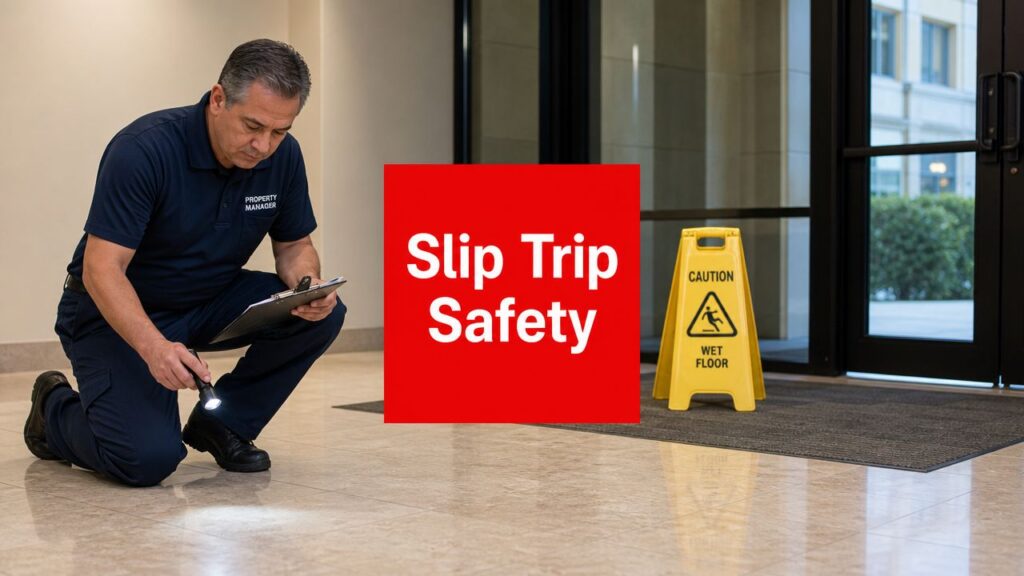
A tenant catches the edge of a curled entry mat on a rainy morning, stumbles, regains balance, and keeps walking. Nobody falls. Nobody files a report. The lobby team exhales and moves on.
That's how many slip and trips start. Not with a dramatic incident, but with a near miss that tells you the system is thin in exactly the place people assume it's fine.
Property managers live in that space every day. You're balancing vendors, tenant expectations, staffing gaps, lighting complaints, deferred maintenance, and weather that changes site conditions in an hour. In that environment, slip and trip prevention can get treated like basic housekeeping. It isn't. It's a frontline risk issue tied to safety, liability, and daily operational discipline.
From Near Miss to Proactive System
A near miss gives you a brief warning window. Use it well, and you can fix the process before someone gets hurt and before a routine hazard turns into a claim.
The operational mistake is treating a close call as a housekeeping issue that was handled in the moment. A wet vestibule may get mopped. A loose stair nosing may get taped off. A box left in a corridor may get moved. If those same conditions show up again on the next shift or after the next rain, the site does not have a cleanup problem. It has a detection and follow-through problem.
That distinction matters for property managers because slip and trip exposure usually builds in ordinary places. Entrances, loading paths, parking lots, stairwells, tenant improvement areas, and service corridors all change throughout the day. Facilities teams cannot be everywhere at once. Security officers already walk those routes, see conditions change in real time, and can act as your early warning layer if you give them a clear reporting role.
Why reactive cleanup falls short
Fast response still matters. It just is not enough on its own.
A caution sign handles the visible hazard in front of you. It does not answer the harder questions that reduce repeat incidents. Why does water keep tracking across that tile? Why does debris collect on one delivery route every afternoon? Why does one stair landing become hard to read after sunset? Those are operations questions, and they need recurring observation, ownership, and verification.
I tell new property managers to treat every near miss like a free inspection with perfect timing. Someone just showed you where your controls are thin.
What a working system looks like
The strongest programs I've seen do not rely on memory or good intentions. They use a closed-loop process between security and facilities.
- Security patrols look for predictable hazard points. Officers note changing floor conditions, lighting failures, damaged mats, blocked walkways, and weather-related risks during routine rounds.
- Reports go to the right owner fast. Maintenance, janitorial, engineering, or site management receives the issue with enough detail to act without chasing basics.
- Closure gets confirmed in the field. Someone checks that the fix worked under normal conditions, not just that a work order was marked complete.
That approach does two things at once. It reduces the chance of injury, and it gives management a stronger operating record if anyone later questions whether the property was being monitored reasonably. For readers who want context on legal rights after an injury on property, that overview helps explain how these incidents are often viewed once lawyers and insurers get involved.
A clear security incident response planning process supports this model because it assigns who observes, who reports, who corrects, and who verifies. That is how a near miss stops being a lucky break and starts improving the property.
Understanding Your True Liability Exposure
A slip or trip incident rarely stays in the safety lane. It moves into claims, insurance, tenant relations, and legal review very quickly. If you manage public-facing property, your liability exposure starts well before anyone argues over fault.

Premises liability is an operations issue
In plain terms, premises liability is the idea that property owners and operators have a duty to maintain reasonably safe conditions. For managers who want a plain-English overview of legal rights after an injury on property, that resource gives useful context on how these claims are framed.
The operational lesson is simple. If a visitor, tenant, contractor, or employee gets hurt and the site condition looks preventable, people will examine what you knew, what you should have known, and what you did about it. That's why loose mats, poor drainage, worn stair edges, and uneven pavement matter long before a claim arrives.
Small defects create large exposure
Many managers underestimate how ordinary these hazards are. In 2023, falls led to more than 8 million emergency-room visits in the U.S., representing 21.3% of all ER visits, and 55% of incidents were linked to uneven or wet surfaces, according to this summary of slip, trip, and fall injury statistics. The same source notes that a floor-level change of ¼ inch or more is considered a tripping hazard.
That last detail matters. A manager might walk past a slight height difference and barely register it. A claimant's counsel, adjuster, or consultant won't. What feels minor in the field can look very different once it's photographed, measured, and discussed after an injury.
Liability often turns on ordinary details. A saturated mat, a lip at a threshold, or a dark landing can look routine during a busy day and look indefensible later.
The hidden costs are usually operational first
Even before legal defense begins, incidents create friction inside the property:
| Exposure area | What managers feel first |
|---|---|
| Tenant confidence | Questions about whether common areas are being checked consistently |
| Vendor management | Pressure on janitorial, maintenance, and site supervisors to reconstruct what happened |
| Insurance relationships | Closer scrutiny of procedures, logs, and prior similar complaints |
| Reputation | A perception that the site is loosely managed or visibly neglected |
That's why smart prevention is the best liability strategy. It's cheaper to build a repeatable inspection and reporting habit than to explain why the same hazard lived in the same place for weeks.
Proactive Hazard Identification on Your Property
Most managers know to look for spills. Fewer are trained to read the property the way a safety professional does. The difference is where you focus your attention.
RIMS has called out entrance areas, transition areas, stairways, and the floor space around water fountains and frequently used machines as overlooked hotspots in material linked through OSHA's slips, trips, and falls handout for safety committees. That tracks with what shows up on real properties. Risk tends to cluster in high-traffic transition zones where surface changes, contamination, lighting, and foot traffic overlap.

Start with transition zones
Don't begin your walk in the quietest hallway. Begin where conditions change.
Look closely at these areas:
- Main entrances and vestibules. Check for water tracking, mat movement, mat saturation, and slick hard-surface flooring just beyond the door.
- Loading docks and service corridors. Watch for pallet wrap, cords, uneven surfaces, and temporary obstructions that become “normal” during busy shifts.
- Garage thresholds and ramps. Inspect lighting, drainage, paint wear, and the way pedestrians move between vehicle and walking zones.
- Stair transitions. Look at edge visibility, handrail continuity, worn nosings, and whether the top and bottom landings are visually clear.
- Flooring change points. Tile to carpet, concrete to resin, lobby stone to exterior pavement. These are common places for people to misread traction or elevation.
Train your eye for failure modes
A good safety walk is specific. It asks whether the control itself has failed.
Use a field checklist like this:
- Check mats like equipment. Are they large enough for several footsteps, lying flat, and still doing their job, or are they saturated and creating a secondary hazard?
- Read stairs from the user's angle. Stand at the approach and look for contrast on edges, visual confusion from floor patterns, and any taper or wear that hides the step line.
- Inspect lighting during real conditions. A garage or exterior path that looks fine at noon may create shadows at dusk that hide a crack or curb edge.
- Look low. Threshold lips, broken sealant, buckled flooring, and small surface changes are easy to miss when you're walking fast and looking ahead.
- Watch behavior. If people cut across landscaping borders, avoid one stair run, or step around the same spot, they're telling you something about the environment.
The site will usually show you where the risk is. You just have to watch how people actually move through it.
Exterior surfaces deserve the same scrutiny
Managers sometimes inspect interiors carefully and treat exterior walking surfaces as a maintenance issue only. That's a mistake, especially around pools, courtyards, and wet recreation areas in residential or hospitality settings. Material choices matter there, and resources on topics like choosing non-slip pool tiles are useful because they push the conversation upstream, before the wrong finish gets installed.
A lot of this overlaps with broader crime prevention through environmental design principles. The same site design choices that improve visibility and movement can also reduce slip and trip exposure. Clear sightlines, legible pathways, better lighting, and well-managed entrances help people move safely and help staff spot problems faster.
Integrating Security and Facilities for Prevention
Here's where many properties lose control. Security patrols see hazards. Facilities teams fix hazards. But the two groups often work in parallel instead of in one loop.
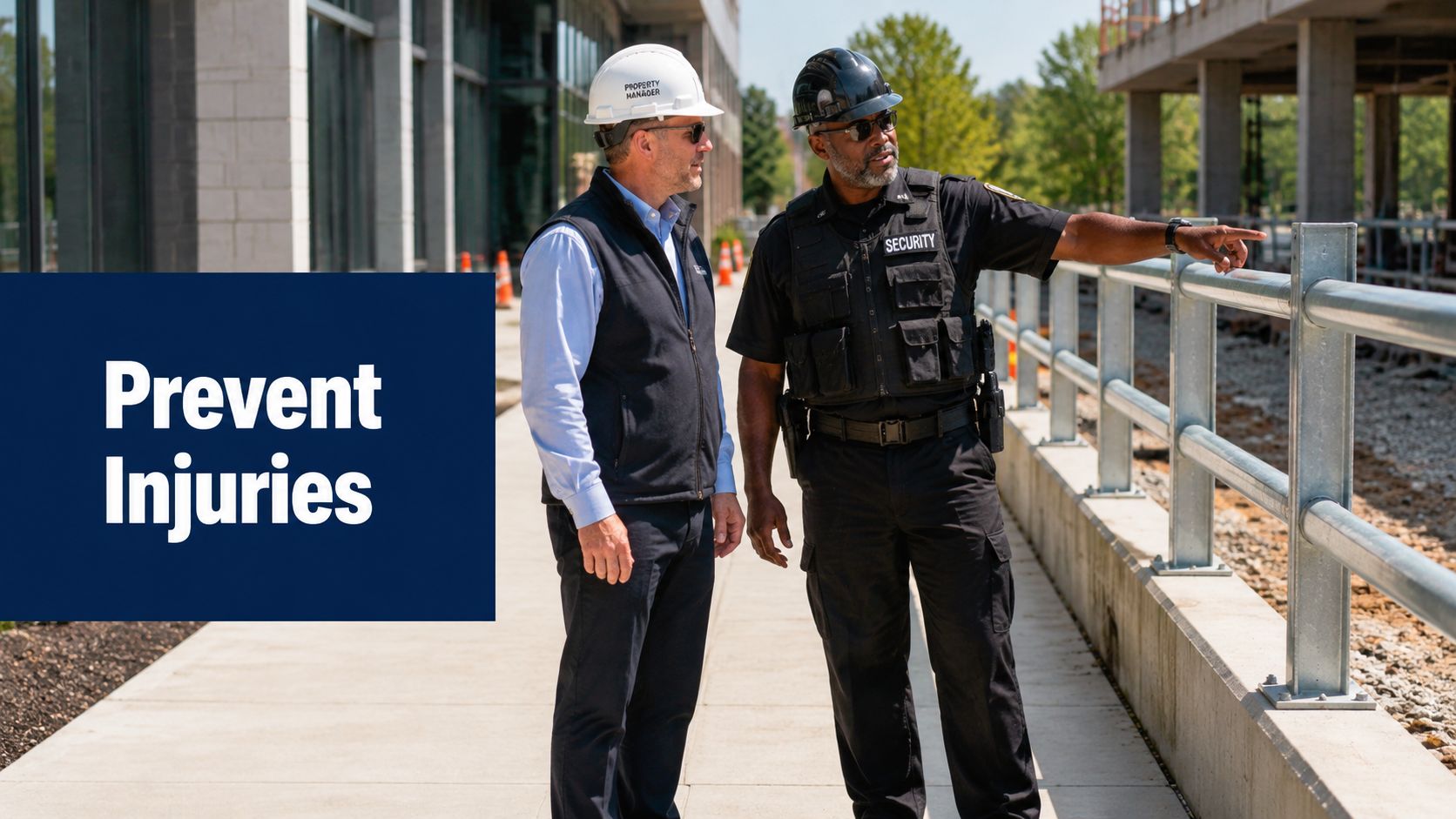
That's a missed opportunity. A patrol officer already walks the site, checks access points, moves through garages, stairwells, loading areas, and building perimeters, and notices when conditions change. If that officer is trained to identify slip and trip risks, security becomes an early-warning system for facilities instead of a separate function.

What security can spot before a claim starts
A strong patrol program doesn't just look for trespassing, vandalism, or forced entry. It also catches conditions that can injure tenants, visitors, staff, and vendors during ordinary movement.
Examples include:
- A leaking irrigation line that starts pooling water across a sidewalk before the morning rush.
- A burned-out stairwell fixture that leaves a landing dim enough to hide the edge.
- A shifting floor mat at an office tower entrance after repeated foot traffic.
- A cracked walkway panel near a parking structure exit where people are looking for cars, not at the pavement.
- A housekeeping cart left in egress space during a tenant-heavy period.
None of those are “security incidents” in the narrow sense. All of them are property risks. That's why the best operations teams train patrol staff to document condition hazards with the same discipline they use for suspicious activity.
Build a closed loop instead of a handoff
The workflow should be simple enough that it happens every day, not just after a bad event.
A practical model looks like this:
| Step | What happens on site |
|---|---|
| Observation | Patrol or onsite staff identify a visible slip or trip hazard during rounds |
| Documentation | The observer records the exact location, time, conditions, and a photo |
| Escalation | The report goes directly to the maintenance or facilities contact who can act |
| Temporary mitigation | Staff isolate the area, place visible warnings, or redirect traffic if needed |
| Repair and verification | Facilities correct the condition and someone confirms the hazard is gone |
That final step matters. Too many properties stop at “reported.” Reported isn't resolved.
A hazard report without verification is just a record of delay.
Use patrol technology to support facilities work
When patrol teams use a digital guard tour or reporting platform, hazard reporting becomes faster and harder to lose. A time-stamped photo, checkpoint location, and written note can give facilities a usable work order within minutes. It also preserves context. Was the puddle tied to weather, irrigation, janitorial activity, or a pipe leak? Did the officer note poor lighting at the same location? Did the condition repeat on earlier rounds?
In this context, integrated site management pays dividends. A good framework for facilities management best practices should include security observations as operational input, not just security output. On a mixed-use property or large residential site, that can make the difference between discovering a hazard through routine patrol and discovering it after someone gets hurt.
In practice, the strongest programs define what patrol officers must report, what photos are required, who receives the report, and how closure is confirmed. They also train supervisors to review these reports for patterns. If three different officers note the same entrance issue over two weeks, the problem isn't awareness. The problem is follow-through.
Creating a Defensible Documentation Trail
A slip claim usually gets harder to defend in the first hour, not the first month. The floor gets cleaned. A cone gets moved. The lighting changes. Staff members remember the event differently by the end of the shift. If your record starts late or stays vague, you lose the chance to show what the condition was, how your team responded, and whether your process worked.
That is why documentation has to serve two purposes at once. It has to preserve the facts for liability defense, and it has to feed the prevention system you are already running between security and facilities.
Travelers recommends post-incident review that includes photographs and witness accounts in its guidance on preventing slips, trips, and falls in the workplace. For property managers, the practical standard is simple. Build a record that a carrier, attorney, or senior owner can follow without guessing.

What to capture right away
Start with facts observed at the scene. Keep opinions out of the report unless they are clearly labeled as a witness statement.
Capture these details as soon as possible:
- Exact location. Record the building, floor, entrance, corridor, stairwell, dock, parking area, or unit-adjacent location.
- Condition of the walking surface. Note water, debris, uneven flooring, curled mats, poor lighting, worn nosings, cords, or any obstruction in the path of travel.
- Scene photos. Take wide and close photos. Show the approach to the area, the full walking path, signage, mat placement, drains, thresholds, and the specific condition involved.
- Time and operating context. Record the time, weather, cleaning activity, delivery activity, and whether the area was under routine patrol or open to heavy foot traffic.
- Witness information. Note who saw the event, who responded first, and what each person directly observed.
- Immediate controls. Record what staff did after discovery or notification, such as placing warning signs, blocking access, cleaning the area, calling EMS, or notifying engineering.
- Related work history. If known at the time, note whether there was a prior work order, recurring complaint, or earlier patrol observation for that exact spot.
A thin report creates two problems. It weakens your defense, and it cuts the feedback loop between patrol and maintenance.
Build the record across teams
The strongest files are not written by one department in isolation. Security may document the initial scene. Facilities may confirm a failed drain, loose transition strip, or lighting outage. Janitorial may confirm scheduled floor work or a recent cleanup. Management ties those entries together and confirms whether the permanent fix was completed.
That cross-team record matters because liability often turns on notice and response. If an officer reported the same wet vestibule three times in two weeks, a later incident is no longer just an isolated event. It raises questions about escalation, repair timing, and whether temporary controls were enough for the actual risk.
This is also where digital reporting earns its keep. A time-stamped patrol entry, attached photos, dispatch notes, maintenance updates, and closure verification create a cleaner timeline than separate emails and handwritten logs. For a property manager, that means fewer gaps and fewer arguments later about who knew what and when.
Review patterns, not just incidents
A single claim file should lead to an operational review. Look for repeat conditions, delayed repairs, weak handoffs, and temporary fixes that stayed in place too long.
Useful review questions include:
- Are events and near misses clustering at a specific entrance, stair, or garage path?
- Do incidents increase during rain, irrigation cycles, porter shifts, or delivery windows?
- Are patrol officers repeatedly documenting the same condition without a verified repair?
- Did the maintenance response solve the root cause, or only clear the immediate hazard?
- Are supervisors checking that closed work orders removed the risk?
I have seen well-run properties reduce claim exposure by tightening this loop. The change was not fancy. Security documented conditions consistently, facilities responded against clear priorities, and management reviewed recurring locations every week until the repeat entries stopped.
Measure the process you can defend
Incident counts matter, but they are not enough on their own. A defensible program also tracks response time, repeat hazard locations, open versus closed corrective actions, and how often temporary controls are used before a permanent repair is made.
That approach gives you something much stronger than a stack of reports. It gives you evidence of a working system. If a claim does arise, you can show that the property was inspecting, reporting, correcting, and verifying conditions through a defined process. That is the kind of record that helps reduce liability exposure and improves the site at the same time.
Building a Lasting Culture of Safety
The properties that handle slip and trips well don't rely on one careful manager or one responsive vendor. They build a culture where everyone notices hazards, reports them quickly, and understands that prevention is part of the job.
That includes janitorial teams, engineers, security officers, front desk staff, porters, property administrators, and supervisors. Each group sees different conditions at different times of day. If people assume “someone else owns that,” hazards sit longer than they should.
What culture looks like in daily operations
A lasting safety culture usually has a few visible habits:
- Staff report near misses. People don't wait for an injury before flagging a bad threshold, saturated mat, or dim stair landing.
- Supervisors respond consistently. Teams keep reporting when they see that issues are acknowledged and tracked to closure.
- Training uses the actual site. Walk the property and point out actual transition zones, not just generic examples from a slide deck.
- Reviews stay blameless and specific. Focus on conditions, timing, communication, and process gaps instead of trying to pin everything on one person.
The manager's role is steady pressure
You don't need drama to improve this. You need repetition.
Ask for the same things every week. What hazards were found, where were they found, how fast were they mitigated, and which ones keep coming back? Over time, that changes what teams pay attention to. It also gives you a stronger position with ownership, vendors, and insurers because you can show that site safety is being managed systematically.
For California properties in places like Los Angeles, San Jose, San Diego, Sacramento, Oakland, Fresno, Long Beach, and San Francisco, that discipline matters even more on mixed-use sites, active retail centers, residential communities, parking structures, and construction-adjacent properties where public access and changing conditions overlap.
A clean lobby helps. A caution sign helps. A good vendor helps. But a repeatable operating system is what reduces liability over the long run.
If you want a security partner that can support that kind of closed-loop prevention, Overton Security brings 26 years of experience, hands-on leadership, GPS-enabled patrol reporting, and real-time accountability systems that help properties turn routine tours into actionable site intelligence. For commercial properties, HOAs, retail centers, hospitals, construction sites, and mixed-use portfolios across California, the goal isn't just coverage. It's better visibility, faster reporting, and safer daily operations.