
For property managers, business owners, and facilities directors, "shrink" is more than just a line item on a spreadsheet. It represents lost profit, operational disruption, and a potential decline in safety and morale. The term encompasses losses from external theft, employee theft, administrative errors, and vendor fraud, silently eroding a company's financial health. While many search for a single, magic-bullet solution, the reality is that the best deterrent to prevent shrink is/are a combination of smart, layered strategies working in unison. A lock on the door is a start, but a truly effective loss prevention program is a comprehensive system, not an isolated tool.
This guide moves beyond generic advice to provide a detailed roadmap for building that system. We will break down 10 proven, actionable deterrents that work together to protect your assets, from retail floors in Los Angeles to construction sites in San Jose. For each deterrent, we will explore not just what it is, but why it works, how to implement it, and how it contributes to a greater, more resilient security posture. You will learn how integrating a physical presence, smart technology, and proactive policies creates a formidable shield against loss. This is about moving past simple fixes and building a sustainable framework that safeguards your inventory, supports your team, and protects your bottom line.
1. Visible Security Presence & Uniformed Guard Deterrence
When asking what the best deterrent to prevent shrink is, the most classic and psychologically powerful answer is a visible, professional security presence. The simple act of stationing a trained, uniformed officer at a key location sends an unambiguous message to potential offenders: this property is monitored, protected, and criminal activity will not be tolerated. This method relies on proactive deterrence rather than reactive response, stopping incidents before they begin.
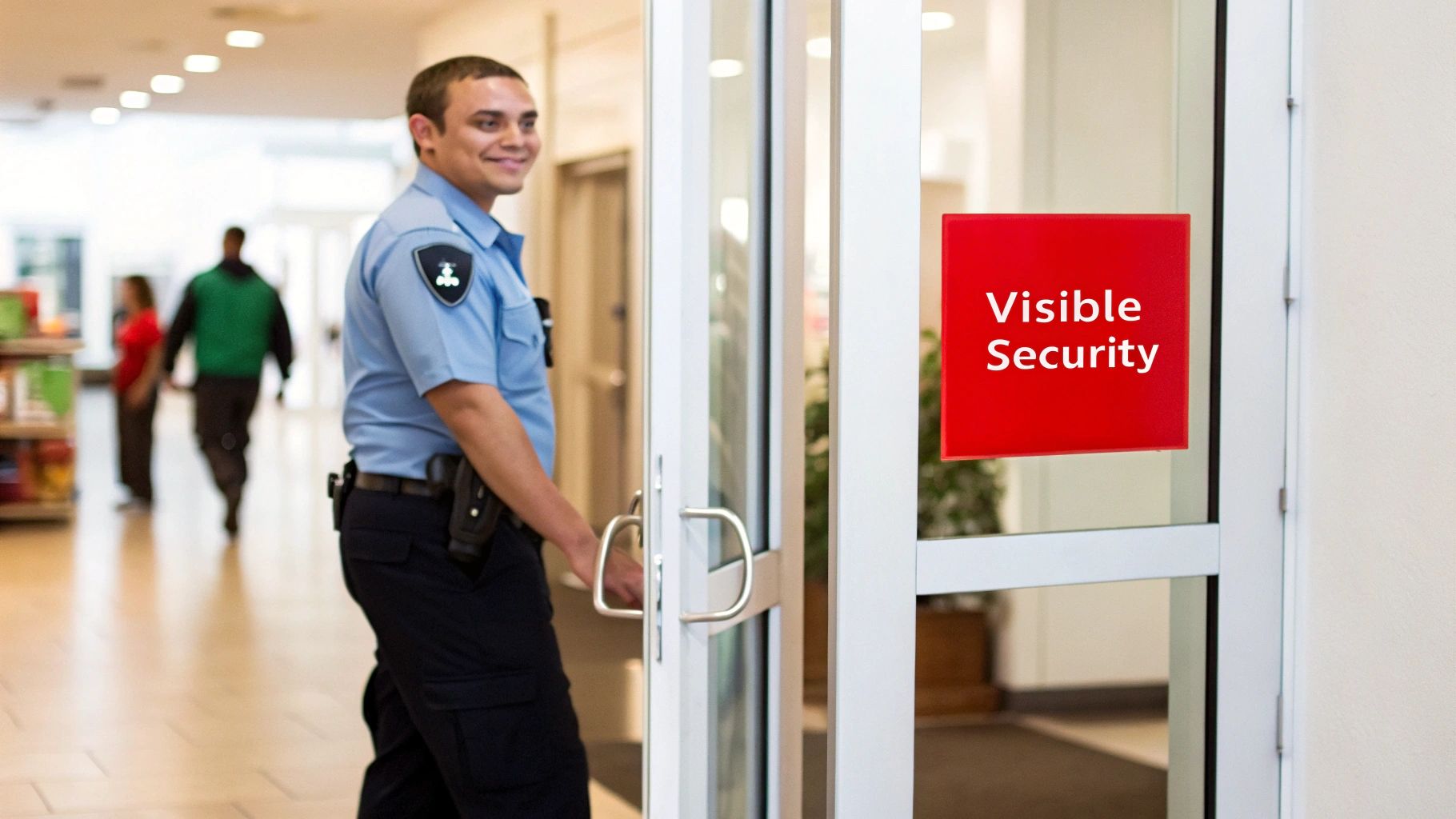
The effectiveness of this strategy is rooted in human psychology. A potential shoplifter or vandal is far less likely to act if they believe they are being watched by an authority figure. Studies and real-world data support this; some retail centers have reported shrink reductions of 30-40% after implementing on-site guards.
Implementation and Best Practices
To maximize the deterrent effect, implementation must be strategic and professional. Simply having a person in a uniform is not enough.
- Strategic Positioning: Place officers at high-traffic entry and exit points, as well as near high-value or frequently targeted merchandise. Their presence should be immediately noticeable upon entering the premises.
- Professionalism is Key: Officers must be impeccably groomed, wear a crisp and authoritative uniform, and maintain a confident posture. This commands respect and reinforces their role as a figure of authority.
- Active and Alert Engagement: Guards should not be static. Regular movement, making eye contact with patrons, and rotating positions prevent complacency and demonstrate active surveillance.
- Clear Communication: The security presence should be supported by clear signage. For instance, integrating custom warning signs that state "Security On-Site" or "Premises Under Surveillance" reinforces the message and addresses specific vulnerabilities.
Overton Security Integration: We provide highly-trained, professional officers who serve as both a deterrent and a customer service asset. Our hands-on management ensures officers are briefed daily on your specific loss prevention goals, integrating seamlessly with your operations to create a secure and welcoming environment.
2. Mobile Patrol & Vehicle Deterrence Programs (with High-Risk Period Management)
For properties spanning large areas like retail centers, construction sites, or multi-building portfolios, a static guard may not be enough. The best deterrent to prevent shrink in these environments is often a dynamic and unpredictable one: a mobile patrol program. Clearly marked security vehicles conducting scheduled and random patrols create a powerful, wide-ranging visual deterrent that disrupts criminal planning and projects a constant state of vigilance across the entire property.
This strategy's effectiveness lies in its unpredictability and scalability. A potential thief cannot predict when a patrol vehicle will appear next, making the window for opportunity dangerously small. Data shows this approach works; retail shopping centers have reduced package and merchandise theft by 25-35% with randomized patrols, while construction sites report cutting equipment theft by over 40% after implementing a dedicated vehicle presence.
Implementation and Best Practices
A successful mobile patrol program is more than just driving around; it's a data-informed, strategic operation designed for maximum impact.
- Vary Routes and Timing: Avoid predictable patterns. By randomizing patrol schedules and routes, you prevent offenders from learning your security routine and identifying blind spots.
- Target High-Risk Periods: Analyze your shrink data to identify peak times for losses, such as Friday evenings or late-night hours. Concentrate patrol frequency during these high-risk windows to maximize resource effectiveness.
- High-Visibility Vehicles: Patrol vehicles must be clearly marked, clean, and professional. The goal is to be seen. A prominent vehicle is a roving billboard that advertises your commitment to security.
- Technology-Enabled Accountability: Use GPS tracking to verify patrol completion and route adherence. Officers should use digital reporting tools to document all findings with timestamped photos, ensuring a clear and actionable record of their activities. You can explore how Overton's technology-driven mobile patrol services deliver this level of accountability.
Overton Security Integration: We specialize in creating data-driven mobile patrol programs that align with your specific vulnerabilities. Our hands-on managers analyze your loss patterns to design optimized patrol schedules, and our GPS-verified patrols with real-time digital reporting give you complete confidence that your property is being actively monitored and protected.
3. Remote Monitoring & CCTV Surveillance Integration
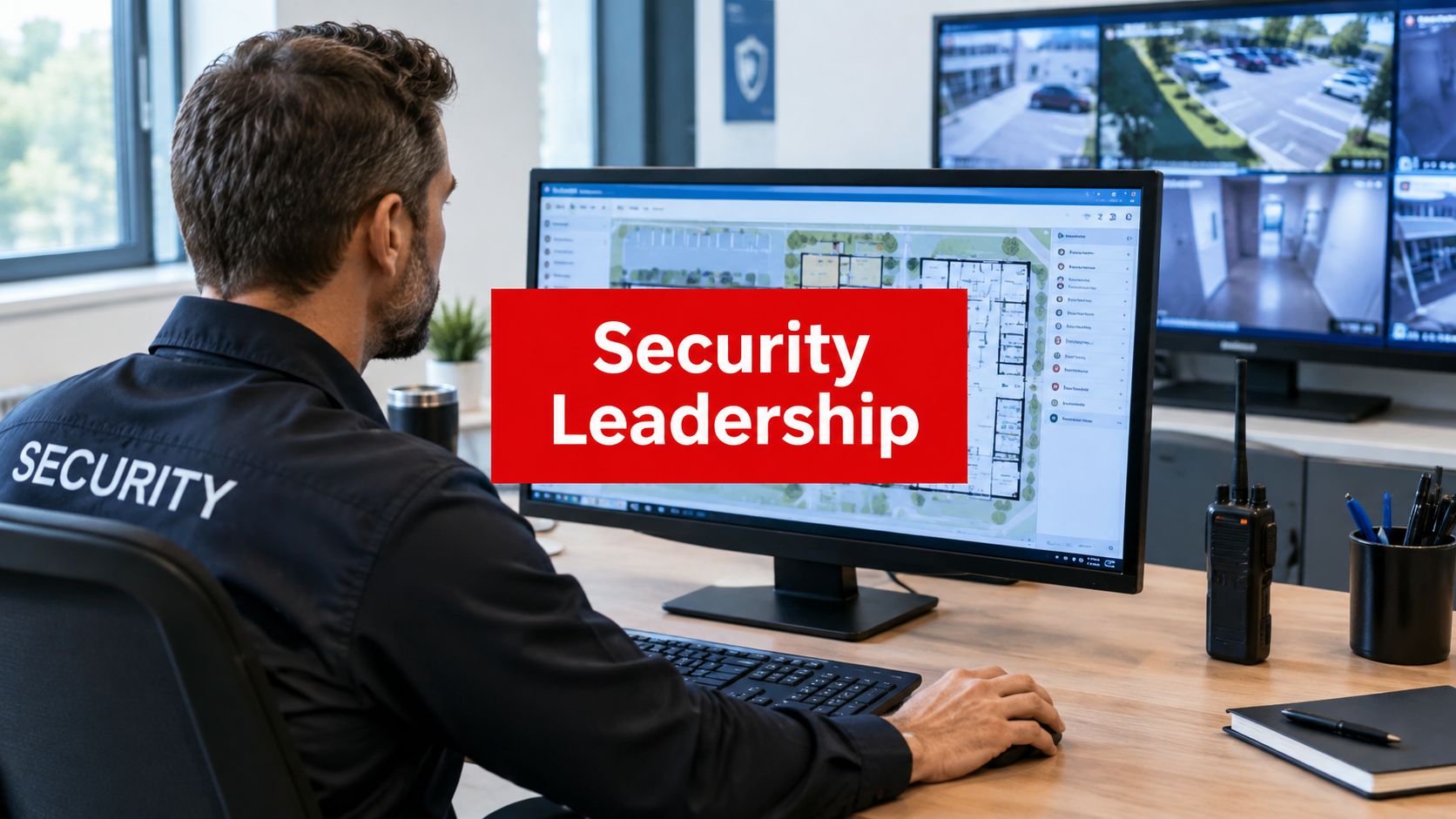
While a physical presence is powerful, the best deterrent to prevent shrink in a modern setting often involves technology working around the clock. Integrating high-definition CCTV surveillance with real-time, remote monitoring from a Security Operations Center (SOC) creates a comprehensive and persistent deterrent. This strategy provides continuous oversight, acting as a digital watchdog that never sleeps and offers invaluable forensic evidence when an incident occurs.

The effectiveness of this method is twofold: it discourages potential thieves who see cameras and signage, and it enables a swift, targeted response to live events. Retail chains have successfully reduced shrink by 15-25% by combining CCTV with SOC monitoring, while warehouse facilities use this approach to pinpoint and stop internal theft. The addition of AI-powered analytics can even detect suspicious behaviors automatically, flagging potential threats for immediate review.
Implementation and Best Practices
A successful surveillance strategy goes beyond simply installing cameras. It requires careful planning and active management to yield the best results.
- Comprehensive Coverage: Position high-definition cameras to cover all critical areas, including high-value merchandise displays, cash registers, entry/exit points, and stockrooms. The goal is to eliminate blind spots where theft can occur.
- Visible Deterrence: Maximize the deterrent effect with clear and professionally installed signage that states "Live Video Monitoring in Progress" or "Premises Under 24/7 Surveillance." This warns potential offenders they are being recorded.
- System Integration: For maximum impact, integrate your camera system with other data points, like Point-of-Sale (POS) systems. This allows for correlating suspicious transactions, such as excessive voids or returns, with corresponding video footage.
- Proactive Monitoring Protocols: Ensure your SOC personnel are trained to recognize specific suspicious behaviors relevant to your business, from loitering near secure areas to patterns associated with organized retail crime.
Overton Security Integration: Our 24/7 Security Operations Center serves as the nerve center for your property's protection. We integrate your existing or new camera systems with our remote monitoring services, providing live virtual patrols and immediate incident verification. This fusion of smart technology and human expertise allows us to dispatch on-site patrols or law enforcement with actionable intelligence, creating an efficient and formidable security solution.
4. Access Control & Electronic Entry Systems
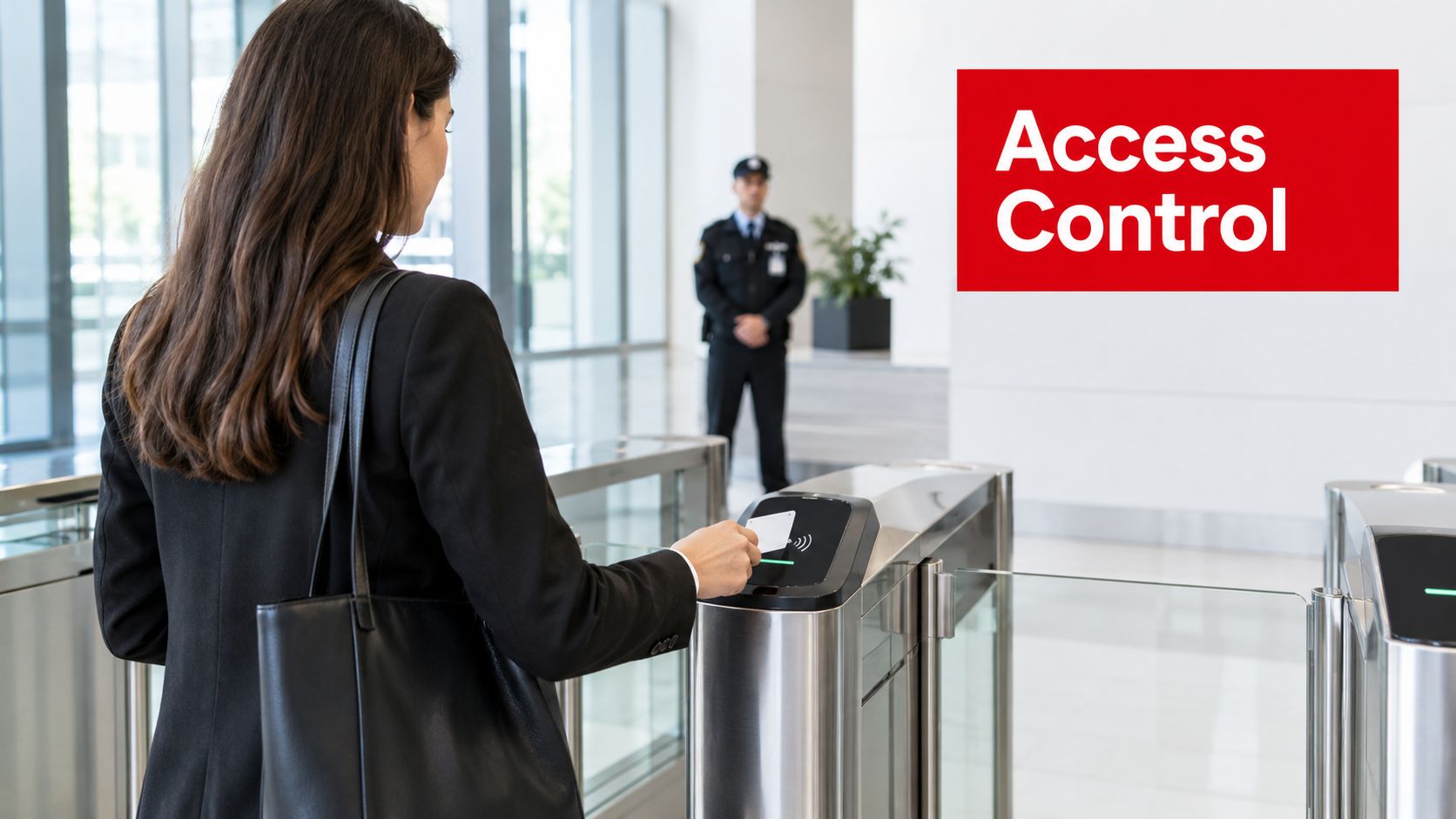
While a visible guard addresses external threats, one of the best deterrents to prevent shrink originating from within is a robust access control system. By electronically managing who can enter specific areas and when, businesses can effectively eliminate unauthorized access to sensitive zones like stockrooms, server rooms, or cash offices. This technological solution creates a powerful barrier against both internal and external opportunists.
The deterrent power of access control lies in its accountability. Every entry attempt, successful or not, is logged, creating a digital audit trail. This knowledge that their movements are being tracked discourages employees from accessing restricted areas without cause and makes it nearly impossible for external parties to slip into secure zones unnoticed. Retailers have seen inventory shrink drop by over 20% simply by securing stockroom access.
Implementation and Best Practices
Deploying an access control system requires more than just installing hardware; it demands a strategic approach to security management.
- Implement Tiered Access: Not every employee needs access to every area. Create access levels based on job function, seniority, and operational need, granting permissions on a least-privilege basis.
- Regular Log Reviews: An audit trail is only useful if it's monitored. Review access logs weekly to identify suspicious patterns, such as after-hours entry attempts or access to areas outside an employee's normal duties.
- Immediate Deactivation: When an employee is terminated or resigns, their access credentials must be disabled immediately to prevent disgruntled former staff from causing harm or theft.
- Integrate with Surveillance: Combine access control with CCTV cameras at entry points. This allows you to visually verify who is using a credential, preventing pass-backs or the use of stolen cards. To learn more about the different systems available, explore these types of access control.
Overton Security Integration: Our expertise extends beyond physical presence. We help clients design and implement comprehensive access control strategies, integrating them with our on-site guard and mobile patrol services. Our officers can verify credentials, respond to unauthorized access alarms, and provide a human checkpoint to reinforce your electronic security measures, creating a layered defense against shrink.
5. Merchandise Display & Floor Layout Optimization
One of the most effective and often overlooked deterrents to prevent shrink is the physical environment of the retail space itself. Strategic store design, including merchandise display and floor layout, can passively yet powerfully discourage theft by eliminating opportunities. By maximizing visibility and making it logistically difficult for offenders to conceal items, you turn your store’s design into a foundational layer of your loss prevention strategy.
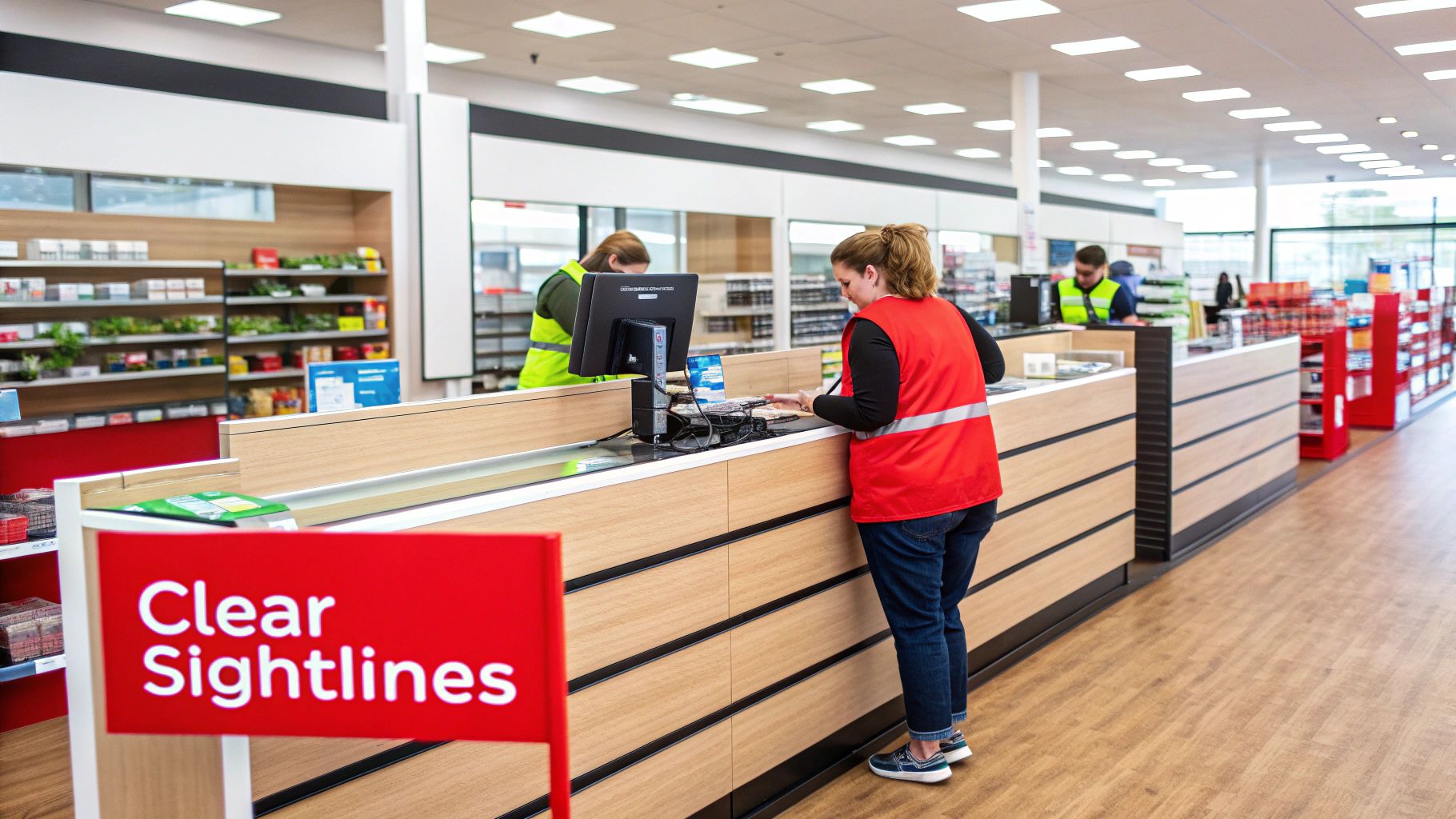
The psychology behind this approach is simple: thieves thrive in environments with blind spots, clutter, and easy access to high-value goods. An open, well-lit, and organized floor plan creates a sense of exposure, making a potential shoplifter feel constantly watched. Retailers like Target and CVS have refined this science, reporting shrink reductions of 15-25% on targeted items like cosmetics and electronics simply by adjusting their placement and display methods.
Implementation and Best Practices
A thoughtful layout requires more than just arranging shelves; it involves a strategic analysis of customer flow and product risk.
- Prioritize High-Risk Items: Place small, expensive, and frequently stolen products in high-traffic, highly visible areas, such as near checkout counters or service desks where staff are always present.
- Maintain Clear Sightlines: Use low-profile shelving (no higher than 5 feet) and avoid large displays that obstruct views from one end of the store to the other. This allows employees to discreetly monitor a larger area.
- Strategic Use of Mirrors: Install convex security mirrors in corners and at the ends of long aisles to eliminate blind spots. This extends the visual reach of your staff and security personnel.
- Design for Openness: Ensure aisles are wide and uncluttered, preventing individuals from lingering or concealing items. An open-concept checkout area also minimizes last-minute theft opportunities.
Overton Security Integration: Our loss prevention specialists can conduct a comprehensive site assessment to identify vulnerabilities in your current layout. We work with your team to recommend practical design adjustments that enhance natural surveillance, then integrate our on-site officers or patrol units to actively monitor the remaining strategic points, ensuring your physical space and security presence work in perfect harmony.
6. Employee Training & Loss-Prevention Culture Development
While technology and physical security are crucial, one of the best deterrents to prevent shrink is often the most overlooked: your own team. A well-trained, engaged workforce transformed into a human firewall is an incredibly effective and cost-efficient asset. This strategy focuses on building a company-wide culture of loss prevention where every employee understands their role in protecting company assets, creating a vigilant and proactive defense against both internal and external threats.
The power of this approach lies in its scalability and psychological impact. When employees are trained to spot the subtle red flags of theft, from suspicious customer behavior to procedural inconsistencies at the register, they become an active part of the security solution. Major retail chains have demonstrated that comprehensive staff training programs can directly contribute to shrink reductions of 10-20%, proving that an aware team is a powerful deterrent.
Implementation and Best Practices
Creating a culture of security requires consistent effort and clear communication, not just a one-time training session.
- Integrate into Onboarding: Make loss-prevention awareness a core component of every new hire's initial training. This sets expectations from day one that asset protection is a shared responsibility.
- Conduct Regular Refreshers: Host brief, monthly or quarterly training sessions focused on current shrink trends, new theft methods, or common procedural mistakes. This keeps security top-of-mind.
- Empower, Don't Accuse: Train staff on how to recognize and report suspicious behavior patterns, not how to profile or accuse individuals. Teach non-confrontational customer service techniques that can deter potential thieves.
- Establish Clear Procedures: Create and communicate simple, unambiguous steps for employees to follow when they suspect theft or identify a loss. Knowing exactly what to do removes hesitation and ensures a proper response.
Overton Security Integration: We view your staff as a critical partner in our security mission. Our site supervisors can conduct joint training sessions with your team, covering topics like situational awareness, emergency response protocols, and how to effectively communicate with on-site security officers. This collaborative approach ensures that your employees and our officers work as a unified, cohesive team to protect your assets.
7. Customer Service & Engagement as Deterrence Strategy
While technology and uniformed guards are powerful tools, one of the most effective and often overlooked deterrents to prevent shrink is exceptional customer service. This strategy transforms a potentially confrontational loss prevention effort into a positive, welcoming experience. By actively and attentively engaging every person who enters the premises, staff create an environment where potential offenders feel seen, acknowledged, and therefore less anonymous, significantly reducing their willingness to attempt theft.
The power of this method lies in its subtlety and psychological impact. A simple, genuine "Hello, can I help you find anything today?" accomplishes two goals simultaneously. It provides excellent service to legitimate customers while signaling to a potential shoplifter that they are being actively observed. This non-confrontational approach disrupts the mindset of an offender, who relies on blending in and going unnoticed.
Implementation and Best Practices
To successfully deploy engagement as a deterrent, the approach must be consistent, genuine, and integrated across all staff, including security.
- Universal Greeting Standard: Mandate that all staff, from sales associates to security officers, make eye contact and offer a friendly greeting to everyone who enters their area. This immediately establishes a culture of awareness.
- Train for Proactive Assistance: Empower employees to approach customers and offer help, not just stand by. Training should focus on reading body language and offering assistance in a way that is helpful, not intrusive or accusatory.
- Integrate Service and Security: Train security personnel in hospitality and customer service protocols alongside their standard duties. An officer who can provide directions or assistance is just as valuable as one who can stop a theft.
- Maintain Staff Presence: Ensure consistent staff coverage, especially in high-value or high-theft areas. An empty, unmonitored space is a prime target for opportunistic theft.
Overton Security Integration: We specialize in providing Concierge Security officers who are dual-trained in both advanced security protocols and high-touch customer service. By placing these professionals at key access points, we transform your first impression from intimidating to welcoming, all while maintaining an unmistakable security presence. Our officers become an extension of your team, enhancing the customer experience and actively reducing shrink through positive, proactive engagement.
8. Inventory Management & Cycle Counting Programs
While external theft gets significant attention, the best deterrent to prevent shrink is often an internal process that creates unflinching accountability. Robust inventory management and frequent cycle counting programs act as a powerful deterrent by removing the opportunity for theft to go unnoticed. This systematic approach ensures that what is physically on the shelves matches what the records say, identifying discrepancies early and enabling targeted interventions.
This strategy's effectiveness lies in its consistency and data-driven nature. When employees know that inventory is regularly and meticulously verified, the perceived risk of getting caught rises dramatically. Distribution centers have slashed internal theft by implementing systematic audits, and retail operations have seen shrink reductions of 15-30% by adopting aggressive cycle counting for high-value goods.
Implementation and Best Practices
A successful program is more about discipline and process than expensive technology, although technology certainly helps. The goal is to create a culture of accuracy and ownership.
- Prioritize High-Value Items: Establish a frequent cycle counting schedule (weekly or even daily) for items that are high-value, high-demand, or frequently targeted for theft.
- Ensure Accuracy and Integrity: Utilize barcode scanning and modern inventory management systems to minimize human error. It's also wise to rotate the staff members responsible for conducting counts to prevent potential collusion.
- Investigate Variances Immediately: Don't let discrepancies linger. All significant variances between physical counts and system records should be investigated within 24-48 hours to pinpoint the cause, whether it's theft, damage, or a process error.
- Promote Transparency: Share shrink metrics and investigation results with staff to reinforce accountability. For a deeper dive into maintaining accurate stock levels across all channels, which is critical for minimizing shrink, consider these omnichannel inventory management best practices.
Overton Security Integration: Our security officers can play a vital role in supporting your inventory program. We can monitor and control access to stockrooms and warehouses, verify shipping and receiving manifests, and provide a visible presence during cycle counts or after-hours audits. This integration ensures that your inventory processes are protected, adding an extra layer of security to your shrink prevention strategy.
9. Point-of-Sale (POS) System Controls & Audit Trails
While external threats are a major source of shrink, internal theft at the point of sale remains a significant and often overlooked vulnerability. A modern, well-configured Point-of-Sale (POS) system is one of the best deterrents to prevent shrink originating from employee fraud. These systems create a digital paper trail for every transaction, making it exceptionally difficult for dishonest actions to go unnoticed.
The deterrent effect stems from accountability. When employees know that every discount, void, refund, and sale is logged, time-stamped, and can be cross-referenced with inventory and video footage, the perceived risk of getting caught increases dramatically. This discourages common schemes like "sweethearting" (giving unauthorized discounts to friends), processing fraudulent returns, or conducting off-book cash sales.
Implementation and Best Practices
To transform your POS system from a simple register into a powerful loss prevention tool, a structured approach is essential. The goal is to close loopholes and maximize transparency.
- Enforce Strict Authorizations: Configure the system to require a manager's password or keycard for all non-standard transactions, including voids, manual price overrides, and refunds without a receipt. This single step prevents the most common forms of checkout fraud.
- Monitor Exception Reports: Regularly review reports that flag unusual activity. This includes tracking high rates of discounts, voids, or "no sale" transactions by a specific employee, which often indicates fraudulent behavior.
- Integrate with Surveillance: Link POS transaction data with your video surveillance system. This allows you to instantly pull up footage corresponding to a specific transaction, verifying if a customer was present for a refund or if merchandise was actually sold.
- Conduct Regular Audits: Routinely compare sales data against physical inventory counts for high-value items. Discrepancies can quickly pinpoint issues at the register, helping to identify problematic locations or employees in multi-unit operations.
Overton Security Integration: Our expertise extends beyond physical security to a comprehensive loss prevention strategy. We can help you analyze your operational vulnerabilities, including those at the POS. Our officers can be trained to observe checkout procedures, and our SOC team can assist in reviewing surveillance footage that has been flagged by your POS exception reports, providing a verified, multi-layered approach to reducing internal shrink.
10. Multi-Layer Security Integration & Comprehensive Risk Management
While individual deterrents are effective, the ultimate answer to what the best deterrent to prevent shrink is lies in a unified, multi-layer strategy. This approach combines physical security, advanced technology, operational policies, and staff training into a single, cohesive system. By creating overlapping layers of protection, you make criminal activity exceptionally difficult, risky, and highly likely to be detected, achieving a level of security far greater than the sum of its parts.
This comprehensive risk management model is the gold standard for high-value environments like distribution centers, hospital pharmacies, and Class-A commercial properties. For instance, a premium shopping center can reduce shrink by 30-40% by combining uniformed guards, sophisticated CCTV analytics, strict POS controls, and robust employee training programs. Each element covers the potential gaps of the others, creating a formidable defense.
Implementation and Best Practices
An integrated system requires meticulous planning and centralized oversight to function correctly. It’s about making disparate systems communicate and work toward a common goal.
- Conduct a Comprehensive Risk Assessment: Begin by identifying every potential source of shrink, from external shoplifting and internal theft to vendor fraud and administrative errors.
- Design an Interconnected System: Architect a solution where each component supports the others. For example, an access control alert can automatically trigger specific CCTV cameras, which are then reviewed by on-site security personnel in real-time.
- Establish Centralized Oversight: All security data, including patrol reports, camera feeds, and alarm alerts, should feed into a unified dashboard or monitoring center for holistic analysis and response.
- Create Clear Escalation Protocols: Develop and train staff on precise procedures for different types of incidents, ensuring the right personnel are involved at every stage, from store managers to security officers. If you want to learn more, explore how to reduce shrinkage with a multi-layered approach.
Overton Security Integration: We specialize in designing and managing truly integrated security programs. Our hands-on leadership team works with you to blend our professional officers, mobile patrols, and 24/7 SOC monitoring with your existing technology and operational procedures. This creates a seamless, responsive, and powerful deterrent tailored to your unique risk profile.
Top 10 Shrink Deterrents Comparison
| Item | Implementation complexity | Resource requirements | Expected outcomes | Ideal use cases | Key advantages |
|---|---|---|---|---|---|
| Visible Security Presence & Uniformed Guard Deterrence | Low–Medium — straightforward to deploy but needs consistent training | Ongoing labor, uniforms, scheduling, supervision | Immediate psychological deterrent; reported 30–40% reductions in some retail cases | Retail entrances, malls, residential lobbies, high-shrink points | Visible deterrence, flexible real-time response, customer-facing benefits |
| Mobile Patrol & Vehicle Deterrence Programs (with High-Risk Period Management) | Medium — requires routing, scheduling and data-driven timing | Patrol vehicles, drivers, GPS/NFC tracking, dispatch, data analysis | Cost-effective area coverage; reported 25–40% reductions in targeted scenarios | Multi-site portfolios, parking areas, construction sites, large perimeters | Unpredictable coverage, targeted high-risk windows, verifiable patrol logs |
| Remote Monitoring & CCTV Surveillance Integration | High — SOC setup, camera deployment, AI analytics integration | Cameras, network/cloud storage, SOC staff, ongoing maintenance | Continuous 24/7 monitoring, forensic evidence; reported 15–25% shrink reduction | Large retail chains, warehouses, pharmacies, high-value asset sites | Continuous oversight, evidence collection, behavior analytics and faster response |
| Access Control & Electronic Entry Systems | Medium–High — hardware and systems integration required | Electronic locks/readers, credentials/biometrics, IT integration, maintenance | Reduces unauthorized/internal access; examples show 20–30% stockroom improvement | Pharmacies, stockrooms, distribution centers, sensitive zones | Audit trails, rapid lockdown, time-based restrictions, reduced internal theft |
| Merchandise Display & Floor Layout Optimization | Low–Medium — planning and possible remodels | Fixture changes, design work, staff training | Improved visibility and deterrence; reported 15–25% reduction for targeted categories | Retail sales floors, supermarkets, cosmetics/electronics departments | Low ongoing cost, better customer experience, natural surveillance |
| Employee Training & Loss-Prevention Culture Development | Low–Medium — program design and continuous reinforcement | Training time, managerial commitment, materials and refreshers | Sustainable behavior change; reported 10–20% shrink reduction when well executed | All retail, hospitality, healthcare and distribution operations | High impact at low incremental cost, leverages existing staff, builds accountability |
| Customer Service & Engagement as Deterrence Strategy | Low — culture and soft-skill training focused | Staff time, hospitality training, adequate staffing levels | Reduces opportunistic theft while improving satisfaction; strong in upscale settings | Luxury retail, concierge properties, hospitality, high-end shopping centers | Non-confrontational deterrent, improves customer experience and loyalty |
| Inventory Management & Cycle Counting Programs | Medium — process discipline and systems required | Inventory systems, barcode scanners, staff time for counts, analysis | Early detection and targeted intervention; reported 15–30% shrink reduction in aggressive programs | Retail stores, distribution centers, pharmacies, high-value inventory sites | Concrete data on shrink, enables targeted responses and accountability |
| Point-of-Sale (POS) System Controls & Audit Trails | Medium–High — POS upgrades and system integrations | Modern POS hardware/software, integrations, training, monitoring | Reduces checkout fraud 20–40% in examples; enables real-time anomaly detection | Retail checkout areas, quick-service restaurants, pharmacies | Transaction-level accountability, integrates with video and inventory for investigations |
| Multi-Layer Security Integration & Comprehensive Risk Management | Very High — complex coordination and systems integration | Multiple technologies, SOC, trained personnel, integration resources | Highest overall impact; examples show 30–50%+ reductions and near-elimination in some scenarios | Enterprise retail, healthcare systems, large portfolios, distribution centers | Redundancy across layers, cross-system analytics, resilient and comprehensive deterrence |
Building Your Integrated Defense with a Trusted Partner
As we've explored the diverse landscape of loss prevention, a central truth has emerged: the best deterrent to prevent shrink is not a single tool, but a multi-layered, integrated strategy. Relying solely on technology leaves you vulnerable to human error, while depending only on personnel ignores the force-multiplying power of modern systems. True asset protection comes from weaving these individual threads into a cohesive, resilient security fabric tailored to your specific environment, risks, and operational goals.
The ten strategies discussed, from a highly visible uniformed guard to sophisticated POS audit trails, are not a menu to choose from; they are interlocking components. A well-trained employee (Strategy #6) is made more effective by optimized floor layouts (Strategy #5). An advanced CCTV system (Strategy #3) reaches its full potential when monitored by a 24/7 Security Operations Center and supported by responsive mobile patrols (Strategy #2). This synergy is where shrink prevention moves from a reactive expense to a proactive investment that safeguards your bottom line.
Key Takeaways for a Stronger Defense
To translate these concepts into action, remember these core principles:
- Deterrence is psychological: The most powerful tools create an environment where theft seems too risky or difficult. A visible security presence, attentive customer service, and clear policies all contribute to this perception of control.
- Integration is non-negotiable: An access control system is just a lock without policies and personnel to manage it. Your strategy must connect people, policies, and technology into a unified system where each part reinforces the others.
- Consistency is crucial: Random or inconsistent enforcement of policies creates loopholes that are easily exploited. Whether it’s cycle counting or guard patrols, predictable and reliable execution is essential for long-term success.
Ultimately, mastering these approaches is about more than just reducing inventory loss. It's about creating a safer, more organized, and more profitable environment for everyone. It reassures honest customers, supports diligent employees, and sends a clear message that your assets are protected with professional vigilance. This foundation of security allows you to focus on your primary mission: running a successful business, managing a thriving property, or serving your community.
Your Path Forward to Reduced Shrink
The journey to a comprehensive loss prevention program begins with a single, decisive step: evaluating your current vulnerabilities with a trusted expert. No two properties are alike, and a solution that works for a high-end retailer in Los Angeles may not be suitable for a distribution center in San Jose. The optimal strategy requires a partner who understands these nuances and can build a program around your specific needs.
For over 26 years, Overton Security has prioritized this partnership model. We differentiate ourselves with a commitment to quality over quantity, reflected in our low manager-to-client ratio and hands-on leadership. We don’t just fill a post; we integrate our professional officers, GPS-enabled patrols, and 24/7 SOC oversight into your operational team. Our focus is on building a stable, reliable security presence that becomes an integral part of your defense against shrink. By blending experienced personnel with accountability-driven technology, we help you construct the resilient, integrated security posture your assets deserve.
Ready to move beyond reactive measures and build a proactive loss prevention strategy? Contact Overton Security for a comprehensive site assessment, and let our team help you design a tailored, multi-layered solution that delivers real peace of mind and measurable results.