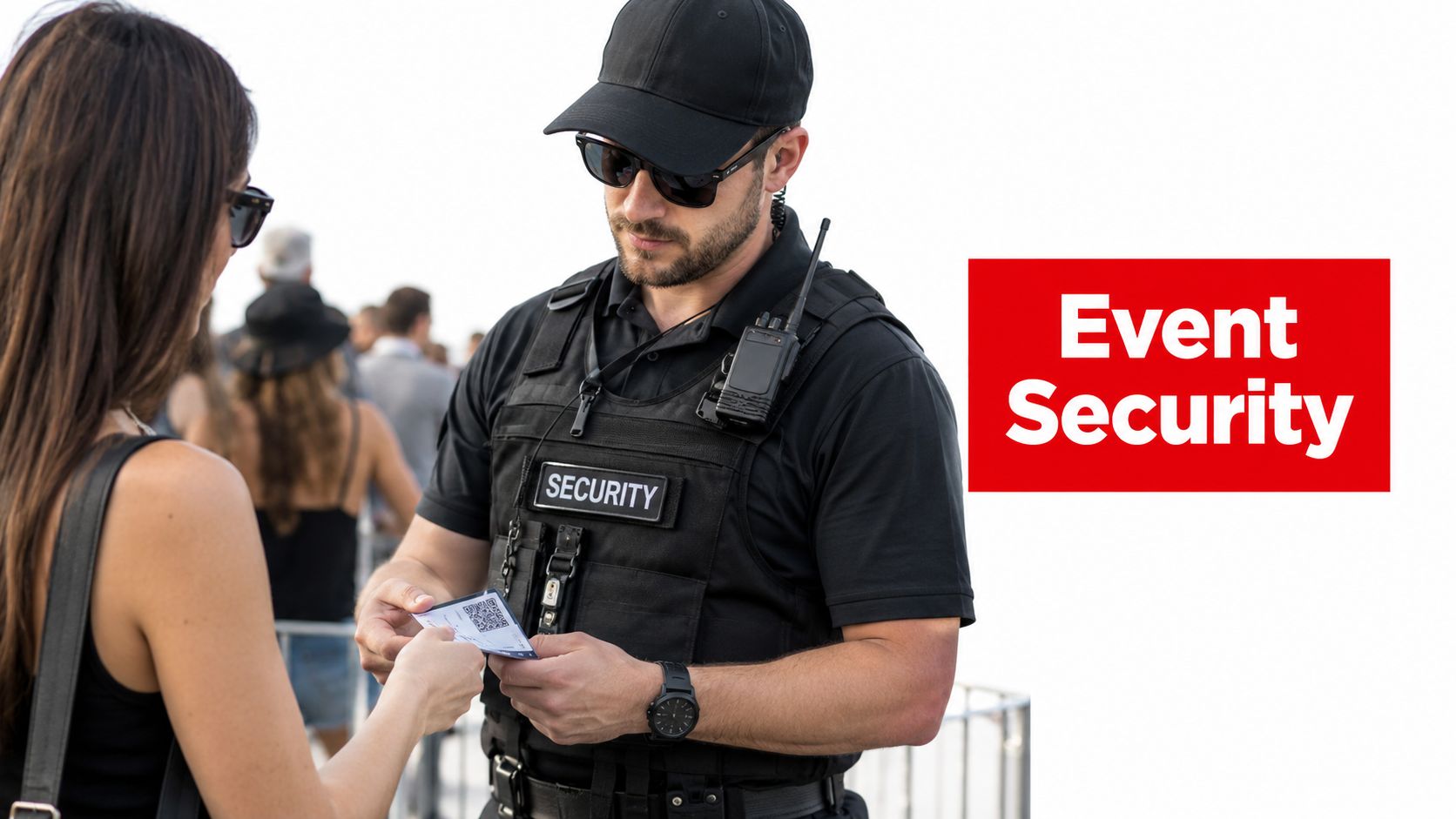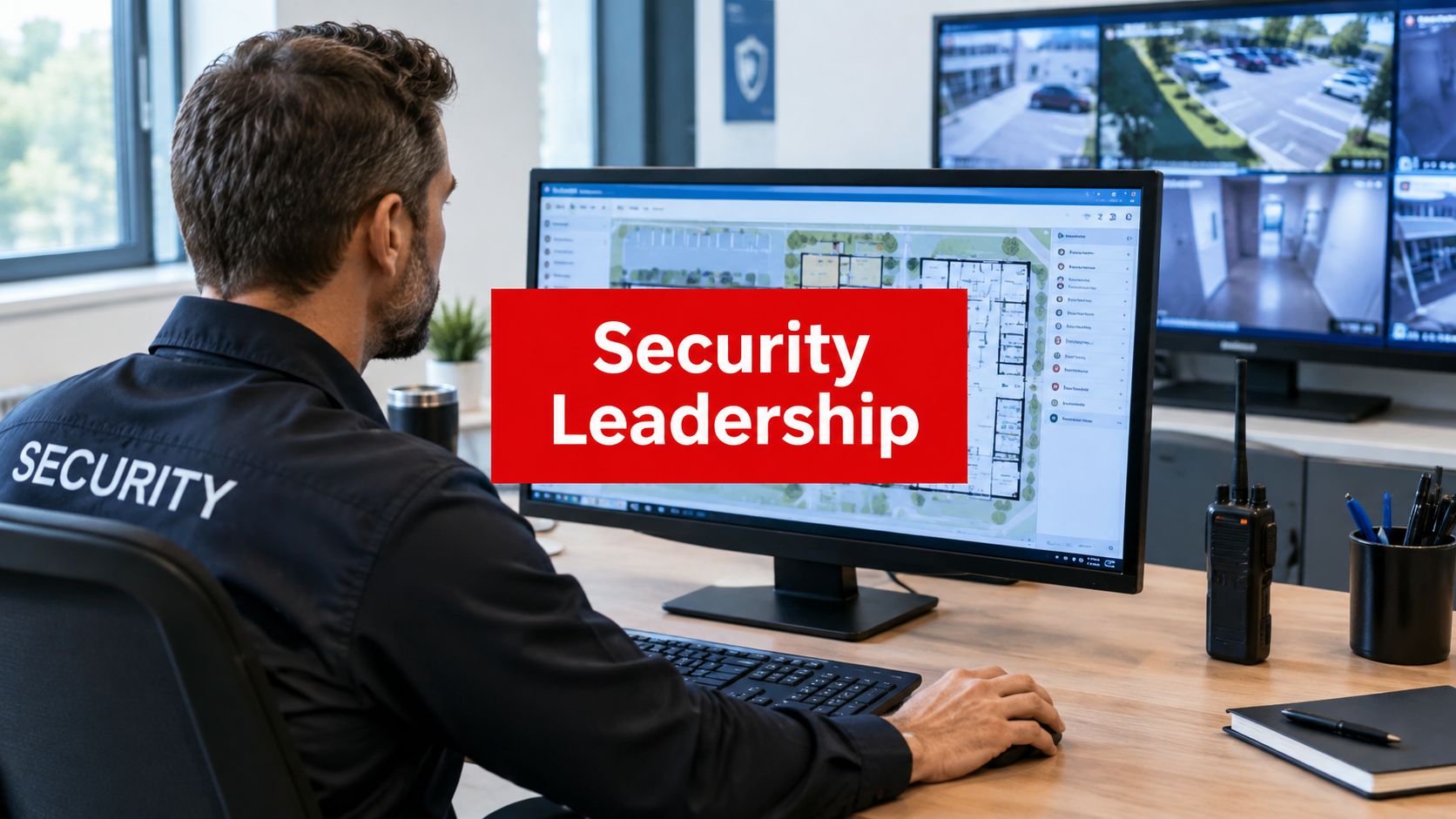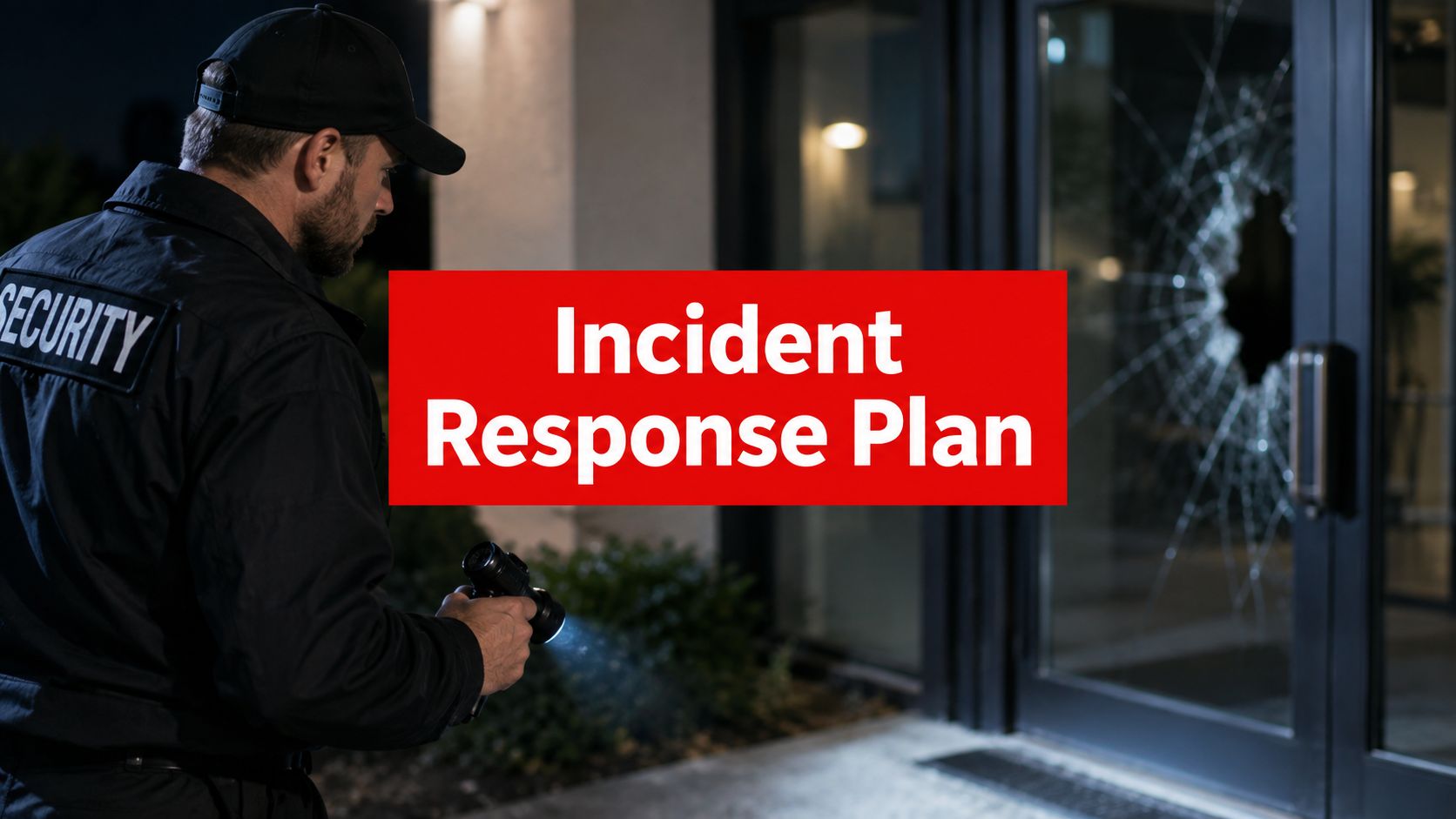

You're three hours from opening a festival gate. The credential list is printed, radios are charged, and guests are already forming a line. Then an officer notices one pass that looks almost right, but not quite. Instead of creating a scene, the officer moves the guest aside, asks a few calm questions, confirms the credential with the event lead, and stops an unauthorized person before the issue reaches the crowd.
That quiet intervention captures the value of an event security officer. The job is not just standing at a door or reacting to fights. It combines preparation, observation, communication, access control, de-escalation, emergency support, and accurate reporting. For planners, the practical question is not just how many officers to hire. It's whether the team understands the written plan, knows who makes each decision, and has support when conditions change.
What an Event Security Officer Really Does
An event security officer is a licensed and trained professional who protects people, property, operations, and the event's reputation. At a private concert, that may mean verifying credentials near backstage access. At a corporate gala, it may involve discreetly monitoring entrances, guiding guests, and resolving a dispute before it interrupts the program. At a festival, the officer may focus on line movement, perimeter control, medical assistance, and early signs of crowd pressure.
The role covers several assignments:
- Fixed-post coverage: Officers remain at entrances, restricted doors, loading areas, cash points, or other locations that need consistent observation.
- Roving patrols: Officers move through public areas, restrooms, parking zones, stages, and back-of-house spaces.
- Guest-facing security: Uniformed or plainclothes personnel handle credential checks, VIP escorts, prohibited-item concerns, and customer-service interactions.
- Supervision: Leads coordinate posts, make escalation decisions, brief the client, and keep the operation aligned with the plan.
The best work is proactive. Officers assess how people are entering, where lines are compressing, which doors are being propped open, and whether a guest's behavior suggests distress, impairment, or conflict. They also know when a matter can be resolved through a calm conversation and when it needs a supervisor, medical team, police, or emergency services.
Practical rule: An officer shouldn't have to invent the response while an incident is unfolding. The written plan should make the first decision clear.
The role has changed as public-event risks have changed. The 1979 Who concert tragedy in Cincinnati, where a crowd rush at the doors caused 11 deaths, became a major turning point in crowd-control practice and helped accelerate more structured safety protocols, specialist roles, and later venue-design changes such as all-seater stadium policies in the UK. In the post-9/11 period, event security expanded further into bag checks, restricted vehicle access, surveillance, police coordination, and broader risk management, as described in this history of event security.
That history explains why today's officer is the connective layer between organizers, venue staff, law enforcement, emergency responders, vendors, and attendees. The officer turns a document approved in a planning meeting into calm decisions made at an actual gate, hallway, stage barrier, or parking exit.
Core Duties Inside an Event Security Plan
A strong event security plan assigns duties in three practical groups: access, crowd, and response. The categories help planners see whether the team is covering the full operation rather than concentrating only on the front gate.
Access duties protect the event boundary
Access officers verify tickets, badges, wristbands, guest-list names, staff credentials, and vendor permissions. Depending on the event, they may conduct visual bag checks, use a handheld metal detector, control VIP movement, log staff entries, protect a loading area, or secure a perimeter gate.
The written post order should answer simple operational questions. Which credential allows entry to backstage? Who handles a disputed ticket? Can a vendor use the service entrance after doors open? What happens when a guest has a prohibited item? Clear answers prevent two officers from applying different rules to similar people.
Crowd duties keep movement predictable
Crowd-focused officers watch ingress and egress, line order, bottlenecks, density, guest behavior, and capacity conditions. They may direct guests toward an open lane, keep an exit clear, identify someone who needs medical help, or patrol a restroom corridor where staff visibility is limited.
ANSI ES1.40-2023 includes wayfinding, emergency evacuation support, overcrowding mitigation, de-escalation, first-aid support, hostile-threat response, and coordination with supervisors or authorities among event-security duties. The standard also notes that no single headcount formula fits every event, while the NFPA Life Safety Code and International Fire Code generally use one trained crowd manager for every 250 occupants in assembly occupancies, as outlined in the ANSI ES1.40-2023 standard.
Response duties create the handoff
Response officers document incidents, request medical or police support, escort ejected individuals, protect relevant evidence, and notify the supervisor or security operations center. They don't all have the same authority. A minor access dispute may stay with the post officer. A credible threat, serious injury, weapon concern, fire, or evacuation decision needs escalation through the chain of command and, when appropriate, emergency responders.
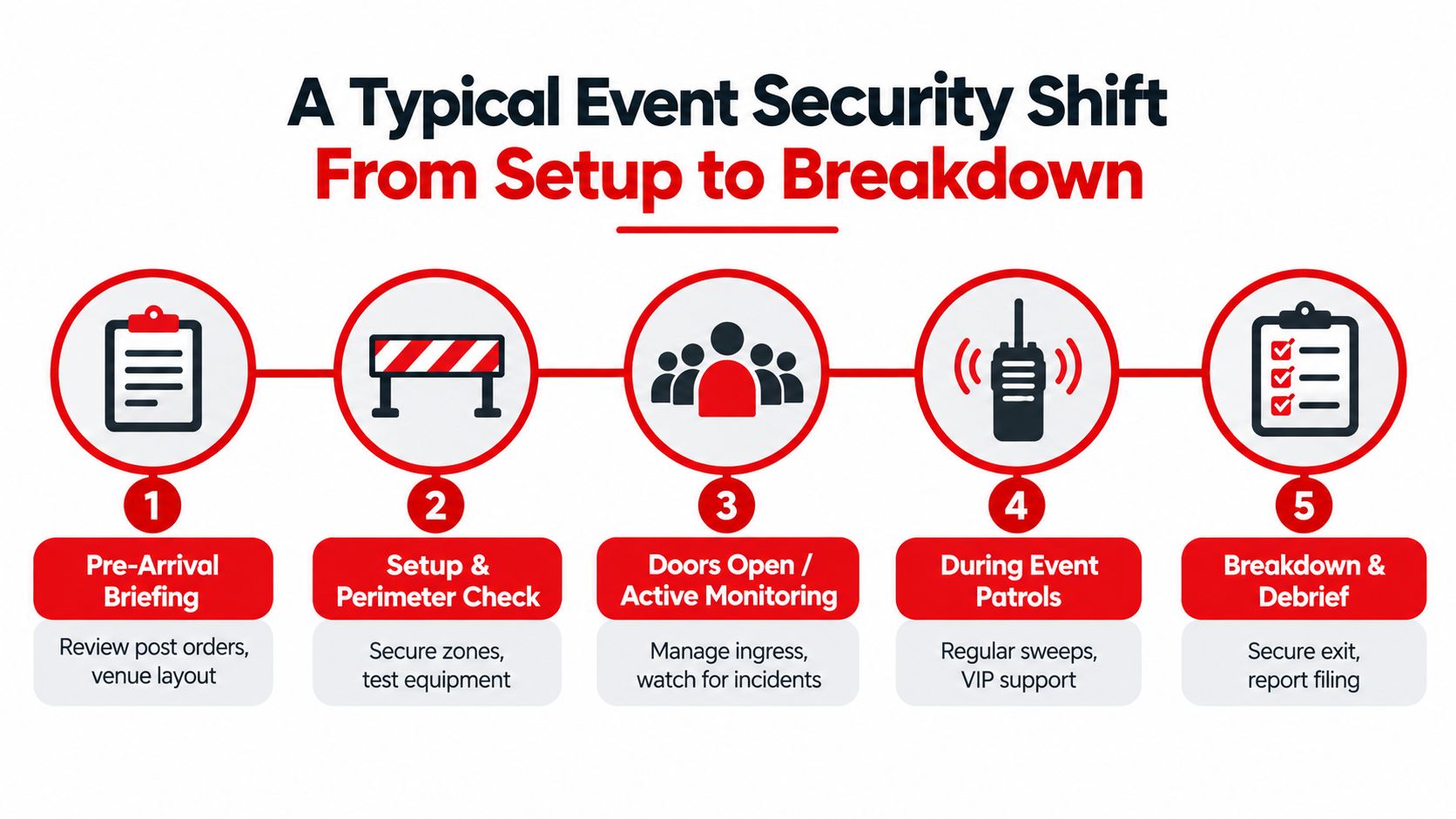
A pre-event briefing turns these broad duties into post numbers, locations, radio channels, patrol routes, emergency exits, and reporting requirements. Good officers follow those post orders while adapting to conditions. They aren't improvising from nothing, and they aren't locked into a plan that no longer matches the crowd.
Training, Licensing, and Qualifications That Matter
California licensing is the starting point, not the finish line. A compliant officer needs the appropriate BSIS guard card and required training, including power-to-arrest instruction. The license establishes a legal and professional baseline, but it doesn't automatically show that an officer can manage a dense entrance line, communicate under loud conditions, or hand an emotionally charged incident to police without making it worse.
The legal authority of a private security officer also has limits. Officers protect private property, enforce the client's rules, observe and report, and act within applicable law and company policy. They aren't a substitute for police officers, and specialized equipment or assignments require appropriate authorization, training, and client approval.
Baseline versus enhanced preparation
| Topic | State Baseline | Enhanced Standard |
|---|---|---|
| Licensing | Valid California guard card and required BSIS training | License verification before assignment, with records kept current |
| Arrest authority | Power-to-arrest training and knowledge of legal limits | Scenario practice focused on lawful intervention, communication, and handoff |
| Guest interaction | Basic professional conduct | De-escalation, verbal-judo techniques, hospitality, and high-pressure customer service |
| Emergency support | Required training applicable to the assignment | First aid and CPR, evacuation drills, hostile-intruder response, and venue-specific exercises |
| Crowd safety | General security readiness | Crowd dynamics, bottleneck awareness, crush-prevention principles, and capacity procedures |
| Equipment | Assignment-appropriate uniform and equipment | Radio discipline, equipment checks, redundancy, and documented readiness |
| Specialized duties | Only when legally and operationally applicable | Taser, baton, or PEP certification where the post and authorization require it |
| Field development | Required renewal and refresher obligations | Classroom learning, scenario drills, ride-alongs, and supervisor mentoring |
A serious training pipeline also includes site-specific briefings. An officer who knows general security may still be unfamiliar with a venue's green room, fire panel, service elevator, medical station, emergency assembly areas, or radio dead zones. Those details belong in the assignment preparation, along with the event schedule and the client's escalation preferences.
Overton's approach to private security officer training can be evaluated against that broader standard. The useful test for any provider is whether training produces officers who can read a room, write a factual report, preserve details, and recognize when an incident exceeds private-security scope.
The strongest officers receive support after training, too. Supervisors reinforce expectations through coaching, field observation, and post-event review. That combination matters more than a certificate sitting in a personnel file.
A Typical Event Security Shift From Setup to Breakdown
An event security shift begins before guests arrive. The officer's first task isn't to look busy at the gate. It's to understand the operation well enough to make consistent decisions when the pace increases.
Before doors open
At the briefing, officers review post orders, venue maps, emergency exits, restricted areas, medical locations, call signs, and the chain of command. The lead confirms who controls the event decision, who contacts emergency services, who meets responders, and which issues require an immediate radio call.
The setup phase follows. Officers inspect the perimeter, confirm that entry lanes and screening stations are positioned as planned, test radios, check batteries, review vendor access, and coordinate with venue staff or law-enforcement liaisons. A missing barricade or dead radio battery is easier to correct before the first guest arrives.
During entry and peak activity
At gates open, officers verify tickets and credentials, reconcile guest-list issues, keep lines moving, and watch for pressure where separate queues meet. One officer may resolve a routine credential question. A supervisor should be called when a guest becomes confrontational, a restricted-area attempt continues, or the entrance design no longer matches the flow.
During the event, patrols cover public areas, VIP routes, restrooms, parking connections, stages, and back-of-house spaces. Officers look for crowd density, blocked exits, distress, disputes, unauthorized access, and changing weather conditions. The response may stay local, move to a field supervisor, or involve the 24/7 SOC and outside responders.
During breakdown
Controlled egress needs the same attention as arrival. Officers keep exits and pickup areas orderly, assist with lost-and-found handling, protect restricted spaces, finalize incident logs, return equipment, and join a client debrief. The lead compares what happened with the post orders and records changes for the next event.
Staffing must reflect the event's risk rather than attendance alone. Western Australia's event guidance, for example, calls for at least two crowd controllers for the first 100 patrons, followed by one additional controller for each extra 100 patrons or part thereof at higher-risk licensed events. Lower-risk events commonly use a reduced approach of one controller per 200 patrons, as set out in the Western Australia event guidelines. Local requirements and the venue's risk assessment still control the final plan.
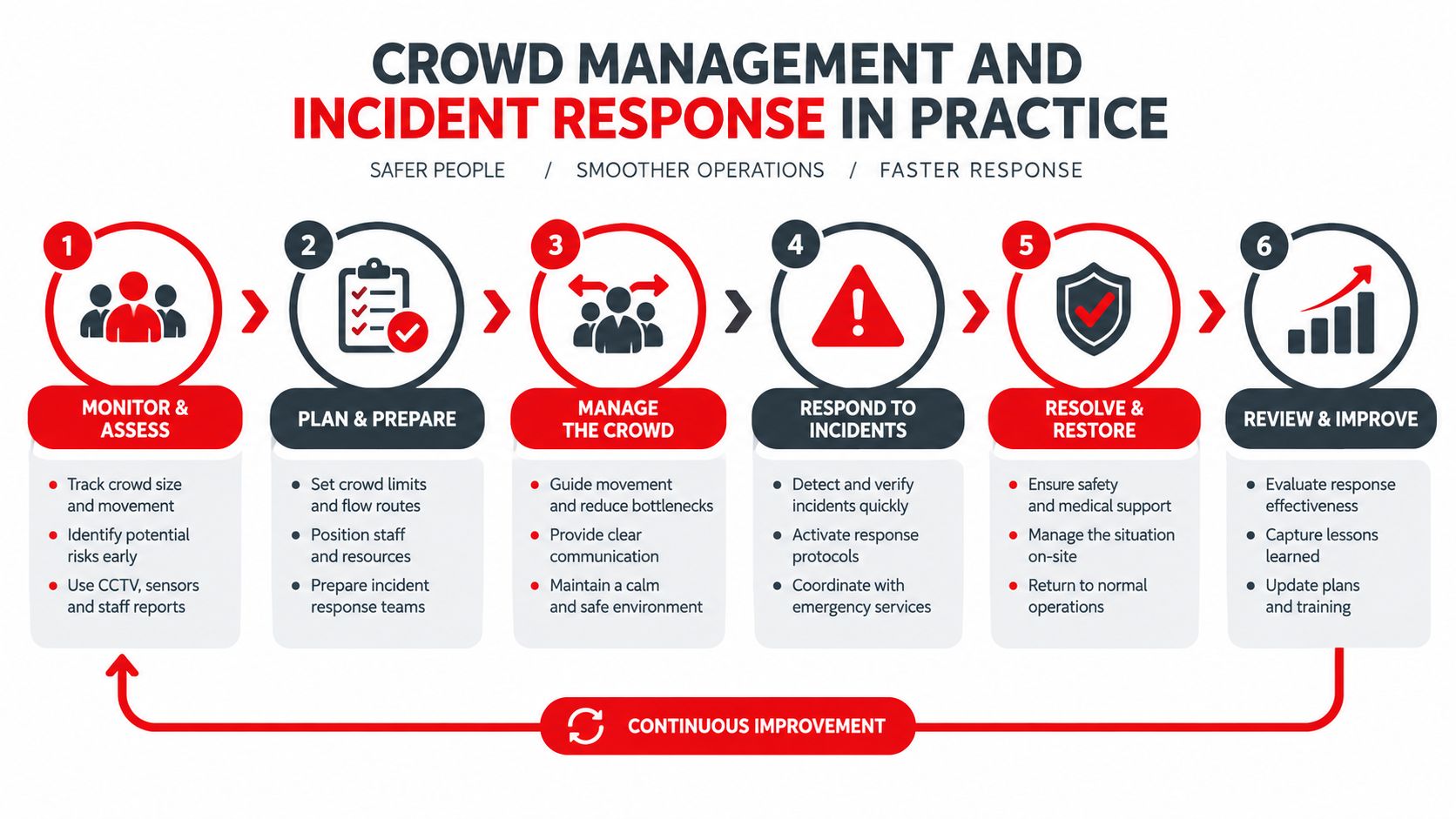
Crowd Management and Incident Response in Practice
Crowd management starts with layout. Before deployment, the security lead studies where people will enter, queue, gather, eat, drink, watch the program, and leave. Signage, barriers, lighting, stage placement, and exit access all influence whether the crowd moves smoothly or presses into a small area.
Officers then watch for early signals. A bottleneck may show up as people turning sideways to move through a gap. Agitation may appear as repeated arguing, aggressive gestures, or a group gathering around a dispute. An unauthorized access attempt may begin with someone testing a door, following an employee, or presenting a credential that doesn't match the area.
The escalation path
A practical decision chain looks like this:
- Observe and assess: Identify the location, immediate risk, people involved, and whether anyone needs urgent medical attention.
- Use calm communication: Give clear directions, create space, and avoid language that adds embarrassment or challenge.
- Notify the supervisor: Radio the facts, not speculation. State the post, problem, assistance needed, and whether the situation is changing.
- Engage the SOC or responders: The 24/7 Security Operations Center can support radio coordination, dispatch guidance, documentation, and escalation while the field team stays focused on the scene.
- Document and review: Record times, actions, witnesses, disposition, and any follow-up required.
For a medical event, the officer protects access for medical staff and manages nearby guests. For an ejected patron, the officer follows the approved removal process and requests support if the person refuses to leave. For a suspected prohibited item or credible threat, the officer avoids unnecessary handling, secures the area when safe, and escalates according to the plan and law-enforcement protocol.
Event organizers should also define conduct expectations in advance. A clearly communicated zero tolerance policy for live music events can help officers explain the rule consistently rather than debating it at the point of conflict. Planners can also use Overton's guidance on risks at events when building scenario-specific post orders.
The report should describe what the officer saw, what was said or done, who was notified, what action followed, and how the matter ended. Witness details, relevant camera footage, and an after-action review can help the planner update post orders instead of repeating the same weakness at the next event.
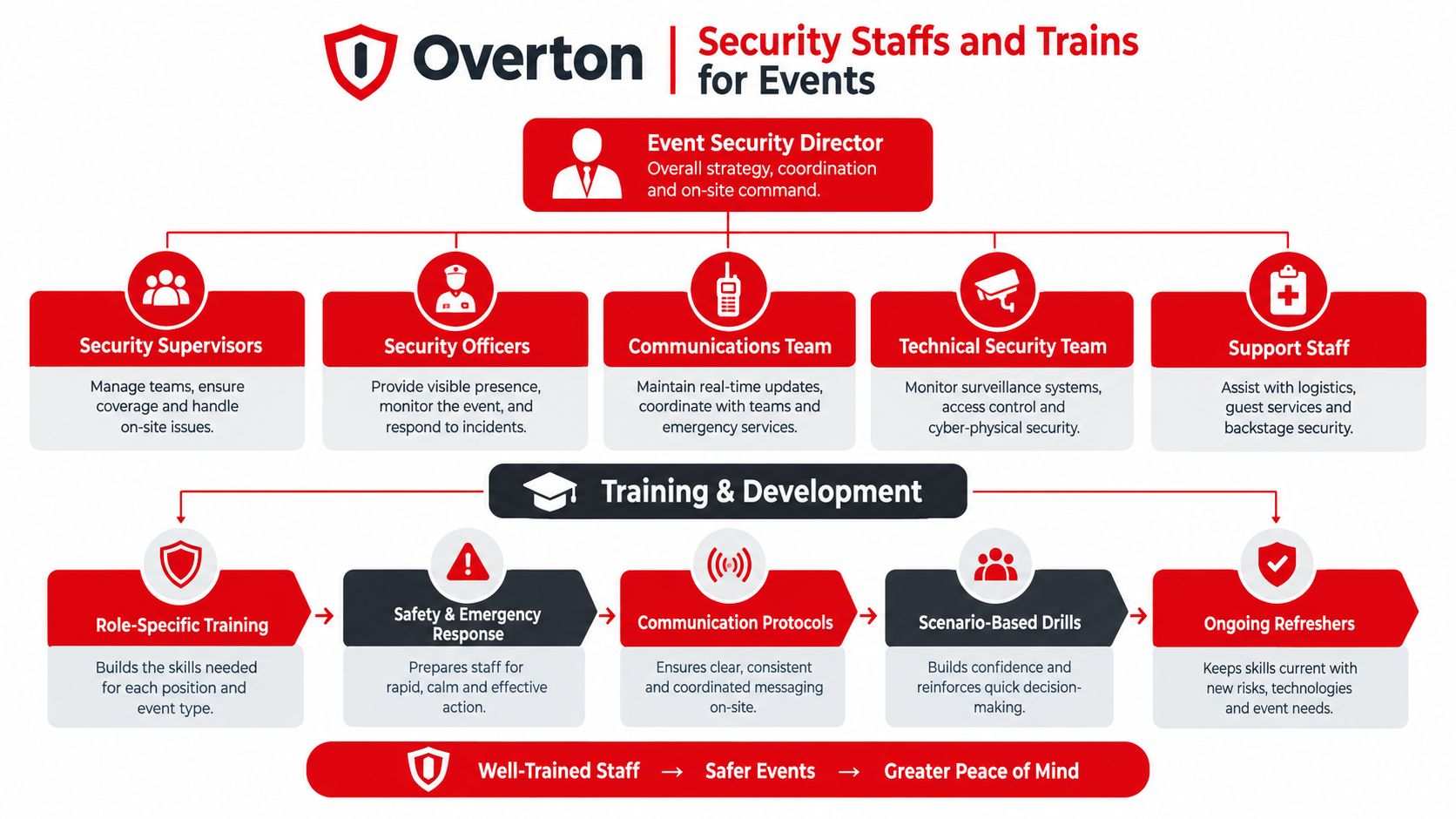
How Overton Security Staffs and Trains for Events
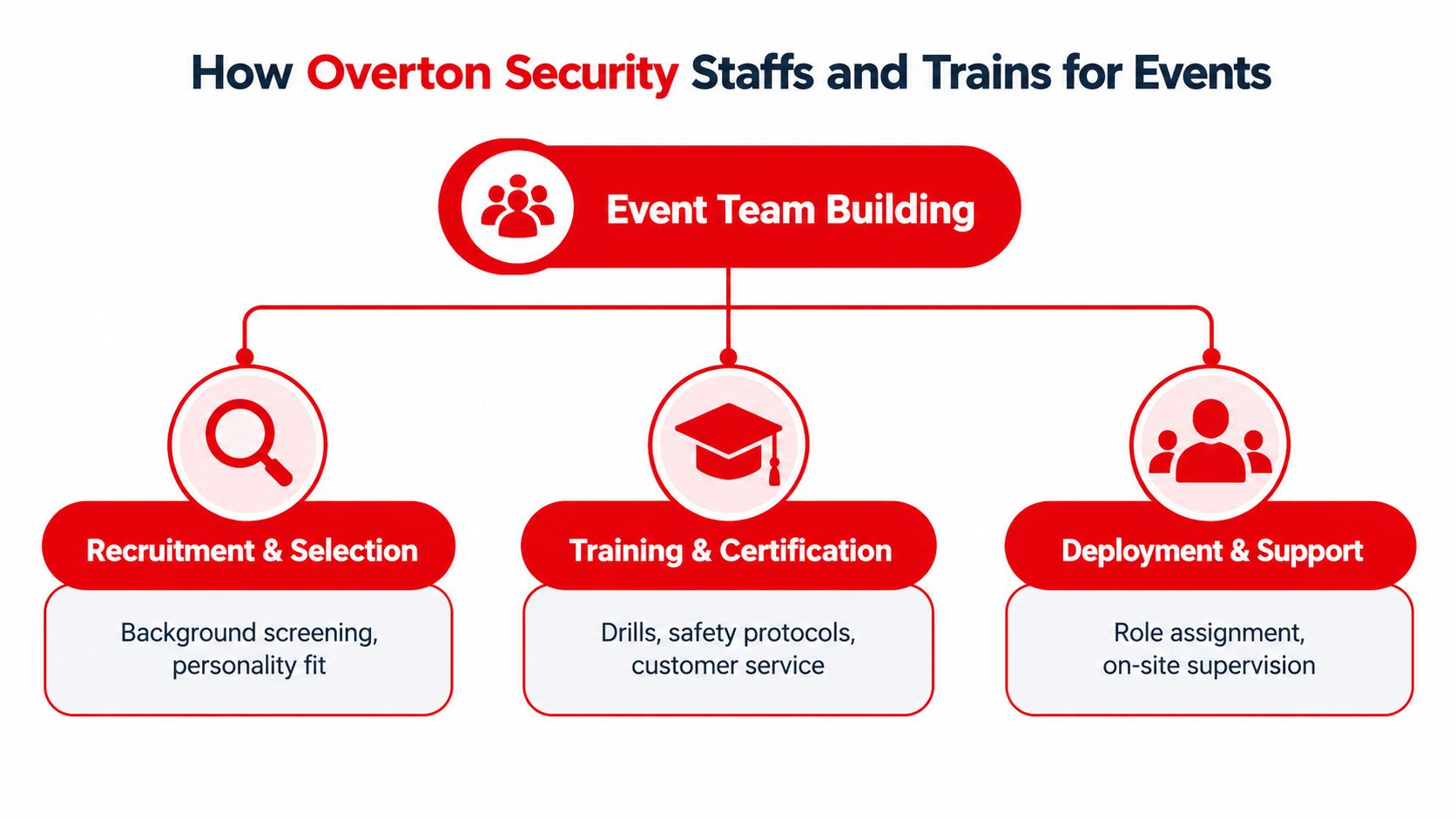
A dependable event team is built before the schedule is published. Recruitment should consider background screening, reliability, communication style, and fit for guest-facing work. An officer with hospitality or venue experience may bring useful judgment, but the provider still needs to verify licensing, training, and assignment readiness.
Overton Security has operated for more than 26 years, and its stated model emphasizes quality over quantity, officer support, hands-on leadership, and a low manager-to-client ratio. Those operating choices matter because event work depends on people who know the expectations and feel supported enough to stay attentive through long, changing shifts.
From selection to deployment
The preparation cycle typically includes:
- Selection and screening: Review qualifications, professionalism, communication, and suitability for the event environment.
- Training and certification: Confirm the California guard-card baseline, then add de-escalation, crowd awareness, VIP procedures, first aid, emergency response, and site-specific post orders where applicable.
- Site preparation: Walk the venue, identify entrances and exits, map restricted areas, assess crowd flow, and align the written plan with the client and venue team.
- Operational briefing: Assign posts, test communications, inspect uniforms and equipment, review escalation triggers, and confirm who has decision authority.
- Live support: Use supervisors and a 24/7 SOC for radio support, welfare checks, GPS-enabled patrol oversight, incident escalation, and documentation review.
Technology supports accountability, but it doesn't replace judgment. GPS-enabled guard tours, digital daily activity reports, time-stamped incident records, and uploaded photographs can show whether assigned checks occurred and give the client a clearer operational record. The officer still has to interpret the environment, communicate with guests, and choose the right escalation.
Retention is part of the security plan. A provider that supports and retains professional officers can build familiarity with procedures, supervisors, and client expectations. That is different from treating every event as a last-minute staffing request and leaving unfamiliar personnel to figure out the venue after arrival.
Choosing the Right Security Partner for Your Next Event
Before signing an event-security contract, ask the provider to show how the operation will work, not just how many officers will appear on an invoice. A capable partner should be comfortable explaining the plan, the people, the equipment, and the handoff to emergency services.
Use this checklist during vendor review:
- Verify licensing: Request confirmation that assigned officers hold current California guard cards and that required training records are maintained.
- Review insurance: Ask for proof of insurance and certificates of insurance that match the venue and event requirements.
- Demand written post orders: The plan should identify posts, duties, locations, schedules, restricted zones, emergency exits, and reporting expectations.
- Ask about supervision: Confirm who leads the shift, how supervisors are reached, and how the provider handles an absent or reassigned officer.
- Inspect training depth: Look for documented de-escalation, crowd management, first aid, evacuation, hostile-threat, and venue-specific preparation.
- Test communications: Ask what radios, spare batteries, backup channels, and escalation procedures will be available.
- Clarify outside coordination: Establish how the security lead will coordinate with venue management, police, fire, EMS, parking, and medical teams.
- Request comparable references: Seek examples from events with similar access challenges, guest profiles, venue layouts, or crowd behavior.
- Read the incident process: Reports should be factual, time-specific, and delivered through a clear client-review process.
- Watch for red flags: Be cautious when a provider can't explain who makes decisions, offers a generic staffing number without a risk assessment, or treats training and post orders as paperwork after the contract is signed.
The U.S. workforce context also deserves careful interpretation. Broader security-guard employment rose from 1,057,100 in 2021 to 1,283,470 in 2025, an increase of 226,370 jobs, or roughly 21.4%, according to the event security officer labor overview. That source also notes that the data cover the broader security-guard occupation rather than event-only roles, so planners should use it as labor-market context, not as a precise event staffing forecast.
The right partner treats your event as a planned operation. Overton Security provides temporary event coverage, advance planning, threat assessment, crowd management, crisis-response support, uniformed officers, and 24/7 SOC oversight for clients across California, including Los Angeles, San Francisco, San Diego, Sacramento, San Jose, Oakland, Long Beach, and Fresno.
Overton Security can help you build a written event security plan, assign trained officers to access, crowd, VIP, patrol, and response posts, and support the operation through its 24/7 SOC. Visit Overton Security to discuss your venue, guest profile, schedule, and escalation needs before your next event.