
The gate works perfectly at 8 a.m., then stops halfway open as residents queue behind it. A delivery driver waits in the wrong lane, a resident searches for a phone-based credential with a dead battery, and the guardhouse starts taking calls from frustrated homeowners. Minutes later, an emergency vehicle approaches from the opposite direction and the community discovers that its backup access procedure exists only in an old binder.
That scenario isn't unusual because gated community gates are more than decorative entrances. They control vehicles, shape daily traffic, protect pedestrians, support emergency response, and create potential safety and liability problems when equipment or procedures fail. HOA boards and property managers need to evaluate them as operating systems, not isolated pieces of hardware.
Why Gated Community Gates Matter More Than You Think
Gated living has become a mainstream part of the housing market. By 2021, an estimated 29% of Americans, approximately 74.2 million people, lived in common interest communities, many of which include gated communities or condominiums, according to the global literature review on gated communities. The same review records more than 200 new towns and cities emerging worldwide between 2000 and 2020, with especially strong growth in Africa and the Gulf region.
That scale changes the management question. A gate failure affects a real operating environment with residents, guests, contractors, package deliveries, waste services, and first responders moving through shared access points. A system that looks secure during a quiet inspection may become a bottleneck during school drop-off, an event, a power interruption, or a medical emergency.
Security layer and liability point
Gates help establish a controlled boundary, but they don't guarantee that every person inside is authorized or that every authorized person can enter smoothly. Poorly configured credentials, shared keypad codes, tailgating, obstructed sensors, and unclear visitor procedures can all weaken the result.
The history of these developments also shows why gated entrances deserve careful planning. Residential gated neighborhoods appeared in the United States in New Jersey, New York, and Brooklyn during the late nineteenth century. Los Angeles saw gated developments in Rolling Hills in 1935 and Bradbury in 1938, followed by larger communities such as Leisure World, which opened in 1964 and housed 19,500 residents, and Canyon Lake, developed in 1968. The historical review of gated communities also traces fortified community roots to approximately 300 B.C.
Practical rule: Treat the entrance as a life-safety system, a traffic-control point, and a resident service point at the same time.
Why the decision lasts
In Southern California, gated development represented an average of 12% of the new homes market, reaching 21% in Orange County, 31% in the San Fernando Valley, and 50% in the Palm Springs desert resort area, according to the global review linked above. Communities in Los Angeles, San Diego, San Jose, and other California markets therefore face a mature operational issue, not a niche design preference.
The right gate reduces friction without weakening control. The wrong one creates recurring repair bills, resident complaints, emergency-access concerns, and avoidable exposure for the people responsible for the property.
Choosing the Right Gate Type for Your Community
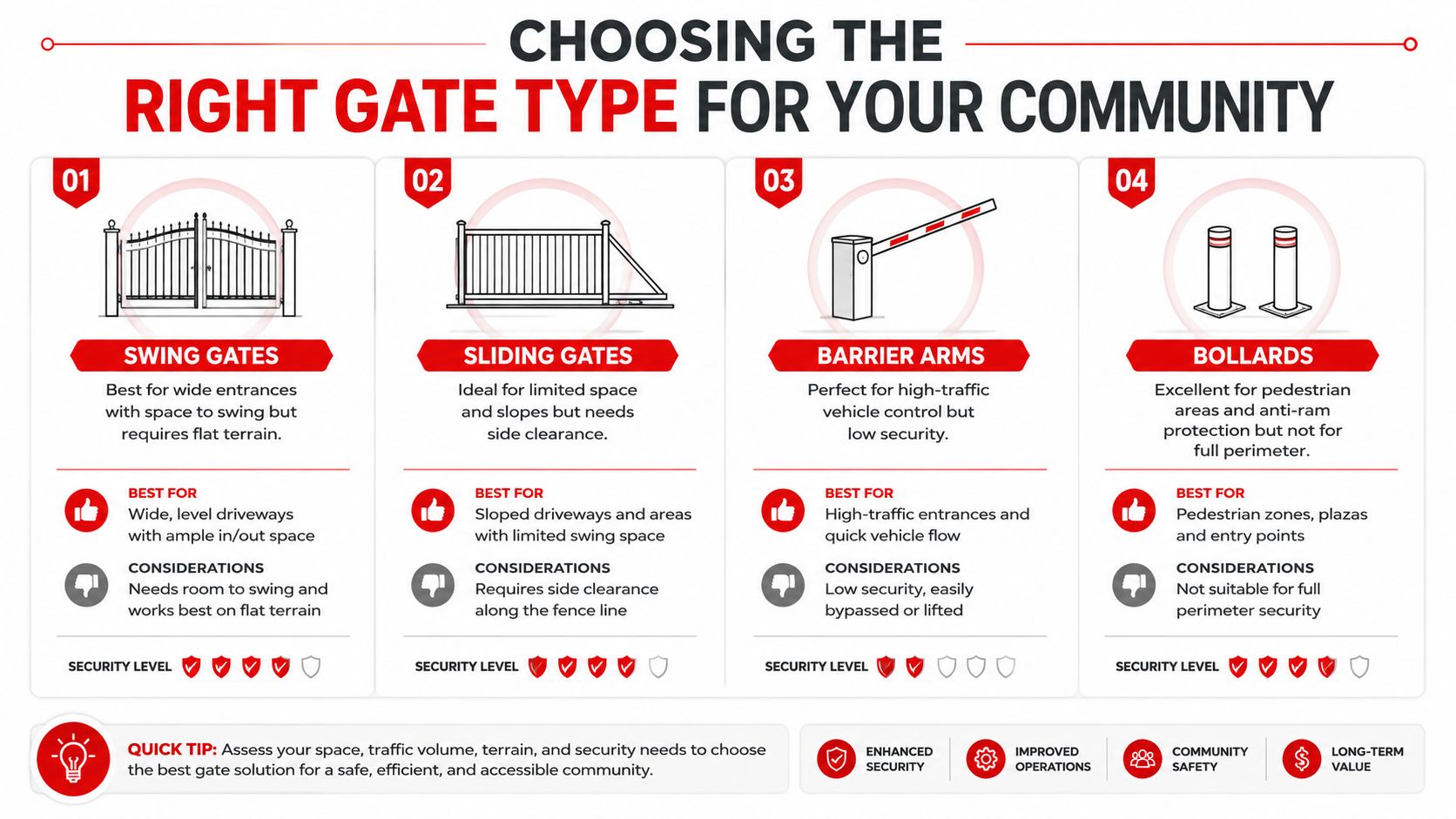
The best gate type depends on the entrance geometry, vehicle flow, available clearance, terrain, pedestrian movement, and maintenance capacity. A visually impressive gate can still perform poorly if its moving path conflicts with traffic or if the operator can't handle the community's daily use.
Swing gates
Swing gates suit entrances with room for the leaves to open and close without crossing a public walkway or interfering with queuing vehicles. They can provide a substantial visual boundary and work well where traffic is moderate and the entrance has a broad, relatively level approach.
Their weakness is movement clearance. The gate needs a safe arc, properly placed controls, and enough separation from walls, curbs, landscaping, and pedestrian paths. Snow, debris, standing water, and uneven surfaces can also affect hinges, operators, and closing performance. A swing gate may look simple, but its geometry deserves the same attention as its access reader.
Sliding gates
Sliding gates are useful where the entrance lacks room for a swing arc or where the approach includes a slope that makes swing movement difficult. They can manage substantial vehicle traffic while keeping the moving gate within a defined side path.
The trade-off is side clearance and maintenance. The gate needs space to travel beside the opening, and its rollers, track, guides, limit controls, and safety devices require regular inspection. Dirt, damage, misalignment, or a blocked track can stop the gate even when the access-control software is functioning normally.
Barrier arms
Barrier arms are effective for fast vehicle control at parking entrances, controlled drive aisles, and locations where the community needs to regulate access without creating a full visual or physical perimeter. They can keep traffic moving when paired with properly configured credentials and clear lane markings.
They offer limited resistance to determined vehicle intrusion. A barrier arm controls passage, but it isn't equivalent to a solid perimeter gate. Boards should use it where traffic management is the primary objective, not where anti-ram protection or a strong physical boundary is required.
Bollards
Bollards work best around pedestrian zones, building approaches, plazas, and locations where vehicle intrusion creates a specific concern. Retractable models can preserve vehicle access during approved periods while protecting walkways at other times.
They aren't a replacement for a full perimeter entrance. Drainage, impact resistance, visibility, maintenance access, and emergency override procedures all matter. For a broader access strategy, review vehicle access control for residential properties alongside the gate hardware rather than selecting bollards in isolation.
A useful proposal comparison should ask:
- Space: What moving path and side clearance does the entrance provide?
- Traffic: Where will vehicles queue, turn, and wait for verification?
- Terrain: Will slope, drainage, or debris affect movement?
- People: Can pedestrians reach the property without crossing a vehicle hazard?
- Maintenance: Can technicians inspect and repair the system without closing the only entrance?
Access Control Technologies and the Friction Trade-Off
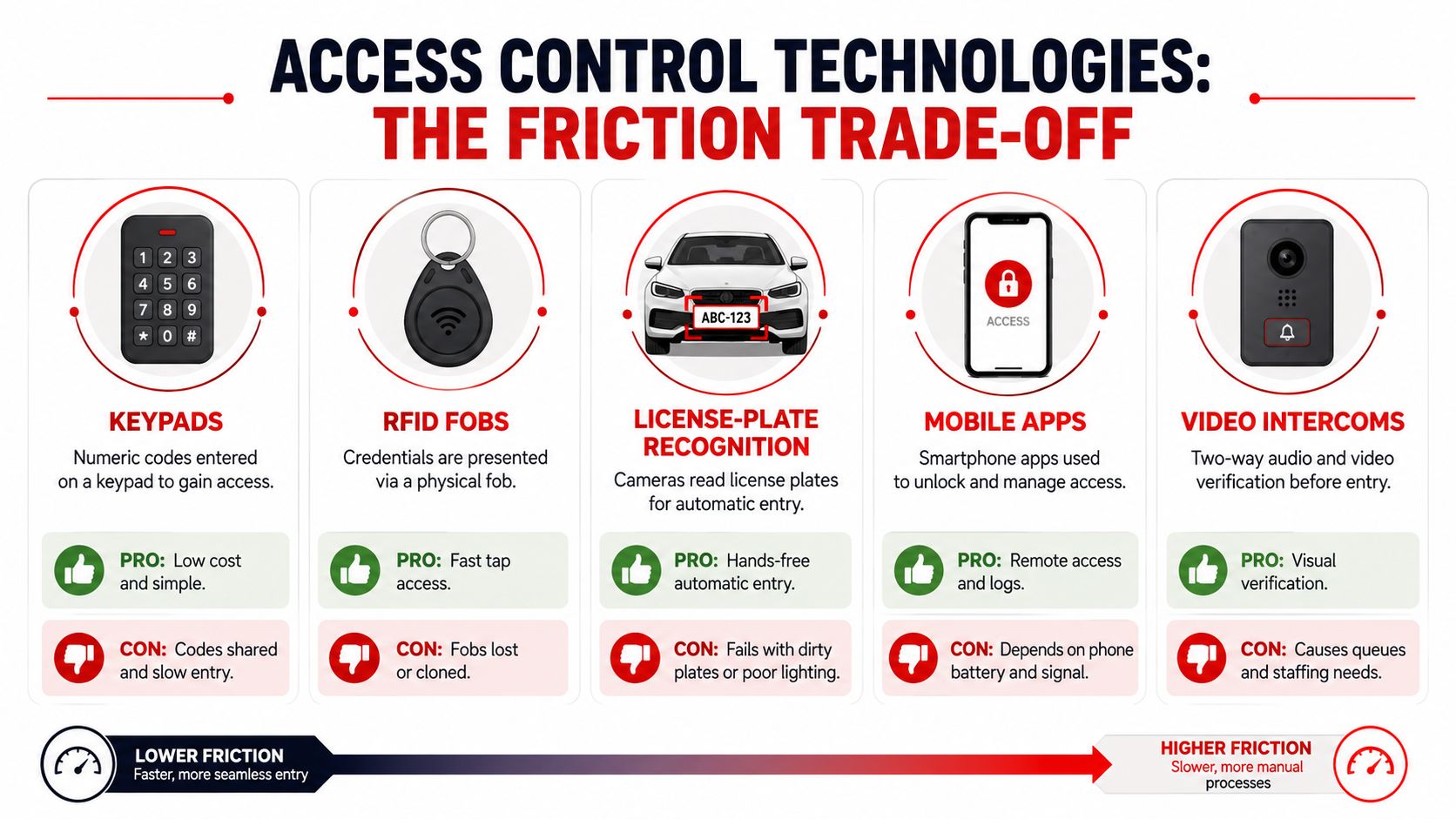
A gate can improve control while making the community harder to use. The right access method isn't the one with the longest feature list. It's the method residents, guests, service providers, and guards can use correctly during ordinary conditions and stressful exceptions.
Match the credential to the user
Keypads are familiar and comparatively simple. They can work at a small entrance with a clear code-management policy, but shared codes weaken accountability and repeated entry can slow a busy lane.
RFID fobs provide quick tap access for residents and approved staff. Managers still need a reliable process for lost, transferred, or duplicated credentials. A fob system works poorly when the community issues credentials but doesn't maintain the resident database behind them.
License-plate recognition can create hands-free entry for known vehicles and approved service providers. Dirty plates, glare, unusual vehicle angles, poor lighting, and temporary vehicles can produce false rejections. A resident shouldn't be trapped outside because the system recognizes the vehicle only under ideal conditions.
Mobile apps support remote access, digital credentials, and activity logs. They also depend on a charged phone, a working application, an adequate signal, and a resident who understands the workflow. Older residents, visitors without smartphones, and people whose devices fail need a practical alternative. Communities considering biometric options should also review biometric access control for residential environments with privacy, accessibility, and fallback procedures in mind.
Video intercoms let guards or residents verify a visitor visually and communicate before opening the gate. They can strengthen judgment at uncertain entries, but they may create queues when every guest requires a conversation or when staffing doesn't match arrival patterns.
Evaluate friction as an operating cost
The hidden cost of access control appears in delivery delays, contractor confusion, resident calls, vehicle queues, and guard intervention. Behavioral research on gated communities describes inconvenience and detours when people lack keys or access methods, while current industry discussion highlights mobile credentials, temporary passes, and cloud-based intercoms for communities with heavy visitor traffic. The research on gated community behavior supports a practical conclusion: security technology should be judged by usability as well as restriction.
Before approving a platform, test the exceptions:
- A resident arrives with a loaner vehicle.
- A contractor needs recurring access.
- A delivery driver reaches the wrong lane.
- A visitor has no app or cellular signal.
- A resident loses a credential during a busy period.
- The guardhouse must verify an unplanned guest without stopping every vehicle.
A system that handles those cases consistently will usually outperform a more advanced platform that leaves guards improvising.
Understanding UL 325 Safety Requirements for Gate Operators
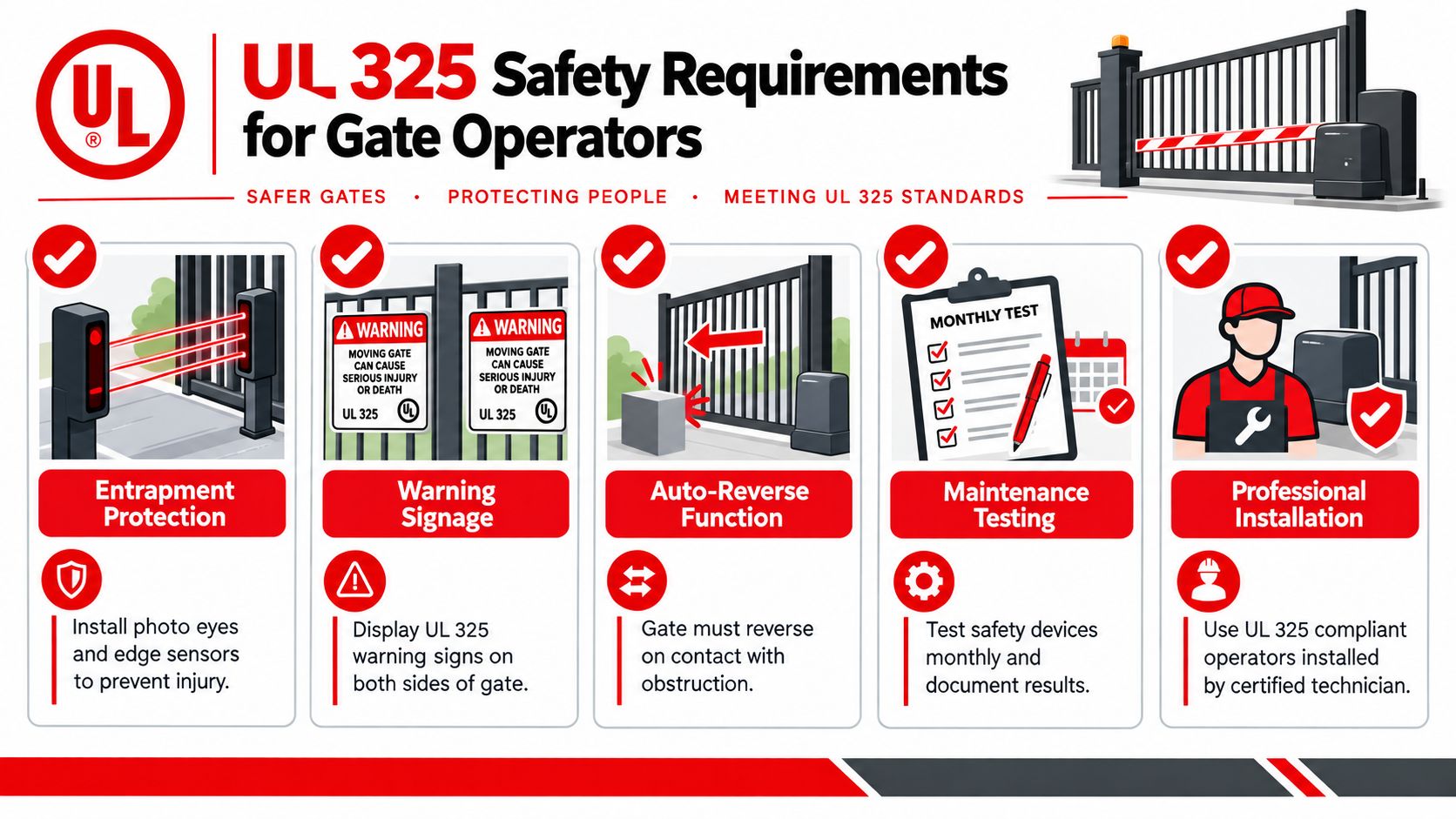
UL 325 treats an automated gate operator as a potential entrapment hazard, not merely a motor that moves a barrier. Since 2000, the standard has required two independent means of entrapment protection for each direction of gate travel, as described in the UL 325 gate operator FAQ.
In plain terms, the operator needs redundant protection wherever a person could be caught or pinned. One layer may be inherent protection in the operator. External layers commonly include monitored photoelectric beams and monitored edge sensors.
What the sensors must do
If the gate creates an entrapment zone during opening or closing, the system must detect an obstruction and reverse or stop within about 2 seconds, according to the same UL 325 guidance. For slide gates, the cited guidance notes that two external sensors are required in each direction of travel, and the operator must monitor those sensors to verify that they function before cycling the gate.
Contact protection usually involves an edge that detects physical pressure. Non-contact protection uses a photoelectric beam or similar device to detect a person or object before contact occurs. The correct arrangement depends on the gate's travel direction, design, adjacent structures, and identified entrapment zones.
A typical device table in industry guidance lists 2 protection devices for opening and 2 for closing on horizontal slide and horizontal swing gates, while vertical lift gates generally require 1 for opening and 2 for closing. Those counts come from the UL 325 safety summary for automated gate operators, and installers must still evaluate the actual configuration rather than apply a table mechanically.
Why an operating gate can still be unsafe
A gate may open and close during a manager's inspection while its safety system remains deficient. Sensors can be misaligned, disconnected, obstructed, incorrectly wired, or installed where they don't cover the actual hazard. A controller that doesn't monitor the devices may continue normal movement after a protection failure.
The UL 325 guidance on installation and control placement states that reset controls must be in the line of sight of the gate and at least 7 feet away so the user can't operate the control while in contact range. It also addresses clearance between the moving gate and adjacent structures and says swing gates shall not open into public access areas.
Property managers should request:
- A map of every entrapment zone.
- The device type and location protecting each zone.
- Evidence that external devices are monitored.
- A test showing the operator's response when a sensor fails.
- Documentation for warning signs, clearances, controls, and reset procedures.
Monitoring became required for sensors on automated gate operators manufactured after January 11, 2016, with the 7th Edition effective August 1, 2018, according to the cited industry summary. Older equipment may remain mechanically functional while falling behind current expectations.
Emergency Access and Fire Code Compliance
A secure entrance can't become an emergency barrier. Municipal rules in multiple jurisdictions require features such as fire-department lockboxes, keypads, remote electronic activation, manual release, radio access, and fail-open behavior during power loss.
One cited municipal benchmark requires a minimum 12-foot clear width for fire and emergency vehicle ingress and egress and mandates fail-open devices on electrically operated vehicular gates. The Midwest City municipal fire-access code illustrates how access width and power-failure behavior can become explicit approval requirements.
Design for the responder's entrance
A community should identify how fire and police personnel will enter each controlled approach, including secondary entrances and private roads. A keypad may work for authorized residents but won't necessarily serve a fire department operating under time pressure. A lockbox, radio receiver, remote activation method, or manual release may be required by the local authority having jurisdiction.
Another cited municipal rule makes it unlawful to obstruct ingress and egress to a public street with a gate and requires emergency access routes and fire-department permitting for blocking devices across public vehicular areas. It also requires electrically operated gates across emergency access routes to provide radio-transceiver access for public safety personnel and authorized users, as explained in the Mount Holly emergency-access code.
Test the procedure, not just the hardware
A backup feature is useful only if responders can use it and staff know its condition. Maintenance contracts should identify who tests the release, who records the result, and what happens when the device fails. Boards should also confirm how the gate behaves during utility loss, controller failure, communications failure, and a damaged vehicle loop.
For communities in California and elsewhere, life-safety compliance support can help facilities teams connect gate operations with broader emergency planning. The important point is operational: fire access belongs in the site plan, inspection record, and maintenance schedule, not only in the original construction documents.
What Happens When Gate Technology Fails
Marketing materials describe mobile credentials, video intercoms, remote management, and license-plate recognition under normal conditions. Managers need a different conversation: what happens when the power is out, the network is unavailable, the sensor fails, or the controller won't respond?
A network outage can affect cloud programming, remote release, visitor approvals, and activity logs. A cellular connection may help where wired internet or stable Wi-Fi isn't available, but it still needs a tested local fallback. Dual-connectivity designs can reduce dependence on one communications path, yet redundancy doesn't replace a written response plan.
Build the failure workflow before installation
Ask vendors to demonstrate the system in failure conditions, not only during a successful product demo. The demonstration should cover:
- Power loss: Does the gate fail open, fail secure, or require manual release, and does that behavior match local code?
- Network loss: Can residents and guards still use approved local credentials?
- Hardware failure: Can staff isolate the failed lane without disabling emergency access?
- Peak traffic: Who directs vehicles when automatic processing stops?
- Emergency entry: How can first responders enter if the primary reader and network are unavailable?
- Recordkeeping: How will staff document entries until normal logs return?
The reliability gap matters because residents may feel secure without the gate consistently delivering controlled, available access. A system that rejects legitimate users during an outage can produce tailgating pressure, guardhouse conflict, and unsafe vehicle positioning. A system that remains open without supervision can undermine perimeter control.
The fallback plan isn't a technical appendix. It determines whether the community can operate safely when the technology is least dependable.
Management should keep current contact information for the installer, a spare-equipment plan where appropriate, clear manual procedures, and a communication method for residents and emergency partners. Test those procedures under realistic conditions and record what staff do, not what the vendor says they should do.
Procurement and Vendor Selection Checklist
A gate proposal should be evaluated as a lifecycle service, not a hardware quote. The lowest initial price can become expensive when the operator uses incompatible components, sensors aren't monitored, emergency features remain undocumented, or replacement parts are difficult to obtain.
Ask for evidence before approval
Use these questions during vendor interviews and proposal review:
- Safety documentation: Does the proposal identify the operator, entrapment zones, sensor arrangement, monitoring method, warning signs, and installation requirements under UL 325?
- Emergency access: Has the vendor coordinated the design with the local fire authority, and does the proposal show lockbox, radio, remote, manual, and power-loss functions where required?
- Maintenance scope: Does the agreement cover inspection of tracks, hinges, loops, readers, sensors, communications equipment, backup releases, and structural hardware?
- Response process: Who receives an outage call, who can arrive or provide remote support, and how will the community receive status updates?
- Visitor workflow: How will residents approve guests, contractors receive recurring access, and guards manage exceptions?
- Data ownership: Can the HOA retrieve access records, change administrators, revoke credentials, and preserve incident information if it changes vendors?
- Training: Will guards, managers, and maintenance personnel receive role-specific instruction and written fallback procedures?
Compare total operating responsibility
Require a clear division of responsibility between the gate installer, access-control provider, internet or cellular provider, electrician, property manager, and security team. Ambiguous ownership creates delays when the gate is down because every party assumes another party will respond.
The board should also inspect the proposed service-level language. It should define preventive maintenance, sensor testing, emergency-access verification, reporting, parts availability, and escalation. A vendor who can't explain how the system behaves during failure hasn't finished the design.
Integrating Gates with Your Broader Security Program
Gated community gates work best as one layer in a larger security plan. A gate can control a credential, but a trained officer can identify a vehicle anomaly, direct traffic during an outage, assist a resident, preserve an incident record, and contact emergency services when the situation falls outside the equipment's capabilities.
A layered program can combine onsite unarmed guards, vehicle patrols, remote camera oversight, visitor procedures, lighting, and documented response protocols. GPS-enabled patrol vehicles can check gate lanes, guardhouses, perimeter paths, and signs of tampering. A 24/7 SOC can support escalation, wellness checks, dispatching, and real-time oversight, while digital reports with time stamps and photographs give managers visibility into what happened.
Lighting deserves practical attention too. Poor illumination can undermine LPR, video verification, pedestrian safety, and officer observations. For electrical planning around gatehouses, lanes, and perimeter approaches, a property team may find this resource on a commercial exterior lighting electrician useful when coordinating security and facilities work.
Overton Security Services applies this layered model through onsite security officers, vehicle patrols, remote monitoring, GPS-enabled guard tour management, digital daily activity reports, and 24/7 SOC oversight. Its operating approach emphasizes quality over quantity, a low manager-to-client ratio, hands-on leadership, and officer retention, so technology supports people rather than replacing operational judgment.
If your community is dealing with unreliable gated community gates, resident access complaints, emergency-entry concerns, or an upcoming security upgrade, contact Overton Security to review the property's gate operations, patrol needs, monitoring options, and response procedures. Their team can help HOA boards and property managers build a practical security program that combines professional officers with documented, accountable technology.