
The call usually comes after the problem has already become expensive. A tenant reports an unsecured door, a resident mentions someone wandering through a parking area, or a construction superintendent discovers missing tools after the weekend. You check the camera system, review the patrol log, and find that the information you need is either incomplete, delayed, or spread across several vendors.
That gap is the core security problem. Physical security solutions only protect a property when the environment, technology, officers, monitoring center, and response procedures work as one operating system. A locked door helps, but it can't identify an attempted entry, verify who was nearby, or ensure someone responds when the alarm activates.
When a Locked Door Is Not Enough
A retail plaza manager notices the back door of a restaurant propped open after closing. The latch still works, the access reader shows no obvious fault, and the camera points toward the doorway. But the video is grainy, the lighting is poor, and nobody can say whether an employee left the door open, a delivery worker used it, or someone entered after hours.
The manager calls the tenant, checks with the patrol officer, and starts reviewing footage. Nothing appears missing that night. Several days later, inventory reveals a discrepancy, but the team can't establish when it happened or whether the open door was connected. The property has hardware, cameras, and a security process on paper. It doesn't have a dependable chain from detection to verification to response.
That distinction matters in every property type. A residential manager may have an access-controlled lobby but no reliable visitor record. A construction superintendent may have perimeter fencing but no way to confirm that the overnight patrol checked the material storage area. A medical facility may record activity near a restricted room without a clear escalation procedure for staff.
The most useful security design reduces uncertainty at each step:
- Discourage: Lighting, visible officers, controlled entrances, and well-maintained surroundings make unauthorized activity more difficult and conspicuous.
- Detect: Cameras, sensors, access events, and patrol observations create signals when something falls outside normal operations.
- Verify: A trained operator or officer determines whether the signal is a real incident, a maintenance issue, or a false alarm.
- Respond: The right person takes the right action, documents it, and escalates it when necessary.
Research from the Office of Justice Programs' systematic review of CCTV found that camera effectiveness varies by setting. The review identified the strongest and most consistent crime-reduction effects in car parks, while results were more modest in residential areas and limited in some other settings. It also found better outcomes when systems included active monitoring and multiple protective components.
That supports a practical principle: a camera isn't a security program. Your site needs a defined operating response around every important alarm, access event, and patrol obligation. Principles from crime prevention through environmental design can strengthen that foundation by making legitimate movement easier to observe and unauthorized behavior harder to hide.
What Physical Security Solutions Actually Cover
Physical security solutions cover more than cameras and guards. They combine the property's physical layout, electronic controls, detection tools, human presence, and management procedures into a coordinated system.
Start at the outside edge and work inward.
The property envelope
The first layer includes fencing, gates, doors, bollards, lighting, landscaping, loading areas, and vehicle routes. These features establish where people should enter, where vehicles should travel, and which areas need extra delay or visibility. A well-positioned barrier can prevent a vehicle from reaching a storefront, while a poorly maintained gate can create a permanent opening in the perimeter.
Access and credentialing
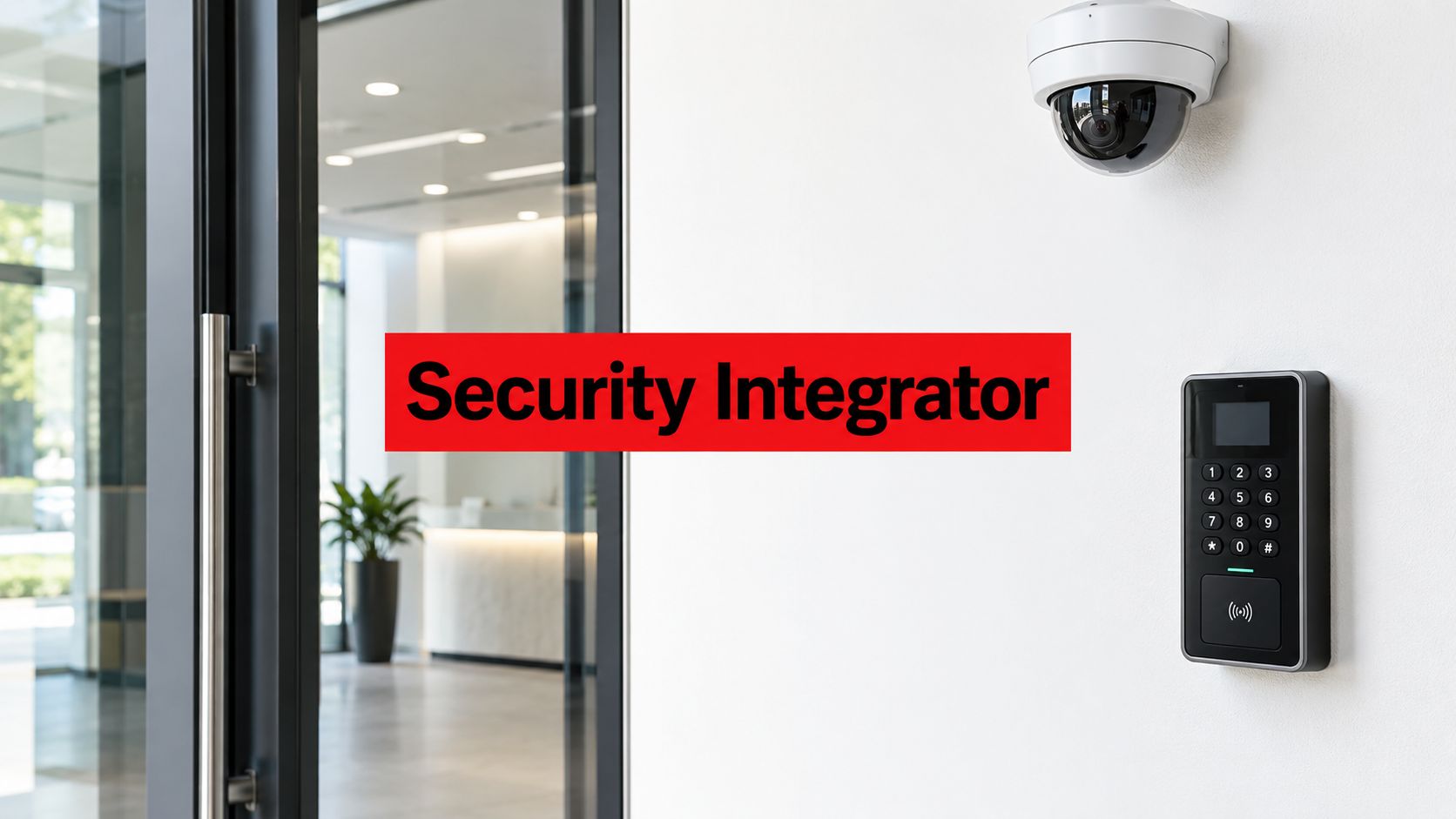
Access control determines who can enter, when they can enter, and which areas they can use. Keycards, fobs, biometric readers, visitor management, intercoms, and mechanical locks all have a role. The important question isn't whether a reader is installed. It's whether credentials are issued, changed, revoked, and reviewed when staffing or tenancy changes.
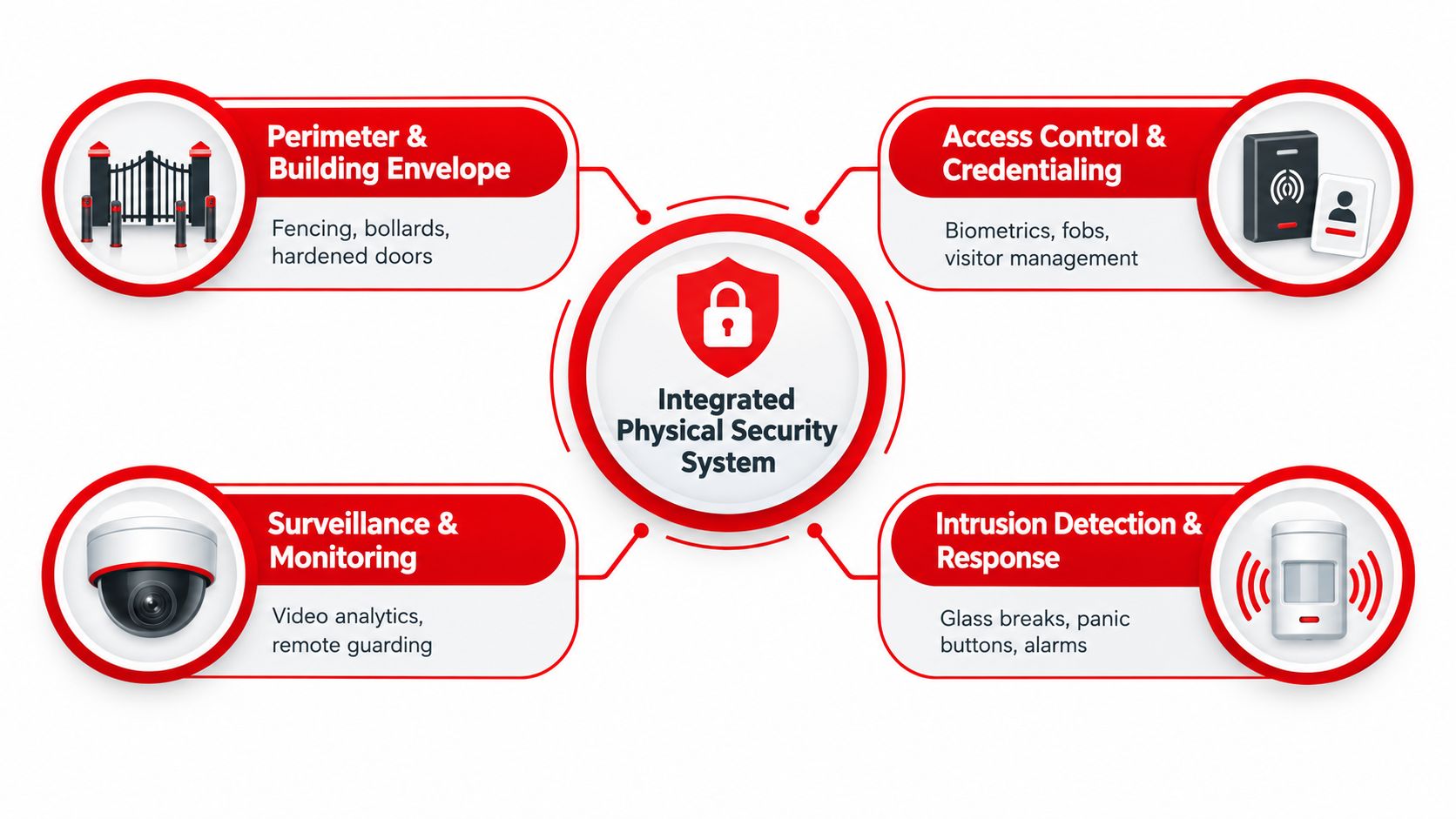
Surveillance and monitoring
CCTV and video surveillance help teams see what happened and, when actively monitored, support intervention while an event is developing. Camera placement should follow actual exposure, such as parking aisles, rear doors, cash-handling points, loading docks, medication storage approaches, and construction material yards. Analytics can help identify movement, loitering, or activity in defined zones, but an alert still needs a person and a procedure behind it.
Detection and response
Intrusion sensors, door contacts, glass-break detectors, panic buttons, fire-watch patrols, alarm monitoring, and officer response complete the system. These tools create useful signals only when someone receives them, evaluates them, and acts within an agreed escalation path.
For properties with regulatory or privacy requirements, a resource on physical security for regulated industries can help frame the relationship between site controls, sensitive areas, documentation, and compliance obligations. Managers evaluating the electronic layer can also review electronic security systems as part of a broader operational plan.
The strongest design uses deterrence, detection, delay, and response together. No single layer should carry the entire burden.
The Main Layers Every Property Should Understand
Property managers often receive proposals that make every component sound equally important. They aren't. Each layer solves a different problem, carries a different maintenance burden, and fails in a different way.
| Solution Category | Primary Function | Key Strengths | Common Limitations | Best Fit |
|---|---|---|---|---|
| Perimeter protection | Defines and restricts the property boundary | Creates clear limits and supports deterrence | Gates, fencing, and landscaping can deteriorate or be bypassed | Construction sites, industrial properties, residential communities |
| Barriers and bollards | Controls vehicle movement and protects vulnerable edges | Adds physical delay and protects storefronts or entrances | Can obstruct deliveries, emergency access, or pedestrian flow | Retail centers, loading areas, pedestrian plazas |
| Locks and door hardware | Secures individual openings | Simple, durable, and familiar to staff | Keys get copied, doors get propped, and hardware doesn't provide event context | Small offices, tenant suites, utility rooms |
| Access control systems | Manages authorized entry | Creates credentials and an audit trail | Bad enrollment, shared credentials, and weak offboarding reduce value | Offices, healthcare, multifamily, data-sensitive areas |
| CCTV and video surveillance | Records and observes activity | Supports deterrence, verification, and investigations | Poor placement, bad lighting, limited retention, or no monitoring create blind confidence | Parking, retail, campuses, common areas |
| Intrusion detection sensors | Signals unauthorized entry or movement | Provides fast notification at protected openings | Sensors can create nuisance alarms if poorly configured | Vacant suites, construction sites, restricted rooms |
| Security lighting | Improves visibility and signals observation | Helps officers, cameras, tenants, and visitors see conditions | Glare, shadows, outages, and neighbor impact require planning | Parking areas, rear corridors, walkways |
| Security personnel | Provides judgment, presence, and response | Handles exceptions, customer contact, patrols, and incident decisions | Quality depends on training, supervision, post orders, and retention | Complex, active, high-liability, or changing properties |
Perimeter and barriers work best when the threat is physical approach, vehicle intrusion, trespass, or material theft. They won't tell you who opened a gate, and they can create operational friction if delivery and emergency routes aren't designed into the plan.
Locks and access control are strongest at the point of entry. Mechanical hardware is reliable when the user population is small and stable. Electronic access becomes more valuable when you need role-based permissions, temporary credentials, visitor records, or a clear history of door activity.
CCTV and lighting should be designed together. A camera that faces glare, darkness, or an unhelpful angle may record activity without producing usable evidence. The systematic CCTV review cited earlier also supports combining surveillance with active monitoring and other protective measures rather than relying on passive recording alone.
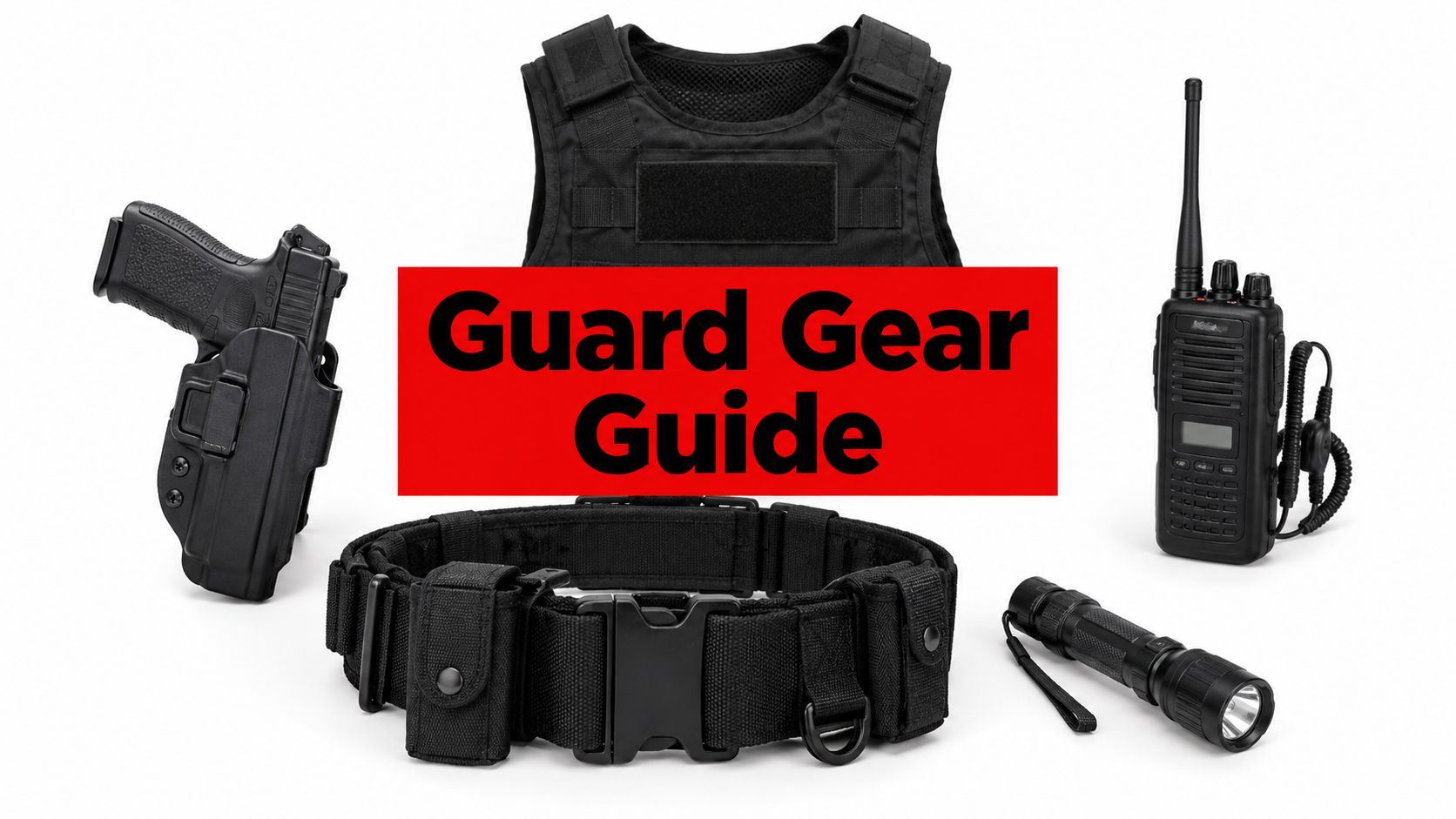
Officers and patrols provide the judgment technology can't. They notice a damaged fence, speak with a confused visitor, de-escalate a conflict, check a changing construction area, and make decisions when an alarm doesn't fit the situation. Their weakness is inconsistency when supervisors don't inspect performance or when post orders don't match the site.
Practical rule: Buy the layer that closes your highest-consequence gap, not the product with the longest feature list.
Choosing Solutions Based on Real Risk
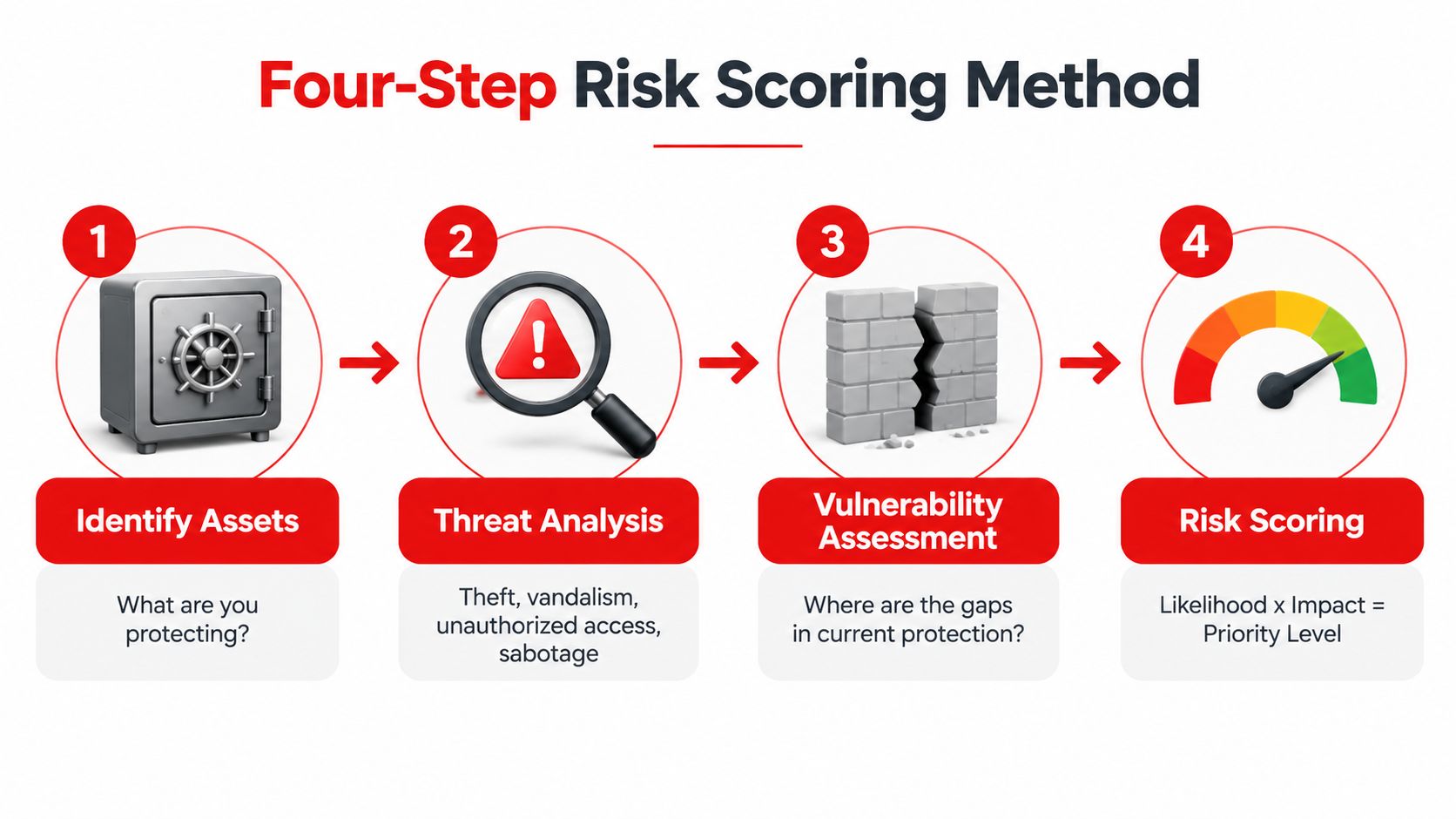
Buying equipment before assessing exposure is the most common budgeting mistake. A property may spend heavily on cameras while leaving a rear service corridor poorly lit, or add access readers without fixing credential offboarding. Start with a documented risk register, then match each control to a specific threat.
Identify what matters
List the assets and activities that require protection. Include people, tenant operations, vehicles, cash, controlled substances, equipment, personal information, building systems, and areas where a disruption could create liability.
Separate absolute targets from loss-tolerance zones. A pharmacy storage room, data closet, infant-care area, or emergency control room may require very tight protection. A parking lot may justify layered deterrence and response without the same access restrictions.
Identify credible threats
Focus on what can realistically occur at that property. Common categories include theft, vandalism, unauthorized access, workplace violence, trespassing, fire-system outages, and disputes involving tenants or visitors. Review incident history, complaints, police calls, tenant reports, and observations from staff and officers.
Assess vulnerabilities and consequences
Walk the site during the hours when risk is highest. Look at doors, gates, lighting, camera views, staffing, delivery routines, visitor flow, blind spots, and alarm coverage. Then calculate consequences in practical terms, including replacement cost, business interruption, tenant impact, regulatory exposure, injury potential, and reputational damage.
Score and prioritize
A useful priority model is:
Likelihood × impact = priority level
The score doesn't need to create false precision. It needs to force a clear comparison between competing projects when the budget is limited.
The same checklist won't fit a retail strip mall and a hospital. A retail center may prioritize visible presence, parking observation, and back-of-house controls. Healthcare adds privacy, patient safety, controlled access, staff protection, and de-escalation requirements.
Spend first where a control reduces a credible risk and improves the response process. A documented register will also show when a lower-cost operational change, such as revised patrol routes or better door discipline, deserves priority over new hardware.
Matching the Right Mix to Each Property Type
The right mix changes with the people, assets, schedule, and movement patterns on the site. A useful plan doesn't treat every property as a generic perimeter with cameras.
| Property Type | Top Priority Solutions | Key Trade-off | Compliance Note |
|---|---|---|---|
| Retail center | Visible officers, parking patrols, camera coverage at entrances and loading areas, back-of-house access control | More presence can improve response and customer confidence, but staffing must align with operating hours and tenant needs | Coordinate tenant procedures, delivery access, and incident documentation |
| Residential community | Controlled entry, visitor management, lighting, package-area observation, foot and vehicle patrols | Stronger access controls improve accountability but can frustrate residents and guests if poorly administered | Apply rules consistently and protect resident privacy |
| Construction site | Temporary fencing, mobile camera units, lighting, intrusion detection, vehicle patrols, live monitoring | Portable systems adapt to changing conditions, but require frequent relocation and power or connectivity planning | Align controls with changing work phases, contractor access, and site safety rules |
| Healthcare facility | Zoned access control, carefully placed cameras, trained officers, panic and intrusion detection, monitored response | More restrictions support safety and privacy but can slow legitimate movement | Protect patient privacy, sensitive clinical areas, infant-care spaces, and controlled substances |
Retail and mixed-use centers
Retail security needs to be visible without becoming disruptive. Officers can address loitering, customer disputes, parking concerns, and after-hours access while cameras support verification at entrances, rear doors, and loading zones. Back-of-house access deserves special attention because employee and vendor movement often creates more complexity than the public entrance.
Residential communities
Residents want security that feels consistent, not intrusive. Use controlled visitor access, good lighting, patrols that cover garages and package areas, and clear rules for deliveries and contractors. Concierge officers can add a service function in high-rise or Class A settings, but the post must still include concrete observation and escalation duties.
Construction sites
Construction conditions change rapidly. Fixed systems may be useful at a main gate, but mobile camera towers, temporary barriers, weather-resistant sensors, and vehicle patrols can move as the site develops. Tie after-hours alerts to live monitoring so a remote operator can verify activity before dispatching an officer or contacting the site lead.
Healthcare facilities
Healthcare requires more than stronger doors. Camera placement must respect privacy, access zones should reflect patient and staff needs, and officers must know how to manage behavioral health events without escalating unnecessarily. Restricted rooms, infant-care areas, medication storage, and staff-only corridors need clear permissions and documented response procedures.
How Technology and Officers Work as One System
Integration means more than placing several security products under one contract. It means each event produces useful context for the person responsible for the response.
A door contact can signal an opening. The nearby camera can show whether an employee, a delivery worker, or an unknown person crossed the threshold. The access record can show which credential was used, while the patrol platform can identify whether an officer is already near the location. A monitoring operator can then verify the event, contact the officer, and create one timestamped incident record.
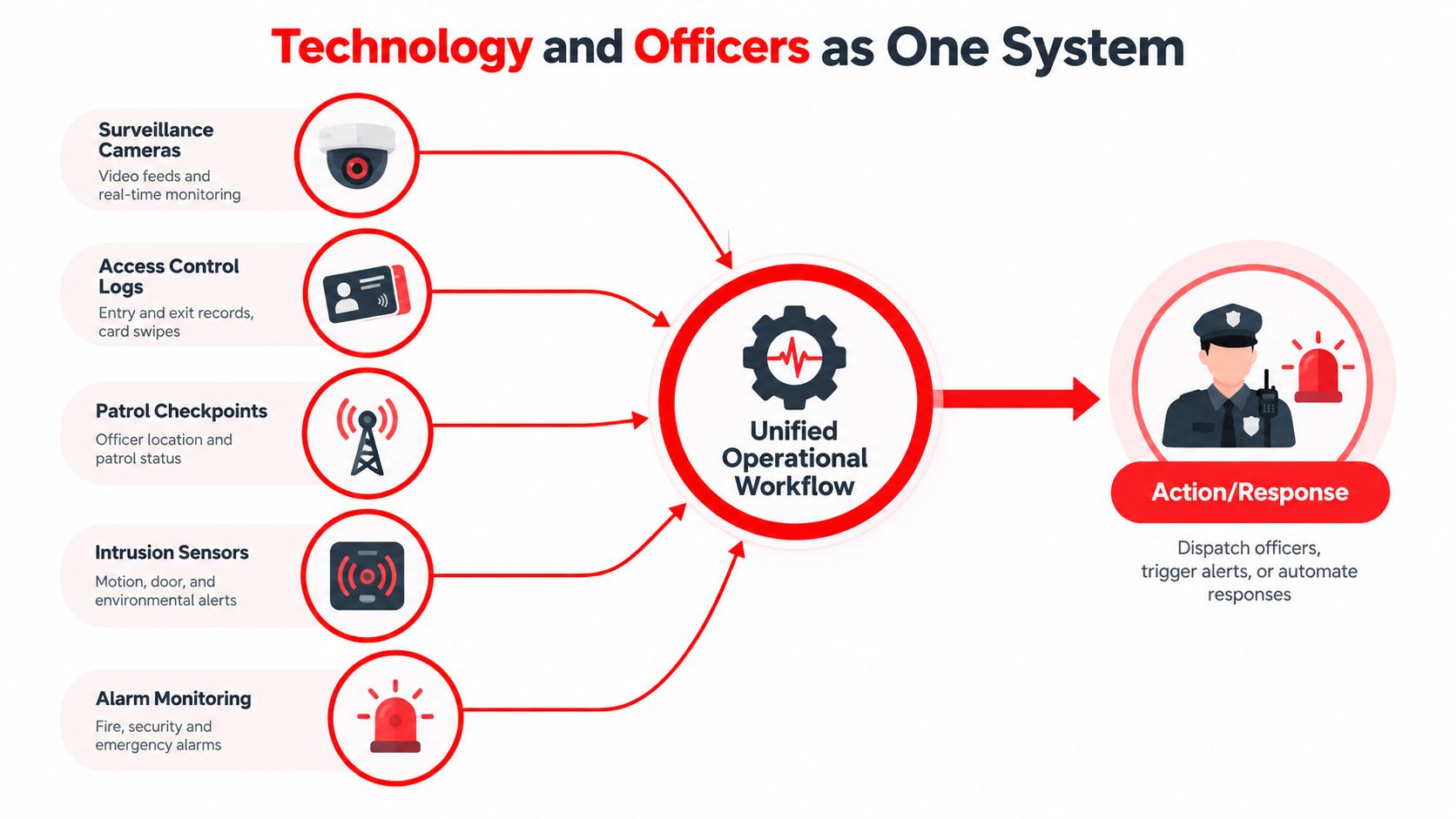
The operating sequence matters
Good integration follows a defined sequence:
- A device creates a signal. This may be an intrusion sensor, camera analytic, panic button, access event, or alarm.
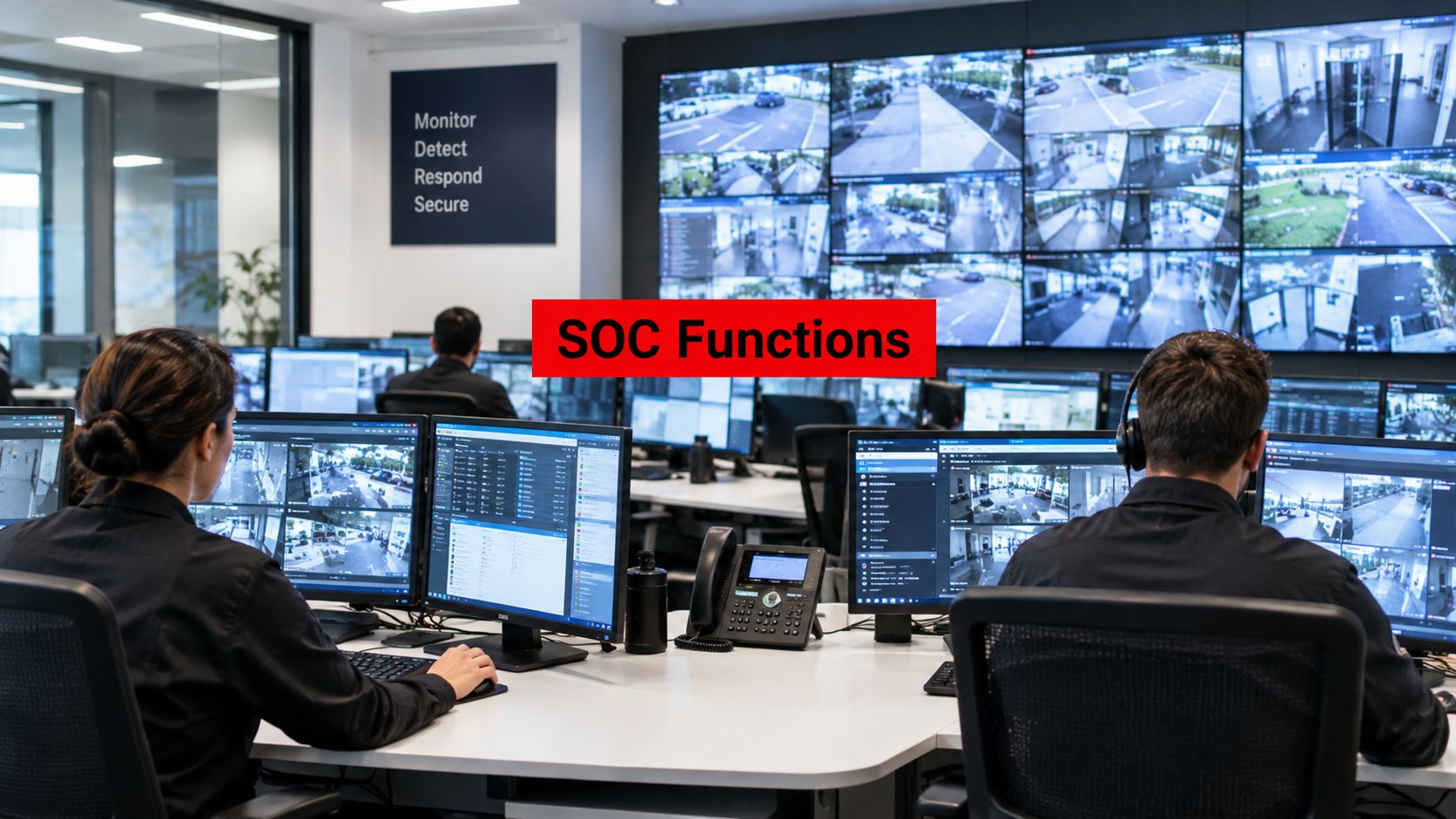
- A monitoring operator verifies context. The operator checks video, related access activity, site conditions, and the current patrol assignment.
- The responsible officer receives direction. A GPS-enabled patrol system can help identify the nearest available officer and record the assignment.
- The manager receives a clear record. The report should connect the event, response, observations, photos, and escalation decisions.
Self-monitored alarms often fail because property staff receive too many low-context notifications. Professional monitoring adds trained operators who can filter signals, follow procedures, and dispatch the appropriate response.
Guard-tour technology creates proof of presence rather than relying on a handwritten claim. With NFC checkpoints, a guard taps each tag, and the system can capture the timestamp, GPS location, guard identity, and incident data before sending the information to a dashboard or client portal, as described by NFC guard-tour verification software. Real-time platforms can also flag missed checkpoints, show patrol activity, and connect photos or notes to a specific location, as outlined by guard-tour monitoring technology.
The common failures are predictable: cameras record but nobody watches, access logs exist but nobody reviews them, and patrols appear complete only because someone filled out a form. A properly designed integrated security system closes those gaps by connecting evidence to action.
What to Look for in a Security Partner
Equipment lists are easy to copy. Execution is where security programs separate themselves.
Before signing, ask the provider to walk the property during relevant operating conditions and explain what each recommended control is meant to prevent, detect, or improve. You should receive a site-specific plan, not a recycled proposal filled with broad promises about complete coverage.
Evaluate the operating team
Look for:
- Qualified officers: Confirm licensing, insurance, documented training, and post-specific preparation.
- Active supervision: Ask how often supervisors visit, what they inspect, and how performance issues are corrected.
- Useful reporting: Reports should arrive on an agreed schedule and include observations, incidents, response actions, and exceptions.
- Customized post orders: Instructions should reflect your doors, tenants, delivery routes, restricted spaces, emergency contacts, and escalation rules.
- A clear escalation path: You should know who receives an urgent call, who manages the account, and who can authorize a change in coverage.
- Officer stability: Retention matters because familiar officers understand the property, recognize unusual conditions, and build better working relationships with tenants and staff.
A partner should be willing to phase the deployment. Start with the highest-priority exposure, establish reporting and response standards, then add technology or staffing where the first phase identifies remaining gaps. That approach protects the budget and gives you evidence that the program is working operationally.
For California property managers, Overton Security Services offers onsite armed and unarmed officers, vehicle patrols, fire watch, construction security, remote monitoring, and GPS-enabled guard tours with NFC checkpoint scans and digital activity reports. Its operating model includes a low manager-to-client ratio, customized post orders, officer support and retention efforts, and 24/7 SOC oversight across locations including Los Angeles, San Francisco, San Diego, Sacramento, San Jose, Oakland, Long Beach, and Fresno.
A serious provider should be able to explain who responds, what gets documented, and how management learns about exceptions before you ask.
Ask for references from properties that resemble yours, not just the provider's largest accounts. Then request a written service scope covering patrol expectations, reporting, supervision, response, technology responsibilities, and review meetings. If the vendor can't describe those details clearly, the equipment won't rescue the relationship.
If your property needs a more dependable connection between physical controls, trained officers, patrol verification, and monitored response, start with a site conversation rather than a product list. Overton Security can help design customized onsite security, mobile patrol, fire watch, construction, retail, residential, and remote monitoring programs around your actual risks. Visit Overton Security to discuss your property and request a practical security assessment.