
Choosing quality security services isn't just about hiring a company to fill a uniform. It’s about finding a genuine partner committed to proactively protecting your property, tenants, and assets. This requires a thoughtful process for defining your needs, vetting providers on their operational substance, and ensuring they have the accountability systems—both human and technological—to deliver consistent, professional results.
Defining Your Security Needs Before Starting Your Search
Before you pick up the phone or send an RFP, it's essential to have a crystal-clear, honest picture of what you're protecting and what a successful outcome looks like for your property.
This first step is more than just deciding you need a guard; it's a practical risk assessment that becomes the foundation of your entire security program. Skipping this phase often leads to generic proposals that don't solve your specific problems, leaving you paying for a service that doesn't deliver real value.
Think about your property’s unique challenges. Is it an HOA board dealing with after-hours loitering near the community pool? A construction superintendent consistently losing high-value materials over the weekend? Or a facilities director who needs to tighten visitor access control without creating a bottleneck for tenants? Each scenario requires a completely different security approach.
Identifying Key Vulnerabilities
Walk your property with a critical eye at different times of the day and night, as the risks at 2 PM are often completely different from the ones at 2 AM. Document every specific area of concern. The goal is to move from a general feeling of insecurity to a concrete list of issues that a quality security provider can solve.
Look for these common pain points:
- Access Control: Are there unsecured entry points, broken gates, or back doors propped open where unauthorized individuals can enter?
- Asset Protection: What are your most valuable assets? For a construction site, it’s tools and copper wiring. For a retail center, it's merchandise and, most importantly, tenant safety.
- Liability Risks: Are there poorly lit walkways, potential trip hazards, or ongoing situations that could lead to resident complaints—or worse, a lawsuit?
- Nuisance Activity: Is loitering, unauthorized parking, or after-hours noise a recurring headache that’s impacting your tenants or residents?
From Vulnerabilities to Operational Requirements
Once you have a list of vulnerabilities, you can translate it into clear, actionable operational requirements. This is the exact information you'll use to request accurate proposals and compare providers apple-to-apples. This simple framework ensures you solicit bids designed to fix your real-world challenges, not just a boilerplate template from a sales representative.
This detailed planning is becoming the norm as the security solutions market grows more sophisticated. The industry is projected to grow from USD 370.15 billion in 2025 to USD 523.98 billion by 2030, with a major focus on integrating security technologies. Property managers want seamless control over video surveillance, access control, and on-site personnel, all working together.
When you start your search, it's also critical to know what kinds of security assessments are out there. For instance, you might benefit from understanding the key differences between penetration testing and vulnerability assessments. This helps you define the scope of your needs, whether they are purely physical or have a digital component. A well-defined scope is the first step toward finding a true security partner.
How To Properly Vet Potential Security Partners
Once you've mapped out your security needs, the real work begins: finding a provider who can deliver. The market is full of companies that talk a good game, but providing truly quality security services is built on a deep operational foundation, not a slick sales pitch. Vetting potential partners is about digging for proof behind their promises.
You need to look for tangible signs of reliability, professionalism, and accountability. This means getting past the marketing fluff and asking for hard evidence that they have the right structure, people, and processes to protect your property as you expect.
Beyond the Basics: Licensing and Insurance
Before diving into operational details, cover the absolute non-negotiables. Any legitimate security provider should be able to instantly provide proof of current state licensing and adequate insurance. This isn't just a formality—it's the first test of their legitimacy and your protection from liability.
- State Licensing: Verify their license is active and in good standing with the state. This confirms they meet the minimum legal standards to operate.
- Insurance Coverage: Ask for their Certificate of Insurance (COI). Ensure they carry sufficient general liability, workers' compensation, and professional liability (errors and omissions) coverage. A company that cuts corners on insurance is a significant red flag.
These simple checks will quickly weed out less reputable operators, allowing you to focus your energy on vendors who have their house in order.
The True Indicators of Quality: Officer Training and Retention
Let's be direct: the single biggest factor in the quality of your security service is the officer on your property. A security company is only as good as its people. That’s why their approach to hiring, training, and—most importantly—retention is one of the best predictors of performance. While the industry is known for high turnover, top-tier firms combat this by investing heavily in their teams.
A security company's officer retention rate is a direct reflection of its company culture and operational stability. A low turnover rate often indicates better training, supportive management, and more experienced, reliable officers for your site.
Ask direct questions about their human resources practices. What does their initial training involve? Do officers receive site-specific training before their first shift? How does the company support its officers to encourage long-term careers? The companies that put their people first are the ones that deliver consistent, high-level service.
This infographic breaks down the foundational process of determining your needs, which you'll use to measure potential partners.
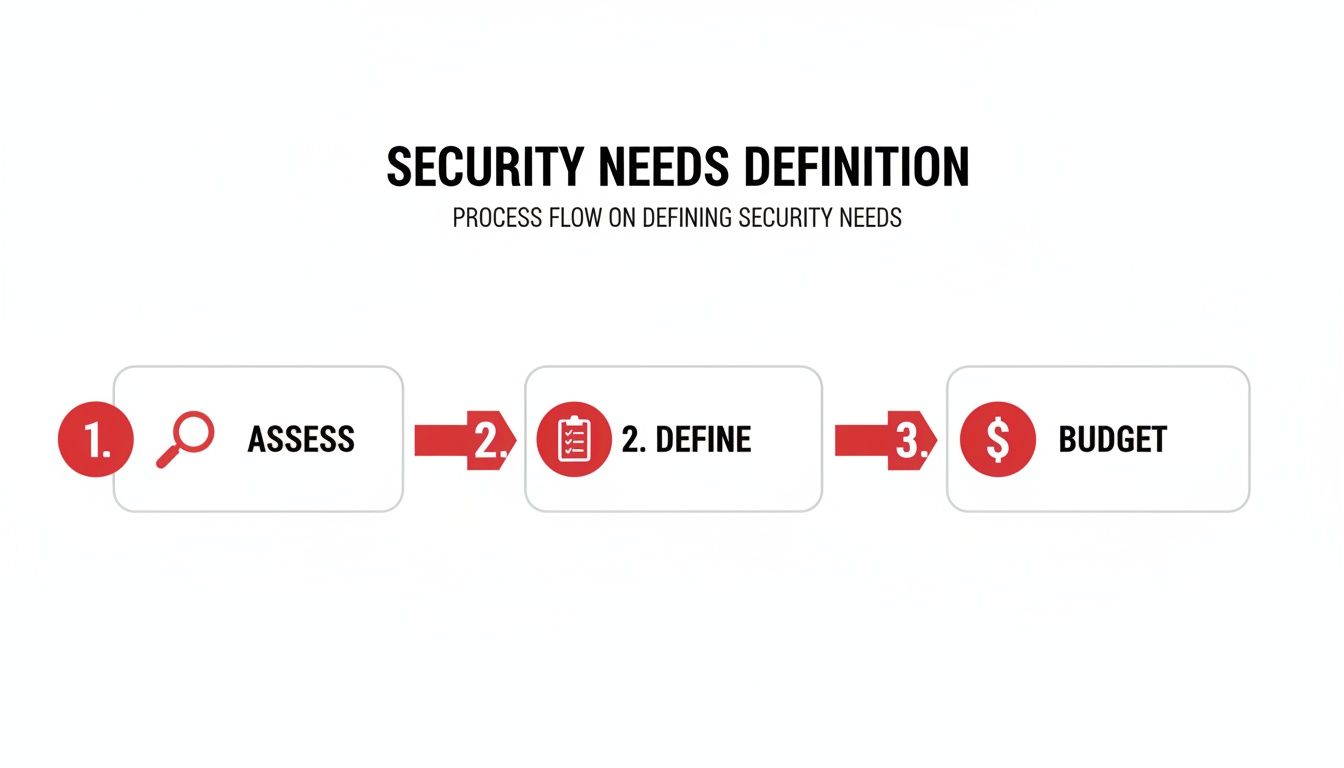
This process—Assess, Define, Budget—is critical. It gives you a clear set of benchmarks so you can enter the vetting stage knowing exactly what "good" looks like for your property.
Operational Structure and Support Systems
How a company supports its people in the field is just as important as the officers themselves. A lone guard with no backup or a manager who never answers their phone is being set up to fail. This is where you need to investigate their operational backbone.
One of the most revealing metrics is the manager-to-client ratio. At Overton Security, we keep this ratio intentionally low because we are committed to quality over quantity. This ensures our managers have the time for frequent site visits, proactive check-ins, and hands-on problem-solving. When a single manager is juggling 50 or 60 accounts, you simply won’t get that level of personal attention.
As you learn how to properly vet potential security partners, it's also crucial to understand the broader process of mastering contracting with suppliers to establish a strong foundation. For a deeper dive into specific questions to include in your RFP, check out our complete guide on what to look for when hiring a security agency. Asking the right questions upfront helps you differentiate a true security partner from a simple vendor.
Security Vendor Evaluation Checklist
To help you systematically compare potential partners, use this checklist. It’s designed to cut through sales pitches and get to the heart of what makes a security provider truly effective.
| Evaluation Criteria | What to Look For (High-Quality Vendor) | Red Flag (Low-Quality Vendor) |
|---|---|---|
| Licensing & Insurance | Provides current, valid licenses and a comprehensive COI without hesitation. | Hesitates, provides expired documents, or has minimal/no coverage. |
| Officer Training | Detailed, multi-phase training program including classroom, field, and site-specific modules. | Vague descriptions of "on-the-job" training; minimal ongoing education. |
| Officer Retention | Proudly shares a low turnover rate; discusses programs for employee engagement and career growth. | Avoids the question or admits to industry-average (high) turnover. |
| Management Support | Low manager-to-client ratio; managers are accessible and conduct regular site visits. | High ratio (e.g., 1 manager for 40+ sites); managers are hard to reach. |
| Technology Integration | Uses modern technology (guard tour systems, SOC) for transparency and efficiency. | Relies on outdated paper logs or has no verifiable tracking systems. |
| Client References | Eagerly provides a list of long-term clients in your industry who can attest to their quality. | Provides only new clients or is reluctant to share references at all. |
| Contract Terms | Clear, flexible terms with transparent pricing and well-defined KPIs. | Rigid, long-term contracts with hidden fees and vague service descriptions. |
Using a structured checklist like this ensures you're making an apples-to-apples comparison. It forces you to look at the operational realities of each company, which is where the real differences in quality are found.
The Role of Technology in Modern Security Operations
Not long ago, the quality of a security service was judged almost entirely by the physical presence of an officer. While a sharp, professional officer is still the heart of any great security program, today their expertise is powerfully amplified by smart, practical technology.
This isn't about chasing flashy gadgets. It’s about using proven tools to deliver something every property manager and business owner craves: transparency, accountability, and better results. A modern security partner’s tech stack elevates their service from a simple guard post to a dynamic, data-driven operation. It gives you verifiable proof of service, so you’re never left wondering if patrols were completed or what happened on an overnight shift.
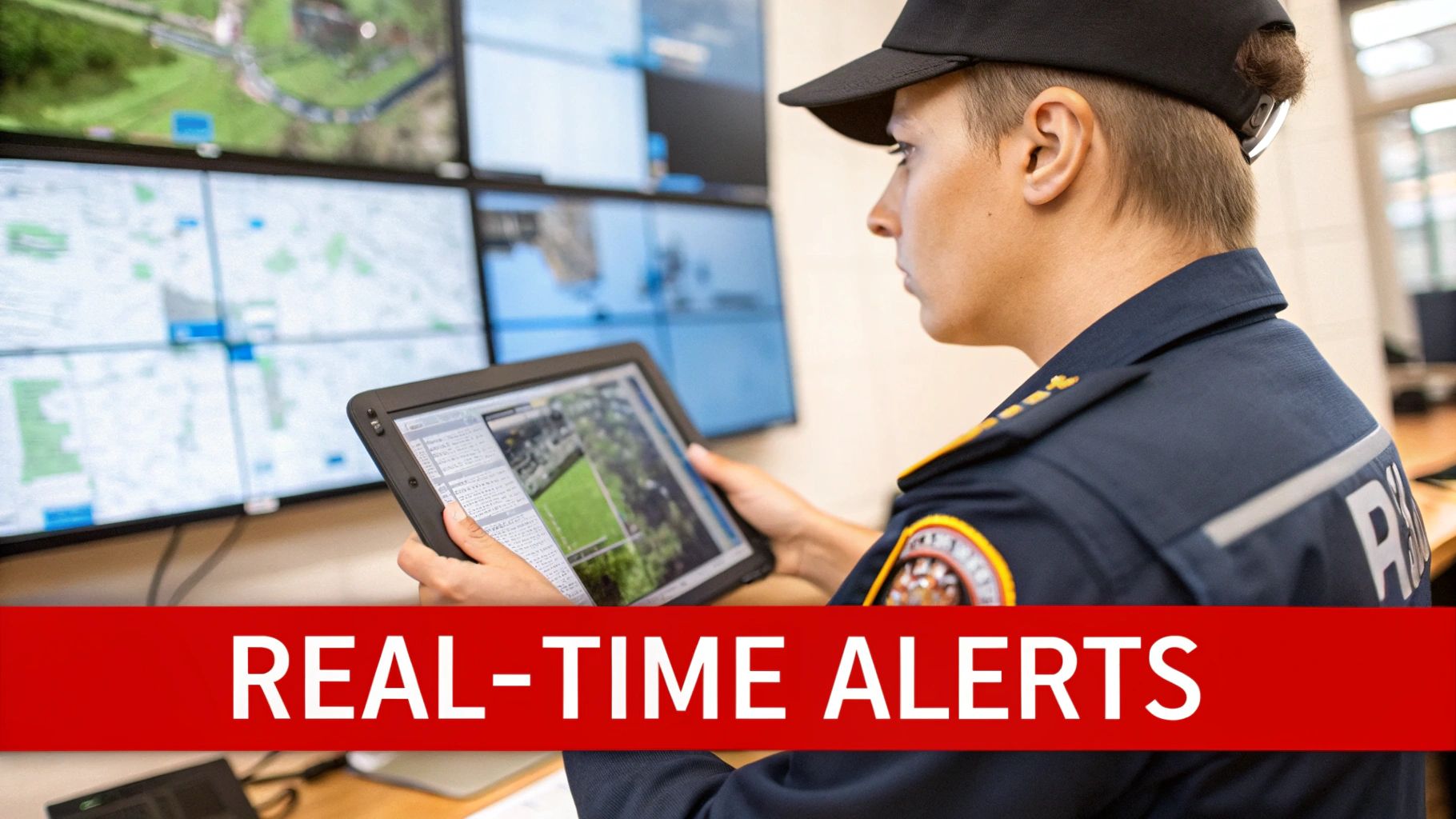
Creating Transparency with Verifiable Data
The single biggest advantage of modern security technology is the accountability it creates. The days of handwritten paper reports and uncertainty are over. Leading firms now use integrated systems that give you a clear window into their field operations, offering genuine peace of mind.
Here are the key technologies you should expect from any quality provider:
- GPS-Enabled Patrol Tracking: This is non-negotiable. Real-time GPS tracking of security vehicles and officers provides a verifiable record that patrols were conducted on schedule and hit all designated areas of your property.
- Real-Time Digital Reporting: Officers in the field should be able to submit incident reports, daily activity logs, and maintenance alerts instantly from a smartphone or tablet. These reports should include time-stamped photos and videos, giving you a detailed, accurate account of any event as it happens.
- Guard Tour Management Systems (GTMS): Using NFC tags or QR codes placed at critical checkpoints—like pool gates, laundry rooms, or equipment storage—officers can scan these points to log their presence. This creates an undeniable digital trail confirming that specific locations were physically inspected.
Technology transforms security from a subjective service into a measurable one. When a security partner provides verifiable data on patrol routes, checkpoint scans, and incident response times, they are demonstrating a true commitment to accountability.
The Power of a 24/7 Security Operations Center
At the center of a modern security program is the Security Operations Center (SOC). This 24/7 command hub acts as the brain of the entire field operation, providing crucial support to officers on the ground and ensuring real-time accountability.
A SOC is much more than a simple dispatch line. It is an active layer of oversight that dramatically enhances safety and efficiency. The SOC team monitors alerts, confirms officer wellness checks, coordinates backup during incidents, and serves as your primary point of contact after hours. To get a better sense of its role, you can learn more about what a Security Operations Center does and see how it adds real value.
Integrating On-Site and Remote Solutions
This blend of human expertise and smart technology is what's driving major growth across the industry. The global security services market is on track to hit USD 139.93 billion by 2030, growing at a compound annual rate of 6.71%. This boom is fueled by the rising demand for integrated solutions that combine on-site officers with remote monitoring, creating a security posture that’s both more comprehensive and more cost-effective.
Ultimately, technology isn’t here to replace professional security officers. Its real purpose is to empower them—making them more effective, efficient, and accountable. When you’re evaluating a potential security partner, ask to see their technology in action. A company that has invested in these systems is a company that has invested in delivering verifiable, high-quality service.
Structuring Your Contract for a Successful Partnership
Once you’ve put vendors through their paces and have a finalist in mind, it’s time to formalize the agreement. A well-structured contract is far more than a legal formality. Think of it as the foundational blueprint for your security partnership—it’s where you define expectations, responsibilities, and what quality security services means for your property.
A solid agreement creates clarity from day one and protects all parties. It eliminates gray areas around the scope of work, how performance will be judged, and how issues will be addressed. One of the biggest mistakes property managers make is rushing this stage or signing a generic, boilerplate agreement. That’s a recipe for future headaches.
Key Clauses You Cannot Overlook
Every security contract needs a thorough review, but a few key clauses demand your undivided attention. These sections directly impact your liability, operational flexibility, and the long-term health of your security program. Don't just skim the fine print here.
Focus on these three areas:
- Liability and Indemnification: This clause answers the critical question: who is responsible if something goes wrong? It needs to state clearly that the security firm will indemnify you (hold you harmless) against claims arising from their negligence or the actions of their officers.
- Insurance Requirements: The contract must spell out the specific types and minimum coverage amounts of insurance the provider must carry. This includes general liability, workers' compensation, and professional liability. Your next step? Ask for a current Certificate of Insurance (COI) that explicitly names your property as an additional insured.
- Termination Clause: What’s your exit strategy if the service isn’t a good fit? A fair contract will include a "for cause" termination clause for clear performance failures. It should also have a "without cause" option that lets you end the agreement with reasonable notice, usually 30 to 60 days. Avoid rigid, long-term contracts that lock you in with no easy way out.
Defining and Measuring Success with KPIs
How do you truly know if your security partner is living up to their end of the bargain? The answer is to bake clear Key Performance Indicators (KPIs) directly into the contract itself. These quantifiable metrics move success from a vague idea to an objective reality.
Vague promises of "excellent service" are meaningless without data to back them up. Specific KPIs transform your contract from a simple list of duties into a performance-based agreement, holding your provider accountable for real, tangible results.
Your KPIs should be tied directly to your property’s operational needs. For instance, you could include metrics like:
- Patrol Check-In Frequency: All designated checkpoints must be scanned using their Guard Tour Management System on 100% of scheduled patrols. No exceptions.
- Incident Report Submission: Critical incident reports must be submitted digitally, with photos attached, within one hour of the event occurring.
- Daily Activity Log (DAR) Delivery: The complete DAR from the previous 24-hour period must be in the property manager’s email inbox by 8:00 AM every morning.
Metrics like these create an undeniable, data-driven record of service delivery. It’s the best way to ensure the contractual security services you’re paying for are exactly what you get.
Ensuring a Seamless Onboarding Process
The first few weeks with a new security provider are critical—they set the tone for the entire relationship. A smooth, comprehensive onboarding process is non-negotiable, and while the contract should outline the provider’s responsibility, your active involvement is key.
A successful launch has a few core components. First, you'll work closely with their management team to draft detailed post orders. These documents are the "bible" for your site, containing every procedure, emergency contact, and protocol your officers will need to know.
Next is an on-site walkthrough with the permanently assigned officers and their direct supervisor. This is their chance to learn the physical layout, see potential trouble spots firsthand, and ask important questions. Finally, you’ll want to establish crystal-clear communication protocols—who to call for routine matters versus emergencies, and how to use their reporting software. This structured approach ensures your new security team is fully prepared from their very first shift.
Managing and Measuring Your Security Program's Performance
Signing the contract isn't the finish line—it’s the starting line. The real work of building an effective security program begins the day your team arrives on site. This is where ongoing management and measurement come in, separating a transactional vendor relationship from a true security partnership.
This phase is about a continuous loop of communication, evaluation, and adjustment to ensure the service you planned for is the service you receive, day in and day out. It’s not about micromanaging; it’s about active partnership. A quality security provider won't just tolerate this oversight—they'll welcome it and have systems ready to make it easy for you.

From Contract KPIs to Daily Realities
Remember those Key Performance Indicators (KPIs) embedded in your contract? They now become your primary management tool. Your regular performance reviews—whether weekly, monthly, or quarterly—should be built around these metrics. This shifts the conversation from a subjective, "How's it going?" to an objective, data-driven look at what's actually happening on your property.
When you sit down with your provider's manager, you should be looking at hard data from their reporting system.
- Patrol Adherence: Did they hit 100% of their required checkpoints on every shift? If not, why?
- Reporting Timeliness: Are incident reports and daily activity logs arriving by the agreed-upon deadlines?
- Issue Resolution: When an officer flags a maintenance issue like a broken gate or a burnt-out light, is that information being used to create a work order and solve the problem?
This level of detail is necessary to maintain service integrity. The demand for this kind of accountable, service-first security is driving major growth in the industry. The investigation and security services market jumped from USD 358.85 billion in 2024 to USD 387.41 billion in 2025, with the service side growing fastest. Property managers are investing in providers who can deliver—and prove it. You can dig into the specifics of these trends in this comprehensive market report.
How to Read Daily Activity Reports for Real Insights
A Daily Activity Report (DAR) should be more than just a log of quiet shifts. For a proactive property manager, it’s a goldmine of operational intelligence. Don't just skim them for major incidents; look for the patterns.
Go beyond the "all clear" entries. Is the same unauthorized vehicle showing up in the fire lane in every report? That’s not just a parking issue; it's a serious liability that needs a permanent solution. Are you seeing frequent reports of loitering near the pool after hours? That might be your cue to upgrade the lighting or rethink access control in that area.
A well-written DAR tells the story of your property's daily life. It helps you connect the dots between small, recurring issues and bigger operational challenges, letting you get ahead of problems before they escalate.
The Impact of Hands-On Leadership
This is where your provider's management structure, particularly their manager-to-client ratio, makes all the difference. An account manager with a manageable portfolio has the time and energy to be a true partner. They won't just forward you reports; they'll be there with you, analyzing the data, offering suggestions, and tackling issues before you even have to call.
At Overton Security, our low manager-to-client ratio is a core part of how we operate. It means our managers are on your property regularly, conducting inspections, coaching officers, and meeting with you face-to-face. This hands-on leadership is the human element of accountability that technology alone can’t replicate. It ensures the standards you set in the contract are the standards you see on the ground, every single day.
Ultimately, managing your security program is a collaborative effort. Through consistent reviews, smart analysis of daily reports, and an open line to a responsive management team, you can ensure your provider delivers the consistent, quality security services your property deserves.
Answering Your Top Questions About Security Services
When you're tasked with protecting a property, the weight of that responsibility is significant. You need straight answers. Choosing the right security partner is a major decision, and it always brings up questions about everything from cost and liability to what really goes into training an officer.
Here are clear, practical answers to the most common questions we hear from property managers, HOA boards, and business owners.
How Much Should We Expect to Pay for Security Guards?
This is often the first question, and the honest answer is: it depends entirely on your specific needs. The final bill rate is a sum of several critical components, and a transparent security provider will be happy to explain how they arrive at their number.
Here's what drives the cost:
- Officer Pay Rate: This is the largest part of the rate. To attract and retain professional, reliable officers, a company must offer competitive wages and benefits. Rock-bottom rates may look tempting, but they often come at the expense of officer quality and lead to high turnover.
- Supervision and Management: An officer in the field is supported by an entire structure—field supervisors conducting spot checks, an accessible account manager, and the 24/7 dispatchers in the Security Operations Center (SOC).
- Technology and Equipment: This covers the tools that enable modern security, including GPS-enabled guard tour systems for accountability, professional reporting software, patrol vehicles, and clean, professional uniforms.
- Insurance and Taxes: A significant portion of the bill rate covers the non-negotiables: general liability insurance, workers' compensation, and associated payroll taxes. This is what protects you.
A quality partner won't just give you a price; they'll show you the value you're receiving for that price.
What Kind of Training Do Your Security Officers Get?
This is an excellent question because an officer's training directly reflects the quality of service you'll receive. A basic state-issued guard card is just the starting point. A professional security firm invests continuously in its people.
Our training is a layered process that goes well beyond the minimum requirements:
- Initial Onboarding: Before stepping onto a property, all officers complete comprehensive classroom instruction. This covers legal responsibilities, emergency response protocols, de-escalation tactics, and essential customer service skills.
- Field Training: Next, every new officer is paired with an experienced Field Training Officer (FTO). They learn procedures in a live environment, gaining hands-on experience before being considered for a solo post.
- Site-Specific Training: This is the most crucial step. Before their first solo shift, every officer receives in-depth training on your property. They learn your specific post orders, emergency contacts, and the unique needs of your site.
An officer who only has a basic guard card is not the same as a professionally trained security officer. Consistent, site-specific training is what transforms a security presence into a genuine security solution.
This ongoing commitment ensures our officers aren't just filling a position—they are prepared, professional, and ready to solve problems.
Should We Use Armed or Unarmed Officers?
We provide both, and determining the right fit is a strategic decision made with you during the initial security assessment. The choice comes down to your property’s specific risk profile.
- Unarmed Officers are the standard for most properties, such as residential communities, commercial office buildings, and retail centers. They are highly effective as a visual deterrent and are trained in observation, reporting, and de-escalation—skills that resolve the vast majority of situations.
- Armed Officers are generally reserved for environments with a higher perceived risk, like financial institutions, sites protecting high-value assets, or locations with a documented history of serious incidents. These officers undergo additional, rigorous training and certifications for firearm use, safety, and legal authority.
The goal is always to match the level of security to the actual level of risk. A thorough needs analysis is the only way to make the right decision for your property.
Who Is Liable If Something Happens on My Property?
Liability is a major concern for any property or facilities manager, and this should be clearly defined in your service agreement. A professional security provider carries millions in insurance specifically to protect their clients.
Look for a clear indemnification clause in the contract. This is the legal language stating the security company will hold you harmless for any claims arising from their negligence or the actions of their officers.
To verify this, they must provide a Certificate of Insurance (COI) that names your property or company as an additional insured. This document isn't a formality; it's your proof that you are properly protected if an incident occurs.
Navigating the world of security services can feel overwhelming, but finding the right partner simplifies everything. At Overton Security, we've built our reputation over 26 years on trust, transparency, and an unwavering commitment to quality. If you have more questions or want to talk about your property's specific needs, we're here to help. Learn more about our approach to security.