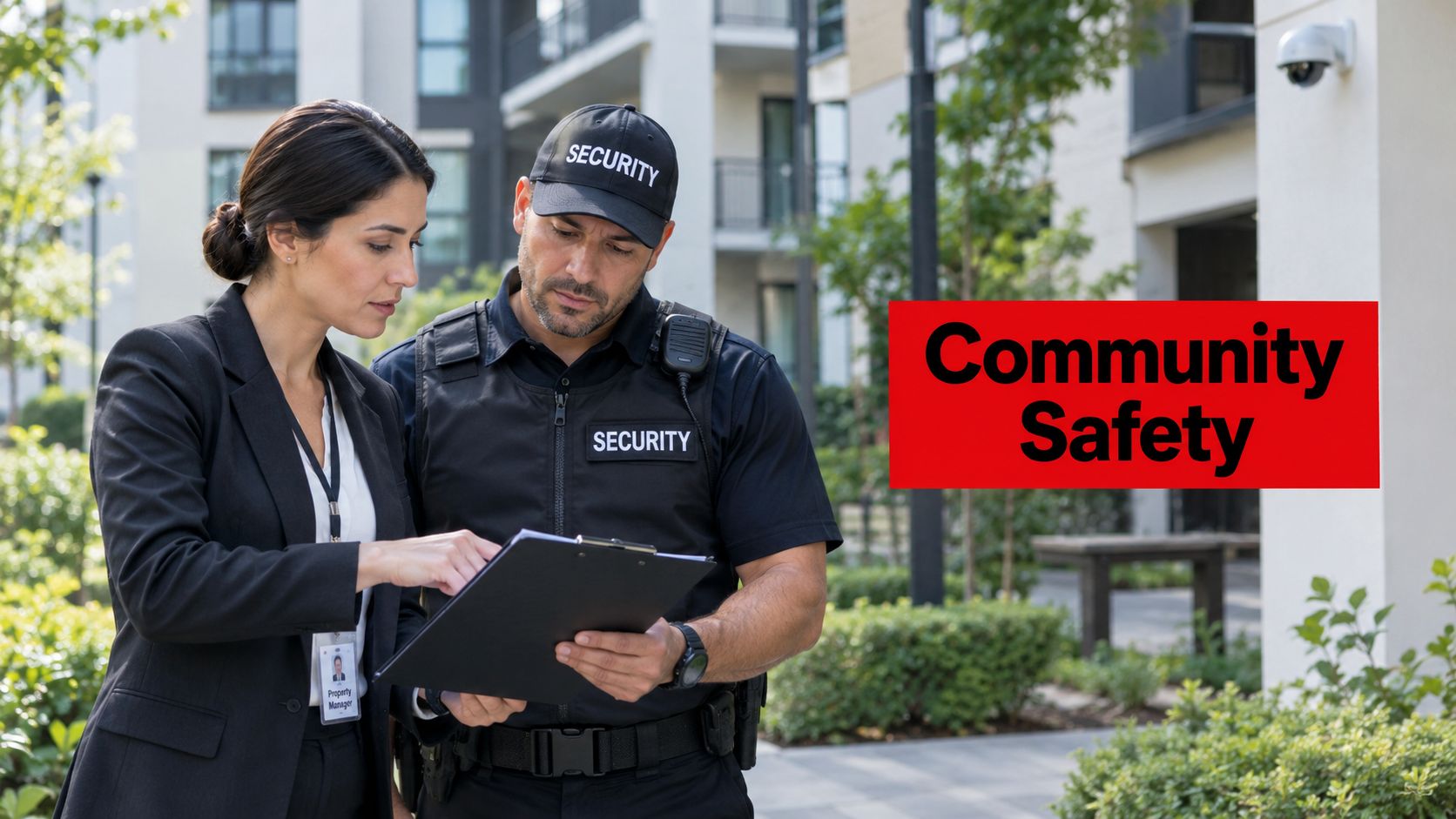
A property manager can inherit a safety program that looks active on paper but has no reliable operating discipline behind it. Officers may be scheduled, cameras may be installed, and incident reports may arrive by email, yet nobody can explain which risks the program is designed to reduce or how leadership should judge performance.
That gap is common in residential communities, retail centers, healthcare properties, construction sites, and mixed-use portfolios. Community safety programs work best as operating systems, not isolated security posts. Governance, documentation, staffing, technology, training, and stakeholder relationships must reinforce one another, or the program will depend on a single manager who may eventually leave.
When a Safety Program Feels Like It Is Failing
Six weeks into a new property management role, a manager discovers that the existing security program was inherited rather than designed. The contract is active, but there's no current needs assessment, no reliable audit trail, and no clear explanation of why officers are posted at particular locations or times.
The incident log is full of entries, but nobody reviews it for patterns. Cameras cover much of the property, yet staff can't quickly retrieve footage when a resident reports a damaged vehicle. Officers rotate frequently, and the board keeps asking for performance metrics that the management team can't produce.
The warning signs usually appear before a major incident:
- Reports accumulate without analysis. Daily activity reports describe what happened during a shift but don't identify repeat locations, recurring behaviors, or unresolved risks.
- Turnover disrupts site knowledge. When officers leave frequently, incoming staff must rediscover access points, resident concerns, emergency contacts, and building-specific procedures.
- Technology operates in isolation. CCTV, patrol tracking, access control, and incident reporting each produce data, but no one connects the records.
- Leadership receives activity instead of performance. A board hears how many patrols occurred, but not whether response improved, repeat incidents declined, or post orders were followed.
- The program changes with each manager. Decisions live in personal email accounts and informal conversations instead of approved procedures and review calendars.
Practical rule: If a new manager can't understand the safety program from its records, the property doesn't have a durable program. It has individual habits.
This isn't an argument for adding more guards automatically. It's an argument for establishing an operating model that explains who makes decisions, what officers are expected to do, how incidents move through escalation channels, and which results matter.
Community safety has long been built around coordination rather than enforcement alone. The history of Safe Communities and community-based traffic safety programs traces the concept to Sweden in the mid-1970s and describes the growth of U.S. multi-agency programs during the 1980s and 1990s. The historical record includes 334 Community Traffic Safety Programs in 1992, nearly 300 Safe Community locations by June 1997, 472 active programs by the end of 1998, and 755 programs by December 1999.
The lesson for a property team is straightforward. A safety program shouldn't be judged by the presence of a uniform at the gate. It should be judged by whether the right people, information, procedures, and resources work together consistently.
Reading the Property Before You Design Anything
A property can have a uniform at the entrance and still leave a parking area, loading zone, or service corridor effectively unmanaged. That failure usually starts before hiring. The team chooses a guard post, patrol route, camera package, or remote monitoring service without first documenting how the property operates and where controls break down.
Run a structured listening tour during the first 30 days. Speak with residents, leasing staff, maintenance teams, vendors, local responders, retail tenants, building engineers, and people who regularly work after hours. Ask where people feel unsafe, which incidents consume staff time, what response has failed, and which informal workarounds employees rely on. Record the answers, the affected location, the time pattern, and the owner responsible for follow-up.
The output should be a stakeholder interview guide and a dated list of recurring concerns. Perception affects resident confidence, tenant behavior, and reporting rates. It should sit beside verified incident activity, not replace it.
Separate observed risk from assumed risk
Create a risk register with two categories:
- Observed risk: Incident reports, calls for service, access-control records, near misses, work-order history, trespass patterns, fire alarms, and documented response delays.
- Assumed risk: Board concerns, resident perception, comparisons with a neighboring property, social media reports, or fears based on a recent event elsewhere.
Both categories deserve attention, but they call for different decisions. A recurring vehicle break-in supported by reports may justify lighting changes, camera repositioning, patrol adjustments, and revised escalation procedures. A general concern about a dark walkway calls for a site inspection first. The inspection may support better lighting or maintenance rather than another staffing post.
Document the physical environment in a property vulnerability map. Mark entrances, parking areas, loading zones, elevators, roof access, blind corners, amenity spaces, construction boundaries, emergency equipment, camera views, and locations where officers must check or report conditions. Apply crime prevention through environmental design principles to assess visibility, territorial cues, access control, and maintenance.

Turn the assessment into a procurement document
The final assessment should define the problem, affected population, existing prevention resources, desired controls, and evaluation method. The national crime-prevention framework on selecting effective programs distinguishes ongoing performance monitoring from formal evaluation and recommends planning measurement from the beginning.
Give every prospective security partner the same baseline. Require each provider to show how staffing, patrol routes, technology, post orders, reporting, and escalation will address the documented risks. Compare proposals against those conditions. A provider should not be allowed to design the program in a vacuum, because the resulting operating model will be difficult to audit and harder to sustain after leadership changes.
Choosing the Right Staffing Model
There isn't a universally correct staffing model for community safety programs. A high-rise residential property with controlled entrances, frequent deliveries, and concierge expectations has different needs from a low-density HOA with broad common areas or a retail center with a large parking field.
Use the decision criteria that affect daily operations: coverage hours, property size, cost per acre, response-time targets, incident types, customer-service expectations, and the consequences of a missed observation.
Staffing Model Comparison
| Model | Best For | Cost Driver | Response Time | Key Limitation |
|---|---|---|---|---|
| Onsite security officers | Access control, visible presence, building patrols, continuous coverage, and immediate action at a defined post | Labor hours, shift coverage, supervision, and relief staffing | Fastest at the assigned location, subject to post position and competing calls | An officer may be fixed at one post while risk develops elsewhere |
| Vehicle patrols | Low-density HOAs, parking areas, construction sites, distributed properties, and visible deterrence | Route distance, visit frequency, vehicle operations, and dedicated versus shared coverage | Depends on route design, dispatch priority, and current location | Scheduled visits can leave gaps between checks |
| Concierge security | High-rise residences, Class A offices, medical facilities, and properties where hospitality and access control overlap | Specialized recruiting, continuous lobby coverage, training, and service expectations | Immediate for lobby and entry issues, slower for remote areas | Customer-service demands can distract from active security observation |
| Hybrid model | Properties needing lobby coverage, perimeter checks, remote monitoring, or after-hours response | Combined labor, technology, management, and integration costs | Varies by incident type and escalation plan | Poorly defined handoffs can create uncertainty about ownership |
For a high-rise residential building, a 24/7 onsite concierge model may make sense when entry control, package handling, visitor management, and resident interaction drive the risk profile. For a low-density HOA, scheduled mobile patrols may cover common areas, parking, gates, and amenities more efficiently than a permanently staffed post.
The failure occurs when a property copies a neighboring contract without comparing geography, incident patterns, operating hours, or service expectations. A patrol model can create confidence without coverage if routes are predictable, while a fixed post can become an expensive observation point if officers lack authority, training, or a defined patrol schedule.
A staffing plan should answer one operational question: who sees the problem, who responds, who documents it, and who verifies the response?
Hybrid programs need explicit handoffs. A lobby officer may identify an unauthorized visitor, a mobile officer may inspect a parking area, and a remote operator may review camera footage. The post orders must state which team owns escalation, what information gets transferred, and when law enforcement, management, maintenance, or emergency services are contacted.
Before signing, ask the provider how it recruits, trains, supervises, and backfills officers. Ask how supervisors inspect posts, how fatigue and blind spots are addressed through rotation, and what happens when a scheduled officer calls out. A low manager-to-client ratio and direct operational oversight can matter more than a long service menu because the program needs someone who will notice drift before the client does.
Wiring Up CCTV, SOC, and GPS Patrol Data
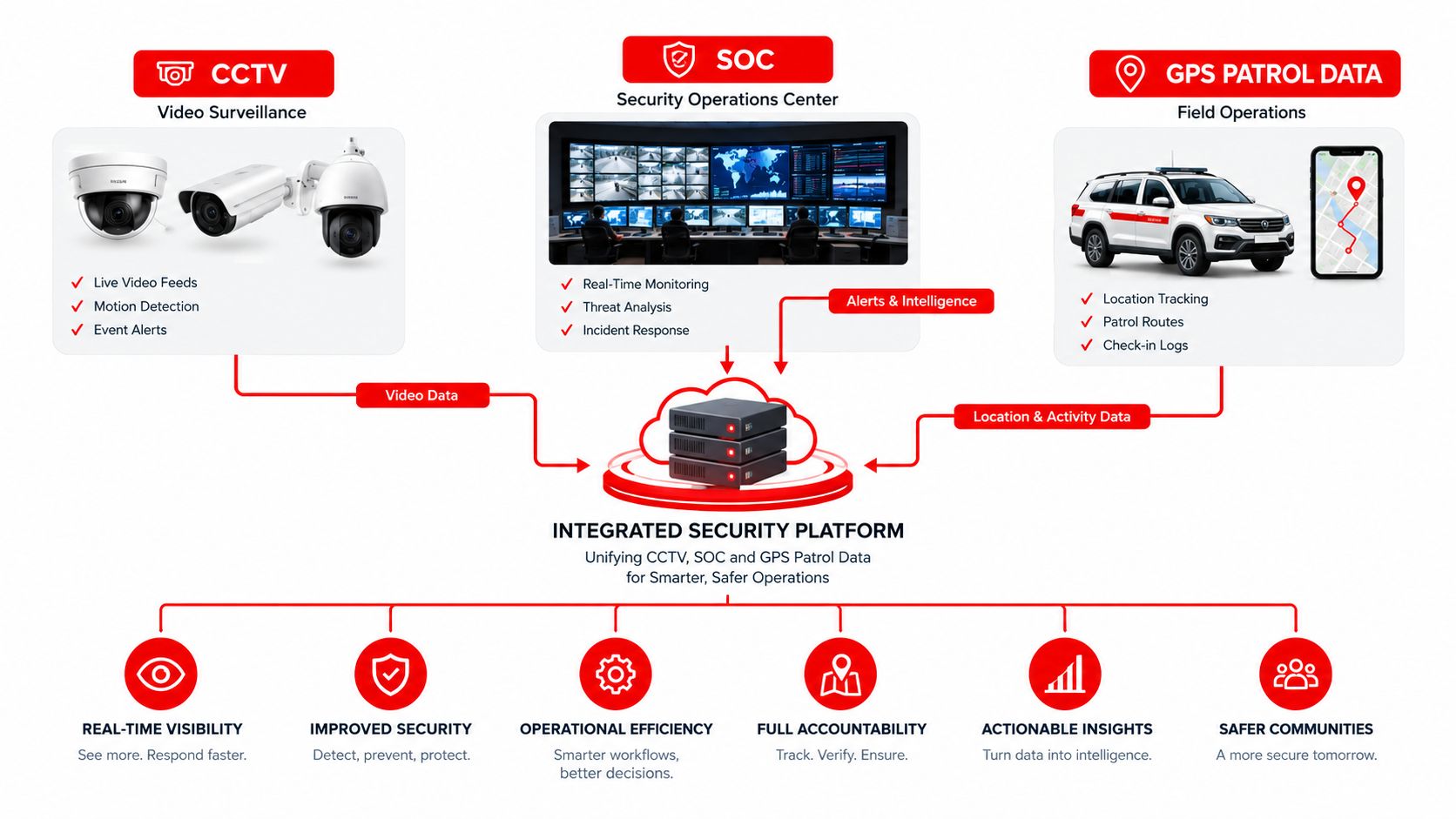
Technology improves accountability only when it changes a decision or verifies an action. CCTV, a security operations center, and GPS-enabled guard tour data should function as one evidence layer, not as three disconnected subscriptions.
CCTV documents conditions and events. Cameras can support deterrence, investigation, and situational awareness, but a camera pointed at the wrong approach, blocked by landscaping, or unable to produce usable footage has limited operational value. Camera placement should follow the vulnerability map. Prioritize entries, vehicle approaches, blind corners, loading areas, cash-handling zones, equipment storage, and locations where an officer needs visual confirmation before acting.
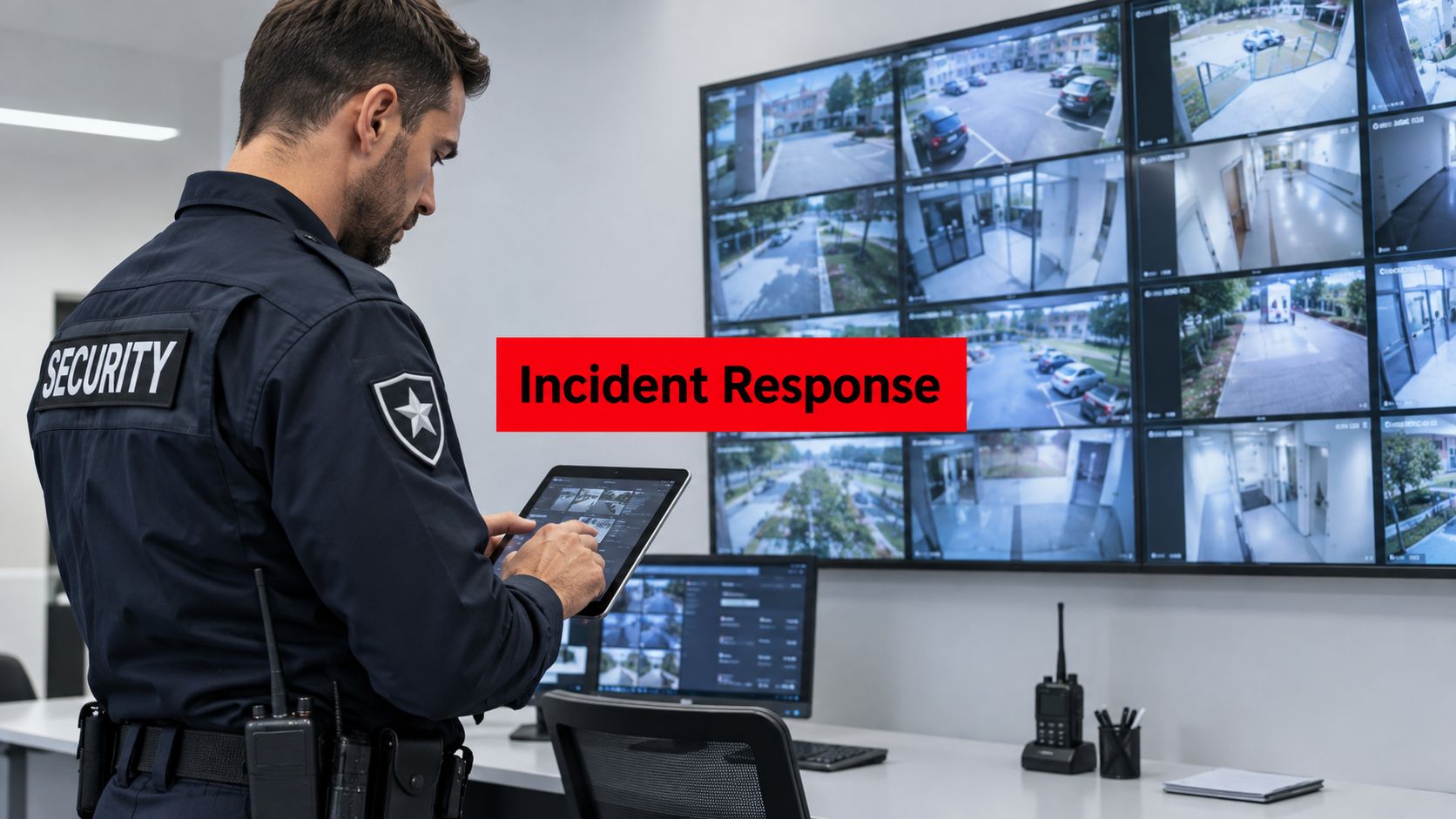
A SOC turns information into decisions. Remote operators can review alerts, monitor selected feeds, contact officers, dispatch mobile patrols, perform wellness checks, and escalate incidents. A 24/7 security operations center should have written triage rules, not merely a wall of screens. The operator needs to know which alarms require immediate voice contact, which require video verification, and which can be assigned for routine follow-up.
GPS patrol data verifies movement and activity. A guard tour management system can record checkpoint scans, time-stamped observations, photographs, daily activity reports, and exceptions. This helps answer whether a required route occurred and what the officer found. It doesn't prove that an officer made a sound decision, wrote an accurate report, or resolved the underlying condition.
Define the handoffs before selecting the dashboard
A useful integration sequence might look like this:
- A camera or resident report identifies an event.
- The SOC verifies the location, time, and apparent activity.
- Dispatch contacts the assigned officer or appropriate responder.
- The officer observes, intervenes within authority, requests support, and documents findings.
- Management receives an exception report with footage, officer notes, response information, and unresolved actions.
Measure what each tool can improve. CCTV may improve evidence availability and review quality. SOC oversight may improve alert triage and escalation consistency. GPS data may improve route verification and exception visibility. None of these systems automatically improves safety because the property can produce more reports.
Contract language should specify camera uptime expectations, footage retention, retrieval support, privacy controls, GPS checkpoint requirements, report delivery times, exception notifications, and ownership of operational records. Require a sample incident package before purchase. If the vendor can't produce a clear, usable record from a test event, the dashboard won't solve the problem.
Post Orders, Training, and Stakeholder Alignment
Post orders are the bridge between a contract and a consistent shift. They should tell an officer what to observe, what to do, what not to do, who to contact, and what evidence to preserve.
A practical post order should cover access control, visitor handling, patrol routes, emergency lock and key controls, incident escalation, officer conduct, radio use, report standards, lost-and-found procedures, and shift handoff. Keep the instructions specific to the property. “Maintain a safe environment” is not an actionable direction. “Inspect the east garage stairwell, confirm the emergency exit is closed but not obstructed, and report forced-entry marks with a photograph” is.
Use a written guide to writing effective security post orders as a starting point, then validate every instruction during a site walk. Training records should show who completed orientation, which procedures were demonstrated, and when refresher training is due. For providers issuing digital credentials or completion badges, badge issuing best practices for training providers can help teams create a more reliable record of identity, completion, and verification.
Post Order Template and Stakeholder Map
| Artifact | Required Content | Owner | Review Cadence |
|---|---|---|---|
| Post orders | Duties, patrol points, access rules, escalation, emergency procedures, reporting, and shift handoff | Security manager and property manager | After incidents, site changes, and scheduled operational reviews |
| Risk register | Observed risks, assumed risks, existing controls, owners, and unresolved actions | Property manager | Routine management review and after significant events |
| Training matrix | Orientation, site procedures, emergency response, equipment, and refresher status | Security training lead | Before assignment and during recurring reviews |
| Stakeholder map | Residents, board, police, fire, EMS, vendors, tenants, and decision rights | Property manager | When contacts, responsibilities, or escalation paths change |
| Incident review log | Event summary, response, evidence, corrective action, and closure status | Security supervisor | After report submission and during trend reviews |
A 30-60-90 day rollout gives the program time to become familiar before a crisis tests it. The first phase should establish site orientation, access credentials, post-order review, and introductions to property stakeholders. The next phase should use ride-alongs, scenario exercises, report-quality checks, and supervisor observations to identify gaps. The final phase should formalize the review rhythm, confirm escalation contacts, and approve corrective actions.
The stakeholder map should also define decision rights. Residents can report concerns and participate in feedback channels. The board can approve policy and budget. Property management can direct site priorities. Security leadership can manage officer performance and escalation. Police, fire, and EMS retain their statutory responsibilities. Clarity prevents a routine concern from becoming a dispute over who was supposed to act.
Building a Budget and Proving the Return
A safety budget should be treated as a controllable operating expense, not a fixed line item that gets cut without examining consequences. The board doesn't need a dramatic promise. It needs a clear explanation of the problem, the chosen control, the expected operating behavior, and the evidence that will show whether the investment is working.
Separate the budget into visible categories:
- Labor: Onsite coverage, patrol visits, supervision, relief staffing, and administrative support.
- Technology subscriptions: Remote monitoring, incident management, patrol tracking, access systems, and reporting tools.
- Capital equipment: Cameras, lighting, gates, radios, panic devices, and other site improvements.
- Training: Orientation, emergency procedures, customer service, reporting, and recurring exercises.
- Incident-driven costs: Overtime, temporary coverage, emergency repairs, investigations, and special deployments.
Don't present every cost as prevention. Some expenses create visibility, some create response capacity, and others reduce exposure by correcting environmental conditions. The board can evaluate the program more intelligently when those functions are separated.
Build a simple ROI narrative
Use a short sequence in board materials:
- Condition: Identify the recurring incident, vulnerability, complaint pattern, or response problem.
- Control: Explain the staffing, technology, environmental change, or partnership being funded.
- Measure: Name the indicators that will be reviewed, such as incident trends, response times, resident satisfaction, report quality, patrol completion, or unresolved actions.
- Decision: State what management will change if the control doesn't perform as intended.
Avoid claiming that every improvement came from security. Regional crime trends, tenant behavior, maintenance changes, police activity, and seasonal conditions can all affect results. A national justice report on SACSI described targeted violent-crime reductions of as much as 50% at some sites but cautioned that the absence of control areas and imperfect comparison cities limited causal certainty. A federal progress report on Project Safe Neighborhoods summarized independent research showing average violent-crime reductions ranging from 4% to 20%, with some locations reaching 42%, while another evaluation reported a statistically significant 22% monthly reduction between treatment and comparison areas. The Project Safe Neighborhoods progress report makes the operational point clear: focused interventions and sound comparisons matter.
Contract terms can reinforce the budget story. Define service levels, reporting obligations, corrective-action deadlines, audit rights, and performance credits where appropriate. The purpose isn't to punish a vendor. It's to make accountability part of the commercial relationship instead of relying on goodwill after performance slips.
Measuring, Auditing, and Closing the Loop
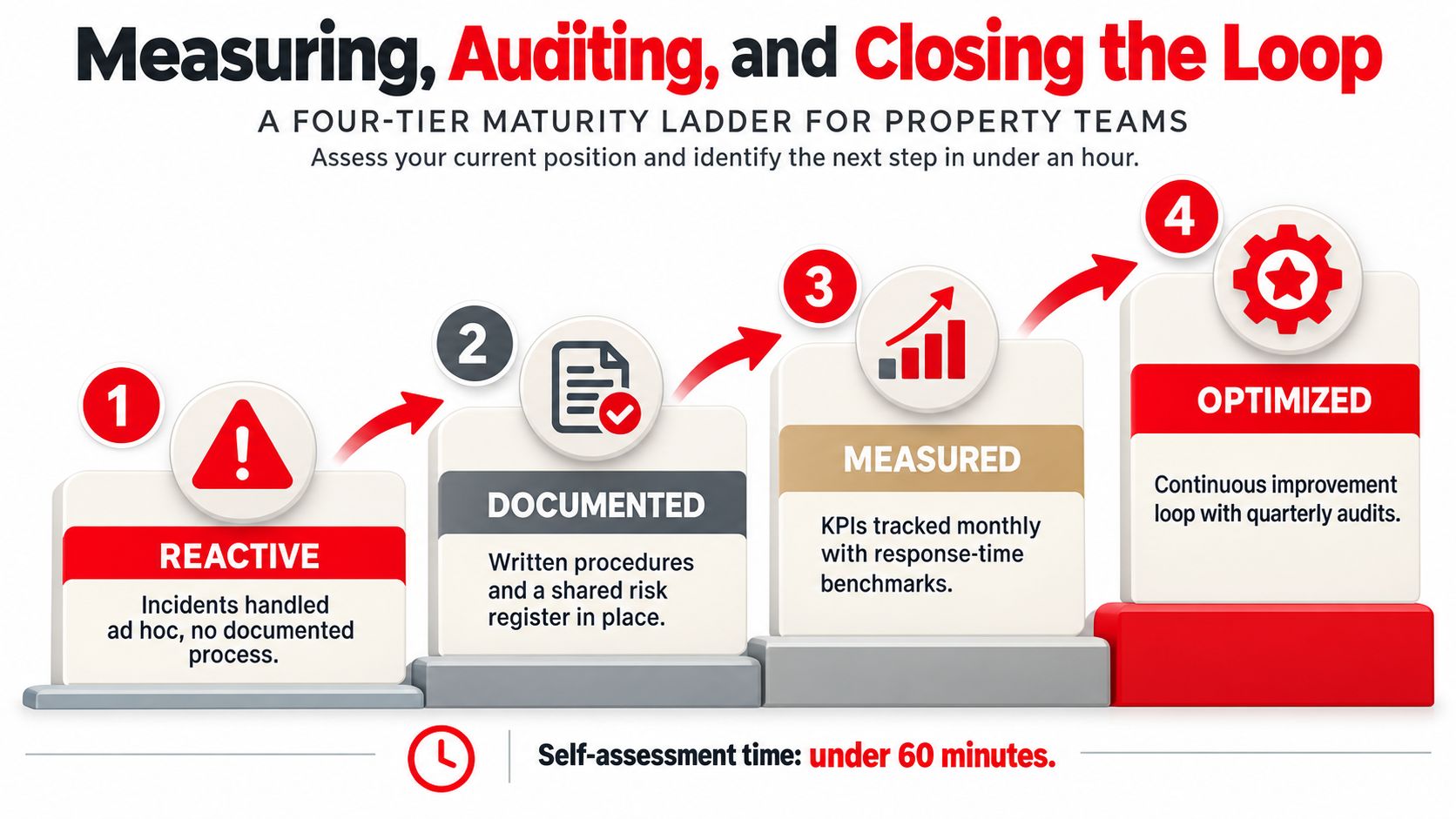
A safety program should be testable before a serious incident exposes the gaps. In practice, the strongest programs move through four stages.
Reactive
At the reactive stage, staff handle incidents as they happen. Reports may live in email threads or scattered spreadsheets, post orders may be out of date, and corrective actions depend on whoever remembers the event. Leadership hears about major problems, but routine failures stay hidden.
Documented
A documented program has approved post orders, a shared risk register, clear escalation contacts, training records, and a consistent incident form. The team can show how officers are expected to respond and where evidence is stored. Documentation does not prove the program works, but it gives management something to inspect, revise, and defend.
Measured
A measured program tracks performance against agreed benchmarks. The team reviews response times, report quality, patrol completion, camera availability, recurring locations, open corrective actions, and stakeholder feedback on a regular schedule. Managers can spot drift before a board meeting or an incident forces the issue.
Optimized
An optimized program closes the loop. Leaders compare current results with the original risk assessment, test procedures through tabletop exercises, adjust staffing or technology, and confirm whether the change produced the intended operational effect. Independent evaluation methods and appropriate comparison groups help a team separate program impact from broader crime trends, as described in national crime-prevention evaluation guidance.
Run a practical audit
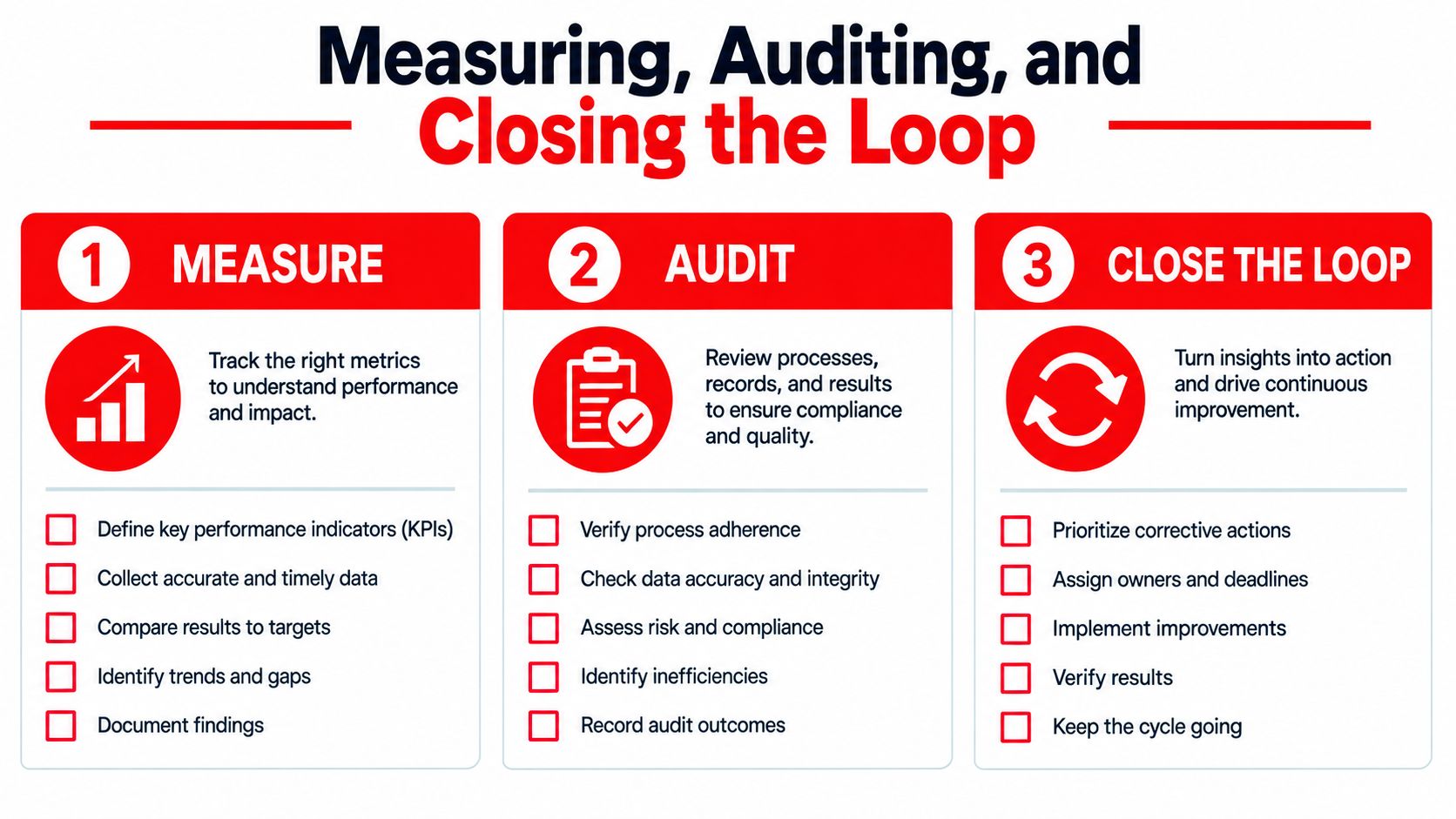
A property team can review these questions in one working session:
- Incident feedback: Are reports reviewed for accuracy, escalation, recurring locations, and unresolved actions?
- Post-order compliance: Can a supervisor verify that officers understand and follow current instructions?
- Training recurrency: Are required orientations, refreshers, and scenario exercises documented?
- CCTV availability: Can staff retrieve usable footage from the locations and time periods that matter?
- GPS tour completion: Are patrol exceptions reviewed, explained, and corrected instead of just recorded?
- Response performance: Does the team distinguish acknowledgment, arrival, intervention, and closure?
- Stakeholder cadence: Do residents, board members, tenants, first responders, and vendors know how to raise concerns?
- Corrective actions: Does every significant incident have an owner, due date, and verification step?
- Leadership continuity: Could a new property manager understand the program without relying on informal history?
The audit should end with two or three priorities for the current quarter. One property may need to move from scattered spreadsheets to a tagged incident-management system. Another may need quarterly tabletop exercises for access control, medical emergencies, or severe weather. A residential community may benefit from a formal resident safety committee that turns recurring concerns into documented actions rather than isolated complaints.
Community safety programs survive leadership changes when measurement, documentation, and accountability sit inside the operating rhythm. They fail when one experienced manager, officer, or board member holds the knowledge alone.