A weekend alarm rarely arrives as a clean, self-contained event. By Monday morning, a property manager may be sorting through a missing package, a damaged gate, an access-control alert, and a patrol note that says only “checked, secure.” The immediate pressure is to find out what happened, but the larger question is whether the property's response system can produce a reliable answer.
Security incident response services should close that gap. They combine trained people, property-specific procedures, monitoring, dispatch, field response, escalation, and evidence so a manager can reconstruct an event without relying on memory or a vague log entry.
The Monday Morning After an Incident
A Class A office property looks quiet on Monday morning. Tenants are arriving, the lobby team is answering routine questions, and the property manager is reviewing the weekend activity log. Then the discrepancies appear: a door contact was taped over, a package is missing from the receiving area, and the patrol record says “checked, secure.”
That wording doesn't answer the questions that matter. Who was on post? What did the SOC see? When did dispatch occur? Did anyone verify the door contact? Was the package area checked before or after the alarm? A report that records only the conclusion leaves the manager with no reliable timeline.
The first question is often, “Was the officer there?” That question is understandable, but it's usually too narrow. The better sequence is to establish the event timeline, identify the first signal, confirm who received it, verify what instructions were issued, and compare the written record with camera, GPS, and checkpoint evidence. A useful security incident reporting process should make those answers available without a Monday-morning reconstruction effort.
Start with the record, not the assumption
A readiness-based program gives every incident a defined chain:
- Detection: What triggered the event, and when did the monitoring team receive it?
- Verification: Was the signal checked against video, access control, guard observations, or a second sensor?
- Response: Who was dispatched, what location were they given, and what did they find?
- Escalation: Did the event require police, fire, EMS, maintenance, ownership, or senior property leadership?
- Closure: What evidence, notifications, corrective actions, and follow-up items were recorded?
This is the difference between a break-fix service and an accountability program. Break-fix response starts after the problem is visible. Readiness establishes the roles, access, escalation paths, and documentation standards before an incident tests them.
A manager shouldn't have to choose between a patrol log and a camera clip. The operational record should connect both. When the system works, the Monday review identifies not only what happened, but also whether the post orders were clear, whether the escalation tree worked, and what needs to change before the next shift.
What Security Incident Response Services Actually Cover
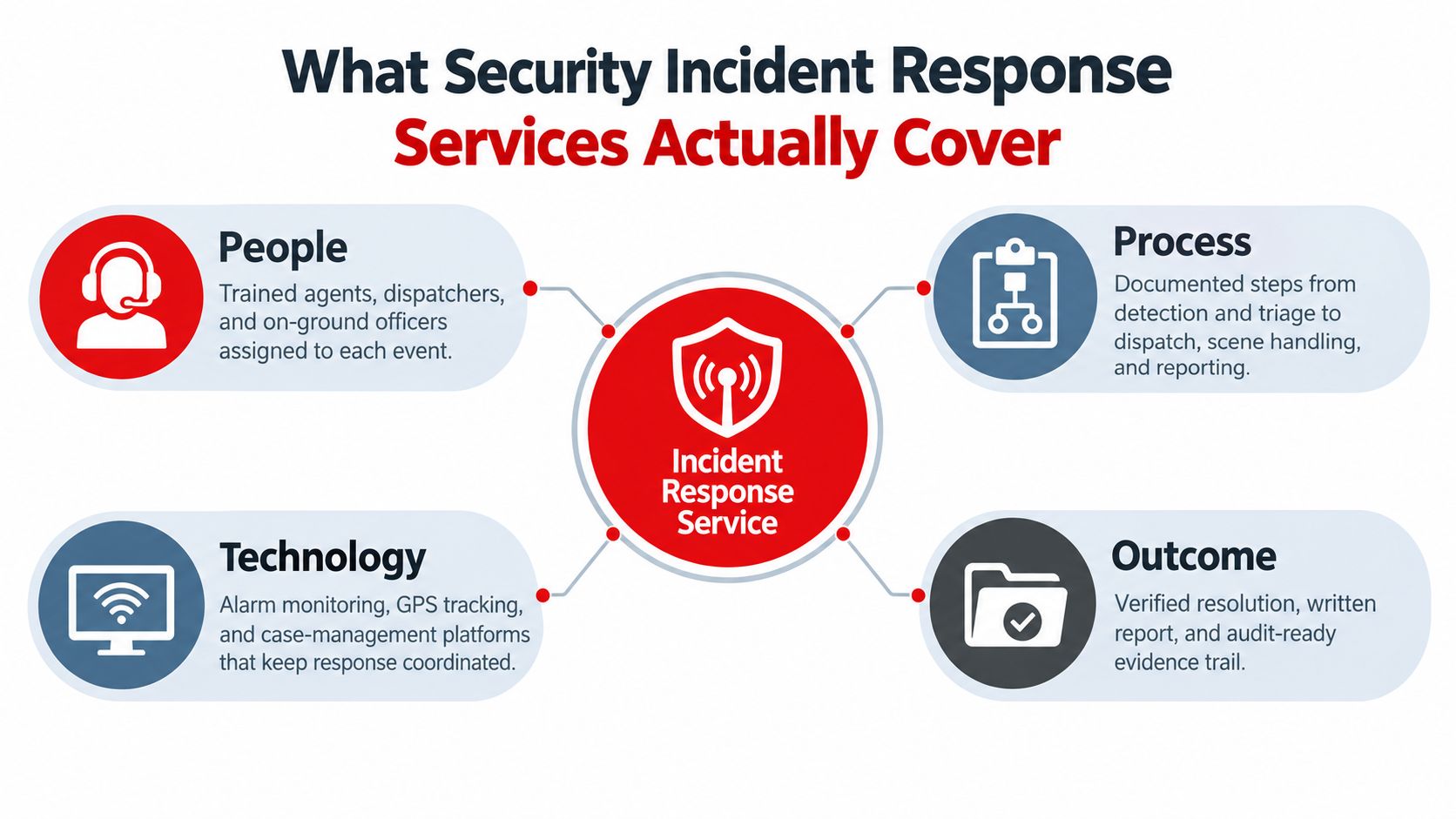
Security incident response services cover the full operating chain from first signal to verified resolution. In practical terms, that means people, process, technology, and outcome, not just a vehicle arriving at a property after an alarm.
People make the decisions
The people layer includes licensed security officers, dispatchers, supervisors, SOC operators, and the on-call leadership chain. Each person needs a defined responsibility. A dispatcher may verify a signal and assign a unit, while an officer assesses the scene and a supervisor handles a policy question or a sensitive escalation.
A service can have impressive software and still fail if nobody owns the event. Buyers should ask who watches the alarm, who can authorize a dispatch, who contacts the property manager, and who remains accountable when the first responder is unavailable.
Process turns judgment into repeatable action
The process layer includes post orders, escalation trees, site plans, communication chains, and playbooks for familiar events. A gate tampering playbook should identify the gate, access points, camera views, safe approach, maintenance contact, and law-enforcement threshold. It shouldn't force an officer to improvise those details at night.
A useful resource on incident response planning from Blowfish Technology reinforces the value of preparation and defined responsibilities. For property operations, the same principle applies to mixed-use centers, residential communities, construction sites, and healthcare facilities.
Technology connects the record
The technology layer may include intrusion alarms, video, access control, GPS-enabled patrols, guard-tour checkpoints, digital reports, and case-management tools. Technology should help the team answer operational questions, not create another disconnected dashboard.
Consider an after-hours trespasser at a retail center. A camera alert reaches the SOC, an operator checks the relevant view and recent activity, and dispatch sends the nearest available officer with the exact storefront or service-corridor location. The officer approaches according to the site plan, documents the person and any damage, requests law enforcement when appropriate, and closes the event with a report that ties together timestamps, images, actions, and notifications.
That sequence is the outcome the buyer is paying for. The service is not merely detection or dispatch. It is a controlled path from signal to defensible resolution.
The Response Workflow from Alarm to Closed Report
At a gated multifamily community, a motion alarm activates near a vehicle entrance during the overnight shift. A strong response doesn't begin with a patrol car moving blindly toward the property. It begins with an operator establishing what the signal means and who needs to act.
Detection
The SOC receives the motion signal, identifies the zone, checks available camera views, and reviews related sensor or access activity. The operator records the initial time and the facts available at that point. If the camera shows a resident entering normally, the event may be handled differently from a person moving along the fence line or testing the gate.
Detection is not the same as confirmation. A signal creates an event record. Verification determines what kind of response the event requires.
Dispatch
Once the operator has enough information to assign the call, dispatch follows the property's escalation tree. The dispatcher identifies the closest available unit, sends the location and relevant instructions, and confirms that the officer accepted the assignment. If the first responder doesn't acknowledge the call, the next contact in the chain must already be known.
Vague contracts and informal communication fail here. “Someone is on the way” isn't a complete operational status. The record should show who received the assignment, what information they received, and whether the property contact was notified.
On-site handling
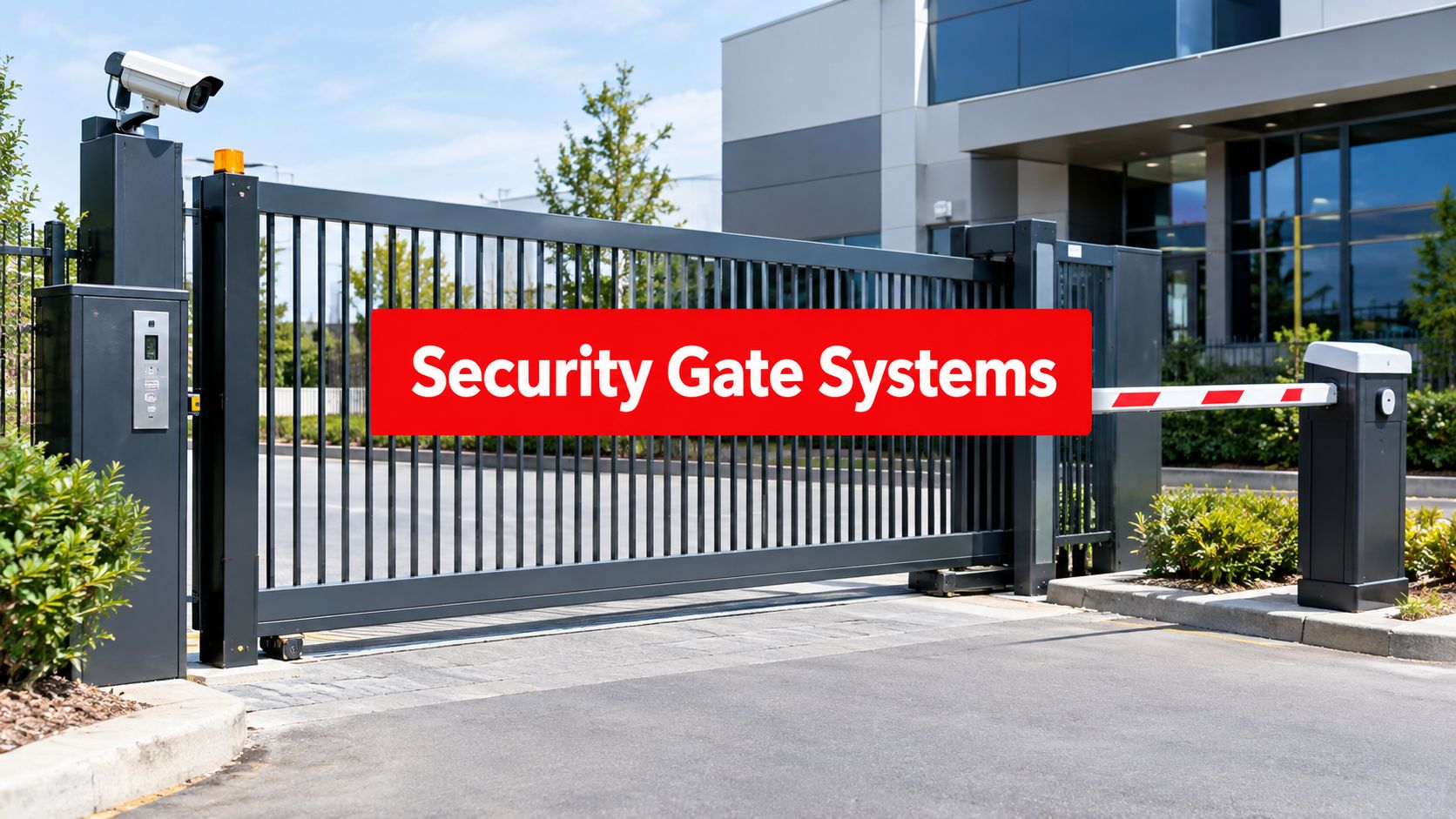
At the gate, the officer checks the approach, observes from a safe position, and looks for signs of forced entry, damaged equipment, or a person still on the property. The officer shouldn't disturb evidence or enter a dangerous area without the training and authority to do so. The immediate priority is to assess, protect people, preserve information, and prevent further access where that can be done safely.
The officer then sends a status update. That update should distinguish observed facts from assumptions. “South pedestrian gate open, hinge damaged, no person visible” is more useful than “gate issue handled.”
Escalation
Police, fire, EMS, maintenance, property leadership, or ownership may enter the chain depending on the facts. A response provider should define who makes the call, what information gets transferred, and how the handoff is documented. The officer's report should identify the notification, the reason for it, and any instructions received.
Reporting
The closed report brings the event together. It should include discovery and arrival times, the exact location, persons involved and witnesses, observed facts, actions taken, officer identity, notifications, preserved evidence, and final disposition. Guidance for property-focused incident reporting also distinguishes response urgency by severity, with low incidents requiring prompt attention and critical incidents requiring immediate emergency-service activation and notification and logging. The AWS partner guidance on security incident response provides useful context for those documentation fields and severity distinctions.
A complete report doesn't end the process. It gives the next shift, property manager, and ownership team enough information to correct a vulnerability, brief stakeholders, and identify whether the response performed as designed. Remote monitoring can provide the command layer that supports this sequence through remote security monitoring services.
How the SOC and Patrol Technology Support the Field
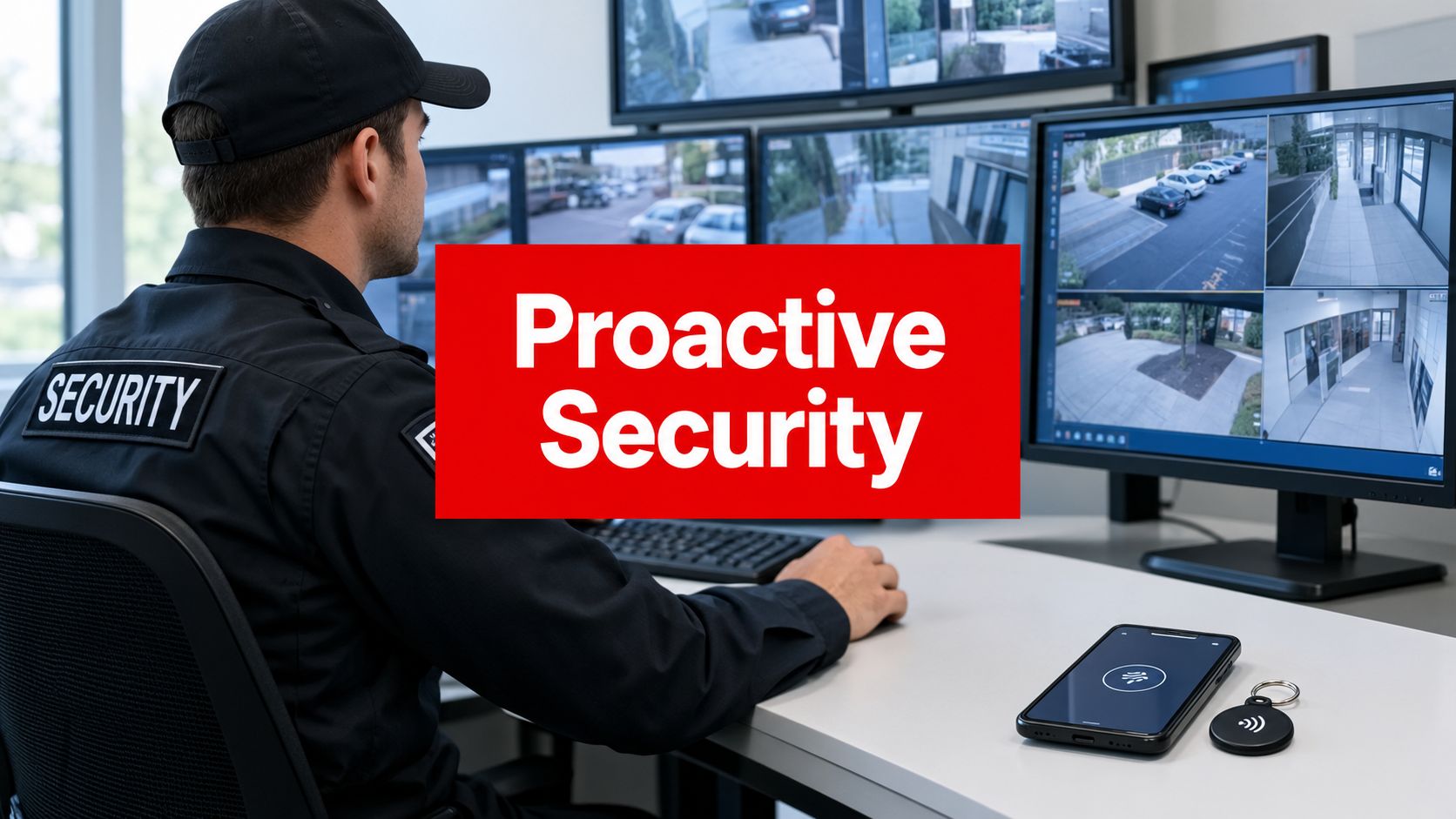
The SOC is the command-and-control layer between an alarm and the officer standing at the property. It doesn't replace field judgment. It gives the officer better information, gives the dispatcher a live view of available resources, and gives the property manager a connected record after the event.
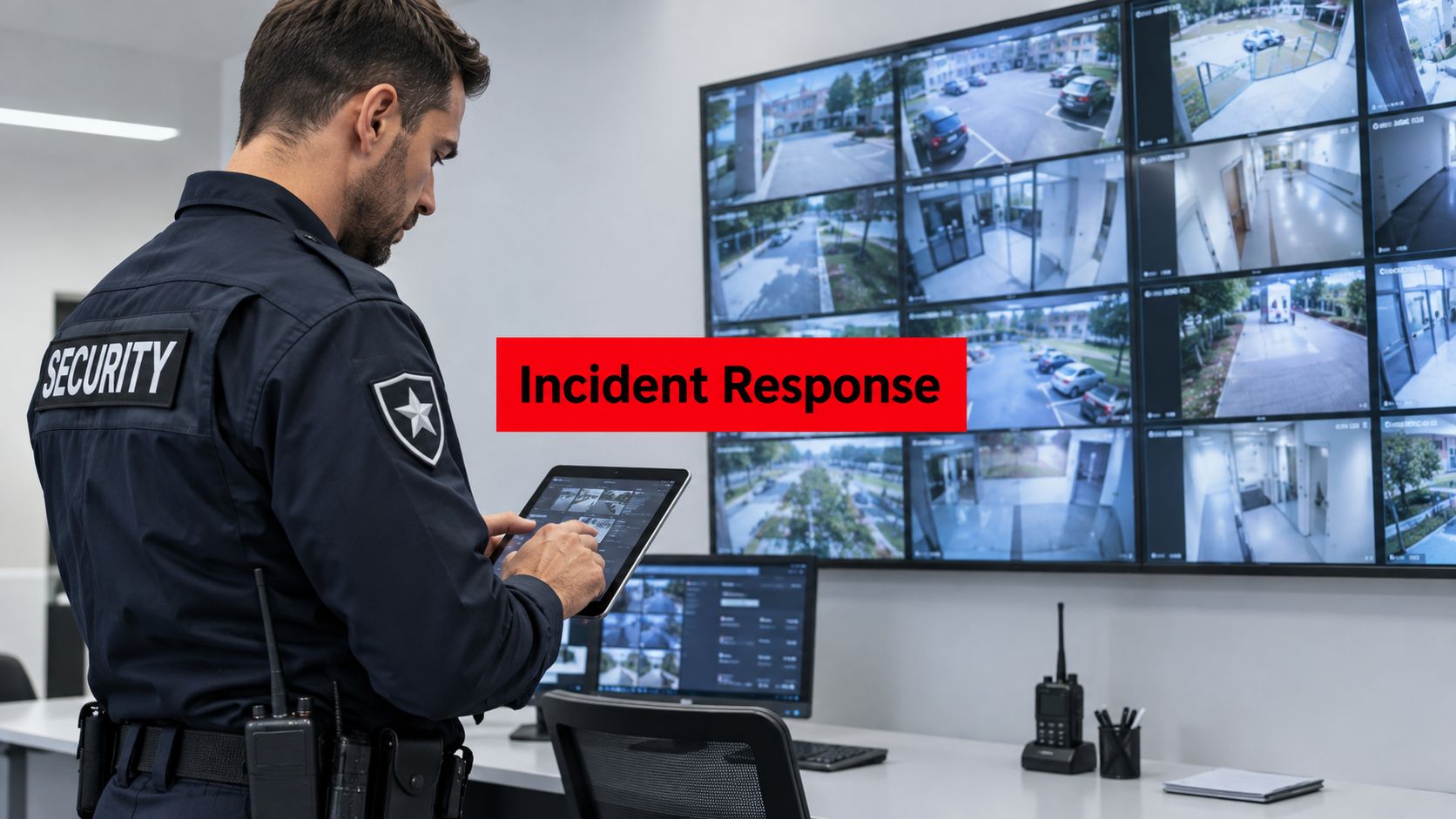
Suppose Camera 12 shows activity near a loading entrance. The SOC operator verifies the view, opens an event, and sends a job ticket through the Guard Tour and Man Tracking System, or GTMS. The dispatcher can use GPS information to identify the nearest patrol unit, while the officer receives the location, relevant instructions, and any safety notes before arriving.
One event file should tell the whole story
The strongest systems connect several records:
- SOC activity: Alarm receipt, verification notes, calls, dispatch instructions, and escalation decisions.
- GTMS activity: Officer assignment, checkpoint scans, status updates, digital Daily Activity Reports, and uploaded evidence.
- GPS history: The unit's route and arrival information, interpreted alongside the assignment and site conditions.
- Property evidence: Camera clips, access records, photos, audio, maintenance notes, and final disposition.
The purpose isn't to collect data for its own sake. It's to create a timestamped chain of accountability. A property manager should be able to determine what happened, who responded, which actions occurred, and where a delay or decision entered the timeline.
Digital reporting systems can make reports available in real time and support the use of timestamps, photos, video, audio, and GPS evidence. Modern security reporting practices show why immediate digital documentation is more useful than a paper log completed after the shift.
Technology also has limits. A GPS breadcrumb won't tell an officer whether a person is dangerous, whether a resident needs assistance, or whether an apparent access violation is a maintenance problem. Those decisions still require training, communication, and calm judgment. The right design treats technology as a force multiplier for people, not as a substitute for people.
A properly managed 24/7 security operations center should own the event from first signal through closure, while the officer retains responsibility for safe on-site observation and action within their authority.
SLAs, Pricing Models, and What You Are Really Paying For
Property managers often compare response proposals by looking at the promised arrival time and the monthly price. That approach misses the service underneath the number. An SLA may define acknowledgement, dispatch, arrival, escalation, reporting, or a remedy for a missed target, and those are different obligations.
Read the SLA as an operating document
Ask the vendor to define:
- The starting point: Does the clock begin at alarm receipt, operator verification, dispatch acceptance, or officer notification?
- The response event: Is the target acknowledgement, arrival, scene assessment, or report delivery?
- The exception rule: What happens when weather, access restrictions, traffic, law enforcement, or a false alarm affects the response?
- The escalation rule: Who is contacted when the target is at risk, and how quickly does that happen?
- The remedy: Does a missed target produce a review, service credit, corrective plan, or nothing beyond a written explanation?
A fast acknowledgement doesn't necessarily mean fast containment. Operational metrics commonly separate detection, investigation start, resolution, and containment, including MTTD, MTTA or MTTI, MTTR, and MTTC. Splunk's security operations metrics guide explains why these measures should be evaluated separately.
Compare the commercial model
| Pricing Model | What It Usually Covers | Best Fit For | Watch Out For |
|---|---|---|---|
| Flat monthly retainer | Defined availability, oversight, reporting, and agreed response capacity | Properties needing predictable support | Scope limits, included hours, and escalation costs |
| Hourly on-site rate | Officer time, with possible supervision and vehicle charges | Planned coverage or known operating windows | Minimum shifts, overtime, and after-hours rules |
| Per-incident dispatch fee | Individual alarm review, dispatch, and closeout | Lower-frequency sites with occasional needs | Fees for repeat alarms, cancellation, mileage, and follow-up |
| Hybrid model | Retainer for monitoring and readiness, plus hourly or incident-based field response | Portfolios with varied property risk | Unclear boundaries between included and billable work |
The line items behind a proposal may include guard wages, dispatch overhead, supervisor visits, vehicle expense, GTMS licensing, training, report preparation, and account management. A lower base price can lose its advantage if after-hours minimums, mileage, special reporting, or emergency escalation sit outside the quoted amount.
Practical rule: Put two proposals into the same worksheet and ask each vendor to price the same scenarios, including a false alarm, a verified trespass, a property-wide emergency, and a report requiring evidence review.
The actual purchase is not a response-time promise in isolation. It's available people, tested procedures, usable technology, and a record that supports management decisions after the event.
Real Property Scenarios and How Response Holds Up
The same response framework should flex across property types. A rigid script may look orderly on paper but can produce poor decisions when the event changes from an access violation to a threat involving people.
At a Class A office tower, a gate tailgating incident may begin with access-control data and a lobby officer's observation. The SOC verifies the camera sequence, dispatches an officer or supervisor to the access point, and asks building management to confirm whether the vehicle belongs to a tenant or authorized vendor. If the driver refuses to cooperate or a crime appears to be in progress, the officer preserves the video and escalates according to the post orders. The asset owner receives a report that separates the access event, the officer's observations, tenant notification, and any corrective action.
At a mixed-use retail center, repeated loitering requires more than treating each call as a separate disturbance. The response team should record locations, times, behavior, officer contacts, and whether the same pattern affects merchants, customers, or residents. A supervisor can then review the trend with property management, adjust patrol visibility, and determine when law enforcement or a formal trespass process is appropriate.
A medical campus visitor escalation has a different threshold. Staff safety and patient privacy may take priority over routine customer-service handling. The officer creates space, notifies the designated campus contact, and requests police or EMS when the person's behavior exceeds the officer's authority or creates an immediate safety concern. The final report documents statements as observed or reported, the people notified, evidence preserved, and the handoff.
These examples show why readiness matters more than rigid procedure. Detection may come from a gate reader, a retailer, or clinical staff. Dispatch may send a patrol unit, a supervisor, or emergency services. The consistent element is the accountable record from first signal through final disposition.
Choosing a Partner and Measuring the ROI
Vendor selection should be a verification exercise, not a presentation contest. A polished proposal doesn't prove that a provider can coordinate a real incident at a multi-site portfolio, especially when the event occurs outside normal management hours.
Verify the operating foundation
Before signing, ask for evidence rather than broad assurances:
- Licensing and insurance: Confirm the provider is properly licensed and insured for the state and services being proposed.
- Officer preparation: Review training records, certification levels, site-specific orientation, and procedures for supervisory support.
- SOC operation: Request a live tour or screenshare showing how alarms, calls, assignments, and escalations are handled.
- SLA reporting: Review a sample dashboard that separates acknowledgement, dispatch, arrival, containment, resolution, and reporting.
- Named escalation contacts: Get the escalation tree, after-hours contacts, backup coverage, and decision authority in writing.
- Comparable references: Speak with properties that match your use type, operating complexity, and geographic footprint.
A California portfolio may need different coverage at a residential community in San Diego, a retail center in Los Angeles, a construction site in San Jose, and an office property in San Francisco. The provider should explain how post orders, patrol routes, access points, and reporting change from site to site.
Measure outcomes that management can use
ROI isn't limited to avoided loss. A useful review tracks whether the program improves operational control:
- Repeat incidents: Are the same access, trespass, alarm, or maintenance weaknesses recurring?
- Dispatch performance: How long does it take to verify an event, assign a responder, and confirm arrival?
- Resolution quality: Are incidents closed with clear disposition and assigned follow-up?
- False-alarm burden: How much staff time is spent on non-events, and is the ratio improving?
- Stakeholder experience: Do tenants, residents, retailers, or staff report greater confidence in the response?
Establish a baseline before changing the program, then review performance over an agreed evaluation period. Include incident patterns, response records, report quality, and open corrective actions. Price matters, but the lowest quote can be expensive when missed alarms, unclear handoffs, and weak documentation leave management carrying the risk.
Questions Property Managers Ask Most
How quickly can an officer reach the property after an alarm is verified? The honest answer depends on location, time of day, available units, traffic, access conditions, and the service level in the contract. Ask for actual performance reporting, not only a best-case target, and require the provider to explain what happens when the first assigned officer can't accept the call.
What happens when the event exceeds an officer's authority? The officer should protect people, maintain a safe position, preserve evidence, and notify the designated escalation contact. The provider should document calls to police, fire, EMS, maintenance, or property leadership, including the reason for the handoff and any instructions received.
How often should I receive reports? Expect an immediate incident report for a significant event, an end-of-shift activity summary where the program requires it, and periodic trend reporting for recurring issues. A useful monthly review should identify patterns, unresolved actions, false alarms, and changes recommended for the property.
What if a tenant or resident says the response was mishandled? Start with the evidence trail rather than the accusation or the officer's memory. Review SOC notes, dispatch records, GPS and checkpoint data, camera footage, calls, photos, and the completed report, then compare the actions with the post orders and escalation plan.
The market for incident response services reflects how seriously organizations now treat containment, investigation, recovery, and reporting. One estimate values the global market at USD 38.17 billion in 2025 and projects USD 136.84 billion by 2035, while another estimates USD 41.5 billion in 2025 and projects USD 160.7 billion by 2034. These are different industry estimates, but both point to a scaled service category rather than a niche function. Palomarr's security incident response market overview provides the cited market context.
Detection and containment speed still deserve close attention. The SANS 2023 Survey found that 76% of organizations detected incidents within 24 hours of compromise, an increase of 17 percentage points from its 2019 survey. The same research area reports an average time to detect of 17 days, an average incident duration of 23 days, and an average time to contain of 3 days in an analysis of 2023 to 2024 investigations. For property teams, the practical lesson is simple: readiness has to exist before the alarm, not after the report lands in the inbox.
Overton Security provides California property teams with onsite officers, mobile patrols, remote monitoring, GPS-enabled reporting, and 24/7 SOC support designed to connect field response with accountable documentation. If you manage a commercial, residential, retail, construction, healthcare, or multi-site property, visit Overton Security to discuss a response program built around your locations, escalation needs, and reporting standards.