A queue can look healthy because the oldest alerts are disappearing. That doesn't mean the SOC is making good decisions. Analysts may be closing notifications only to reduce visible backlog, while Tier 2 receives escalations with no asset context, no confirmed scope, and no clear next action.
Security event triage is the control point between detection and response. It determines which events deserve attention first, what evidence supports that decision, who owns the next move, and how the organization can defend the decision later. The strongest programs don't treat triage as a race to empty the queue. They treat it as disciplined decision-making based on consequence, confidence, and business context.
The Moment a Triage Queue Becomes a Bottleneck
The shift starts normally. A detection fires, the analyst opens the alert, checks the user and host, and closes a routine false positive. Then the queue begins to move more slowly. The oldest alert keeps changing hands, new notifications arrive faster than analysts can review them, and a Tier 2 escalation appears with nothing beyond a detection name and a severity label.
That is the moment a queue becomes an operational bottleneck. The problem isn't merely that there are many alerts. The problem is that analysts no longer have a reliable way to decide what deserves attention first.
Security event triage developed because alert volumes outgrew human review capacity. A Cisco security operations text describes triage as the initial response stage used to determine the next steps in the incident response plan, including verification, initial classification, and assignment. By the late 2000s, advanced persistent threats made simple verification insufficient. Analysts also needed to recognize subtle indicators hidden among routine events. Cisco's security operations text provides useful historical context for that shift.
The pressure is measurable. One 2023 study reported that SOC teams received an average of 4,484 alerts per day and spent nearly three hours daily manually triaging alerts, as summarized in the same Cisco reference. A separate industry analysis described typical mid-to-large enterprise SOCs ingesting 1,000 to 10,000 alerts per day, with some financial services and critical infrastructure organizations exceeding 20,000.
The queue signals that matter
Watch for these signs:
- Dwell time is growing: Alerts remain unreviewed long enough that the surrounding activity becomes harder to reconstruct.
- Closures become vague: Analysts use “benign” or “no action” to clear the queue without recording what they checked.
- Escalations lose context: Tier 2 receives a ticket without affected assets, identity details, scope, or a reason for escalation.
- Analyst overrides increase: The team repeatedly changes tool-assigned severity because the original priority doesn't match operational risk.
- Reopened cases become routine: Events that appeared closed return after new evidence reveals broader activity.
A useful SOC cyber threat hunting playbook can help teams connect triage decisions with hypothesis-driven investigation instead of treating each alert as an isolated notification. The same principle applies to SOC automation workflows, where routing and escalation should reflect defined decisions rather than move tickets between queues without clear rationale.
Practical rule: A triage queue is healthy when every open event has a reason, an owner, a next action, and a defensible priority.
Headcount can relieve pressure temporarily, but it won't repair inconsistent decisioning. If one analyst escalates a suspicious login because the account belongs to a privileged administrator while another closes the same event because the detection is labeled medium, the process is the problem. Triage must bring identity, asset value, exposure, and business consequence into the decision before fatigue takes over.
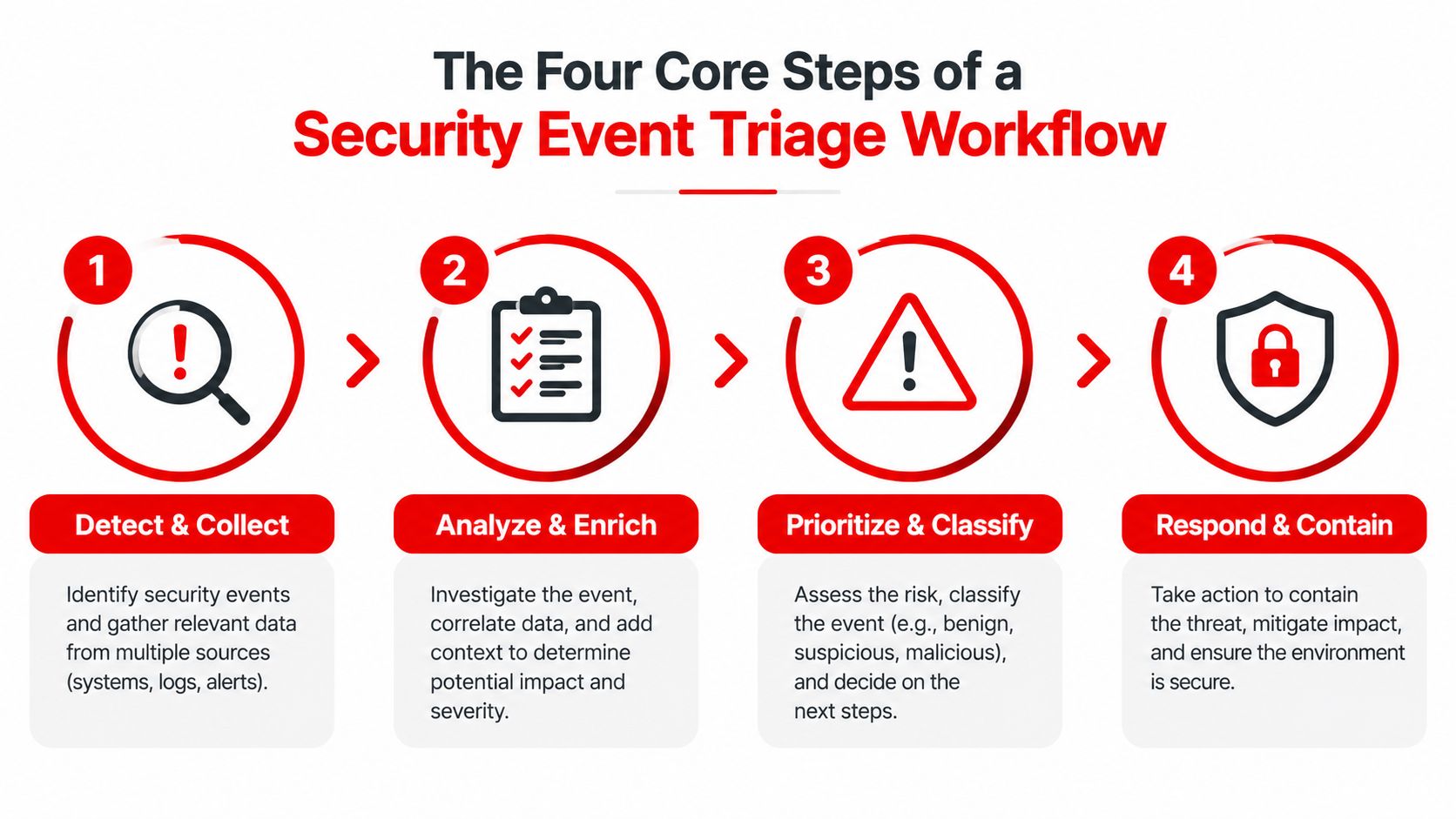
The Four Core Steps of a Security Event Triage Workflow
A reliable workflow starts before an analyst opens the alert. Ingestion should capture the original event, normalization should place it into a common schema, and routing should preserve the source and detection rule. Without those foundations, the analyst spends the first part of triage translating fields instead of assessing risk.
Enrichment gives the alert meaning
A single log line rarely contains enough evidence. The analyst should correlate the event with identity, asset inventory, recent activity, endpoint state, network context, and relevant threat intelligence. A failed login against a test account is not equivalent to a successful login against a privileged account on a production system.
Enrichment is complete when the analyst can answer who acted, what was affected, where it happened, whether the behavior is expected, and what related signals appeared around the same time. “Checked the user” isn't a sufficient handoff. The ticket should identify the user's role, the asset's importance, and the evidence that supports or challenges legitimacy.
Scoping defines the size of the problem
Next, determine whether the event is isolated or connected to other activity. Search for related hosts, accounts, sessions, processes, source locations, and matching detections. Scope doesn't require a full forensic investigation, but it should establish the boundaries of what is currently known.
A complete scope statement might say that one account and one managed endpoint are involved, with no related alerts found during the review window. A half-finished review says only that the triggering host was checked.
Classification selects the investigation path
Classification gives the event a working type, such as suspicious authentication, endpoint execution, data access, phishing, malware, or policy violation. That label should point to a runbook, detection guide, or specialist queue.
The classification can change as evidence develops. A suspicious login may become an account compromise investigation after the analyst finds impossible travel, an unfamiliar device, and a successful session. The important point is to record why the event moved from one path to another.
Disposition records the decision
The analyst must decide whether to close, monitor, contain, or escalate. The decision should include the evidence considered, what was ruled out, what remains uncertain, and who owns the next action.
Automated incident triage guidance describes a practical sequence of ingestion, normalization, enrichment, risk scoring, and routing, with high-risk events sent immediately and low-risk events deprioritized or closed. The human version follows the same logic. Automation can prepare the evidence, but the organization still needs a clear disposition standard.
Scoring Events by Consequence Rather Than Detection Severity
A detection tool's severity is a useful starting signal, not a final decision. The same alert can mean very different things depending on the account, asset, data, exposure, and business process involved.
A port scan against a disposable test system may deserve monitoring. A similar scan against an exposed payment environment may require immediate review because the consequence of compromise is materially different. Likewise, a low-fidelity phishing click on a marketing laptop shouldn't receive the same treatment as an active compromise of an administrative account connected to a payment system.
Build the score around consequence
A practical priority model combines four questions:
- How credible is the detection? Consider rule quality, corroborating signals, and known false-positive patterns.
- What is the asset or identity worth? Account privilege, data sensitivity, operational importance, and recovery difficulty matter.
- How exposed is the target? Internet exposure, remote access, third-party access, and control-plane access increase concern.
- How far may the activity have progressed? Persistence, lateral movement, privilege escalation, and suspected exfiltration raise priority.
A composite score doesn't need to be mathematically elaborate. It needs to be consistent enough that two analysts reach a similar conclusion from the same evidence. Reassess the score when scope changes, a new identity is involved, or the event moves from suspicious activity to confirmed impact.
A working severity comparison
| Severity Band | Detection Signal | Asset and Data Context | Business Consequence | Example Event |
|---|---|---|---|---|
| Sev-1 | Credible evidence of active compromise or destructive activity | Critical production system, privileged identity, regulated or highly sensitive data | Immediate operational, legal, safety, or material business impact is possible | Active compromise of an administrator account connected to a payment system |
| Sev-2 | Strong malicious indicators with meaningful corroboration | Important business system, executive identity, or exposed service | Significant disruption or lateral movement is plausible | Confirmed credential misuse across several corporate systems |
| Sev-3 | Suspicious but incomplete evidence | Standard user device or noncritical application | Investigation is needed, but immediate harm is not established | Unusual authentication followed by a new device registration |
| Sev-4 | Low-confidence or expected activity with limited concern | Low-value or isolated asset with no sensitive access | Little evidence of material impact | Low-fidelity phishing click on a marketing laptop with no follow-on activity |
Common severity frameworks use low, medium, high, and critical bands, with critical events such as active exploitation, confirmed data exfiltration, or ransomware requiring immediate escalation. A practical incident triage checklist provides this type of severity framing.
The failure mode is severity theater. Teams treat every “critical” label as critical, then stop trusting the label altogether. Consequence-based scoring forces the analyst to explain why the event matters, what could happen next, and whether the evidence justifies immediate action.
Incident triage guidance from Swimlane frames priority as a function of confidence, potential impact, and attack progression. That is a better operating model than allowing the SIEM to make an unreviewed decision based on detection severity alone.
Escalation Paths and Ownership Across the SOC
An escalation path works only when ownership changes at a defined threshold. “Send to Tier 2” is not a threshold. A useful handoff states what has been confirmed, what remains suspected, how broad the scope may be, and what the receiving role must decide.
Tier 1 should own initial validation, enrichment, basic scoping, classification, and low-risk closure decisions. Tier 1 shouldn't close an event involving confirmed privileged account misuse, suspected data exposure, destructive behavior, or an asset whose business owner has declared it critical.
Who owns what
| Tier / Role | Owns | Time to Acknowledge | Handoff Trigger | Loops In |
|---|---|---|---|---|
| Tier 1 analyst | Validate, enrich, scope, classify, and document routine dispositions | According to the queue's priority policy | Confirmed compromise, uncertain high-impact scope, sensitive asset, or action beyond authorization | Tier 2, system owner, or on-call responder |
| Tier 2 or senior analyst | Deeper correlation, hypothesis testing, severity reassessment, and investigation direction | Promptly for high-impact events, according to the SOC policy | Evidence of persistence, lateral movement, privilege abuse, data access, or expanding scope | Incident response, threat hunting, engineering |
| Incident responder | Containment strategy, evidence preservation, incident coordination, and response execution | Immediate for confirmed or potentially damaging incidents | Confirmed incident, material business impact, destructive activity, or suspected data exposure | Incident commander, legal, communications, executive owner |
| Threat hunter | Proactive investigation of related behaviors, entities, and detection gaps | Based on the investigation priority | Repeated signals, suspected lateral movement, unknown technique, or weak detection coverage | Detection engineering and incident response |
| Engineering or system owner | Technical remediation, access changes, recovery, and validation of system state | Based on asset criticality and response plan | Containment or remediation requires system access, configuration change, or service interruption | Business owner and incident commander |
| Business owner or incident commander | Risk acceptance, operational trade-offs, communications, and final coordination | Based on business impact | Cross-functional impact, legal exposure, customer effect, or major service disruption | Legal, privacy, communications, leadership |
A good handoff contains the alert summary, affected entities, evidence reviewed, confirmed findings, unresolved questions, current severity, recommended next action, and named owner. If the receiving analyst has to repeat basic searches before understanding the case, the first review wasn't complete.
Response targets should be explicit. One published workflow maps critical incidents to 15 minutes, high to 1 hour, medium to 4 hours, and low to 1 business day, with owner roles and closure actions defined alongside those targets. This incident triage workflow is a useful example of turning priority into an operational commitment.
For organizations building or reviewing their response process, an incident response process should make these boundaries visible in the runbook, ticket fields, on-call schedule, and escalation directory. A policy that exists only in a document won't help when the queue is active.
Documentation Templates That Actually Get Used
The ticket is the control surface. It is what the next analyst reads during an overnight shift, what the post-incident review examines, and what an auditor uses to understand why the organization closed or escalated an event.
Templates fail when they try to capture every possible detail. A triage note should force the fields that change the next decision, not create paperwork that analysts bypass.
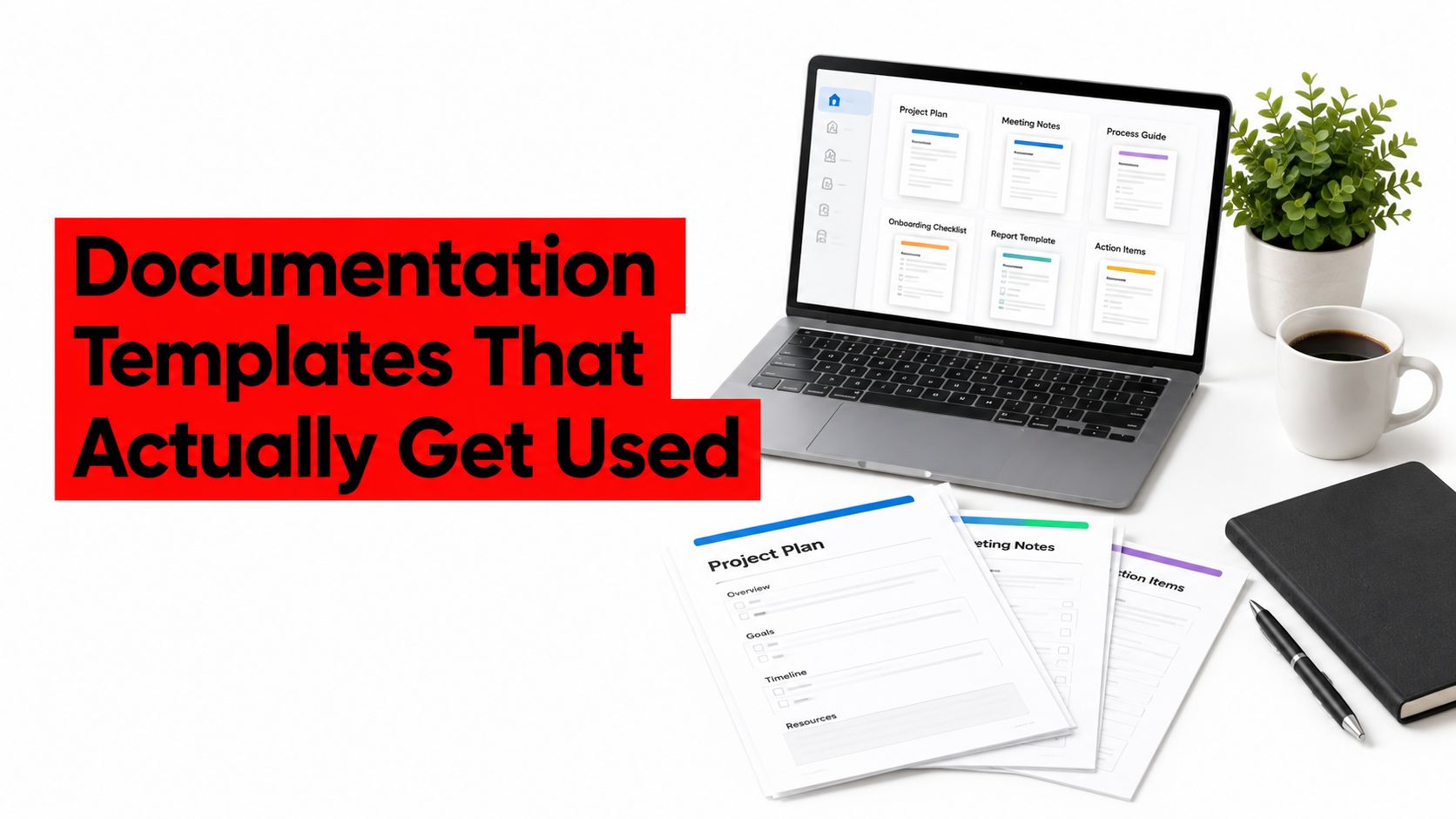
A copy-paste triage note
Event:
Detection source and rule:
Time observed:
Time range reviewed:
Affected identity or identities:
Affected asset or assets:
Business context:
What was observed:
What was confirmed:
What was ruled out:
Current scope:
Severity and rationale:
Disposition:
Next action:
Action owner:
Escalation or review time:
Evidence links:
The fields should support decisions. “Time range reviewed” shows how far the analyst looked. “Business context” explains why the same behavior may be routine on one asset and serious on another. “What was ruled out” prevents the next person from repeating completed checks.
Compare these two notes:
Weak: “Suspicious login reviewed. Benign, no action.”
Strong: “Successful login for a standard user from a new device triggered the detection. Identity records show the device was enrolled by IT earlier that day, and the user confirmed the session. No privileged access, password reset, or related endpoint alerts were found in the reviewed period. Close as expected enrollment activity. Detection owner to review whether new-device enrollment should be excluded after device trust is confirmed.”
The second note isn't long, but it tells the next analyst what happened, why the event was closed, and what tuning opportunity remains. Teams can adapt existing incident report templates for this purpose, but the triage record should remain concise enough to complete during the initial review.
Documentation test: If a field doesn't change who acts next or what they do, it probably doesn't belong in the triage record.
Roles, Cadence, and KPIs That Hold the Program Together
A triage program needs named roles and a review rhythm. Without them, metrics become a dashboard exercise and detection tuning becomes a series of urgent requests from whichever analyst complained most recently.
The core role set is straightforward:
- Triage lead: Owns queue health, decision standards, priority disputes, and daily operating issues.
- Quality reviewer: Samples closures and escalations, checks evidence quality, and tracks overrides or reopened cases.
- Detection content owner: Maintains rules, suppression logic, enrichment requirements, and runbook links.
- On-call incident responder: Receives defined escalations and confirms that high-impact events move into incident management.
Use each metric to answer a question
| Metric | Question it answers | Failure mode to watch |
|---|---|---|
| Alert volume by source | Which detections create the workload? | Volume falls because a source stopped reporting |
| Triage dwell time | How long does an event wait before a decision? | The team optimizes easy alerts while complex cases age |
| Escalation rate | How often does initial triage require another role? | Tier 1 sends everything upward to avoid accountability |
| False-positive ratio after enrichment | Which alerts remain noisy after context is added? | Analysts close without recording the evidence used |
| Override rate | How often do analysts disagree with automated or tool-assigned priority? | Overrides aren't reviewed, so decision rules never improve |
| Reopened case rate | How often do closures fail to survive later evidence? | The queue looks clean while missed context accumulates |
| Confirmed incident dwell time | How long do real incidents remain unresolved? | The severity mix shifts downward and hides response delays |
| Recurrence rate | Do the same causes keep generating events? | Teams close symptoms without fixing the detection or control |
A benchmark report describes elite performance using targets such as alert-to-triage in about 2 minutes, critical escalation in under 15 minutes, false-positive rates below 30%, and at least 95% of investigations auto-closed as benign. The same report notes that an initial tier may still see false-positive rates near 50%, while other SOC guidance places mature false-positive targets below 10% to 15%. These figures should be treated as comparison points, not universal promises, and they appear in this SOC benchmark report.
Run one operating rhythm
Start each day with a short queue huddle. Review aged alerts, high-priority events, blocked handoffs, and any reopened cases. Once a week, the triage lead, quality reviewer, and detection owners should inspect a sample of closures, the highest-override rules, and the sources generating the most unresolved work. Each month, review recurrence, confirmed incident dwell time, and whether business owners still agree with asset criticality definitions.
The numbers only matter when someone changes the process in response. A falling mean time to resolution can look positive while the team reclassifies difficult cases as low priority without fanfare. Read metrics together, and always compare speed with quality indicators such as false negatives, overrides, and reopened work.
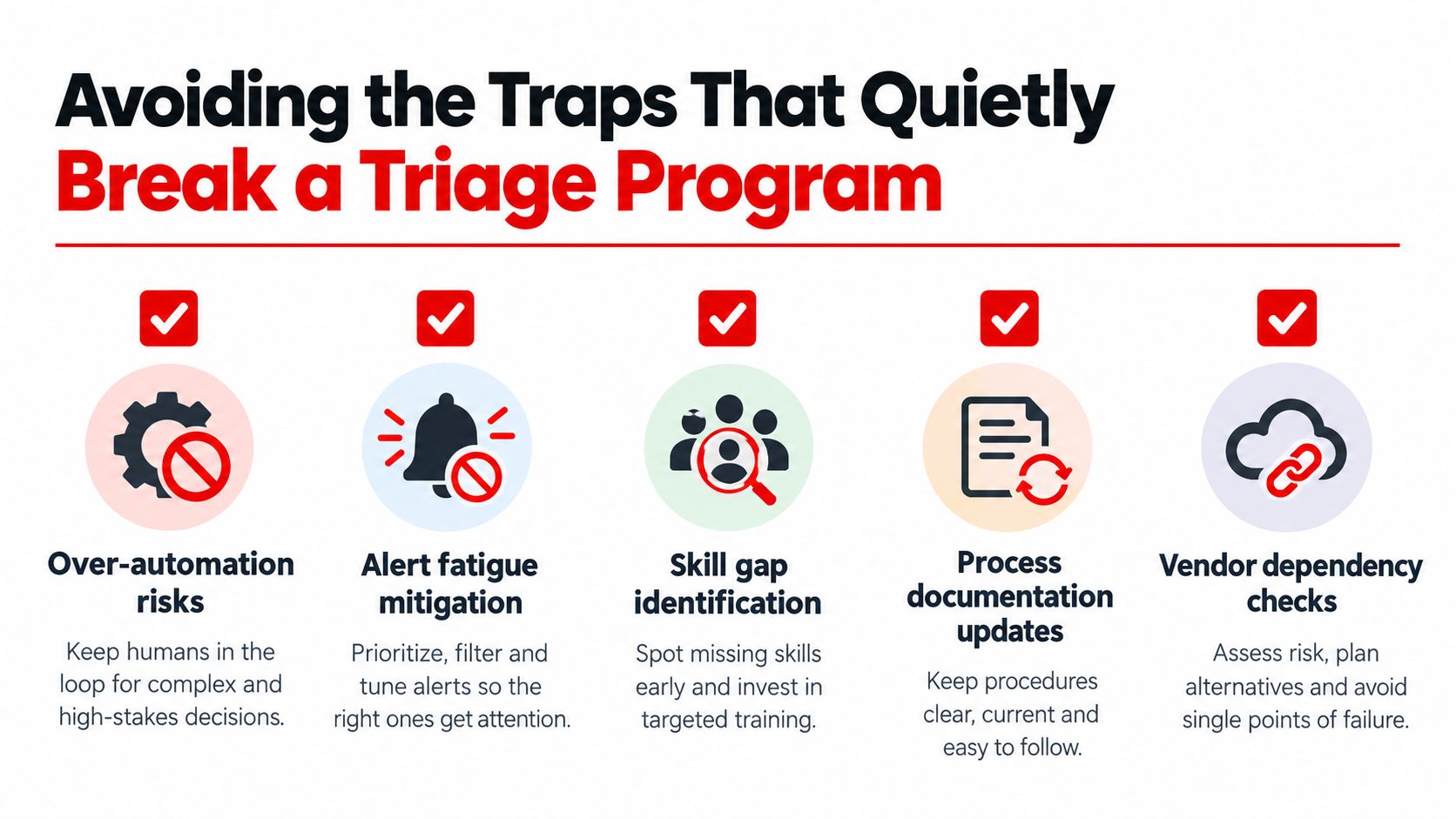
Avoiding the Traps That Quietly Break a Triage Program
The first trap is assuming more automation automatically creates better triage. It doesn't. Automation can repeat a weak decision rule faster, close an alert without enough context, or route every event through a playbook that analysts don't trust.
Use automation for predictable work first. Normalize fields, pull asset and identity context, correlate related events, apply known-safe conditions, and create consistent tickets. Keep human review for ambiguous evidence, high-consequence decisions, and actions that could disrupt a business process.
The second trap is severity theater. A SIEM label isn't a business impact assessment. A credential spray against a finance identity provider and a broad port scan against a low-value test segment may both produce high-volume alerts, but they don't create the same consequence. Require analysts to state what makes the target important and what evidence supports the assigned priority.
The third trap is using the queue as a dump. Tickets marked “benign, no action” don't preserve reasoning. The next analyst repeats the same investigation, and the organization loses the opportunity to improve the detection.
Three controls that improve the queue
- Require a closure rationale: Every closure should state the evidence that made the activity expected, irrelevant, or unsupported.
- Audit one decision rule at a time: Review whether the rule still matches the current environment, identities, assets, and business processes.
- Set an auto-closure boundary: Automatically close only events that meet a documented, reversible, and reviewable condition.
A fourth trap is trusting fragmented data. An automated system can appear confident while stitching together incomplete identity, asset, or activity records. If the asset inventory is stale or a service account has no owner, a polished risk score may conceal uncertainty rather than resolve it.
The practical test is whether the program catches decision failure, not just alert volume. Track reopened cases, analyst overrides, false negatives, duplicate alerts, and closures that later require escalation. A shorter queue is not a success if the team has only moved risk out of view.
The change to ship this week: Add a mandatory one-line closure rationale to the ticket form, then review a sample of those rationales in the next queue audit.
Overton Security offers 24/7 Security Operations Center oversight, site-specific procedures, event verification, patrol dispatch, and escalation support for properties across California. If your organization needs a practical partner for security event triage, remote monitoring, mobile patrols, or onsite security officers, visit Overton Security to discuss a program built around clear ownership, documentation, and response decisions.