
Choosing the right security partner in Los Angeles goes beyond just placing a uniform on your property. For property managers, HOA boards, and business owners, it's about building a smart, strategic security program tailored to your unique risks. An effective partnership begins with a clear understanding of your vulnerabilities and what you truly aim to accomplish.
Defining Your Security Needs in Los Angeles
Before reviewing proposals, it’s essential to clarify what you need to protect. A generic security plan often leads to wasted resources and, more importantly, missed threats. Every property in Los Angeles, from a retail center in the Valley to a high-rise in DTLA, has its own unique security profile.
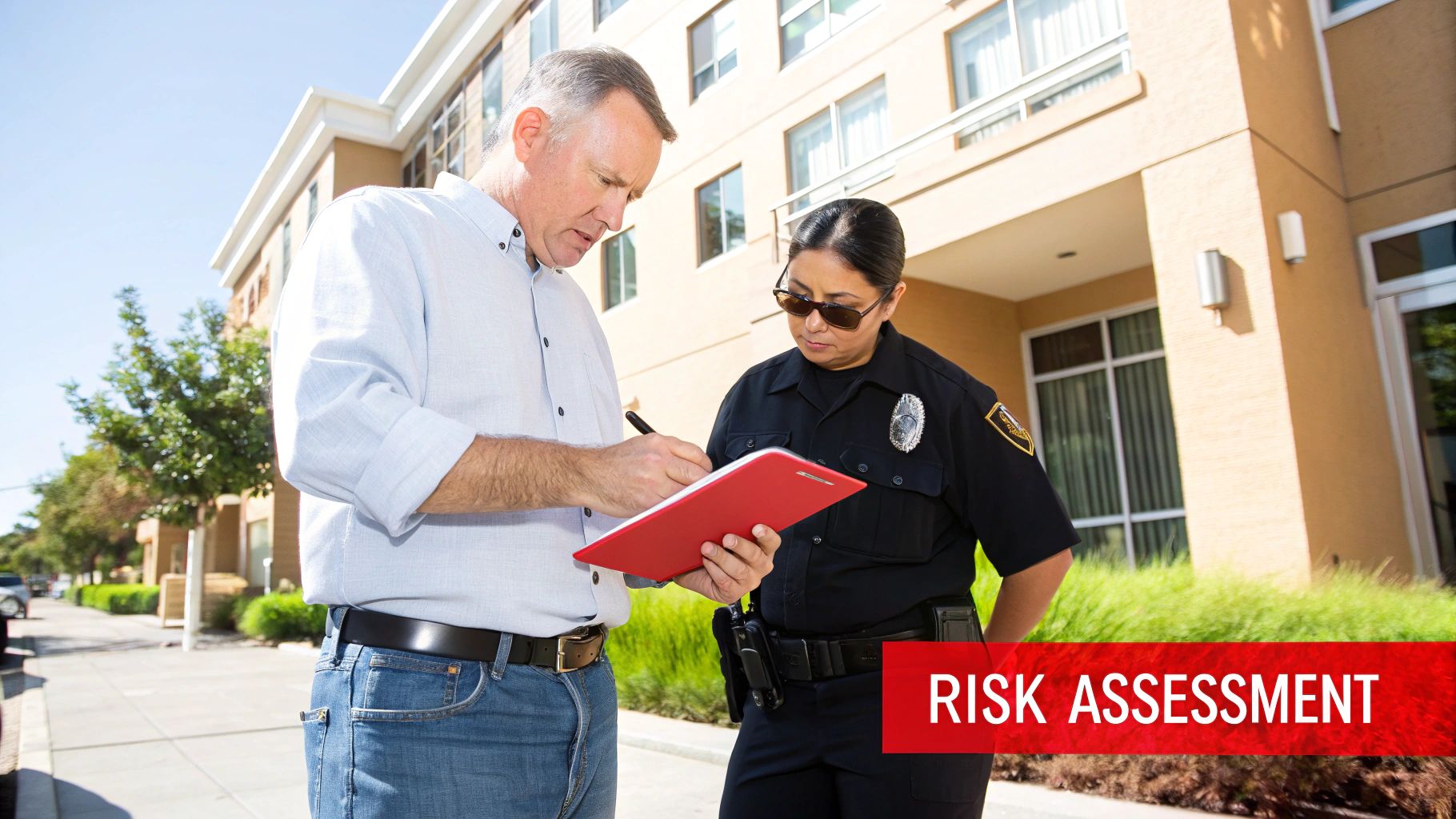
The first step is a practical risk assessment. Walk your property as if you were trying to find a way in. Where are the weak spots? Are there poorly lit parking areas? Unsecured doors after hours? Common areas that attract loitering? Answering these questions transforms a general need for "security" into a concrete action plan.
Identify Your Primary Objectives
Once you understand the risks, you can set clear goals. Your objectives will directly shape the type of security guard service you hire. Are you focused on:
- Visible Deterrence? Your main goal might be to prevent crimes of opportunity like graffiti or trespassing. In this case, the professional presence of a uniformed officer and a clearly marked patrol vehicle provides a powerful deterrent.
- Strict Access Control? For a corporate campus or an exclusive residential community, the mission may be to verify every person and vehicle. No unauthorized individuals should gain entry.
- Rapid Incident Response? If your property has a history of incidents, you need a trained officer on-site who can respond, de-escalate, and document events in seconds, not minutes.
- Asset Protection? A construction site superintendent faces a different challenge—preventing theft of valuable materials and equipment. This requires a specific strategy focused on securing the perimeter and monitoring activity.
This simple flow illustrates how to move from a basic assessment to a solid, actionable plan.
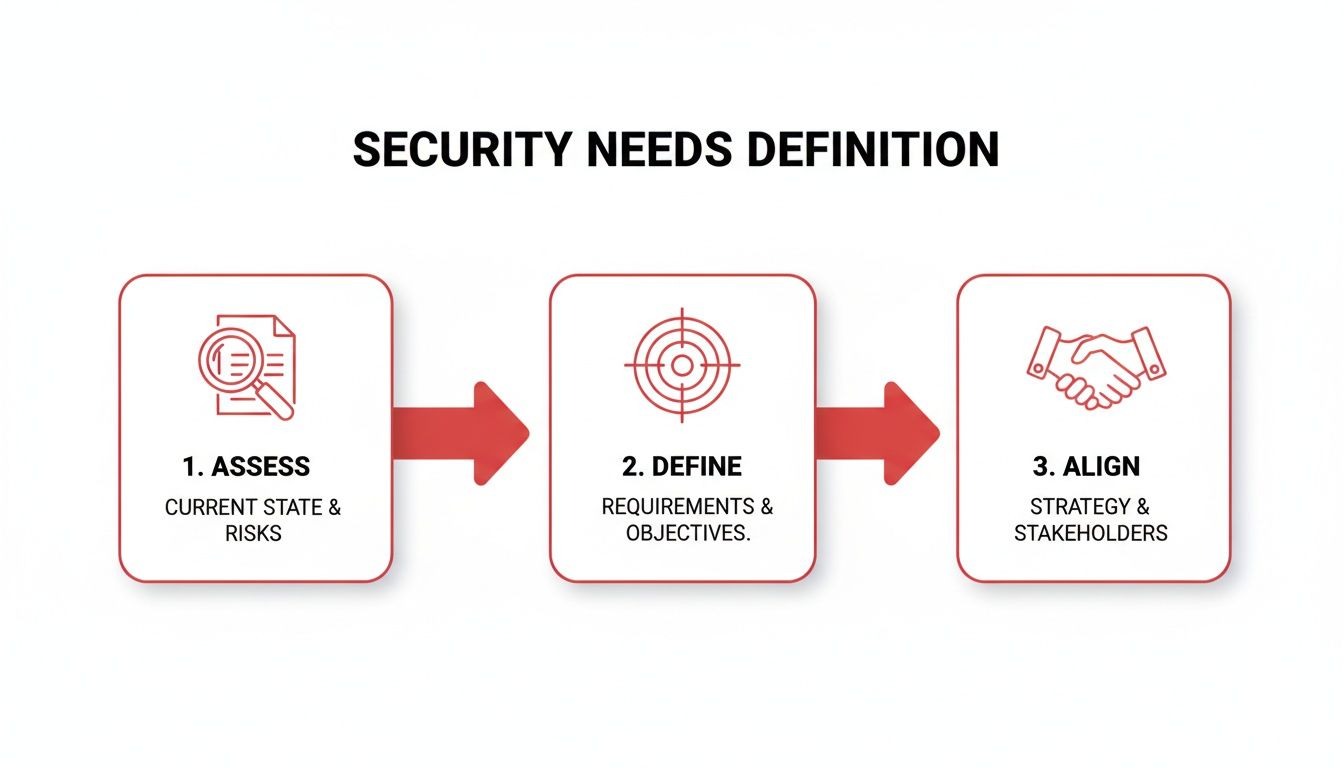
By following this process—assess risks, define goals, align with a provider—you develop a security program that works effectively and delivers real value for your property.
Aligning Needs with the Right Service Type
With your objectives defined, you can match them to specific services, making it easier to identify what you truly need.
A sprawling apartment complex dealing with late-night noise and unauthorized pool access would likely benefit most from a mobile patrol service. You can learn more about how patrols solve specific community problems in our guide on Los Angeles security patrol. In contrast, a Class A office tower requires a polished, concierge-style officer who excels at both customer service and access control.
To simplify this, here is a quick-reference table to help match common Los Angeles property types with the services that tend to work best.
Matching Security Solutions to Your LA Property
| Property Type | Common LA-Specific Risks | Recommended Security Service | Key Benefit |
|---|---|---|---|
| Class A Office Building | Unauthorized access, corporate espionage, public disturbances (DTLA). | Concierge/Lobby Ambassador & Access Control | Professional image, tenant safety, strict visitor management. |
| Retail Center / Mall | Shoplifting rings, loitering, parking lot incidents, vandalism. | Standing Guards (at entrances) & Mobile Patrols (parking areas). | High visibility deters theft, rapid response to incidents. |
| Apartment Complex / HOA | Trespassing, package theft, noise complaints, amenity misuse. | Mobile Patrols, Remote Video Monitoring. | Cost-effective coverage for large areas, enforces community rules. |
| Construction Site | Theft of copper/lumber, equipment vandalism, liability from trespassers. | On-Site Guard (overnight/weekends), Fire Watch. | Protects high-value assets, ensures site safety and compliance. |
| Industrial / Warehouse | Cargo theft, insider threats, after-hours break-ins. | Gate Access Control & Roving Patrols. | Secures supply chain, prevents unauthorized vehicle entry. |
This table provides a solid starting point for aligning your property’s specific needs with a practical security solution.
Effective security plans are not about adding more personnel; they are about deploying the right assets to the right places at the right times. This strategic approach prevents overspending and ensures every dollar enhances your property's safety.
As you define your needs, consider the importance of a constant presence. For properties that cannot afford coverage gaps, understanding the logistics of 24/7 service operations is crucial. This clarity helps you find a security provider in Los Angeles that is a true partner for your goals and budget.
Verifying LA Security Licensing and Compliance
Selecting a security partner in Los Angeles requires more than comparing prices. You must investigate the legal requirements, particularly California’s stringent licensing and insurance mandates. Overlooking this step is a significant risk. Partnering with a non-compliant or uninsured vendor can expose your organization to serious legal and financial consequences.
This part of the process is non-negotiable. It ensures the company you hire is authorized to operate and its officers hold the proper certifications to protect your property. A company that cuts corners on compliance will almost certainly cut corners on service.
BSIS and the PPO License: The Foundational Requirement
In California, the security industry is regulated by the Bureau of Security and Investigative Services (BSIS). Any company providing security guards must hold a valid Private Patrol Operator (PPO) license. There are no exceptions.
The PPO license is the foundational credential, proving the company has passed state background checks and carries the necessary insurance. If a potential vendor cannot provide a valid PPO license, they are operating illegally.
A professional tip: If a company is hesitant to provide its PPO license number, consider it a major red flag. A legitimate firm will display it on its website, proposals, and business cards. Any reluctance is a clear sign to move on.
Your Essential Verification Checklist
Before signing a contract, perform your due diligence by verifying key documents. A reputable company will readily provide this proof as an opportunity to demonstrate its professionalism and legitimacy.
Ensure you verify the following:
- PPO License Status: Do not take their word for it. Visit the BSIS website and look up the company yourself. The license status should read "Current" or "Clear." Anything else is unacceptable.
- Proof of Insurance: At a minimum, the provider needs general liability, workers' compensation, and commercial auto insurance. Request their Certificate of Insurance (COI) and review it carefully, checking policy limits and expiration dates. Inadequate coverage could leave you liable after an incident.
- Individual Officer Guard Cards: Every security officer assigned to your property must have a valid Guard Card from BSIS. This card confirms they have completed state-mandated training and passed a criminal history background check.
This checklist is the most effective way to eliminate unqualified vendors from the start. It protects you from the risk of having uninsured, untrained, or unvetted guards responsible for your property's safety. To learn more, it's worth understanding the specifics of California’s security guard licensing. This knowledge will empower you to choose a partner who takes accountability as seriously as you do.
Understanding Security Service Costs in Los Angeles
When property managers receive their first proposal for a security guard service in Los Angeles, a common question arises: Why is the hourly bill rate significantly higher than the officer's wage?
It’s a fair question, and the answer is key to selecting a quality partner and avoiding suspiciously low bids. The quoted price includes direct labor costs plus the entire operational infrastructure needed to deliver reliable, professional security.
The final bill rate covers more than just an officer in a uniform. It ensures that officer is well-trained, properly insured, actively supervised, and equipped to handle any situation. Companies that skimp on these operational costs often provide a service that appears adequate on paper but fails in practice, leading to high turnover, missed patrols, and significant liability for you.

Key Factors That Drive Security Costs
Several core components contribute to the final hourly rate. A transparent security partner will be able to explain how each element adds value. These are not just line items; they are direct investments in the quality and consistency of your protection.
- Officer Wages and Benefits: This is the largest component. To attract and retain experienced, reliable professionals in a competitive market like Los Angeles, a company must offer competitive pay, health benefits, and paid time off. Companies paying minimum wage often experience high turnover, resulting in a constant rotation of new, inexperienced guards at your property.
- Insurance and Liability: This is non-negotiable. A professional security firm must carry substantial general liability, workers' compensation, and commercial auto insurance. This coverage protects you from significant financial risk if an incident occurs on your property.
- Supervision and Management: Effective security requires active oversight. This cost covers field supervisors who conduct site inspections and support officers, plus an account manager who serves as your dedicated point of contact. At Overton Security, we maintain a low manager-to-client ratio to ensure every client receives the hands-on attention they deserve.
- Technology and Equipment: Modern security relies on more than a clipboard and a flashlight. Costs include uniforms, communication devices, patrol vehicles, and advanced reporting software. Our 24/7 Security Operations Center (SOC) provides an additional layer of real-time support and oversight, all factored into the service rate.
Realistic Hourly Rate Ranges in Los Angeles
The Los Angeles security market is one of the most expensive in the country, driven by local labor laws and high demand. The difference between an officer's direct pay and the client's bill rate covers essential overhead for insurance, training, and management.
For a deeper dive, you can explore our guide on how much to pay for security guard services.
Current market data indicates that unarmed security guards in Los Angeles typically command bill rates between $30 and $37 per hour. For armed professionals, that range increases to $50 to $95 per hour.
These rates are significantly higher than the average guard's wage, which the Bureau of Labor Statistics places at around $20.86 per hour for the LA metro area. The difference is not just profit; it covers the critical operational costs that ensure you receive quality, reliable service.
A bid that falls well below these market averages should be a major red flag. It strongly suggests the company is cutting corners on insurance, training, or wages, which inevitably leads to poor performance and high turnover.
Understanding these cost components empowers you to evaluate proposals with confidence. Instead of focusing solely on the bottom-line number, you can ask insightful questions about a vendor’s investment in their people, technology, and operational support. This is how you find a true security partner who delivers predictable costs and consistently high-quality protection.
Vetting Potential Security Partners: A Practical Checklist
Once you have a shortlist of licensed vendors within your budget, the real evaluation begins. This is where you move beyond proposals and pricing to understand the operational integrity of each company—how they hire, train, support, and supervise their team.
Choosing the right firm is about selecting a partner with a proven culture of accountability. For any property manager in Los Angeles, this means finding a company with hands-on leadership that treats its officers as valuable, long-term assets, not just temporary placements.
Evaluating Officer Training and Retention
A security company's employee turnover rate is one of the most revealing indicators of its quality. High turnover is a significant red flag, signaling low pay, poor management, or a lack of support—problems that will ultimately affect your property through inconsistent service and a revolving door of unfamiliar faces.
When interviewing a potential security guard service in Los Angeles, ask direct questions:
- What is your average officer turnover rate? A quality company will be proud of a low number and have retention programs in place. In contrast, many firms in the industry experience turnover exceeding 100% annually.
- Can you describe your ongoing training program? The state-mandated Guard Card is just the beginning. Ask about site-specific training, de-escalation protocols, customer service, and emergency response drills.
- How do you support your officers in the field? Look for answers that mention frequent supervisor check-ins, employee recognition, and clear pathways for career advancement. A company that invests in its people is investing in your property’s safety.
A security company that supports its team directly enhances your property’s safety. Officers who feel valued are more alert, professional, and proactive, resulting in a stable and effective security program you can rely on.
Assessing Field Supervision and Technological Oversight
An unsupervised officer can become a liability. A key differentiator for a premium security service is its structure for both in-person supervision and technological oversight. This system ensures that the promises made during the sales process are delivered on the ground, even at 3 a.m.
Ask potential partners to detail their accountability systems. A strong answer will describe a blend of human expertise and smart technology. The principles for evaluating a security partner are similar to learning how to choose a reliable service provider in any critical role; it comes down to proven processes and reliability.
Before signing a contract, dig into these operational details. The table below outlines essential questions to help you separate serious contenders from the rest.
Key Questions for Vetting Security Vendors
| Category | Essential Question | What a Good Answer Looks Like |
|---|---|---|
| Hiring & Screening | "Can you walk me through your hiring process from application to first day on site?" | "Our multi-step process includes several interviews, a comprehensive background check beyond state minimums, and reference checks. We hire for temperament and reliability, not just a license." |
| Training | "What does your site-specific training involve for a property like mine?" | "Before an officer works a shift alone, they shadow a senior officer and complete a site-specific training module covering post orders, emergency contacts, your access control system, and key tenant protocols." |
| Supervision | "How often does a field supervisor physically visit the property and interact with the officer?" | "Our supervisors conduct unannounced site visits multiple times per week at varied hours, including overnight. Every visit is documented in our guard tour management system." |
| Technology | "What technology do you use to ensure accountability and provide real-time reporting?" | "We use a guard tour system like TrackTik or GuardTek for real-time tracking and incident reporting. Our SOC also monitors officer wellness and GPS location 24/7." |
| Retention | "Besides pay, what are the top 3 things you do to retain your best officers?" | "We offer clear career advancement paths, ongoing professional development, and a robust employee recognition program. We want our officers to view this as a career, not just a job." |
Asking these direct, operational questions pushes vendors beyond marketing claims to demonstrate their true capabilities. A great partner will welcome this level of scrutiny.
The Power of a 24/7 Security Operations Center
A modern, professional security provider must operate a Security Operations Center (SOC). This is the mission control for your property's security, providing real-time support and oversight.
An effective SOC does more than just answer phones. Look for:
- GPS Monitoring: Supervisors know the real-time location of every officer and patrol vehicle.
- Wellness Checks: Regular, automated check-ins ensure officers are safe and alert, especially during quiet overnight shifts.
- Incident Support: If an officer handles a serious issue, the SOC can dispatch backup or coordinate with law enforcement instantly.
This centralized oversight provides a powerful layer of accountability that you simply don't get from companies that just drop off a guard and hope for the best.
Finally, always ask for references—and be specific. Request contact information for clients who manage properties similar to yours in the Los Angeles area. Speaking with a fellow property manager who can vouch for a company’s responsiveness, reporting, and hands-on leadership is often the most valuable insight you can gather.
Launching Your New Security Program
Signing the contract is the beginning, not the end. The true value of any security guard service in Los Angeles is demonstrated in the actions that follow. A smooth rollout and disciplined, hands-on management are what elevate a vendor to a true strategic partner.
This transition from sales to service is where a company’s operational strength becomes clear. A professional security firm will guide you through a structured onboarding process, ensuring everything is in place from day one.
Crafting Your Operational Playbook
The foundation of any effective security program is a clear set of Post Orders. This is not just a to-do list; it is the daily operational guide for every officer on your property. Vague Post Orders lead to confused officers and inconsistent service.
Developing this document is a collaborative effort. You provide property-specific knowledge, and your provider contributes security expertise. The final document must be detailed, specific, and easily understood by any officer.
A strong set of Post Orders always covers:
- Property Overview: Include laminated maps showing critical assets like utility rooms, fire control panels, and access points.
- Routine Duties: Provide a clear schedule of patrols, door checks, and other recurring tasks.
- Access Control Procedures: Detail step-by-step instructions for handling visitors, vendors, and after-hours deliveries.
- Emergency Contacts: Establish a clear chain of command for both your team and the security company.
- Incident Response Protocols: Offer simple instructions for common scenarios like fire alarms, trespassers, or water leaks.
Post Orders are living documents. Review and update them quarterly or whenever a significant change occurs at your property. An outdated playbook is nearly as risky as having no playbook at all.
Using Technology for Real Accountability
In today’s environment, verification is essential. Modern technology provides the tools to ensure you receive the services you pay for. A Guard Tour Management System (GTMS) is no longer an optional feature; it is a fundamental requirement for any professional security service.
This system uses GPS and NFC tags placed at key checkpoints. As an officer makes their rounds, they scan these tags, creating a time-stamped, digital log of their movements. This eliminates guesswork and brings full transparency to their patrols.
You should receive detailed daily activity reports (DARs) and instant incident reports—complete with photos—directly from this system. This data is invaluable for tracking performance and identifying recurring security issues before they escalate.
Establishing a Communication Rhythm
A great security partner remains engaged long after the contract is signed. They communicate proactively.
Establish a regular communication schedule with your account manager. A brief weekly check-in or a bi-weekly call is ideal for reviewing reports, addressing minor issues, and planning for upcoming events. This ongoing dialogue prevents small problems from becoming major concerns and builds a strong, accountable working relationship.
The LA security market is highly competitive. With 183,620 security guard positions in California, retaining a stable, professional team is a significant advantage. You can find more insights about security guard employment trends and their impact on service quality. A partnership approach is key to retaining good officers at your site and maintaining high service levels.
Answering Your Los Angeles Security Service Questions
When hiring a security team, many practical questions arise. After 26 years providing security guard services in Los Angeles, we have addressed nearly every concern from property and facility managers. Here are straightforward answers to the most common questions we receive.
What Is the Difference Between Proprietary and Contract Security?
You have two main options: building an in-house team (proprietary) or outsourcing to a specialized firm (contract).
A proprietary team means you are responsible for everything—hiring, training, scheduling, payroll, insurance, and liability. While it offers direct control, it is a significant administrative and financial burden.
Contract security, which is our focus, allows you to delegate these responsibilities. For the vast majority of LA properties, this is the more efficient and cost-effective choice. You gain access to a pool of trained officers, transfer liability, and free up your management team to focus on their core responsibilities.
How Much Notice Is Needed to Start a New Security Service?
The timeline depends on your needs. For a straightforward, single-officer post, such as for an emergency fire watch or last-minute coverage, we can often have an officer on-site within 24 to 72 hours.
For a more comprehensive setup with multiple officers and a detailed security plan, providing 7 to 14 days is ideal. This lead time ensures a smooth, professional launch.
A well-planned start is critical. The extra time allows us to select the right officers for your property, conduct hands-on site training, and finalize the post orders. It sets the entire program up for long-term success.
Rushing the start can lead to preventable issues later. A little planning upfront ensures your security program is solid from day one.
What Happens If an Officer Isn't the Right Fit?
It can happen. Every property has a unique culture, and finding an officer with the right temperament is as important as their skills. This is a valid concern, and a good security partner will have a straightforward solution.
If an assigned officer is not a good match for your environment, a simple call to your account manager is all that is needed. At Overton Security, our goal is to find the perfect long-term fit. This may involve additional coaching or reassigning the officer. The bottom line is that you should be 100% comfortable with the team protecting your property.
Are Dedicated Vehicle Patrols Better Than Shared Patrols?
One is not inherently "better" than the other; it depends on your security goals and budget. They serve two different purposes for LA properties.
- Shared Patrols: This is a cost-effective option where one patrol vehicle serves multiple properties in a designated area. It is an excellent way to create a visible deterrent against crimes of opportunity like trespassing, loitering, or vandalism.
- Dedicated Patrols: A patrol vehicle is assigned exclusively to your property or portfolio. This provides much faster response times and a constant, powerful visible presence. The officers also develop deep, specific knowledge of your site’s unique characteristics and vulnerabilities.
For a large corporate campus, a sprawling HOA, or a high-value industrial park, a dedicated patrol is almost always the superior choice. The investment pays for itself by transforming your patrol from a simple deterrent into an immediate, on-site response asset.
Finding a security partner who provides clear, confident answers is the first step toward building a truly secure property. With 26 years of hands-on experience, the team at Overton Security is here to provide reliable service and transparent solutions. See how our client-first approach can make a difference for you at https://www.overtonsecurity.com.