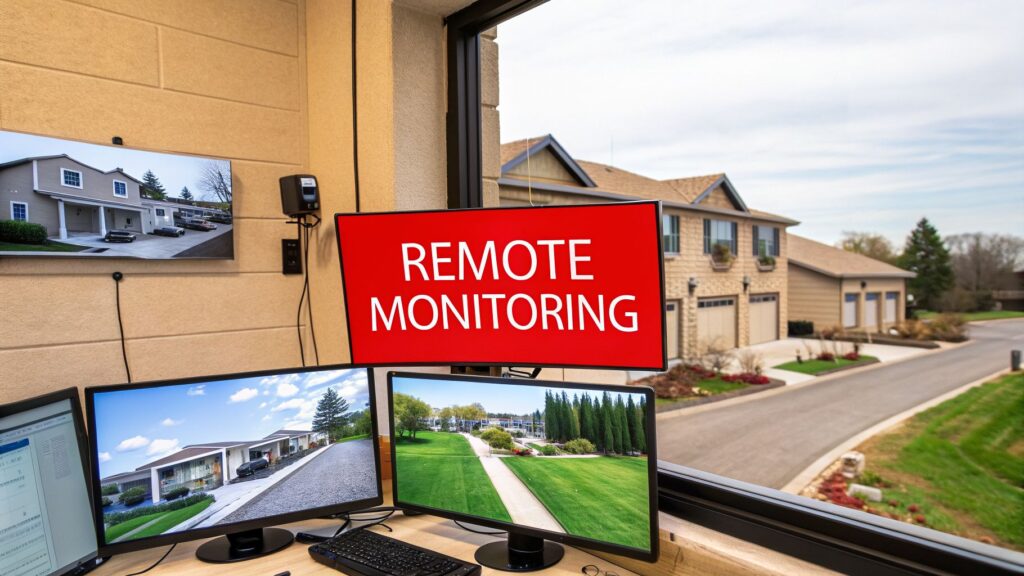
Are you looking for a way to have a dedicated security team watch over your property 24/7—a team that never blinks, takes a break, or gets tired? That is the practical reality of remote video monitoring. It’s an active service that uses strategically placed cameras and real-time professional oversight to transform your security from a passive recording tool into a proactive shield.
How Remote Video Monitoring Works
This isn't just about placing a few cameras on a wall and hoping for the best. Remote video monitoring is an active, intelligent service that acts as a powerful force multiplier for your security program. It provides your property with the immense benefit of around-the-clock surveillance without the steep costs of a full-time, onsite guard force. The entire system is built to do one thing: stop threats before they cause damage or loss.
Think of it as a high-tech watchtower for your property, staffed by trained security specialists from a central command center. They’re always watching, always ready to act.
A Quick Look at Security Models
To truly grasp the value of active monitoring, it helps to see how it stacks up against other common security setups. Each model has its place, but they offer vastly different levels of protection and responsiveness.
| Feature | Onsite Security Guards | Passive CCTV Recording | Remote Video Monitoring |
|---|---|---|---|
| Primary Function | Physical presence, immediate response | Records events for later review | Proactive detection and live intervention |
| Deterrence | High (visible presence) | Low (criminals often ignore cameras) | High (live audio warnings, visible tech) |
| Response Time | Immediate (if on scene) | Delayed (after the event is over) | Instant (live intervention, fast dispatch) |
| Cost | Very High | Low to Moderate | Moderate |
| Coverage | Limited to guard's location/patrol | Comprehensive (wherever cameras are) | Comprehensive (wherever cameras are) |
| Verification | Verified by sight | Unverified until footage is reviewed | Verified in real-time by live agents |
This table makes it clear: while traditional guards offer a physical presence and CCTV provides a record, remote video monitoring bridges the gap. It delivers active, verified, and immediate intervention at a fraction of the cost of onsite personnel.
The Three-Step Process
At its heart, the system is a simple, powerful loop: see something, analyze it, and act on it. This workflow is what turns a simple video stream into a security powerhouse, whether you're protecting a construction site in San Jose or a retail center in Los Angeles.
This is the basic flow of how an event is handled from start to finish.

It’s a seamless blend of on-site technology and human expertise.
- Site Observation: It all starts with high-definition cameras placed at key points across your property. These aren't just recording devices; they are the system's eyes, sending a secure, live video feed over the network.
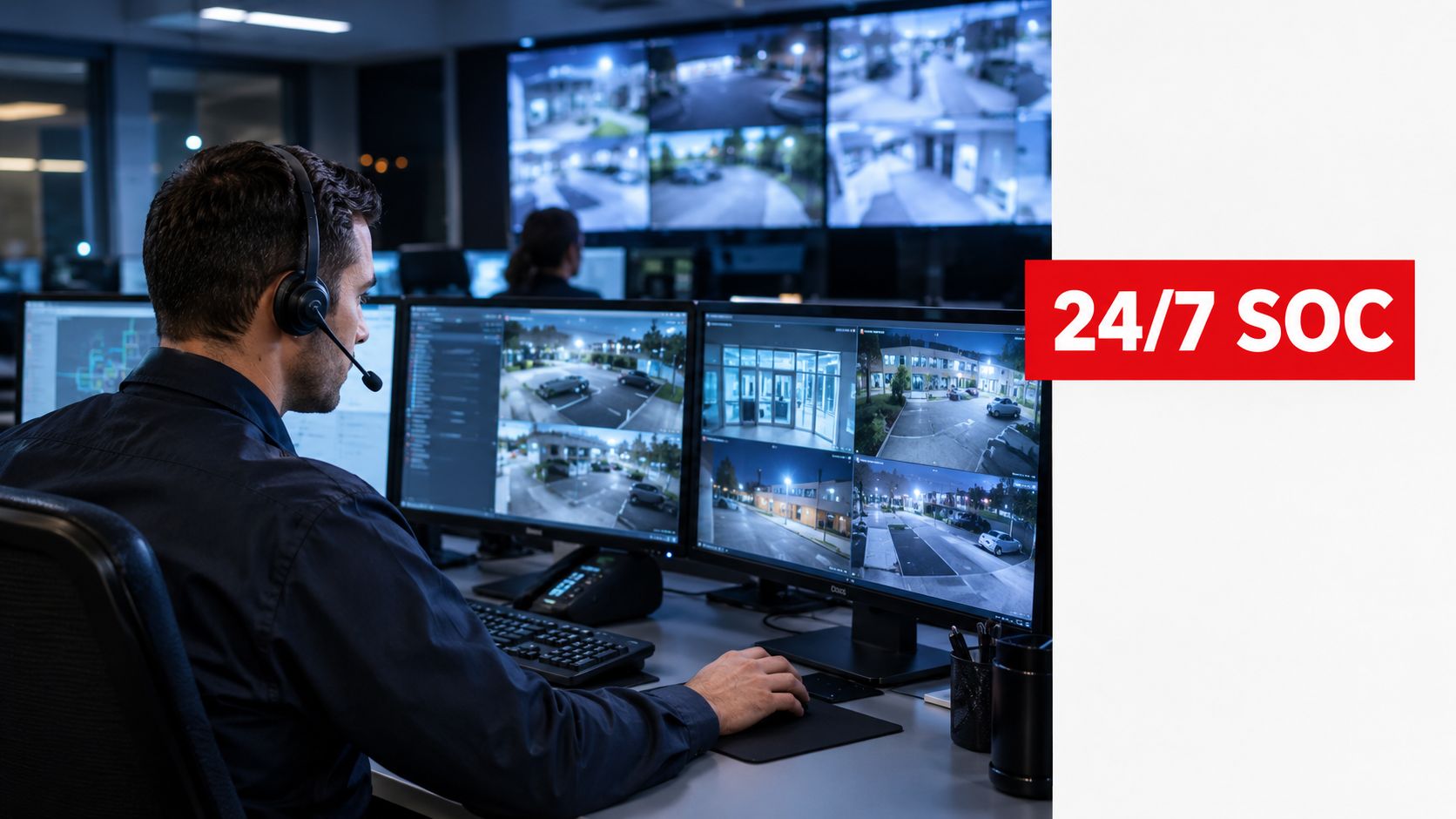
- Hub Analysis: That feed goes directly to a 24/7 Security Operations Center (SOC). Here, our highly trained agents use smart video analytics to monitor the feeds. The AI does the heavy lifting, filtering out false alarms from things like falling leaves or stray animals, so agents can focus only on genuine threats.
- Decisive Action: The moment a potential threat is confirmed—like a trespasser hopping a fence—an agent takes immediate action. This is where the service truly proves its worth.
The real power of remote video monitoring is the ability to intervene the second an incident begins. An agent can activate powerful on-site speakers and issue a live audio warning, telling intruders they are being watched in real-time. This "voice-down" alone is enough to deter the vast majority of would-be criminals.
Beyond the Basics of Monitoring
If an intruder ignores the audio warning, our agent immediately escalates the response based on pre-approved protocols. This could mean dispatching a mobile patrol car or contacting local law enforcement with verified, live information about a crime in progress. A verified report like this typically gets a much higher priority response from police than a standard, unverified alarm. As surveillance technology evolves, exploring options like Drone in a Box solutions also shows how automated, next-generation tools are changing the game.
Ultimately, the human element is what makes this system so effective. The technology provides the eyes and ears, but it’s the seasoned judgment of the SOC agents that ensures a calm, appropriate, and effective response every time. It's this combination of smart tech and human expertise that truly sets professional remote video monitoring apart.
The Components of an Effective Monitoring System
An effective remote monitoring setup is so much more than just a few cameras. It’s a complete ecosystem where advanced technology and human expertise work together, hand-in-glove. For property managers, understanding these moving parts is key to seeing how this service delivers such robust protection. A truly dependable system is built on four essential pillars that create a security solution that is both intelligent and reliable.

This powerful combination of hardware, software, and skilled professionals is what turns passive surveillance footage into proactive, real-time security.
1. High-Definition Security Cameras
The foundation of any remote video monitoring system is the cameras themselves. Think of them as the “eyes” on your property—and their quality directly impacts how effective the entire service can be. Modern systems rely on high-definition cameras to provide crystal-clear images, making sure our security agents can accurately identify people, vehicles, and other critical details, day or night.
Of course, every property has unique challenges. A comprehensive security plan often mixes in specialized cameras to handle specific environments.
- Low-Light and Infrared (IR) Cameras: These are absolutely essential for visibility after dark. They capture sharp details in unlit parking lots, on construction sites, or along dark perimeters where a standard camera would be blind.
- Thermal Cameras: Perfect for large, open areas or places with tricky lighting, thermal cameras see heat signatures instead of light. This lets them spot an intruder hiding in deep shadows or behind bushes, giving an incredible advantage in detection.
- Pan-Tilt-Zoom (PTZ) Cameras: These cameras put our remote agents in the driver's seat. They can actively follow a suspect, zoom in on a license plate, or get a wider view of a situation as it unfolds in response to an alert.
Just having the right tech isn't enough; placement is everything. The strategic positioning of cameras is crucial for maximizing impact and deterrence.
2. Intelligent Video Analytics
If cameras are the eyes, then intelligent video analytics software is the “brain” of the operation. This powerful AI technology is constantly watching the video feeds, programmed to know the difference between normal, everyday activity and a potential threat. It's what allows a system to monitor dozens of cameras at once without the risk of human fatigue.
Think of it this way: The AI is like a tireless digital gatekeeper. It’s trained to ignore the noise—things like falling leaves, birds, or small animals—so that our trained security agents only get alerts for events that actually matter, like a person loitering near an entrance or a vehicle entering a restricted zone after hours.
This smart filtering means our agents can focus all their attention on verified incidents, leading to a much faster and more accurate response. The AI never gets tired, never looks away, and never gets distracted.
3. Secure and Reliable Network Infrastructure
All this advanced hardware and software is tied together by a secure network infrastructure. This is the central nervous system, carrying video data from your property's cameras straight to our Security Operations Center (SOC). In this role, reliability is everything.
The entire system depends on a stable, uninterrupted connection to make sure there are zero gaps in surveillance. Modern systems also use heavily encrypted data transmission to shield video feeds from being hacked or intercepted, keeping your property’s security data private and secure from the camera all the way to the command center.
4. The 24/7 Human Element
While technology provides the powerful tools for seeing and analyzing, it’s the human element that provides critical judgment and decisive action. At the very heart of our remote video monitoring service is our 24/7 Security Operations Center (SOC), staffed by highly trained and experienced security agents.
These aren't just passive screen-watchers; they are security professionals. When an AI-powered alert flags a potential threat, an agent instantly takes over to verify what’s happening, assess the context, and execute a pre-approved response protocol. This blend of smart tech and human expertise ensures every response is calm, measured, and effective, giving you true peace of mind.
What Are The Real-World Benefits for Property Managers?
As a property manager, you're constantly balancing budgets, tenant safety, and the day-to-day work of keeping things running smoothly. The big question for any new service is simple: will it actually improve my operations and my bottom line? When it comes to remote video monitoring, the answer is a clear "yes." It’s about moving away from just reacting to problems and starting to proactively prevent them.

The advantages go way beyond just recording what happens. This technology actively creates a safer environment for residents, shoppers, and employees while protecting your physical assets. Let's dig into the key benefits this service offers property managers today.
Major Cost Reductions
One of the first things you'll notice is the positive impact on your security budget. Staffing onsite guards around the clock is easily one of the biggest security expenses a property can have. With remote monitoring, a single, highly-trained agent can effectively watch over multiple sites—or one very large property—all from a central command center.
This model gives you comprehensive, 24/7 coverage for just a fraction of what you’d pay for traditional guard services. You get more eyes on your property for fewer dollars, which directly helps your operating budget.
Active Deterrence and Stopping Trouble Before It Starts
Let's be honest: passive cameras are often ignored. Criminals know they’ll likely be gone long before anyone bothers to check the footage. Remote video monitoring completely changes that equation. The system isn't just a silent witness; it's an active participant.
Imagine a construction site in Fresno after hours. When our AI analytics spot a trespasser, a live agent can immediately activate a loudspeaker. A loud, clear voice announcing, “You are trespassing on private property and are being recorded,” is an incredibly powerful deterrent that stops most incidents right there.
This kind of proactive intervention turns a potential crime into a non-event. It prevents theft and vandalism before the damage is done.
Faster, Smarter Emergency Response
So what happens if a determined intruder ignores the warning? This is where the speed and quality of the response truly matter. A remote agent doesn’t just sound a generic alarm; they become a live intelligence source for police or a dedicated mobile patrol unit.
Because the agent can give a live, verified description of what's happening—including how many people there are, where they are, and what they're doing—police departments often give these calls a much higher priority. A verified report of a crime in progress is far more effective than an unconfirmed alarm bell, ensuring help gets there faster. For a property manager in a busy area like Los Angeles, that level of coordination is invaluable.
Solid Proof for Liability and Investigations
After an incident, high-quality video is your best asset. Whether you're dealing with a fraudulent slip-and-fall claim in a retail parking lot or a break-in at a community clubhouse, clear video provides indisputable evidence.
- Incident Investigations: Video gives law enforcement the proof they need to identify suspects and accurately piece together what happened.
- Liability Protection: It can quickly confirm or disprove claims, protecting you from fraudulent lawsuits and helping to keep your insurance premiums down.
- Operational Insights: Simply reviewing footage can also reveal safety hazards or operational issues you weren't even aware of.
This documentation creates a transparent record that protects both your assets and your reputation. It's no surprise that this technology is seeing massive adoption. The global video surveillance market is projected to grow significantly by 2032, with commercial properties making up a substantial portion of all systems. You can read more about the dramatic growth of video surveillance and its market impact.
Practical Applications Across Different Industries
Remote video monitoring isn't a one-size-fits-all security solution. Its power comes from its adaptability to the specific risks and daily realities of different properties. A security plan for a busy Los Angeles retail center will naturally look much different than one for a quiet San Jose residential community.
Grasping these differences is the first step to building a security strategy that actually works. When property managers see how this technology is used in various sectors, it stops being a general idea and becomes a practical, results-driven tool.
Safeguarding Commercial and Office Properties
For commercial property managers, the biggest security headaches often start after everyone has gone home. Empty lobbies, deserted parking garages, and vacant office floors are prime targets for vandals, thieves, and trespassers. Remote video monitoring provides a vigilant, after-hours presence without the steep cost of hiring multiple onsite guards.
During the day, the system can help monitor lobby traffic and loading docks. After hours, it switches into a high-alert protective mode.
- Parking Structure Security: Smart analytics can spot someone loitering near cars or trying to break an access gate, triggering a live audio warning to send them away.
- Lobby and Common Area Protection: The system can immediately identify anyone trying to force their way in after closing. A remote agent can verify the threat and provide law enforcement live, actionable information.
This proactive approach doesn't just protect the building itself; it gives tenants who work late or arrive early a real sense of security.
Securing Residential Communities and HOAs
Homeowners' associations and residential community managers have a unique balancing act. They need strong security but also have to maintain a welcoming atmosphere. The goal is to protect amenities and access points without making residents feel like they're living in a fortress.
Remote video monitoring is perfect for this, offering discreet but powerful oversight.
For an HOA, a major concern is preventing unauthorized use of shared amenities like pools or gyms, which can lead to liability problems and expensive repairs. Remote monitoring agents can see who is using the facilities and use audio voice-downs to politely break up unauthorized late-night parties, solving the problem without confrontation.
This service can also be used to manage gate access. Agents can verify guests and vendors remotely, which stops tailgating and makes sure only authorized people get inside. It's a sophisticated and much more affordable alternative to staffing a gatehouse 24/7.
Protecting High-Value Construction Sites
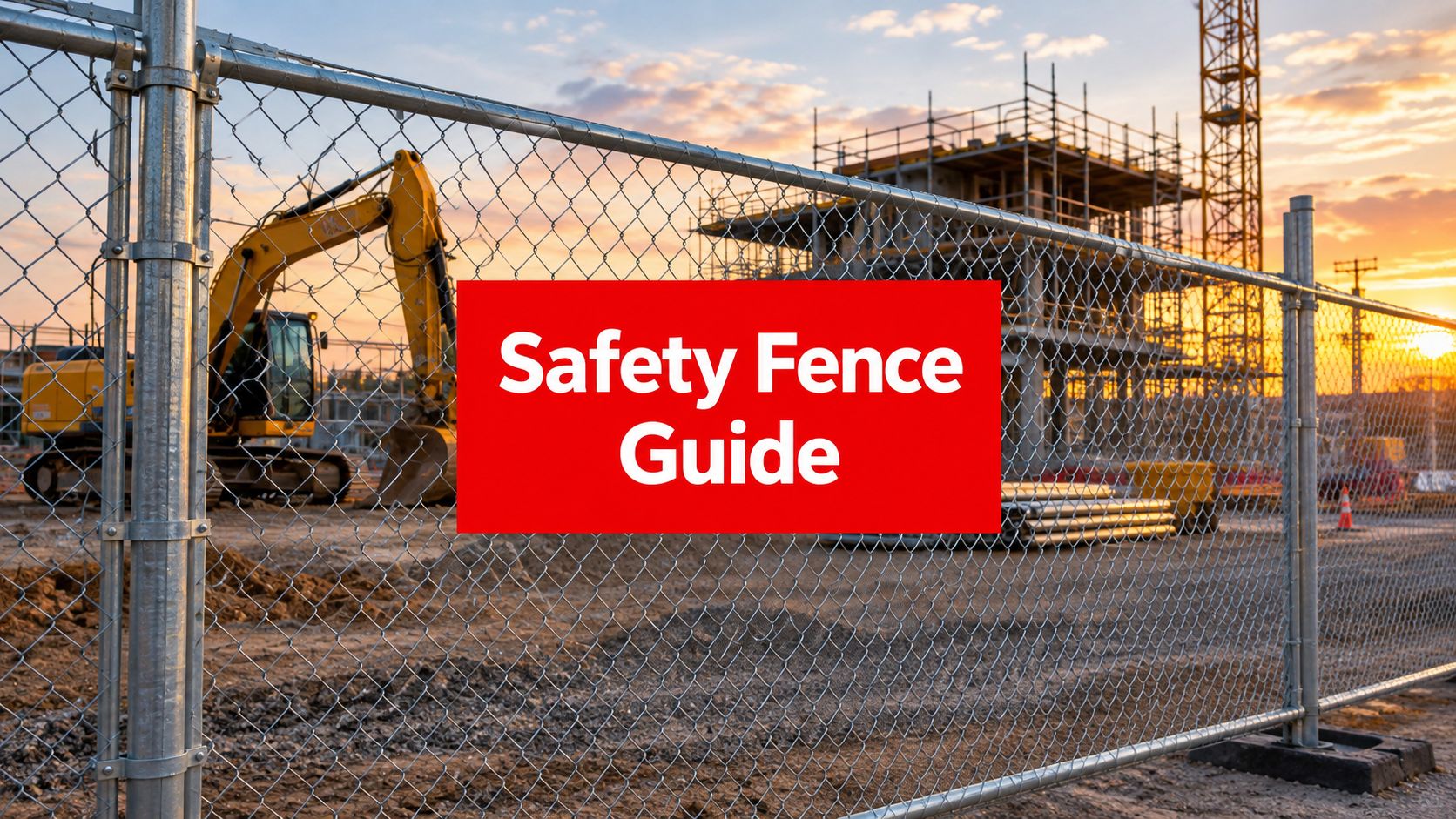
Construction sites are magnets for trouble. They’re full of valuable materials, tools, and heavy equipment that are tough to lock down. Because these sites are open and constantly changing, they are a frequent target for organized theft rings, leading to significant project delays and insurance challenges.
Remote video monitoring creates a powerful defense for these high-risk environments, especially in areas like Fresno where construction is booming.
- Perimeter Protection: Analytics draw a virtual line around the job site. If anyone crosses that line after hours, it triggers an instant alert.
- Asset Protection: Cameras can be aimed directly at high-value assets like copper wiring, lumber, or heavy machinery. Agents are ready to intervene at the first sign of tampering.
- Deterrence and Evidence: The combination of bright lights, obvious cameras, and an immediate audio warning is incredibly effective at scaring off would-be thieves. If a crime does happen, the high-definition footage gives police the critical evidence they need.
The broader video surveillance market, which includes remote monitoring, is projected to grow to over $267 billion by 2035. While hardware is currently the biggest piece of the pie, video analytics software—the brain behind remote monitoring—is set to grow the fastest, with industrial sectors leading the charge. You can explore the market projections and learn more about this industry-wide shift toward smarter security. This growth shows just how much industries are starting to rely on intelligent monitoring to protect their assets.
How to Choose the Right Monitoring Partner
Choosing a remote video monitoring partner is an important decision. You’re not just buying a service; you’re entrusting someone with the safety and security of your property. The right partner acts as a true extension of your team, providing proactive protection and real peace of mind. But not all monitoring services are the same, and the difference in quality can be night and day.

To make a confident choice, you have to look deeper than a slick website. It’s about vetting their operations, their people, and their history. These are the factors that truly matter when an incident occurs.
Evaluate Their Security Operations Center
The Security Operations Center (SOC) is the heart of any monitoring service. It’s where trained agents watch for threats and launch a response. The quality of this facility is your first and most important checkpoint.
A critical question to ask is whether their SOC is UL-listed. This isn't just a fancy sticker. A UL listing is a tough, third-party certification proving the facility meets incredibly high standards for reliability and security. It guarantees they have backup power, redundant data connections, and the structural integrity to operate without fail, 24/7/365.
Review Their Response Protocols
So, the system spots a threat. What happens next? A provider’s answer to this question tells you everything you need to know about how effective they truly are. The most advanced camera in the world is useless without a clear, fast-acting response plan.
You need to understand their exact process for intervening and escalating the situation.
- Initial Intervention: Do their agents use live audio voice-downs? This is a surprisingly powerful way to deter trespassers in real time.
- Law Enforcement Coordination: How do they work with the police? A professional SOC gives dispatchers verified, real-time information about a crime in progress, which often results in a much faster, higher-priority police response.
- On-Site Escalation: Can they dispatch mobile patrol units to the scene when a physical presence is needed?
A detailed, clearly defined response plan is the mark of a professional security partner. It shows they have considered every scenario and have a proven method for protecting your property calmly and effectively, whether it's a construction site in San Jose or a retail center in Los Angeles.
Assess Their Technological Capabilities
While the human agents are vital, the technology has to be rock-solid. Any credible partner will use high-definition cameras, but their real strength is in the software and infrastructure behind them.
When looking at remote video monitoring, it's key to understand your options. For more on this, it's worth exploring the process for choosing the best security camera systems for your business. Look for a provider whose system uses intelligent video analytics. This AI-driven technology is what filters out false alarms from things like falling leaves or stray animals, letting human agents focus their attention on actual threats.
Verify Their Industry Experience
Finally, look at the company’s history and reputation. A security partner with a long track record, like Overton Security's 26 years in the business, has a deep understanding of the unique security challenges different properties face. They’ve built their reputation on consistent service and hands-on leadership, not just selling cameras.
A company with a history of quality and a focus on low manager-to-client ratios demonstrates stability and a genuine commitment to its clients. As you look at your options, our guide on the top considerations when choosing a security outsourcing partner can give you more helpful criteria. Partnering with a provider who has a proven history is the best way to ensure your property is in capable hands.
Frequently Asked Questions About Remote Monitoring
When you're considering a new security solution, it's completely normal to have practical questions. Getting clear, straightforward answers is the first step toward feeling confident in your choice. Here are a few of the most common questions we hear from property managers and business owners about making the switch to remote video monitoring.
Can Remote Monitoring Use My Existing Cameras?
This is a question we get all the time, and in many cases, the answer is yes. Most modern IP-based camera systems can be connected directly to our monitoring platform.
As part of our initial site assessment, we’ll take a close look at your current hardware to see if it’s compatible. If your cameras provide the image quality and network security we need, we can usually integrate them. If not, we can recommend and install upgraded cameras to ensure our team has the clear visuals necessary for effective monitoring. Our goal is always to build the strongest system in the most efficient way.
How Does It Work During a Power or Internet Outage?
Your security can't afford to take a break, and our systems are built with that reality in mind. Professional remote monitoring solutions have built-in backups to keep your property protected, even when the utilities go down.
- Backup Power: Key components, like cameras and on-site networking gear, are connected to uninterruptible power supplies (UPS). For longer outages, we can incorporate on-site generators for extended runtime.
- Redundant Connectivity: We typically use cellular data as a fail-safe network connection. If your main internet service drops, the system instantly switches to the cellular network, so the video feed to our SOC is never lost.
With these redundancies in place, your property stays protected through power failures, internet outages, and other unexpected events.
How Is Privacy Respected in Residential Communities?
Protecting resident privacy is a top priority, and we take this responsibility very seriously. In residential settings like apartment buildings or HOAs, our monitoring is strictly limited to public and common areas. We work with you to program clear "blind spots" so that cameras never have a view inside a resident's home or any other private space.
Our monitoring protocols are built to protect community assets and common areas—like pools, clubhouses, parking lots, and entry gates—not to watch over personal lives. All monitoring activity is guided by strict ethical standards and the specific rules set by your community.
What Is the Implementation Process Like?
We’ve refined our process to be comprehensive but also simple and direct, ensuring we get your system up and running with minimal disruption to your daily operations. The entire process breaks down into a few key stages:
- Site Assessment & System Design: It all starts with a detailed walkthrough of your property. We listen to understand your specific risks, identify vulnerabilities, and clarify your security goals.
- Installation & Integration: Our technicians install any new cameras or equipment and connect the entire system to our 24/7 Security Operations Center (SOC).
- Protocol Development: We’ll sit down with you to create crystal-clear response protocols. This ensures our agents know exactly what to do and who to call when an event occurs.
- System Activation & Training: Once everything is tested, we take the system live. We'll walk you through the platform and make sure your team has all the training and access you need.
Your Partner in Proactive Property Security
At the end of the day, choosing a security strategy is a serious investment in proactive protection, not just a plan for reacting to problems after they happen. Remote video monitoring is where smart technology and dedicated human expertise come together, offering a powerful way to safeguard your assets. As we've covered, a professionally managed system is incredibly effective at deterring crime, cutting operational costs, and delivering real peace of mind for property managers across California.
The market for this technology is growing fast—and for good reason. The global remote video monitoring market is projected to expand significantly by 2033. This isn't just a random number; it's a clear signal that property managers in residential, retail, and construction are seeing immense value in these advanced solutions. You can see the data behind the remote monitoring market's growth for yourself.
Choosing a partner is about more than technology; it’s about entrusting your property’s safety to a team with a proven track record. With over 26 years of experience, Overton Security combines hands-on leadership with state-of-the-art systems to deliver consistent, dependable protection.
We know that every property is different. A construction site in Fresno has completely different security needs than a high-rise in San Francisco. Our entire approach is built on providing a service that blends the best of both worlds—intelligent technology watched over by seasoned professionals. We invite you to take the next step toward making your property safer.
Ready to see how a tailored remote video monitoring solution can protect your property? Contact Overton Security today for a customized security assessment. Let's build a safer environment together.