
That initial search for "security guards near me" usually comes after a wake-up call—a break-in, a new construction project kicking off, or perhaps a growing sense of unease from your tenants. It's an important first step. But the real work begins when you move past just finding a vendor and start looking for a genuine security partner who's in it for the long haul.
Starting Your Search for the Right Security Partner
When you begin looking into security services, you're tapping into a massive and critical industry. The demand for well-trained security officers is growing as more businesses and properties focus on protecting their people and assets. It’s no surprise the global physical security market hit a staggering $319 billion in 2023. Guarding services make up a significant portion of that figure, which tells you just how vital professional, on-the-ground security really is. For a deeper dive into these numbers, CognitiveMarketResearch.com offers some great insights.
This guide is your roadmap. We want to help you move beyond that urgent, reactive feeling and make a smart, informed decision that will actually bring you peace of mind.
Moving from Vendor to Partner
So, what's the real difference between a security vendor and a security partner? It all comes down to their mindset and level of commitment.
- A Vendor Provides Coverage: They send a person in a uniform to fill a time slot. It checks a box and meets the bare-bones requirement of the contract.
- A Partner Delivers Service: They take the time to understand your property's vulnerabilities, build custom post orders that make sense, and deliver proactive protection you can count on.
A true partner is focused on quality, not just filling shifts. You can usually see it in their officer retention rates and how involved their management team is. Here at Overton Security, we've built our 26-year reputation on this exact principle. It’s about making sure every client feels like our only client. You can see more about how we operate as a trusted private security company and what that means for our clients.
This isn't just semantics; it's a crucial distinction. When you choose a partner, you're not just hiring a guard. You're investing in a complete security program backed by hands-on leadership, transparent reporting technology, and a deep-seated commitment to doing the job right. It’s a relationship built on trust and results you can actually see.
Defining Your Real Security Needs
Before you even start searching for "security guards near me," it's essential to get crystal clear on what you need to protect and, more importantly, why. A vague plan is a recipe for ineffective security and wasted budget. The sharper your objectives, the better your security partner can perform.
Start with the most basic question: what is my primary goal? Perhaps you're trying to stop copper theft at a construction site in San Jose. Or maybe you're on an HOA board in Los Angeles and your main concern is preventing overnight loitering and responding to noise complaints. Each scenario demands a completely different security strategy.
Matching Services to Your Risks
The right service is one that directly addresses your biggest concerns. A highly visible, uniformed officer walking a retail center is a powerful deterrent against opportunistic crime. But a high-end residential building in San Francisco might get more value from a discreet, concierge-style officer who blends top-tier security with professional hospitality.
To determine the best approach, get specific about your property:
- Vulnerable Hours: Does trouble tend to occur overnight, on weekends, or during the quiet early morning hours?
- Property Type: Are we talking about an open-air shopping plaza, a fenced-in industrial yard, or a multi-tenant office building with controlled access?
- Key Risks: What keeps you up at night? Is it theft, vandalism, unauthorized access, or ensuring your residents feel safe?
This quick decision tree can help you visualize whether you just need to fill a shift or if you're looking for a genuine, long-term security partner.
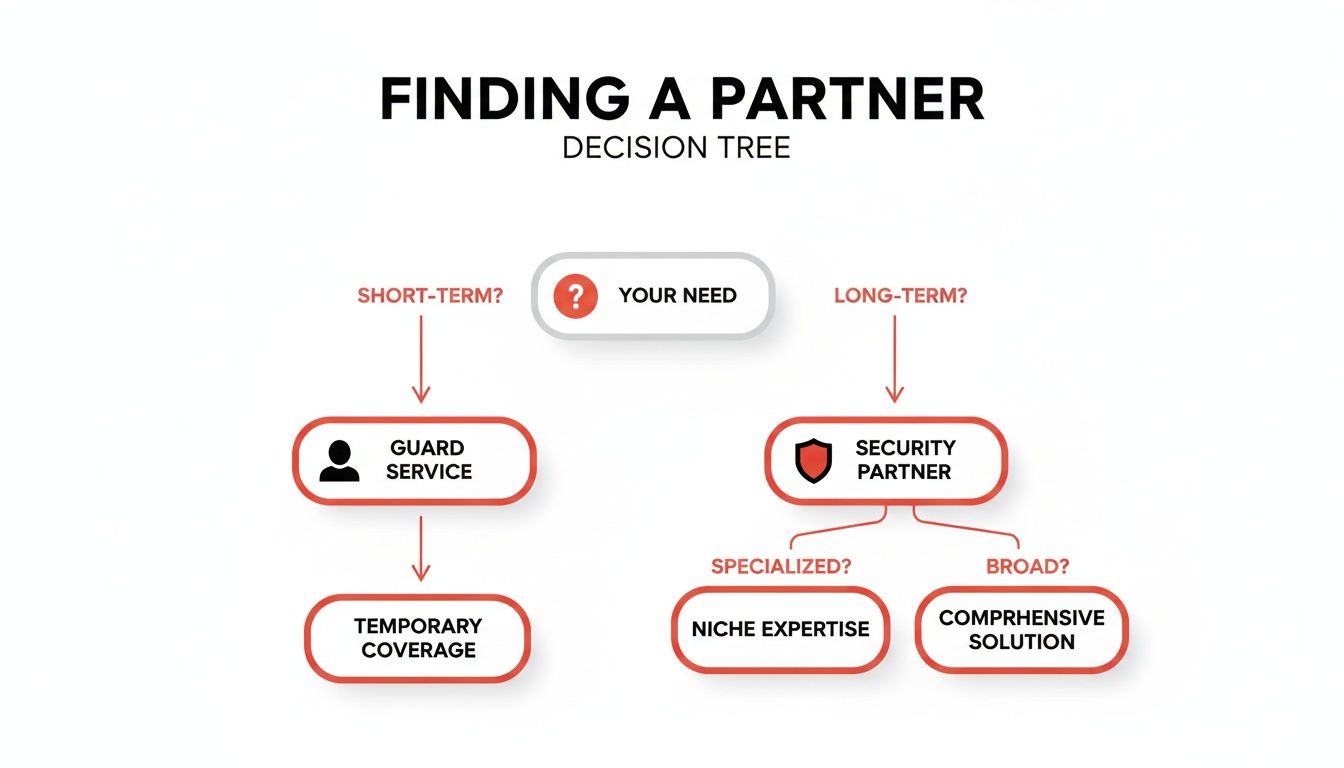
The key takeaway is that a true security partner works with you to figure this out. They go way beyond just being a body in a uniform.
Understanding Your Service Options
Once you know what you’re trying to achieve, you can start matching those goals to the right type of service. Not all security is created equal, and choosing the right tool for the job saves you money while delivering much better results.
The table below is a quick reference to help you connect the dots between your property, your main problems, and the service that makes the most sense.
Matching Security Services to Your Property's Needs
| Property Type | Primary Concern | Recommended Service | Key Benefit |
|---|---|---|---|
| Construction Site | After-hours theft & vandalism | Onsite Guard or Vehicle Patrol | Visible deterrent, secures valuable materials. |
| Residential HOA | Loitering, noise, access control | Vehicle Patrol or Concierge Guard | Enforces community rules, provides resident assistance. |
| Retail Center | Shoplifting, parking lot safety | Onsite Guard | High visibility deters crime, fast incident response. |
| Office Building | Unauthorized access, tenant safety | Concierge Guard or Onsite Guard | Manages visitors, provides a professional front. |
| Industrial Park | Large area coverage, trespassing | Vehicle Patrol | Cost-effective way to monitor a large perimeter. |
| Fire System Outage | Life safety, code compliance | Fire Watch Guard | Meets legal requirements, ensures rapid fire detection. |
Ultimately, picking the right service type is about aligning the solution with the problem for maximum impact and efficiency.
Key Takeaway: The goal isn't just to have a guard on-site. It's to have the right type of security presence, deployed intelligently to shut down your specific risks and help you hit your operational goals.
Here’s a quick rundown of the most common services you'll encounter:
- Onsite Guards: This is your best option for properties that need a constant, visible presence. They're ideal for controlling access at corporate lobbies, maintaining order in residential communities, and providing a rapid, on-the-spot response to any incidents.
- Vehicle Patrols: A fantastic, cost-effective solution for covering large areas like sprawling business parks or several properties scattered across a neighborhood. These mobile patrols provide a visible deterrent, perform lock-up duties, check for unsecured doors, and report any suspicious activity they spot.
- Fire Watch: This is a mandatory, highly specialized service you need when your building's fire alarm or sprinkler systems are down for maintenance or repairs. Officers are trained to patrol designated areas, watch for any signs of fire, and ensure everyone's safety, keeping you compliant with fire code.
Taking the time to do this self-assessment is the most important step you can take. It turns your search from a shot in the dark into a targeted process, setting you up to find a partner who delivers real value and peace of mind.
How to Properly Vet a Security Company
Alright, you've identified your needs and have a shortlist of local security companies. Now comes the crucial part—separating the truly professional organizations from the ones that just look good on paper. This is where you have to do your homework. Making the right choice brings peace of mind; the wrong one can create a whole new set of headaches.
Not every security company is built the same. A slick proposal and a low price can hide issues ranging from undertrained guards to inadequate insurance. You need to dig deeper to find a partner you can actually trust. It's about verifying the essentials, understanding their operational standards, and getting a feel for their company culture.

Verifying the Non-Negotiables
Before you even start talking about patrol schedules or pricing, there are a few absolute deal-breakers to check off. If a company can't provide these immediately, it's a major red flag.
- California BSIS Licensing: In California, every legitimate security provider must hold a Private Patrol Operator (PPO) license from the Bureau of Security and Investigative Services (BSIS). Ask for their PPO number and look it up on the BSIS website to confirm it’s active and in good standing.
- Comprehensive Insurance: Your security partner must carry adequate general liability, workers' compensation, and commercial auto insurance. Don't just take their word for it. Request a Certificate of Insurance (COI) and make sure the coverage limits meet or exceed your property's requirements.
These aren't just suggestions; they are the bare minimum. This paperwork protects you from significant liability and confirms the company is operating professionally. Any reputable firm will have this ready to go without hesitation.
Look for Signs of a Healthy Company Culture
The security industry is a challenging business. There are over 1.2 million guards in the U.S. alone, and companies are constantly competing for contracts. The best ones stand out not by being the cheapest, but by how they treat their people. Officer retention and hands-on management tell you everything you need to know.
High turnover is a common problem in the security world, usually a direct result of low pay, minimal support, and a lack of respect for officers on the ground. This "burn and churn" model will always affect the quality of service you receive.
A stable, well-supported team is the backbone of reliable security. When a company invests in its officers, you get consistency, professionalism, and officers who are genuinely committed to protecting your property.
When you're figuring out how to vet a security company, it helps to apply some broader facility-focused vendor management best practices. This approach helps you see them not just as a guard provider, but as a critical partner in your entire operation.
Don't hesitate to ask direct questions about how they hire, train, and support their team:
- What does your officer training program involve?
- What is your average officer retention rate?
- Can you walk me through your background check and screening process?
If you get vague answers or they seem reluctant to discuss these topics, it can be a sign of a weak link in their operations. A company that’s proud of its team, like Overton Security, will be an open book about how it supports its people. For a deeper dive, check out our article on the top 5 considerations when choosing a security outsourcing partner.
The Role of Technology in Modern Security
When you’re searching for “security guards near me,” you’re looking for reliable people. But today, the best security companies back their officers with powerful technology that adds an undeniable layer of accountability and transparency.
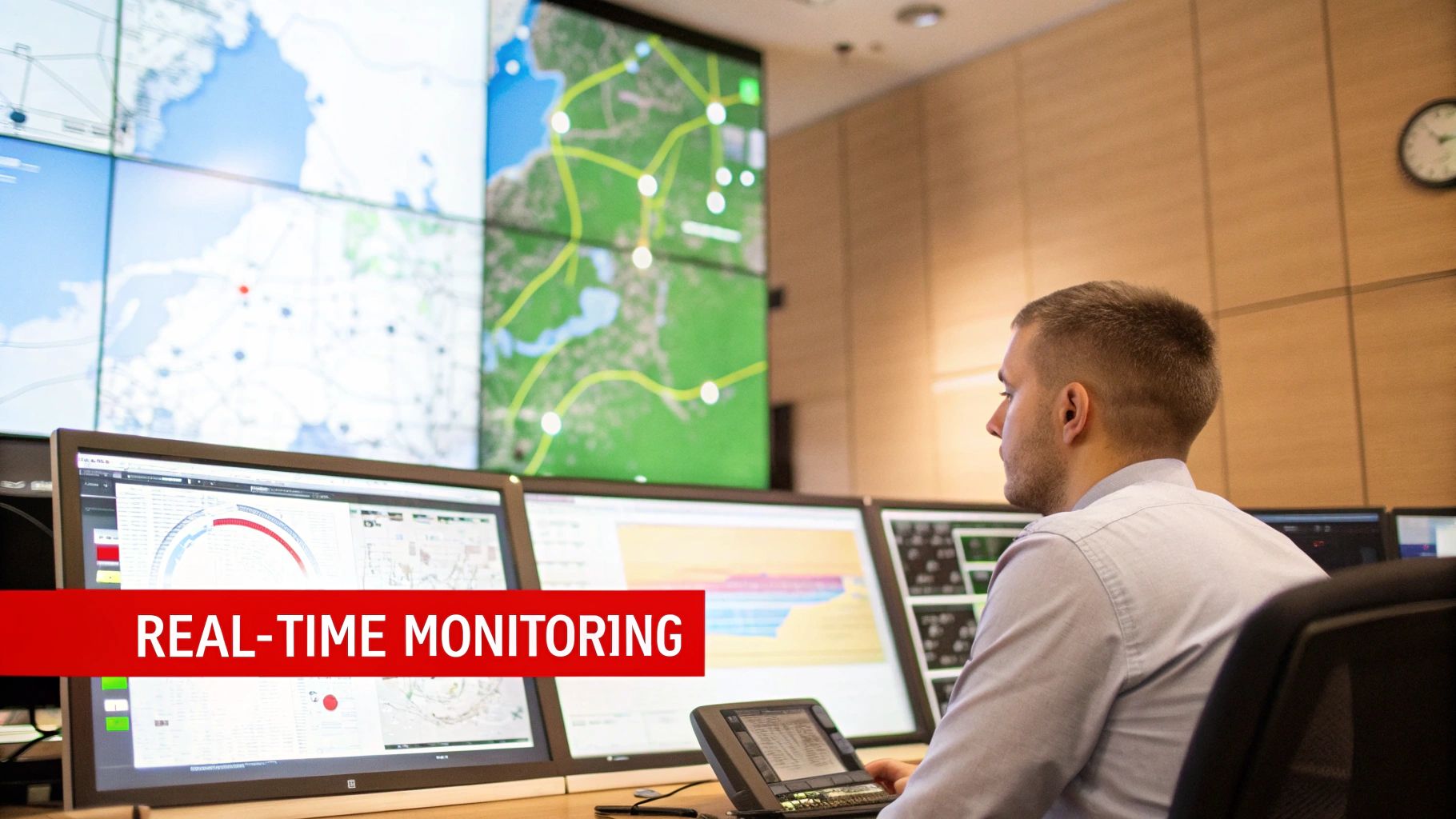
This isn’t about replacing human expertise. It's about amplifying it—making sure you get exactly the service you’re paying for. The old days of guards punching a time clock and scribbling notes on a clipboard are long gone. Modern security runs on systems that offer complete, real-time transparency, eliminating guesswork and giving you concrete proof that your property is being protected as promised.
Unpacking Guard Tour Management Systems
At the heart of this transparency is the Guard Tour Management System (GTMS). Think of it as a digital accountability tool that verifies every patrol and documents every action an officer takes on your property.
Here’s a quick breakdown of how it works:
- Checkpoints (NFC Tags): We place small, discreet tags at critical points around your property, such as the back entrance of a retail store in Oakland or the pool gate of an HOA in Long Beach.
- Real-Time Scans: As an officer patrols, they scan each tag with a GPS-enabled device. This creates a time-stamped, location-verified record that proves they were physically at that exact spot.
- Digital Reporting: Any incidents, observations, or maintenance issues are logged directly into the system, often with photos. This information is compiled into a detailed Daily Activity Report (DAR) that lands in your inbox.
What does this mean for you? Verifiable proof of service. As a client, you no longer have to wonder if patrols were completed. You can see the digital footprint of every tour, giving you complete confidence in the security program you've invested in.
The Power of a 24/7 Security Operations Center
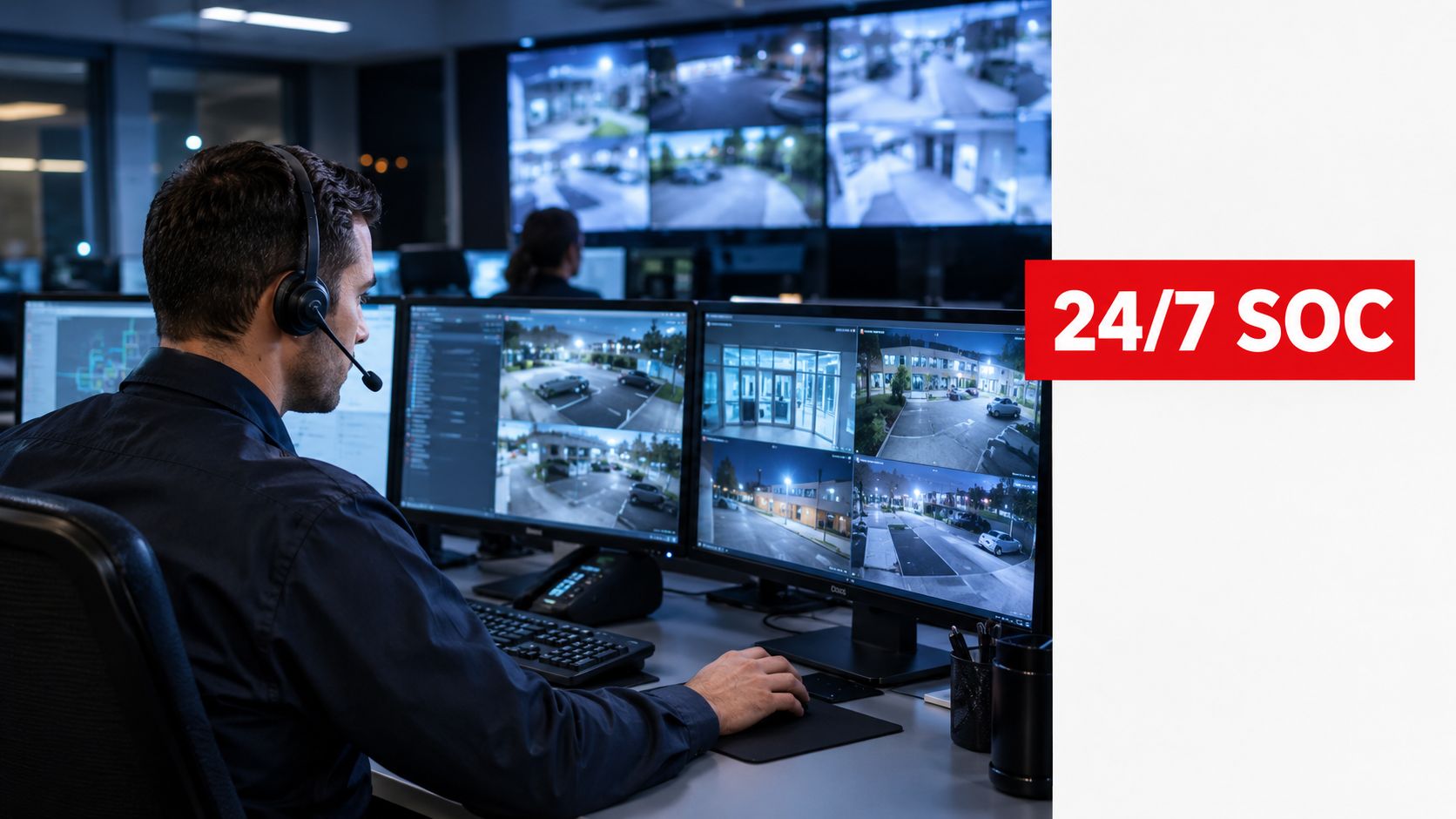
A professional security officer is never truly alone in the field. A top-tier company provides constant backup through a 24/7 Security Operations Center (SOC), which acts as the command hub supporting officers and providing an extra layer of oversight for clients.
The SOC acts as a force multiplier, connecting field officers to a team of dispatchers and supervisors. It ensures that if an incident occurs, the officer has immediate access to support, guidance, and emergency escalation protocols.
Let's say an officer at a San Diego construction site spots a potential trespasser. The SOC can help coordinate a law enforcement response while simultaneously documenting the event.
This integration of security systems—blending human expertise with centralized support—is a hallmark of a professional security partner. It's what truly sets a premier service apart from a basic guard vendor.
Asking the Right Questions Before You Hire
Once you have a shortlist of companies and their proposals, the real work begins. The price tag is important, but it only tells a fraction of the story. If you want to find a true security partner, you need to dig deeper with questions that reveal what a company is really made of.
This is your chance to determine if you’re talking to a vendor that fills shifts or a partner that solves problems. How they answer will tell you everything you need to know about the kind of support, professionalism, and accountability you can expect.
Questions About Supervision and Support
An officer on your property is only as good as the support structure behind them. Without active supervision and a clear chain of command, performance can suffer. These questions get to the heart of how a company manages its people.
"Can you walk me through your field supervision structure?"
- What you're listening for: A confident answer about dedicated field supervisors who conduct regular, unannounced site inspections. They should mention checking on officers, reviewing post orders on-site, and ensuring uniform and appearance standards are being met.
- A red flag: Vague responses like, "Our managers check in," or anything that puts the burden on you to report problems. That’s a sign of a hands-off, reactive approach.
"What's your manager-to-client ratio?"
- What you're listening for: A company that’s proud of its service, like Overton Security, will know this number. A low ratio—meaning fewer clients for each manager—is a great sign. It means your property will get personal attention from a manager who actually knows your site's specific challenges.
- A red flag: If they can't answer this or the number seems high, it’s a warning. It suggests their managers are stretched thin, which often translates to poor, reactive service for you.
Questions About Customization and Operations
Every property is different. A "one-size-fits-all" security plan is a recipe for failure. Your goal here is to find a provider that will invest the time to understand your specific needs and build a plan to address them directly.
Key Takeaway: A security proposal shouldn't just be a price quote; it should be the beginning of a strategic conversation. The best partners listen more than they talk, focusing on building a plan tailored to your property’s unique risks and goals.
Ask them how they plan to adapt their services to your site:
- "How do you customize post orders for a property like mine?"
- What you're listening for: The best response will include a commitment to do a detailed site walk-through with you before the post orders are finalized. They should talk about identifying key patrol points, defining emergency protocols, and building your specific rules into the officers' official instructions.
- A red flag: If you get a generic answer or they promise to email over a "standard template," it shows they aren’t interested in the details. And in security, the details are everything.
Asking these targeted questions pushes the conversation past the hourly rate and into the realm of true value. A company that gives you thoughtful, detailed answers is a company that takes its commitment to protecting your property seriously.
Turning a Contract Into a Real-World Security Plan
You’ve done the hard work and picked the right security partner. That's a huge step. But the job isn't quite done. The real success of a security partnership hinges on how well you launch it together. This final step is all about taking the agreement you signed and turning it into a clear, effective plan that protects your property from day one.
The cornerstone of this plan is the post orders. Think of these as the custom rulebook for your specific site. They need to cover everything from patrol routes and access control procedures to emergency contacts and incident reporting. Any security company worth its salt will insist on working with you to get these details right.
The Make-or-Break On-Site Walk-Through
Before the first officer begins their shift, a manager from your new security partner needs to walk the site with you. This is a non-negotiable step.
This is where the plan on paper meets reality. During this meeting, you’ll:
- Pinpoint the exact patrol checkpoints that will be logged in their Guard Tour Management System.
- Spot vulnerabilities you might have missed, like a dimly lit walkway or a section of fence hidden by landscaping.
- Establish how and when you’ll get daily reports and who to call in an urgent situation.
Getting hands-on like this ensures everyone is on the same page. It builds your security program on a true understanding of your property's real-world challenges, not just assumptions.
A great security partnership is built on clear communication and shared expectations from the very beginning. The initial site walk and post-order finalization are where you turn a contract into a functional, effective security plan.
From that first "security guards near me" search to this final setup phase, the goal has always been the same: finding a partner you can genuinely trust. By seeing this process through, you’ve done more than just hire a vendor. You've built a relationship based on transparency and accountability, giving you real peace of mind for your California property.
Your Top Questions About Hiring Security Guards, Answered
As a property manager, HOA board member, or business owner, it's natural to have questions when considering security services. Over our 26 years in the industry, we've found that a few key concerns come up time and again. Let's address them directly.
Armed vs. Unarmed Guards: Which Do I Actually Need?
This is often the first question we hear, and it's a critical one. The choice isn't just about a weapon; it’s about the specific role the officer will play and the environment they're in.
Unarmed guards are specialists in deterrence, observation, and providing a reassuring presence. They are the ideal first line of defense in most commercial, residential, and retail settings. They are experts at managing access control, enforcing property rules, and de-escalating situations professionally.
Armed guards are reserved for environments where there is a clear, credible threat to life or extremely high-value assets. This decision should always be based on a professional risk assessment that identifies a specific need for that level of protection, not a gut feeling.
How Much Do Security Guards Cost?
The cost of hiring a security guard in California varies based on several factors. The officer's experience, whether they are armed or unarmed, and the specific location all play a role—rates in Los Angeles will naturally differ from those in Fresno.
A word of caution: if you receive a bid that seems too good to be true, it almost certainly is. Extremely low rates are a major red flag. It often means the company is cutting corners on officer wages, proper training, or insurance coverage. This doesn't save you money; it exposes your property to significant risk.
A fair price from a reputable company is an investment in professional, reliable officers who are compensated well enough to build a career, ensuring consistency for your site.
How Do I Know My Property Is Actually Being Patrolled?
You should never be left wondering if the patrols you're paying for are happening. Any professional security company today uses a Guard Tour Management System, often called a GTMS.
Here's how it works: the officer scans checkpoints at key locations around your property as they make their rounds. This creates a real-time, time-stamped digital log of their entire patrol route. We provide you with these detailed reports, giving you complete transparency and the peace of mind that comes with verifiable proof of service.
A solid security program is always built on a foundation of transparency, deep experience, and a real commitment to service. To see how Overton Security puts these principles into practice for properties across California, get in touch with us for a personalized security assessment.