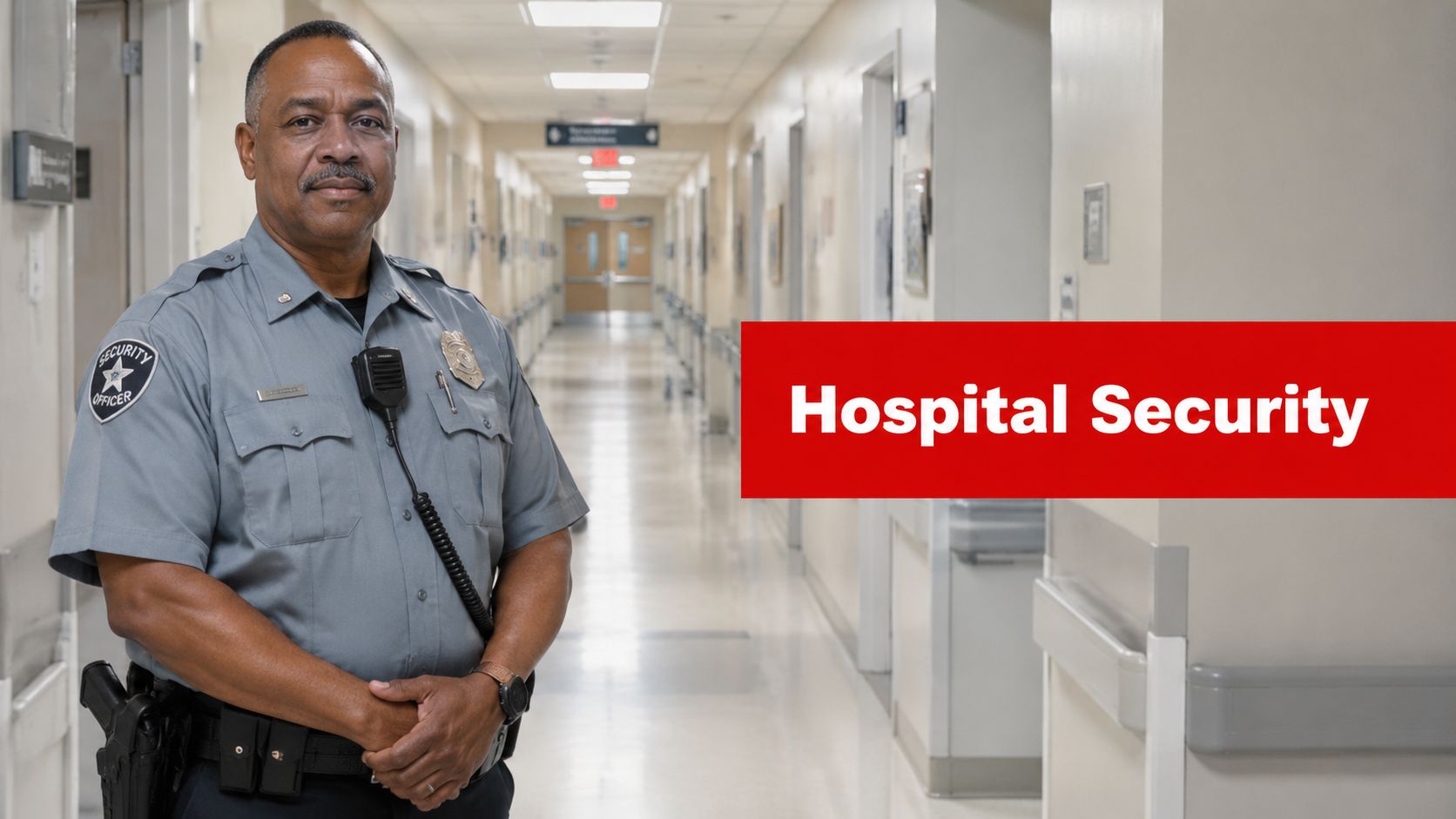
If you're looking at security jobs at hospitals right now, you're probably weighing more than hourly pay. You want steady work, a serious environment, and a role that feels like it matters when you show up for shift.
That instinct is a good one. Hospital security can become a stable career for people who want structure, responsibility, and a clear path to grow. It also asks more of you than a basic post at a quiet property, which is exactly why strong candidates often build better long-term careers here.
Why a Career in Hospital Security Is a Smart Move
A Friday night in the emergency department can tell you more about this profession than any job ad. The waiting room is full, a family argument is building near triage, a nurse needs help clearing a hallway, and someone at the front entrance is trying to get past visitor policy. In that kind of environment, hospitals do not look for a warm body in a uniform. They look for people who can stay steady, follow policy, and treat people with respect under pressure.
That is why hospital security is a smart career choice for the right person. The work has staying power because hospitals operate around the clock, carry real safety risk, and need officers who can support staff without creating new problems. Good officers become known fast, and in a quality program that reputation can turn into better assignments, more training, and a clear path into lead or supervisory roles.

What makes hospital work different
Hospital security asks for more judgment than many entry-level posts. You are working around patients, clinical staff, visitors, sensitive information, and fast-changing incidents in the same shift. One poor decision can disrupt care, escalate a family situation, or damage trust with a department that needs security to be reliable.
That higher standard is also the opportunity.
Candidates who study how professional healthcare security programs operate usually interview better and last longer once hired. Hospitals and strong contract firms both pay attention to the same things: composure, report writing, communication, presence, and whether you can enforce rules without turning every contact into a contest of authority.
Why good candidates stay in this niche
Hospital work rewards people who are dependable, coachable, and serious about training. A high school diploma or GED is often enough to get started, but advancement usually goes to officers who build skill on purpose, learn healthcare procedures quickly, and show they can be trusted in sensitive areas.
Practical rule: If you want a job that can become a career, choose an environment where training matters and performance is visible.
I have seen officers plateau in low-expectation posts for years. I have also seen newer officers grow quickly in healthcare because their supervisors could see, shift after shift, who handled conflict well, who wrote clean reports, and who staff members asked for by name. That is the difference between getting hired and building a career. In hospital security, the right culture and training track matter almost as much as the badge on your shirt.
Understanding the Modern Hospital Security Role
A hospital security officer has two jobs at the same time. The first is straightforward security work: control access, respond to incidents, protect staff, watch high-risk areas, and support emergency procedures. The second is less obvious but just as important: help people who are scared, upset, confused, or grieving without losing control of the scene.
That balancing act is one of the hardest parts of the profession. A NewYork-Presbyterian job posting highlights this challenge directly, noting that the role involves enforcing access control while simultaneously providing compassionate patient support, and that many job postings don't explain how officers manage that tension in real situations (NewYork-Presbyterian security officer posting).

Guardian and service professional
On a real shift, your responsibilities can change minute to minute. You may be screening visitors at one entrance, then walking a discharged patient safely to transportation, then assisting clinical staff with a disruptive individual, then securing a restricted doorway outside a treatment area.
The officers who do well in hospitals understand that tone matters. Firm doesn't mean cold. Helpful doesn't mean passive.
A few examples of what that looks like in practice:
- At public entrances: You may need to deny access, check identification, enforce visitor rules, and still keep the interaction respectful.
- In treatment areas: Staff need an officer who can arrive fast, take direction, and lower the temperature instead of escalating it.
- With families: Emotions can run high. The right move is often calm repetition, clear boundaries, and a path forward instead of a verbal contest.
- With patients in distress: You may be the first uniformed person they see. Your posture, voice, and patience can shape the entire encounter.
Security officer versus patient greeter
One mistake candidates make is assuming every hospital-facing role has the same authority and requirements. It doesn't. Job postings sometimes blur the line between a true security position and a more hospitality-focused front-door role.
Hospitals also rely on structured systems, not guesswork. That's why candidates who want to work in this niche should pay attention to how hospital access control systems support visitor management and restricted areas. The officer isn't separate from that system. The officer is often the person making it work at ground level.
In hospital security, the best officers know when to slow a situation down and when to act immediately.
That distinction matters when you read listings. Some "security" jobs are really customer service positions with limited enforcement responsibility. Others expect licensing, emergency response, report writing, and close coordination with nursing staff and administration. Read every line carefully, especially around certifications, post duties, and response expectations.
Getting the Right Credentials for Hospital Security
A hiring manager reviews two applications for the same hospital post. Both candidates want healthcare work. One has a current guard license, clean paperwork, current CPR, and training that fits a hospital environment. The other says they are a fast learner and can train after hire. The first candidate gets the interview more often.
Hospitals can train good people, but they usually prefer candidates who show up prepared for a regulated, high-accountability role. That is the difference between chasing any opening and building a career in healthcare security. Strong employers look for people who respect the standards before they ever put on the uniform.

Start with the essentials
The baseline is straightforward. You generally need a high school diploma or GED, any state-required security license or guard card, and current eligibility to work in a position that may involve controlled access areas, incident documentation, and direct contact with the public.
From there, hospital employers often look for certifications that reduce risk on day one:
- State security license: In many markets, this is the first screening point. If your license is expired, delayed, or still in process, you can lose the opportunity before anyone reads your experience.
- First Aid and CPR: In a hospital, officers are part of the life-safety picture. Even when clinical staff lead care, security is expected to respond calmly and support the scene.
- Fire and emergency response training: Hospitals care about disciplined response under pressure, especially during alarms, evacuations, or restricted-area incidents.
- De-escalation and defensive tactics training: Good employers want officers who can control behavior, protect staff, and document the event clearly. Force is the last option, not the first skill.
A posting for a Safety and Security Officer I role at Larned State Hospital reflects that reality. It lists training tied to CPR, fire safety, emergency response, weapons handling, and self-defense, and notes that officers may need to complete and maintain certifications such as First Aid/CPR/AED as a condition of employment (Larned State Hospital safety and security officer posting).
Credentials matter, but relevance matters more
Candidates sometimes collect certificates that look impressive but do little for a hospital post. Hiring teams notice the difference between generic training and training that fits patient care settings, behavioral incidents, access control, report writing, and coordination with nursing leadership.
That is why the better move is targeted preparation. A structured security officer training program for healthcare and other high-responsibility posts signals that you understand the standard hospitals and quality security firms expect.
Don't overlook the screening process
Screening problems knock out qualified candidates every week. The issue is often avoidable. Missing dates, inconsistent job titles, unexplained separations, or expired documents create delays and raise questions about reliability.
Before you apply, review what may appear during pre-employment screening. This overview of VolunteerBadge screening details gives a useful plain-English explanation of what may appear on background checks.
Keep copies of your license, certifications, training records, and identification in one place. Bring order to your file before an employer has to ask for it.
Hiring reality: Credentials get you in the conversation. Judgment, professionalism, and follow-through are what turn that conversation into an offer.
If you are early in your career, start with the license your state requires, current medical response training, and de-escalation. Then add the credentials that fit the kind of hospital work you want to do.
Finding Openings and Crafting Your Application
Good hospital jobs don't all live in one place. Some sit on hospital career pages. Others are posted by national or regional security firms that staff healthcare accounts. The key is to read the posting like an operator, not just an applicant.
One common source of confusion is role naming. Listings frequently blend front-desk hospitality language with security language. In the New York metro market, postings have shown that employers can blur the difference between a licensed security officer and a patient greeter, and at Gracie Square Hospital, for example, security officers must hold an NYS Security Guard License and BCLS certification, while greeter roles often don't list those same requirements (NYC hospital security job listings and role distinctions).
Compare the employer, not just the job title
Use the table below to think through the trade-offs.
| Factor | In-House Security (Employed by Hospital) | Contracted Security (Employed by Security Firm) |
|---|---|---|
| Identity on site | Part of the hospital's internal team | Assigned to the hospital by a security provider |
| Training style | Often tied closely to hospital policy and department culture | Can be excellent if the firm invests in site-specific instruction and supervision |
| Career mobility | May grow within one healthcare system | May offer movement across sites, account types, and supervisory roles |
| Hiring speed | Can be slower due to internal HR processes | Often faster, especially when a provider staffs multiple healthcare posts |
| Role clarity | Usually clearer once inside the system | Varies by firm and by contract quality |
| What to watch for | Bureaucratic hiring and narrow mobility | High turnover firms, weak supervision, or generic post training |
Build a resume that sounds like hospital security
Don't send a generic guard resume. Translate your experience into healthcare language.
Focus on skills such as:
- Access control: Mention badge checks, visitor screening, key control, or monitored entry points.
- De-escalation: Include examples of resolving disturbances without force when possible.
- Customer-facing professionalism: Hospitals notice candidates who can give directions, answer questions, and stay composed under stress.
- Incident documentation: Strong report writing matters more in healthcare than many new applicants realize.
- Team coordination: Any work with reception staff, managers, dispatch, or emergency responders is relevant.
If you're applying through larger systems, it's also smart to understand how recruiters screen applications and balance speed with standards. This piece on AI strategies for healthcare HR leaders helps explain how hiring teams may review candidates at scale without lowering expectations.
Your application should make one thing easy to see. You understand that this is a healthcare post, not just another uniformed position.
Acing the Hospital Security Interview
A hospital security interview is usually less about memorized answers and more about judgment. The panel wants to know whether you'll stay calm, follow policy, communicate with respect, and make safe decisions when the facts are incomplete.
That's why scenario questions matter so much. You're being tested on temperament as much as experience.
Use the STAR method without sounding rehearsed
A clean way to answer behavioral questions is the STAR method: Situation, Task, Action, Result. Keep it natural. The goal isn't to sound polished for its own sake. The goal is to show that you can think in order under pressure.
Common interview questions often sound like this:
- "Tell us about a time you de-escalated an upset person."
- "What would you do if a family member refused to leave a restricted area?"
- "How do you handle confidential information or sensitive situations?"
- "Describe a time you had to work closely with a team during an incident."
A strong answer usually includes four things:
- The setting: Where were you and what was happening?
- The responsibility: What were you expected to do?
- The action: What specific steps did you take?
- The outcome: How did the situation end, and what did you learn?
When candidates struggle in these interviews, it's usually because they describe traits instead of actions. "I'm calm under pressure" is weak. A short story that proves it is much stronger.
Be ready to discuss pay professionally
Compensation varies a lot by employer and region. Nationally, hospital security officer salaries generally range from $24,000 to $53,000 annually, with ZipRecruiter showing an average near $34,000 and Glassdoor reporting an average over $39,000. In California, especially major metro areas, pay is often toward the higher end of that range, according to Axon's overview of the modern hospital security officer role.
That data gives you a useful frame, but don't make the interview only about wages. Ask how the employer handles training, shift assignments, probationary periods, certifications, and advancement. Those answers tell you whether you're looking at a short-term post or a real career track.
Practice for the questions that actually matter
You don't need to overprepare, but you do need to sharpen how you speak about your experience. If you want help tightening your responses, an AI interview prep tool can be useful for rehearsing scenario-based answers before the actual meeting.
A few final habits help:
- Bring documentation: Licenses and certifications should be current and organized.
- Use precise language: Say what you did, not what your team generally handled.
- Show balance: Hospitals want officers who can be firm, respectful, and policy-driven at the same time.
- Ask thoughtful questions: Good candidates ask about orientation, site risks, and support from supervisors.
The interview cuts both ways. You're also finding out whether the employer trains people well, communicates clearly, and respects the seriousness of the post.
Building Your Career Path in Healthcare Security
The best candidates don't treat hospital security as a holding pattern. They treat it as a profession. That's the difference between chasing openings and building a career.
A strong start usually includes onboarding that goes beyond uniform issue and basic paperwork. You want site orientation, post orders that reflect the actual layout, mentoring from experienced staff, and recurring training tied to the areas you'll cover. In healthcare, generic training wears thin fast.

What upward movement usually looks like
A typical progression can move through several stages:
- Entry-level officer: You learn access control, patrol, report writing, and incident response in a healthcare setting.
- Lead officer or field trainer: You start helping newer officers, reinforcing post expectations, and setting the tone on shift.
- Supervisor: You manage coverage, review reports, coach staff, and serve as the link between frontline operations and management.
- Manager or director-level roles: You work on staffing, training standards, policy, site risk issues, and client or hospital leadership communication.
- Specialized tracks: Some officers move toward emergency preparedness, operations center work, life safety, or compliance-related functions.
Training is what separates a job from a career
One of the clearest signs of a healthy employer is whether they invest in continuing development after hire. Hospitals that require annual training in crisis response, BLS certification, and de-escalation see incident prevention rates rise by 35% when officers complete those programs within 90 days of hire, according to Catholic Health system hiring information.
That number matters because it reflects something experienced security leaders already know. Early, site-specific training changes performance. It improves judgment, consistency, and confidence.
A good healthcare security career usually doesn't begin with the perfect title. It begins with the right training culture.
If you're choosing between offers, pay attention to the company that supports officers, retains strong supervisors, and gives people room to improve. In this field, culture shows up in daily operations. You can feel it in the handoff at shift change, in the quality of post orders, and in whether leadership coaches people or just fills holes.
If you're exploring your next move in healthcare security, Overton Security is worth a look. With 26 years of experience, a quality-over-quantity approach, hands-on leadership, GPS-enabled reporting, and 24/7 SOC oversight, the company has built its reputation by supporting professional officers and delivering accountable service across California, including Los Angeles, San Diego, San Jose, San Francisco, Sacramento, Oakland, Long Beach, and Fresno. For candidates who want more than a basic post, that's the kind of environment where a hospital assignment can turn into a real career.