A fundraiser, concert, company celebration, or neighborhood festival can look straightforward on the calendar. Then the details arrive: a guest list, alcohol service, temporary entrances, a VIP attendee, vendor vehicles, restricted areas, and hundreds or thousands of people moving through the same space.
That's when many planners ask, what is special event security, and how much protection does the event need? The answer isn't a fixed number of guards. Special event security is a proportionate operating plan that connects the event's risk, venue, attendance, local requirements, staffing, technology, and emergency response.
What Special Event Security Really Means
At 6 p.m., guests arrive through three doors, a delivery van blocks the emergency lane, and a line forms beside the bar. The venue team may know the building well, but that does not mean they can manage every risk created by a public event. A plan that works for a small private gathering can fail once alcohol, ticket sales, valuable equipment, a VIP guest, or several entrances change how people use the property.
Special event security is a temporary operating plan that combines trained personnel, access procedures, crowd management, communication, and emergency readiness. Its purpose is to protect people, property, and the event's reputation. Unlike residential or commercial property security, it is built for a specific date, audience, venue, program, and risk level.
The staffing decision should follow three questions: What could happen at this venue? How many people and access points must staff manage? What do local permits or authorities require? A low-risk indoor gathering may need a small, clearly assigned team. A public festival with alcohol, multiple entrances, vehicle movement, or a high-profile guest may need layered coverage and a faster response plan.
Practical rule: If the event changes how people enter, move through, or leave a property, change the security plan with it.
Risk also changes by event phase. Arrival can bring vehicle and pedestrian conflicts. The peak period can put pressure on bars, restrooms, stages, and narrow corridors. Closing can leave tired guests, reduced lighting, vendor breakdowns, and isolated staff. The right plan assigns coverage to these pressure points instead of treating the event as one continuous block.
Underplanning can delay permits, complicate insurance, create unsafe access routes, and increase liability after an incident. U.S. guidance for planned special events uses threat, vulnerability, and consequence analysis to shape the response, rather than using attendance alone as the deciding factor (federal guidance on planned special events).
The broader market reflects this shift. Spending is moving beyond entrance staffing toward coordinated crowd-flow management, identity verification, event visibility, and rapid response, as reflected in a global crowd management and event security market estimate. The practical lesson is simple: match staffing and tools to the venue, risk tier, and local threshold.
Core Services That Make Up an Event Security Program
The easiest way to understand an event security program is to compare the venue to a building. The outer grounds act like a perimeter wall. The entry gates are locked doors. The arrival area is a controlled lobby, and the event floor is the interior space that staff monitor and protect.
Start outside the venue
Planning begins before the first officer arrives. A risk assessment, site walk, venue diagram, and written post orders identify entrances, exits, service roads, loading areas, restricted rooms, emergency routes, and likely congestion points.
Perimeter and traffic personnel then manage the space around the event. They may keep delivery vehicles away from guest routes, protect emergency lanes, separate pedestrians from moving vehicles, and direct people toward the correct entrance. Federal event operations guidance emphasizes crowd density, flow patterns, bottlenecks, traffic management, and contingency planning as connected parts of event safety (planned event operations and crowd-flow guidance).
Make entry controlled but workable
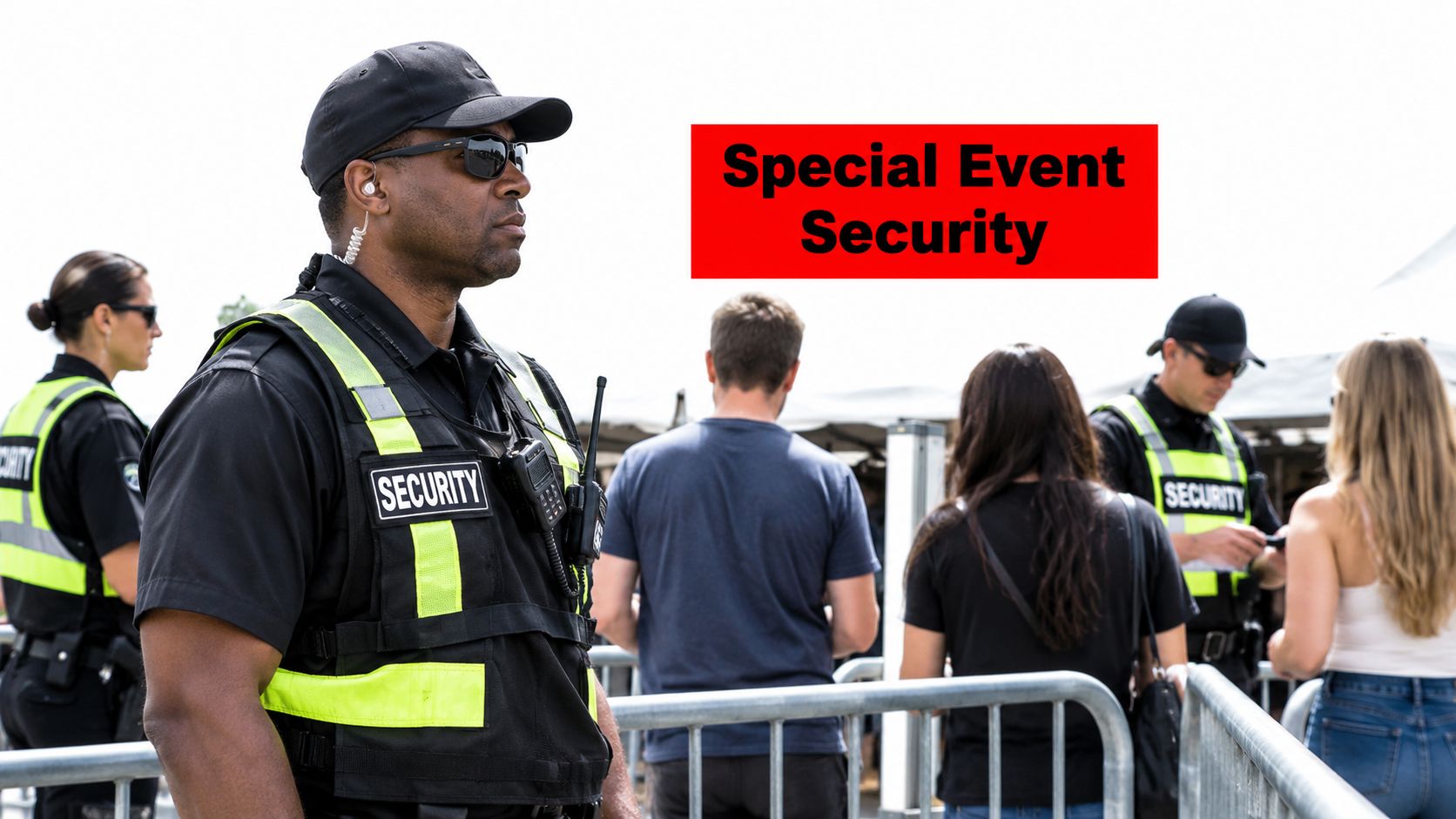
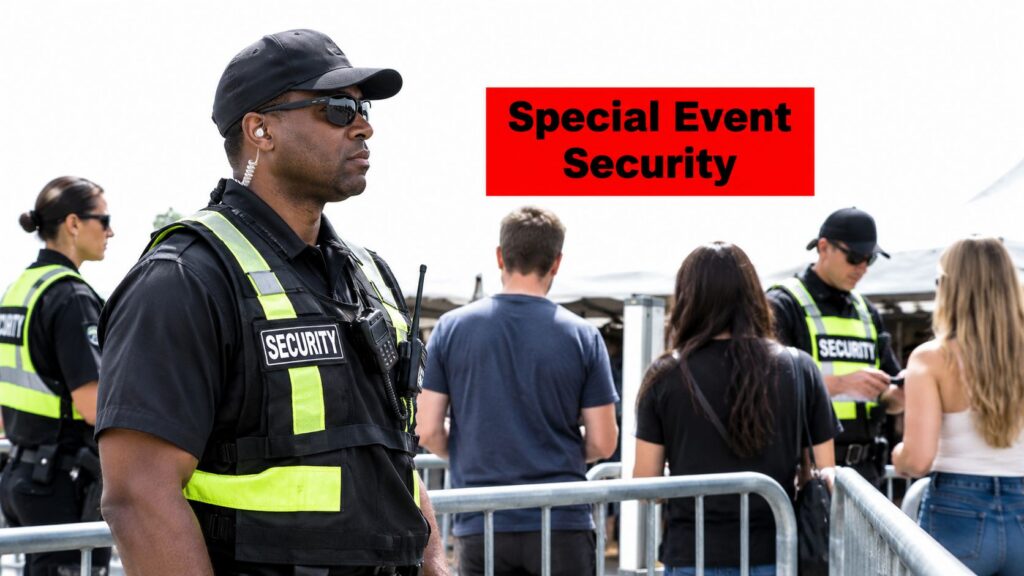
At the gate, trained staff verify tickets, credentials, invitations, age eligibility, or vendor access. Depending on the risk assessment, the entry process may include bag screening, metal-detecting wands, magnetometers, or a separation between general admission and VIP access.
The goal isn't to create the longest possible queue. It's to prevent unauthorized entry while keeping people moving. A screening checkpoint that produces a compression point can create a new safety problem, so supervisors need a plan for overflow lanes, rejected items, late arrivals, and guests who need assistance.
Keep the interior organized
Ushers and trained crowd managers do more than point people toward seats. They notice blocked aisles, rising density, disputes, medical concerns, and guests entering restricted areas. Uniformed or plainclothes rovers can move between zones, while VIP teams handle escorts, protective positioning, and discreet communication.
Emergency response must connect all of these roles. The event plan should identify who calls for medical assistance, who meets responding personnel, who opens a route, who communicates with the event manager, and who preserves access to the incident. Readers looking for broader planning ideas can also review these safer events insights from WipesBlog.com.
The strongest programs don't treat crowd management, access control, traffic, VIP protection, and emergency response as separate guard duties. Each layer passes information to the next, giving supervisors a clear operating picture before a minor problem becomes a major interruption.
How Risk Assessment Shapes the Security Plan
Risk assessment is the decision engine behind staffing and equipment. It asks three practical questions: What could cause harm? Where is the event exposed? What would happen if the exposure became an incident?
Threat identifies possible sources of harm
Threats vary by event. An open public festival may face disorderly behavior, lost children, vehicle conflicts, or unauthorized access. A contentious public meeting may require more attention to protests and opposing groups. A corporate launch may place greater emphasis on executive movement, sensitive products, or confidential areas.
The assessment doesn't need dramatic language. It needs clear observations about the people, activities, environment, and timing that could create trouble.
Vulnerability shows where the plan can fail
A venue with several open sides has a different exposure from a controlled building with a single monitored entrance. Shared loading docks, unsecured backstage doors, temporary fencing, poor lighting, narrow walkways, and an entrance beside a busy road can all change the plan.
This is why a site walk matters. A floor plan may show doors, but it won't always show where guests naturally stop, where vendors leave carts, or where a queue spills into a vehicle lane.
Consequence determines the response depth
The same threat can require different controls depending on the outcome. An unattended bag in a low-density private dinner is handled differently from an unattended bag beside a packed stage. A disagreement at a quiet reception may need a supervisor, while a fight near a dense crowd may require immediate separation, medical access, and a coordinated pause in movement.
The threat, vulnerability, and consequence model is also used in the federal SEAR process. During a five-year period, DHS received 104,198 event submissions for SEAR assessments, including 1,717 in the National Capital Region (Congressional Research Service event security statistics). The point for a private planner isn't to copy a federal process. It's to understand that security decisions should follow a documented risk profile.
A beer garden may increase the need for trained intervention, visible supervision, and medical coordination. A product launch with an executive guest may justify controlled movements, credentialed backstage access, and a designated escort team. For additional context on planning for hospitality risk, consider how guest behavior, service arrangements, and venue operations interact.
A useful event-specific reference is Overton's discussion of risks at events. The final plan may adjust radio coverage, camera placement, barriers, screening, patrol routes, and public-agency coordination. Headcount matters, but it's only one input.
Staffing Ratios and Equipment You Can Expect
There is no universal guard count that fits every event. A small invitation-only gathering may need a few carefully placed personnel, while a public event with multiple gates, alcohol service, performers, and vehicle access may need separate teams for each operating zone.
One recognized benchmark is one trained crowd manager for every 250 occupants in assembly occupancies, as described in ANSI ES1.40-2023 and associated life-safety guidance (ANSI event safety standard). That benchmark concerns trained crowd managers. It doesn't replace local requirements or determine the total number of security officers.
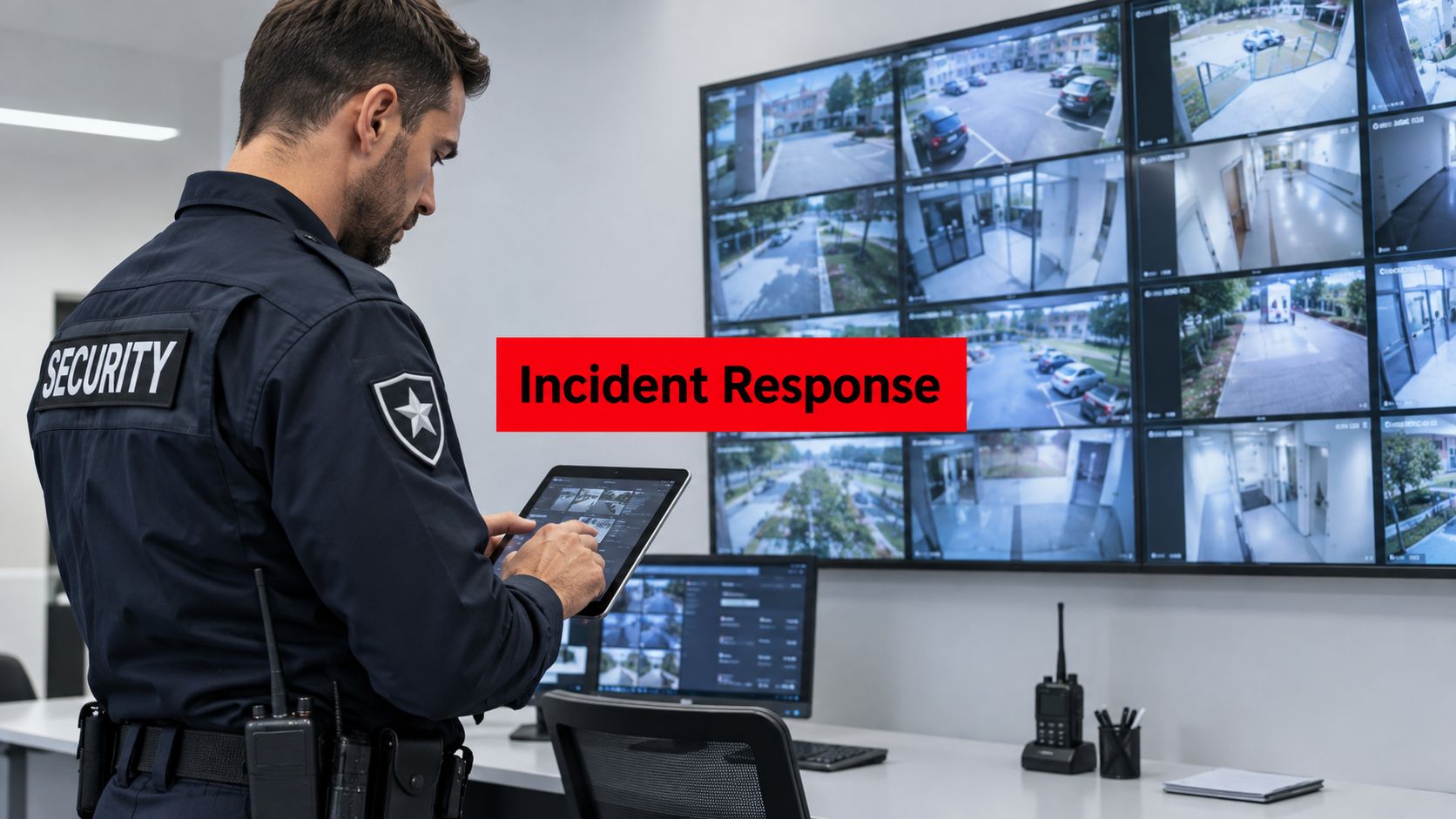
A plan may divide personnel into perimeter, entry, event-floor, stage, back-of-house, traffic, and command-post assignments. Equipment can range from two-way radios and high-visibility vests to screening tools, access-control software, cameras, and documented incident-reporting systems.
| Event Profile | Crowd Manager Ratio | Typical Additional Officers | Common Equipment |
|---|---|---|---|
| Invitation-only meeting or private dinner | Apply the 1:250 benchmark where applicable | Site-specific personnel for entry, guest assistance, and response | Radios, credentials, emergency plan, incident forms |
| Ticketed event or gala | Apply the 1:250 benchmark where applicable | Entry, perimeter, floor, and supervisor coverage based on risk | Radios, screening tools, barriers, credential system |
| Large public festival or concert | Apply the 1:250 benchmark where applicable | Separate teams for gates, perimeter, stage, traffic, and response | Layered screening, cameras, command communications, medical-access controls |
Local rules can add sworn-officer requirements. For example, College Station, Texas, requires a special-event permit for temporary events expected to draw over 200 attendees, while the threshold for events in a city park is more than 5,000 attendees. Its guide lists 2 officers for 251 to 1,500 people, 4 for 1,501 to 3,000, 6 for 3,001 to 5,000, and 6 plus 1 additional officer for every 1,000 people over 5,000 (College Station special-event guide).
Before hiring, ask which roles are included, which are required by the jurisdiction, and whether supervisors, screening staff, crowd managers, and emergency coordinators are counted separately. A provider's event security service information can help planners frame that conversation around duties rather than a single headline number.
Matching Security Level to Event Risk Tier
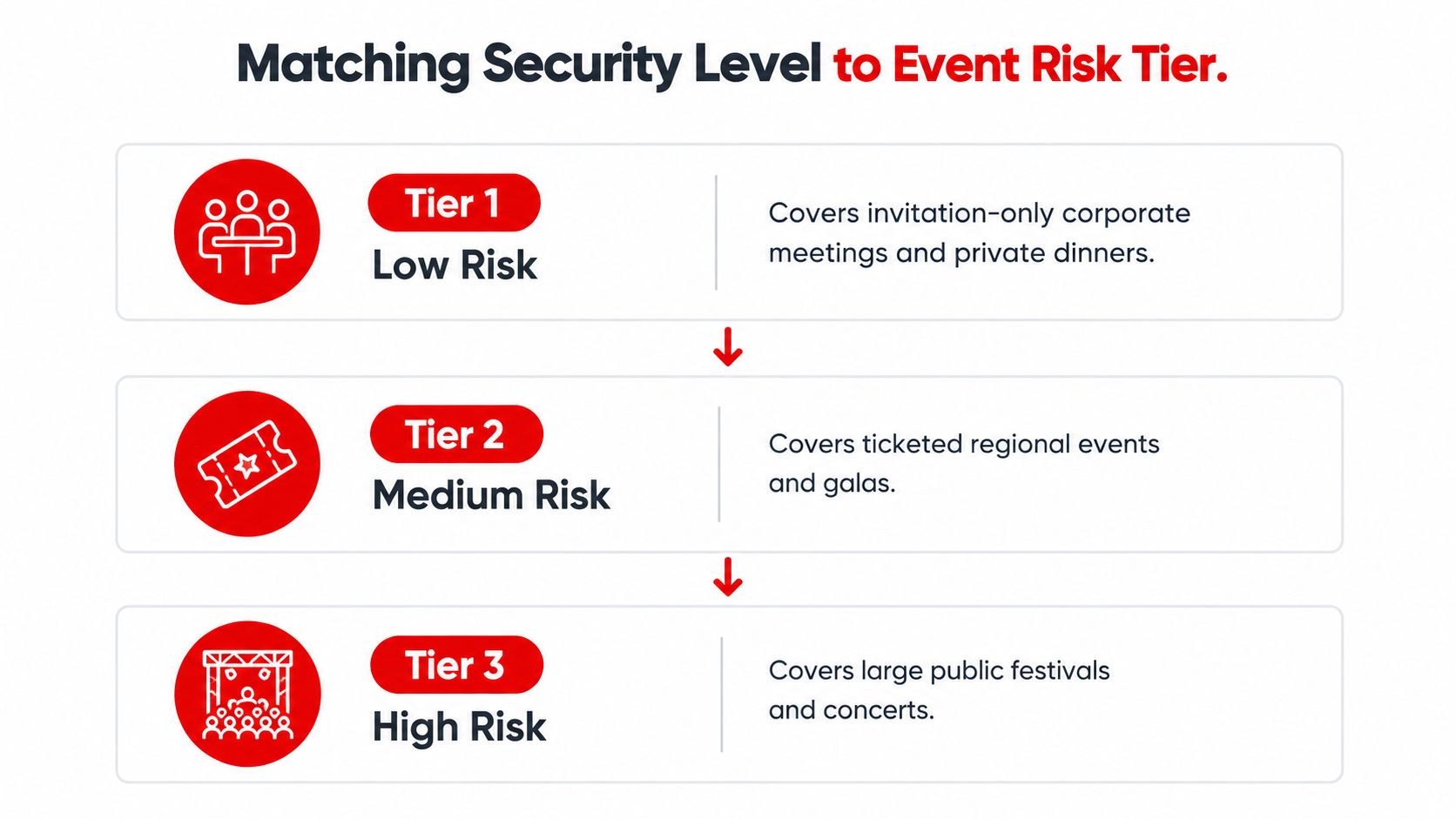
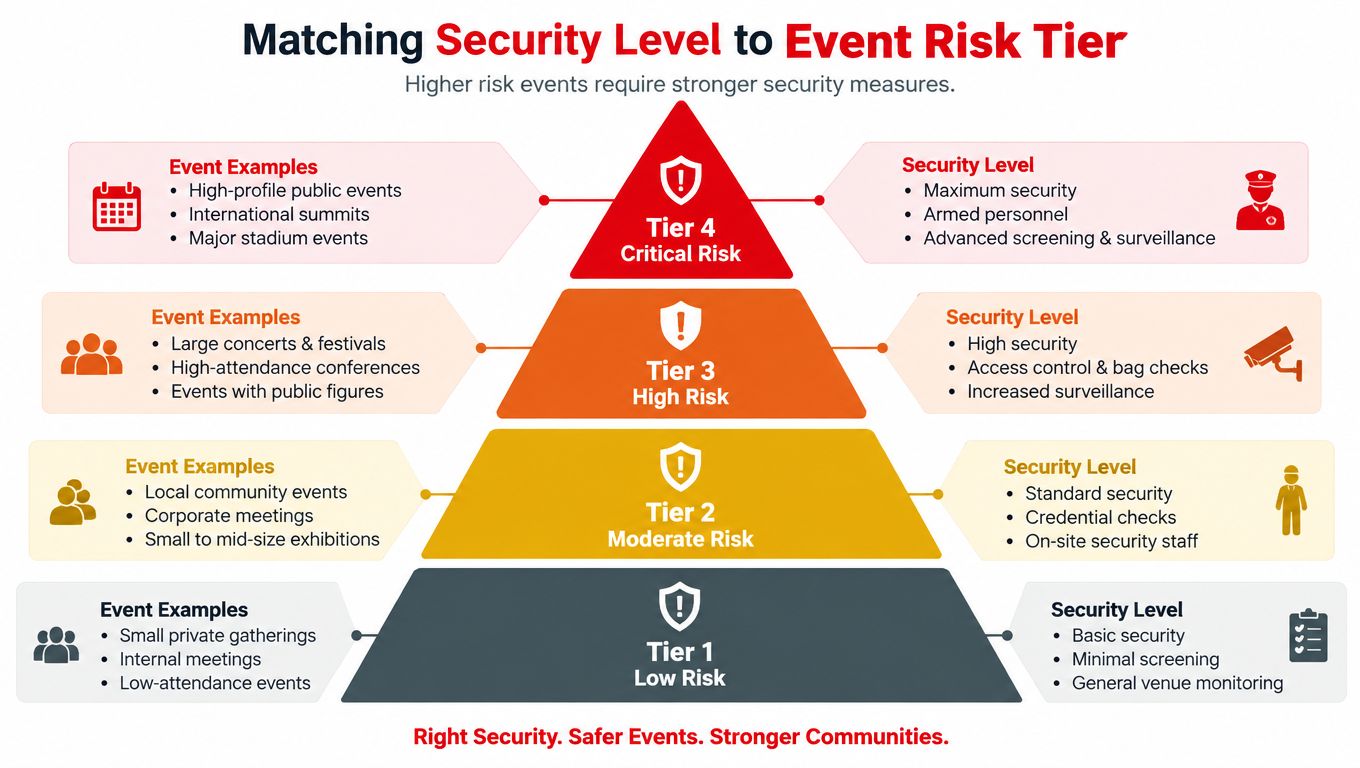
A private dinner in a familiar venue and a crowded outdoor concert may both need security, but they do not need the same plan. Risk tiering gives the planner a starting point for matching staffing, equipment, and coordination to the event's audience, venue, movement, and local permit thresholds. These tiers guide planning. They do not replace a formal assessment or approval from the relevant authorities.
Tier one for lower-risk events
Invitation-only corporate meetings, private dinners, and small gallery openings usually have a known guest list and a controlled venue. A proportionate plan may use one or two greeters, discreet uniformed coverage, invitation or credential checks, a written emergency procedure, and one named contact for venue management.
A small event still needs ownership. Someone should know who opens the site, handles a guest concern, calls for medical help, restricts access to staff rooms, and confirms that the venue is clear at closing. The security decision is often about assigning these responsibilities clearly, not adding a large guard team.
Tier two for medium-risk events
Ticketed regional events, galas, public programs, and events with alcohol service introduce more movement and more opportunities for confusion. The plan may call for a staffed perimeter, controlled entry, bag screening where justified, dedicated crowd managers, supervisor coverage, and a liaison for fire or emergency services.
Local thresholds can change the tier in practice. For example, San Francisco requires events with more than 500 attendees to submit a formal security plan to the Police Department at least 3 months before the event (San Francisco outdoor-event security guidance). Confirm those requirements before publishing the event or fixing the layout, because the permit process may affect entrances, staffing, and emergency access.
Tier three for high-risk events
Political rallies, concerts with high-energy audience areas, and large outdoor festivals can require layered screening, controlled vehicle approaches, enhanced observation, a unified incident-command structure, and direct coordination with law enforcement, fire, EMS, and venue leadership.
Technology should answer a specific operational need. Larger venues increasingly use AI video analytics, biometric access, and IoT monitoring. Market data on event security technology describes that broader adoption (event security technology market data), but the planner still has to decide whether a tool improves detection, entry throughput, or response for this event.
A camera system that creates alerts no one can review does not strengthen the plan. The team must also account for privacy, staff training, system compatibility, and any delay at the gate. Choose technology only when its benefit is clear enough to support the event's risk tier.
Permits, Compliance, and Local Coordination in Practice
A street festival may look manageable on paper, yet a road closure, emergency lane, or alcohol service can change the security plan before the first guest arrives. Permits and venue rules set operating boundaries, so confirm them before fixing the site map, staffing level, or access layout.
Consider an outdoor festival in San Francisco that closes several blocks. The organizer may need a special-event permit, a site map showing entrances and exit routes, traffic coordination with the police department, and a plan that keeps fire access open. San Francisco guidance requires a formal security plan for events with more than 500 attendees, submitted to the Police Department at least 3 months ahead (San Francisco event security requirements). That threshold can affect when the planner hires supervisors, assigns traffic posts, and submits the operating plan.
A corporate activation on a Los Angeles hotel rooftop creates a different set of checks. Confirm the venue's occupancy limit and emergency procedures, verify alcohol-service requirements with the appropriate California agency, document the private security arrangement, and include rooftop entrances, elevators, stairwells, and service areas in the response plan. An indoor reception, city park, and street closure each create different staffing and coordination needs.
Treat local rules as operating conditions
A jurisdiction may set requirements for permits, officer details, site plans, insurance documents, or submission timelines. A city park may use a different threshold from a private venue, while a street closure can add traffic duties that an indoor event does not need. Guidance on permits for park events reinforces the practical step: confirm venue and municipal requirements before committing to event logistics.
Accessibility must also shape crowd flow. Keep accessible routes open, position screening and queues away from required paths, and give staff a clear process for guests who need assistance. The emergency action plan should identify evacuation, sheltering, medical response, communications, and the person authorized to pause or end the event.
UK venue guidance emphasizes a current security threat assessment, counterterrorism assessment, controls for vehicle and pedestrian access, a named security lead, defined emergency command, and liaison with police and specialists (UK event security and counterterrorism guidance). Rules differ by location, but the operating lesson is consistent: assign responsibility early and document how agencies, venue staff, and security teams will work together.
What Drives Cost and How to Choose the Right Provider
An event security quote reflects the work required, not just the number of people standing in uniform. Five factors usually move the price: risk tier, staffing hours, officer qualifications, equipment, and administrative overhead.
| Cost Driver | Why It Moves the Price | What to Ask the Provider |
|---|---|---|
| Risk tier | Higher exposure may require more supervision, screening, coordination, and response capability | What threats and vulnerabilities does the proposal address? |
| Headcount and hours | More zones, longer coverage, setup, and breakdown periods require more labor | Does the roster include setup, event hours, closing, and relief coverage? |
| Qualifications | Unarmed officers, supervisors, crowd managers, EMTs, and sworn personnel have different duties and requirements | Which licenses, training, and certifications apply to each role? |
| Equipment and technology | Radios, barriers, screening tools, cameras, and reporting systems require deployment and oversight | Is equipment included, rented, or billed separately? |
| Supervision and administration | Planning meetings, insurance, travel, post orders, reporting, and account oversight affect delivery | Who manages the event, and what reports will the client receive? |
Ask every bidder to price the same scope. Give them the venue diagram, schedule, expected attendance, access points, alcohol arrangements, VIP considerations, permit requirements, and desired reporting. Then compare the roster, supervisor coverage, post orders, equipment, response procedures, and cancellation terms.
A responsible provider should explain what each assignment does. Request licensing verification, training records, insurance information, references for comparable events, a written chain of command, and a sample incident-reporting process. A vague lump-sum proposal may look inexpensive until you discover that the vendor excluded setup, screening equipment, supervision, or emergency coordination.
A useful test: If you can't tell where every assigned person will stand, move, report, and hand off responsibility, the scope isn't finished.
Overton Security is one California-based option for event and temporary security. Its services include event staffing, advance planning, threat assessment, crowd control, crisis response, GPS-enabled patrol oversight, digital reporting, and support from a 24/7 security operations center. Planners can use Overton's event security cost guidance as one reference point while comparing deliverables from multiple providers.
Bringing It All Together With a Practical Checklist
Special event security isn't a fixed guard count. It's a plan that matches the risk tier, venue type, local requirements, operating hours, guest profile, and emergency consequences. The plan should be simple enough for staff to use under pressure and specific enough that every person knows their assignment.
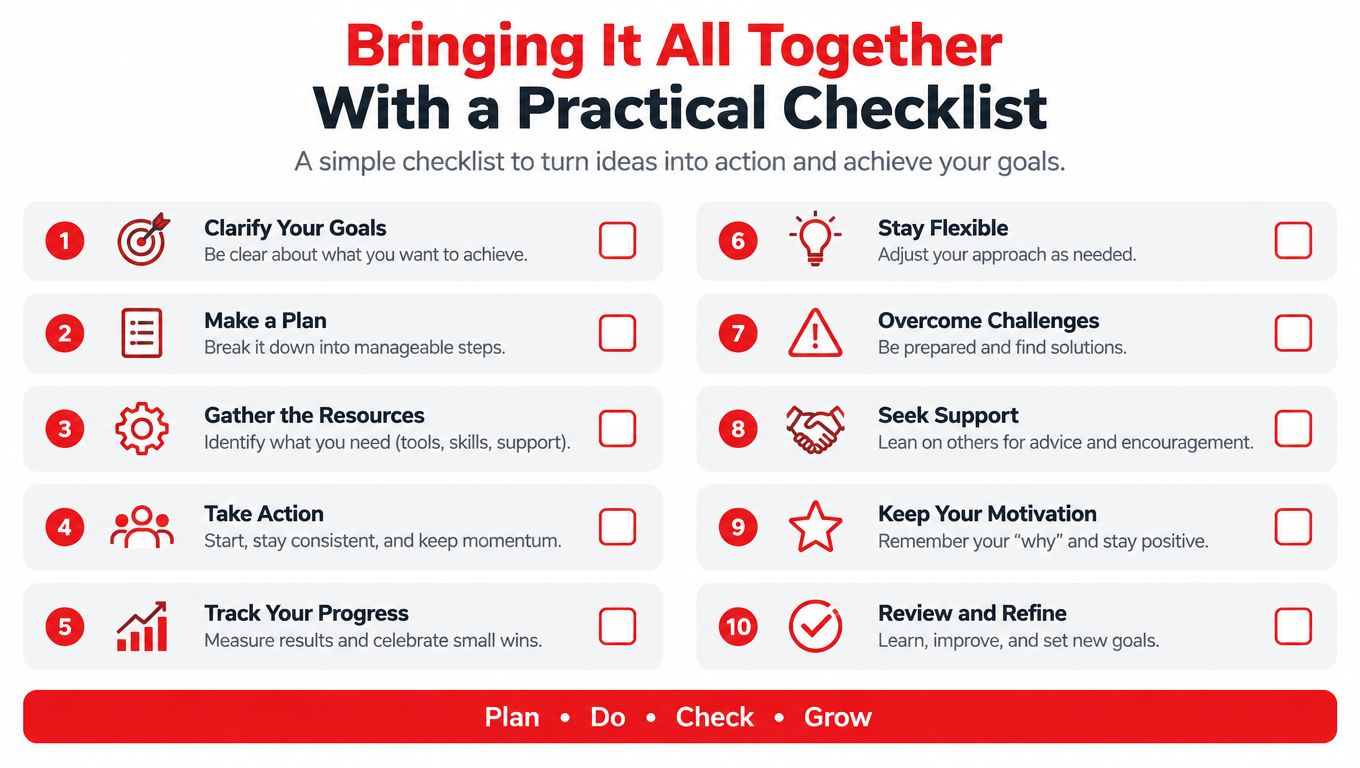
Save this checklist for the planning meeting:
- Classify the event: Identify whether it is a private, controlled gathering, a ticketed public event, or a high-exposure event with complex coordination.
- Write the risk assessment: Record threats, vulnerable locations, likely crowd pressures, and consequences.
- Lock the venue diagram: Mark entrances, exits, screening points, queues, restricted areas, emergency lanes, medical locations, and holding areas.
- Set staffing assignments: Separate crowd managers, security officers, supervisors, traffic personnel, entry staff, and back-of-house coverage.
- Write post orders: Explain each position, escalation path, radio channel, relief process, and response duty.
- Verify permits: Confirm municipal, venue, fire, alcohol, traffic, accessibility, and insurance requirements.
- Test communications: Check radios, backup contacts, command-post procedures, and emergency messaging.
- Coordinate with responders: Share the site plan and confirm how police, fire, EMS, and venue personnel will meet and communicate.
- Brief the team: Walk the site, review likely scenarios, and confirm who has authority to make operational decisions.
- Debrief afterward: Record incidents, near misses, queue problems, equipment issues, and changes for the next event.
Start the security conversation well before the event date, especially when permits, site changes, public agencies, or specialized equipment are involved. Early planning gives you time to compare providers, revise the layout, train staff, and resolve coordination problems before guests arrive.
If you're planning a corporate event, private function, festival, or temporary activation in California, Overton Security can help assess the venue, develop event-specific post orders, staff access and crowd-management positions, and support accountability through digital reporting and 24/7 SOC oversight. Contact the team before the event plan is locked so security, permits, guest flow, and emergency response work together.